Within Haunted Northumberland
Why Do Northumberland's Sea Castles Gather Ghosts?
Bamburgh and Dunstanburgh show how Northumberland's coast turns ruined towers, grief stories and storm legends into folklore.
On this page
- Bamburgh's Pink Lady
- Dunstanburgh and Sir Guy the Seeker
- Romance, Ruin and Coastal Isolation
Page outline Jump by section
Introduction
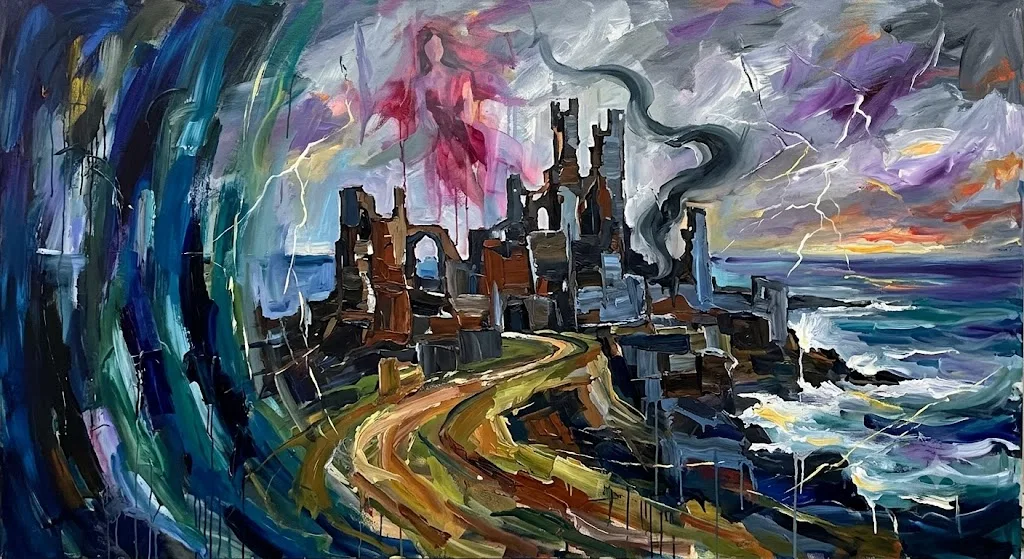
Northumberland’s sea-castle ghost legends work because the coast does half the storytelling before any apparition appears. Bamburgh rises over sand, surf and ancient burial ground; Dunstanburgh is reached by a long coastal walk to broken towers on a headland. Their best-known tales are not evidential “ghost cases” in the modern sense, but romantic folklore: the Pink Lady who returns in grief at Bamburgh, and Sir Guy the Seeker, doomed to search Dunstanburgh after failing a supernatural test. Both stories turn exposed architecture into emotional theatre. The castles face the North Sea, but their legends face inward: towards separation, failed rescue, lost love, bad choices and the way ruins invite people to imagine what has vanished. Official heritage sources confirm the dramatic settings and deep histories of both sites; the hauntings themselves are best read as layered local tradition, literary retelling and visitor folklore rather than verified witness record.[bamburghcastle.com]bamburghcastle.comOpen source on bamburghcastle.com.
Why the Coast Makes These Castle Legends Different
A ghost story in an inland manor often depends on a room, staircase or family portrait. On the Northumberland coast, the setting is wider and harsher. Bamburgh Castle has “stood guard” above the coastline for more than 1,400 years, while Historic England lists it as a Grade I building; Dunstanburgh, also protected and managed as a major ruin, defends a headland on the rugged coast between Craster and Embleton. These are not hidden-haunting locations. They are visible for miles, exposed to wind, tide, seabirds and shifting weather.[bamburghcastle.com]bamburghcastle.comOpen source on bamburghcastle.com.
That exposure matters. The Northumberland Coast National Landscape notes that open beaches, dunes, basalt headlands and rocky coves create the dramatic setting for Bamburgh and Dunstanburgh castles. The same landscape that makes them beautiful also makes them feel isolated: a traveller approaching Dunstanburgh from Craster sees the ruin slowly grow on the skyline, while Bamburgh’s mass dominates the village and beach below. It is easy to see why folklore here favours figures who wander, wait, look seaward, search through ruins or return at intervals.[National Landscapes]national-landscapes.org.ukOpen source on national-landscapes.org.uk.
The coastal mechanism is therefore simple but powerful. The castles already contain real history: border warfare, royal power, shipwreck, burial, decay and restoration. The legends translate those hard facts into human emotion. Bamburgh’s Pink Lady turns separation into a recurring apparition. Dunstanburgh’s Sir Guy turns the ruined approach, storm and empty gatehouse into a moral quest. The stories are memorable because they are not just “a ghost in a castle”; they are grief and longing placed against cliffs, sea and ruins.
Bamburgh’s Pink Lady: Love, Waiting and the Castle Above the Sands
The Pink Lady is usually described as a young woman in a pink dress who haunts Bamburgh Castle after being separated from the man she loved. In the common modern version, her father disapproves of her suitor and sends him away, sometimes for seven years. A pink dress is given to comfort her, but the story ends in despair: she is said to throw herself from the castle, and her spirit returns wearing the dress that gives her the name. Haunted-site retellings vary in detail, but they keep the same emotional pattern: blocked love, a waiting woman, a sea-facing castle and a repeated return.[great-castles.com]great-castles.comOpen source on great-castles.com.
The tale’s credibility is different from the credibility of Bamburgh’s documented history. The castle’s deep past is well attested: it is a major coastal fortress with medieval and later phases, and the official castle history frames it as royal fortress, Norman stronghold and coastal home. The Pink Lady, by contrast, is primarily a legend preserved in ghost guides, local tourism writing and retellings rather than a tightly dated witness case with named observers and contemporary records. That does not make it worthless. It tells us what kind of haunting Bamburgh has become famous for: not a battlefield revenant or a demonic figure, but a romantic, sorrowful woman whose story fits the castle’s height, grandeur and isolation.[bamburghcastle.com]bamburghcastle.comOpen source on bamburghcastle.com.
Bamburgh also has a stronger foundation for atmosphere than many invented haunted settings. The Bowl Hole cemetery in the dunes south of the castle was first revealed after violent winter storms in 1816–17, when sand was stripped away and graves appeared. Later work by the Bamburgh Research Project identified an early medieval burial ground connected with the royal centre at Bamburgh. This is not evidence for the Pink Lady, but it does show why the landscape itself feels storied: storm, sand and burial are part of Bamburgh’s documented memory, not just gothic decoration.[bamburghresearchproject.co.uk]bamburghresearchproject.co.ukBamburgh Research Project Bamburgh Bowl Hole CemeteryBamburgh Research Project Bamburgh Bowl Hole Cemetery
There is another coastal layer too. In 1786 Dr John Sharp, linked with Lord Crewe’s Charity, commissioned Lionel Lukin to convert a coble into an “unimmergible” lifeboat for Bamburgh; the RNLI’s own history describes this as the first known lifeboat and Bamburgh Castle as the first lifeboat station of the time. That humanitarian story sits beside the ghost tradition in an interesting way. Bamburgh’s coastal folklore is not only about doomed lovers; it is also about danger from the sea, watching the shore, rescuing strangers and remembering lives threatened by weather.[RNLI]rnli.org1785 the first lifeboats1785 the first lifeboats
Dunstanburgh and Sir Guy the Seeker: A Ruin Made for a Quest
Dunstanburgh’s signature legend is stranger and more literary than Bamburgh’s Pink Lady. Sir Guy the Seeker is said to arrive at the ruined castle during a storm, meet a supernatural guide, and find a sleeping lady in an enchanted chamber. He must choose between a sword and a horn. In many versions he chooses wrongly, fails to free her, and spends the rest of his life trying to find the hidden place again. After death, his ghost is said to keep searching among the ruins. Northumberland Archives summarises the tale as one of lost chambers, magical guardians, treasure-like enchantment and a test of character, while noting that comparable motifs occur elsewhere in Britain.[Northumberland Archives]northumberlandarchives.comsir guy the seekersir guy the seeker
This is important because Sir Guy is not best understood as a simple local sighting report. He belongs to a wider folklore family: the sleeping lady, the enchanted chamber, the failed choice, the hero who cannot return. Northumberland Archives specifically points out the tale’s similarity to other British variants, including stories of hidden chambers beneath castles. The Dunstanburgh version became especially attached to this place because the ruin supplies the perfect stage: storm, gatehouse, darkness, broken masonry and the possibility of hidden spaces below a vast abandoned fortress.[Northumberland Archives]northumberlandarchives.comsir guy the seekersir guy the seeker
The historical castle gives the legend weight. English Heritage states that Dunstanburgh was begun in 1313 by Thomas, Earl of Lancaster, cousin and leading baronial enemy of Edward II, and built on a massive scale as a statement of rivalry with the Crown. Later, John of Gaunt altered and added to the castle, and English Heritage’s research pages discuss the 1380s work on the gateway and defences. In other words, Dunstanburgh really was an aristocratic project of ambition, anxiety and display. The legend turns that political grandeur into a private failure: a knight cannot make the right choice, and a beautiful sleeper remains lost.[English Heritage]english-heritage.org.ukOpen source on english-heritage.org.uk.
The literary afterlife is unusually clear. The Sir Guy story has been associated with Dunstanburgh since at least the early 19th century; Northumberland Archives and later folklore summaries connect its popularisation to Matthew Gregory Lewis, the gothic writer best known for The Monk, whose “Sir Guy, the Seeker” helped fix the story in print. A digitised reprint of the poem notes that it had appeared in Romantic Tales, was later reprinted in Metrical Legends of Northumberland, and circulated through other 19th-century publications. That makes Dunstanburgh’s ghost less a raw village rumour than a meeting-point of local legend, gothic literature and Romantic taste for ruins.[northumberlandarchives.com]northumberlandarchives.comsir guy the seekersir guy the seeker

Romance, Ruin and Coastal Isolation
Bamburgh and Dunstanburgh show two different ways a sea castle gathers ghosts. Bamburgh’s legend is vertical: a woman, a high castle, a fall, a return. Dunstanburgh’s is horizontal and subterranean: a rider on the coast, a ruined gatehouse, a hidden chamber, a lifelong search. Both are romantic in the older sense of the word, meaning shaped by chivalry, longing, emotional extremity and dramatic scenery rather than by ordinary domestic life.
The ruins also change how readers judge the stories. Dunstanburgh is now approached as an “iconic castle ruin” in a coastal setting, and English Heritage emphasises its headland, towered walls and sheer drops to the sea. That setting makes Sir Guy’s tale feel plausible as experience even when it is not plausible as evidence. A person walking back from the ruin in bad weather does not need to believe in enchanted sleepers to understand why the story stuck.[nationaltrust.org.uk]nationaltrust.org.ukOpen source on nationaltrust.org.uk.
Bamburgh is different because it is not a shattered ruin in the same way. It remains a restored, inhabited and highly visible fortress. Its Pink Lady legend therefore softens the castle’s public grandeur with private sorrow. The apparition is not mainly about military defence or noble politics; it is about the emotional cost of authority inside a place built to project power. That is why the tale fits so neatly beside other Northumberland castle ghosts, especially stories of women in coloured dresses, betrayed lovers and family tragedies.
The sea intensifies both forms. It supplies absence: ships leave, lovers depart, storms cut people off, paths become difficult, and ruins appear and disappear in mist or rain. It also supplies recurrence: waves return, tides repeat, weather cycles, and so a ghost returning every few years or a knight searching forever feels in tune with the place. The landscape does not prove the legends, but it explains their staying power.
How Strong Are the Sources?
The strongest sources for this subtopic are not the ghost retellings themselves, but the heritage and archive material that helps us understand how the legends formed. Bamburgh’s architecture, status and coastal setting are supported by the castle’s own history and Historic England’s listing. Dunstanburgh’s construction, political purpose, later decay and managed ruin are strongly supported by English Heritage and the National Trust. These sources confirm the places, the dates and the physical features that make the legends work.[bamburghcastle.com]bamburghcastle.comOpen source on bamburghcastle.com.
The ghost stories sit on a softer evidence base. The Pink Lady appears mainly in ghost guides, local tourism writing and popular haunted-place summaries. It is a recognisable Bamburgh tradition, but not a well-documented historical case with an early named witness, fixed date and archival trail. The safest wording is therefore “the castle is said to be haunted by the Pink Lady”, not “the Pink Lady haunts the castle”.[great-castles.com]great-castles.comOpen source on great-castles.com.
Sir Guy is better documented as folklore and literature, even if not as apparition evidence. Northumberland Archives gives the most useful framing: the story shares motifs with other British tales and has a distinctive Dunstanburgh ending. The 19th-century printed tradition, including Matthew Lewis’s treatment and later reprints, helps explain why this particular legend became attached to this particular ruin. For readers of haunted Northumberland, Sir Guy is valuable not because he is a reliable ghost report, but because he shows how a coastal ruin can turn a wandering knight story into local identity.[northumberlandarchives.com]northumberlandarchives.comsir guy the seekersir guy the seeker

Why These Legends Still Matter on the Northumberland Coast
The Pink Lady and Sir Guy endure because they give emotional names to places that already feel charged. Bamburgh’s story asks the reader to imagine love constrained by rank and family power inside a fortress above the sea. Dunstanburgh’s asks what happens when courage fails at the decisive moment, and why a person might spend a lifetime trying to return to the place where everything went wrong. Neither tale needs to be treated as factual haunting to matter.
They also help distinguish Northumberland’s coastal haunted tradition from its inland castle and border stories. Chillingham’s haunted reputation is tied to curated rooms, family scandal and ghost tours; Alnwick’s revenant belongs to medieval chronicle tradition; the Simonside Hills and Kielder stories belong more to moorland, forest and misleading lights. Bamburgh and Dunstanburgh are different. Their ghosts are sea-facing, romantic and scenic. They depend on distance, weather and the ache of looking out from a high or ruined place.
That is why these castles remain so effective in haunted travel writing and local folklore. A visitor can stand on Bamburgh’s beach or walk the path from Craster to Dunstanburgh without accepting every supernatural claim. The stories still alter the view. The castle becomes more than stone; the coastline becomes more than scenery. It becomes a place where Northumberland remembers grief, desire, failed rescue and the strange human habit of turning ruins into stories that keep returning.
Amazon book picks
Further Reading
Books and field guides related to Why Do Northumberland's Sea Castles Gather Ghosts?. Use these as the next step if you want deeper reading beyond the article.

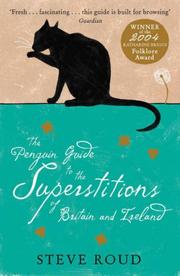
The Penguin Guide to the Superstitions of Britain and Ireland
Provides wider folklore background.
eBay marketplace picks
Marketplace Samples
Live-tested eBay searches with available results related to this page.
Endnotes
1.
Source: great-castles.com
Link:https://great-castles.com/bamburghghost.html
2.
Source: rnli.org
Title: 1785 the first lifeboats
Link:https://rnli.org/about-us/our-history/timeline/1785-the-first-lifeboats
3.
Source: upload.wikimedia.org
Link:https://upload.wikimedia.org/wikipedia/commons/1/13/Sir_Guy%2C_the_seeker%3B_a_Northumbrian_legendary_tale_…_%28IA_b31870806%29.pdf
4.
Source: archive.org
Link:https://archive.org/stream/archaeologiaael02tynegoog/archaeologiaael02tynegoog_djvu.txt
5.
Source: great-castles.com
Link:https://great-castles.com/dunstanburghghost.html
6.
Source: great-castles.com
Link:https://great-castles.com/dunstanburgh.html
7.
Source: rnli.org
Title: new hartlepool rnli lifeboat officially named
Link:https://rnli.org/news-and-media/2025/july/06/new-hartlepool-rnli-lifeboat-officially-named
8.
Source: bamburghcastle.com
Link:https://www.bamburghcastle.com/castle/
9.
Source: english-heritage.org.uk
Link:https://www.english-heritage.org.uk/visit/places/dunstanburgh-castle/
10.
Source: northumberlandarchives.com
Title: sir guy the seeker
Link:https://northumberlandarchives.com/2020/06/15/sir-guy-the-seeker/
11.
Source: historicengland.org.uk
Link:https://historicengland.org.uk/listing/the-list/list-entry/1280155
12.
Source: visitnorthumberland.com
Link:https://www.visitnorthumberland.com/explore/things-to-do/attractions/historic-sites/dunstanburgh-castle
13.
Source: national-landscapes.org.uk
Link:https://national-landscapes.org.uk/national-landscapes/northumberland-coast
14.
Source: nationaltrust.org.uk
Link:https://www.nationaltrust.org.uk/visit/north-east/dunstanburgh-castle
15.
Source: spookyisles.com
Link:https://www.spookyisles.com/northumberland-coast-haunted/
16.
Source: chroniclelive.co.uk
Title: most haunted locations best places 18510739
Link:https://www.chroniclelive.co.uk/whats-on/whats-on-news/most-haunted-locations-best-places-18510739
17.
Source: bamburghresearchproject.co.uk
Title: Bamburgh Research Project Bamburgh Bowl Hole Cemetery
Link:https://bamburghresearchproject.co.uk/index.php/bowl-hole/
18.
Source: archaeology.co.uk
Title: Current Archaeology Bamburgh’s bowl hole burials
Link:https://archaeology.co.uk/articles/features/bamburghs-bowl-hole-burials.htm
19.
Source: english-heritage.org.uk
Link:https://www.english-heritage.org.uk/visit/places/dunstanburgh-castle/history/
20.
Source: english-heritage.org.uk
Link:https://www.english-heritage.org.uk/visit/places/dunstanburgh-castle/history/research/
21.
Source: visitnorthumberland.com
Link:https://www.visitnorthumberland.com/explore/destinations/towns-villages/bamburgh
22.
Source: visitnorthumberland.com
Link:https://www.visitnorthumberland.com/inspire-me/most-haunted
23.
Source: visitnorthumberland.com
Link:https://www.visitnorthumberland.com/inspire-me/itineraries/visit-bamburgh
24.
Source: visitnorthumberland.com
Link:https://www.visitnorthumberland.com/explore/destinations/castles
25.
Source: mapservices1.historicengland.org.uk
Title: HLE A4L Grade|HLE A3L Grade
Link:https://mapservices1.historicengland.org.uk/printwebservicehle/StatutoryPrint.svc/255453/HLE_A4L_Grade%7CHLE_A3L_Grade.pdf
26.
Source: facebook.com
Link:https://www.facebook.com/groups/281886105961506/posts/2021971995286233/
27.
Source: facebook.com
Link:https://www.facebook.com/HappyDaysTravelBlog/posts/bamburgh-castle-dominates-the-coastline-and-the-village-sitting-on-the-summit-of/986788416782244/
28.
Source: facebook.com
Link:https://www.facebook.com/groups/735389799823006/posts/9670200903008473/
29.
Source: Wikipedia
Link:https://en.wikipedia.org/wiki/Bamburgh
30.
Source: Wikipedia
Title: Bamburgh Castle
Link:https://en.wikipedia.org/wiki/Bamburgh_Castle
31.
Source: Wikipedia
Title: Bamburgh Castle Lifeboat Station
Link:https://en.wikipedia.org/wiki/Bamburgh_Castle_Lifeboat_Station
32.
Source: bamburghcastle.com
Link:https://www.bamburghcastle.com/
33.
Source: youtube.com
Link:https://www.youtube.com/watch?v=l81mASvE7O8
34.
Source: youtube.com
Title: Bamburgh Castle
Link:https://www.youtube.com/watch?v=wU6ws77R-8U
35.
Source: northumberlandarchives.com
Title: dr sharp
Link:https://northumberlandarchives.com/learn/welfare-state/dr-sharp/
36.
Source: historic-uk.com
Link:https://www.historic-uk.com/DestinationsUK/Bamburgh-Castle/
37.
Source: fhithich.uk
Title: sir guy the seeker
Link:https://www.fhithich.uk/2020/04/10/sir-guy-the-seeker/
38.
Source: bamburghresearchproject.wordpress.com
Title: bamburgh ghosts tales from the eighteenth century things spiritual in bamburgh
Link:https://bamburghresearchproject.wordpress.com/2013/11/25/bamburgh-ghosts-tales-from-the-eighteenth-century-things-spiritual-in-bamburgh/
39.
Source: bamburghresearchproject.wordpress.com
Title: bamburgh ghosts tales from the eighteenth century tragedy at the bowl hole
Link:https://bamburghresearchproject.wordpress.com/2013/03/29/bamburgh-ghosts-tales-from-the-eighteenth-century-tragedy-at-the-bowl-hole/
40.
Source: bamburghresearchproject.wordpress.com
Link:https://bamburghresearchproject.wordpress.com/
41.
Source: bamburghresearchproject.wordpress.com
Link:https://bamburghresearchproject.wordpress.com/2026/02/03/exciting-news-as-the-monograph-for-the-bowl-hole-cemetery-at-bamburgh-is-published/
42.
Source: paullettgolden.com
Title: bamburgh castle
Link:https://www.paullettgolden.com/post/bamburgh-castle
43.
Source: berwickfriends.org.uk
Link:https://www.berwickfriends.org.uk/history/bamburgh/
44.
Source: englandsnortheast.co.uk
Link:https://englandsnortheast.co.uk/bamburgh/
Additional References
45.
Source: youtube.com
Link:https://www.youtube.com/watch?v=egJT2bN_uDU
Source snippet
The (True?) Medieval Ghost Stories of William of Newburgh...
46.
Source: youtube.com
Title: Exit 94: Haunting Tales of Alnwick Castle
Link:https://www.youtube.com/watch?v=4tf0XoYBjoQ
Source snippet
Revenants - Europe's Punchiest Undead - Scottish - Extra Mythology...
47.
Source: facebook.com
Link:https://www.facebook.com/groups/OurNorthumberland/posts/1695378694529440/
48.
Source: bamburghbones.org
Link:https://bamburghbones.org/bamburgh-research-project/
49.
Source: kingfishervisitorguides.com
Link:https://kingfishervisitorguides.com/features/bamburgh-skeletons-reveal-secrets-of-multi-cultural-anglo-saxon-life/
50.
Source: chillingham-castle.com
Link:https://chillingham-castle.com/
51.
Source: heartofhadrianswall.com
Link:https://www.heartofhadrianswall.com/forts-and-castles/1000-dunstanburgh-castle
52.
Source: facebook.com
Link:https://www.facebook.com/NlandAdventures/posts/dunstanburgh-castle-is-one-of-the-most-dramatic-ruins-along-the-northumberland-c/995756353411930/
53.
Source: crazyaboutcastles.com
Link:https://crazyaboutcastles.com/english-castles/dunstanburgh-castle/
54.
Source: exploring-castles.com
Link:https://www.exploring-castles.com/uk/england/dunstanburgh_castle/
Topic Tree