Within Haunted Tyrone
Why Did Mullaghmoyle Road Draw Ghost Hunters?
The Mullaghmoyle Road white lady shows how one winter roadside story became Tyrone's best-known modern haunting.
On this page
- The Coalisland road and the derelict cottage
- Witness reports, press attention and ghost hunting crowds
- Sceptical explanations and older local rumours
Page outline Jump by section
Introduction
Mullaghmoyle Road, near Coalisland in County Tyrone, became famous in the winter of 2008–09 because of reports of a pale female figure seen on or beside a lonely stretch of road near a derelict cottage. The story mattered not because it proved a haunting, but because it showed how quickly a local roadside rumour could become a public event: cars queued, ghost-hunters waited in the dark, reporters arrived, and older talk of a phantom woman, a fairy tree and a vanished hitchhiker was pulled into one modern Tyrone legend. The best reading of the case is cautious but fascinating. It is part witness story, part winter crowd phenomenon, part local folklore, and part sceptical puzzle involving mist, moonlight, water, pranksters and expectation.[theguardian.com]theguardian.comThe GuardianCoalisland's ghostly attraction | Northern IrelandJanuary 10, 2009 — 9 Jan 2009 — She is said to have died around seven years…
The Coalisland road and the derelict cottage
Mullaghmoyle Road lies in the Coalisland and Brackaville area of east Tyrone, within the historic county identity that still shapes how local stories are remembered, even though Northern Ireland’s six historic counties no longer function as local government units. The Office for National Statistics notes that the six historic counties, including Tyrone, are still generally referred to but are not an administrative tier. That distinction suits this story well: Mullaghmoyle is not famous because of an official heritage plaque, but because people in and around Coalisland knew where “the road” was, where the old house stood, and where the sightings were said to happen.[Office for National Statistics]ons.gov.ukOffice for National StatisticsNorthern IrelandThe six historic counties (Antrim, Armagh, Down, Fermanagh, Londonderry and Tyrone) are sti…
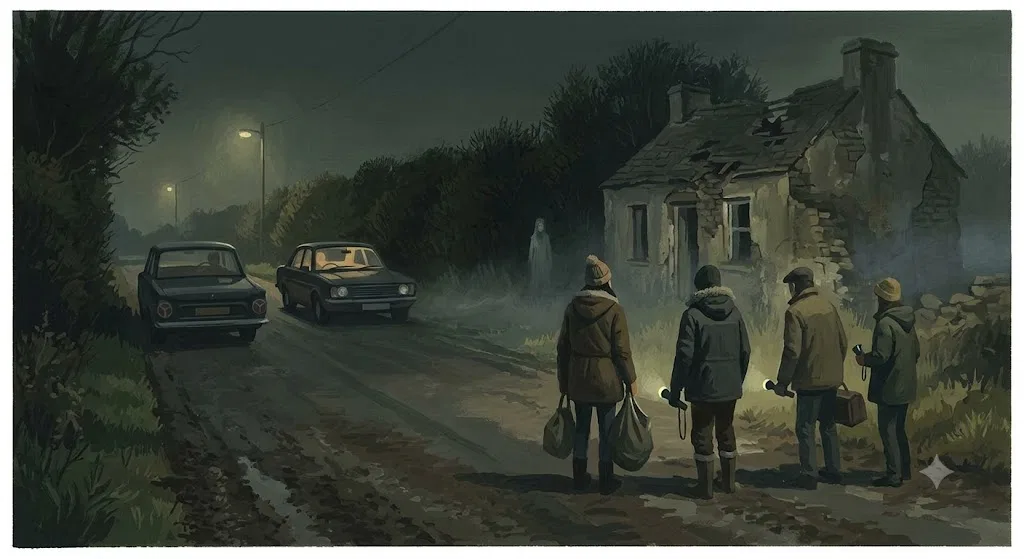
The setting helped the story travel. Press accounts in January 2009 repeatedly described a lonely country road, a hollow or dip, a stream or river nearby, and a ruined farmhouse or cottage whose broken, exposed condition gave the scene a ready-made Gothic frame. The Guardian’s gallery identified the site as the ruins of a farmhouse in the hollow of Mullaghmoyle Road, while later haunted-place summaries describe the apparition as passing a derelict cottage on an isolated stretch of the road.[The Guardian]theguardian.comtyrone ghosttyrone ghost
This physical setting matters because roadside ghost stories usually need a stage. A castle ghost can belong to a turret, a hotel ghost to a bedroom, and a battlefield ghost to a remembered conflict. Mullaghmoyle’s “white lady” belonged to a different kind of haunted geography: a rural lane, a ruin, a dip in the road, moving headlights, bad weather, winter darkness and a local pub close enough to turn sightings into conversation. The road was not just a backdrop; it shaped what people thought they saw.
Coalisland’s wider history also gives the area a distinctive texture without needing to force a grand historical explanation onto the ghost. The town is associated with coal, brickmaking and canal heritage; Discover Northern Ireland describes the Coalisland Canal Walk as part of an industrial heritage landscape, with the canal opened in the late eighteenth century to transport coal. Mullaghmoyle’s ghost story is not directly a canal haunting, but it sits in the same east Tyrone world of old roads, working landscapes, derelict structures and local memory.[Discover Northern Ireland]discovernorthernireland.comcoalisland canal walkcoalisland canal walk
What witnesses said they saw
The core claim was simple: a woman in white, or a pale female shape, appeared near the road. Some accounts made her elderly and human-shaped; others were less precise, describing something more like a white cloth or moving mist. That variation is important. The story’s power came from repetition, but the details were not perfectly stable.
In the Guardian’s January 2009 report, Ryan Bell, one of the most quoted young witnesses, described the apparition as an old woman with a long cape-like shape behind her, standing in the road and stopping in the same place. The same report also recorded other visitors’ experiences: one person said she saw a dark female figure on a hill, while another ghost-seeker had returned night after night without seeing the apparition.[The Guardian]theguardian.comThe GuardianCoalisland's ghostly attraction | Northern IrelandJanuary 10, 2009 — 9 Jan 2009 — She is said to have died around seven years…
The Belfast Telegraph account, reproduced and discussed in contemporary online archives, gave a slightly different flavour. Raymond Bell, landlord of the nearby Four Corners, said people of different ages had reported sightings and that his son Ryan had seen the figure several times. Another young local, Paul Corr, described what he had seen more modestly as a white cloth-like thing moving across the road on the hill, without visible features.[Flickr]flickr.comOpen source on flickr.com.
Those differences do not make the story worthless; they make it recognisably folkloric. A modern haunting often begins with ambiguous perception and then gathers narrative shape. One person sees a figure. Another hears the figure is an old woman. Someone else links her to the old house. Soon the apparition has a place, a costume, a likely identity and a reason for being there, even if none of those elements is firmly documented.
Why did Mullaghmoyle Road draw ghost-hunters?
The road became famous because the story crossed a threshold from private talk to public spectacle. By early January 2009, local claims were no longer only being exchanged in pubs or between drivers; they were being reported as a news event. The Guardian described convoys of ghost-hunters camping in cars, while the Belfast Telegraph reported hundreds of visitors to the road after nightly sightings of a mysterious white lady.[The Guardian]theguardian.comtyrone ghosttyrone ghost
The crowd itself then became part of the haunting. A report attributed to BBC News and repeated in contemporary paranormal-news archives said that at one point there was a line of up to 60 cars on Mullaghmoyle Road, with people trying to see the apparition. Local councillor Desmond Donnelly was quoted as saying he did not know exactly how it had started, but that “this type of thing spreads” — a plain description of how modern ghost fame works.[Ghost Radio]ghostradio.wordpress.comOpen source on wordpress.com.
Several forces seem to have come together at once:
- A specific sighting spot. People were not asked to believe in a vague haunted county; they were told where to park, where to look, and what to expect.
- A repeated time window. The story grew over the Christmas and New Year period, when more people had time to drive out at night.
- A striking visual hook. A “white lady” is instantly legible as a ghost figure, even to people with no specialist knowledge of folklore.
- Press momentum. Local attention drew regional and national coverage, which in turn sent more visitors to the road.
- Social performance. Some people came to investigate, some to be frightened, some to laugh, and some to join a temporary roadside happening.
That last point matters. The Mullaghmoyle episode was not only about belief. It was also about participation. The road became a night-time theatre where sceptics, teenagers, journalists, ghost-hunters and locals all had roles to play.
The derelict house, Dora Gilmore and the problem of identity
A natural question quickly attached itself to the story: who was the white lady supposed to be? One explanation connected the apparition to Dora Gilmore, named in the Guardian as an elderly woman who had once lived in the now derelict house. People who knew her remembered her affectionately, and the resemblance between the reported old woman and a former resident made the theory emotionally powerful.[The Guardian]theguardian.comThe GuardianCoalisland's ghostly attraction | Northern IrelandJanuary 10, 2009 — 9 Jan 2009 — She is said to have died around seven years…
But the same report also weakened that neat explanation. Dora was said to have died only around seven years before the 2009 coverage, whereas stories of a phantom at Mullaghmoyle Road were reportedly much older. Drinkers at the nearby Four Corners recalled encounters with misty objects near the hollow in the road since the mid-1980s, and the Guardian quoted Warren Coates of the Northern Ireland Paranormal Research Association as saying the group had received more than ten reports from that location over the years.[The Guardian]theguardian.comThe GuardianCoalisland's ghostly attraction | Northern IrelandJanuary 10, 2009 — 9 Jan 2009 — She is said to have died around seven years…
That leaves the identity of the apparition unresolved. Dora Gilmore may have helped the modern story gain a human face, but the evidence does not securely establish her as the origin of the legend. The better conclusion is that a remembered local resident, an abandoned house and older road rumours were drawn together because they made narrative sense. Folklore often works like that: it does not require a single documented origin if several half-known fragments can be made to fit the place.
A later local report from the Coalisland Post adds another layer by recording memories in the comments beneath a 2011 article. One commenter, William Seawright, said he had known the occupants of the house in the 1940s and 1950s and remembered members of the Gilmore family. Such recollections are valuable as local memory, though they do not verify the haunting. They do, however, show why the ruined house was not just scenery. It was attached to real people, family memory and an older Brackaville community.[coalislandpost.co.uk]coalislandpost.co.ukparanormal investigators brackaville ghost site truly hauntedparanormal investigators brackaville ghost site truly haunted
Fairy trees, bottled spirits and older rumours
One reason the Mullaghmoyle story became more than a simple “woman in white” report was the arrival of older-sounding folklore. The Belfast Telegraph account said some people believed the reappearance was linked to the cutting down of a nearby fairy tree in a field beside the ruined farmhouse. A local explanation, repeated in the same account, claimed that a spirit had once been bottled and a tree planted above it so that it would not be disturbed.[Belfast Telegraph]belfasttelegraph.co.ukBelfast TelegraphHaunting tale of a ghost from Tyrone10 Jan 2009 — Others believe its reappearance is linked to the recent cutting down o…
This is one of the most intriguing parts of the case, but also one of the hardest to verify. It sounds like traditional Irish and Ulster fairy belief, in which certain trees, fields and boundaries are treated with caution. Yet in the Mullaghmoyle material, the fairy-tree story appears mainly as local rumour reported during a media frenzy. There is no clear, independent documentary trail showing that a named ritual, priest, bottled spirit and tree were historically recorded at this exact site before the 2008–09 sightings.
That does not make the rumour irrelevant. It helps explain why some people read the apparition not as a random ghost but as the consequence of disturbing a charged place. The road, the stream, the old house and the tree story combine into a familiar supernatural pattern: an ordinary landscape becomes dangerous because something old has been interfered with.
There was also a phantom hitchhiker strand. The Belfast Telegraph report quoted Warren Coates of NIPRA as saying earlier local activity had involved a female hitchhiker who appeared by the roadside and vanished when drivers stopped. The Paranormal Database later filed the Mullaghmoyle case under the compact title “Moon or Hitchhiker”, noting both the January 2009 traffic jam and Donnelly’s moon-reflection explanation.[Flickr]flickr.comOpen source on flickr.com.
That matters because “phantom hitchhiker” stories are a classic road-ghost form. The Mullaghmoyle white lady was not simply a house ghost who happened to be near a road. She belonged to a family of stories in which drivers encounter a figure at the edge of the carriageway, often at night, often in a liminal place, and often with just enough ambiguity to keep the tale alive.

Sceptical explanations: moonlight, water, mist and mischief
The most persuasive sceptical explanations do not require anyone to have lied. They begin with the conditions of the road itself: darkness, a dip, nearby water, mist, hedges, headlights, expectation and moving observers. Councillor Desmond Donnelly’s explanation, widely repeated at the time, was that the supposed ghost was more likely a reflection of the moon on the nearby river or stream, though he acknowledged that people were talking about something shaped like a person.[Ghost Radio]ghostradio.wordpress.comOpen source on wordpress.com.
That explanation fits some, but not all, of the reports. It fits sightings described as misty, white, cloth-like or light-based. It fits a repeated location near a hollow and water. It also fits the timing: winter nights, low light and people looking from cars. It is less satisfying for witnesses who insisted they saw an old woman with a cape-like outline, but even there, expectation can shape ambiguous perception. Once a road is known for a white lady, a pale patch in the right place is more likely to be interpreted as a figure.
The Guardian report also documented prank activity during the height of the craze. Teenagers tried to frighten visitors with sheets and a mannequin, and the article described screams, a white shape in a tree and giggling from the hedges. That does not explain the earliest reports, but it does show how quickly a serious haunting claim can become mixed with performance, hoaxing and local entertainment once crowds arrive.[The Guardian]theguardian.comThe GuardianCoalisland's ghostly attraction | Northern IrelandJanuary 10, 2009 — 9 Jan 2009 — She is said to have died around seven years…
The strongest cautious reading is therefore mixed. Some sightings may have been misperceived natural effects. Some may have been shaped by rumour. Some later “evidence” may have been prank or wishful thinking. A small core of witness experience remains difficult to reconstruct because the reports were informal, repeated through media summaries, and not tested under controlled conditions.
Paranormal investigators and the evidence problem
Paranormal groups became part of Mullaghmoyle Road’s fame almost immediately. NIPRA was mentioned in 2009 as having received previous reports and being aware of the site. In 2011, the Coalisland Post reported that members of a group called Violet Flame visited the Brackaville site, used a radio-scanning device often called a Frank’s box, and later described the place as haunted.[The Guardian]theguardian.comThe GuardianCoalisland's ghostly attraction | Northern IrelandJanuary 10, 2009 — 9 Jan 2009 — She is said to have died around seven years…
For a public haunted-history page, the key point is not whether such investigations should be mocked or accepted. It is that their evidence has limits. Devices that scan radio frequencies can produce fragments of broadcast sound, static and suggestive words; believers may interpret these as spirit communication, while sceptics see them as pattern-finding in noise. The 2011 report is useful because it shows the legend persisted after the initial press storm, but it does not turn the haunting into a verified fact.[coalislandpost.co.uk]coalislandpost.co.ukparanormal investigators brackaville ghost site truly hauntedparanormal investigators brackaville ghost site truly haunted
The internet also kept the case alive. Video clips, reposted newspaper extracts, paranormal blogs and later haunted-place directories ensured that Mullaghmoyle Road remained findable long after the crowds had gone. Spirited Isle, for example, now presents the site as part of a haunted-Ireland map, summarising the December 2008 and January 2009 accounts for modern readers. The Belfast Telegraph also returned to the case in a 2021 haunted-places roundup, showing that the road had become shorthand for Tyrone’s most famous modern ghost craze.[Spirited Isle]spiritedisle.iemullaghmoyle road tyronemullaghmoyle road tyrone
That afterlife is part of the evidence. A haunting can become culturally important even when the original sightings are uncertain. Mullaghmoyle Road is now remembered because the story left traces in journalism, local discussion, paranormal catalogues and tourism-style haunted listings.
Why this became Tyrone’s best-known modern haunting
Tyrone has older and arguably stronger ghost material, including nineteenth-century newspaper cases and long-preserved oral traditions. Mullaghmoyle Road stands out for a different reason: it was a modern media haunting that unfolded in public view. It had witnesses, sceptics, named locals, a visible location, crowds, jokes, investigators, photographs of the ruined house and a burst of national attention.[The Guardian]theguardian.comtyrone ghosttyrone ghost
Its fame also came from being unusually accessible. A castle haunting may require an admission ticket or a guided tour. A private-house haunting may be impossible to visit respectfully. A roadside ghost, by contrast, can be sought from a car. That accessibility made Mullaghmoyle exciting, but it also created problems: traffic, noise, trespass risk, hoaxes and the transformation of a quiet rural road into a temporary attraction.
The white lady figure helped the story travel beyond Coalisland. “White lady” is one of the most recognisable ghost types in Britain and Ireland: a pale female apparition, often linked in popular tradition to grief, death, betrayal, a dangerous road or an old house. Mullaghmoyle’s version did not need a fully proven backstory because the image already carried meaning. Readers and visitors knew how to understand her before anyone had explained her.
At the same time, the Tyrone specificity should not be lost. This was not a generic internet ghost pasted onto a random lane. It was rooted in a particular east Tyrone place: the Brackaville road, the ruined cottage, the Four Corners conversations, the local names, the fairy-tree rumour, the moon-on-water scepticism and the sudden winter crowds. That combination is what gives the Mullaghmoyle story its local weight.
How credible is the Mullaghmoyle White Lady story?
The Mullaghmoyle case is credible as a documented local and media event, but not as proof of a ghost. There is good evidence that people reported sightings, that crowds gathered, that journalists visited, that locals debated explanations, and that paranormal groups treated the road as significant. There is much weaker evidence for the identity of the apparition, the fairy-tree explanation, or any claim that a supernatural presence was objectively established.[theguardian.com]theguardian.comThe GuardianCoalisland's ghostly attraction | Northern IrelandJanuary 10, 2009 — 9 Jan 2009 — She is said to have died around seven years…
The most reliable facts are the public ones: in late 2008 and early 2009, reports of a white female figure on Mullaghmoyle Road drew large numbers of visitors to a rural road near Coalisland. The most uncertain elements are the ones that make the story feel older and deeper: whether a cut fairy tree triggered the sightings, whether the apparition was connected to a former resident, whether earlier hitchhiker stories describe the same phenomenon, and whether any individual witness saw something that cannot be explained naturally.
For readers interested in haunted Tyrone, that uncertainty is not a flaw to hide. It is the heart of the case. Mullaghmoyle Road shows how a ghost story forms in real time: a strange sighting on a winter road becomes pub talk, then a local news item, then a night-time crowd, then a national curiosity, then a durable entry in Tyrone’s haunted map. The white lady remains unproven, but the fame of the roadside haunting is beyond dispute.
Amazon book picks
Further Reading
Books and field guides related to Why Did Mullaghmoyle Road Draw Ghost-Hunters?. Use these as the next step if you want deeper reading beyond the article.
The Mammoth Book of Haunted House Stories
Appeals to readers interested in expanding from one haunting account to classic supernatural cases.
Ghost Hunters: William James and the Search for Scientific Pr...
Examines scepticism, investigation and belief surrounding paranormal claims.

Ghostland: In Search of a Haunted Country
Closely matches themes of roadside legends, memory and belief.

Ghosts: A Haunted History
Explains recurring patterns behind modern ghost reports and public fascination.
eBay marketplace picks
Marketplace Samples
Live-tested eBay searches with available results related to this page.

Endnotes
1.
Source: flickr.com
Link:https://www.flickr.com/photos/21212853%40N08/3192068190
2.
Source: coalislandpost.co.uk
Title: paranormal investigators brackaville ghost site truly haunted
Link:https://coalislandpost.co.uk/paranormal-investigators-brackaville-ghost-site-truly-haunted/
3.
Source: theguardian.com
Link:https://www.theguardian.com/uk/2009/jan/10/mullaghmoyle-ghost-coalisland-phantom-seekers
Source snippet
The GuardianCoalisland's ghostly attraction | Northern IrelandJanuary 10, 2009 — 9 Jan 2009 — She is said to have died around seven years...
Published: January 10, 2009
4.
Source: belfasttelegraph.co.uk
Link:https://www.belfasttelegraph.co.uk/news/haunting-tale-of-a-ghost-from-tyrone/a/119244543.html
Source snippet
Belfast TelegraphHaunting tale of a ghost from Tyrone10 Jan 2009 — Others believe its reappearance is linked to the recent cutting down o...
5.
Source: ons.gov.uk
Link:https://www.ons.gov.uk/methodology/geography/ukgeographies/administrativegeography/northernireland
Source snippet
Office for National StatisticsNorthern IrelandThe six historic counties (Antrim, Armagh, Down, Fermanagh, Londonderry and Tyrone) are sti...
6.
Source: theguardian.com
Title: tyrone ghost
Link:https://www.theguardian.com/uk/gallery/2009/jan/09/tyrone-ghost
7.
Source: spiritedisle.ie
Title: mullaghmoyle road tyrone
Link:https://spiritedisle.ie/explore/listing/mullaghmoyle-road-tyrone/
8.
Source: discovernorthernireland.com
Title: coalisland canal walk
Link:https://discovernorthernireland.com/listing/coalisland-canal-walk/75040101/
9.
Source: ghostradio.wordpress.com
Link:https://ghostradio.wordpress.com/2009/01/06/
10.
Source: telegraph.co.uk
Title: Ghostly white lady sparks hunts by spirit hunters
Link:https://www.telegraph.co.uk/news/newstopics/howaboutthat/4176249/Ghostly-white-lady-sparks-hunts-by-spirit-hunters.html
11.
Source: belfasttelegraph.co.uk
Link:https://www.belfasttelegraph.co.uk/life/features/most-haunted-30-paranormal-places-that-promise-to-spook-the-absolute-bejaysus-out-of-you/a/115714755.html
12.
Source: Wikipedia
Link:https://en.wikipedia.org/wiki/Brackaville
13.
Source: Wikipedia
Title: Coalisland Canal
Link:https://en.wikipedia.org/wiki/Coalisland_Canal
14.
Source: genuki.org.uk
Link:https://www.genuki.org.uk/big/irl/TYR/Coalisland
15.
Source: wikishire.co.uk
Link:https://wikishire.co.uk/wiki/Coalisland
Additional References
16.
Source: paranormaldatabase.com
Link:https://www.paranormaldatabase.com/reports/roaddata.php?pageNum_paradata=11&totalRows_paradata=692
Source snippet
Paranormal DatabaseHaunted RoadsMoon or Hitchhiker. Location: Coalisland (County Tyrone) - Mullaghmoyle Road, Brackaville... Local Counc...
17.
Source: youtube.com
Title: Northern Ireland’s Greatest Haunts
Link:https://www.youtube.com/watch?v=KYRyH0njTVw
Source snippet
Prehen House...
18.
Source: coalisland-lnp.com
Link:https://www.coalisland-lnp.com/wp-content/uploads/2021/01/07-LNP-LOUGH-NEAGH-PARTNERSHIP-Digging-Deep-exhibition.pdf
19.
Source: townlands.ie
Link:https://www.townlands.ie/tyrone/dungannon-middle/donaghenry/tullyniskane/brackaville/
20.
Source: facebook.com
Link:https://www.facebook.com/groups/212699529845967/posts/1323597492089493/
21.
Source: facebook.com
Link:https://www.facebook.com/groups/21988775605/posts/10163886137965606/
22.
Source: ghosttheory.com
Link:https://www.ghosttheory.com/2009/01/06/ghost-sighting-creates-traffic-jam
23.
Source: facebook.com
Link:https://www.facebook.com/groups/21988775605/posts/10157313530585606/
24.
Source: iwai.ie
Link:https://www.iwai.ie/coalisland-canal/
25.
Source: facebook.com
Link:https://www.facebook.com/thehighkings/posts/irelands-best-known-ghost-story-is-about-the-white-lady-of-kinsale-the-tragic-ta/768062414680512/
Topic Tree