Why Do Londonderry's Old Places Feel Haunted?
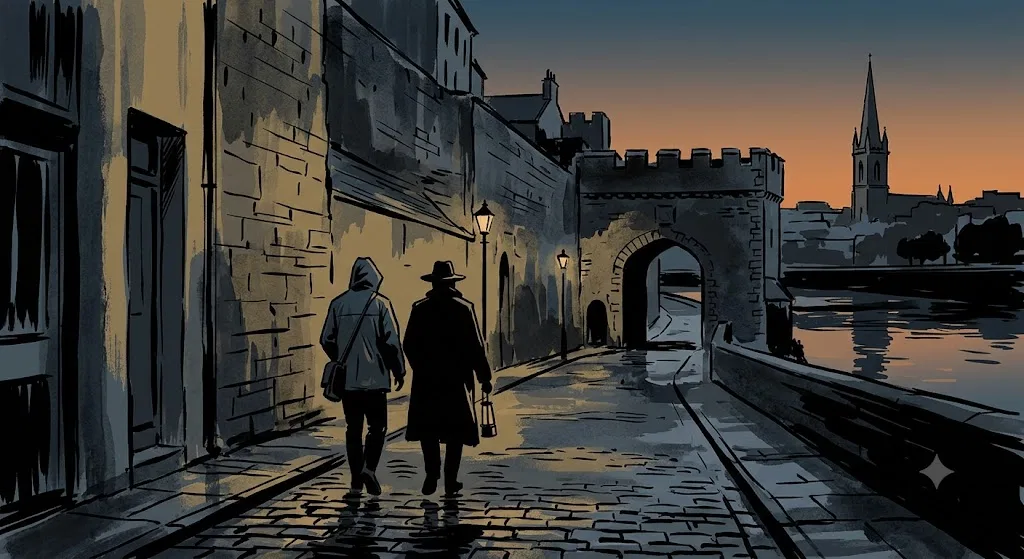
County Londonderry’s haunted reputation is strongest where its history is already dramatic: the walled city of Derry, the ruined estates of the north coast, old Plantation houses, river crossings, graveyards, and rural lanes where older banshee and fairy traditions still cling to place.
Page outline Jump by section
Introduction
For this UK historic-county project, County Londonderry is treated as the historic county rather than only the modern council map. The old county took shape during the Plantation of Ulster, when County Coleraine, the city and liberties of Londonderry, and adjoining liberties were consolidated under the 1613 charter; today its places fall across modern local government areas including Derry City and Strabane, Causeway Coast and Glens, and Mid Ulster.[Wikishire]wikishire.co.ukWikishire County LondonderryWikishire County Londonderry
Why County Londonderry’s ghosts cluster around walls, estates and thresholds
County Londonderry’s haunted geography is unusually clear. The strongest stories gather at boundaries: city walls, river crossings, cliff edges, grave sites, demesne gates, staircases, nurseries, ruined houses and old roads. That is typical of ghost folklore, but here it is sharpened by the county’s history. Londonderry was created in the Plantation period, with the walled city acting as a frontier stronghold; Wikishire’s historic-county account notes the 1613 charter, the role of the London livery companies, and the city’s later reputation as the “Maiden City” because its walls were never breached.[Wikishire]wikishire.co.ukWikishire County LondonderryWikishire County Londonderry
That matters for haunted history because many local legends are not simply “a ghost was seen here” tales. They are stories about disturbance: a bishop’s grave moved during restoration, a wife unable to stop a death in a country house, a banshee heard at the edge of bereavement, a coach crossing between Waterside and city, or an estate spirit supposedly bound to a tree. The story is often less about a monster than about a place where the past has not settled.
The county also has a strong public-facing spooky culture. Derry Halloween, now promoted as one of the world’s best-known Halloween celebrations, draws on the city’s mythical and cultural history, with parade, fireworks, folklore and seasonal spectacle becoming part of how visitors encounter the city.[Ireland.com]ireland.comDerry Halloween | Ireland.comDerry Halloween | Ireland.com
St Columb’s Cathedral and the disturbed grave of Bishop Higgins
St Columb’s Cathedral in the walled city is the county’s most widely repeated ecclesiastical haunting. The story centres on William Higgins, a former Bishop of Derry. Tourism Ireland’s account says that the haunting tradition began after his grave was disturbed in 1867, with later reports of footsteps in a locked gallery and an organ sounding before the power had been switched on.[Ireland.com]ireland.comTales from Ireland’s crypts | Ireland.comTales from Ireland’s crypts | Ireland.com
The appeal of the story is easy to understand. A cathedral already carries a heavy atmosphere: stone, memorials, silence, ritual, locked spaces and the weight of generations. Add the detail of a disturbed grave, and the haunting becomes a warning tale about the unease caused when the dead are moved for the needs of the living. It is not necessary to treat the footsteps or organ as established events to see why the story endures. The narrative gives architectural change a moral charge: restoration may improve a building, but folklore asks what, or whom, it unsettled.
The legend also fits a wider church-haunting pattern found across Britain and Ireland: footsteps in galleries, organ music with no visible player, apparitions in photographs, and the idea that clergy remain tied to their church after death. What makes the Derry version distinctive is its exact anchoring to a named person, a named building and a dated act of disturbance.

Springhill: the “friendly” ghost of Olivia Lenox-Conyngham
Springhill, near Moneymore, is one of County Londonderry’s strongest haunted-house cases because the ghost story is tied to a well-preserved National Trust property and a well-documented family setting. The National Trust describes Springhill as a rare surviving Plantation-era house, built in the late seventeenth century and home to ten generations of the Conyngham and Lenox-Conyngham family for more than 250 years.[National Trust]nationaltrust.org.ukNational Trust History of Springhill │ County Londonderry | National TrustNational Trust History of Springhill │ County Londonderry | National Trust
The ghost tradition usually centres on Olivia Lenox-Conyngham, second wife of George Lenox-Conyngham. In the most common version, Olivia is associated with the Blue Room and with the tragedy of George’s death in 1816. Haunted-place accounts describe her as a tall grey lady, sometimes seen calmly moving through the house or standing on the staircase, and often portrayed not as threatening but as watchful, maternal and attached to children.[Spirited Isle]spiritedisle.ieSpirited Isle Springhill House | Haunted Derry, Northern Ireland | Spirited IsleSpirited Isle Springhill House | Haunted Derry, Northern Ireland | Spirited Isle
The Springhill story has several features that make it unusually memorable. First, it is domestic rather than monstrous: a staircase, a nursery, a bedroom, a cot, a woman in period dress. Second, it sits inside a house whose ordinary history is already rich: Plantation settlement, family continuity, land changes, the Second World War, and National Trust preservation. Third, some versions include wartime detail, such as US soldiers hearing a cot knock in the nursery and asking for it to be removed.[National Trust]nationaltrust.org.ukNational Trust History of Springhill │ County Londonderry | National TrustNational Trust History of Springhill │ County Londonderry | National Trust
As evidence, the case remains folkloric and anecdotal. The National Trust history gives the solid frame of the house and family; the ghost tradition comes from later retellings, haunted-site summaries and witness-type accounts. The most careful reading is to treat Olivia not as a verified apparition, but as the house’s emotional shorthand: grief, maternal care, class memory, inherited rooms and the feeling that some family histories linger in the architecture.
Downhill and Mussenden Temple: cliff-edge beauty with spectral overtones
Mussenden Temple and Downhill Demesne bring a different kind of haunting into the county: the romantic ruin. The National Trust describes the site as a clifftop landscape of history and nature, with Mussenden Temple perched at the cliff edge above the North Atlantic and originally built to house the Earl Bishop’s library, based on the Temple of Vesta in Italy.[National Trust]nationaltrust.org.ukNational Trust Visit Mussenden Temple & Downhill Demesne | National TrustNational Trust Visit Mussenden Temple & Downhill Demesne | National Trust
The ghost traditions here are less firmly documented than Springhill’s, but they are powerful because the setting does half the work. Haunted accounts attach several motifs to Downhill and Mussenden: a pale female figure linked to Frideswide Mussenden, mysterious lights, cold spots, a phantom figure of the Earl Bishop, and a vanishing stain or “puddle of blood” in the ruined house.[Spirited Isle]spiritedisle.ieSpirited Isle Downhill Demesne and Mussenden Temple | Explore Haunted IrelandSpirited Isle Downhill Demesne and Mussenden Temple | Explore Haunted Ireland
These stories should be handled cautiously. The National Trust’s reliable material confirms the place, its landscape, its library function and its ruined mansion; the spectral details come from haunted-tourism and folklore retellings. Yet the fit between place and legend is striking. A temple built as a memorial-like folly, a mansion in ruin, a cliff edge, Atlantic weather, and a family story involving affection, status and loss are all ingredients that encourage ghostly interpretation.[National Trust]nationaltrust.org.ukNational Trust Visit Mussenden Temple & Downhill Demesne | National TrustNational Trust Visit Mussenden Temple & Downhill Demesne | National Trust
For visitors, the most credible way to approach Mussenden’s haunting is as atmospheric folklore rather than a case file. The story’s real strength is not a single witness report, but the way the landscape encourages a sense of exposure: sea below, sky above, and a small classical building standing where erosion has long threatened to pull history towards the edge.
Derry city street legends: banshees, bridges and the dead in motion
Not all County Londonderry hauntings belong to grand houses. Some of the most locally vivid tales are urban or semi-urban: heard in yards, seen on bridges, repeated along streets, and preserved by storytellers rather than institutions.
The Brandywell Banshee is a classic death-warning story. In the Belfast Live retelling, a young man keeping company with his ill grandfather hears a dreadful wailing from outside, compared to dogs and cats screeching; when his father reaches the sick man’s bedside, the grandfather dies, and the grandmother identifies the sound as the banshee.[Belfast Live]belfastlive.co.ukBelfast Live Derry's best spooky stories: Banshees, ghosts and devilish delightsBelfast Live Derry's best spooky stories: Banshees, ghosts and devilish delights
The Headless Coachman is another strong Derry motif. Local ghost-story collections place him on the old wooden bridge between the Waterside and the city side, with an 1865 setting and the familiar image of a coachman without a head crossing a liminal route.[Derry Ghosts]derryghosts.comOpen source on derryghosts.com.
These tales are not “evidence” in the modern investigative sense. They are better read as oral-history folklore: stories that help a community dramatise fear, death, night travel and the dangerous space between home and elsewhere. The banshee warns that death is close; the coachman turns a crossing into a stage for dread. Both also show how Derry’s haunted map is not limited to famous monuments. It runs through ordinary neighbourhoods and remembered routes.
Cumber House and the problem of highly haunted reputations
Cumber House, near Claudy in the Faughan valley, is often presented as one of the north-west’s most haunted houses. The stories attached to it are dramatic: a Browne family patriarch supposedly appearing in flames, a spirit confined to a tree, scratching noises, moans, dark figures, footsteps, moving objects and unseen music. Spirited Isle summarises the legend and also notes that such experiences are open to interpretation and cannot always be verified.[Spirited Isle]spiritedisle.ieSpirited Isle Cumber House | Explore Haunted IrelandSpirited Isle Cumber House | Explore Haunted Ireland
The site’s historical frame is more solid than its supernatural claims. Haunted and local-history accounts identify Cumber House as a Georgian-era estate associated with the Browne-Lecky family, later linked to wartime use and local community memory. Spooky Isles places the house in the Faughan valley and describes its reputation as a haunted place while also giving a family and estate-history context.[Spooky Isles]spookyisles.comSpooky Isles Relentless Spirits Haunt Cumber House | Spooky IslesSpooky Isles Relentless Spirits Haunt Cumber House | Spooky Isles
Cumber is a good example of why haunted-history writing needs restraint. The stories are vivid, but many versions come from paranormal retellings and local legend rather than from early documentary sources. That does not make them worthless. It means their value is folkloric: they show how a grand house, a landlord family, religious authority, a tree, and rumours of punishment after death can merge into a memorable local haunting.
The most useful reader question is not “did the burning ghost literally appear?” but “why did this story attach to this house?” One answer is that Cumber’s legend gives social unease a supernatural form. Big houses in rural Ulster carried authority, wealth, employment, resentment, deference and gossip. A tale in which a patriarch is judged, exposed and contained is a powerful way of turning social memory into ghost story.

Prehen and Half-Hanged McNaughton
The legend of Half-Hanged McNaughton links County Londonderry haunting to violence, execution and the afterlife of scandal. Belfast Live’s account says McNaughton was sentenced to hanging, that the rope broke twice, and that after the crowd wanted him spared he insisted he should not be left “half-hanged”; his ghost is then said to wander through Prehen, where the tragic killing took place.[Belfast Live]belfastlive.co.ukBelfast Live Derry's best spooky stories: Banshees, ghosts and devilish delightsBelfast Live Derry's best spooky stories: Banshees, ghosts and devilish delights
This story sits close to the borderlands of history, ballad and ghost lore. John McNaughton was a real figure in eighteenth-century Ulster tradition, but the haunting depends on the dramatic ritual of failed execution: the broken rope, the watching crowd, the idea that death itself hesitated. In folklore terms, that is a perfect recipe for a restless dead man. A person who dies wrongly, violently or incompletely often returns in local tradition because the story itself feels unfinished.
Prehen’s association with the tale also connects County Londonderry’s haunted history to neighbouring Tyrone and Donegal routes. This is important for the wider UK counties project: ghost stories often ignore neat boundaries. The historic county remains the centre of the page, but the cultural route of a legend can cross rivers, roads, estates and modern jurisdictions.
Fairy places, banshees and older folklore beneath the ghost stories
County Londonderry’s haunted map is not made only of Victorian-style ghosts. Older Irish folklore motifs are present too: banshees, fairy forts, warning sounds, lights, uncanny animals and places that should not be disturbed. The Brandywell Banshee is the clearest urban example, but the wider pattern belongs to a long tradition in which the supernatural is attached to family death, thresholds and old earthworks.[Belfast Live]belfastlive.co.ukBelfast Live Derry's best spooky stories: Banshees, ghosts and devilish delightsBelfast Live Derry's best spooky stories: Banshees, ghosts and devilish delights
The National Trust’s Springhill history is useful here because it notes that the demesne landscape includes a surviving rath, or ringfort, and that the area once belonged to the O’Lynns before later Plantation settlement.[National Trust]nationaltrust.org.ukNational Trust History of Springhill │ County Londonderry | National TrustNational Trust History of Springhill │ County Londonderry | National Trust Ringforts across Ireland commonly attract fairy lore, not because every site has a documented ghost story, but because they mark ancient, half-understood places in the landscape. Even when a particular County Londonderry tale is not well sourced, the pattern of respect, avoidance and unease around old earthworks is historically recognisable in Irish folklore collections.
This older layer changes how the county’s hauntings read. A banshee is not the same thing as a house ghost. A fairy place is not the same thing as a phantom coach. A cathedral haunting is not the same thing as a death omen. County Londonderry’s eerie tradition is strongest when these layers are kept distinct rather than flattened into generic “paranormal activity”.
How credible are County Londonderry’s haunted stories?
The evidence varies sharply from place to place. The strongest historical grounding usually belongs to the location, not to the apparition. St Columb’s Cathedral, Springhill, Mussenden Temple and Cumber House are real historic places with documentary, architectural or institutional records. The ghost claims attached to them are mostly later retellings, witness memories, tourism copy, local journalism, paranormal summaries or oral tradition.[ireland.com]ireland.comTales from Ireland’s crypts | Ireland.comTales from Ireland’s crypts | Ireland.com
A fair credibility scale looks like this:
- Well-grounded setting, folkloric haunting: Springhill, St Columb’s Cathedral and Mussenden Temple all have strong historical settings, but the apparitions themselves remain unverified stories.
- Local oral tradition: The Brandywell Banshee, Headless Coachman and Half-Hanged McNaughton belong mainly to repeated local storytelling and seasonal press or tour culture.[Belfast Live]belfastlive.co.ukBelfast Live Derry's best spooky stories: Banshees, ghosts and devilish delightsBelfast Live Derry's best spooky stories: Banshees, ghosts and devilish delights
- Paranormal-reputation sites: Cumber House has a rich haunted reputation, but much of the evidence is anecdotal and should be read as legend unless supported by earlier records.[Spooky Isles]spookyisles.comSpooky Isles Relentless Spirits Haunt Cumber House | Spooky IslesSpooky Isles Relentless Spirits Haunt Cumber House | Spooky Isles
- Atmospheric tourism: Derry Halloween and haunted tours are important to how modern visitors encounter the supernatural, but festival atmosphere should not be mistaken for historical proof.[Ireland.com]ireland.comDerry Halloween | Ireland.comDerry Halloween | Ireland.com
Sceptical explanations are often simple without being dismissive. Old buildings produce footsteps, knocks, draughts and temperature shifts. Empty churches and country houses amplify sound. Ruins invite pareidolia, the human habit of seeing figures or meaning in uncertain shapes. Family tragedies become compressed into memorable scenes. Local newspapers and ghost tours repeat the versions that are easiest to tell. None of that means the stories are worthless. It means their value lies in what they reveal about memory, fear, place and identity.
Visiting the haunted county without losing the history
For a reader planning an eerie heritage route, the most rewarding approach is to pair ghost stories with daylight history. In Derry city, St Columb’s Cathedral, the walls, old streets and Halloween festival culture show how sacred architecture, siege memory and seasonal performance overlap. On the north coast, Mussenden Temple and Downhill Demesne offer the county’s most cinematic haunted setting, with cliff-edge views and ruins that make the folklore easy to imagine. Around Moneymore, Springhill gives the most intimate haunted-house tradition, especially for readers interested in family memory rather than shock.[ireland.com]ireland.comTales from Ireland’s crypts | Ireland.comTales from Ireland’s crypts | Ireland.com
The key is to treat the stories as invitations into deeper local history. Bishop Higgins leads to church restoration and burial custom. Olivia at Springhill leads to Plantation houses, women’s memory and family tragedy. Mussenden leads to the Earl Bishop, landscape design and romantic ruin. Cumber leads to landlord folklore and rural unease. The Brandywell Banshee leads to older death-warning belief. The Headless Coachman leads to the uncanny power of bridges and night travel.
County Londonderry’s haunted history is therefore not a list of “most haunted” claims. It is a map of places where the past feels close: under cathedral stone, along city streets, in demesne gardens, beside old trees, across bridges, and on the cliff edge where the Atlantic wind turns architecture into atmosphere.
Amazon book picks
Further Reading
Books and field guides related to Why Do Londonderry's Old Places Feel Haunted?. Use these as the next step if you want deeper reading beyond the article.
The Mammoth Book of Haunted House Stories
Provides classic haunted-place stories that match readers interested in haunted historic locations.
The Penguin Guide to the Superstitions of Britain and Ireland
Explains beliefs and traditions behind Irish and British ghost legends.
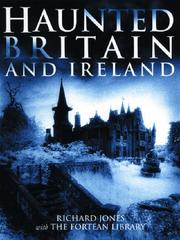
Haunted Britain and Ireland
Covers haunted sites across Britain and Ireland, fitting county-level exploration.

The world of Lore
Explores folklore and supernatural traditions that resonate with local ghost lore.
eBay marketplace picks
Marketplace Samples
Live-tested eBay searches with available results related to this page.
Endnotes
1.
Source: ireland.com
Title: Tales from Ireland’s crypts | Ireland.com
Link:https://www.ireland.com/magazine/built-heritage/attractions-crypts/
2.
Source: ireland.com
Title: Derry Halloween | Ireland.com
Link:https://www.ireland.com/en-us/things-to-do/events/derry-halloween/
3.
Source: ireland.com
Link:https://www.ireland.com/en-us/magazine/culture/nine-most-haunted/
4.
Source: ireland.com
Title: attractions crypts
Link:https://www.ireland.com/en-us/magazine/built-heritage/attractions-crypts/
5.
Source: ireland.com
Link:https://www.ireland.com/en-gb/plan-your-trip/trip-ideas/derry-londonderry-causeway-coast/
6.
Source: ireland.com
Link:https://www.ireland.com/de-de/things-to-do/events/derry-halloween/
7.
Source: nationaltrust.org.uk
Title: National Trust History of Springhill │ County Londonderry | National Trust
Link:https://www.nationaltrust.org.uk/visit/northern-ireland/springhill/history-of-springhill-house-and-estate
8.
Source: nationaltrust.org.uk
Title: National Trust Visit Mussenden Temple & Downhill Demesne | National Trust
Link:https://www.nationaltrust.org.uk/visit/northern-ireland/mussenden-temple-and-downhill-demesne/things-to-do-at-mussenden-temple-and-downhill-demesne
9.
Source: belfastlive.co.uk
Title: Belfast Live Derry’s best spooky stories: Banshees, ghosts and devilish delights
Link:https://www.belfastlive.co.uk/news/northern-ireland/derrys-best-spooky-stories-banshees-21982930
10.
Source: wikishire.co.uk
Title: Wikishire County Londonderry
Link:https://wikishire.co.uk/wiki/County_Londonderry
11.
Source: en.wikivoyage.org
Title: County Londonderry
Link:https://en.wikivoyage.org/wiki/County_Londonderry
12.
Source: spiritedisle.ie
Title: Spirited Isle Springhill House | Haunted Derry, Northern Ireland | Spirited Isle
Link:https://spiritedisle.ie/explore/listing/springhill-house/
13.
Source: spiritedisle.ie
Title: Spirited Isle Downhill Demesne and Mussenden Temple | Explore Haunted Ireland
Link:https://spiritedisle.ie/explore/listing/downhill-demesne-and-mussenden-temple/
14.
Source: derryghosts.com
Link:https://www.derryghosts.com/headless.htm
15.
Source: derryghosts.com
Link:https://www.derryghosts.com/stories.htm
16.
Source: spiritedisle.ie
Title: Spirited Isle Cumber House | Explore Haunted Ireland
Link:https://spiritedisle.ie/explore/listing/cumber-house/
17.
Source: spookyisles.com
Title: Spooky Isles Relentless Spirits Haunt Cumber House | Spooky Isles
Link:https://www.spookyisles.com/cumber-house/
18.
Source: spiritedisle.ie
Title: Haunted Armagh: Exploring Ghostly Legends Discover Ireland’s most haunted places
Link:https://spiritedisle.ie/haunted-armagh/
19.
Source: spiritedisle.ie
Title: Northern Ireland’s Most Haunted Locations Discover Ireland’s most haunted places
Link:https://spiritedisle.ie/northern-ireland/
20.
Source: spiritedisle.ie
Link:https://spiritedisle.ie/haunted-derry/
21.
Source: spiritedisle.ie
Title: st columbs cathedral
Link:https://spiritedisle.ie/explore/listing/st-columbs-cathedral/
22.
Source: spiritedisle.ie
Link:https://spiritedisle.ie/video-springhill-house/
23.
Source: Wikipedia
Title: Mussenden Temple
Link:https://en.wikipedia.org/wiki/Mussenden_Temple
24.
Source: Wikipedia
Title: County Londonderry
Link:https://en.wikipedia.org/wiki/County_Londonderry
25.
Source: wikishire.co.uk
Link:https://wikishire.co.uk/wiki/Londonderry
26.
Source: facebook.com
Link:https://www.facebook.com/photo.php?fbid=10159786330898586&id=13533633585&set=a.97566018585
27.
Source: facebook.com
Link:https://www.facebook.com/DerryHalloween/
28.
Source: nationaltrust.org.uk
Link:https://www.nationaltrust.org.uk/visit/northern-ireland/springhill
29.
Source: derryghosts.com
Link:https://www.derryghosts.com/banshee.htm
30.
Source: derryghosts.com
Link:https://www.derryghosts.com/cumber.htm
31.
Source: derryghosts.com
Link:https://www.derryghosts.com/mcnaught.htm
32.
Source: discovernorthernireland.com
Title: Derry Halloween
Link:https://discovernorthernireland.com/event/derry-halloween/75410101/
33.
Source: visitderry.com
Link:https://www.visitderry.com/whats-on/hauntings-p923591
34.
Source: causewaycoast.guide
Title: Downhill Demesne
Link:https://www.causewaycoast.guide/locations/downhill-demense
35.
Source: baseview.uk
Title: Derry City and Strabane
Link:https://www.baseview.uk/district/derry-city-and-strabane
36.
Source: nationaltrustcollections.org.uk
Link:https://www.nationaltrustcollections.org.uk/place/springhill
37.
Source: nationaltrustscones.com
Link:https://www.nationaltrustscones.com/2019/08/springhill.html
38.
Source: gostargazing.co.uk
Title: Mussenden Temple and Downhill Demesne
Link:https://gostargazing.co.uk/locations/mussenden-temple-and-downhill-demesne-national-trust/
39.
Source: historyhit.com
Title: mussenden temple and downhill demesne
Link:https://www.historyhit.com/locations/mussenden-temple-and-downhill-demesne/
Additional References
40.
Source: x.com
Link:https://x.com/derryjournal/status/1983865250970792056
41.
Source: hellorayo.co.uk
Link:https://www.hellorayo.co.uk/cool-fm/halloween/halloween-fun/11-of-the-most-haunted-places-in-northern-ireland
42.
Source: hauntedrooms.co.uk
Link:https://www.hauntedrooms.co.uk/haunted-places/northern-ireland
43.
Source: atlasobscura.com
Link:https://www.atlasobscura.com/lists/haunted-northern-ireland-tour
44.
Source: duchas.ie
Link:https://www.duchas.ie/en/cbes/4541317/4422041/4541319
45.
Source: facebook.com
Link:https://www.facebook.com/groups/ClaudyAndPark/posts/802462893493543/
46.
Source: derryhalloween.com
Link:https://derryhalloween.com/about/
47.
Source: reddit.com
Link:https://www.reddit.com/r/northernireland/comments/18l8f7r/any_haunted_locations_around_northern_ireland/
48.
Source: communities-ni.gov.uk
Link:https://www.communities-ni.gov.uk/services/buildings-database
49.
Source: abcounties.com
Link:https://abcounties.com/counties/county-profiles/county_londonderry/
Topic Tree
Follow this branch
Related pages 91
- Haunted Clackmannanshire
- Haunted Antrim
- Haunted Armagh
- Haunted Durham
- Haunted Buteshire
- +86 more in sidebar