Within Haunted Fife
Why Is St Andrews Fife's Haunted Heart?
St Andrews gathers Fife's most famous eerie traditions around cathedral ruins, a white lady, a monk and the castle's violent Reformation memory.
On this page
- The White Lady of the Cathedral
- St Rule's Tower, Pilgrims and Place Memory
- Castle Dungeons, Beaton and Ghost Walks
Page outline Jump by section
Introduction
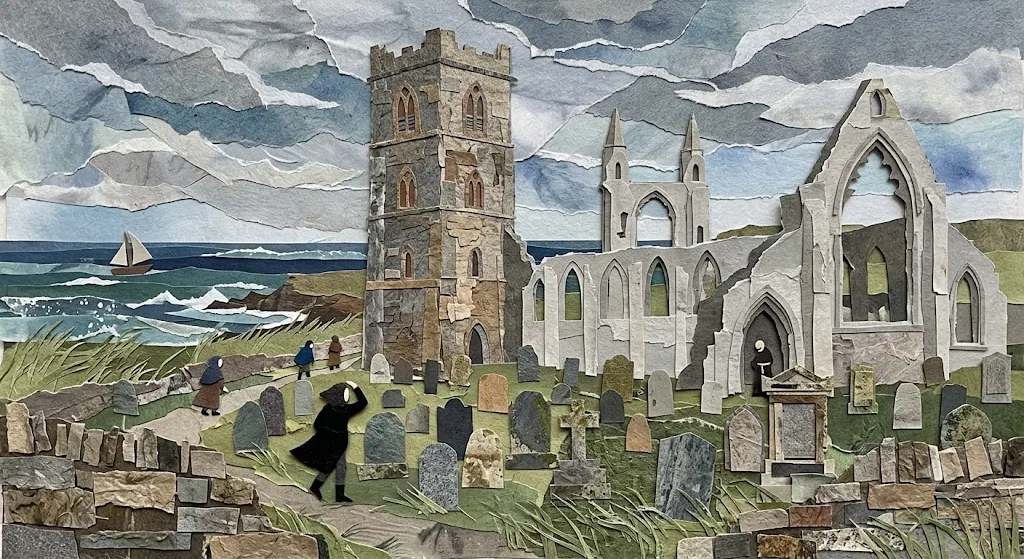
St Andrews is Fife’s haunted heart because its best-known ghost stories are tied to places a visitor can still stand inside or beside: the broken cathedral precinct, St Rule’s Tower, the so-called Haunted Tower in the old boundary wall, and the prison spaces of St Andrews Castle. The town’s apparitions are not presented here as proven supernatural events, but as durable traditions built around visible ruins, local memory and violent religious history. The White Lady belongs to the cathedral precinct and its sealed-tower legend; the monk or prior belongs to St Rule’s Tower and the older pilgrim landscape; the castle stories belong to dungeons, execution, assassination and the 1546–47 siege that helped make St Andrews a key site in Scotland’s Reformation memory. Historic Environment Scotland describes the cathedral as the remains of what was once Scotland’s largest church, while the castle is identified as a bishop’s palace, fortress and state prison caught in the struggle between Catholic and Protestant power.[Historic Environment Scotland]historicenvironment.scotHistoric Environment Scotland St Andrews Cathedral | Historic ScotlandHistoric Environment Scotland St Andrews Cathedral | Historic Scotland
The White Lady of the Cathedral
The most famous St Andrews haunting is the White Lady of the cathedral ruins. In modern visitor summaries she is usually described as a woman in white, sometimes wearing white gloves, gliding through the grounds before vanishing into the Haunted Tower. VisitScotland gives the compact tourist version: for about 200 years people have reported sightings of her at St Andrews Cathedral, while legend adds that stonemasons repairing the tower broke into a sealed chamber and found coffins inside.[VisitScotland]visitscotland.comOpen source on visitscotland.com.
The story matters because it joins three things that make a strong local haunting: a repeated apparition, a named structure, and a physical discovery narrative. The “Haunted Tower” is not just an atmospheric nickname invented for ghost walks. Canmore, now presented through Historic Environment Scotland’s Trove portal, records Tower No. 2 in the St Andrews Cathedral precinct wall as being known as the “Haunted Tower”. The same record places it within the cathedral boundary wall, a monastic enclosure probably present from at least the 14th century and substantially rebuilt in the 16th century, with a series of wall towers surviving into later records.[Canmore]canmore.org.ukOpen source on canmore.org.uk.
The strongest literary preservation of the White Lady tradition comes from W. T. Linskill’s St Andrews Ghost Stories, published in its fourth edition in 1921 by J. & G. Innes at the St Andrews Citizen Office. Linskill was not a detached antiquarian footnote: the University of St Andrews Special Collections blog identifies him as a town councillor, Dean of Guild, president of the St Andrews Antiquarian Society and “ghost hunter”, while also noting his own admission that he had never had the “good fortune” to see a ghost himself.[Wikisource]en.wikisource.orgSt. Andrews Ghost StoriesSt. Andrews Ghost Stories
In Linskill’s White Lady chapter, the witness-narrative pattern is already familiar. A figure in a long white dress passes near the cathedral and disappears by the square tower known as the Haunted Tower. In a second sighting, the narrator says both he and his sister saw the silent figure, with long dark hair and an object like a rosary, cross or locket. The same passage then connects the apparition with the sealed-chamber story: masons repairing the tower allegedly opened a space and found a young woman dressed in white lying in a coffin.[Wikisource]en.wikisource.orgSt. Andrews Ghost Stories/The Beautiful White Lady of the Haunted TowerSt. Andrews Ghost Stories/The Beautiful White Lady of the Haunted Tower
That does not make the story historically secure. It makes it unusually well rooted as folklore. The White Lady has the shape of a classic “woman in white” apparition, but the St Andrews version is more local than generic because the sightings repeatedly lead back to a particular wall tower, a burial chamber motif and the cathedral precinct’s ruined religious landscape. The story also carries a mild tension between evidence and embellishment. The tower is documented as a named historic feature; the cathedral wall and towers are recorded by heritage sources; Linskill and later writers preserve sighting traditions. The identity of the woman, however, shifts between romance, religious symbolism and local speculation.
For a reader walking the site, the useful point is not “Was she real?” but “Why did this story stick here?” The answer lies in the cathedral’s mixture of openness and enclosure. St Andrews Cathedral is now an open ruin and graveyard, visible from land and sea, but the Haunted Tower story imagines hidden chambers, sealed coffins and a body glimpsed only by accident. That contrast gives the legend its power: the town’s most public ruin is said to contain a private, half-revealed mystery.
St Rule’s Tower, Pilgrims and Place Memory
St Rule’s Tower gives St Andrews its older haunted vertical line. Historic Environment Scotland describes the 33-metre tower as part of the earlier religious landscape: a Celtic monastery existed on the site from the 8th century, a church dedicated to St Rule was probably built around 1130, and the tower may have served as a beacon for pilgrims heading to the shrine of St Andrew.[Historic Environment Scotland]historicenvironment.scotHistoric Environment Scotland St Andrews Cathedral | Historic ScotlandHistoric Environment Scotland St Andrews Cathedral | Historic Scotland
That pilgrim function matters for the ghost stories. Towers that guide the living are easily imagined as places where the past still looks out. St Rule’s Tower is not merely a viewpoint; in the St Andrews imagination it is a survivor from before the great cathedral, a structure that outlasted medieval pilgrimage, Reformation destruction and centuries of visitors climbing for the view. Its haunting is therefore less about a single scare than about continuity: a monk, prior or religious figure remains attached to the route, the stair, the height and the memory of worship.
Linskill preserves the St Rule’s Tower story through the figure of Prior Robert de Montrose. In his version, a “good Prior of St Andrews” is said to have climbed the tower at night to admire the view. A troublesome monk follows him, stabs him and throws him from the tower. Linskill’s own narrator immediately notes a variant, asking whether the murder took place on the dormitory stairs rather than the tower, which is a useful reminder that the tale was already unstable in location and detail.[Project Gutenberg]gutenberg.orgThe Project Gutenberg eBook of St Andrews Ghost Stories, by W. T. Linskill…
The apparition then replays the fatal movement. Linskill’s source says the prior had been seen peering from the top of the tower and sometimes falling from it, while another episode describes a moonlit figure appearing, leaping onto the parapet and dropping over. The legend is theatrical, but it is not random. It uses the tower’s height, night-time exposure and medieval religious setting to turn architecture into a memory machine: the ghost is not just present in the ruins; he repeats the action that explains why he belongs there.[Project Gutenberg]gutenberg.orgThe Project Gutenberg eBook of St Andrews Ghost Stories, by W. T. Linskill…
Modern summaries often soften this into the “friendly monk” of St Rule’s Tower. VisitScotland lists a friendly monk encountered on the tower stairs alongside the White Lady of the cathedral grounds.[VisitScotland]visitscotland.comOpen source on visitscotland.com. That shift is revealing. Linskill’s early 20th-century version is more Gothic and violent; the public-facing visitor version is more approachable, a ghostly presence attached to a stair rather than a murder tableau. Both versions serve the same purpose: they make the cathedral precinct feel inhabited by its religious past.
The monk also shows how St Andrews’ haunted reputation differs from some castle-only ghost traditions elsewhere in Fife. This is not just a laird’s house with a family spectre. St Andrews is haunted, in the stories, by the infrastructure of medieval Christianity: shrine, tower, priory wall, cathedral close, processional route and burial ground. The ghosts are part of the town’s identity as Scotland’s former ecclesiastical centre, not just decorative figures added to a ruin.
Castle Dungeons, Beaton and Ghost Walks
St Andrews Castle gives the town’s haunted landscape its harshest historical core. Historic Environment Scotland describes it as a bishop’s palace, fortress and state prison during a 450-year history, and specifically links it to the Protestant Reformation struggle. Its surviving visitor features include the bottle dungeon, the mine and countermine, and the remains of a castle scarred by political and religious violence.[Historic Environment Scotland]historicenvironment.scotHistoric Environment Scotland St Andrews Castle | Historic ScotlandHistoric Environment Scotland St Andrews Castle | Historic Scotland
The bottle dungeon is central to the prison stories because it is a real, still-interpretable space. HES describes it as a dank and airless hole, one of medieval Britain’s most infamous castle prisons. The official wording is careful about George Wishart, saying the Protestant preacher “may have been imprisoned” there, while Cardinal David Beaton’s murdered body was “certainly kept” in it. That distinction matters. Some retellings confidently put Wishart in the dungeon, but the strongest heritage summary keeps the imprisonment claim cautious and the Beaton corpse claim firm.[Historic Environment Scotland]historicenvironment.scotHistoric Environment Scotland St Andrews Castle | Historic ScotlandHistoric Environment Scotland St Andrews Castle | Historic Scotland
The historical sequence is grim enough without invention. HES’s account of Cardinal Beaton’s murder says Beaton had George Wishart burned at the stake for heresy on 1 March 1546, after which a group of Fife lairds entered St Andrews Castle on 29 May 1546, killed the cardinal, displayed his body from the castle walls and threw it into the bottle dungeon. John Knox’s later account says the corpse was kept there covered in salt to prevent the smell.[Historic Environment Scotland Blog]blog.historicenvironment.scotHistoric Environment Scotland Blog The macabre murder of Cardinal BeatonHistoric Environment Scotland Blog The macabre murder of Cardinal Beaton
This is where St Andrews’ prison haunting becomes more than a dungeon cliché. The castle is not merely “spooky” because it has underground spaces. It is haunted in local tradition because the underground spaces are attached to a specific trauma: execution, revenge killing, desecrated remains and siege. HES notes that Beaton’s assassination sparked the siege of 1546–47, during which the attackers and defenders dug the mine and countermine into the rock near the battlements. Its castle guide describes those mine works as remarkable; an HES publication also calls the bottle dungeon, mine and countermine among the castle’s notable surviving elements, with the siege works among the most important medieval examples surviving in Europe.[Historic Environment Scotland]historicenvironment.scotHistoric Environment Scotland St Andrews Castle | Historic ScotlandHistoric Environment Scotland St Andrews Castle | Historic Scotland
Linskill’s early 20th-century ghost map explicitly includes the castle. In the University of St Andrews blog’s quotation from his St Andrews tour material, he lists “spectres wailing in the Castle dungeons” and “murdered Cardinal Beaton stalking around the Castle” among the town’s crowded supernatural company.[university-collections.wp.st-andrews.ac.uk]university-collections.wp.st-andrews.ac.ukOpen source on st-andrews.ac.uk. These are not presented as courtroom-level testimony. They are evidence of what the town had learned to dramatise: the castle’s violence was not sealed in history books but retold as sound, movement and presence.
Modern ghost walks continue that process. VisitScotland describes St Andrews Ghost Tours as a way to learn the town’s history through haunted locations, including the cathedral and university, and says the tours are based on extensive research rather than theatrical jump scares.[VisitScotland]visitscotland.comOpen source on visitscotland.com. Local tourism listings similarly route visitors through places such as the Haunted Tower and the old ecclesiastical quarter.[Elderburn Lodges]elderburnlodges.co.ukOpen source on elderburnlodges.co.uk. For this page’s scope, the important point is not whether every tour claim can be independently verified. It is that public storytelling still follows the same geography Linskill used: cathedral, tower, castle, dungeons and old streets.

How Strong Is the Evidence?
The St Andrews material is strongest as evidence of a long-lived haunted tradition, not as proof of apparitions. The physical places are well documented: St Andrews Cathedral was Scotland’s largest church, St Rule’s Tower is a 33-metre landmark associated with pilgrimage, the cathedral precinct wall contains a tower known in heritage records as the Haunted Tower, and St Andrews Castle contains prison and siege features tied to the Reformation crisis.[historicenvironment.scot]historicenvironment.scotHistoric Environment Scotland St Andrews Cathedral | Historic ScotlandHistoric Environment Scotland St Andrews Cathedral | Historic Scotland
The historical violence is also secure in broad outline. Beaton’s role in Wishart’s death, Beaton’s murder in the castle, the treatment of his body and the siege that followed are all treated by Historic Environment Scotland as central to the castle story.[Historic Environment Scotland Blog]blog.historicenvironment.scotHistoric Environment Scotland Blog The macabre murder of Cardinal BeatonHistoric Environment Scotland Blog The macabre murder of Cardinal Beaton That gives the prison legends a firmer historical anchor than many vague “restless prisoner” tales.
The apparition evidence is different. Linskill’s book is valuable because it shows how the stories were being told in St Andrews by the early 20th century, and because Linskill was embedded in local civic and antiquarian life. But his tone is playful, literary and self-aware. He collects, dramatises and sometimes frames stories as told-at-second-hand rather than verified reports. The University of St Andrews blog’s reminder that Linskill himself said he had not seen a ghost is especially useful: it places him as a collector and performer of local supernatural tradition, not as a witness who settled the matter.[university-collections.wp.st-andrews.ac.uk]university-collections.wp.st-andrews.ac.ukOpen source on st-andrews.ac.uk.
The White Lady’s sealed-coffin episode is the most intriguing but also the most difficult to test from popular retellings alone. The recurring claim is clear: repairs to the Haunted Tower exposed a chamber with coffins, including a woman in white. Yet the details vary, and many modern summaries repeat one another. A careful reading should therefore treat it as a powerful local legend attached to a documented tower, not as an established archaeological report unless supported by a specific excavation or conservation record.
The monk of St Rule’s Tower is even more openly folkloric. Its value lies in what it says about place memory: a tower associated with pilgrimage becomes a stage for a religious death; a stair or summit becomes the route by which the past returns; a ruined ecclesiastical capital populates itself with monks, priors and spectral worship. The story’s variations are not a weakness for folklore study. They are the mark of an oral and literary tradition adjusting itself to different audiences.
Why St Andrews Became Fife’s Haunted Heart
St Andrews became Fife’s haunted heart because its legends are unusually easy to map. Many haunted places depend on vanished rooms, private houses or vague lanes. St Andrews offers a compact public route: the cathedral grounds, St Rule’s Tower, the Haunted Tower in the precinct wall, the Pends and the castle above the sea. A visitor can move from pilgrimage to burial ground to prison in a short walk.
The town also carries two kinds of sacred memory at once. The cathedral preserves the grandeur of medieval devotion: relics, pilgrims, bishops, processions and Scotland’s largest church. The castle preserves the rupture of that world: Wishart’s execution, Beaton’s assassination, Knox’s presence in the besieged garrison, bombardment and the collapse of ecclesiastical power. That is why the haunted stories feel denser here than in a single-house haunting. They dramatise a whole religious landscape before and after breaking point.
The White Lady gives St Andrews its emblem: beautiful, elusive, bound to a tower and a coffin story. St Rule’s monk gives it depth: the idea that the older devotional town still moves on the stairs and heights of its surviving tower. The castle dungeons give it moral weight: not just a shiver in a ruin, but a memory of imprisonment, execution, revenge and bodies treated as political objects.
For Fife’s wider haunted geography, St Andrews is therefore the natural anchor. Falkland, Culross, Kellie, Wemyss, Balgonie and other Fife sites have their own ghost traditions, but St Andrews concentrates the county’s most recognisable haunted ingredients in one place: medieval ruins, church power, sea wind, prison architecture, Reformation violence, local antiquarian storytelling and modern ghost walks. Its ghosts are best understood as stories that keep asking visitors to read the stones twice — once as history, and once as memory that refuses to stay entirely still.
Amazon book picks
Further Reading
Books and field guides related to Why Is St Andrews Fife's Haunted Heart?. Use these as the next step if you want deeper reading beyond the article.


The Lore of Scotland: A Guide to Scottish Legends
Frames St Andrews ghost traditions within Scottish legend.
The world's most haunted places
Places St Andrews among famous haunted heritage sites.
eBay marketplace picks
Marketplace Samples
Live-tested eBay searches with available results related to this page.


Endnotes
1.
Source: visitscotland.com
Link:https://www.visitscotland.com/things-to-do/attractions/haunted-sites
2.
Source: en.wikisource.org
Title: St. Andrews Ghost Stories
Link:https://en.wikisource.org/wiki/St._Andrews_Ghost_Stories
3.
Source: university-collections.wp.st-andrews.ac.uk
Link:https://university-collections.wp.st-andrews.ac.uk/2013/10/31/special-collections-ghost-tour/
4.
Source: en.wikisource.org
Title: St. Andrews Ghost Stories/The Beautiful White Lady of the Haunted Tower
Link:https://en.wikisource.org/wiki/St._Andrews_Ghost_Stories/The_Beautiful_White_Lady_of_the_Haunted_Tower
5.
Source: gutenberg.org
Title: Project Gutenberg
Link:https://www.gutenberg.org/files/56411/56411-h/56411-h.htm
Source snippet
The Project Gutenberg eBook of St Andrews Ghost Stories, by W. T. Linskill...
6.
Source: visitscotland.com
Link:https://www.visitscotland.com/nl-nl/places-to-go/st-andrews/things-to-do
7.
Source: gutenberg.org
Link:https://www.gutenberg.org/ebooks/56411
8.
Source: gutenberg.org
Link:https://www.gutenberg.org/ebooks/author/48826
9.
Source: gutenberg.org
Link:https://www.gutenberg.org/ebooks/subject/2716?sort_order=release_date
10.
Source: en.wikisource.org
Title: Concerning More Appearances of the White Lady
Link:https://en.wikisource.org/wiki/St._Andrews_Ghost_Stories/Concerning_More_Appearances_of_the_White_Lady
11.
Source: trove.scot
Link:https://www.trove.scot/place/94410
12.
Source: wishart.org
Title: george wishart
Link:https://www.wishart.org/Legacy/george_wishart.html
13.
Source: historicenvironment.scot
Title: Historic Environment Scotland St Andrews Cathedral | Historic Scotland
Link:https://www.historicenvironment.scot/visit/all/st-andrews-cathedral/
14.
Source: historicenvironment.scot
Title: Historic Environment Scotland St Andrews Castle | Historic Scotland
Link:https://www.historicenvironment.scot/visit/all/st-andrews-castle/
15.
Source: canmore.org.uk
Link:https://canmore.org.uk/site/94500/st-andrews-cathedral-precinct-wall
16.
Source: blog.historicenvironment.scot
Title: Historic Environment Scotland Blog The macabre murder of Cardinal Beaton
Link:https://blog.historicenvironment.scot/2020/05/the-macabre-murder-of-cardinal-beaton/
17.
Source: elderburnlodges.co.uk
Link:https://www.elderburnlodges.co.uk/things-to-do/tours-fife/st-andrews-ghost-tours/
18.
Source: historicenvironment.scot
Title: history and stories
Link:https://www.historicenvironment.scot/visit/all/st-andrews-castle/history-and-stories/
19.
Source: historicenvironment.scot
Link:https://www.historicenvironment.scot/visit/all/st-andrews-cathedral/history-and-stories/
20.
Source: blog.historicenvironment.scot
Title: saints that made scotland
Link:https://blog.historicenvironment.scot/2018/09/saints-that-made-scotland/
21.
Source: spookyscotland.net
Title: cardinal beaton
Link:https://spookyscotland.net/cardinal-beaton/
22.
Source: canmore.org.uk
Link:https://www.canmore.org.uk/site/93055
23.
Source: Wikipedia
Title: St Andrews Castle
Link:https://en.wikipedia.org/wiki/St_Andrews_Castle
24.
Source: facebook.com
Link:https://www.facebook.com/HauntedScotlandInvestigates/photos/st-regulus-tower-the-ghostly-monkst-rules-tower-is-located-within-the-cathedral-/3340454726072519/
25.
Source: books.google.com
Title: St Andrews Ghost Stories
Link:https://books.google.com/books/about/St_Andrews_Ghost_Stories.html?id=ZUDdzgEACAAJ
26.
Source: cdnsm5-ss6.sharpschool.com
Title: st andrews castle
Link:https://cdnsm5-ss6.sharpschool.com/UserFiles/Servers/Server_65154/File/Migration/st_andrews-castle.pdf
27.
Source: openvirtualworlds.org
Title: st andrews castle
Link:https://openvirtualworlds.org/omeka/exhibits/show/a-virtual-exhibition-of-mediev/st-andrews-castle
Additional References
28.
Source: youtube.com
Link:https://www.youtube.com/watch?v=5LEFnRoLhmo
Source snippet
THE MEDIEVAL CITY WHERE GOLF WAS BORN: St Andrews, Fife, Scotland...
29.
Source: youtube.com
Title: Bottle Dungeons and Siege Mines at St Andrews Castle | Dig It! TV
Link:https://www.youtube.com/watch?v=pDK94Zfgf4g
Source snippet
St Andrews Ghost Stories by William Thomas LINSKILL read by David Wales | Full Audio Book...
30.
Source: youtube.com
Title: St Andrews Castle Tour & History Timeline
Link:https://www.youtube.com/watch?v=H5ELkG7tnYM
Source snippet
The Strange Events at Kirkcaldy and St Andrews in 1958 / Scotland's History...
31.
Source: youtube.com
Title: THE MEDIEVAL CITY WHERE GOLF WAS BORN: St Andrews, Fife, Scotland
Link:https://www.youtube.com/watch?v=hRKfXKJq3RQ
Source snippet
St Andrews Castle Tour & History Timeline - The Kingdom of Fife, Scotland...
32.
Source: facebook.com
Link:https://www.facebook.com/groups/352255064804308/posts/23918729697730180/
33.
Source: standrewsghosttours.com
Link:https://standrewsghosttours.com/ghosts/
34.
Source: great-castles.com
Link:https://great-castles.com/standrewsghost.html
35.
Source: vehmasters.com
Link:https://vehmasters.com/pit-prisons-and-the-bottle-dungeon
36.
Source: electricscotland.com
Link:https://electricscotland.com/hiStory/wars/081SiegeOfStAndrewsCastle1546.pdf
37.
Source: curious-sta.org
Link:https://www.curious-sta.org/st-andrews-castle/
Topic Tree