Within Haunted Sussex
Was Cowdray Ruined by Curse or Coincidence?
Cowdray's ruined Tudor house gives Sussex a classic curse legend shaped by monastic loss, family decline, fire and drowning.
On this page
- The Tudor house and the 1793 fire
- The prophecy of fire, water and family decline
- How ruins make folklore feel fated
Page outline Jump by section
Introduction
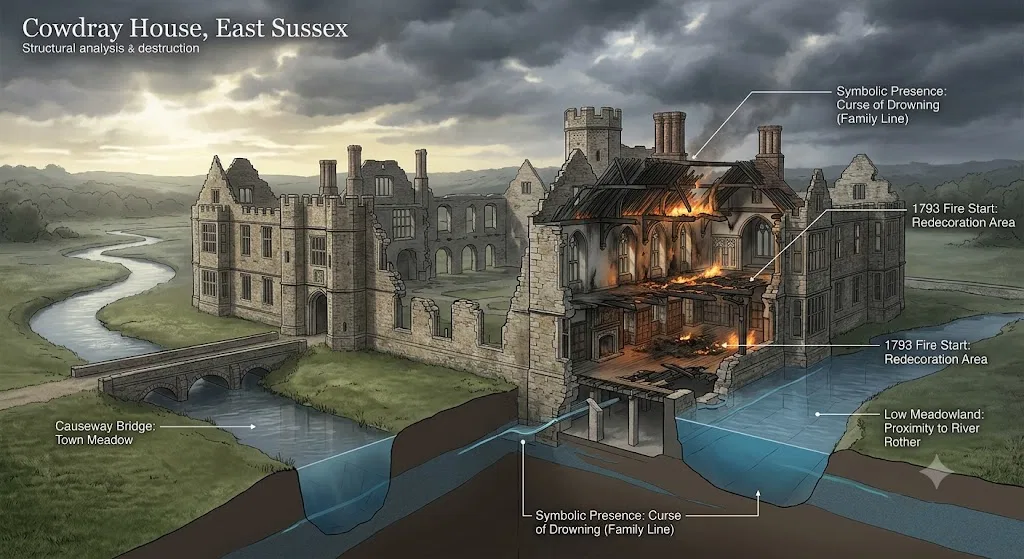
Cowdray’s “curse of fire and water” is one of Sussex’s most memorable ruin legends because the hard facts are dramatic enough without adding a ghost. Cowdray House, beside the River Rother near Midhurst in West Sussex, was one of England’s great Tudor houses; in September 1793 it was gutted by fire while being prepared for the marriage of George Samuel Browne, 8th Viscount Montague. Within weeks, the young Viscount drowned on the Rhine. Later tellings linked both disasters to a supposed curse placed on the Browne family after the Dissolution of the Monasteries: their line would end by fire and water. The story matters less as proof of supernatural punishment than as a classic Sussex example of how documented disaster, Catholic memory, monastic loss and romantic ruin-making can fuse into folklore.[cowdray.co.uk]cowdray.co.ukthe history of cowdray ruinswdray EstateHistoryIn September 1793, whilst undergoing repairs and refurbishments for the impending marriage of the 8th Viscount Monta…
The Tudor House and the 1793 Fire
Cowdray House stands just east of Midhurst, in the historic county of Sussex, today within West Sussex and the South Downs National Park. Historic England describes the wider registered site as lying beside the A272 and the River Rother, with the ruins approached from Midhurst by a raised causeway over Town Meadow. That approach matters to the legend: Cowdray is not a hidden ruin in woodland, but a grand shell set in wet meadowland, with water physically present in the visitor’s route and in the story’s symbolism.[Historic England]historicengland.org.ukHistoric England Cowdray House, EasebourneHistoric EnglandCowdray House, Easebourne - 1001210 | Historic England…
The house was begun around 1520 and completed by 1542, forming a courtyard mansion with a major gatehouse, great hall, chapel and Tudor kitchen tower. Historic England lists the ruins as Grade I and also recognises the site as a scheduled monument, underlining that Cowdray’s importance is architectural and historical before it is folkloric. The north and south ranges were destroyed, but the surviving walls still give the visitor enough scale to imagine the loss.[Historic England]historicengland.org.ukHistoric England The Ruins of Cowdray House, EasebourneHistoric England The Ruins of Cowdray House, Easebourne
The fire itself is not a vague legend. Cowdray Estate’s own history says that in September 1793, while the house was undergoing repairs and refurbishment for the impending marriage of the 8th Viscount Montague, a devastating fire destroyed most of the property; the Kitchen Tower is the main intact survivor. Historic England gives the date as 25 September 1793 and says the fire reduced Cowdray House to its present ruined state.[Cowdray Estate]cowdray.co.ukthe history of cowdray ruinswdray EstateHistoryIn September 1793, whilst undergoing repairs and refurbishments for the impending marriage of the 8th Viscount Monta…
The Novium Museum’s account gives the most story-shaped version of the practical cause: workmen kept a fire burning in a workshop at one end of the North Gallery while redecoration was under way for the Viscount’s return and marriage. This makes the later curse tradition feel especially cruel. The house was not destroyed in war, rebellion or lightning-strike spectacle, but during preparations for continuity: a wedding, an inheritance and a future that never arrived.[The Novium Museum]thenovium.orgThe Novium Museum Cowdray HouseThe Novium MuseumCowdray House - The Novium Museum…

The Prophecy of Fire, Water and Family Decline
The curse is usually attached to the Browne family’s gain from the Dissolution of the Monasteries. After Henry VIII’s break with Rome and the suppression of religious houses, monastic property passed into secular hands. The Novium Museum summarises the local tradition by saying that after the Dissolution, Easebourne Priory went to Sir William Fitzwilliam and Battle Abbey to his half-brother Anthony Browne; legend then has a dispossessed monk calling down a curse of Heaven “in fire and water” on the family connected with the abbey property.[The Novium Museum]thenovium.orgThe Novium Museum Cowdray HouseThe Novium MuseumCowdray House - The Novium Museum…
There is, however, not just one stable version. A scholarly discussion by Alison Shell notes that the legend is preserved as a “sacrilege narrative”: a story in which later misfortunes are read as punishment for profiting from former church lands. In that account, the curse is associated not only with Battle Abbey but also with Easebourne Priory, and with a sub-prioress dispossessed when the religious community was removed. This variation is important. Folklore often keeps the moral pattern more firmly than the exact speaker: monk, nun, priory, abbey, curse, fire, water, extinction.[UCL Discovery]discovery.ucl.ac.ukUCL Discovery
The “water” part of the story came with startling neatness. George Samuel Browne, the 8th Viscount Montague, drowned in 1793 while attempting to shoot the falls of the Rhine at Laufenburg in a rowing boat. The Novium Museum adds the grim detail that he never learned of the fire that had gutted his house. Historic England records the same broad sequence: the house burned in 1793, and the 8th Viscount died shortly afterwards that year.[The Novium Museum]thenovium.orgThe Novium Museum Cowdray HouseThe Novium MuseumCowdray House - The Novium Museum…
The line did not simply vanish in a single instant, which is one reason to handle the curse carefully. After the 8th Viscount’s death, the title passed to a fourth cousin, Mark Anthony Browne, and was extinguished when he died childless in 1797. Cowdray itself passed through the 8th Viscount’s sister, Elizabeth, who married William Stephen Poyntz; they did not rebuild the old house but moved to a remodelled keeper’s lodge. The curse story becomes powerful because it compresses that messier legal and family history into a memorable pattern: fire destroys the house, water takes the heir, the male title ends.[Historic England]historicengland.org.ukHistoric England Cowdray House, EasebourneHistoric EnglandCowdray House, Easebourne - 1001210 | Historic England…
A further drowning deepened the legend. Shell’s discussion of Julia Roundell’s Victorian history of Cowdray notes the later boating accident of 1815, in which William Montague Browne and Courtenay John Browne, sons of Elizabeth Mary Browne, also drowned. By then the curse was not just a tidy explanation for 1793; it had become a family memory through which later grief could be interpreted.[UCL Discovery]discovery.ucl.ac.ukUCL Discovery
Why the Curse Feels So Persuasive
Cowdray’s curse has lasted because it has the structure of a perfect local legend. It links a visible ruin, a documented disaster, a named aristocratic family, a morally charged Tudor event and a pair of elemental images that are easy to remember. “Fire and water” is almost too exact: the house burned, the heir drowned, and the family’s dynastic future failed.
Its setting also helps. The ruins stand in the Rother valley, approached across low meadowland and close to the river. Historic England’s description of the site emphasises the causeway, the river bridge and the open valley floor. For a visitor, the story is not abstract. Water is part of the landscape, while the roofless walls are the visible aftermath of fire.[Historic England]historicengland.org.ukHistoric England Cowdray House, EasebourneHistoric EnglandCowdray House, Easebourne - 1001210 | Historic England…
The legend also speaks to a deeper Sussex memory of the Reformation. The Brownes were prominent Catholics in post-Reformation England, yet their wealth and status were tied to lands that had come from suppressed religious houses. Shell points out the tension: a Catholic family could preserve religious identity while also retaining property that earlier Catholic communities had lost. The curse gave that contradiction a supernatural grammar.[UCL Discovery]discovery.ucl.ac.ukUCL Discovery
That does not mean the curse should be treated as a factual cause. It works more convincingly as retrospective meaning-making. The disasters happened; the supernatural explanation was a way of arranging them into a moral story. Shell notes that sacrilege narratives could be activated centuries after the original transfer of church property, especially when bloodlines failed or misfortunes clustered. Cowdray fits that pattern closely.[UCL Discovery]discovery.ucl.ac.ukUCL Discovery
Curse or Coincidence?
The cautious answer is: coincidence made the legend possible, and folklore made the coincidence memorable. There is good evidence for the central historical events: Cowdray House was a major Tudor mansion; it was almost completely destroyed by fire in 1793; the 8th Viscount drowned shortly afterwards; and the Montague title soon became extinct in the male line. Those facts do not prove a curse, but they explain why the story became hard to resist.[cowdray.co.uk]cowdray.co.ukthe history of cowdray ruinswdray EstateHistoryIn September 1793, whilst undergoing repairs and refurbishments for the impending marriage of the 8th Viscount Monta…
There are several reasons to be sceptical of a literal curse:
- The timing is retrospective. The supposed curse was linked backwards to the Dissolution once later disasters seemed to fit it.
- The origin varies. Some tellings blame a monk from Battle Abbey; others connect it to the dispossessed religious women of Easebourne Priory.
- The family had long periods of success. The disasters came more than two centuries after the Tudor grants of former church property.
- The fire had a practical cause. Accounts point to refurbishment work and a workshop fire, not to inexplicable combustion.
- The water deaths were real tragedies, but not evidence of supernatural agency. They became meaningful because the story already supplied the right symbolic frame.
A particularly useful sceptical note comes from the 19th-century local historical tradition discussed by Shell: one writer dryly observed that the curse only seemed to take effect after roughly two centuries of prosperity. That does not kill the legend, but it changes how it should be read. It is less a reliable prophecy than a moral pattern imposed on a run of disasters.[UCL Discovery]discovery.ucl.ac.ukUCL Discovery
How Ruins Make Folklore Feel Fated
Cowdray is a lesson in how ruins can make a story feel inevitable. A written curse is easy to doubt; a burned-out Tudor shell is harder to ignore. The visitor sees the ruined gatehouse, the roofless ranges and the surviving Kitchen Tower, and the mind naturally asks what catastrophe left them that way. Once the answer includes a drowned heir and a failed line, the curse becomes a powerful interpretive shortcut.[Historic England]historicengland.org.ukHistoric England Cowdray House, EasebourneHistoric EnglandCowdray House, Easebourne - 1001210 | Historic England…
The afterlife of the site strengthened that feeling. Cowdray was not rebuilt. Elizabeth and William Poyntz moved instead to Cowdray Lodge, and the old house remained a ruin. Historic England notes later phases of repair and consolidation, including work in the early 20th century and again by English Heritage in the late 20th century, but those efforts preserved the ruin rather than restoring the mansion as a lived-in house.[Historic England]historicengland.org.ukHistoric England Cowdray House, EasebourneHistoric EnglandCowdray House, Easebourne - 1001210 | Historic England…
That choice matters for haunted Sussex. A rebuilt Cowdray would have become a country house with a tragic fire in its past. The preserved ruin became something more atmospheric: a place where visitors can stand inside the consequence. It is easy to see why the curse survives in heritage writing, local history and ghostly county storytelling, even when careful sources frame it as legend rather than fact.[sussexexclusive.com]sussexexclusive.comOpen source on sussexexclusive.com.
Cowdray’s curse is therefore not best understood as a straightforward haunting with a recurring apparition. Its ghostliness is structural. The “presence” is the pattern itself: monastic dispossession, aristocratic splendour, fire, drowning, extinction and a ruin left open to the weather. In Sussex’s haunted geography, Cowdray belongs beside abbeys, castles and battlefields not because it proves the supernatural, but because it shows how a place can become haunted by interpretation.

What to Remember at Cowdray
The most honest way to tell Cowdray’s curse is to keep both halves in view. Historically, Cowdray House was a great Tudor residence, associated with royal visits, Catholic aristocracy and the reshaping of Sussex after the Dissolution. In 1793 it burned during preparations for a wedding, and the young heir drowned abroad before the family future could resume. Folklorically, those events were drawn into an older moral fear: that property taken from religious houses carried a spiritual debt.[The Novium Museum]thenovium.orgThe Novium Museum Cowdray HouseThe Novium MuseumCowdray House - The Novium Museum…
That is why the curse remains more compelling than many country-house legends. It does not depend on a single dubious sighting or a theatrical apparition. It is anchored in an actual ruin, a documented fire, named deaths and a religious conflict that shaped Sussex for centuries. The supernatural claim remains unproven, but the story’s emotional logic is clear: Cowdray looks like a place where history itself passed judgement, even if coincidence and human storytelling did most of the work.
Amazon book picks
Further Reading
Books and field guides related to Was Cowdray Ruined by Curse or Coincidence?. Use these as the next step if you want deeper reading beyond the article.

The folklore of Sussex
First published 1973. Subjects: Folklore, Social life and customs, Sussex, England, Folklore, great britain.
The lore of the land
First published 2005. Subjects: Tales, Legends, British Mythology, Legends, great britain.
eBay marketplace picks
Marketplace Samples
Live-tested eBay searches with available results related to this page.

Endnotes
1.
Source: discovery.ucl.ac.uk
Title: UCL Discovery
Link:https://discovery.ucl.ac.uk/10080666/3/Shell_11.Shell.pdf
2.
Source: midhurst.org
Title: The story of the Cowdray Ruins
Link:https://www.midhurst.org/cowdray-ruins.shtml
3.
Source: cowdray.co.uk
Title: the history of cowdray ruins
Link:https://www.cowdray.co.uk/the-history-of-cowdray-ruins/
Source snippet
wdray EstateHistoryIn September 1793, whilst undergoing repairs and refurbishments for the impending marriage of the 8th Viscount Monta...
Published: September 1793
4.
Source: thenovium.org
Title: The Novium Museum Cowdray House
Link:https://www.thenovium.org/article/28835/Cowdray-House
Source snippet
The Novium MuseumCowdray House - The Novium Museum...
5.
Source: historicengland.org.uk
Title: Historic England Cowdray House, Easebourne
Link:https://historicengland.org.uk/listing/the-list/list-entry/1001210
Source snippet
Historic EnglandCowdray House, Easebourne - 1001210 | Historic England...
6.
Source: historicengland.org.uk
Title: Historic England The Ruins of Cowdray House, Easebourne
Link:https://historicengland.org.uk/listing/the-list/list-entry/1277176
7.
Source: historicengland.org.uk
Title: Historic England Cowdray Park, Easebourne
Link:https://historicengland.org.uk/listing/the-list/list-entry/1401451
8.
Source: sussexexclusive.com
Link:https://sussexexclusive.com/cowdray-heritage-ruins/
9.
Source: historicengland.org.uk
Link:https://historicengland.org.uk/listing/the-list/list-entry/1017500
10.
Source: Wikipedia
Title: Cowdray House
Link:https://en.wikipedia.org/wiki/Cowdray_House
11.
Source: philippagregory.com
Title: cowdray house
Link:https://www.philippagregory.com/news/cowdray-house
12.
Source: cowdray.co.uk
Title: wdray Ruins
Link:https://www.cowdray.co.uk/historic-cowdray/
13.
Source: britainexpress.com
Title: cowdray house
Link:https://www.britainexpress.com/counties/westsussex/houses/cowdray-house.htm
Additional References
14.
Source: youtube.com
Title: The Abandoned Tudor House That Was Destroyed By Fire! Cowdray ruins
Link:https://www.youtube.com/watch?v=6D8BEEQUoKw
Source snippet
Cowdray House, Castle and Ruins | West Sussex | EXPLORE WITH REBECCA...
15.
Source: youtube.com
Title: Cowdray Castle
Link:https://www.youtube.com/watch?v=swUWUTMudyQ
Source snippet
Cowdray House ruins history curse fire water Cowdray House and the Legendary Curse of Fire and Water The Tudor Travel Guide...
16.
Source: youtube.com
Title: True Scary Story
Link:https://www.youtube.com/watch?v=9W2Y7qMODe4
Source snippet
The Abandoned Tudor House That Was Destroyed By Fire! Cowdray ruins...
17.
Source: youtube.com
Title: Cowdray House and the Legendary Curse of Fire and Water
Link:https://www.youtube.com/watch?v=UpMF-Akeo1g
Source snippet
True Scary Story - Cowdray House Family Curse...
18.
Source: alamy.com
Link:https://www.alamy.com/cowdray-heritage-ruins-of-great-tudor-house-destroyed-by-fire-in-1793-set-on-cowdray-park-estate-midhurst-atmospheric-ruins-image372803354.html
19.
Source: facebook.com
Link:https://www.facebook.com/groups/143520235831162/posts/3165158810333941/
20.
Source: instagram.com
Link:https://www.instagram.com/reel/DRo2eU1CB5E/
21.
Source: elizregina.com
Link:https://elizregina.com/book-reviews/cowdray-the-history-of-a-great-english-house/
22.
Source: abebooks.com
Link:https://www.abebooks.com/signed-first-edition/Cowdray-history-Great-English-house-Letters/22566433293/bd
23.
Source: archive.org
Link:https://archive.org/stream/sussexarchaeolog54suss/sussexarchaeolog54suss_djvu.txt
Topic Tree