Within Renfrewshire Hauntings
Do Monks Still Haunt Paisley Abbey?
Paisley Abbey's monk stories turn real monastic history into one of Renfrewshire's most recognisable ghost traditions.
On this page
- The Abbey's medieval foundation
- Phantom monks in local tradition
- Drains, shadows, and sceptical readings
Page outline Jump by section
Introduction
Paisley Abbey’s monk haunting is one of Renfrewshire’s most natural ghost traditions: not because there is strong proof of a dated apparition, but because the setting almost writes the story for itself. A medieval abbey, founded in the 12th century, still stands at the heart of Paisley, with centuries of worship, burial, rebuilding, ruin, restoration and subterranean archaeology beneath its stones. Local haunting listings preserve the claim that phantom monks are still sometimes seen at Paisley Abbey, but the evidence is better read as folklore attached to a real monastic past than as a verified case file.[paranormaldatabase.com]paranormaldatabase.comOpen source on paranormaldatabase.com.
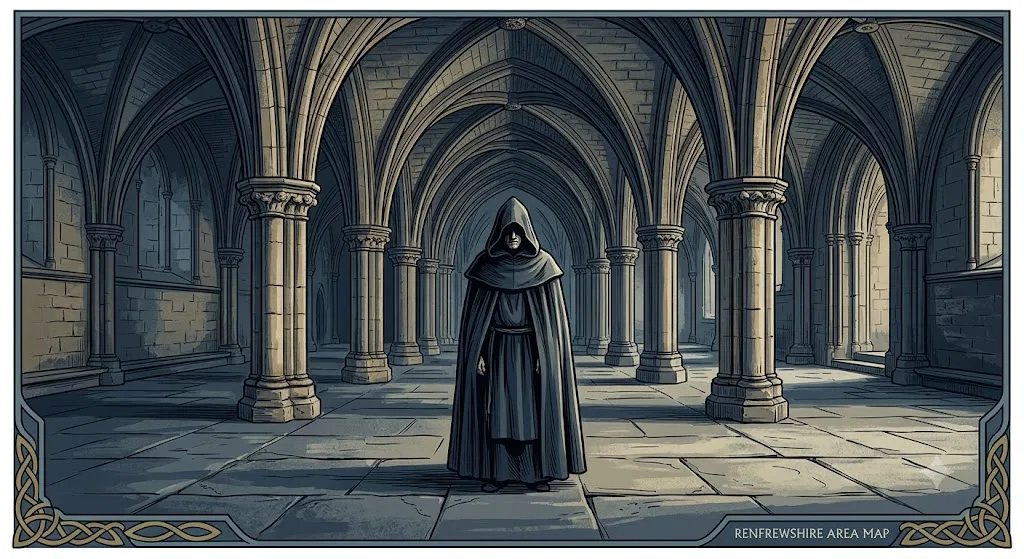
That does not make the story unimportant. For haunted Renfrewshire, Paisley Abbey supplies the county’s clearest medieval image: hooded figures moving through old stone, prayers lingering in a building that outlived the monastery that created it, and shadows around the Abbey Close turning ordinary history into something eerie.
Why Paisley Abbey attracts monk stories
The Abbey’s ghost tradition begins with a simple fact: Paisley really was a major medieval religious house. The Abbey’s own history says it was founded around 1163 by Walter FitzAlan, the first High Steward of Scotland, after a charter was signed for a Cluniac monastery on his Renfrewshire land.[paisleyabbey.org.uk]paisleyabbey.org.ukOpen source on paisleyabbey.org.uk. Paisley’s visitor heritage material adds the detail that thirteen monks came from Much Wenlock in Shropshire to establish the priory, and that it was raised to abbey status in 1245.[Paisley]paisley.isOpen source on paisley.is.
That matters for the haunting tradition because the “ghostly monk” is not a random figure imported into Paisley. It is the most obvious human shape the building’s history suggests. A hooded monk in a medieval church or close is instantly legible to visitors: he belongs to the place, even if the sighting itself is only a story. The Abbey’s surviving architecture strengthens that effect. Historic Environment Scotland records Paisley Abbey as a Category A listed building, founded in 1163, with surviving medieval fabric including late 12th-century and 13th-century elements as well as later 15th-century work and restoration.[Historic Environment Scotland]portal.historicenvironment.scotOpen source on historicenvironment.scot.
The result is a haunting tradition rooted less in one dramatic incident than in continuity. The Abbey is not a ruined shell hidden in a field; it is still a working church in the middle of town. Its official website presents it as a place where worship and hospitality have continued from its foundation to the present.[paisleyabbey.org.uk]paisleyabbey.org.ukOpen source on paisleyabbey.org.uk. That living continuity gives the monk stories a particular atmosphere. They are not simply tales of a dead monastery, but stories about an old sacred site still carrying older identities inside a modern town.
The Abbey’s medieval foundation
Paisley Abbey’s medieval story is unusually rich for a local haunting site. It is associated with the Stewarts, with the development of Paisley as a religious centre, and with the broader Cluniac tradition that linked Scottish monastic life to religious networks beyond Scotland. The town’s heritage site calls the Abbey the “Cradle of the Royal House of Stewart”, because Walter FitzAlan’s descendants became the Stewart or Stuart dynasty.[Paisley]paisley.isthe cradle of the stewartsthe cradle of the stewarts
For ghost-lore readers, this background does two things. First, it gives the Abbey depth. The alleged monks are not decorative phantoms placed in an empty Gothic setting; they represent a community that shaped the site for centuries. Secondly, it helps explain why Paisley Abbey became one of Renfrewshire’s strongest haunted-history anchors. Many counties have old kirks, castles and ruined towers, but Paisley has a medieval landmark that sits at the centre of civic memory as well as religious history.
The Abbey also carries scars of change. Historic Environment Scotland’s listing describes a building made up of medieval fabric, later Gothic work and restoration.[Historic Environment Scotland]portal.historicenvironment.scotOpen source on historicenvironment.scot. That layered appearance is important. Haunting traditions often gather where a place visibly contains different ages at once: a medieval doorway, restored stonework, old tombs, modern lighting, a surviving church where a monastery once stood. A visitor does not need to know the full architectural history to feel the contrast between the present congregation and the vanished monastic community.
The monk tradition is therefore best understood as a memory-shape. It gives Renfrewshire’s medieval past a human form. Instead of asking visitors to imagine charters, abbots and monastic administration, the story asks them to imagine a silent figure crossing the nave or standing in a shadowed corner.
Phantom monks in local tradition
The clearest modern record of the Paisley Abbey monk haunting is brief. The Paranormal Database lists “Monks” at Paisley Abbey under Renfrewshire, describing the type as a haunting manifestation and saying that locals report phantom monks still being seen at the Abbey.[Paranormal Database]paranormaldatabase.comOpen source on paranormaldatabase.com. That is useful evidence for the existence of the tradition, but it is not the same as strong evidence for an apparition. It does not, in the accessible listing, provide a named witness, a precise date, a signed testimony or an investigation record.
That distinction is central to reading the story honestly. The Paisley Abbey monks are locally recognisable folklore, not a well-documented psychical research case. They sit in the same family as many British abbey hauntings in which hooded figures, white monks, black monks or processions are reported at former monastic sites. English Heritage notes that supernatural stories are associated with many monastery sites, with some tales reaching back towards medieval religious storytelling and others shaped by later Gothic imagination around ruined religious buildings.[English Heritage]english-heritage.org.ukOpen source on english-heritage.org.uk.
Paisley’s version is quieter than the more elaborate abbey legends found elsewhere. There is no single famous named monk, no widely repeated murder story, and no strong public archive of repeated dated sightings. Its power lies in the fit between figure and place. The Abbey was founded by monks; it still preserves medieval stone; it stands in the historic county town’s memory; and the image of a hooded figure in such a setting feels plausible as folklore even when the evidential base is thin.
The wording “locals report” is also important. It suggests oral or community tradition rather than a polished tourist narrative. In haunted-place writing, that can be both a strength and a weakness. It is a strength because folklore often survives in repeated local remarks before it appears in formal print. It is a weakness because details can blur, duplicate, or be borrowed from the wider ghostly-monk tradition without anyone deliberately inventing them.
What makes the monk image so persistent?
The monk is one of the most durable figures in British haunting because he solves a storytelling problem. Many old religious buildings feel ancient, but a general “presence” is hard to describe. A hooded monk gives that atmosphere a body. He is recognisable at a glance, yet obscure enough to remain frightening: a hidden face, a lowered head, a dark robe, a slow movement through a church or close.
Paisley Abbey intensifies that image through its setting. It is not only a church; it is a landmark beside the White Cart Water, surrounded by the traces of an older precinct and linked to underground archaeology. Historic Environment Scotland records the Abbey drain as a large stone structure built to carry waste water through the monastic precinct, with the earliest portions probably dating from AD 1350–1400 and later work mostly from AD 1400–1500.[Historic Environment Scotland]portal.historicenvironment.scotOpen source on historicenvironment.scot. A medieval drain is not a ghost story in itself, but it adds a hidden, physical underworld to the Abbey’s atmosphere.
There is also a wider cultural pattern. A former rector discussing the Bolton Abbey monk story in a newspaper letter described the returning monk as an “old tradition” associated with places where monastic establishments had existed.[Secret Library]secretlibraryleeds.netSecret Library A Spectral Monk – The Bolton Abbey Ghost StorySecret Library A Spectral Monk – The Bolton Abbey Ghost Story That comment was about Yorkshire, not Renfrewshire, but it helps explain the folklore mechanism at Paisley. Once a building is known as a former monastery, the monk becomes the expected ghost.
This expectation can shape perception. In dim spaces, at dusk, or in a building where visitors already know the story, ordinary shadows and glimpsed movement can be interpreted through the monk tradition. That does not mean every witness is dishonest. It means the mind reaches for the most culturally available explanation, and at Paisley Abbey the most available figure is the medieval monk.
Drains, shadows, and sceptical readings
The Abbey’s underground drain is one of the best reasons to keep the haunting discussion grounded in real history. It shows that Paisley’s eerie reputation does not need invented tunnels or exaggerated legends to feel atmospheric. The actual archaeology is striking enough. GUARD Archaeology describes the Great Drain of Paisley Abbey as the best preserved monastic drain in Scotland, with evidence including medieval pottery, slate fragments inscribed with music and poetry, seeds and animal bones, all helping to illuminate the medieval monastic community and its European links.[guard-archaeology.co.uk]guard-archaeology.co.ukOpen source on guard-archaeology.co.uk.
The 2019 Big Dig was not a paranormal investigation; it was a public archaeology project. Its report says the work was undertaken by GUARD Archaeology with support from Renfrewshire Council, the National Lottery Heritage Fund, Historic Environment Scotland and Paisley Abbey, and that the excavation investigated the drain, the monastic precinct, post-medieval use of the area and future public access.[guard-archaeology.co.uk]guard-archaeology.co.ukPaisley Big Dig DSRPaisley Big Dig DSR It also drew nearly 8,000 visitors and involved local volunteers, which shows how strongly the hidden Abbey landscape continues to attract public curiosity.[guard-archaeology.co.uk]guard-archaeology.co.ukPaisley Big Dig DSRPaisley Big Dig DSR
For sceptical readers, the drain and the building’s layered architecture provide natural explanations for some haunting impressions:
- Dark fabric and visual ambiguity: Gothic stone, deep recesses, pillars, arches and changing light can make human-like shapes appear briefly convincing.
- Expectation: Visitors who have heard of phantom monks may be more likely to interpret a shadow, reflection or robed clergy member as something spectral.
- Underground atmosphere: The knowledge that a medieval drain runs beneath or near the Abbey gives the site a hidden dimension, even when the visitor is above ground.
- Folklore inheritance: Monk stories are common at former monastic sites, so Paisley’s version may preserve a general British abbey motif adapted to a genuine Renfrewshire landmark.
None of these explanations disproves every personal experience. They do, however, explain why the story can persist without strong dated evidence. The Abbey gives the imagination unusually good material to work with.
How old is the haunting account?
The medieval history is old; the clearly traceable ghost account is much harder to date. Paisley Abbey’s foundation belongs to the 12th century, its medieval drain largely to the 14th and 15th centuries, and its surviving fabric spans several phases.[paisleyabbey.org.uk]paisleyabbey.org.ukOpen source on paisleyabbey.org.uk. The monk haunting, by contrast, appears in modern paranormal and local-interest circulation as a tradition rather than as a medieval document or early modern court record.[Paranormal Database]paranormaldatabase.comOpen source on paranormaldatabase.com.
That gap should not be ignored. A story about medieval monks is not automatically a medieval story. Many “old” hauntings are old in setting but modern in their recorded form. Paisley Abbey’s monks may preserve long-standing local talk, but the accessible evidence does not prove a continuous line of reports from the Middle Ages to today.
There is, however, a meaningful connection to medieval ghost tradition more broadly. Medieval religious houses did preserve and transmit supernatural stories, and Byland Abbey in Yorkshire is famous for a group of ghost stories written down around 1400. Medievalist summaries of the Byland material describe a monk recording stories that reveal how people thought about the dead, absolution and troubled spirits.[Medieval Histories]medieval.euHistories Ghost Stories from Byland AbbeyHistories Ghost Stories from Byland Abbey This does not mean Paisley Abbey has an equivalent medieval ghost manuscript. It means that ghost storytelling and monastic culture were not strangers to one another.
Paisley’s monk tradition should therefore be dated cautiously: medieval in imagery and setting, modern or uncertain in its documented haunting record.

Why the story became locally famous
Paisley Abbey’s monk story became recognisable because it attaches a simple haunting image to the town’s most important medieval building. The Abbey is already promoted as a major visitor attraction and one of Paisley’s defining landmarks, with heritage material stressing its foundation in 1163, Cluniac origins, Stewart connections and striking architecture.[Paisley]paisley.isOpen source on paisley.is. A ghost story placed there does not need much explanation. Readers instantly understand why monks, rather than soldiers, witches or highwaymen, would be the expected apparitions.
The Abbey also benefits from being visible and visitable. Some haunted traditions fade because the site is lost, private, demolished or hard to identify. Paisley Abbey remains a public landmark, a working church and a focus of heritage activity. The National Churches Trust describes it as one of western Scotland’s greatest abbeys when founded and still impressive today.[National Churches Trust]nationalchurchestrust.orgpaisley abbey paisleypaisley abbey paisley
Its underground archaeology has refreshed that interest in modern times. The 2019 investigations into the Great Drain uncovered a well-preserved 14th-century stone archway marking where the drain once flowed towards the River Cart, helping solve a long-standing question about the tunnel’s end.[guard-archaeology.co.uk]guard-archaeology.co.ukOpen source on guard-archaeology.co.uk. Such discoveries make the Abbey feel less like a static monument and more like a place still giving up secrets. For a haunted-history audience, that matters: the more a site appears layered, hidden and only partly known, the easier it is for ghost tradition to cling to it.
What the Paisley Abbey monks mean for haunted Renfrewshire
The Paisley Abbey monk tradition is not Renfrewshire’s most evidentially detailed haunting, but it may be its most symbolically fitting one. It turns the county’s medieval religious history into a single memorable image: a hooded figure moving where monks once genuinely lived and worshipped. The story belongs to Paisley specifically, but it also helps define the haunted character of Renfrewshire as a whole — quieter than Edinburgh’s closes, less theatrical than Highland castles, but deeply tied to old buildings and local memory.
Its credibility depends on what question is being asked. As proof of ghosts, the evidence is weak: the public record is brief, undated and largely traditional. As folklore, it is strong: the place, the history, the architecture and the wider British pattern of ghostly monks all support why such a story would arise and endure.[paranormaldatabase.com]paranormaldatabase.comOpen source on paranormaldatabase.com.
That is the most honest way to stand inside the story. Paisley Abbey does not need confirmed apparitions to feel haunted. Its medieval foundation, royal associations, restored Gothic spaces, hidden drain and living worship all create a powerful sense of time compressed into one place. The phantom monks are best understood as the Abbey’s past made visible in local imagination: not proven spirits, but enduring shadows cast by one of Renfrewshire’s great medieval survivors.
Amazon book picks
Further Reading
Books and field guides related to Do Monks Still Haunt Paisley Abbey?. Use these as the next step if you want deeper reading beyond the article.
The Mammoth Book of Haunted House Stories
Examines haunted historic buildings and folklore.
The Monasteries of Scotland
Directly supports understanding Paisley Abbey's monastic past.
eBay marketplace picks
Marketplace Samples
Live-tested eBay searches with available results related to this page.
Endnotes
1.
Source: paisleyabbey.org.uk
Link:https://www.paisleyabbey.org.uk/history/
2.
Source: paisley.is
Link:https://paisley.is/visit/paisley-abbey/
3.
Source: paisleyabbey.org.uk
Link:https://www.paisleyabbey.org.uk/
4.
Source: paisley.is
Title: the cradle of the stewarts
Link:https://paisley.is/listing/the-cradle-of-the-stewarts/
5.
Source: guard-archaeology.co.uk
Link:https://www.guard-archaeology.co.uk/news/news15/PaisleyAbbeyNews.html
6.
Source: guard-archaeology.co.uk
Title: Paisley Big Dig DSR
Link:https://www.guard-archaeology.co.uk/PDF/PaisleyBigDigDSR.pdf
7.
Source: medieval.eu
Title: Histories Ghost Stories from Byland Abbey
Link:https://www.medieval.eu/ghost-stories-from-byland-abbey/
8.
Source: guard-archaeology.co.uk
Link:https://www.guard-archaeology.co.uk/GALNews/?p=348
9.
Source: dn790002.ca.archive.org
Link:https://dn790002.ca.archive.org/0/items/historyofpaisley00metcuoft/historyofpaisley00metcuoft.pdf
10.
Source: archaeology.org
Link:https://archaeology.org/news/2019/07/19/190719-scotland-great-drain/
11.
Source: paisleyabbey.org.uk
Link:https://www.paisleyabbey.org.uk/music/
12.
Source: paisleyabbey.org.uk
Title: Abbey Herald October 2025 for Website
Link:https://www.paisleyabbey.org.uk/wp-content/uploads/2025/10/Abbey-Herald-October-2025-for-Website.pdf
Published: October 2025
13.
Source: guard-archaeology.co.uk
Link:https://guard-archaeology.co.uk/news/news13/PaisleyDrainNews.html
14.
Source: guard-archaeology.co.uk
Link:https://www.guard-archaeology.co.uk/GALNews/?p=326
16.
Source: guard-archaeology.co.uk
Link:https://www.guard-archaeology.co.uk/BigDigPaisley2019/?p=31
17.
Source: paisley.is
Title: Secrets and songs based underground
Link:https://paisley.is/stories-from-renfrewshire/the-great-medieval-drain/
18.
Source: paisley.is
Title: what was found at abbey drain big dig
Link:https://paisley.is/listing/what-was-found-at-abbey-drain-big-dig/
19.
Source: paranormaldatabase.com
Link:https://www.paranormaldatabase.com/lowlands/renfdata.php
20.
Source: portal.historicenvironment.scot
Link:https://portal.historicenvironment.scot/apex/f?p=1505%3A300%3A%3A%3A%3A%3AVIEWTYPE%2CVIEWREF%3Adesignation%2CLB38910
21.
Source: english-heritage.org.uk
Link:https://www.english-heritage.org.uk/members-area/members-magazine/haunted-monasteries/
22.
Source: portal.historicenvironment.scot
Link:https://portal.historicenvironment.scot/apex/f?p=1505%3A300%3A%3A%3A%3A%3AVIEWTYPE%2CVIEWREF%3Adesignation%2CSM8078
23.
Source: secretlibraryleeds.net
Title: Secret Library A Spectral Monk – The Bolton Abbey Ghost Story
Link:https://secretlibraryleeds.net/local-history/ghost-stories/a-spectral-monk-the-bolton-abbey-ghost-story/
24.
Source: nationalchurchestrust.org
Title: paisley abbey paisley
Link:https://www.nationalchurchestrust.org/church/paisley-abbey-paisley
25.
Source: paisley.org.uk
Title: exploring the mysteries and legends of paisley abbey
Link:https://paisley.org.uk/news/exploring-the-mysteries-and-legends-of-paisley-abbey
26.
Source: facebook.com
Link:https://www.facebook.com/groups/lovetovisitscotland/posts/25708141912218733/
27.
Source: facebook.com
Link:https://www.facebook.com/groups/Paisleyscotlamd/posts/10158148329707802/
28.
Source: facebook.com
Title: paisley abbey in central scotland dates back to 1163 originally a cluniac monast
Link:https://www.facebook.com/100088539433942/posts/paisley-abbey-in-central-scotland-dates-back-to-1163-originally-a-cluniac-monast/320652270896085/
29.
Source: facebook.com
Link:https://www.facebook.com/groups/362289782482215/posts/1339230521454798/
30.
Source: facebook.com
Link:https://www.facebook.com/PaisleyHeritage/posts/paisley-abbey-a-historical-and-architectural-reflection-through-the-eyes-of-robe/1185521533615845/
31.
Source: facebook.com
Link:https://www.facebook.com/groups/VisitScotland/posts/2455632541552291/
32.
Source: Wikipedia
Title: Paisley (design)
Link:https://en.wikipedia.org/wiki/Paisley_%28design%29
33.
Source: Wikipedia
Title: Paisley Abbey
Link:https://en.wikipedia.org/wiki/Paisley_Abbey
34.
Source: portal.historicenvironment.scot
Link:https://portal.historicenvironment.scot/apex/f?p=1505%3A300%3A%3A%3A%3A%3AVIEWTYPE%2CVIEWREF%3Adesignation%2CLB38911
35.
Source: rlhf.info
Link:https://rlhf.info/wp-content/uploads/ABBEY-EXCAVATIONS-1990-2019-for-web-site-.pdf
36.
Source: trove.scot
Link:https://www.trove.scot/place/43139
37.
Source: trove.scot
Link:https://www.trove.scot/place/43140
38.
Source: paisleytours.org.uk
Title: history and heritage of paisley abbey
Link:https://www.paisleytours.org.uk/post/history-and-heritage-of-paisley-abbey?srsltid=AfmBOorwrD6ecCmrX5A4Uq40g6EbzFsUmYDFrZQL8HOaKuPxGsO-QvLu
39.
Source: nrscotland.gov.uk
Title: Paisley No information is available for this page
Link:https://www.nrscotland.gov.uk/media/wzvdzhpi/1891-paisley.pdf
40.
Source: paisleyheritage.org.uk
Title: monastic origins and medieval might the founding of paisley abbey
Link:https://www.paisleyheritage.org.uk/post/monastic-origins-and-medieval-might-the-founding-of-paisley-abbey
41.
Source: paisleyheritage.org.uk
Title: beneath the abbey exploring the medieval drain of paisley and its legacy
Link:https://www.paisleyheritage.org.uk/post/beneath-the-abbey-exploring-the-medieval-drain-of-paisley-and-its-legacy
42.
Source: lizworld.com
Title: Paisley Abbey in Springtime
Link:https://www.lizworld.com/paisley-abbey-in-springtime/
43.
Source: weewalkingtours.com
Title: paisley abbey
Link:https://www.weewalkingtours.com/post/paisley-abbey
44.
Source: britainexpress.com
Title: Paisley Abbey
Link:https://www.britainexpress.com/attractions.htm?attraction=980
45.
Source: historicalpaisley.com
Title: paisley abbey
Link:https://www.historicalpaisley.com/historical-paisley-sites/paisley-abbey/
46.
Source: icysedgwick.com
Title: ghostly monks
Link:https://www.icysedgwick.com/ghostly-monks/
47.
Source: wikishire.co.uk
Title: Paisley Abbey
Link:https://wikishire.co.uk/wiki/Paisley_Abbey
48.
Source: scotlandschurchestrust.org.uk
Title: paisley abbey
Link:https://www.scotlandschurchestrust.org.uk/church/paisley-abbey/
Additional References
49.
Source: scarf.scot
Link:https://scarf.scot/regional/rarfa/5-the-early-prehistory-of-argyll-the-archaeological-record-research-themes-and-future-priorities-for-the-palaeolithic-mesolithic-and-earliest-neolithic-periods-12000bp-6000bp-10050bc-4050b/
50.
Source: facebook.com
Link:https://www.facebook.com/NantwichGhostWalk/posts/beware-walking-down-monks-lane-in-the-dead-of-night-you-might-be-joined-by-ghost/131338844932998/
51.
Source: mythslegendsodditiesnorth-east-wales.co.uk
Link:https://www.mythslegendsodditiesnorth-east-wales.co.uk/ghost-monks
52.
Source: visit-burystedmunds.co.uk
Link:https://visit-burystedmunds.co.uk/blog/ghosts-of-the-abbey
53.
Source: instagram.com
Link:https://www.instagram.com/p/DZ0b-ctCkT8/
54.
Source: facebook.com
Link:https://www.facebook.com/groups/957741139593445/posts/1374194251281463/
55.
Source: facebook.com
Link:https://www.facebook.com/groups/281886105961506/posts/2080489736101125/
56.
Source: discoverrenfrewshireheritage.com
Link:https://discoverrenfrewshireheritage.com/situation-and-surrounding-of-paisley-abbey/
57.
Source: reddit.com
Link:https://www.reddit.com/r/Paisley/comments/tzwh6w/spooky_paisley/
58.
Source: facebook.com
Link:https://www.facebook.com/LeeDunnOfficial/posts/the-ghost-of-a-monk-haunts-this-ancient-abbey-in-scotland-during-the-investigati/886735669490561/
Topic Tree