Within Haunted Norfolk
Where Do Norfolk's City Ghosts Gather?
Norwich and King's Lynn show how rebellion, punishment, rivers and old streets shaped Norfolk's city ghost traditions.
On this page
- Norwich Castle, Robert Kett and rebel memory
- Elm Hill, Tombland and ghost walk geography
- King's Lynn's Witch's Heart and punishment folklore
Page outline Jump by section
Introduction
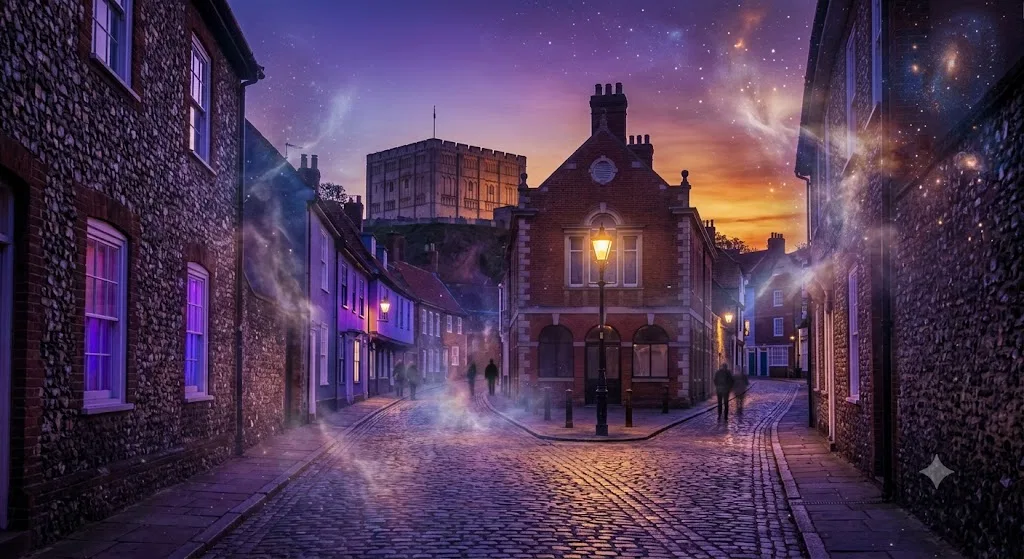
Norwich and King’s Lynn show a more urban side of Norfolk’s haunted reputation: not lonely lanes or remote halls, but castles, market squares, riversides, old inns and streets that people still walk every day. The most memorable stories gather around three mechanisms. Norwich Castle turns rebellion and punishment into a visible ghost tradition, especially through Robert Kett’s execution after the 1549 rising. Elm Hill, Tombland and the Wensum create ghost-walk geography, where narrow medieval streets, plague memories and old river routes make the city feel layered after dark. King’s Lynn’s Witch’s Heart gives West Norfolk a harsher punishment legend, tying a carved heart in Tuesday Market Place to stories of accused witches and public execution. These are not proven hauntings. They are urban folklore: stories preserved by heritage interpretation, ghost walks, local history, tourism and repeated retelling.
Why City Ghosts Gather Around Public Places
Norfolk’s urban ghost stories often attach themselves to places where the town once watched, traded, punished or processed death in public. That is why Norwich Castle and King’s Lynn’s Tuesday Market Place matter so much. They were not private settings. They were civic stages.
Norwich Castle is a Norman royal fortress, later used for centuries as a gaol. Historic England records that the castle had been used as a gaol from about 1220, with later prison rebuilding and adaptation before its conversion into a museum context. That long institutional history gives the castle a strong basis for prison and execution folklore, even before any specific apparition is considered.[Historic England]historicengland.org.ukHistoric England Norwich Castle, Non Civil ParishIt is not known when the first extension was made for this purpose but during repair work in 1747-9 it…Read more…
King’s Lynn’s Tuesday Market Place works in a similar way. The Norfolk Record Office describes the market place as a long-standing place of public execution, and local heritage material links it to the Witch’s Heart legend at the north side of the square.[Norfolk Record Office]norfolkrecordofficeblog.orgNorfolk Record Office The Witches of Lynn | Norfolk Record OfficeNorfolk Record Office The Witches of Lynn | Norfolk Record Office
The urban setting changes the flavour of the haunting. Rural legends often depend on isolation: a black dog at a crossroads, a light on the marsh, a phantom carriage on a road. Norwich and King’s Lynn instead turn everyday civic space into memory. A visitor can stand in a shopping street, outside a pub, beneath a castle wall or in a market square and be told that the ordinary pavement is also a site of rebellion, plague, execution or accusation.

Norwich Castle: Robert Kett and Rebel Memory
The strongest Norwich haunting tradition is not simply that the castle is “spooky”. It is that the castle preserves the memory of a very specific political death. Robert Kett, a Wymondham yeoman, became leader of the Norfolk rising of 1549, a rebellion driven largely by anger over enclosure and rural inequality. The rebels camped on Mousehold Heath, challenged city and royal authority, and were eventually defeated. Kett was captured, tried for treason and hanged from the walls of Norwich Castle on 7 December 1549.[Wikipedia]WikipediaKett's RebellionKett's Rebellion
That execution is the historical core of the ghost story. Norwich Castle’s educational material states that Kett was “hung in chains from Norwich Castle” and that his body was left there for years as a warning. The public nature of the punishment is crucial: the body was meant to be seen, remembered and feared.[norwichcastle.norfolk.gov.uk]norwichcastle.norfolk.gov.ukp9ks2 ketts rebellion resourcep9ks2 ketts rebellion resource
Later ghost accounts build directly on that image. Popular haunted-place summaries and local ghost retellings describe reports of Kett’s body or decomposing remains appearing near the castle, sometimes imagined as still hanging from the walls. These claims should be treated as folklore rather than evidence, but they make cultural sense: the apparition is a supernatural version of the original punishment display.[Haunted Rooms®]hauntedrooms.co.ukOpen source on hauntedrooms.co.uk.
The castle also attracts more general prison-haunting material. Some accounts mention a ghostly woman in black or an old lady seen within the museum setting, with one popular summary connecting such reports to early nineteenth-century prisoners. The sourcing for those apparitions is much thinner than the documented history of Kett’s execution, so the safest reading is that Norwich Castle’s verifiable role as fortress, gaol and execution site has made it a natural container for later ghost traditions.[Haunted Rooms®]hauntedrooms.co.ukOpen source on hauntedrooms.co.uk.
What makes Kett’s ghost different from a generic castle spectre is the politics behind it. The story is attached to land, poverty, rebellion and state violence. In haunted Norfolk, Kett is not just a dead man at a castle. He is a reminder that Norwich’s most famous urban haunting grew from a real conflict between ordinary people, local elites and royal power.
Elm Hill and Tombland: How Norwich Became a Ghost-Walk City
Norwich’s ghost-walk geography works because the city centre still has unusually strong historical texture. Elm Hill is promoted by Visit Norwich as the city’s most complete medieval street, with cobbles, merchants’ houses, thatch, shops and cafés. A major fire destroyed much of the area in 1507, after which the street was rebuilt, giving the modern visitor a concentrated Tudor and late-medieval atmosphere.[Visit Norwich]visitnorwich.co.ukOpen source on visitnorwich.co.uk.
Norwich City Council’s conservation material adds the deeper urban context: Tombland remained an affluent area close to the Cathedral, wealthy merchants occupied houses around Elm Hill, Bedford Street and Charing Cross, and medieval undercrofts survive beneath later buildings. The same material notes that Elm Hill was realigned in the fifteenth century and devastated by the 1507 fire.[Norwich City Council]norwich.gov.ukNorwich City Council6. Elm Hill and MaddermarketNorwich City Council6. Elm Hill and Maddermarket
That matters because ghost walks need more than isolated legends. They need a route. Norwich Ghost Walks advertises routes through the Cathedral area, Castle, Elm Hill, Tombland, Quayside and the River Wensum, with walks starting outside the Adam and Eve pub by St Helen’s Wharf.[Norwich Ghost Walks]ghostwalksnorwich.co.ukOpen source on ghostwalksnorwich.co.uk.
The result is a city where atmosphere is partly architectural and partly theatrical. Elm Hill’s narrowness, Tombland’s cathedral setting, the Wensum’s quays and the old pub starting point allow stories to be experienced as movement through layered space. Visitors are not only told that something happened “somewhere in Norwich”; they are led from one historic pocket to another.
Some of the most effective stories are those that sit between history and performance. Travel writing on a Norwich ghost walk describes the route passing through the Cathedral area and Tomb Alley, linked in the telling to a mass grave for victims of plague in the late sixteenth century. A National Centre for Writing piece also evokes Norwich’s haunted urban imagination through plague ghosts and older buildings. These are useful as evidence of the city’s modern storytelling culture, though not as proof of supernatural events.[Stars and Stripes]stripes.comOpen source on stripes.com.
Elm Hill and Tombland therefore show a different mechanism from Norwich Castle. The castle fixes attention on one major historical trauma: Kett’s execution. The old-street routes create cumulative unease. A doorway, an alley, a pub sign, a river bend and a patch of cobbles each adds a small charge until the city itself feels haunted.
The River Wensum and the Pull of the Quayside
The River Wensum is important because Norwich’s ghosts are not confined to buildings. The Quayside and riverside lanes form a second haunted map, one associated with movement, trade, water, night-time danger and older industry.
Norwich Ghost Walks separates its River Walk from its Elm Hill route, advertising it as a journey along the Quayside and lanes beside the river, with stories of the river’s haunted past.[Norwich Ghost Walks]ghostwalksnorwich.co.ukOpen source on ghostwalksnorwich.co.uk.
This is not accidental packaging. Elm Hill itself historically ran close to the river, and accounts of the street’s development note that merchant houses and commercial activity were tied to the Wensum and its routes to Great Yarmouth.[Wikipedia]WikipediaElm Hill, NorwichElm Hill, Norwich
Rivers make strong ghost territory because they are practical and symbolic at once. They carry goods, bodies, rubbish, rumours and travellers. They also mark boundaries. In Norwich, the Wensum helps connect the Cathedral quarter, Cow Tower, Quayside and older merchant streets into a walkable haunted circuit. The city’s ghost tradition is therefore not a list of sealed interiors. It is a pattern of movement through spaces where trade, punishment, plague, religion and entertainment overlap.
King’s Lynn’s Witch’s Heart: Punishment Folklore in Tuesday Market Place
King’s Lynn’s best-known urban haunting is not centred on a castle or inn, but on a mark in brickwork. The Witch’s Heart is usually identified as a heart shape within a diamond above a window on the north side of Tuesday Market Place, commonly associated with numbers 15 and 16. Norfolk County Council’s “Weird walk in King’s Lynn” describes the carving and links it to Margaret Read, said to have been burned in the square in 1590 after being found guilty of witchcraft.[Norfolk County Council]norfolk.gov.ukOpen source on norfolk.gov.uk.
The legend says that, as Read burned, her heart burst from her body and struck the building opposite, leaving the mark still pointed out today. Historic England includes Tuesday Market Place in its account of English witchcraft and witch-trial heritage, repeating the tradition that alleged witches were publicly executed there and that Margaret Read’s heart left a permanent burn or mark on the wall.[Historic England]historicengland.org.ukOpen source on historicengland.org.uk.
As folklore, the story is powerful because it gives the town a visible relic. Many ghost stories require belief in a witness. The Witch’s Heart asks the passer-by to look up and see a sign. That makes it especially durable in tourism, walking trails and local retellings.
But the evidence is complicated. The Norfolk Record Office treats the Witch’s Heart as a legend and places it within broader fear of witchcraft before the better-known seventeenth-century witch-hunting panic. It also notes that under the Elizabethan witchcraft law, hanging was the punishment where witchcraft was alleged to have caused death, while burning was reserved for crimes such as heresy or, for women, treason-related offences.[Norfolk Record Office]norfolkrecordofficeblog.orgNorfolk Record Office The Witches of Lynn | Norfolk Record OfficeNorfolk Record Office The Witches of Lynn | Norfolk Record Office
That legal point does not automatically disprove every version of the story, but it does warn against taking the popular form too literally. Local historian discussions also note confusion between Margaret Read and Mary Smith, the King’s Lynn woman whose 1616 witchcraft case is much better documented in Alexander Roberts’s contemporary pamphlet. The Shakespeare Birthplace Trust describes Roberts’s Treatise of Witchcraft as centred on Mary Smith’s local trial in King’s Lynn.[Shakespeare Birthplace Trust]shakespeare.org.uktreatise witchcraft 1616 alexander robertstreatise witchcraft 1616 alexander roberts
The most careful reading is therefore this: Tuesday Market Place really was associated with punishment and witchcraft memory; Mary Smith’s case is strongly documented; Margaret Read’s Witch’s Heart is a famous and locally embedded legend; the exact relationship between the carved mark, the named woman and the claimed mode of execution is less secure than the story itself suggests.
Why Norwich and King’s Lynn Feel Different
Norwich and King’s Lynn both turn public punishment into haunting, but they do it in different ways.
Norwich’s stories are spatially dense. The castle, Tombland, Elm Hill, the Cathedral area, Adam and Eve pub, Quayside and Wensum sit close enough to form a walkable network. The ghost tradition feels like a city map: one route can move from rebellion to plague to river lore to medieval street atmosphere. Visit Norwich’s own ghost-walk listing presents the city in exactly that clustered way, naming the Cathedral, Castle, Elm Hill, Tombland and River Wensum as part of the haunted visitor experience.[Visit Norwich]visitnorwich.co.ukOpen source on visitnorwich.co.uk.
King’s Lynn’s Witch’s Heart is more concentrated. Tuesday Market Place acts as a single strong emblem: a civic square, a public punishment site, a carved mark and a story of an accused woman whose body refuses to disappear quietly. The wider town has other haunted sites, and Visit West Norfolk promotes a broader haunted trail, but the Witch’s Heart remains the sharpest urban image because it compresses accusation, execution and visible folklore into one place.[Visit West Norfolk]visitwestnorfolk.comOpen source on visitwestnorfolk.com.
The contrast helps explain Norfolk’s urban haunted landscape. Norwich is haunted by routes. King’s Lynn is haunted by a mark.
How Credible Are These Urban Hauntings?
The historical settings are credible. Norwich Castle really was a major fortress, gaol and execution site. Robert Kett really was executed at Norwich Castle after the 1549 rebellion. Elm Hill and Tombland really are old, heavily layered urban spaces with documented medieval and post-medieval histories. King’s Lynn’s Tuesday Market Place really has a strong association with public punishment and witchcraft memory.[historicengland.org.uk]historicengland.org.ukHistoric England Norwich Castle, Non Civil ParishIt is not known when the first extension was made for this purpose but during repair work in 1747-9 it…Read more…
The apparitions are much harder to verify. Reports of Kett’s ghost, ghostly women at Norwich Castle, plague ghosts in Norwich lanes or supernatural force behind the Witch’s Heart belong mainly to folklore, ghost walks, tourism copy and popular retelling. That does not make them worthless. It means their value lies in what they preserve: fear of punishment, sympathy for rebels, unease about plague, suspicion of women accused of witchcraft, and the way old streets can make history feel close.
For readers exploring haunted Norfolk, the best approach is to hold both truths together. The ghosts are unproven, but the memories beneath them are real enough. Norwich and King’s Lynn show how urban hauntings gather where people once assembled to trade, accuse, punish, watch and remember.
Amazon book picks
Further Reading
Books and field guides related to Where Do Norfolk's City Ghosts Gather?. Use these as the next step if you want deeper reading beyond the article.

Haunted Castles of Britain and Ireland
Relevant to Norwich Castle and other fortified sites.

Ghosts: A History of Phantoms, Ghouls and Other Spirits
Explains why urban ghost traditions cluster around historic cities.
The Mammoth Book of Haunted House Stories
First published 2000. Subjects: ghost stories, haunted house stories, ghost story anthology, Ghost stories.
eBay marketplace picks
Marketplace Samples
Live-tested eBay searches with available results related to this page.

Endnotes
1.
Source: norwichcastle.norfolk.gov.uk
Title: OC R B (SHP) Criteria page
Link:https://www.norwichcastle.norfolk.gov.uk/article/30410/OCR-B-SHP-Criteria-page—pre-redevelopment
Source snippet
OCR B (SHP) Criteria page - pre-redevelopmentGaol moved to Mousehold Heath in 1887 and the process of converting the Castle's prison buil...
2.
Source: norfolk.gov.uk
Link:https://www.norfolk.gov.uk/article/42981/Weird-walk-in-Kings-Lynn
3.
Source: Wikipedia
Title: Kett’s Rebellion
Link:https://en.wikipedia.org/wiki/Kett%27s_Rebellion
4.
Source: norwichcastle.norfolk.gov.uk
Title: p9ks2 ketts rebellion resource
Link:https://www.norwichcastle.norfolk.gov.uk/media/14193/Ks2-Ketts-Rebellion-Resource/pdf/p9ks2-ketts-rebellion-resource.pdf?m=1701427818977
5.
Source: norwich.gov.uk
Title: Norwich City Council6. Elm Hill and Maddermarket
Link:https://www.norwich.gov.uk/download/downloads/id/3000/6_elm_hill_and_maddermarket_character_area.pdf
6.
Source: stripes.com
Link:https://www.stripes.com/news/2019-10-02/take-a-spooky-informative-journey-through-the-citys-most-haunted-areas-on-a-norwich-ghost-walk-1492098.html
7.
Source: nationalcentreforwriting.org.uk
Link:https://nationalcentreforwriting.org.uk/writing-hub/the-creepiest-walk-in-norwich/
8.
Source: Wikipedia
Title: Elm Hill, Norwich
Link:https://en.wikipedia.org/wiki/Elm_Hill%2C_Norwich
9.
Source: norwich.gov.uk
Link:https://www.norwich.gov.uk/planning/historic-buildings-and-conservation/listed-buildings-and-scheduled-monuments
10.
Source: norwich.gov.uk
Link:https://www.norwich.gov.uk/download/downloads/id/3997/booklet_on_london_street_history.pdf
11.
Source: norwich.gov.uk
Link:https://www.norwich.gov.uk/downloads/file/5512/poe_save_britains_heritage
12.
Source: norwich.gov.uk
Link:https://www.norwich.gov.uk/download/downloads/id/3657/norwichs_nooks_and_crannies.pdf
13.
Source: norwich.gov.uk
Title: norwich city centre
Link:https://www.norwich.gov.uk/sites/default/files/2026-02/City-Centre-Conservation-Area-Appraisal-introduction_0.pdf
14.
Source: norwich.gov.uk
Title: Statement of common ground
Link:https://www.norwich.gov.uk/downloads/file/6658/norwich_city_councils_supplementary_statement_of_common_ground_on_heritage_matters
15.
Source: norwich.gov.uk
Link:https://www.norwich.gov.uk/downloads/file/3254/heritage_investment_strategy
16.
Source: norwich.gov.uk
Title: historic englands statement of common ground
Link:https://www.norwich.gov.uk/download/downloads/id/5538/historic_englands_statement_of_common_ground.pdf
17.
Source: norwich.gov.uk
Title: heritage townscape and visual impact assessment addendum
Link:https://www.norwich.gov.uk/download/downloads/id/8322/heritage_townscape_and_visual_impact_assessment_addendum.pdf
18.
Source: norwich.gov.uk
Title: ncc2 1 design and heritage proof
Link:https://www.norwich.gov.uk/downloads/file/5475/ncc2-1_design_and_heritage_proof
19.
Source: Wikipedia
Title: Norwich Castle
Link:https://en.wikipedia.org/wiki/Norwich_Castle
20.
Source: Wikipedia
Title: King’s Lynn
Link:https://en.wikipedia.org/wiki/King%27s_Lynn
21.
Source: norwichcastle.norfolk.gov.uk
Link:https://www.norwichcastle.norfolk.gov.uk/media/44004/Guidebook-pages-4-17-Norwich-Castle-A-Restored-Historic-Building-and-Scheduled-Ancient-Monument/pdf/j0Guidebook_Norwich_Castle_A_Restored_Historic_Building_and_Scheduled_Ancient_Monument.pdf?m=1760349736373
22.
Source: norwichcastle.norfolk.gov.uk
Title: norfolk.gov.uk Norwich Castle
Link:https://www.norwichcastle.norfolk.gov.uk/
23.
Source: historicengland.org.uk
Title: Historic England Norwich Castle, Non Civil Parish
Link:https://historicengland.org.uk/listing/the-list/list-entry/1372724
Source snippet
It is not known when the first extension was made for this purpose but during repair work in 1747-9 it...Read more...
24.
Source: norfolkrecordofficeblog.org
Title: Norfolk Record Office The Witches of Lynn | Norfolk Record Office
Link:https://norfolkrecordofficeblog.org/2018/10/31/the-witches-of-lynn/
25.
Source: hauntedrooms.co.uk
Link:https://www.hauntedrooms.co.uk/haunted-places/norwich
26.
Source: visitnorwich.co.uk
Link:https://www.visitnorwich.co.uk/service/elm-hill/
27.
Source: ghostwalksnorwich.co.uk
Link:https://www.ghostwalksnorwich.co.uk/
28.
Source: historicengland.org.uk
Link:https://historicengland.org.uk/whats-new/features/halloween/witchcraft-and-witch-trials-in-england/
29.
Source: shakespeare.org.uk
Title: treatise witchcraft 1616 alexander roberts
Link:https://www.shakespeare.org.uk/explore-shakespeare/blogs/treatise-witchcraft-1616-alexander-roberts/
30.
Source: visitnorwich.co.uk
Link:https://www.visitnorwich.co.uk/service/norwich-ghost-walks/
31.
Source: visitwestnorfolk.com
Link:https://www.visitwestnorfolk.com/news/strange-stroll-in-kings-lynn/
32.
Source: visitwestnorfolk.com
Link:https://www.visitwestnorfolk.com/news/13-haunted-locations-in-and-around-kings-lynn/
33.
Source: facebook.com
Link:https://www.facebook.com/ghostwalksnorwich/?locale=en_GB
34.
Source: facebook.com
Link:https://www.facebook.com/HistoricEngland/photos/for-many-years-during-the-16th-century-the-market-place-in-kings-lynn-was-the-sc/867802735457981/
35.
Source: tripadvisor.com
Title: Elm Hill
Link:https://www.tripadvisor.com/Attraction_Review-g186342-d214442-Reviews-Elm_Hill-Norwich_Norfolk_East_Anglia_England.html
36.
Source: tripadvisor.com
Title: Norwich Ghost Walks
Link:https://www.tripadvisor.com/Attraction_Review-g186342-d4573943-Reviews-or80-Norwich_Ghost_Walks-Norwich_Norfolk_East_Anglia_England.html
37.
Source: tripadvisor.co.uk
Link:https://www.tripadvisor.co.uk/Attraction_Review-g186342-d4573943-Reviews-Norwich_Ghost_Walks-Norwich_Norfolk_East_Anglia_England.html
38.
Source: instagram.com
Title: Norwich Ghost Walks (@ghostwalksnorwich)The new River Walk
Link:https://www.instagram.com/ghostwalksnorwich/?hl=en
39.
Source: caleyhallhotel.co.uk
Title: tuesday market place
Link:https://caleyhallhotel.co.uk/blog/tuesday-market-place/
40.
Source: visitnorwich.co.uk
Title: robert kett
Link:https://www.visitnorwich.co.uk/service/robert-kett/
41.
Source: youtube.com
Link:https://www.youtube.com/watch?v=KpeJFME9UbE
42.
Source: youtube.com
Link:https://www.youtube.com/watch?v=5olkMAkfBlU
43.
Source: visitwestnorfolk.com
Title: two days in kings lynn heritage hanse and hauntings
Link:https://www.visitwestnorfolk.com/news/two-days-in-kings-lynn-heritage-hanse-and-hauntings/
44.
Source: norfolkbroads.com
Link:https://www.norfolkbroads.com/link/norwich-ghost-walks-757/
Additional References
45.
Source: youtube.com
Title: Unlocked Cow Tower & Black Tower – see inside Norwich’s Forgotten Fortresses!
Link:https://www.youtube.com/watch?v=qw9kFHOOEIA
Source snippet
Norfolk Ghost Stories | The Monk who Haunts Elm Hill | Father Ignatius of Norwich...
46.
Source: youtube.com
Title: Weird Norfolk: The ghost of 19 Magdalen Street, Norwich
Link:https://www.youtube.com/watch?v=VGnglC_X0eg
Source snippet
Unlocked Cow Tower & Black Tower – see inside Norwich's Forgotten Fortresses...
47.
Source: youtube.com
Title: Norfolk Ghost Stories | King’s Lynn Witches, Hauntings & The Devil
Link:https://www.youtube.com/watch?v=oxQF1rPzBBE
Source snippet
Weird Norfolk: The ghost of 19 Magdalen Street, Norwich...
48.
Source: youtube.com
Title: Weird Norfolk
Link:https://www.youtube.com/watch?v=a8uE9pzdjv4
Source snippet
Norfolk Ghost Stories | King's Lynn Witches, Hauntings & The Devil...
49.
Source: discoverkingslynn.com
Link:https://www.discoverkingslynn.com/guide/art-in-the-streets-update/
50.
Source: discoverkingslynn.com
Link:https://www.discoverkingslynn.com/events/art-in-the-streets/
51.
Source: instagram.com
Link:https://www.instagram.com/p/DQcZRYTjacq/
52.
Source: instagram.com
Link:https://www.instagram.com/p/DXtE4ZniPGF/
53.
Source: questoapp.com
Link:https://questoapp.com/norwich/places-to-visit/elm-hill
54.
Source: reddit.com
Link:https://www.reddit.com/r/Norwich/comments/1fnl9vd/ghosts_in_norwich/
Topic Tree