Where Do Lincolnshire's Ghost Stories Gather?
Lincolnshire’s haunted reputation is not built around one single “most haunted” site.
Page outline Jump by section
Introduction
For visitors and folklore readers, Lincolnshire is especially interesting because its stories range from well-worn tourist legends, such as the Lincoln Imp, to older regional motifs such as phantom hares and black dogs. Some tales have a traceable antiquarian or folkloric source; others are modern newspaper, television or ghost-tour traditions. That mix is part of the county’s character.
Where Lincolnshire’s haunted geography begins
For this project, Lincolnshire is treated as the historic county shown in the UK historic-counties mapping tradition, rather than only as a modern council area. The broader historic-counties framework recognises 92 UK historic counties: 39 in England, 34 in Scotland, 13 in Wales and 6 in Northern Ireland.[Association of British Counties]abcounties.comAssociation of British Counties About the CountiesAssociation of British Counties About the Counties The Wikimedia Commons historic-counties SVG describes the British Isles as they were mapped by counties from the late twelfth century until the late nineteenth-century local government reforms, and includes Lincolnshire among the English historic counties.[Wikimedia Commons]commons.wikimedia.orgOpen source on wikimedia.org.
That matters because Lincolnshire’s ghost traditions do not sit neatly inside modern administrative lines. The county has long been understood through its “Parts” of Lindsey, Kesteven and Holland: Lindsey in the north, Kesteven in the south-west and Holland in the south-east.[British County Flags]britishcountyflags.comBritish County Flags The Parts Of LincolnshireBritish County Flags The Parts Of Lincolnshire Tales from Grimsby and Bradley Woods, from the Lincoln Edge, from the fen roads near Metheringham, and from Old Bolingbroke all feel Lincolnshire, even though they belong to different landscapes and historic sub-regions.
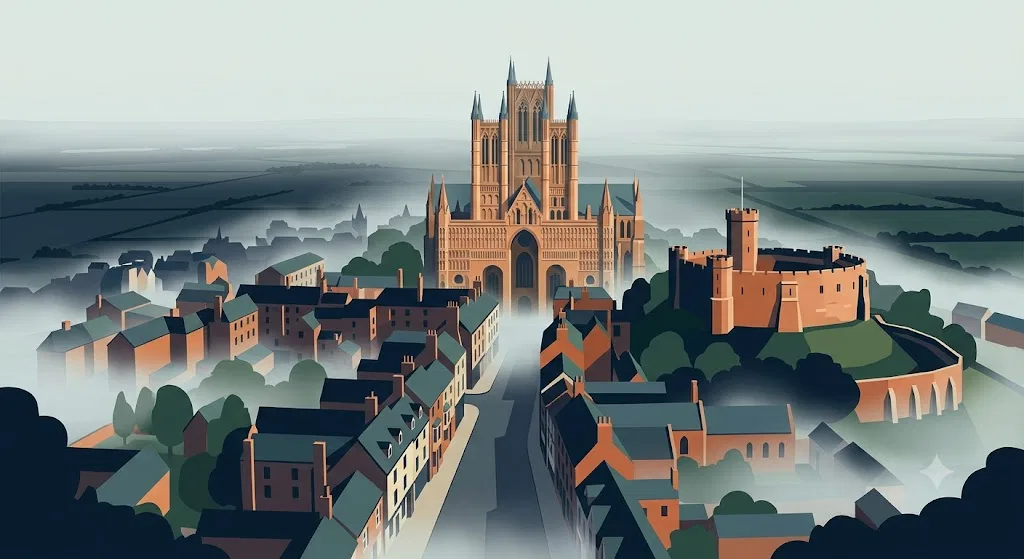
The county’s haunted map is therefore best read in bands. Around Lincoln itself, stories cling to the cathedral close, castle, prison, Steep Hill and old urban buildings. In the Wolds and south Lincolnshire, ruined castles and Civil War sites carry older fears. In the north and west, especially near river systems and old lanes, black dogs and watchful roadside apparitions become more prominent. In the flat fen country and former bomber stations, twentieth-century grief and visibility across empty land shape a different kind of ghost story.
Lincoln Castle: punishment, prison and the city’s strongest haunted stage
Lincoln Castle has one of the most convincing settings for a haunted-place tradition, even if the reported phenomena remain folklore and witness claims rather than verified events. The castle was founded in the Norman period and remains a symbol of power and punishment; today it presents itself as “a place where kings and convicts have walked” and houses an original 1215 Magna Carta alongside the 1217 Charter of the Forest.[Lincoln Castle]lincolncastle.comOpen source on lincolncastle.com.
The haunting stories most often cluster around the Victorian Prison and chapel. Lincoln Castle’s own history explains why the site feels so charged: the Victorian prison was designed around the “separate system”, an isolating regime intended to keep prisoners apart so they might reflect, repent and reform. Men, women and children as young as eight were held there between 1848 and 1878, for offences ranging from theft to highway robbery and murder.[Lincoln Castle]lincolncastle.comvictorian prisonvictorian prison The castle’s history page adds that the system was never fully implemented because of overcrowding, fever and reluctance by magistrates, and that the prison closed in 1878 after only about 30 years because of high costs and falling prisoner numbers.[Lincoln Castle]lincolncastle.comOpen source on lincolncastle.com.
Modern ghost accounts at the castle often mention footsteps, cold sensations, banging doors, disembodied sounds, apparitions in the women’s prison and the strange atmosphere of the separate-system chapel. Visit Lincoln describes Lincoln Castle as one of the city’s most haunted places, citing reported screams, slamming doors and unexplained occurrences.[Visit Lincoln]visitlincoln.comVisit Lincoln The Most Haunted Places in LincolnVisit Lincoln The Most Haunted Places in Lincoln LincolnshireLive similarly reports claims of cold spots, something brushing against visitors, footsteps and a woman seen on the stairs of the old Victorian women’s prison, sometimes said to be carrying a baby.[lincolnshirelive.co.uk]lincolnshirelive.co.uklincolnshire most haunted places revealed 4470539lincolnshire most haunted places revealed 4470539
The credibility of these claims varies. The castle’s documented history of confinement and punishment is strong; the ghost reports are mostly modern visitor tradition, tourism writing and local media. That does not make them worthless. It means the castle’s haunted reputation works as a form of emotional memory: people experience, retell or embellish unease in a building explicitly designed around isolation, fear and moral discipline.

Lincoln Cathedral and the Imp: more legend than haunting, but central to the county’s supernatural identity
The Lincoln Imp is not a ghost in the usual sense, yet no haunted Lincolnshire guide makes sense without it. The tale says that the Devil sent imps to cause mischief, and that one was turned to stone by an angel after wreaking havoc inside Lincoln Cathedral. Visit Lincoln places the imp high on a pillar on the north side of the choir and notes that the figure has become a city symbol, appearing in shops, jewellery and even Lincoln City Football Club’s identity as the Red Imps.[Visit Lincoln]visitlincoln.comVisit Lincoln The Legend of the Lincoln ImpVisit Lincoln The Legend of the Lincoln Imp Lincoln Cathedral’s own shop material preserves the same broad legend of the Devil’s imps being blown to Lincoln.[Lincoln Cathedral]lincolncathedral.comOpen source on lincolncathedral.com.
For a careful reader, the important point is that the Imp is a carved grotesque around which legend has gathered, not evidence of a medieval demonic incident. Lincoln Museum’s educational material is notably cautious, saying the supposedly “mediaeval” legend was almost certainly revived as a sales gimmick by the Lincoln jeweller and watchmaker James Ward Usher.[Lincoln Museum]lincolnmuseum.comLincoln Museum The Lincoln ImpLincoln Museum The Lincoln Imp That makes the Imp more interesting, not less: it shows how a carved figure, cathedral architecture, local commerce and civic pride can turn into a durable supernatural emblem.
The Imp also helps explain why Lincolnshire’s ghostly culture is not only about apparitions. The county’s eerie imagination includes devils, protective marks, black dogs, phantom animals, monks, roadside women and moral tales for children. A stone imp in a cathedral can sit beside castle ghosts and fenland phantom hitchhikers because all of them belong to the same local habit of attaching supernatural meaning to visible places.
Gainsborough Old Hall: the Grey Lady, secret spaces and protective marks
Gainsborough Old Hall is one of Lincolnshire’s most atmospheric haunted houses because the building itself still feels domestic, enclosed and survivable. English Heritage describes it as a medieval manor house whose surviving structures were built by Sir Thomas Burgh II in the late fifteenth century; it was the Burgh family seat from 1430 until 1596 before passing to the Hickman family.[English Heritage]english-heritage.org.ukOpen source on english-heritage.org.uk. The visitor page calls it an imposing late fifteenth-century mansion that later became a Jacobean residence, then declined into uses including a theatre, tenements and a pub.[English Heritage]english-heritage.org.ukOpen source on english-heritage.org.uk.
The best-known ghost is usually called the Grey Lady. In popular accounts she is linked to the Burgh family: a daughter of the house falls in love with a socially unsuitable man, is locked away or separated from him, dies of grief, and is then seen walking the hall or tower. Haunted-venue accounts identify her as Elizabeth Burgh, while other local versions focus less on a name and more on the repeated image of a grey female figure vanishing into or through the building.[Haunted Happenings]hauntedhappenings.co.ukOpen source on hauntedhappenings.co.uk.
Gainsborough Old Hall gained a fresh eerie layer in 2024 when English Heritage announced the discovery of a large group of protective “witch marks” and rare curse inscriptions. The Guardian reported that around 20 ritual protection marks were identified, including daisy wheels, Marian marks and an inverted inscription of William Hickman’s name, probably dating from the period after Hickman acquired the property in 1596.[The Guardian]theguardian.comOpen source on theguardian.com. Such marks were not ghost sightings. They were historical attempts to protect buildings or people from evil, witches, fire or ill luck. In a haunted-history context, they are valuable because they show fear and supernatural thinking written into the fabric of the house.
The Grey Lady story is folkloric and not securely documented as a contemporary Tudor event. The marks, by contrast, are material evidence that people in or around the household took invisible threat seriously. Gainsborough Old Hall therefore gives readers both sides of haunted history: a romantic apparition story, and physical signs of early modern protective belief.
Bolingbroke Castle and Winceby: a phantom hare beside Civil War memory
Bolingbroke Castle has one of Lincolnshire’s stranger and older supernatural traditions: a phantom hare. English Heritage identifies the site as the remains of a thirteenth-century hexagonal castle at Old Bolingbroke, famous as the birthplace in 1367 of Henry of Bolingbroke, later Henry IV. It also notes that the castle was a Royalist base during the Civil War and was besieged and taken by Parliamentarian forces in 1643.[English Heritage]english-heritage.org.ukbolingbroke castlebolingbroke castle
The haunting is not the usual white lady or clanking knight. Later folklore sources preserve the claim that Bolingbroke Castle was haunted by a hare, sometimes interpreted as the spirit of a witch once held prisoner there. The Paranormal Database dates the tradition from the 1660s onwards and describes the hare leaping over people or running between their legs, with dogs sent after it returning in terror.[Paranormal Database]paranormaldatabase.comParanormal Database The Paranormal DatabaseParanormal Database The Paranormal Database Occult World links the story to notes by the Lincolnshire antiquarian Gervase Holles from 1634–42 and cautions that the hare may have been understood as a witch’s familiar or bogey beast rather than literally the ghost of a dead hare.[Occult World]occult-world.comOpen source on occult-world.com.
The castle’s documented history gives the tale weight as a place-memory, even if not as proof of an apparition. Heritage Lincolnshire explains that the 1643 siege of Bolingbroke lasted more than a month and that Parliamentarian victories there and at nearby Winceby helped secure Royalist defeat in the county.[heritagelincolnshire.org]heritagelincolnshire.orgthe siege of bolingbroke castlethe siege of bolingbroke castle Historic UK describes the Battle of Winceby as a Civil War clash in which Royalist cavalry and dragoons trying to relieve Bolingbroke were intercepted near Winceby.[Historic UK]historic-uk.comThe Battle of WincebyThe Battle of Winceby
The phantom hare belongs to an older layer of witchcraft and animal-transformation folklore, while Winceby and the siege belong to political and military history. Together they make Old Bolingbroke one of Lincolnshire’s richest haunted landscapes: ruined stone, royal birth, Civil War violence and an animal ghost that feels far more local than generic.
Thornton Abbey: monastic ruins, collapse legends and the afterlife of the Reformation
Thornton Abbey’s haunted appeal comes from scale and absence. English Heritage describes Thornton as founded in 1140 and as one of Britain’s richest Augustinian abbeys by the late thirteenth century. Its surviving gatehouse, built in 1377–82, is the largest and most impressive monastic gatehouse in Britain.[English Heritage]english-heritage.org.ukOpen source on english-heritage.org.uk. The site page emphasises the gatehouse’s turrets, sculpture, carved figures, chambers and passages, all of which make it easy to see why visitors read the building as uncanny.[English Heritage]english-heritage.org.ukOpen source on english-heritage.org.uk.
The most useful legend is not a simple ghost story, but a destruction-and-punishment tale. English Heritage’s myths and legends material recounts the story that Sir Vincent Skinner demolished the abbey to build a Jacobean mansion, only for the finished house to fall down without visible cause and destroy its rich furniture. The same tradition says workmen found a room containing a monk seated at a table with book, pen and paper, all of which crumbled to ashes when touched.[English Heritage]english-heritage.org.ukOpen source on english-heritage.org.uk.
This is exactly the kind of tale that grows from the English Reformation and the suppression of monasteries. Thornton Abbey really was suppressed and briefly refounded as a secular college before that too closed in 1547.[English Heritage]english-heritage.org.ukOpen source on english-heritage.org.uk. But the story of the collapsed mansion and the preserved monk is a moral legend, not a settled historical account. English Heritage’s research page is careful about the site’s uncertainties, noting that many questions remain about individual events and buildings, and that modern research has highlighted problems with the long-accepted account of the “collapse” of Skinner’s house.[English Heritage]english-heritage.org.ukOpen source on english-heritage.org.uk.
Thornton Abbey therefore belongs in Lincolnshire’s haunted history because it preserves the emotional aftershock of religious destruction. The ghostly monk is less a witness statement than a symbol: the old monastic world imagined as still present, sealed away, and disturbed at a cost.
Black dogs, Hairy Jack and the county’s older folklore
Lincolnshire’s black-dog traditions are among the county’s most important contributions to British supernatural folklore. They are not tied to one ticketed attraction but to lanes, river country, fields, plantations and lonely ways. The Lincolnshire Folk Tales Project summarises Ethel Rudkin’s influential 1938 article “The Black Dog”, noting her claim that “the Black Dog walks in Lincolnshire still” and that her collected anecdotes came largely from the country between the Lincoln Cliff and the River Trent, near rivers including the Till, Ancholme and Eau, but also from the coast and Fens.[Lincolnshire Folk Tales Project]lincolnshirefolktalesproject.comLincolnshire Folk Tales Project Black Dog (also Black Shuck or Hairy JackLincolnshire Folk Tales Project Black Dog (also Black Shuck or Hairy Jack
Rudkin is important because she was not merely repeating a single pub tale. She was a major collector of Lincolnshire tradition, active in the 1920s and 1930s, and published on Lincolnshire folklore, witches, black dogs and will-o’-the-wisps.[Wikipedia]WikipediaEthel RudkinEthel Rudkin A later Folklore article by Theo Brown referred to Rudkin’s black-dog work while comparing regional traditions, and the search-result extract notes Lincolnshire’s high number of black-dog records.[JSTOR]jstor.orgThe Black DogThe Black Dog
What makes the Lincolnshire dog distinctive is that it is not always a death omen. Many British black dogs are terrifying, but Rudkin’s Lincolnshire material includes a more ambiguous or even protective figure. The Folk Tales Project notes that she saw the Lincolnshire black dog as focused on Humber river systems and, in some accounts, as “a kindly beast”.[Lincolnshire Folk Tales Project]lincolnshirefolktalesproject.comLincolnshire Folk Tales Project Black Dog (also Black Shuck or Hairy JackLincolnshire Folk Tales Project Black Dog (also Black Shuck or Hairy Jack Popular retellings call the creature Hairy Jack and place it in fields, village lanes and lonely waste places around locations such as Hemswell, with sightings reported more widely from Brigg to Spalding.[mythical-beasts.fandom.com]mythical-beasts.fandom.comHairy JackHairy Jack
For modern readers, this is a reminder not to flatten all hauntings into horror. Lincolnshire’s black dog can frighten, warn, guard or simply appear. It is a landscape spirit as much as a ghost: a dark shape made plausible by low light, wet ground, river crossings and the long walk home.
Bradley Woods and the Black Lady: a cautionary tale in woodland form
The Black Lady of Bradley Woods, near Grimsby, is one of north Lincolnshire’s best-known local ghost stories. The Lincolnshire Folk Tales Project describes the legend as a tale in which the Black Lady can supposedly be summoned on Christmas Eve by taunting her over a stolen baby, and it suggests that the origin may have been a cautionary story to keep children safe.[Lincolnshire Folk Tales Project]lincolnshirefolktalesproject.comLincolnshire Folk Tales Project The Black Lady of Bradley WoodsLincolnshire Folk Tales Project The Black Lady of Bradley Woods
Modern accounts usually describe a young woman in a black cloak or hood, sometimes with a tear-stained face, seen walking in the woods or sensed as a presence watching from the trees. Hypnogoria’s folklore account preserves the common description of a black-cloaked female apparition and notes reports of people feeling followed.[hypnogoria.blogspot.com]hypnogoria.blogspot.comFOLKLOR E ON FRIDAYFOLKLOR E ON FRIDAY Other summaries of the tradition give competing explanations: a bereaved woman searching for a child, a nun from the wider Grimsby area, or a socially isolated woman whose memory was darkened into witch-like folklore.[Wikipedia]WikipediaBlack Lady of Bradley WoodsBlack Lady of Bradley Woods
The story’s credibility as a literal haunting is weak, because its versions vary and its origin is hard to pin down. Its credibility as folklore is much stronger. It has the shape of a warning tale: children, woods, darkness, a forbidden call, and a grieving female figure who punishes mockery. In that sense, Bradley Woods is a classic example of how local haunting legends regulate behaviour. They make a place memorable, but they also tell people where not to wander, what not to shout, and why grief should not be treated as a game.
Roads, airfields and modern ghosts
Not all Lincolnshire hauntings feel ancient. Some of the county’s most discussed stories are modern, attached to cars, wartime runways and media retelling. The Metheringham Lass is the clearest example. The Lincolnshire Folk Tales Project identifies it as a version of the twentieth-century “phantom hitchhiker” legend: a young woman is said to stop motorists near the former RAF Metheringham, claim that her boyfriend has fallen from a motorbike, then vanish, sometimes leaving the smell of decay or lavender.[Lincolnshire Folk Tales Project]lincolnshirefolktalesproject.comLincolnshire Folk Tales Project The Metheringham LassLincolnshire Folk Tales Project The Metheringham Lass
The RAF itself has treated Metheringham as part of its Halloween folklore, describing the airfield as a haunting hotspot where a young Women’s Auxiliary Air Force figure named Catherine Bystock allegedly appears at summer sunsets after dying in a motorcycle accident near the site.[Royal Air Force]raf.mod.ukspooky stations and storiesspooky stations and stories This does not verify the apparition, but it shows how the story has moved beyond niche paranormal circles into broader military heritage storytelling.
The county also has road-ghost traditions around the Lincoln-to-Sleaford road and the Ruskington turn-off. LincolnshireLive reported sightings on the route including a phantom cyclist, a little girl in a pink gown and horses running along the road, with particular attention to the turn-off for Ruskington.[lincolnshirelive.co.uk]lincolnshirelive.co.ukhaunted stretch lincolnshire road left 3455381haunted stretch lincolnshire road left 3455381 A folklore blog tracing “The Ruskington Horror” argues that the modern legend grew from a 1998 television appearance and then gathered newspaper and fortean attention, making it a useful case of a ghost story forming in public view rather than surviving unchanged from antiquity.[Boggart Stones]boggartstones.co.ukBoggart Stones The Ruskington HorrorBoggart Stones The Ruskington Horror
These stories matter because they show that haunted Lincolnshire did not stop with castles and abbeys. In the twentieth century, danger moved onto roads and airfields. The ghost became a figure in headlights, a woman at the verge, a memory of wartime loss, or a repeated story drivers tell because the flat night road already feels uncanny.
Inns, shops and ghost tours: how Lincoln keeps the stories alive
Lincoln’s haunted reputation is also sustained by pubs, restaurants, walking tours and local tourism. This is the most commercial part of the tradition, so it needs careful handling: such stories can be vivid and beloved, but they are often harder to verify than older collected folklore or official site histories.
Hobbson’s or Brown’s Pie Shop on Steep Hill is a good example. Visit Lincoln places the building in the city’s haunted trail, saying it dates to 1649 and is associated with a returning presence.[Visit Lincoln]visitlincoln.comVisit Lincoln The Most Haunted Places in LincolnVisit Lincoln The Most Haunted Places in Lincoln The University of Lincoln’s Haunted History of Lincolnshire project describes the restaurant’s famous ghost “Humphrey”, a young boy reportedly seen or heard running around when no child was present, and notes the story’s appearance on the television programme Most Haunted.[Haunted History of Lincolnshire]hauntedhistoryoflincolnshire.blogs.lincoln.ac.ukOpen source on lincoln.ac.uk. Pride Magazines gives a similar account: a diner supposedly complained about children running around, while a chef later heard movement and found pots and pans moved.[Pride Magazines]pridemagazines.co.ukOpen source on pridemagazines.co.uk.
Such accounts are best read as living urban folklore. They are not supported by the kind of documentation that would establish a historical child behind the haunting, but they are important to how people experience Steep Hill, one of Lincoln’s most atmospheric streets. A ghost tour does not simply transmit evidence; it choreographs the city. It tells visitors where to pause, which doorway to look at, and how to imagine the past pressing against the present.
How credible are Lincolnshire’s hauntings?
Lincolnshire’s haunted stories fall into several different evidence categories, and readers get a clearer picture if these are not blurred together.
The strongest historical foundations belong to the places themselves. Lincoln Castle’s prison regime, Bolingbroke Castle’s thirteenth-century origins and Civil War siege, Thornton Abbey’s monastic wealth and suppression, and Gainsborough Old Hall’s long domestic history are all well supported by institutional heritage sources.[lincolncastle.com]lincolncastle.comvictorian prisonvictorian prison These facts explain why such places attract ghost stories, but they do not prove the ghost stories.
The strongest folklore foundations belong to motifs collected or discussed by folklorists: black dogs, witch-hare traditions, phantom animals, cautionary woodland women and roadside revenants. Ethel Rudkin’s work is especially important because it gathered Lincolnshire material as folklore rather than treating it only as entertainment.[Lincolnshire Folk Tales Project]lincolnshirefolktalesproject.comLincolnshire Folk Tales Project Black Dog (also Black Shuck or Hairy JackLincolnshire Folk Tales Project Black Dog (also Black Shuck or Hairy Jack The phantom hare at Bolingbroke also has unusual value because it is linked to antiquarian reporting and to wider beliefs about witches, familiars and animal transformation.[Occult World]occult-world.comOpen source on occult-world.com.
The weakest evidence, but often the liveliest storytelling, comes from modern visitor reports, commercial ghost hunts, television appearances and seasonal local-news pieces. These may preserve genuine witness experiences, but they are usually hard to check, easy to repeat and often shaped by expectation. That does not mean they should be dismissed outright. It means they should be labelled honestly as claims, legends or reported experiences.
Sceptical explanations are often simple but not insulting: old buildings amplify sound; prison and abbey settings prime people to expect fear; low light changes perception; flat roads and headlights create ambiguous figures; grief and wartime memory make airfield stories emotionally persuasive; and repeated local storytelling teaches people what they might see before they see anything at all. The best haunted history keeps both truths in view: the places are historically real, and the apparitions remain unproven stories.
Why Lincolnshire’s ghost stories endure
Lincolnshire’s haunted tradition lasts because it fits the county’s landscape. A cathedral city on a hill, a castle with a prison, fen roads, exposed airfields, ruined abbeys, Civil War villages, wooded edges near Grimsby and river-country black dogs all give the imagination something to work with. The stories are not random decorations placed on the county; they grow from the county’s particular mix of openness and enclosure.
The most memorable Lincolnshire hauntings also attach themselves to strong human themes. Lincoln Castle’s ghosts speak to punishment and isolation. Gainsborough’s Grey Lady turns social control and forbidden love into a domestic apparition. Thornton Abbey’s monk expresses unease about religious destruction. Bolingbroke’s hare preserves witchcraft and animal-transformation lore in a ruined royal castle. The Metheringham Lass turns wartime youth and road death into a modern phantom hitchhiker. Hairy Jack and the black dogs keep older, less tidy folklore moving through lanes and fields.
That is why Lincolnshire rewards careful haunted-history reading. Its best stories are eerie, but they are also local memory in narrative form: uncertain, changeable, sometimes commercialised, sometimes deeply old, and always tied to the question of what a place remembers after ordinary history has gone quiet.
Amazon book picks
Further Reading
Books and field guides related to Where Do Lincolnshire's Ghost Stories Gather?. Use these as the next step if you want deeper reading beyond the article.
The lore of the land
Covers folklore and ghost traditions across England including regional legends.
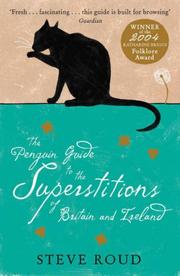
The Penguin Guide to the Superstitions of Britain and Ireland
Explains beliefs and traditions behind many haunted stories.

eBay marketplace picks
Marketplace Samples
Live-tested eBay searches with available results related to this page.

Endnotes
1.
Source: commons.wikimedia.org
Link:https://commons.wikimedia.org/wiki/File%3ABritish_Isles_map_showing_UK%2C_Republic_of_Ireland%2C_and_historic_counties.svg
2.
Source: lincolnshirelive.co.uk
Title: lincolnshire most haunted places revealed 4470539
Link:https://www.lincolnshirelive.co.uk/news/local-news/lincolnshire-most-haunted-places-revealed-4470539
3.
Source: occult-world.com
Link:https://occult-world.com/bolingbroke-castle/
4.
Source: heritagelincolnshire.org
Title: the siege of bolingbroke castle
Link:https://heritagelincolnshire.org/resources/the-siege-of-bolingbroke-castle
5.
Source: historic-uk.com
Title: The Battle of Winceby
Link:https://www.historic-uk.com/HistoryMagazine/DestinationsUK/The-Battle-of-Winceby/
6.
Source: Wikipedia
Title: Ethel Rudkin
Link:https://en.wikipedia.org/wiki/Ethel_Rudkin
7.
Source: jstor.org
Title: The Black Dog
Link:https://www.jstor.org/stable/1258857
8.
Source: mythical-beasts.fandom.com
Title: Hairy Jack
Link:https://mythical-beasts.fandom.com/wiki/Hairy_Jack
9.
Source: hypnogoria.blogspot.com
Title: FOLKLOR E ON FRIDAY
Link:https://hypnogoria.blogspot.com/2017/09/folklore-on-friday-black-lady-of.html
10.
Source: Wikipedia
Title: Black Lady of Bradley Woods
Link:https://en.wikipedia.org/wiki/Black_Lady_of_Bradley_Woods
11.
Source: lincolnshirelive.co.uk
Title: haunted stretch lincolnshire road left 3455381
Link:https://www.lincolnshirelive.co.uk/news/local-news/haunted-stretch-lincolnshire-road-left-3455381
12.
Source: jstor.org
Link:https://www.jstor.org/stable/1256169
13.
Source: Wikipedia
Title: Gainsborough Old Hall
Link:https://en.wikipedia.org/wiki/Gainsborough_Old_Hall
14.
Source: Wikipedia
Title: Lincoln Imp
Link:https://en.wikipedia.org/wiki/Lincoln_Imp
15.
Source: Wikipedia
Title: Black dog (folklore)
Link:https://en.wikipedia.org/wiki/Black_dog_%28folklore%29
16.
Source: Wikipedia
Title: Parts of Lindsey
Link:https://en.wikipedia.org/wiki/Parts_of_Lindsey
17.
Source: Wikipedia
Title: Historic counties of England
Link:https://en.wikipedia.org/wiki/Historic_counties_of_England
18.
Source: Wikipedia
Title: Parts of Holland
Link:https://en.wikipedia.org/wiki/Parts_of_Holland
19.
Source: hypnogoria.com
Link:https://hypnogoria.com/folklore_blacklady1.html
20.
Source: lincolnshirelive.co.uk
Title: 12 haunted spots lincolnshire ghosts 5547433
Link:https://www.lincolnshirelive.co.uk/news/history/12-haunted-spots-lincolnshire-ghosts-5547433
21.
Source: lincolnshirelive.co.uk
Title: Meet Humphrey
Link:https://www.lincolnshirelive.co.uk/news/meet-humphrey-crafty-ghost-said-6161624
22.
Source: commons.wikimedia.org
Title: Category:SVG maps of historic counties of the United Kingdom in Sect 3
Link:https://commons.wikimedia.org/wiki/Category%3ASVG_maps_of_historic_counties_of_the_United_Kingdom_in_Sect_3
23.
Source: commons.wikimedia.org
Title: Category:Historic counties of the United Kingdom
Link:https://commons.wikimedia.org/wiki/Category%3AHistoric_counties_of_the_United_Kingdom
24.
Source: pdsh.fandom.com
Title: Black Lady of Bradley Woods
Link:https://pdsh.fandom.com/wiki/Black_Lady_of_Bradley_Woods
25.
Source: monarchies.fandom.com
Title: Historic counties of England
Link:https://monarchies.fandom.com/wiki/Historic_counties_of_England
26.
Source: heritagelincolnshire.org
Link:https://heritagelincolnshire.org/explore/historic-sites/bolingbroke-castle
27.
Source: abcounties.com
Title: Association of British Counties About the Counties
Link:https://abcounties.com/introduction/
28.
Source: britishcountyflags.com
Title: British County Flags The Parts Of Lincolnshire
Link:https://britishcountyflags.com/2016/12/03/the-parts-of-lincolnshire/
29.
Source: lincolncastle.com
Link:https://www.lincolncastle.com/
30.
Source: lincolncastle.com
Title: magna carta
Link:https://www.lincolncastle.com/explore/magna-carta
31.
Source: lincolncastle.com
Title: victorian prison
Link:https://www.lincolncastle.com/explore/victorian-prison
32.
Source: lincolncastle.com
Link:https://www.lincolncastle.com/explore/history
33.
Source: visitlincoln.com
Title: Visit Lincoln The Most Haunted Places in Lincoln
Link:https://www.visitlincoln.com/blog/post/the-most-haunted-places-in-lincoln/
34.
Source: visitlincoln.com
Title: Visit Lincoln The Legend of the Lincoln Imp
Link:https://www.visitlincoln.com/blog/post/the-legend-of-the-lincoln-imp/
35.
Source: lincolncathedral.com
Link:https://lincolncathedral.com/product/the-legend-of-the-lincoln-imp/
36.
Source: lincolnmuseum.com
Title: Lincoln Museum The Lincoln Imp
Link:https://www.lincolnmuseum.com/assets/downloads/IS_art_2_the_lincoln_imp.pdf
37.
Source: english-heritage.org.uk
Link:https://www.english-heritage.org.uk/visit/places/gainsborough-old-hall/history/
38.
Source: english-heritage.org.uk
Link:https://www.english-heritage.org.uk/visit/places/gainsborough-old-hall/
39.
Source: hauntedhappenings.co.uk
Link:https://www.hauntedhappenings.co.uk/gainsborough-old-hall/
40.
Source: theguardian.com
Link:https://www.theguardian.com/culture/2024/oct/29/witches-marks-discovered-english-heritage-gainsborough-old-hall
41.
Source: english-heritage.org.uk
Title: bolingbroke castle
Link:https://www.english-heritage.org.uk/visit/places/bolingbroke-castle/
42.
Source: paranormaldatabase.com
Title: Paranormal Database The Paranormal Database
Link:https://www.paranormaldatabase.com/lincolnshire/lincdata.php
43.
Source: english-heritage.org.uk
Link:https://www.english-heritage.org.uk/visit/places/thornton-abbey-and-gatehouse/history/
44.
Source: english-heritage.org.uk
Link:https://www.english-heritage.org.uk/visit/places/thornton-abbey-and-gatehouse/
45.
Source: english-heritage.org.uk
Link:https://www.english-heritage.org.uk/members-area/members-magazine/quizzes/2019-july-myths-and-legends/
46.
Source: english-heritage.org.uk
Link:https://www.english-heritage.org.uk/visit/places/thornton-abbey-and-gatehouse/history/research/
47.
Source: lincolnshirefolktalesproject.com
Title: Lincolnshire Folk Tales Project Black Dog (also Black Shuck or Hairy Jack)
Link:https://lincolnshirefolktalesproject.com/2024/02/20/black-dog-also-black-shuck-or-hairy-jack/
48.
Source: lincolnshirefolktalesproject.com
Title: Lincolnshire Folk Tales Project The Black Lady of Bradley Woods
Link:https://lincolnshirefolktalesproject.com/2024/02/20/the-black-lady-of-bradley-woods/
49.
Source: lincolnshirefolktalesproject.com
Title: Lincolnshire Folk Tales Project The Metheringham Lass
Link:https://lincolnshirefolktalesproject.com/2024/02/20/the-metheringham-lass/
50.
Source: raf.mod.uk
Title: spooky stations and stories
Link:https://www.raf.mod.uk/news/articles/spooky-stations-and-stories/
51.
Source: boggartstones.co.uk
Title: Boggart Stones The Ruskington Horror
Link:https://www.boggartstones.co.uk/2023/04/the-ruskington-horror.html
52.
Source: hauntedhistoryoflincolnshire.blogs.lincoln.ac.uk
Link:https://hauntedhistoryoflincolnshire.blogs.lincoln.ac.uk/lincoln/browns-pie-shop-2/
53.
Source: pridemagazines.co.uk
Link:https://www.pridemagazines.co.uk/lincolnshire/highlights/top-10-most-haunted-places-in-lincolnshire/11-2018
54.
Source: facebook.com
Link:https://www.facebook.com/RealCounties/photos/lincolnshire-is-divided-into-three-parts-lindsey-kesteven-holland-historiccounti/946360877647480/
55.
Source: english-heritage.org.uk
Link:https://www.english-heritage.org.uk/visit/places/bolingbroke-castle/history/
56.
Source: english-heritage.org.uk
Link:https://www.english-heritage.org.uk/visit/places/thornton-abbey-and-gatehouse/history/significance/
57.
Source: english-heritage.org.uk
Link:https://www.english-heritage.org.uk/visit/places/bolingbroke-castle/opening-times/
58.
Source: english-heritage.org.uk
Link:https://www.english-heritage.org.uk/visit/places/bolingbroke-castle/directions/
59.
Source: english-heritage.org.uk
Link:https://www.english-heritage.org.uk/visit/places/chester-castle-agricola-tower-and-castle-walls/history/
60.
Source: english-heritage.org.uk
Link:https://www.english-heritage.org.uk/visit/places/thornton-abbey-and-gatehouse/history/description/
61.
Source: english-heritage.org.uk
Title: sibsey trader windmill
Link:https://www.english-heritage.org.uk/visit/places/sibsey-trader-windmill/
62.
Source: english-heritage.org.uk
Link:https://www.english-heritage.org.uk/visit/places/thornton-abbey-and-gatehouse/history/sources/
63.
Source: english-heritage.org.uk
Link:https://www.english-heritage.org.uk/visit/region/eastmidlands/
64.
Source: english-heritage.org.uk
Title: member recommended thornton abbey
Link:https://www.english-heritage.org.uk/visit/inspire-me/blog/blog-posts/member-recommended-thornton-abbey/
65.
Source: english-heritage.org.uk
Link:https://www.english-heritage.org.uk/visit/places/tattershall-college/
66.
Source: english-heritage.org.uk
Link:https://www.english-heritage.org.uk/search?page=1&searchTerm=Thornton+Abbey+and+Gatehouse&type=
67.
Source: english-heritage.org.uk
Link:https://www.english-heritage.org.uk/visit/inspire-me/100-meadows/
68.
Source: english-heritage.org.uk
Title: March 2019 20 questions quiz
Link:https://www.english-heritage.org.uk/members-area/members-magazine/2021/March-2019-20-questions-quiz/
Published: March 2019
69.
Source: english-heritage.org.uk
Title: Beeston Castle and Woodland Park
Link:https://www.english-heritage.org.uk/siteassets/home/visit/places-to-visit/beeston-castle/school-visits/learning-resources/beeston-castle-teachers-kit-2023.pdf
70.
Source: books.google.com
Title: Lincolnshire Folklore
Link:https://books.google.com/books/about/Lincolnshire_Folklore.html?hl=en&id=9SQKAQAAIAAJ
71.
Source: instagram.com
Link:https://www.instagram.com/lincolnshirefolktales/
72.
Source: youtube.com
Link:https://www.youtube.com/playlist?list=PLMn8TwjvfDYCYDTPE4Lf7_4s3qfMLEpR4
73.
Source: youtube.com
Link:https://www.youtube.com/shorts/Y8f990xAL_A
74.
Source: lincolncastle.com
Title: Welcome to Lincoln Castle
Link:https://www.lincolncastle.com/homepage/1/the-homepage
75.
Source: lincolncastle.com
Link:https://www.lincolncastle.com/downloads/file/6/castle-map
76.
Source: lincolncastle.com
Link:https://www.lincolncastle.com/castle/plan/sample-itinerary
77.
Source: lincolncastle.com
Link:https://www.lincolncastle.com/plan/accessibility
78.
Source: rosemaryandporkbelly.co.uk
Title: gainsborough old hall
Link:https://rosemaryandporkbelly.co.uk/gainsborough-old-hall/
79.
Source: lincolnshirelife.co.uk
Title: gainsborough old hall
Link:https://www.lincolnshirelife.co.uk/heritage/gainsborough-old-hall/
80.
Source: hauntedhistoryoflincolnshire.blogs.lincoln.ac.uk
Title: lincoln.ac.uk About | Haunted History of Lincolnshire
Link:https://hauntedhistoryoflincolnshire.blogs.lincoln.ac.uk/about/
81.
Source: hauntedhistoryoflincolnshire.blogs.lincoln.ac.uk
Link:https://hauntedhistoryoflincolnshire.blogs.lincoln.ac.uk/surrounding-areas/newark/
82.
Source: tripadvisor.com
Title: Gainsborough Old Hall
Link:https://www.tripadvisor.com/Attraction_Review-g1226793-d2357473-Reviews-Gainsborough_Old_Hall-Gainsborough_Lincolnshire_England.html
83.
Source: hauntedhappenings.co.uk
Link:https://www.hauntedhappenings.co.uk/bolebroke-castle/
84.
Source: engole.info
Title: Black Lady of Bradley Woods
Link:https://engole.info/black-lady-of-bradley-woods/
85.
Source: visitlincoln.com
Link:https://www.visitlincoln.com/listing/gainsborough-old-hall/96587101/
86.
Source: lincolncathedral.com
Link:https://lincolncathedral.com/product/lincoln-imp-life-size-replica/
87.
Source: paranormaldatabase.com
Link:https://www.paranormaldatabase.com/hotspots/lincoln.php
88.
Source: lincolnshirefolktalesproject.com
Link:https://lincolnshirefolktalesproject.com/folktales/
Additional References
89.
Source: youtube.com
Title: The Butchered Bride Lincolnshire’s real nightmare ghost tale
Link:https://www.youtube.com/watch?v=pLTfZqXEo0k
Source snippet
Hanged at Lincoln Castle 4 Dark TRUE stories of Victorian justice...
90.
Source: youtube.com
Title: LIVE Dark History Walk in Lincoln
Link:https://www.youtube.com/watch?v=DGoLkMxbO2U
Source snippet
HAUNTED Airbases of the UK - Secrets of RAF Metheringham and the Tale of the Metheringham Lass...
91.
Source: youtube.com
Title: 10 Extremely Haunted Places in Lincolnshire
Link:https://www.youtube.com/watch?v=Fin0q3hIfZU
Source snippet
The Butchered Bride Lincolnshire's real nightmare ghost tale...
92.
Source: hauntedrooms.co.uk
Link:https://www.hauntedrooms.co.uk/haunted-places/lincoln
93.
Source: facebook.com
Link:https://www.facebook.com/abcounties/posts/a-printable-version-of-this-splendid-map-is-also-available-on-the-gazetteer-at/4952166104840822/
94.
Source: facebook.com
Link:https://www.facebook.com/TheCOLC/posts/as-a-city-with-a-rich-history-lincoln-has-some-haunting-tales-and-ghost-stories-/971087941712992/
95.
Source: facebook.com
Link:https://www.facebook.com/groups/735389799823006/posts/8440315955996980/
96.
Source: ghostcatcherisles.com
Link:https://ghostcatcherisles.com/category/folklore-mythology/british-irish-folklore/
97.
Source: famous-historic-buildings.org.uk
Link:https://www.famous-historic-buildings.org.uk/gainsborough-old-hall.html
98.
Source: reddit.com
Link:https://www.reddit.com/r/Lincolnshire/comments/sdc0th/ghost_stories/
Topic Tree
Follow this branch
Related pages 91
- Haunted Clackmannanshire
- Haunted Antrim
- Haunted Armagh
- Haunted Durham
- Haunted Londonderry
- +86 more in sidebar