Within Haunted Shetland
What Are Shetland Trows, and Why Do They Haunt the Hills?
Trow stories explain Shetland's uncanny hills, mounds, roads and night sounds through beings older than ordinary ghost lore.
On this page
- Mounds, stones and nocturnal mischief
- Trow tales from Yell and old Christmas nights
- How folklore turns lonely places into haunted ground
Page outline Jump by section
Introduction
Shetland trows are not ghosts in the usual sense. They are the islands’ hill-folk: small, uncanny beings said to live in mounds, rocky places and hidden houses under the hills, emerging at night to meddle with human lives. Their stories help explain why Shetland’s moorland, stones, winter roads and old paths can feel haunted even when no dead person is supposed to appear there. In trow lore, a lonely hill is not just empty ground; it may be a threshold. A strange sound is not just weather; it may be music from below. A standing stone may be imagined as a trow caught by sunrise. Shetland Museum and Archives still presents a reconstructed “trowie knowe” as part of its customs and folklore gallery, showing how deeply these beings belong to the islands’ supernatural imagination.[Shetland Museum & Archives]shetlandmuseumandarchives.org.ukShetland Museum & Archives Customs and Folklore | Shetland Museum & ArchivesShetland Museum & Archives Customs and Folklore | Shetland Museum & Archives
What trows are in Shetland folklore
A trow is best understood as a mischievous or dangerous supernatural being from the folklore of Shetland and Orkney, with roots in Scandinavian tradition but a very local island character. The Dictionaries of the Scots Language define a trow as a mischievous sprite or fairy associated with Scandinavian mythology and Northern Isles folklore, while later Shetland and Orkney usage gives the word a whole family of related forms: trowie, trow-bewitched, trowie knowe, trows’ hollow and trows’ dwelling.[dsl.ac.uk]dsl.ac.ukDictionaries of the Scots Language:: SND:: trow n1Dictionaries of the Scots Language:: SND:: trow n1
That vocabulary matters because it turns folklore into geography. The trow is not just a creature in a tale; it is a way of naming certain places and conditions. A “trowie knowe” is a knoll or fairy hill inhabited by trows. “Trowie” can mean supernatural, unhealthy, bewitched or under trow influence. Older dialect evidence even links trows with ferns, summer lightning, illness, infant substitution and hidden retreats in the landscape.[dsl.ac.uk]dsl.ac.ukDictionaries of the Scots Language:: SND:: trow n1Dictionaries of the Scots Language:: SND:: trow n1
Modern folklore summaries often describe Shetland trows as hill-dwellers who come out after dark, dislike daylight and are fond of music. An academic discussion of Northern Isles folklore notes that Jessie Saxby’s 1932 account described them as small grey-clad men, continually playing the fiddle, with homes under green knolls or sunny hillsides; the same discussion connects them more closely with Norse hidden people than with the giant mountain trolls of later popular imagination.[PureAdmin]pureadmin.uhi.ac.ukPure AdminPure Admin
Mounds, stones and nocturnal mischief
Trow stories make Shetland’s haunted landscape work through concealment. The frightening thing is not usually a visible monster charging across the moor, but the suspicion that ordinary ground contains another household beneath it. A mound, a ferny bank, a low hill, a stony hollow or a roadside rise might be imagined as inhabited. This is why trow lore feels so different from a single haunted-house story: the “haunting” spreads across the land.
The Shetland Museum’s reconstructed trowie knowe captures that idea in public heritage form. It sits among displays about superstition, births, marriages, deaths, witchcraft, the supernatural and language, with the museum explicitly presenting it as an example of where Shetland’s “little people” live.[Shetland Museum & Archives]shetlandmuseumandarchives.org.ukShetland Museum & Archives Customs and Folklore | Shetland Museum & ArchivesShetland Museum & Archives Customs and Folklore | Shetland Museum & Archives The exhibit is not proof that trows existed; it is evidence that the belief-world around them is important enough to be interpreted as part of Shetland’s cultural history.
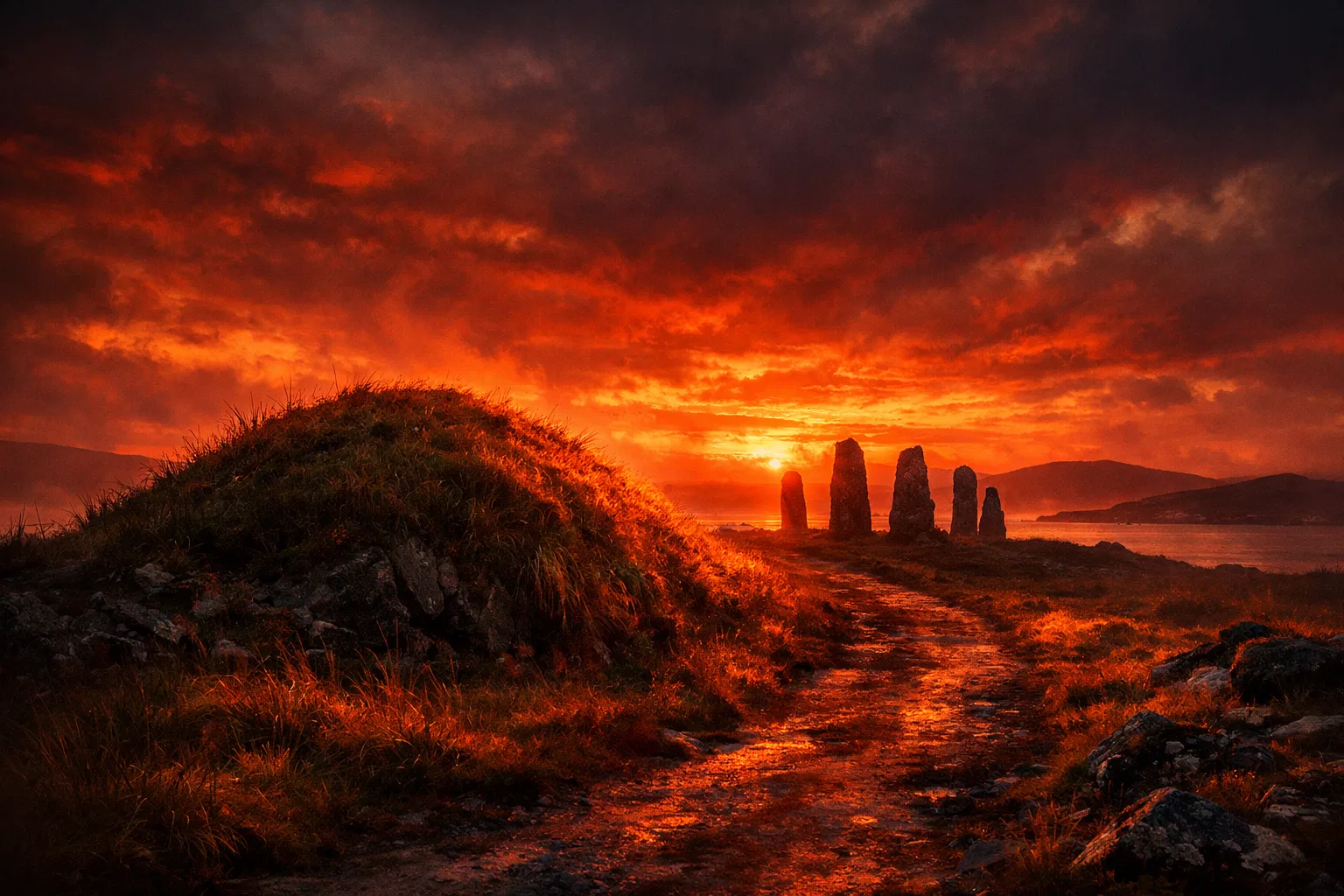
Stones carry the same charge. On Fetlar, the ancient ring known as the Haltadans is explained in local legend as a group of trows turned to stone at sunrise while dancing to music played by a fiddler and his wife. Shetland.org’s area guide describes the two centre stones as the fiddler and his wife, with the surrounding dancers petrified when the sun came up.[Shetland.org]shetland.orgFetlar | Shetland.orgFetlar | Shetland.org The story makes the monument doubly uncanny: archaeologically ancient, but folklorically alive with a night-long dance that failed to end before dawn.
This is one of the clearest examples of the mechanism behind trow-haunted ground. A physical feature already attracts attention because it is old, isolated or oddly shaped. Folklore then gives it behaviour: music, dancing, danger after dark, punishment by sunrise. The result is not a ghost report in the modern witness-statement sense, but a place-story that makes the landscape feel watched and inhabited.
Trow tales from Yell and old Christmas nights
Some of the most memorable Shetland trow material is tied to winter, especially the old Christmas season. Shetland.org’s account of past Christmas customs says that trows were thought to live in caves or rocky mounds and that, on Tulya’s Eve, seven days before Yule Day, they were believed to have permission to leave their hiding places and move above ground. People responded with protective customs: crosses of straw at gates, plaited animal hairs above byre doors, and a blazing peat carried through outbuildings to keep trows away from life and property.[Shetland.org]shetland.orgChristmas traditions | Shetland.orgChristmas traditions | Shetland.org
These details show why trows belong in a haunted-history project even though they are not human ghosts. The fear is practical and domestic. The vulnerable places are gates, byres, stores, animals, babies, tools and winter roads. In Shetland’s older rural imagination, the supernatural was not confined to ruined castles; it pressed against the everyday systems that kept a household alive.
A well-known Yell tale, “Robbie Anderson and the Trows”, gives the old Christmas setting a human face. In the version retold by NorthLink Ferries for Scotland’s Year of Stories, Robbie Anderson lives at Cullivoe in Yell and is famous as a fiddler. On Old Christmas Eve, 7 January, he is stopped on the path by a small red-haired trow who asks him to play at the trows’ feast. Robbie later finds a door open in the hillside, with laughter and the sound of glasses inside, and plays until morning.[NorthLink Ferries]northlinkferries.co.ukOpen source on northlinkferries.co.uk.
The tale is especially useful because it is not simply “a man sees a fairy”. It shows the whole trow pattern at work: night travel, a hillside entrance, music, secrecy, reward and unease. Robbie’s luck improves after his dealings with the trows: fish become plentiful, sheep survive bad weather, and crops stand when others fail. But when a new minister comes and the trows leave for the Faroe Islands, the luck ends and Robbie becomes ordinary again.[NorthLink Ferries]northlinkferries.co.ukOpen source on northlinkferries.co.uk.
That ending is easy to overread, but it is suggestive. The story remembers a world in which older supernatural explanations sit uneasily beside formal religion. The trows are not merely frightening; they are also a source of uncanny prosperity, artistry and local distinctiveness. Their disappearance is both a moral victory and a loss of enchantment.
Eerie music, night roads and the hidden house under the hill
Music is one of the strongest links between trows and Shetland’s haunted atmosphere. Many ghost stories depend on sight: a figure in a corridor, a face at a window, a shape on a stair. Trow stories often begin with sound. A traveller hears fiddling where no human party should be. A mound seems to contain laughter. A musician learns tunes that feel as though they came from somewhere outside ordinary life.
The Robbie Anderson tale places the fiddler at the centre of the encounter, but the motif is broader. The academic discussion of Northern Isles folklore cited above notes that trows were described as continually playing the fiddle, and that their homes were imagined beneath knolls and hillsides.[PureAdmin]pureadmin.uhi.ac.ukPure AdminPure Admin This makes the landscape acoustically haunted. Hills do not merely hide figures; they seem to hum, play, echo or answer.
For a reader walking through Shetland today, this is one reason trow lore remains powerful. The islands have wind, bird calls, moving water, distant machinery, sheep, sea noise and sudden changes in visibility. Folklore does not need to invent eeriness from nothing. It offers a pattern for interpreting the sensations already produced by lonely ground and changeable weather.
The trow’s hidden dwelling also reverses the usual haunted-house idea. Instead of a human building invaded by a ghost, the human traveller accidentally approaches a non-human household. The “house” may be under the hill. The trespass may be simply walking too late, hearing too much, or accepting an invitation that should have been refused.
How trow lore turns lonely places into haunted ground
Trow stories make Shetland feel haunted through repeated rules rather than through one fixed apparition. The rules are simple and memorable: avoid certain places after dark; beware music from hills; guard animals and children; protect the byre and threshold; do not assume an old mound is empty; do not trust all good luck.
Several mechanisms keep the tradition alive:
Thresholds become dangerous. Gates, doors, byres, paths and hill entrances matter because they are where the human world meets the trow world. Christmas customs around gates and outbuildings show how strongly this boundary-thinking shaped older household practice.[Shetland.org]shetland.orgChristmas traditions | Shetland.orgChristmas traditions | Shetland.org
Ancient features gain a story. Haltadans is not only a prehistoric stone setting; in folklore it becomes the frozen remains of a supernatural dance. The tale gives visitors a vivid way to remember both the place and the warning against losing track of night.[Shetland.org]shetland.orgFetlar | Shetland.orgFetlar | Shetland.org
Sound becomes evidence of hidden life. Fiddle music, laughter and movement beneath the hill are central to many trow traditions. The landscape is therefore haunted by what might be heard as much as by what might be seen.[NorthLink Ferries]northlinkferries.co.ukOpen source on northlinkferries.co.uk.
Misfortune gets a cause. Older dialect evidence links trow influence with sickly animals, infant substitution and wasting illness. These are not modern medical explanations, but they show how folklore gave shape to frightening events that rural families could not easily control.[dsl.ac.uk]dsl.ac.ukDictionaries of the Scots Language:: SND:: trow n1Dictionaries of the Scots Language:: SND:: trow n1
This is why trows sit naturally beside Shetland’s more conventional haunted places. A ruined house such as Windhouse may gather named apparitions, but trow lore haunts the open ground: the hill, the knowe, the moor, the stone circle, the winter road home.
How credible are trow hauntings?
Trow stories are credible as folklore, not as verified paranormal evidence. The strongest sources do not prove that supernatural beings lived under Shetland’s hills; they show that Shetlanders preserved, repeated, named and interpreted such beings across oral tradition, dialect, literature, museum display and local heritage.
The evidence is layered. There are early antiquarian references, such as John Brand’s 1701 description of sea-trows damaging fishing nets, now quoted in Scots language resources.[Scots Language]scotslanguage.comScots Language TrowScots Language Trow There are dialect records that preserve how trow words were used in Shetland and Orkney speech.[dsl.ac.uk]dsl.ac.ukDictionaries of the Scots Language:: SND:: trow n1Dictionaries of the Scots Language:: SND:: trow n1 There are collected and retold folktales, such as the Yell story of Robbie Anderson.[NorthLink Ferries]northlinkferries.co.ukOpen source on northlinkferries.co.uk. There is museum interpretation, which treats trow belief as part of Shetland’s customs and supernatural heritage.[Shetland Museum & Archives]shetlandmuseumandarchives.org.ukShetland Museum & Archives Customs and Folklore | Shetland Museum & ArchivesShetland Museum & Archives Customs and Folklore | Shetland Museum & Archives
The weak point, for anyone looking for hard proof of hauntings, is that these are not modern case files with dates, named witnesses and independent investigation. They are traditions shaped by memory, performance, moral teaching and local identity. Details can shift between tellings. A trow may appear as a dangerous thief, a music-loving neighbour, a giver of luck, a household threat or a melancholy remnant of an older world.
That does not make the stories useless. It means their value lies in what they reveal about place. Trow lore records how Shetlanders imagined risk in a landscape of darkness, weather, scattered homes and ancient remains. It also preserves a distinctive Northern Isles blend: Norse-derived names and hidden-people motifs, Scottish fairy-story patterns, Christian anxiety about older beliefs, and very local attachments to Yell, Fetlar, Whalsay and other island places.[PureAdmin]pureadmin.uhi.ac.ukPure AdminPure Admin
Why trows still matter to Shetland’s haunted landscape
Trows matter because they make Shetland’s eerie places feel inhabited without turning every story into a conventional ghost tale. They belong to the same haunted map as ruins, old houses and burial grounds, but they work by a different logic. They are older than the named spectre, closer to the hill than the hallway, and more interested in thresholds than in dramatic apparitions.
For visitors and readers, trow lore changes how Shetland’s landscape is read. A moorland stone circle can be a petrified dance. A low hill can be a hidden dwelling. A winter custom can become a defence against unseen neighbours. A fiddler’s tune can carry the suggestion of another world just beneath the ground. The result is one of Shetland’s most distinctive contributions to Britain’s haunted geography: a landscape where the uncanny is not always a dead person returning, but a hidden people who may never have left.
Amazon book picks
Further Reading
Books and field guides related to What Are Shetland Trows, and Why Do They Haunt the Hills?. Use these as the next step if you want deeper reading beyond the article.

The folklore of Orkney and Shetland
The strongest dedicated source for trows, fairy belief and Northern Isles folklore.

Scottish Myths and Legends
Introduces readers to the wider mythological landscape surrounding stories like the trows.
The Gaelic otherworld
Explores Celtic supernatural beliefs closely related to fairy lore.
eBay marketplace picks
Marketplace Samples
Live-tested eBay searches with available results related to this page.
Endnotes
1.
Source: dsl.ac.uk
Title: Dictionaries of the Scots Language:: SND:: trow n1
Link:https://www.dsl.ac.uk/entry/snd/trow_n1
2.
Source: shetland.org
Title: Fetlar | Shetland.org
Link:https://www.shetland.org/visit/areas/fetlar
3.
Source: shetland.org
Title: Christmas traditions | Shetland.org
Link:https://www.shetland.org/blog/shetland-christmas-past
4.
Source: dsl.ac.uk
Link:https://dsl.ac.uk/our-publications/scots-word-of-the-week/trow/
5.
Source: shetland.org
Title: career moves the folklore inspired heritage apprentic
Link:https://www.shetland.org/blog/career-moves-the-folklore-inspired-heritage-apprentic
6.
Source: shetland.org
Link:https://www.shetland.org/blog/shetland-folklore
7.
Source: shetland.org
Title: exploring fetlar
Link:https://www.shetland.org/blog/exploring-fetlar
8.
Source: fetlar.org
Title: fetlar2013 earlyhistory
Link:https://www.fetlar.org/site/assets/files/1379/fetlar2013-earlyhistory.pdf
9.
Source: shetlandmuseumandarchives.org.uk
Title: Shetland Museum & Archives Customs and Folklore | Shetland Museum & Archives
Link:https://www.shetlandmuseumandarchives.org.uk/visit/galleries/customs-and-folklore
10.
Source: scotslanguage.com
Title: Scots Language Trow
Link:https://www.scotslanguage.com/articles/view/id/6684
11.
Source: pureadmin.uhi.ac.uk
Title: Pure Admin
Link:https://pureadmin.uhi.ac.uk/ws/portalfiles/portal/24965837/Folklore_Between_the_Northern_and_Western_Isles.pdf
12.
Source: northlinkferries.co.uk
Link:https://www.northlinkferries.co.uk/shetland-blog/a-shetland-folk-tale-robbie-anderson-and-the-trows/
13.
Source: Wikipedia
Title: Jessie Saxby
Link:https://en.wikipedia.org/wiki/Jessie_Saxby
14.
Source: Wikipedia
Link:https://en.wikipedia.org/wiki/Haltadans
15.
Source: shetlandmuseumandarchives.org.uk
Title: shetland witches
Link:https://www.shetlandmuseumandarchives.org.uk/blog/shetland-witches
16.
Source: shetlandmuseumandarchives.org.uk
Link:https://www.shetlandmuseumandarchives.org.uk/collections/museum/folklife
17.
Source: shetlandfolkfestival.com
Link:https://www.shetlandfolkfestival.com/archive/2024/local/haltadans
18.
Source: facebook.com
Link:https://www.facebook.com/ScotsDictionars/photos/trow-a-mischievous-sprite-or-fairy-a-supernatural-being-dslacukscots-word-of-the/1039818314847191/
19.
Source: northlinkferries.co.uk
Link:https://www.northlinkferries.co.uk/shetland-blog/small-shetland-historic-sites-worth-visiting/
20.
Source: ojs.setur.fo
Link:https://ojs.setur.fo/index.php/frit/article/view/50/138
21.
Source: spookyscotland.net
Link:https://spookyscotland.net/trow/
22.
Source: aroundus.com
Link:https://aroundus.com/p/12846484-haltadans
Additional References
23.
Source: youtube.com
Link:https://www.youtube.com/watch?v=W5v8VDn57Mw
Source snippet
Spooky Shetland 2024 - The Trows...
24.
Source: youtube.com
Title: The Giant And The Trows | Folktales From Shetland
Link:https://www.youtube.com/watch?v=vkiC_t4uS3g
Source snippet
The Trowie Tunes - Traditional Shetland Fiddle Music...
25.
Source: abebooks.co.uk
Link:https://www.abebooks.co.uk/first-edition/Brief-Description-Orkney-Zetland-Pightland-Firth-Caithness/22791502093/bd
26.
Source: themodernantiquarian.com
Link:https://www.themodernantiquarian.com/site/4754/haltadans
27.
Source: researchgate.net
Link:https://www.researchgate.net/profile/Adam-Grydehoj/publication/230667855_Historiography_of_Picts_Vikings_Scots_and_Fairies_and_Its_Influence_on_Shetland%27s_Twenty-First_Century_Economic_Development/links/09e41502b76e0245ec000000/Historiography-of-Picts-Vikings-Scots-and-Fairies-and-Its-Influence-on-Shetlands-Twenty-First-Century-Economic-Development.pdf
28.
Source: megalithic.co.uk
Link:https://www.megalithic.co.uk/article.php?sid=3285
29.
Source: scottishwomenwritersontheweb.net
Link:https://www.scottishwomenwritersontheweb.net/writers-a-to-z/jessie-saxby
30.
Source: instagram.com
Link:https://www.instagram.com/reel/DRfKGD-EYGS/
31.
Source: jstor.org
Link:https://www.jstor.org/stable/40622023
32.
Source: goodreads.com
Link:https://www.goodreads.com/book/show/13484416-shetland-traditional-lore
Topic Tree