Within Haunted Wigtownshire
Why Do Covenanting Stories Haunt Wigtownshire?
Galdenoch Tower and the Wigtown Martyrs show how Covenanting violence became part of the county's haunted memory.
On this page
- Galdenoch Tower and the pursued soldier
- The Martyrs' Stake as haunted memory
- Violence, guilt and religious landscape
Page outline Jump by section
Introduction
Covenanting stories haunt Wigtownshire because they attach religious violence to very visible local places: a ruined tower at Galdenoch, the roads and farms of the Rhinns, Wigtown’s old burgh centre, the River Bladnoch, and the memorials to the Wigtown Martyrs. The most ghostly tale is not the Martyrs’ Stake itself, but Galdenoch Tower, where a Covenanting soldier is said to have been followed home by the vengeful spirit of a Royalist host he had shot. At Wigtown, the haunting is more like public memory than apparition: the drowning of Margaret Wilson and Margaret McLachlan in 1685 became a moral landscape of graves, monuments, prison cell, tide and accusation. Together, Galdenoch and Wigtown show how south-west Scotland’s “Killing Time” was remembered not only as history, but as an unsettled presence in the county’s folklore.[gutenberg.org]gutenberg.orgProject GutenbergWitchcraft and Superstitious Record in the South-Western District of Scotland, by J. Maxwell Wood—A Project Gutenberg eBook…
Galdenoch Tower and the pursued soldier
Galdenoch Castle, usually called Galdenoch Tower in ghost lore, stands near Meikle Galdenoch in the parish of Leswalt, on the Rhinns of Galloway. Historic Environment Scotland describes it as a ruined L-plan tower house, built between 1547 and 1570, with three storeys and an attic, a turnpike stair, a barrel-vaulted ground-floor chamber, crowstepped gables and a plaque inscribed “G A 1547”. The official record says it was built by Gilbert Agnew, second son of Andrew Agnew of Lochnaw, while Trove, Scotland’s historic environment portal, places it among the recorded monuments of the former county of Wigtown.[Historic Environment Scotland]portal.historicenvironment.scotOpen source on historicenvironment.scot.
The ghost story was preserved in J. Maxwell Wood’s 1911 folklore collection, Witchcraft and Superstitious Record in the South-Western District of Scotland. Wood calls the Galdenoch tradition “perhaps the best-known Galloway ghost story” and says he received the version from Sir Andrew Agnew. That matters, because the tale is not a modern ghost-hunter invention. It is an antiquarian account of a local family tradition, shaped by oral memory, estate history and the moral language of Covenanting conflict.[Project Gutenberg]gutenberg.orgWitchcraft and Superstitious Record in the South-Western District of Scotland, by J. Maxwell Wood—A Project Gutenberg eBook…
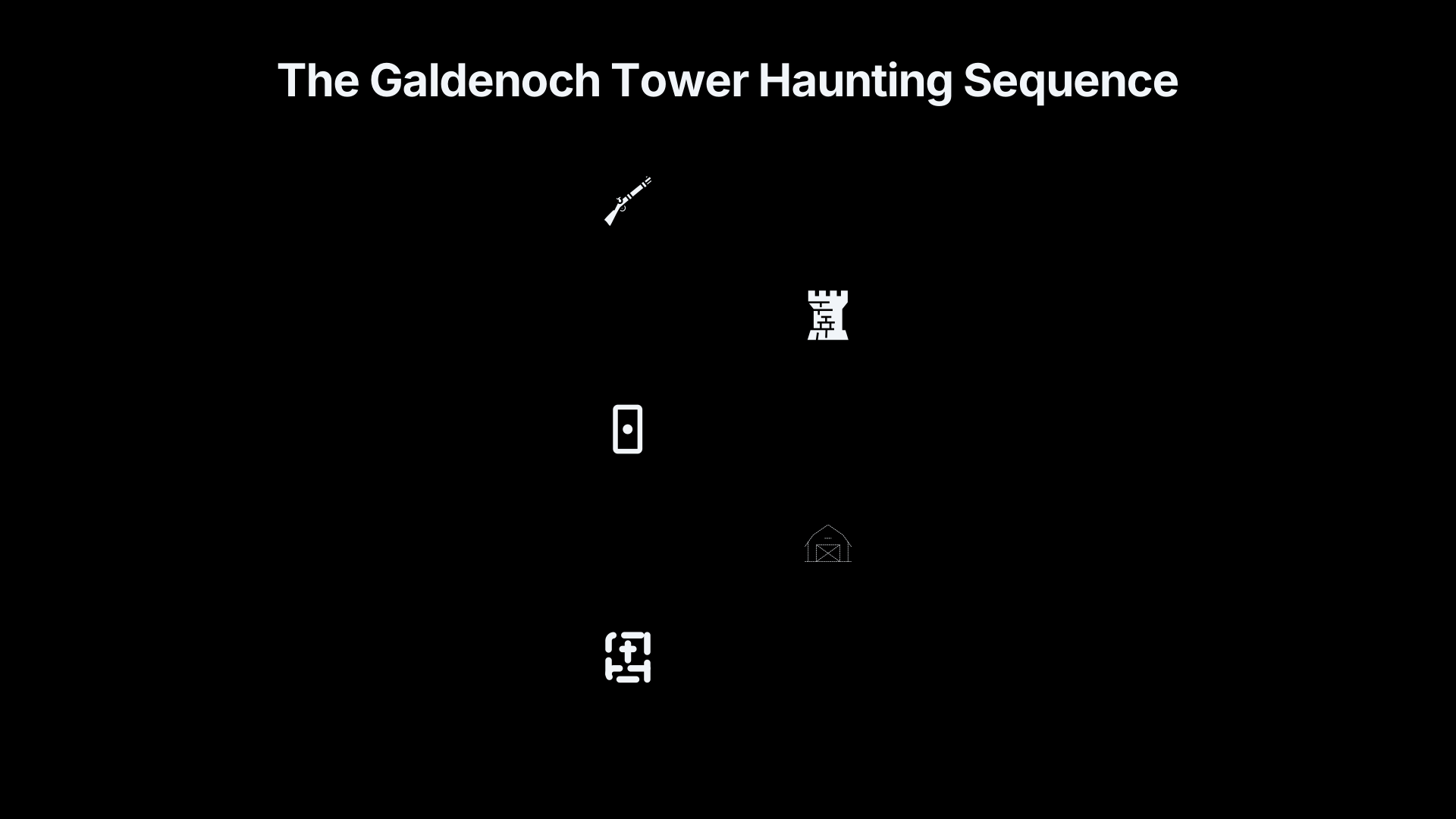
The story begins after a defeat in one of the Covenanting battles. A young Agnew, described as a “scion of the house”, asks for food and shelter at a house near the battlefield. His host, a Royalist sympathiser, lets him eat and sleep by the fire. In the morning, however, the host blocks his way and seems ready to detain him. The soldier, fearing capture, shoots the man dead, takes a horse and escapes westwards to Galdenoch.[Project Gutenberg]gutenberg.orgWitchcraft and Superstitious Record in the South-Western District of Scotland, by J. Maxwell Wood—A Project Gutenberg eBook…
That is where the haunting begins. Once the soldier reaches the tower, the household celebrates his return, but as soon as the lights are out, strange noises announce another arrival: the ghost of the man he has killed. The apparition is not a pale figure glimpsed on a stair. It is a disruptive, poltergeist-like presence, making sleep impossible and eventually making life unbearable for later tenants too.[Project Gutenberg]gutenberg.orgWitchcraft and Superstitious Record in the South-Western District of Scotland, by J. Maxwell Wood—A Project Gutenberg eBook…
The most vivid episodes turn the tower from a family refuge into a place of repeated punishment. In one scene, a glowing peat vanishes from the hearth and is found moments later in the thatch of a barn, starting a fire that the household barely contains. In another, the tenant’s mother is carried by an unseen force to the Mill-Isle burn; the ghost’s voice is said to announce that it has washed her and laid her out on a dyke to dry. Several neighbouring clergymen try and fail to “lay” the ghost before the Rev. Mr Marshall of Kirkcolm finally overcomes it by shouting it down.[Project Gutenberg]gutenberg.orgWitchcraft and Superstitious Record in the South-Western District of Scotland, by J. Maxwell Wood—A Project Gutenberg eBook…
For a haunted-Wigtownshire reader, the key point is not whether the apparition “really” walked. It is that Galdenoch turns a political killing into a domestic haunting. The Covenanting soldier is not simply a martyr or hero. He is also a man who kills a host under ambiguous pressure. The ghost therefore carries guilt as much as persecution. It is a story about civil conflict entering the house, sitting by the fire, following a man home, and refusing to stay buried.
Why Galdenoch is different from a simple castle ghost
Many Scottish tower-house legends involve murdered heirs, hidden treasure, secret tunnels or betrayed lovers. Galdenoch belongs to that world, but its emotional engine is sharper. The haunting does not grow from an ancient curse or a romantic tragedy. It grows from the religious and political split between Covenanters and Royalists: the very division that marked south-west Scotland in the seventeenth century.
That makes the ghost unusually morally complicated. The pursued soldier belongs to the persecuted side of the story, but the supernatural punishment falls on him and his household. The dead Royalist is not presented as noble, yet his ghost becomes the one that demands recognition. In folklore terms, the tale refuses a clean victory narrative. It suggests that violence committed in fear still leaves a trace.
The setting strengthens this effect. Galdenoch is not a grand royal fortress; it is a western Wigtownshire tower later surrounded by farm buildings and described by Trove as already ruined in the early twentieth century, with the ground floor once used as a byre. A haunted tower embedded in farm life makes the story feel local rather than theatrical. The ghost does not merely frighten aristocrats in a panelled chamber. It disturbs tenants, kitchens, barns, burns, firesides and ordinary labour.[Trove Scot]trove.scotScot Galdenoch Castle | Place | trove.scotScot Galdenoch Castle | Place | trove.scot
The story also sits naturally within Maxwell Wood’s wider Wigtownshire route of ghost lore. Immediately after Galdenoch, Wood moves through other western county apparitions: a headless woman near Stoneykirk, a white woman troubling a carrier near High Ardwell, and later Wigtown, Bladnoch, Sorbie, Whithorn and Glasserton. Galdenoch therefore works as a gateway haunting: it begins in the Rhinns and points the reader towards the more explicitly martyr-haunted landscapes around Wigtown and Bladnoch.[Project Gutenberg]gutenberg.orgWitchcraft and Superstitious Record in the South-Western District of Scotland, by J. Maxwell Wood—A Project Gutenberg eBook…
The Martyrs’ Stake as haunted memory
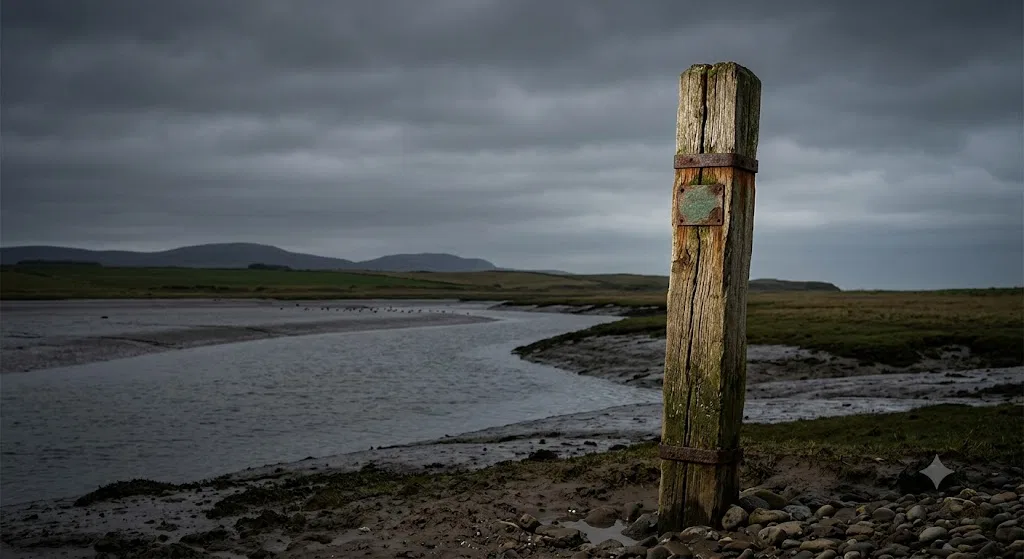
Wigtown’s Covenanting story is centred on the execution of Margaret Wilson and Margaret McLachlan, usually known as the Wigtown Martyrs or Solway Martyrs. The commonly repeated account says that the two women were tied to stakes in the tidal waters of the Bladnoch on 11 May 1685 and drowned for refusing the oath that renounced the Covenant. A younger girl, Agnes Wilson, was spared after her father promised a large bond.[Wigtown Booktown]wigtown-booktown.co.ukWigtown Booktown Wigtown Martyrs | Wigtown BooktownWigtown Booktown Wigtown Martyrs | Wigtown Booktown
This is not usually told as a conventional ghost story in which the two women appear on command at the water’s edge. Its power is different. It is a haunted site because the landscape itself has been made to remember: the stake near the traditional place of death, the graves in Wigtown churchyard, the Windy Hill monument, and the prison cell associated with their confinement before execution. Undiscovered Scotland describes three memorials in and around Wigtown: the Windy Hill monument, the kirkyard graves, and the more poignant memorials around the old kirk and town.[Undiscovered Scotland]undiscoveredscotland.co.ukUndiscovered Scotland Wigtown Martyrs Feature Page on Undiscovered ScotlandUndiscovered Scotland Wigtown Martyrs Feature Page on Undiscovered Scotland
The Windy Hill monument gives the public memory its most visible form. Historic Environment Scotland records it as a dated 1858 classical ashlar monument, with an inscription to the Wigtown Martyrs, “Covenanters who were drowned in the River Bladnoch (1685), or were hung”. The wording matters: the monument gathers the two drowned women and the three hanged men into one local martyrology, turning separate deaths into a shared Wigtownshire memory of persecution.[Historic Environment Scotland]portal.historicenvironment.scotOpen source on historicenvironment.scot.
For ghost folklore, the Martyrs’ Stake shows how a place can become eerie without needing a recurring apparition. The mudflats, tide and stake are already spectral images. The story asks the visitor to imagine the water rising slowly around bodies fixed in place, while the younger woman is said to have been made to watch the older woman die first. Wigtown Booktown’s local account preserves the tradition that a pardon had been issued in Edinburgh on 30 April 1685 but did not save the women, leaving the drowning surrounded by a sense of failed mercy and unresolved responsibility.[Wigtown Booktown]wigtown-booktown.co.ukWigtown Booktown Wigtown Martyrs | Wigtown BooktownWigtown Booktown Wigtown Martyrs | Wigtown Booktown
That unresolved quality is why the Martyrs’ Stake belongs in a haunted-history map of Wigtownshire. It is not “haunted” chiefly by a named spectre, but by a repeated public question: how could such a sentence be passed, who carried it out, and why did local memory keep returning to the water?
Wigtown’s accused men and the ghost of Provost Coltran
The Wigtown martyr story also produced darker folklore around the men associated with enforcement. Maxwell Wood singles out Provost Coltran, proprietor of Drummorall, as a figure who stood “in stronger relief” in the history of Wigtown. Wood says Coltran was appointed in 1683, along with David Graham and Sir Godfrey McCulloch, to administer the test to the people of Galloway, and that he was chief magistrate at the drowning of the Martyrs on Wigtown Sands on 11 May 1685.[Project Gutenberg]gutenberg.orgWitchcraft and Superstitious Record in the South-Western District of Scotland, by J. Maxwell Wood—A Project Gutenberg eBook…
The supernatural tradition around Coltran is fierce. Wood reports that people said he had sold himself to the Devil, that the windows of his house appeared to blaze at his death, and that his ghost later walked the earth as a terrifying figure “snorting fire from his nostrils”. His house, Wood adds, was avoided after nightfall for many years.[Project Gutenberg]gutenberg.orgWitchcraft and Superstitious Record in the South-Western District of Scotland, by J. Maxwell Wood—A Project Gutenberg eBook…
This is exactly the kind of moral haunting that often grows around persecution traditions. The victims are memorialised in stone; the official becomes demonised in story. Whether or not the details are historically fair to Coltran as an individual, the folklore tells us how later memory distributed blame. The drowned women became holy sufferers. The magistrate became a restless, fiery figure whose very house was contaminated by dread.
The contrast with Galdenoch is revealing. At Galdenoch, a Covenanting soldier is haunted by a Royalist he killed. At Wigtown, a man associated with coercive authority is haunted in reputation after the death of Covenanting martyrs. Both tales use ghosts to express a community’s sense that civil violence does not end when the body is buried or the legal sentence is complete.
Violence, guilt and the religious landscape
The Covenanting past gave Wigtownshire a set of haunted places that are not random. They cluster around thresholds: a fugitive’s overnight shelter, a tower reached after flight, a burgh prison, a tidal river, a graveyard, a monument on a hill, and a house avoided after dark. These are places where ordinary geography becomes morally charged.
The larger historical frame is the late seventeenth-century persecution of Covenanters, especially in south-west Scotland. Undiscovered Scotland notes that the Abjuration Oath became the government’s main weapon from December 1684, requiring Scots to renounce the Covenant on pain of death; it also describes south-west Scotland as a particular focus for Covenanters and their suppression. The Wigtown Martyrs’ story belongs to that “Killing Time”, but the Galdenoch ghost shows that the same conflict also entered local storytelling at the scale of the household and farm.[Undiscovered Scotland]undiscoveredscotland.co.ukUndiscovered Scotland Wigtown Martyrs Feature Page on Undiscovered ScotlandUndiscovered Scotland Wigtown Martyrs Feature Page on Undiscovered Scotland
The stories also show two different ways in which a county becomes haunted. Galdenoch is haunted by a claimed presence: noises, fire, assault, a voice, an attempted clerical exorcism. Wigtown is haunted by commemoration: inscriptions, annual retelling, controversy, graves, monuments and the physical memory of the tide. One is a poltergeist story; the other is a martyr landscape.
There is a credibility difference too. Galdenoch survives mainly as folklore, mediated through Maxwell Wood and Sir Andrew Agnew’s family tradition. The Wigtown Martyrs belong to a more documented but also more disputed historical field. Wigtown Booktown refers to Kirk Session records from Penninghame and Kirkinner; Cambridge’s abstract for A. M. Starkey’s article on Robert Wodrow notes that Wodrow’s 1721 History of the Sufferings of the Church of Scotland deeply embedded a dark picture of Presbyterian persecution in national consciousness, while also recording Mark Napier’s later fierce attack on Wodrow’s reliability.[Wigtown Booktown]wigtown-booktown.co.ukWigtown Booktown Wigtown Martyrs | Wigtown BooktownWigtown Booktown Wigtown Martyrs | Wigtown Booktown
For readers of haunted history, that dispute should not flatten the story. It should sharpen it. Wigtown’s Covenanting memory is powerful partly because it sits between record, martyrology, sectarian argument, local commemoration and folklore. The haunting is the persistence of the question as much as the apparition.
How to read these stories today
The best way to understand Covenanting ghosts in Wigtownshire is to hold two ideas together. First, these are not neutral spooky tales detached from history. They are rooted in a landscape where religious allegiance, state power, family loyalty and fear of betrayal could have deadly consequences. Secondly, they are not straightforward evidence for supernatural events. They are traditions, memorial stories and local claims that reveal how communities gave shape to guilt and suffering.
Galdenoch Tower gives the most dramatic ghost: the pursued soldier who reaches safety, only to find that the man he killed has arrived before sleep. The Martyrs’ Stake gives the strongest haunted memory: a place where the rising tide became the central image of Wigtownshire’s Covenanting suffering. Provost Coltran’s fiery ghost adds a third element, showing how blame itself can become spectral in local tradition.[gutenberg.org]gutenberg.orgProject GutenbergWitchcraft and Superstitious Record in the South-Western District of Scotland, by J. Maxwell Wood—A Project Gutenberg eBook…
Together, they make a compact but distinctive haunted route across western Wigtownshire: from the ruined Agnew tower in Leswalt, through the religious violence of the “Killing Time”, to Wigtown’s monuments, graves and tidal edge. The result is not a county of theatrical apparitions alone, but a landscape where ghost stories and martyr memory do the same work: they insist that the past has not quite left the room.
Amazon book picks
Further Reading
Books and field guides related to Why Do Covenanting Stories Haunt Wigtownshire?. Use these as the next step if you want deeper reading beyond the article.
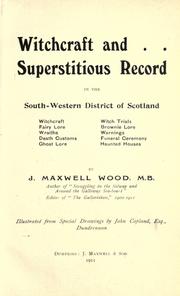
Witchcraft and superstitious record in the south-western dist...
Primary source for regional supernatural traditions.
The Mammoth Book of Haunted House Stories
First published 2000. Subjects: ghost stories, haunted house stories, ghost story anthology, Ghost stories.
eBay marketplace picks
Marketplace Samples
Live-tested eBay searches with available results related to this page.



Endnotes
1.
Source: gutenberg.org
Title: Project Gutenberg
Link:https://www.gutenberg.org/files/43966/43966-h/43966-h.htm
Source snippet
Witchcraft and Superstitious Record in the South-Western District of Scotland, by J. Maxwell Wood—A Project Gutenberg eBook...
2.
Source: trove.scot
Title: Scot Galdenoch Castle | Place | trove.scot
Link:https://www.trove.scot/place/60378
3.
Source: cambridge.org
Link:https://www.cambridge.org/core/journals/church-history/article/robert-wodrow-and-the-history-of-the-sufferings-of-the-church-of-scotland/72D8AA37DC0A6B757F19E60BC424DE73
4.
Source: persecution.com
Title: Margaret Wilson and Margaret Mac Lachlan
Link:https://www.persecution.com/stories/margaret-wilson-and-margaret-maclachlan/
5.
Source: youtube.com
Title: The Wigtown Martyrs | Scotland’s History
Link:https://www.youtube.com/watch?v=DuozY6h7fgQ
Source snippet
The Wigtown Martyrs - Why were these two women drowned at the stake?...
6.
Source: youtube.com
Title: The Wigtown Martyrs
Link:https://www.youtube.com/watch?v=OXbZr-Xlw60
Source snippet
Wigtown Martyrs 340 Years On...
7.
Source: wigtown-booktown.co.uk
Title: Wigtown Booktown Wigtown Martyrs | Wigtown Booktown
Link:https://www.wigtown-booktown.co.uk/wigtown-martyrs/
8.
Source: undiscoveredscotland.co.uk
Title: Undiscovered Scotland Wigtown Martyrs Feature Page on Undiscovered Scotland
Link:https://www.undiscoveredscotland.co.uk/wigtown/martyrs/index.html
9.
Source: portal.historicenvironment.scot
Link:https://portal.historicenvironment.scot/apex/f?p=1505%3A300%3A%3A%3A%3A%3AVIEWTYPE%2CVIEWREF%3Adesignation%2CLB13491
10.
Source: portal.historicenvironment.scot
Link:https://portal.historicenvironment.scot/apex/f?p=1505%3A300%3A%3A%3A%3A%3AVIEWTYPE%2CVIEWREF%3Adesignation%2CLB42442
11.
Source: facebook.com
Title: Galdenoch Castle
Link:https://www.facebook.com/groups/1374585613358260/posts/1551458432337643/
12.
Source: portal.historicenvironment.scot
Link:https://portal.historicenvironment.scot/apex/f?p=1505%3A300%3A%3A%3A%3A%3AVIEWTYPE%2CVIEWREF%3Adesignation%2CSM1982
13.
Source: freepages.rootsweb.com
Link:https://freepages.rootsweb.com/~ainsty/history/articles/humour/ghost.html
14.
Source: Wikipedia
Title: Wigtown Martyrs
Link:https://en.wikipedia.org/wiki/Wigtown_Martyrs
15.
Source: Wikipedia
Title: Galdenoch Castle
Link:https://en.wikipedia.org/wiki/Galdenoch_Castle
16.
Source: paranormalscholar.com
Title: Witchcraft and Superstitious Record
Link:https://www.paranormalscholar.com/wp-content/uploads/2018/11/Witchcraft-and-Superstitious-Record-in-the-South-Western-District-of-Scotland-J.-Maxwell-Wood-1911.pdf
17.
Source: britainexpress.com
Title: wigtown martyrs
Link:https://www.britainexpress.com/scotland/Dumfries-Galloway/properties/wigtown-martyrs.htm
Additional References
18.
Source: facebook.com
Link:https://www.facebook.com/groups/2683053621814578/posts/8478095788976970/
19.
Source: facebook.com
Link:https://www.facebook.com/100042248899008/videos/agnew-monument-leswalt-the-agnew-monument-is-found-the-site-of-an-iron-age-hillf/156762166605235/
20.
Source: facebook.com
Link:https://www.facebook.com/groups/739179902901018/posts/2974162669402719/
21.
Source: iwm.org.uk
Link:https://www.iwm.org.uk/memorials/item/memorial/79276
22.
Source: sobt.co.uk
Link:https://sobt.co.uk/galdenoch-castle/
23.
Source: castle-finders.co.uk
Link:https://castle-finders.co.uk/Scotland/galdenoch%2520tower.html
24.
Source: electricscotland.com
Link:https://electricscotland.com/history/covenanters/gallowaycovenant00mort.pdf
25.
Source: canmore.org.uk
Link:https://canmore.org.uk/site/232548/meikle-galdenoch-farmhouse?display=image
26.
Source: ratedtrips.com
Link:https://www.ratedtrips.com/walks/dumfries-galloway/on-the-trail-of-the-wigtown-martyrs
27.
Source: facebook.com
Link:https://www.facebook.com/groups/scotlandsscenery/posts/4707793015906701/
Topic Tree