Within Haunted Radnorshire
Radnorshire's Strangest Farm Haunting
The Llangunllo farm story is Radnorshire's clearest printed haunting, with a household spirit said to throw tools, books and stones.
On this page
- What Wirt Sikes recorded
- How the disturbances unfold
- Folklore, witnesses and credibility
Page outline Jump by section
Introduction
The Llangunllo farm haunting is Radnorshire’s most sharply printed old ghost case: a nineteenth-century account of a rural household spirit said to snatch a threshing flail, disturb knitting and yarn, smash crockery, throw a prayer book, hurl stones and iron, and finally burn the farmhouse down. The story was preserved by Wirt Sikes in British Goblins, his 1880 collection of Welsh folklore, and is set on the farm of Edward Roberts in the parish of Llangunllo, west of Knighton.[Project Gutenberg]gutenberg.orgAs the servant-man wasProject GutenbergBritish Goblins Welsh Folk-lore, Fairy Mythology, Legends…On the farm of Edward Roberts, in the parish of Llangunllo…
What makes the case memorable is not proof of a ghost, but detail. It reads less like a romantic apparition and more like a household poltergeist tradition, with work tools, domestic objects, neighbours, prayer, market-road gossip and a ruined building all folded into one local narrative. For Radnorshire’s haunted history, it matters because the claim is unusually specific: a named parish, a named farmer, a sequence of disturbances, and a visible end-point said to have been remembered by people travelling to and from Knighton market.[Heyzine]cdnc.heyzine.comBRITISH GOBLINS Welsh Folklore, Fairy Mythology,Llangunllo, in Radnorshire, there was a spirit whose antics were somewhat remarkable. As the servant-man was.Read more…
Where the Llangunllo story sits in Radnorshire
Llangunllo, also rendered Llangynllo, is a village and parish in historic Radnorshire, now within Powys. Local and gazetteer sources place it around five miles west of Knighton, on the River Lugg and near the B4356 route between Llanbister and Presteigne.[Wikishire]wikishire.co.ukOpen source on wikishire.co.uk.
That geography matters to the haunting. Sikes’s version does not place the story in an unnamed “Welsh farmhouse” but in a working Radnorshire parish with a practical connection to Knighton. The final image of the account is especially local: the burnt remains, with walls and two chimneys standing, were said to have greeted travellers going to and from Knighton market.[Heyzine]cdnc.heyzine.comBRITISH GOBLINS Welsh Folklore, Fairy Mythology,Llangunllo, in Radnorshire, there was a spirit whose antics were somewhat remarkable. As the servant-man was.Read more…
The historic-county frame is also important. Radnorshire was one of Wales’s thirteen historic counties, created in the sixteenth-century reorganisation of the Welsh Marches; modern Powys was formed much later, in 1974, from the old counties of Montgomeryshire, Radnorshire and Brecknockshire.[Data Map Wales]datamap.gov.walesData Map Wales Historic County Boundaries of WalesData Map Wales Historic County Boundaries of Wales For older ghost stories, parish names, market routes and county labels often preserve the world in which the tale circulated more accurately than modern council boundaries do.
What Wirt Sikes recorded
Sikes presents the Llangunllo case in the “Spirit-World” portion of British Goblins: Welsh Folk-Lore, Fairy Mythology, Legends and Traditions, first published in 1880. The Internet Archive record identifies the original London edition as a 412-page folklore volume by Wirt Sikes, published by Sampson Low, Marston, Searle & Rivington.[Internet Archive]archive.orgInternet ArchiveBritish goblins: Welsh folk-lore, fairy mythology, legends…29 May 2007 — British goblins: Welsh folk-lore, fairy myt…
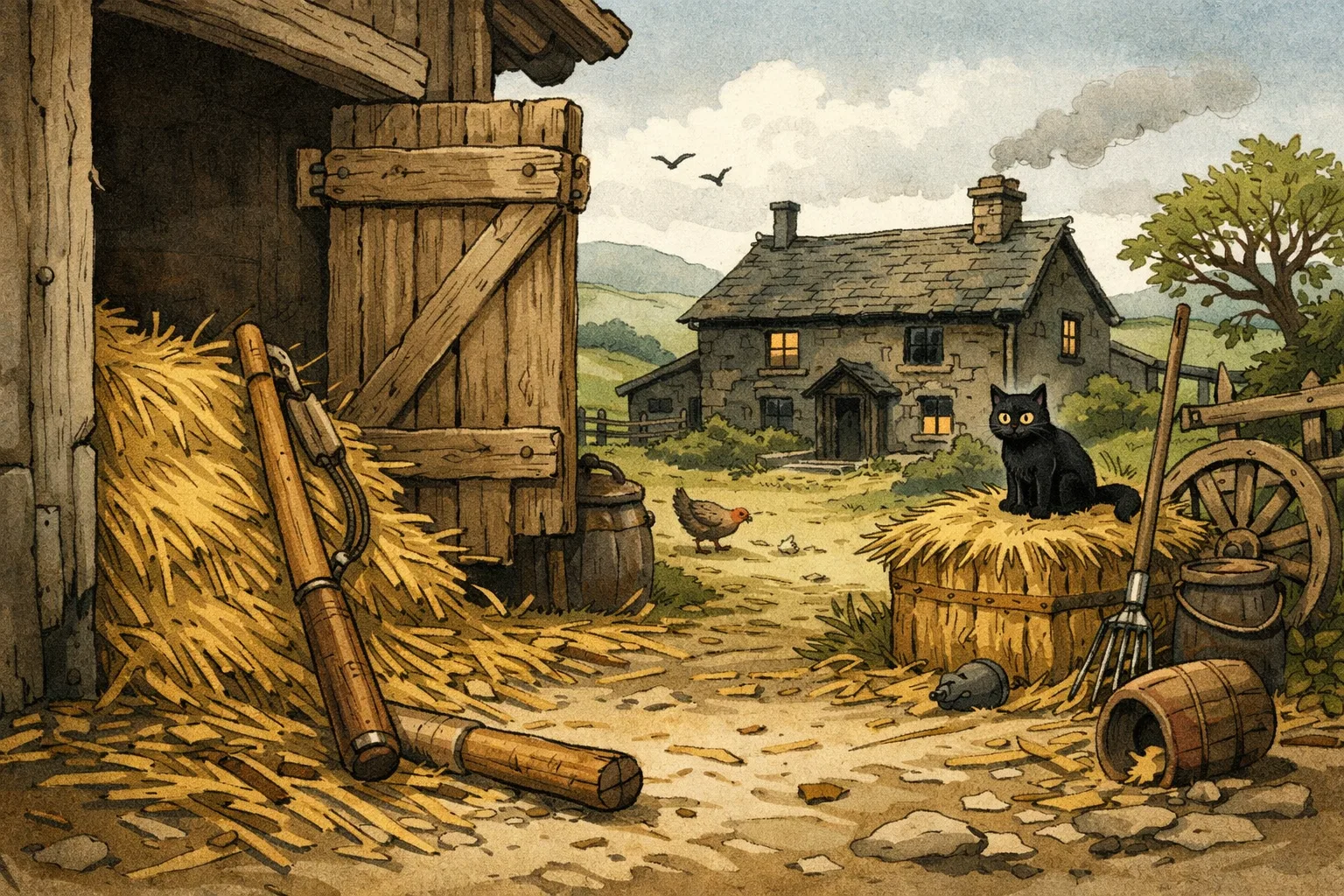
The account begins with ordinary farm work. A servant-man is threshing when the “threshel” or flail is allegedly taken from his hand and thrown into the hayloft. At first he treats it as a nuisance, but after the trick is repeated several times he goes into the house to report it. The farmer, Edward Roberts, is away; the wife and maid-servant laugh and go to the barn to protect him.[Heyzine]cdnc.heyzine.comBRITISH GOBLINS Welsh Folklore, Fairy Mythology,Llangunllo, in Radnorshire, there was a spirit whose antics were somewhat remarkable. As the servant-man was.Read more…
The mockery does not last. While the women sit in the barn, one knitting and the other winding yarn, their things are said to be pulled from their hands and thrown about. When they return to the house, the disturbance follows: dishes move on the shelves, crockery falls to the stone floor, and by the next morning broken ware is scattered so thickly that the household can hardly walk without stepping on it.[Heyzine]cdnc.heyzine.comBRITISH GOBLINS Welsh Folklore, Fairy Mythology,Llangunllo, in Radnorshire, there was a spirit whose antics were somewhat remarkable. As the servant-man was.Read more…
The case then becomes public. Sikes says neighbours came to see, and that visitors arrived from as far as Knighton. One man from Knighton came to read prayers to exorcise the spirit, only for the book to be snatched from his hand and thrown upstairs. Later episodes include stones thrown at people, iron projected from the chimney, and the final fire that destroys the house.[Heyzine]cdnc.heyzine.comBRITISH GOBLINS Welsh Folklore, Fairy Mythology,Llangunllo, in Radnorshire, there was a spirit whose antics were somewhat remarkable. As the servant-man was.Read more…
How the disturbances unfold
The Llangunllo story has the rhythm of a classic domestic poltergeist claim: a small unexplained interference, then repeated object movement, then social attention, then religious intervention, then destructive escalation. The pattern is one reason the account stands out from Radnorshire’s more atmospheric place-legends.
The first stage is workplace disruption. The spirit does not begin with a death omen or a visible figure, but by interfering with a farm servant’s labour. The flail is a telling object: threshing was repetitive, noisy, physical work, and the interruption turns a normal barn task into a scene of helplessness.[Heyzine]cdnc.heyzine.comBRITISH GOBLINS Welsh Folklore, Fairy Mythology,Llangunllo, in Radnorshire, there was a spirit whose antics were somewhat remarkable. As the servant-man was.Read more…
The second stage is domestic embarrassment. The women enter the barn confidently, but their knitting and yarn are disturbed. This moves the claim from male farm labour into the household economy: not a grand supernatural visitation, but a force meddling with the everyday work of keeping a rural home running.[Heyzine]cdnc.heyzine.comBRITISH GOBLINS Welsh Folklore, Fairy Mythology,Llangunllo, in Radnorshire, there was a spirit whose antics were somewhat remarkable. As the servant-man was.Read more…
The third stage is damage inside the house. Crockery on shelves, dishes on a stone floor, broken fragments underfoot: these are the details that make the narrative feel like a lived household crisis rather than a distant legend. The story’s terror comes from familiar objects behaving wrongly.[Heyzine]cdnc.heyzine.comBRITISH GOBLINS Welsh Folklore, Fairy Mythology,Llangunllo, in Radnorshire, there was a spirit whose antics were somewhat remarkable. As the servant-man was.Read more…
The fourth stage is public testing. Neighbours and visitors come to watch, which is crucial for folklore. A private fright becomes a communal event. The arrival of a man from Knighton to read prayers gives the story a social witness-structure, even though Sikes does not provide names, dates, sworn testimony or parish documentation for independent verification.[Heyzine]cdnc.heyzine.comBRITISH GOBLINS Welsh Folklore, Fairy Mythology,Llangunllo, in Radnorshire, there was a spirit whose antics were somewhat remarkable. As the servant-man was.Read more…
The final stage is catastrophe and memory. The spirit allegedly sets the house on fire; nothing can quench it; only walls and two chimneys remain. Whether read as haunting, moral tale, village rumour or embellished tradition, that ending explains why the story would have lasted: a ruin beside a market route makes a convenient landmark for repetition.[Heyzine]cdnc.heyzine.comBRITISH GOBLINS Welsh Folklore, Fairy Mythology,Llangunllo, in Radnorshire, there was a spirit whose antics were somewhat remarkable. As the servant-man was.Read more…
Why this is closer to a poltergeist claim than an apparition story
Many ghost stories centre on a figure: a white lady, a murdered man, a monk, a spectral coach. The Llangunllo case is different. Sikes does not describe a visible ghost at all. The “spirit” is known through physical disturbance: objects are snatched, moved, broken, thrown or burned.[Heyzine]cdnc.heyzine.comBRITISH GOBLINS Welsh Folklore, Fairy Mythology,Llangunllo, in Radnorshire, there was a spirit whose antics were somewhat remarkable. As the servant-man was.Read more…
That makes the story especially useful for readers interested in Radnorshire’s haunted places because it shows a different kind of supernatural tradition. The fear is not that someone sees the dead, but that the household itself becomes unstable. Barn, kitchen, shelves, chimney, prayer book and crockery all become part of the haunting.
Sikes places the Llangunllo episode alongside other Welsh spirit-world accounts involving stone-throwing, noisy disturbance and household persecution. Immediately before the Llangunllo passage, he summarises a Caernarfonshire case in which stones were thrown into a house and clergymen came to read prayers; after Llangunllo, he moves to another domestic haunting in Glamorganshire.[Heyzine]cdnc.heyzine.comBRITISH GOBLINS Welsh Folklore, Fairy Mythology,Llangunllo, in Radnorshire, there was a spirit whose antics were somewhat remarkable. As the servant-man was.Read more… This placement suggests Sikes saw the Radnorshire story not as an isolated marvel, but as part of a wider Welsh category of troublesome household spirits.
A modern database of ghost and folklore reports also classifies the Edward Roberts farm case as a poltergeist and notes the same basic sequence: objects snatched from hands, crockery smashed, a prayer book or Bible pulled away, and the house eventually burned.[Paranormal Database]paranormaldatabase.comOpen source on paranormaldatabase.com. That modern listing is secondary and derivative, but it shows how the case continues to be remembered in exactly that poltergeist frame.
Folklore, witnesses and credibility
The strongest source for the Llangunllo haunting is also the main limitation: Wirt Sikes. He was an important nineteenth-century collector and populariser of Welsh supernatural lore, but British Goblins is a Victorian folklore collection, not a police file, court record or modern psychical investigation. Project Gutenberg and the Internet Archive identify the book clearly, while later discussion of the volume notes both its importance and its dependence on earlier folklore material and uneven sourcing.[gutenberg.org]gutenberg.orgOpen source on gutenberg.org.
The account contains several credibility-strengthening details. It names Edward Roberts, gives the parish as Llangunllo, connects the audience to Knighton, and describes a chain of events rather than a single vague apparition. It also fits the social mechanics of rural marvels: a servant reports trouble, household members test it, neighbours gather, outsiders arrive, a religious reader attempts intervention, and the story ends with a visible ruin.[Heyzine]cdnc.heyzine.comBRITISH GOBLINS Welsh Folklore, Fairy Mythology,Llangunllo, in Radnorshire, there was a spirit whose antics were somewhat remarkable. As the servant-man was.Read more…
Yet the evidential gaps are just as important. Sikes does not provide a precise date for the haunting, identify the farm by a surviving modern name, cite parish records, reproduce signed witness statements, or explain how he obtained the story. The later Paranormal Database entry says the farm is no longer standing, but that is a modern summary, not independent proof of the original event.[Paranormal Database]paranormaldatabase.comOpen source on paranormaldatabase.com.
The fairest reading is therefore cautious. The Llangunllo case is strong as a printed Radnorshire haunting tradition, strong as an example of nineteenth-century Welsh poltergeist folklore, and weak as proof of a supernatural event. Its value lies in what it reveals about local memory: how a rural disturbance story could attach itself to a named parish, a market route, domestic labour, religious intervention and a ruin.

What might explain the story without proving or disproving it?
A sceptical reading does not have to flatten the tale into “nothing happened”. Several ordinary mechanisms could have helped create or preserve it, even if some incident lay behind the tradition.
The first possibility is escalating household rumour. In a small rural parish, damage to crockery, a troublesome servant, a barn accident or a fire could become a supernatural story as neighbours repeated it. Llangunllo’s own community history emphasises a small village tied closely to surrounding farms, the kind of setting where a dramatic domestic event could travel quickly through personal networks.[Llangunllo]llangunllo.co.ukLlangunllo Welcome to LlangunlloLlangunllo Welcome to Llangunllo
The second is performance and mischief. Poltergeist traditions often revolve around objects moving when attention is high and proof is low. Sikes’s account includes servants, domestic work, laughter, embarrassment and visitors. That does not prove fraud, but it does mean the story belongs to a type of haunting in which social pressure and expectation can shape what people report.
The third is retrospective ruin-lore. The burnt walls and chimneys are the story’s most powerful image. If a farmhouse really did burn down, later memory may have explained the ruin through the spirit narrative. The line about travellers to Knighton market seeing the remains gives the haunting a public anchor: a physical place that people could point to long after any original witnesses had gone.[Heyzine]cdnc.heyzine.comBRITISH GOBLINS Welsh Folklore, Fairy Mythology,Llangunllo, in Radnorshire, there was a spirit whose antics were somewhat remarkable. As the servant-man was.Read more…
The fourth is religious framing. The attempted reading of prayers is not a decorative detail. It tells us that the disturbance was understood through a moral and spiritual world in which prayer, exorcism and public seriousness still had explanatory force. In the story, even the prayer book is defeated, which intensifies the sense that the household has slipped beyond ordinary control.[Heyzine]cdnc.heyzine.comBRITISH GOBLINS Welsh Folklore, Fairy Mythology,Llangunllo, in Radnorshire, there was a spirit whose antics were somewhat remarkable. As the servant-man was.Read more…
Why the Llangunllo farm spirit still matters
The Llangunllo haunting is not famous because it has modern ghost-tour branding or dramatic photographs. It matters because it is one of the clearest old printed examples of a Radnorshire haunting with a full narrative shape. Many county ghost stories survive as a name, a road, a glimpse or a rumour. This one has a beginning, escalation, witnesses-by-implication, a failed religious remedy and a destructive ending.
It also gives Radnorshire’s haunted map a distinct rural texture. Instead of a castle spectre or an inn apparition, the scene is a working farm: threshing in the barn, women with yarn, dishes on shelves, neighbours arriving, and market travellers later passing the ruin. That makes the story feel rooted in the social life of the old county rather than pasted onto it.
For readers exploring Radnorshire’s ghost lore, Llangunllo is best treated as a case page rather than a solved mystery. The known evidence points to a nineteenth-century printed folklore account preserved by Sikes; the story itself claims a much more vivid haunting on Edward Roberts’s farm; and the gap between those two things is where its fascination lies. It is eerie, local, unusually concrete, and still resistant to certainty.
Amazon book picks
Further Reading
Books and field guides related to Radnorshire's Strangest Farm Haunting. Use these as the next step if you want deeper reading beyond the article.

The Mammoth Book of Haunted House Stories
Suitable companion reading for domestic haunting themes.

eBay marketplace picks
Marketplace Samples
Live-tested eBay searches with available results related to this page.
Endnotes
1.
Source: gutenberg.org
Title: As the servant-man was
Link:https://www.gutenberg.org/files/34704/34704-h/34704-h.htm
Source snippet
Project GutenbergBritish Goblins Welsh Folk-lore, Fairy Mythology, Legends...On the farm of Edward Roberts, in the parish of Llangunllo...
2.
Source: archive.org
Link:https://archive.org/details/britishgoblinswe00sikerich
Source snippet
Internet ArchiveBritish goblins: Welsh folk-lore, fairy mythology, legends...29 May 2007 — British goblins: Welsh folk-lore, fairy myt...
Published: May 2007
3.
Source: cdnc.heyzine.com
Title: BRITISH GOBLINS Welsh Folklore, Fairy Mythology,
Link:https://cdnc.heyzine.com/files/uploaded/v2/4c9720389a14c5a0db1c6b137a277b5ef93e4ccd.pdf
Source snippet
Llangunllo, in Radnorshire, there was a spirit whose antics were somewhat remarkable. As the servant-man was.Read more...
4.
Source: gutenberg.org
Link:https://www.gutenberg.org/ebooks/34704
5.
Source: gutenberg.org
Link:https://www.gutenberg.org/ebooks/34704.epub.images
6.
Source: gutenberg.org
Link:https://www.gutenberg.org/cache/epub/34704/pg34704.rdf
7.
Source: gutenberg.org
Link:https://www.gutenberg.org/ebooks/55025.epub.images
8.
Source: ia801802.us.archive.org
Link:https://ia801802.us.archive.org/15/items/britishgoblinswe00sikeuoft/britishgoblinswe00sikeuoft.pdf
9.
Source: archive.org
Link:https://archive.org/download/britishgoblinswe00sikerich/britishgoblinswe00sikerich.pdf
10.
Source: ia800109.us.archive.org
Link:https://ia800109.us.archive.org/21/items/britishgoblinswe00sikerich/britishgoblinswe00sikerich.pdf
11.
Source: wikishire.co.uk
Link:https://wikishire.co.uk/wiki/Llangunllo
12.
Source: datamap.gov.wales
Title: Data Map Wales Historic County Boundaries of Wales
Link:https://datamap.gov.wales/layers/geonode%3Ahistoric_counties_bng_rcahmw_ply
13.
Source: Wikipedia
Title: British Goblins
Link:https://en.wikipedia.org/wiki/British_Goblins
14.
Source: paranormaldatabase.com
Link:https://www.paranormaldatabase.com/wales/Powys.php?pageNum_paradata=1
15.
Source: llangunllo.co.uk
Title: Llangunllo Welcome to Llangunllo
Link:https://llangunllo.co.uk/
16.
Source: facebook.com
Link:https://www.facebook.com/Llangunllo/
17.
Source: llangunllo.co.uk
Link:https://llangunllo.co.uk/history-of-llangunllo/
18.
Source: llangunllo.co.uk
Link:https://llangunllo.co.uk/llangynllo-a-brief-moment-in-time/
19.
Source: Wikipedia
Link:https://en.wikipedia.org/wiki/Llangunllo
20.
Source: Wikipedia
Link:https://en.wikipedia.org/wiki/Radnorshire
21.
Source: genuki.org.uk
Link:https://www.genuki.org.uk/big/wal/RAD/Llangynllo
22.
Source: wikishire.co.uk
Link:https://wikishire.co.uk/wiki/Radnorshire
23.
Source: scribd.com
Link:https://www.scribd.com/document/771787745/British-Goblins
24.
Source: heneb.org.uk
Link:https://heneb.org.uk/archive/cpat/ycom/radnor/llangunllo.pdf
25.
Source: discovery.nationalarchives.gov.uk
Link:https://discovery.nationalarchives.gov.uk/details/a?_ref=210
26.
Source: tinstaafl.co.uk
Link:https://www.tinstaafl.co.uk/eandwhmi/radnorshire/church%20pages/llangunllo.htm
27.
Source: llangunllobleddfa.wordpress.com
Link:https://llangunllobleddfa.wordpress.com/about/llangunllo/
28.
Source: datamap.gov.wales
Title: metadata detail
Link:https://datamap.gov.wales/layers/geonode%3Ahistoric_counties_bng_rcahmw_ply/metadata_detail
Additional References
29.
Source: youtube.com
Title: Ghosts, Bogies, Fairies, Goblins! | Welsh Witchcraft & Folklore
Link:https://www.youtube.com/watch?v=To9j9177yHA
Source snippet
When Evil Spirits Attack: Demonic Hellfire Strikes a Welsh Mansion...
30.
Source: youtube.com
Link:https://www.youtube.com/watch?v=JAy11Q16iE4
Source snippet
Ghosts, Bogies, Fairies, Goblins! | Welsh Witchcraft & Folklore...
31.
Source: youtube.com
Title: When Evil Spirits Attack: Demonic Hellfire Strikes a Welsh Mansion
Link:https://www.youtube.com/watch?v=Ya7uSBkEKE0
Source snippet
Did You Know Fairies Were This Sinister?...
32.
Source: kobo.com
Link:https://www.kobo.com/in/en/ebook/british-goblins-welsh-folk-lore-fairy-mythology-legends-and-traditions-5?srsltid=AfmBOoo9MN8uyBOFddiyCb9GX4-VwFgEiSxoXQkdGZHfGjTSnF0ri8-i
33.
Source: goodreads.com
Link:https://www.goodreads.com/en/book/show/12150102-british-goblins
34.
Source: amazon.co.uk
Link:https://www.amazon.co.uk/British-Goblins-Folk-lore-Mythology-Traditions-ebook/dp/B018PKXUIU?tag=searcht-20
35.
Source: globalgreyebooks.com
Link:https://www.globalgreyebooks.com/british-goblins-ebook.html
36.
Source: gazetteer.org.uk
Link:https://gazetteer.org.uk/place/Llangunllo_C%2C_Radnorshire_317228
37.
Source: heneb.org.uk
Link:https://heneb.org.uk/archive/cpat/ycom/radnor/CPAT1088int.pdf
38.
Source: familysearch.org
Link:https://www.familysearch.org/en/wiki/Llangynllo%2C_Cardiganshire%2C_Wales_Genealogy
Topic Tree