Within Haunted Kirkcudbrightshire
How Did Kirkcudbright Become a Haunted Town?
MacLellan's Castle, the Tolbooth and nearby town landmarks show how Kirkcudbright turns historic buildings into haunted heritage.
On this page
- Mac Lellan's Castle and the laird's lug
- Tolbooth prison atmosphere and ghost tour culture
- What heritage storytelling adds and leaves uncertain
Page outline Jump by section
Introduction
Kirkcudbright’s haunted reputation is less about one ancient, securely documented ghost than about the way a compact historic town turns stone buildings, old punishments and guided storytelling into eerie heritage. The core places are MacLellan’s Castle, with its laird’s lug and later “dark servant” legend; the Tolbooth, whose real prison history gives ghost walks a powerful setting; and nearby cultural landmarks such as Broughton House, where modern events can frame Galloway’s supernatural tales in candlelit, heritage-rich surroundings. The result is a town-haunt tradition that sits between folklore, architecture and tourism. The stories should be read as claims and legends rather than proven hauntings, but their locations are real, visitable and historically suggestive: ruined castle rooms, former cells, court buildings, High Street closes and museum spaces, all within the old county world of Kirkcudbrightshire, or the Stewartry of Kirkcudbright.[wikishire.co.uk]wikishire.co.ukOpen source on wikishire.co.uk.
Why Kirkcudbright works as a haunted town
Kirkcudbright is a small place with a dense historical centre. That matters for ghost-tour culture because the visitor does not need to travel far to move from a late sixteenth-century castle ruin to a seventeenth-century tolbooth, an old court-and-prison complex, an artists’ house and the riverside townscape. The buildings are close enough for stories to overlap: the castle supplies aristocratic secrecy and vaults, the Tolbooth supplies confinement and punishment, and the modern artists’ town supplies the visitor economy that keeps these stories circulating.
The town also sits inside historic Kirkcudbrightshire, the old Stewartry on the north coast of the Solway Firth. Modern maps usually place it in Dumfries and Galloway, but haunted-history projects work best when they respect older counties, parishes and estate networks, because folklore often follows older local identities rather than current council boundaries. Kirkcudbright’s ghostly image therefore belongs both to the living town and to the broader Stewartry tradition of castles, prisons, witchcraft memory, Covenanter stories and rural supernatural lore.[Wikishire]wikishire.co.ukOpen source on wikishire.co.uk.
What makes Kirkcudbright distinctive is the balance between hard architecture and soft legend. MacLellan’s Castle and the Tolbooth are not invented “haunted attractions”; they are protected historic places with documented civic, domestic and penal histories. The supernatural layer is thinner and more interpretive. It depends on guide narration, local retellings, atmosphere, and the reader’s willingness to see how old rooms acquire new meanings after dark.
MacLellan’s Castle and the laird’s lug
MacLellan’s Castle is the natural starting point for Kirkcudbright castle legends because it looks like a fortress but was designed largely as a fashionable townhouse. Historic Environment Scotland describes it as the remains of Sir Thomas MacLellan’s late sixteenth-century tower house, built after he acquired former Greyfriars land following the Protestant Reformation. By 1582 it was complete enough for Sir Thomas to move in, and in 1587 he and his wife Grissel entertained James VI there.[Historic Environment Scotland]historicenvironment.scotOpen source on historicenvironment.scot.
That historical setting gives the castle its first haunted quality: it is a ruin of status, surveillance and decline. Historic Environment Scotland stresses that the building reflects a shift away from heavily defended medieval towers towards comfort and display. It retained some gun holes and defensive details, but its design was more about domestic prestige than resisting armies. The family’s fortunes later collapsed, and by 1742 a descendant, William MacLellan, Lord Kirkcudbright, was working as a glove maker in Edinburgh; the house was stripped of roof and contents before coming into state care in 1912.[Historic Environment Scotland]historicenvironment.scotOpen source on historicenvironment.scot.
The most important physical feature for ghost-tour storytelling is the laird’s lug, literally the “lord’s ear”. Behind the great hall fireplace is a hidden closet from which the master of the house could listen to guests in the hall. This is not a ghost story in itself; it is a documented architectural survival. Yet it is exactly the sort of feature that makes a castle feel uncanny. A room designed for secret listening turns ordinary hospitality into something more suspicious. It lets a guide talk about power, mistrust and the unseen watcher without needing to claim that anything supernatural definitely happened.[Historic Environment Scotland]historicenvironment.scotOpen source on historicenvironment.scot.
The laird’s lug also helps explain why MacLellan’s Castle lends itself to haunted heritage more than to a single fixed apparition. The building’s eerie charge comes from its mechanics: hidden space, overheard speech, vaulted lower rooms, an empty great hall and the knowledge that domestic comfort and control once shared the same walls. For a visitor, that can be more memorable than a named spectre. The castle asks a simple question: who might have been listening?
The “dark servant” legend
The darker legend attached to MacLellan’s Castle is usually told as the story of a servant tested by Sir Thomas MacLellan. In modern retellings, the laird locks the servant overnight in the castle vaults, supposedly to prove his courage in a place already rumoured to be haunted. By morning the servant is found dead, his face fixed in terror, and the lower parts of the castle are later associated with strange noises, cold gusts and uneasy sensations.[Galloway View]gallowayview.co.ukGalloway View Spooky Stories and Haunted Places of GallowayGalloway View Spooky Stories and Haunted Places of Galloway
This tale has the shape of a classic castle haunting: a powerful master, a vulnerable servant, a dare or punishment, a night spent below stairs, and a death that leaves the building morally stained. It also fits the architecture. The stone-vaulted ground floor at MacLellan’s Castle contained kitchen and storage spaces, while the upper floors held the more prestigious family rooms and great hall. A story that sends a servant into the vaults therefore mirrors the social hierarchy of the house: authority above, labour below, fear in the dark spaces between.[Historic Environment Scotland]historicenvironment.scotOpen source on historicenvironment.scot.
Its evidential status, however, is weak compared with Kirkcudbrightshire’s better-attested supernatural traditions such as the Ringcroft disturbances near Auchencairn. The “dark servant” story is easy to find in modern local and visitor-facing retellings, but it is not presented by Historic Environment Scotland as part of the castle’s formal documented history. That does not make it worthless. It means it should be treated as folklore or heritage storytelling rather than as a verified historical incident. The useful question is not “did this happen exactly?” but “why did this building attract exactly this kind of story?”
One reason is that the legend makes the ruin emotionally legible. A roofless townhouse can be admired for architecture, but a frightened servant in the vaults gives visitors a human route into the place. It turns stonework into a moral scene: wealth, obedience, cruelty, fear and the possibility that the dead are remembered most strongly where the living once had least power.
Tolbooth prison atmosphere and ghost-tour culture
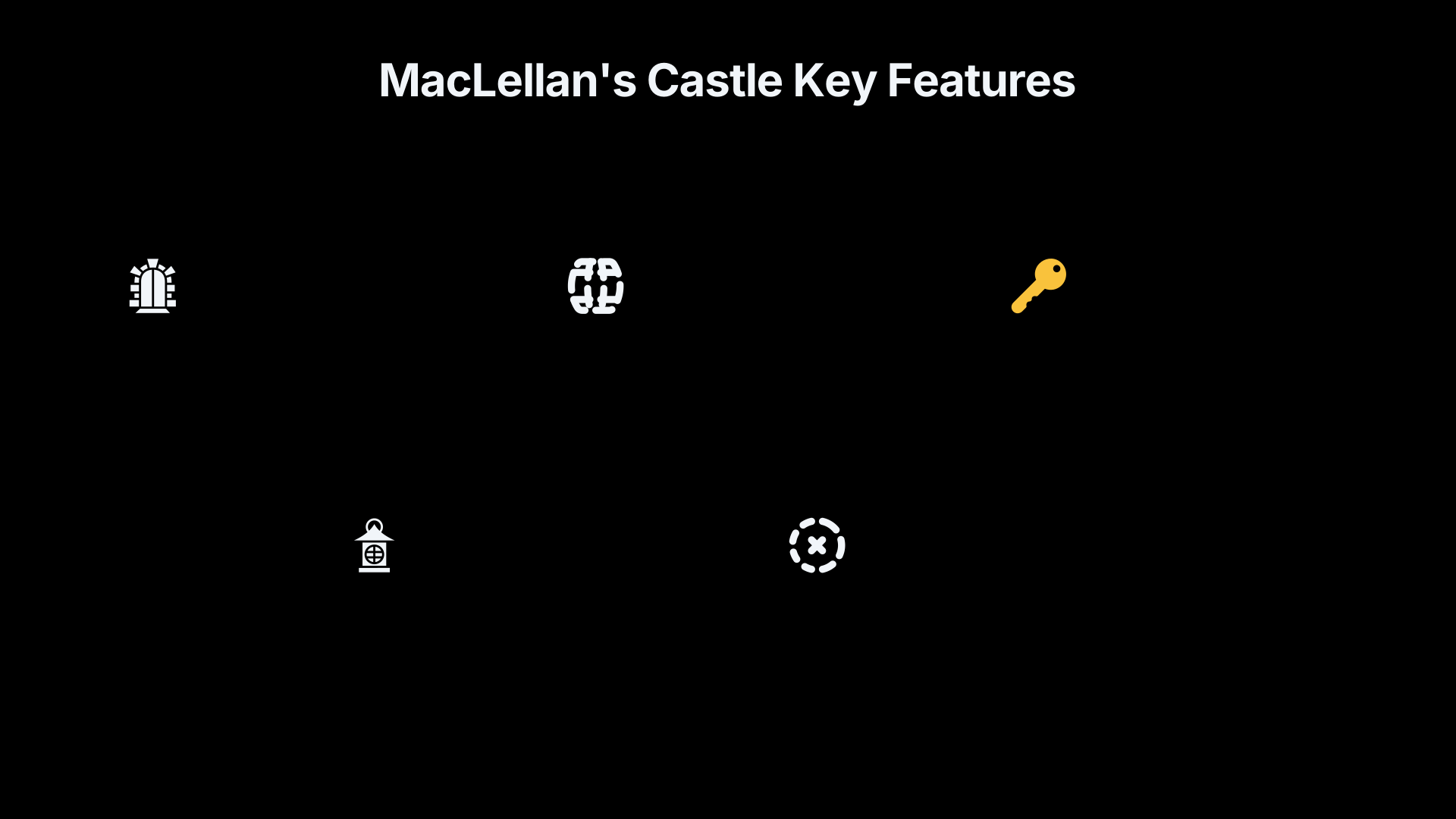
If MacLellan’s Castle gives Kirkcudbright its castle legend, the Tolbooth gives the town its prison atmosphere. The building on the High Street was built around 1625–1629 as Kirkcudbright’s Tolbooth and served as town council meeting place, burgh and sheriff court, and criminal and debtor’s prison. The modern Tolbooth Art Centre preserves original features such as stonework, doorways, the clocktower, cell-gate hinges and external jougs, or iron prisoner collars.[Future Museum]futuremuseum.co.ukFuture Museum Kirkudbright Tolbooth & Art GalleryFuture Museum Kirkudbright Tolbooth & Art Gallery
That history matters because ghost walks often work best where the frightening story does not have to be invented from nothing. A former prison cell, court room or punishment fixture already carries emotional weight. Kirkcudbright History Society notes that Scottish burghs such as Kirkcudbright originally kept prisoners in tolbooth gaols, and identifies two famous Tolbooth prisoners: Elspeth McKewan, described there as the last witch burned in Galloway in 1698, and John Paul Jones, later the American naval hero, held on a murder charge in 1770.[kirkcudbrighthistorysociety.org.uk]kirkcudbrighthistorysociety.org.ukOpen source on kirkcudbrighthistorysociety.org.uk.
The later Sheriff Court House and Prison deepen the same atmosphere. The prison tower opened in 1817 after the Tolbooth’s accommodation proved insufficient, and Scotland Starts Here describes it as a 25-metre tower for civil and criminal prisoners. Thousands of prisoners passed through the court house and prison for offences ranging from poaching to murder; some were transported overseas, and Mary Timney, later the last woman publicly hanged in Dumfries, was held there in 1862.[Scotland Starts Here]scotlandstartshere.comScotland Starts Here Sheriff Court House and Prison | History & HeritageScotland Starts Here Sheriff Court House and Prison | History & Heritage
These details explain why Kirkcudbright ghost-tour culture can feel grounded even when its supernatural claims remain unproven. The dread does not depend only on apparitions. It comes from documented institutions of confinement: debtors, criminal prisoners, witchcraft memory, transportation, solitary cells, court authority and the visible hardware of punishment. A guide can stand near a former civic building and talk about fear without pretending that every sound in the stonework is paranormal.
Mostly Ghostly, the regional ghost-tour group associated with Dumfries and Galloway, frames its work as a blend of ghosts, hauntings, local studies and tourism. Its own regional listing describes it as an award-winning creator of ghost and local-history tours and says the team developed ghost walks from a mix of paranormal interest, local research and a desire to promote tourism and culture.[Scotland Starts Here]scotlandstartshere.comScotland Starts Here Mostly Ghostly | Tours & ExperiencesScotland Starts Here Mostly Ghostly | Tours & Experiences That is a useful description of what has happened in Kirkcudbright more broadly: the haunted town is not just inherited folklore, but an active visitor experience built out of local history.
Broughton House and the gentler edge of the ghost walk
Broughton House is not a castle or a prison, but it helps show how Kirkcudbright’s haunted identity now sits inside a wider heritage economy. The National Trust for Scotland describes it as the Edwardian home and studio of E A Hornel, one of the Glasgow Boys, standing in the heart of Kirkcudbright’s artists’ colony and set in a Japanese-inspired garden. Hornel bought the house in 1901, transformed it into home, studio and salesroom, and filled it with art, archives and one of the world’s largest collections of Robert Burns material.[National Trust for Scotland]nts.org.ukOpen source on nts.org.uk.
Historic Environment Scotland’s garden designation adds another layer: Broughton House garden was created in the 1920s, runs back towards the River Dee, and is considered a fine artist’s garden with outstanding artistic and architectural interest. This is not inherently spooky material, but it is deeply atmospheric: enclosed garden compartments, period interiors, river views, old collections and the sense of a preserved private world.[Historic Environment Scotland]portal.historicenvironment.scotOpen source on historicenvironment.scot.
That is why Broughton House can function as a ghost-tour place even when the stories told there are not necessarily “Broughton House ghosts”. Event listings have advertised candlelit or seasonal ghost-story evenings there, including Mostly Ghostly events presented with National Trust for Scotland guides.[Facebook]facebook.comOpen source on facebook.com. The building becomes a stage for Galloway’s supernatural memory: not just a haunted site, but a trusted heritage setting where stories can be performed with atmosphere and restraint.
This matters because modern ghost tourism is not only about claiming that a particular apparition lives in a particular room. It is also about where people feel willing to listen. A candlelit historic house, a former prison, a roofless castle and an old High Street each change how a story lands. Kirkcudbright’s strength is that it has all of them within a walkable heritage landscape.

What heritage storytelling adds and leaves uncertain
The value of Kirkcudbright’s haunted places lies in the way they connect visible buildings to half-visible memories. MacLellan’s Castle gives visitors the material fact of a laird’s lug and the folkloric possibility of the dead servant. The Tolbooth gives the material fact of courts, cells and punishment, and the interpretive possibility of lingering fear. Broughton House gives a gentler cultural setting where Galloway’s darker stories can be curated for an audience.
The uncertainty is just as important. There is strong evidence for the buildings, their dates, their functions and many of their historical associations. There is weaker evidence for specific ghostly manifestations. The laird’s lug is real; the servant’s death is a legend. The Tolbooth’s prison history is real; any haunting attached to its atmosphere needs to be treated as story, report or performance unless supported by stronger witness documentation.[historicenvironment.scot]historicenvironment.scotOpen source on historicenvironment.scot.
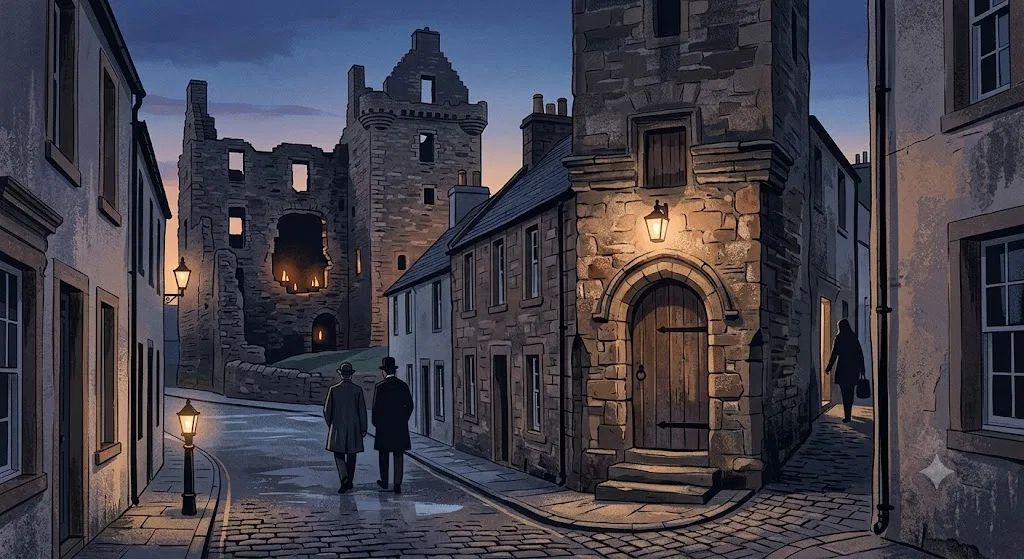
This is not a problem for a haunted-history page. In fact, it is the point. Kirkcudbright shows how a town becomes haunted not only through ancient apparitions, but through the reuse of buildings, the survival of uncomfortable histories, and the modern skill of guides who know how to place a listener in the right doorway at the right moment. The ghost-tour version of Kirkcudbright is therefore best understood as layered heritage: architecture first, history second, folklore third, and atmosphere binding them together.
For readers exploring Kirkcudbrightshire’s wider haunted map, the town’s stories work as a gateway. They are more accessible than remote rural cases, more architectural than roadside apparitions, and more visitor-facing than archival poltergeist accounts. MacLellan’s Castle and the Tolbooth do not prove that Kirkcudbright is haunted. They show why, in the old Stewartry, a town of artists, courts, prisons and ruined status can so easily be imagined as one.
Amazon book picks
Further Reading
Books and field guides related to How Did Kirkcudbright Become a Haunted Town?. Use these as the next step if you want deeper reading beyond the article.
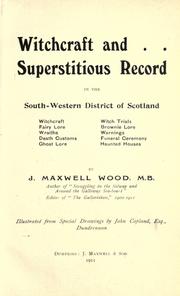
Witchcraft and superstitious record in the south-western dist...
Provides local folklore background relevant to Kirkcudbright.
eBay marketplace picks
Marketplace Samples
Live-tested eBay searches with available results related to this page.
Endnotes
1.
Source: kirkcudbrighthistorysociety.org.uk
Link:https://www.kirkcudbrighthistorysociety.org.uk/2013/01/
2.
Source: facebook.com
Link:https://www.facebook.com/mostlyghostlytours/posts/join-mostly-ghostly-this-halloween-at-beautiful-broughton-house-garden-nts-for-a/1059960418466477/
3.
Source: facebook.com
Link:https://www.facebook.com/mostlyghostlytours/posts/mostly-ghostly-at-the-kirkcudbright-fringe-were-super-excited-to-be-bringing-our/1564324574696723/
4.
Source: facebook.com
Link:https://www.facebook.com/andythehighlander/videos/the-castles-ghost-the-ell-maid-of-dunstaffnage-is-said-to-wander-the-ramparts-dr/1152124143347455/
5.
Source: facebook.com
Link:https://www.facebook.com/groups/stewartrypostcards/posts/1937239420387016/
6.
Source: facebook.com
Link:https://www.facebook.com/groups/stewartrypostcards/posts/1695169971260630/
7.
Source: facebook.com
Link:https://www.facebook.com/groups/stewartrypostcards/posts/1958335254944099/
8.
Source: facebook.com
Link:https://www.facebook.com/groups/Welovedumfriesandgalloway/posts/35757384247243643/
9.
Source: facebook.com
Link:https://www.facebook.com/groups/323500131086/posts/10159709731401087/
10.
Source: facebook.com
Title: have you ever visited scotlands secret artists town kirkcudbright is colourful p
Link:https://www.facebook.com/61554949751761/posts/have-you-ever-visited-scotlands-secret-artists-town-kirkcudbright-is-colourful-p/122291294738164991/
11.
Source: facebook.com
Link:https://www.facebook.com/kirkcudbright.artandcraftstrail/
12.
Source: facebook.com
Title: kirkcudbright art and crafts trail 2026
Link:https://www.facebook.com/events/kirkcudbright-harbour/kirkcudbright-art-and-crafts-trail-2026/2126220111568840/
13.
Source: kirkcudbrighthistorysociety.org.uk
Title: kirkcudbright prison august
Link:https://www.kirkcudbrighthistorysociety.org.uk/news/kirkcudbright-prison-august/
14.
Source: kirkcudbrighthistorysociety.org.uk
Link:https://www.kirkcudbrighthistorysociety.org.uk/wp-content/uploads/2024/06/Broughton-House-.pdf
15.
Source: kirkcudbrighthistorysociety.org.uk
Title: museum blog parishes and their lands
Link:https://www.kirkcudbrighthistorysociety.org.uk/news/museum-blog-parishes-and-their-lands/
16.
Source: kirkcudbright.town
Link:https://www.kirkcudbright.town/art-and-artists/broughton-house-kirkcudbright/
17.
Source: kirkcudbright.town
Title: Visit Kirkcudbright
Link:https://www.kirkcudbright.town/
18.
Source: kirkcudbright.town
Link:https://www.kirkcudbright.town/kirkcudbright-summer-festivities/art-craft-trail/
19.
Source: kirkcudbright.co
Link:https://www.kirkcudbright.co/historyarticle.asp?ID=145&g=5&p=29
20.
Source: wikishire.co.uk
Link:https://wikishire.co.uk/wiki/Kirkcudbrightshire
21.
Source: historicenvironment.scot
Link:https://www.historicenvironment.scot/visit/all/maclellans-castle/history-and-stories/
22.
Source: futuremuseum.co.uk
Title: Future Museum Kirkudbright Tolbooth & Art Gallery
Link:https://www.futuremuseum.co.uk/museum/tolbooth-art-centre
23.
Source: scotlandstartshere.com
Title: Scotland Starts Here Mostly Ghostly | Tours & Experiences
Link:https://scotlandstartshere.com/point-of-interest/mostly-ghostly/
24.
Source: historicenvironment.scot
Title: Historic Environment Scotland Mac Lellan’s Castle | Historic Scotland
Link:https://www.historicenvironment.scot/visit/all/maclellans-castle/
25.
Source: gallowayview.co.uk
Title: Galloway View Spooky Stories and Haunted Places of Galloway
Link:https://www.gallowayview.co.uk/post/spooky-stories-and-haunted-places-of-galloway
26.
Source: scotlandstartshere.com
Title: Scotland Starts Here Sheriff Court House and Prison | History & Heritage
Link:https://scotlandstartshere.com/point-of-interest/sheriff-court-house-and-prison/
27.
Source: nts.org.uk
Link:https://www.nts.org.uk/visit/places/broughton-house-garden
28.
Source: portal.historicenvironment.scot
Link:https://portal.historicenvironment.scot/apex/f?p=1505%3A300%3A%3A%3A%3A%3AVIEWTYPE%2CVIEWREF%3Adesignation%2CGDL00075
29.
Source: scotlandstartshere.com
Link:https://scotlandstartshere.com/event/broughton-house-ghost-hunt/
30.
Source: scotlandstartshere.com
Link:https://scotlandstartshere.com/point-of-interest/tolbooth-art-centre/
31.
Source: scotlandstartshere.com
Link:https://scotlandstartshere.com/event/kirkcudbright-art-crafts-trail/
32.
Source: Wikipedia
Title: Broughton House
Link:https://en.wikipedia.org/wiki/Broughton_House
33.
Source: Wikipedia
Link:https://en.wikipedia.org/wiki/Kirkcudbrightshire
34.
Source: nts.org.uk
Link:https://www.nts.org.uk/stories/ghosts-of-the-trust
35.
Source: nts.org.uk
Title: the great eight at broughton house
Link:https://www.nts.org.uk/stories/the-great-eight-at-broughton-house
36.
Source: nts.org.uk
Title: E A Hornel
Link:https://www.nts.org.uk/visit/places/broughton-house-garden/e-a-hornel
37.
Source: wikishire.co.uk
Link:https://wikishire.co.uk/wiki/Kirkcudbright
38.
Source: britainexpress.com
Title: Broughton House
Link:https://www.britainexpress.com/scotland/Dumfries-Galloway/houses/broughton-house.htm
Additional References
39.
Source: instagram.com
Link:https://www.instagram.com/p/DUTzRggFHXh/
40.
Source: thecastlesofscotland.co.uk
Link:https://www.thecastlesofscotland.co.uk/the-best-castles/scenic-castles/duntulm-castle/
41.
Source: dgwgo.com
Link:https://www.dgwgo.com/out-and-about-in-dg/ghostly-goings-on-spark-return-to-broughton-house/
42.
Source: gilnockietower.co.uk
Link:https://gilnockietower.co.uk/gilnockie-tower-ghost-hunt-with-mostly-ghostly-tours/
43.
Source: darkartdistillery.com
Link:https://darkartdistillery.com/events/kirkcudbright-art-trail
44.
Source: towntoolkit.scot
Link:https://towntoolkit.scot/case-studies/kirkcudbright-artists-town
45.
Source: kirkcudbrightgalleries.org.uk
Link:https://www.kirkcudbrightgalleries.org.uk/
46.
Source: canmore.org.uk
Link:https://canmore.org.uk/site/211803/kirkcudbright-8-high-street-blair-house
47.
Source: gazetteer.org.uk
Link:https://gazetteer.org.uk/place/Kirkcudbrightshire
48.
Source: aladyinlondon.com
Link:https://www.aladyinlondon.com/2016/08/kirkcudbright-art-crafts-trail-scotland.html
Topic Tree