Within Haunted Ayrshire
What Happened to Culzean's Lost Piper?
Culzean's cliff caves, smuggling memories and castle apparitions make its lost piper one of Ayrshire's strongest haunted-place stories.
On this page
- The piper beneath the cliffs
- Caves, smugglers and useful fear
- Indoor ghosts in the castle
Page outline Jump by section
Introduction
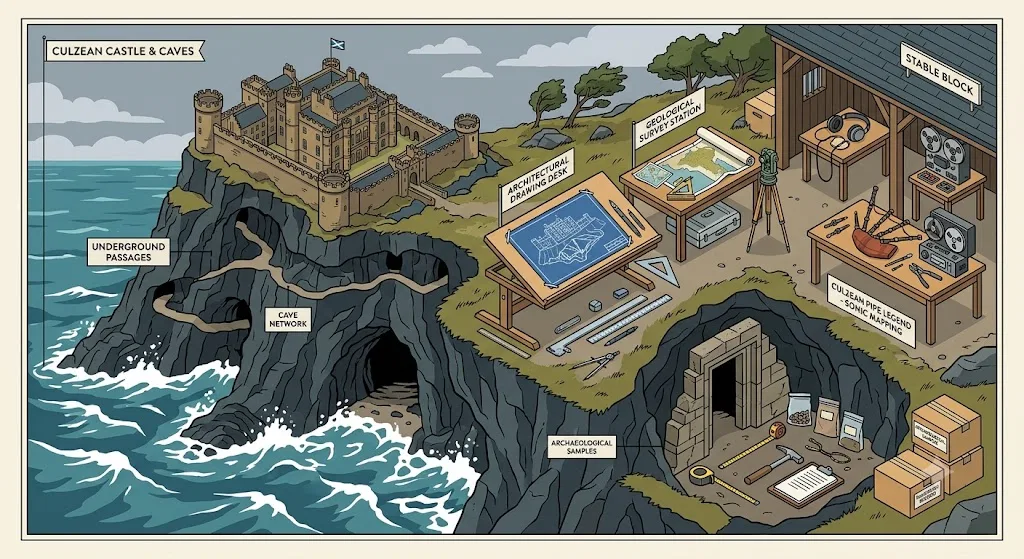
Culzean Castle’s lost piper is the kind of Ayrshire ghost story that works because the place itself seems to invite it. The castle stands above the Carrick coast near Maybole, with woodland, beaches, cliffs and caves below Robert Adam’s late 18th-century showpiece. The legend says a piper and his dog entered the caves beneath the castle to prove that the underground passages were not haunted. Their music and barking were heard from above, then faded, stopped, and neither piper nor dog emerged. In later tradition, the pipes are heard again on stormy nights or before a Kennedy family wedding, and a lone figure is said to appear at Piper’s Brae.[National Trust for Scotland]nts.org.ukOpen source on nts.org.uk.
The story is best read as folklore rather than a verified disappearance. Its power comes from the meeting point of real caves, genuine smuggling history, old Kennedy family associations and the theatrical cliff-top setting. Culzean is not just a haunted castle tale with a cave attached; it is a cave story that the castle, coastline and family history have kept alive.
The piper beneath the cliffs
The National Trust for Scotland preserves the central version of the tale: a piper, accompanied by his dog, was sent into the caves below Culzean to follow the passage from an entrance beneath the castle to an exit on a hill some distance away. The point of the expedition was to reassure local people that the caves were not haunted. As he went, he played his pipes so those above could track his progress through the underground route.[National Trust for Scotland]nts.org.ukOpen source on nts.org.uk.
At first, the sound carried clearly. Then it seemed to move away, as though the piper was making his way deeper through the rock. The barking of the dog was heard too. Then both sounds stopped. A search party went in after him, but found no trace, and the piper and dog were not seen again. In the after-story, the cave does not simply swallow the man; it keeps him as an omen. Local legend says that pipes can be heard from the caves on the eve of a Kennedy family wedding, while a solitary figure may be seen on Piper’s Brae.[National Trust for Scotland]nts.org.ukOpen source on nts.org.uk.
That structure is important. Many “lost piper” legends in Scotland and Britain use the same basic mechanism: a musician enters a cave, tunnel or underground passage, plays as a living signal, and disappears when the music stops. Culzean’s version becomes distinctive because it is tied to a named estate, a named landscape feature, the Kennedy family, and a known cave system under a major Ayrshire landmark. The repeated wedding omen also gives the tale a social role. It is not merely a story about someone being lost underground; it is a story about an old family hearing its past return at moments of inheritance, marriage and continuity.
The dog matters too. In folklore terms, the animal makes the test feel practical and human. The piper is not an abstract victim but a working musician with a companion. The barking gives listeners a second sound to follow, and its sudden absence sharpens the ending. The story depends on sound more than sight: pipes rising through rock, echoes from hidden chambers, and the silence that follows. That is why Culzean’s legend remains so memorable for visitors even when there is no dated witness statement, court record or parish entry to prove that such a disappearance occurred.
Why the caves make the legend believable
Culzean’s caves are not invented scenery. The castle was built over a real warren of coastal caves, with one set below the stables and another below the castle itself. The National Trust for Scotland has described the castle as standing over caves whose human use predates the present mansion by a very long time; archaeological work found evidence of Iron Age occupation, including charcoal from Castle Cave dated to AD 135–325.[National Trust for Scotland]nts.org.ukOpen source on nts.org.uk.
The setting also has medieval depth. Trust archaeologists uncovered the remains of a doorway leading into the caves, including two sides of a doorway buried about a metre deep and surviving up to eight courses high. Derek Alexander, the Trust’s Head of Archaeology, linked the stone walling defending both cave sets to the medieval castle, probably from the 15th or 16th century, and noted that the caves were used as storage cellars before Robert Adam’s late 18th-century transformation of Culzean into a picturesque mansion.[National Trust for Scotland]nts.org.ukOpen source on nts.org.uk.
This is where the folklore becomes more than decorative. A cave that has been occupied, walled, barred, used for storage and entered from the shore already has the right ingredients for stories about hidden movement. It is easy to see how local imagination could turn a confusing or restricted underground space into a test of courage. The piper’s job in the legend is to make the invisible route audible. The moment the music stops, the landscape becomes mysterious again.
Culzean’s earlier identity also strengthens the cave connection. The National Trust’s archaeological account explains that before Adam’s alterations, the headland worked as a defensive site, protected by cliffs and natural hollows; only fragments of the medieval tower remain clearly legible after the 1770s–90s remodelling.[National Trust for Scotland]nts.org.ukOpen source on nts.org.uk. Historic Environment Scotland also notes that traces of the earlier Coif Castle survive within the cave system immediately below the present castle.[Historic Environment Scotland]portal.historicenvironment.scotOpen source on historicenvironment.scot. The haunting therefore grows from the oldest part of the place: not the polished rooms above, but the cliff, cave and defensive undercroft beneath.
Caves, smugglers and useful fear
The lost piper belongs to a wider Culzean cave tradition in which fear has practical uses. The National Trust for Scotland says the caves beneath the clifftop castle were a smugglers’ lair for several decades in the 1700s, used to hide illicit wine, port, rum, brandy, tea, silks and other goods. The Trust also states that the Kennedy family and their staff almost certainly turned a blind eye to the activity, with some possibly involved.[National Trust for Scotland]nts.org.ukOpen source on nts.org.uk.
That history changes the way the ghost story reads. A supposedly haunted cave can keep curious people away. A reputation for danger, strange noises or old disappearances can serve smugglers, servants, estate workers and anyone else who benefits from privacy. Culzean’s underground spaces were not just romantic hollows under a castle; they were useful coastal infrastructure on a smuggling route linking Ayrshire with wider networks involving Ayr, Glasgow, the Isle of Man, Ireland, continental Europe and the Caribbean.[National Trust for Scotland]nts.org.ukOpen source on nts.org.uk.
The Trust gives concrete examples of those links. Sir John Kennedy, 2nd Baronet of Culzean, co-owned a boat seized by revenue officers in 1726 while running contraband from the Isle of Man to Scotland. Sir Thomas Kennedy’s farm manager, Archibald Kennedy, ran a wine and spirits business from a bedroom in the castle and traded with prominent smugglers on the Isle of Man.[National Trust for Scotland]nts.org.ukOpen source on nts.org.uk. This does not prove that the piper story was invented by smugglers, but it makes the surrounding atmosphere easier to understand. The caves had secrecy built into their social use.
The 2018 archaeological discoveries add another layer. Alongside the medieval doorway, the excavation found modern pottery, glass and 18th-century wine bottles; an iron strip may have been part of a door hinge or fittings.[National Trust for Scotland]nts.org.ukOpen source on nts.org.uk. Those finds are not ghost evidence, but they show that the caves were handled, entered, secured and reused across centuries. A place with barred entrances, controlled access, bottles, storage and old walls naturally produces stories about hidden passages and people who do not come back.
In that sense, the “useful fear” around Culzean’s caves may have worked in several directions. It could warn children and casual visitors away from dangerous cliff caves. It could protect illicit storage. It could dramatise the power of the Kennedy estate. It could also preserve a folk memory of genuine risk: tides, darkness, unstable footing, echoing chambers and the difficulty of finding one’s way in a coastal cave system.
Indoor ghosts in the castle
Culzean’s cave piper is the strongest and most place-specific haunting, but the castle interior has its own ghost traditions. The National Trust for Scotland records stories of a young girl running along corridors near the kitchen, a black or grey apparition ascending from the ground floor to the first floor, and the State Bedroom on the first floor being described on guided tours as the castle’s most haunted room.[National Trust for Scotland]nts.org.ukOpen source on nts.org.uk.
The State Bedroom tradition has also been preserved through a guide’s account in a National Trust article. Guide Bill Rogers described a visitor who reported being gently pushed forward in the State Bedroom, then gave a statement to the head guide and another witness after turning around and finding nobody there. In the same account, the room is said to be associated with the ghost of Thomas Kennedy, 9th Earl of Cassillis, and to have featured in the paranormal television series Most Haunted.[National Trust for Scotland]nts.org.ukNational Trust for Scotland Spooky stories | National Trust for ScotlandNational Trust for Scotland Spooky stories | National Trust for Scotland
These indoor accounts feel different from the piper legend. They are more like modern haunted-house reports: movement glimpsed in rooms, touches, apparitions, a reputedly active bedroom, and a television investigation choosing particular locations. The piper, by contrast, is an origin legend attached to terrain. It explains a named place, Piper’s Brae, and gives the cliffs a voice. The indoor ghosts may enrich Culzean’s haunted reputation, but the lost piper gives the castle’s supernatural identity its strongest local shape.
There is also a useful contrast between architecture and folklore. Above ground, Culzean is a carefully composed country house, recognised by Historic Environment Scotland as an outstanding example of Robert Adam’s work in a cliff-top setting, with later additions and a landscape shaped by the Picturesque movement.[Historic Environment Scotland]portal.historicenvironment.scotOpen source on historicenvironment.scot. Below ground, the cave stories are older, rougher and harder to organise. The polished house and the dangerous underworld make each other more dramatic.
How credible is the lost piper story?
As a ghost claim, Culzean’s lost piper is not well evidenced in the way a historian would need for a confirmed disappearance. The most reliable sources available today present it as local legend, not as a documented missing-person case. The National Trust for Scotland’s version is valuable because it preserves the story at the site itself, but it does not give a date, the piper’s name, a contemporary record, or a primary witness.[National Trust for Scotland]nts.org.ukOpen source on nts.org.uk.
As folklore, however, the story is strong. It has a clear plot, a memorable sound image, a named landscape, a family omen and a real physical setting. It also fits the history of the site: caves under the castle, medieval access control, old storage use, 18th-century smuggling and a long Kennedy association. Historic Environment Scotland notes that Culzean was associated with the Kennedy family from the Middle Ages, became the principal family seat in the 18th century, and passed to the National Trust for Scotland in 1945.[Historic Environment Scotland]portal.historicenvironment.scotOpen source on historicenvironment.scot.
The most careful reading is therefore neither to dismiss the tale as empty nor to treat it as proof of a haunting. It is a place-memory. It turns real hazards and hidden histories into a story that visitors can understand in a single image: a piper walking into darkness, the castle listening from above, and the music stopping beneath the cliffs.
That is why Culzean’s lost piper belongs at the centre of haunted Ayrshire. Alloway has Burns and the witches of Tam o’ Shanter; Culzean has the sound of pipes under stone. One is literary night-terror on the road home from Ayr. The other is coastal folklore rooted in caves, smuggling and aristocratic estate history. Both show how Ayrshire’s most enduring hauntings are not random apparitions, but stories that grow directly from landscape.
What the legend leaves behind
Culzean’s piper survives because the story gives visitors a way to read the site vertically. The castle above is grand, curated and architectural. The caves below are older, darker and more uncertain. Between them lies the sound of the pipes: a human attempt to map a hidden route that becomes, in the legend, the very sign of being lost.
The tale also shows how a haunting can attach itself to practical places. These caves were not merely picturesque; they were occupied, fortified, secured, used as cellars, associated with smuggling and later investigated by archaeologists.[National Trust for Scotland]nts.org.ukOpen source on nts.org.uk. A ghost story in such a setting does cultural work. It warns, explains, entertains and preserves unease around spaces that were genuinely dangerous or secret.
For readers tracing Ayrshire’s haunted geography, Culzean’s lost piper is best understood as a mechanism story: it explains why the caves feel haunted, why the cliffs seem to hold sound, and why Kennedy family occasions became tied to an underground omen. The facts establish the caves and their history; the legend supplies the missing human figure. In the silence after the pipes stop, Culzean becomes one of Ayrshire’s most atmospheric haunted places.
Amazon book picks
Further Reading
Books and field guides related to What Happened to Culzean's Lost Piper?. Use these as the next step if you want deeper reading beyond the article.
The castles of Scotland
Provides historical context for Scotland's famous castles including Ayrshire.

The secret commonwealth of elves, fauns, and fairies
Explores traditional Scottish supernatural beliefs connected with mysterious places.
The Penguin Book of Ghost Stories
Supports readers seeking wider supernatural reading after Culzean.
eBay marketplace picks
Marketplace Samples
Live-tested eBay searches with available results related to this page.


Endnotes
1.
Source: nts.org.uk
Link:https://www.nts.org.uk/stories/the-ghosts-of-culzean-castle
2.
Source: nts.org.uk
Title: National Trust for Scotland Culzean Castle | National Trust for Scotland
Link:https://www.nts.org.uk/visit/places/culzean
3.
Source: nts.org.uk
Link:https://www.nts.org.uk/stories/hidden-doorway-revealed-at-culzean-caves
4.
Source: nts.org.uk
Link:https://www.nts.org.uk/stories/culzean-castle-before-robert-adam
5.
Source: portal.historicenvironment.scot
Link:https://portal.historicenvironment.scot/apex/f?p=1505%3A300%3A%3A%3A%3A%3AVIEWTYPE%2CVIEWREF%3Adesignation%2CGDL00124
6.
Source: nts.org.uk
Link:https://www.nts.org.uk/visit/places/culzean/culzeans-smuggling-histories
7.
Source: nts.org.uk
Title: National Trust for Scotland Spooky stories | National Trust for Scotland
Link:https://www.nts.org.uk/stories/spooky-stories
8.
Source: portal.historicenvironment.scot
Link:https://portal.historicenvironment.scot/apex/f?p=1505%3A300%3A%3A%3A%3A%3AVIEWTYPE%2CVIEWREF%3Adesignation%2CLB51827
9.
Source: nts.org.uk
Title: going underground
Link:https://www.nts.org.uk/stories/going-underground
10.
Source: nts.org.uk
Title: chance to discover culzean castles subterranean secrets
Link:https://www.nts.org.uk/stories/chance-to-discover-culzean-castles-subterranean-secrets
11.
Source: weewalkingtours.com
Title: culzean castle
Link:https://www.weewalkingtours.com/post/culzean-castle
Additional References
12.
Source: youtube.com
Title: The Culzean Castle & Stable Caves, Maybole, Ayrshire
Link:https://www.youtube.com/watch?v=kdDbK43vLhQ
Source snippet
The Most HAUNTED Castle In Scotland - CULZEAN CASTLE...
13.
Source: facebook.com
Link:https://www.facebook.com/NationalTrustforScotland/posts/culzean-castle-country-park-nts-in-south-ayrshire-is-a-cliff-top-masterpiece-fil/679028330919586/
14.
Source: facebook.com
Link:https://www.facebook.com/groups/2686102378119843/posts/8852507928145893/
15.
Source: visitscotland.com
Link:https://www.visitscotland.com/de-de/info/tours/culzean-castle-burns-country-and-ayrshire-coast-f21b4f5e
16.
Source: aboutscotland.com
Link:https://www.aboutscotland.com/culzean/adam.html
17.
Source: facebook.com
Link:https://www.facebook.com/historyscotlandmagazine/posts/details-of-a-medieval-doorway-revealed-in-caves-beneath-culzean-castlewell-also-/2589682347724159/
18.
Source: spookyisles.com
Link:https://www.spookyisles.com/the-ghosts-of-culzean-castle-scotland/
19.
Source: instagram.com
Link:https://www.instagram.com/reel/DPzVpJdjhwy/
20.
Source: facebook.com
Link:https://www.facebook.com/groups/276392770336010/posts/722720925703190/
21.
Source: facebook.com
Link:https://www.facebook.com/CulzeanCastle/posts/the-ghosts-of-culzean-castle-there-may-be-no-visitors-in-the-castle-at-the-momen/1314268355410075/
Topic Tree