Within Haunted Dunbartonshire
Why Does Dumbarton Castle Feel Haunted?
Dumbarton Castle's ghost stories draw their force from real imprisonment, military danger and the rock's long symbolic power.
On this page
- The rock, fortress and first prisoners
- Wallace, French prisoners and local legend
- How modern ghost claims use older history
Page outline Jump by section
Introduction
Dumbarton Castle feels haunted because its ghost stories sit on top of unusually hard history: captivity, siege, betrayal, military watchfulness and a rock that has dominated the Clyde for more than 1,500 years. The strongest claims are not early, well-documented apparition cases. They are modern haunted-place traditions built around real prison associations: Wallace’s contested stop at Dumbarton after his capture, the named English knights imprisoned after Stirling Bridge, later political prisoners, Jacobite-era confinement and the French prisoners held during the Napoleonic period. Historic Environment Scotland describes Dumbarton Rock as having the longest documented history as a stronghold in Scotland, and its surviving Georgian features include the French Prison, Governor’s House, magazine and batteries. That is why the castle’s haunted reputation works: the ghosts are uncertain, but the prison memory is not.[HES Publications]app-hes-pubs-prod-neu-01.azurewebsites.netHES Publications Dumbarton Castle statement of significanceHES Publications Dumbarton Castle statement of significance
The rock, fortress and first prisoners
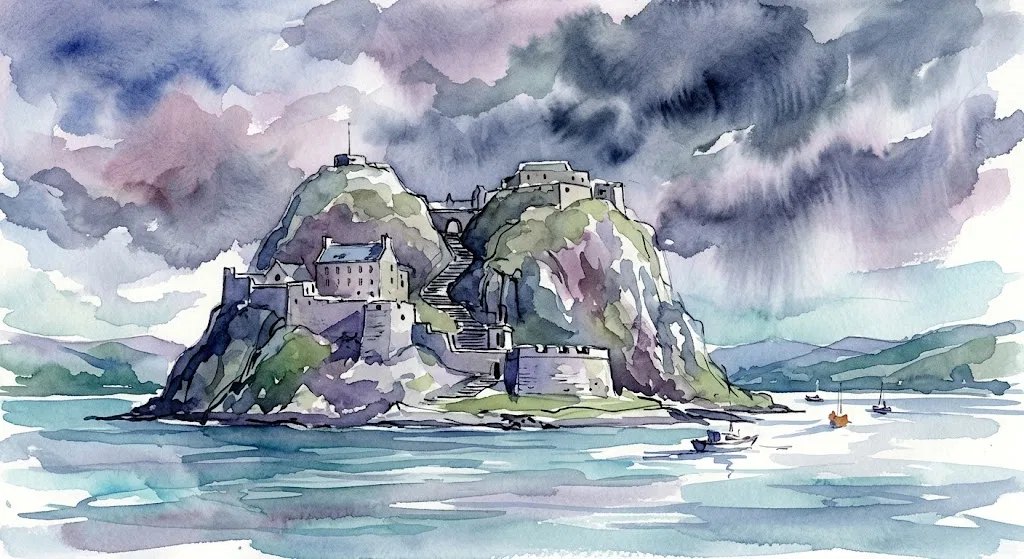
Dumbarton Castle stands in historic Dunbartonshire at the meeting of the River Leven and the River Clyde, on a twin-peaked volcanic plug whose setting does half the storytelling before any ghost is mentioned. Historic Environment Scotland places the site’s recorded story back around 1,500 years, with Dumbarton Rock known as Alt Clut, or Clyde Rock, at the heart of the early kingdom of Strathclyde before the medieval royal castle and later garrison fortress developed there.[Historic Environment Scotland]historicenvironment.scotOpen source on historicenvironment.scot.
That deep chronology matters for a haunted-place reading because Dumbarton is not a romantic ruin invented by tourist language. It was a defensive, administrative and symbolic place of power. The official scheduled-monument record describes the remains on the rock as including a Dark-Age fort, medieval castle and Georgian garrison; it also notes that the medieval royal castle was later used as a place of safety and a state prison.[Historic Environment Scotland]portal.historicenvironment.scotOpen source on historicenvironment.scot.
The castle’s first clearly named prisoners belong to the Wars of Independence. After Edward I captured Dumbarton in 1296, the Scots recovered it following Wallace and Andrew Moray’s victory at Stirling Bridge in 1297. Historic Environment Scotland names William FitzWarin, William de Ros and Marmaduke Tweng as the three English knights imprisoned afterwards, calling them the castle’s first named prisoners.[Historic Environment Scotland]historicenvironment.scotOpen source on historicenvironment.scot.
That gives the prison legends an early anchor. The usual haunted-castle pattern is to begin with a white lady, murdered servant or spectral soldier. Dumbarton’s stronger route is different: it begins with named captives, a state fortress and a rock whose narrow stairs, gates and guard points still make visitors feel the practical mechanics of confinement. The story is less “a ghost was seen here in 1297” than “this was exactly the kind of place where high-value prisoners disappeared into the machinery of war”.
The physical survival of the site reinforces that mood. Historic Environment Scotland’s statement of significance says little of the Dark-Age and medieval fabric survives above ground, while much of what visitors now see belongs to the 17th and 18th centuries, including the Governor’s House, the French Prison, the powder magazine and artillery defences. The apparent mismatch between ancient reputation and later masonry can actually make the place feel stranger: the rock is older than the buildings, but the buildings still express control, watching and enclosure.[HES Publications]app-hes-pubs-prod-neu-01.azurewebsites.netHES Publications Dumbarton Castle statement of significanceHES Publications Dumbarton Castle statement of significance
Wallace, betrayal and the prison that may not have been
The Wallace tradition is the emotional centre of Dumbarton Castle’s prison folklore, but it has to be handled carefully. National Records of Scotland’s education material states that Wallace was captured on 3 August 1305 by Sir John Menteith, keeper of Dumbarton Castle, before his London trial and execution on 23 August.[Scottish Archives for Schools]scottisharchivesforschools.orgScottish Archives for Schools Wars of IndependenceScottish Archives for Schools Wars of Independence
The harder question is whether Wallace was actually held at Dumbarton Castle. Here the evidence splits between tradition and caution. Historic Environment Scotland’s blog says Menteith’s troops likely captured Wallace and handed him to the English, but adds that the legend of Wallace being held briefly at Dumbarton has no supporting evidence “as far as we know”.[Historic Environment Scotland Blog]blog.historicenvironment.scotHistoric Environment Scotland Blog Hidden meanings in Scotland's historic placesHistoric Environment Scotland Blog Hidden meanings in Scotland's historic places
That uncertainty has not stopped the tradition from becoming locally powerful. The Dumbarton Castle Society’s account of the French Prison says an abiding local legend places Wallace briefly in the castle after his capture by Sir John Menteith, then governor of the castle.[Dumbarton Castle Soc]dumbartoncastle.co.ukDumbarton Castle Soc The French Prison | Dumbarton Castle SocDumbarton Castle Soc The French Prison | Dumbarton Castle Soc The National Wallace Monument goes further in its visitor interpretation of the Wallace Sword, stating that the sword was first recorded at Dumbarton Castle in 1505 and presenting as common belief the story that Wallace’s sword was taken from him and left there until James IV ordered repairs to its handle.[National Wallace Monument]nationalwallacemonument.comNational Wallace Monument The Hall of ArmsNational Wallace Monument The Hall of Arms
This is where history turns into haunted memory. Wallace does not need to appear as a clearly recorded ghost for the castle to feel ghosted by him. His supposed presence is attached to several material and visual cues:
- The Wallace Sword tradition: the sword’s long association with Dumbarton Castle gave the site a relic-like connection to Wallace, whether or not every part of the story can be proved.[National Wallace Monument]nationalwallacemonument.comNational Wallace Monument The Hall of ArmsNational Wallace Monument The Hall of Arms
- The “Fause Menteith” memory: a carved face on the Guard House has been connected in local interpretation with Menteith, the figure blamed in tradition for Wallace’s betrayal. A Wikimedia Commons entry quoting I. M. M. MacPhail’s Dumbarton Castle notes that the Guard House was once called “Wallace’s Prison”, while also stressing that no record proves Wallace’s confinement there.[Wikimedia Commons]commons.wikimedia.orgCommons File:Dumbarton Rock, Carved face on Guard HouseCommons File:Dumbarton Rock, Carved face on Guard House
- Victorian visual culture: the University of Edinburgh’s archive catalogue includes a late 19th-century stereoscopic view titled “Sir William Wallace’s Prison, Dumbarton Castle, Scotland”, showing that the prison label had become part of the way the place was being presented to viewers by the 1880–1910 period.[ArchivesSpace]archives.collections.ed.ac.ukArchives Space Stereoscopic views | Archives Space Public InterfaceArchives Space Stereoscopic views | Archives Space Public Interface
For haunted-history readers, the important point is not to flatten this into either fact or fiction. Wallace’s capture by Menteith is historically grounded; Wallace’s stop at Dumbarton is plausible but not securely evidenced; “Wallace’s Prison” is best treated as a powerful local and antiquarian tradition rather than a documented cell. That is exactly the kind of uncertainty in which ghost stories grow.
French prisoners and the Napoleonic shadow
The clearest prison building in the modern visitor imagination is the French Prison. The scheduled-monument record identifies the French Prison as one of the Georgian garrison structures on the rock, and the Dumbarton Castle Society says it was built around 1790, near the site of the old Wallace Tower, and used to house French prisoners during the Napoleonic Wars.[Historic Environment Scotland]portal.historicenvironment.scotOpen source on historicenvironment.scot.
This part of the legend has an unusually tangible quality. The Dumbarton Castle Society notes that the castle collection includes a decorated wooden box made by French prisoners, giving the captivity story a surviving object rather than only a mood. It also identifies General Edouard Francais Simon, captured at Busaco during the Peninsular War, as the most famous French prisoner associated with the site, and says he may have had more comfortable quarters in the Governor’s House because of his rank.[Dumbarton Castle Soc]dumbartoncastle.co.ukDumbarton Castle Soc The French Prison | Dumbarton Castle SocDumbarton Castle Soc The French Prison | Dumbarton Castle Soc
The Simon story adds a different emotional register from the Wallace tradition. Wallace belongs to national martyrdom and betrayal; French prisoners belong to the long, bureaucratic misery of war captivity. According to the same local account, Simon was allowed twice-daily walks on the Beak, closely guarded by soldiers with loaded rifles and fixed bayonets.[Dumbarton Castle Soc]dumbartoncastle.co.ukDumbarton Castle Soc The French Prison | Dumbarton Castle SocDumbarton Castle Soc The French Prison | Dumbarton Castle Soc That is the kind of image that easily becomes spectral in later imagination: a foreign officer pacing a high rock above the Clyde, watched by armed men, separated from home by war and sea.
A wider Napoleonic prisoner-of-war context helps explain why this was not an isolated curiosity. Research published by The Napoleon Series on General Simon and prisoner correspondence notes that Britain sent prisoners of war north from 1810 onwards to improve security in the south, and that Simon and his servant returned to France in May 1814 with other prisoners after the war’s end.[The Napoleon Series]napoleon-series.orgOpen source on napoleon-series.org. This makes Dumbarton’s French Prison part of a larger British wartime detention system rather than a local oddity.
There is a good reason modern ghost retellings reach for this period. It offers confined men, foreign voices, guarded walks, craft objects, war anxiety and a prison block still named for its captives. Even without a strong archive of dated apparitions, the place supplies the raw ingredients of a haunting: repetition, isolation, unfinished longing and a building whose name keeps the prisoners present.

How modern ghost claims use older history
Modern claims about Dumbarton Castle being haunted tend to be broad rather than evidentially precise. Spooky Isles, for example, presents the castle as a haunted stronghold where ghosts are said to roam ancient corridors and “keep watch” over Scotland’s past, but the article’s main force comes from atmosphere and historic association rather than named witnesses, dates, investigation notes or archival ghost reports.[Spooky Isles]spookyisles.comSpooky Isles Haunting Of Dumbarton Castle, Scotland | Spooky IslesSpooky Isles Haunting Of Dumbarton Castle, Scotland | Spooky Isles
That does not make the reputation meaningless. It means the castle’s haunting works more as folklore than as a documented psychical case. The stories use older history in three main ways.
First, they turn captivity into presence. A place that demonstrably held prisoners invites the idea that some memory of confinement remains. At Dumbarton this can attach to the English knights of 1297, Wallace tradition, later state prisoners and French prisoners of war.[Historic Environment Scotland]historicenvironment.scotOpen source on historicenvironment.scot.
Second, they turn watchfulness into haunting. Dumbarton was a garrison fortress and lookout over the Clyde. Historic Environment Scotland describes its later defences as bristling with guns and notes that it last saw military action during the Second World War.[HES Publications]app-hes-pubs-prod-neu-01.azurewebsites.netHES Publications Dumbarton Castle statement of significanceHES Publications Dumbarton Castle statement of significance In ghost-story language, sentries, guards and prisoners easily become figures who continue to “watch” long after the military purpose has gone.
Third, they turn landscape into emotional evidence. Historic Environment Scotland’s statement of significance says the character of Dumbarton Rock can depend strongly on weather, describing mist, rain, black basalt, exposed stairs and the stark contrast between rock and river as part of its aesthetic power. It also notes that many people may feel a spiritual, if not religious, bond with the rock because of what it symbolises and the natural drama of the setting.[HES Publications]app-hes-pubs-prod-neu-01.azurewebsites.netHES Publications Dumbarton Castle statement of significanceHES Publications Dumbarton Castle statement of significance
This is important for interpreting the haunting honestly. Visitors may feel unease at Dumbarton not because they have encountered a verifiable ghost, but because the site is designed by history and geology to make the body feel small: steep steps, exposed heights, dark stone, military thresholds, river winds and the knowledge that the place once held people who could not simply leave.
How credible are the prison ghosts?
The most credible part of Dumbarton Castle’s haunted reputation is not the apparition evidence; it is the historical memory beneath it. The castle was a state stronghold and prison, its first named prisoners are recorded by Historic Environment Scotland, and the French Prison is a recognised surviving element of the Georgian garrison.[Historic Environment Scotland]historicenvironment.scotOpen source on historicenvironment.scot.
The least secure part is the jump from that history to specific ghosts. Publicly available modern haunted accounts tend to be general, atmospheric and secondary. They rarely give the kind of detail that would let a reader test a claim: witness identity, date, exact location, weather, lighting, corroboration, earlier publication trail or alternative explanation. For a careful haunted-county page, Dumbarton Castle should therefore be described as a place with a haunted reputation, not as a place with proven hauntings.
Wallace is the clearest example of how the evidence should be graded. His capture by Menteith is historically attested in reputable educational and heritage sources.[Scottish Archives for Schools]scottisharchivesforschools.orgScottish Archives for Schools Wars of IndependenceScottish Archives for Schools Wars of Independence The tradition that he was briefly confined at Dumbarton is persistent, visible in local interpretation and older visual culture, but Historic Environment Scotland explicitly warns that evidence for the confinement is lacking.[historicenvironment.scot]blog.historicenvironment.scotHistoric Environment Scotland Blog Hidden meanings in Scotland's historic placesHistoric Environment Scotland Blog Hidden meanings in Scotland's historic places
The French Prison has a firmer physical basis. It exists as a named structure, is recognised in the scheduled-monument description and is tied to Napoleonic prisoners through local interpretation.[Historic Environment Scotland]portal.historicenvironment.scotOpen source on historicenvironment.scot. Yet even here, the surviving evidence supports imprisonment and atmosphere more strongly than it supports named ghosts.
That distinction makes Dumbarton Castle more interesting, not less. Its prison legends show how haunted reputations often form in layers: a real place of fear and authority, a famous uncertain tradition, a visible building with a charged name, a dramatic landscape, then modern retellings that translate historical pressure into ghostly language. In Dunbartonshire’s haunted map, Dumbarton Castle is therefore the county’s great prison-haunting anchor — not because the ghosts are proven, but because the rock gives old captivity a place to linger.
Amazon book picks
Further Reading
Books and field guides related to Why Does Dumbarton Castle Feel Haunted?. Use these as the next step if you want deeper reading beyond the article.
The Lore of Scotland
Explains legendary traditions associated with historic Scottish sites.
The world's most haunted places
Appeals to readers comparing famous haunted landmarks.
eBay marketplace picks
Marketplace Samples
Live-tested eBay searches with available results related to this page.


Endnotes
1.
Source: commons.wikimedia.org
Title: Commons File:Dumbarton Rock, Carved face on Guard House
Link:https://commons.wikimedia.org/wiki/File%3ADumbarton_Rock%2C_Carved_face_on_Guard_House_-geograph.org.uk-_1380538.jpg
2.
Source: napoleon-series.org
Link:https://www.napoleon-series.org/resources/18th-and-19th-century-society/a-traitorous-correspondence-general-edouard-simon-and-the-conspirators-of-odiham/
3.
Source: youtube.com
Title: The Betrayal Site of William Wallace | History Traveler Episode 446
Link:https://www.youtube.com/watch?v=L7q8hB0upQU
Source snippet
Dumbarton Castle | Scotland's History...
4.
Source: youtube.com
Title: Dumbarton Castle | Scotland’s History
Link:https://www.youtube.com/watch?v=HEw53Heh6qc
Source snippet
Dumbarton Castle (A Scottish Castle A Day Podcast)...
5.
Source: app-hes-pubs-prod-neu-01.azurewebsites.net
Title: HES Publications Dumbarton Castle statement of significance
Link:https://app-hes-pubs-prod-neu-01.azurewebsites.net/api/file/48124661-f9d2-4792-9f83-afc7011e7c35
6.
Source: portal.historicenvironment.scot
Link:https://portal.historicenvironment.scot/apex/f?p=1505%3A300%3A%3A%3A%3A%3AVIEWTYPE%2CVIEWREF%3Adesignation%2CSM90107
7.
Source: historicenvironment.scot
Link:https://www.historicenvironment.scot/visit/all/dumbarton-castle/
8.
Source: historicenvironment.scot
Link:https://www.historicenvironment.scot/visit/all/dumbarton-castle/history-and-stories/
9.
Source: scottisharchivesforschools.org
Title: Scottish Archives for Schools Wars of Independence
Link:https://www.scottisharchivesforschools.org/WarsOfIndependence/Unit06WallaceFinalYears.asp
10.
Source: blog.historicenvironment.scot
Title: Historic Environment Scotland Blog Hidden meanings in Scotland’s historic places
Link:https://blog.historicenvironment.scot/2021/01/hidden-meanings-in-scotlands-historic-places/
11.
Source: dumbartoncastle.co.uk
Title: Dumbarton Castle Soc The French Prison | Dumbarton Castle Soc
Link:https://www.dumbartoncastle.co.uk/the-french-prison
12.
Source: nationalwallacemonument.com
Title: National Wallace Monument The Hall of Arms
Link:https://www.nationalwallacemonument.com/explore/the-hall-of-arms/
13.
Source: archives.collections.ed.ac.uk
Title: Archives Space Stereoscopic views | Archives Space Public Interface
Link:https://archives.collections.ed.ac.uk/subjects/8121
14.
Source: spookyisles.com
Title: Spooky Isles Haunting Of Dumbarton Castle, Scotland | Spooky Isles
Link:https://www.spookyisles.com/haunting-of-dumbarton-castle/
15.
Source: historicenvironment.scot
Link:https://www.historicenvironment.scot/visit-a-place/places/dumbarton-castle/history/
16.
Source: historicenvironment.scot
Link:https://www.historicenvironment.scot/publications/all/publication/?publicationId=907e4567-610d-447d-966e-a75300e26948
17.
Source: nationalwallacemonument.com
Title: our story
Link:https://www.nationalwallacemonument.com/explore/our-story/
18.
Source: Wikipedia
Title: William Wallace
Link:https://en.wikipedia.org/wiki/William_Wallace
19.
Source: Wikipedia
Title: Dumbarton Castle
Link:https://en.wikipedia.org/wiki/Dumbarton_Castle
20.
Source: Wikipedia
Title: Wallace Sword
Link:https://en.wikipedia.org/wiki/Wallace_Sword
21.
Source: dumbartoncastle.co.uk
Title: william wallace
Link:https://www.dumbartoncastle.co.uk/william-wallace
22.
Source: legendsatthemonument.co.uk
Title: the wallace sword
Link:https://www.legendsatthemonument.co.uk/william-wallace-stirling/the-wallace-sword/
23.
Source: historicenvironmentscotland.teamkinetic.co.uk
Link:https://historicenvironmentscotland.teamkinetic.co.uk/volunteers/provider-profile/DumbartonCastle/268415
24.
Source: britainexpress.com
Title: Dumbarton Castle
Link:https://www.britainexpress.com/attractions.htm?attraction=1381
25.
Source: discoverbritain.com
Title: dumbarton castle
Link:https://www.discoverbritain.com/heritage/castles/dumbarton-castle/
26.
Source: williamwallacetrail.co.uk
Title: dumbarton castle
Link:https://www.williamwallacetrail.co.uk/dumbarton-castle.php
27.
Source: burgen.de
Title: Dumbarton Castle
Link:https://www.burgen.de/burgen-und-schloesser/schottland/dumbarton-castle/
28.
Source: piningforthewest.co.uk
Title: dumbarton castle
Link:https://piningforthewest.co.uk/tag/dumbarton-castle/
29.
Source: geograph.org.uk
Link:https://www.geograph.org.uk/photo/1380538
30.
Source: wikishire.co.uk
Title: Dumbarton Castle
Link:https://wikishire.co.uk/wiki/Dumbarton_Castle
31.
Source: flickr.com
Title: Dumbarton Castle
Link:https://www.flickr.com/photos/joesonoftherock/52753028902
32.
Source: historyhit.com
Title: Dumbarton Castle
Link:https://www.historyhit.com/locations/dumbarton-castle/
Additional References
33.
Source: facebook.com
Link:https://www.facebook.com/NationalWallaceMonument/posts/dyk-william-wallace-was-betrayed-by-a-scottish-nobleman-named-john-menteith-afte/622362370344092/
34.
Source: facebook.com
Link:https://www.facebook.com/pixbypedro/posts/scotland/1281714477327609/
35.
Source: tradeshouselibrary.org
Link:https://www.tradeshouselibrary.org/uploads/4/7/7/2/47723681/ancient_records_of_dumbarton.pdf
36.
Source: brownsignblogging.com
Link:https://brownsignblogging.com/dumbarton-castle-rock/
37.
Source: west-dunbarton.gov.uk
Link:https://www.west-dunbarton.gov.uk/leisure-parks-events/museums-and-galleries/collections/buildings/castles-and-country-houses/castles-and-country-houses-dumbarton/dumbarton-castle
38.
Source: facebook.com
Link:https://www.facebook.com/HauntedScotlandInvestigates/posts/dumbarton-castle-has-the-longest-recorded-history-of-any-castle-stronghold-in-sc/5095774377207203/
39.
Source: trimontium.co.uk
Link:https://www.trimontium.co.uk/archive-item/dumbarton-castle-west-dunbartonshire-scotland/
40.
Source: democratonline.net
Link:https://democratonline.net/2026/07/03/dumbarton-castle-west-dunbartonshire-is-the-place-imagination-goes-to-die/amp/
41.
Source: alamy.com
Link:https://www.alamy.com/french-prison-dumbarton-castle-west-dunbartonshire-scotland-image425822941.html
42.
Source: instagram.com
Link:https://www.instagram.com/p/DESz9xzzK9O/
Topic Tree