Within Haunted Leicestershire
What Was Seen at Belgrave Hall?
Belgrave Hall became famous for alleged CCTV ghosts, but its story is just as much about interpretation, media attention and sceptical explanations.
On this page
- The 1999 security camera footage
- Paranormal fame and media retellings
- Leaves, reflections and other sceptical readings
Page outline Jump by section
Introduction
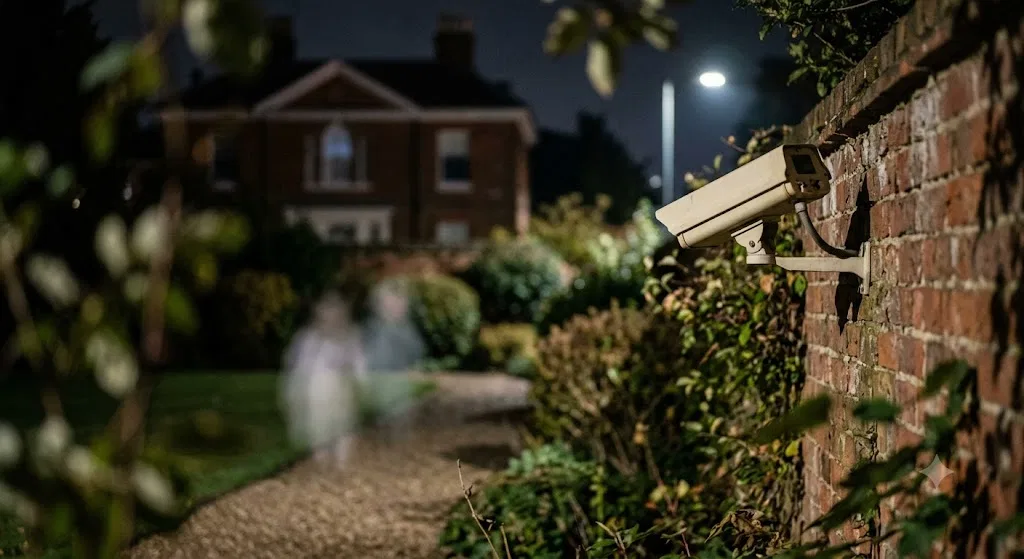
Belgrave Hall is Leicester’s best-known example of a camera-age ghost story: not a medieval ruin apparition glimpsed on a lane, but a pale shape caught by security cameras and then argued over by museum staff, journalists, ghost hunters and sceptics. The claim that made it famous is simple: in 1999, footage from the grounds of this historic house was said to show ghostly figures outside the Hall. The strongest reading, however, is not that Belgrave Hall proves ghosts exist. It is that the case shows how quickly a few ambiguous seconds of CCTV can become local folklore when they are attached to the right building, the right family story and the right media moment.
That makes Belgrave Hall unusually useful within Leicestershire’s haunted history. It is not just a “haunted house” tale. It is a small case study in evidence: what a camera appears to record, what people want it to mean, and how later explanations — leaves, rain, reflections, reflective clothing, time-lapse artefacts and suggestion — change the story without quite killing it.
Why Belgrave Hall Was the Perfect Place for a Camera Ghost
Belgrave Hall stands on Church Road in Belgrave, north of Leicester city centre. Historic England lists it as a Grade II* building, built in 1709, with red and blue chequer-pattern brickwork, fine gates, panelled interiors, fireplaces and a notable staircase. The official listing also places it as part of a historic group with St Peter’s Church, Belgrave House, garden walls, stables and Cross Corners, giving the site the layered setting that ghost stories often need: old house, enclosed gardens, church, walls, gates and a sense of looking back into another Leicester.[Historic England]historicengland.org.ukHistoric EnglandBelgrave Hall and railings and gates in front of the Hall, Non Civil Parish - 1074030 | Historic England…
The house’s real history matters because the ghost story did not attach itself to an anonymous building. Belgrave Hall had long been associated with wealthy Leicester families, especially the Ellis family. British History Online’s account of Belgrave records that John Ellis, chairman of the Midland Counties Railway, bought the Hall in 1845, and that it remained inhabited by his family until the death of his last daughter.[British History Online]british-history.ac.ukpp420 428British History OnlineParishes added since 1892: Belgrave10) In 1845 John Ellis, Chairman of the Midland Counties Railway, bought the Hal… Leicester Museums’ guided-tour material similarly presents Ellis as a major local figure: a railway promoter, reformer, town councillor, anti-slavery campaign attendee and Leicester MP.[Leicester Museums]leicestermuseums.orgLeicester MuseumsBelgrave Hall Guided ToursJohn Ellis took possession of Belgrave Hall in 1847, when he was 58, with a wife and seven dau…
This is the bridge between history and haunting. Once a pale figure was seen on footage from the grounds, retellings could connect it to the Ellis daughters, especially Charlotte Ellis. That does not prove an identification; it shows how ghost traditions borrow emotional force from local biography. A blur becomes a woman. A woman becomes “Victorian”. “Victorian” becomes one of the Ellis daughters. The house’s past gives the image a face.
The 1999 Security-Camera Footage
The core Belgrave Hall claim concerns security-camera footage publicised in 1999. Contemporary and later summaries describe two ghostly or misty figures recorded outside the Hall, with BBC references from February 1999 helping turn the incident from a local curiosity into a widely circulated story. Search-indexed copies and later summaries preserve the wording of the BBC item “Museum gives up the ghost”, while video reposts of the BBC segment describe security cameras catching two mysterious figures for only a few seconds, followed by a pale mist or shape near the wall.[Google Groups]groups.google.comGroups Skeptic NewsGroups Skeptic News
The important point is how limited the original “evidence” seems to have been. The case was not a sustained sighting by a named witness in daylight, nor a long close-up recording of a recognisable person. It was a short, low-detail, security-camera image from the grounds. Later retellings sometimes sharpen this into a more dramatic scene: a “six-foot-tall white figure”, a shape by a rear window, or figures disappearing near a wall. Those details may reflect how the story grew through repetition as much as what the camera actually proved. Paranormal event listings still use the 1999 footage as the headline reason Belgrave Hall became famous, showing how enduring the camera story has been in the site’s public reputation.[Haunted Happenings]hauntedhappenings.co.ukbelgrave hallbelgrave hall
What made the footage powerful was its apparent modernity. Older ghost stories depend on memory: someone says they saw a woman on a staircase, heard footsteps, felt a cold patch or watched a figure vanish. Belgrave Hall seemed different because the “witness” was a machine. To many viewers, CCTV carried an aura of neutrality. A camera was not frightened, suggestible or trying to tell a good story.
Yet that is also the trap. CCTV can record real light, motion and weather while still giving a misleading impression. A security camera does not necessarily explain scale, distance, focus, depth, frame rate or what is close to the lens. A pale object near the camera can look like a large figure in the distance. Rain, insects, leaves and reflections can become “forms” when the viewer already knows the building is meant to be haunted.
Paranormal Fame and Media Retellings
Belgrave Hall’s ghost reputation expanded because the footage arrived at exactly the right cultural moment. By the late 1990s and early 2000s, British television and local media were increasingly comfortable turning ghost claims into public entertainment: haunted buildings, night vigils, ghost-hunting teams and “caught on camera” mysteries. Belgrave Hall fitted that format perfectly. It had a historic house, a plausible “Victorian lady”, an apparent recording, and a city audience close enough to visit.
Leicester City Council later acknowledged the practical impact of the story. A 2013 cultural-services report states that Belgrave Hall and gardens had often attracted fewer than 20,000 visits a year, but that numbers rose in 1999–2000 following press coverage of a suspected ghost on CCTV. The same report notes that later initiatives tried to build visitor numbers, while the site’s future was being considered partly in terms of heritage use and income generation.[cabinet.leicester.gov.uk]cabinet.leicester.gov.ukMicrosoft WordMicrosoft Word
That is one of the most revealing pieces of evidence in the whole case. Whatever appeared on the footage, the ghost story demonstrably affected the Hall’s public life. It did not need to be proven paranormal to matter. It drew attention to a heritage venue, gave Leicester a nationally shareable eerie story and created a new layer of folklore around a building whose official importance was already architectural and historical.
Later paranormal publicity continued to recycle the same core narrative. Haunted-events operators describe Belgrave Hall as famous worldwide after the 1999 security-camera figures and now market it as a venue for ghost hunts, adding reports of an old-fashioned lady on the stairs, footsteps, closing doors and displaced objects.[Haunted Happenings]hauntedhappenings.co.ukbelgrave hallbelgrave hall Local student journalism from 2015 also repeated the account that ghostly figures were recorded in the gardens and used it to frame a Halloween ghost-hunt event.[Leicestershire Press]leicestershirepress.comOpen source on leicestershirepress.com.
This is how camera-era folklore works. The original clip becomes a seed. Around it gather older-sounding motifs — footsteps, cold spots, women in period dress, doors moving by themselves — until the place feels as if it has always been haunted in exactly that way. Some of those stories may pre-date the CCTV attention; others may have gained prominence because the footage made people look at the building differently.
Leaves, Reflections and Other Sceptical Readings
The most persuasive sceptical readings of the Belgrave Hall footage do not require anyone to have faked anything. They rely on ordinary camera problems: uncertain distance, poor focus, environmental debris and the human habit of seeing figures in vague shapes.
The Association for the Scientific Study of Anomalous Phenomena, in an article discussing how “classic” ghost cases evolve, uses Belgrave Hall as an example of how an ambiguous image can acquire a confident identity. It describes the video shape as amorphous and “almost certainly” an out-of-focus falling leaf, then notes how media and later retellings turned it into a “Victorian Lady” and even suggested Charlotte Ellis as the figure.[ASSAP]assap.ac.ukASSAPStone Tape TheoryASSAPStone Tape Theory
A ghost researcher’s memoir of an ASSAP-linked November 1999 session at Belgrave Hall says the site had achieved worldwide fame because of an anomalous CCTV shape, but adds that the shape was later identified as a falling leaf. The same account is valuable because it captures the atmosphere after the publicity: researchers converged on the Hall, the vigil itself was mostly quiet, and some later camera effects elsewhere reminded the writer of streaks caused by falling rain on the Belgrave security video.[Paul Lee]paullee.comPaul Lee Memoirs of a Ghost HunterPaul Lee Memoirs of a Ghost Hunter
Other explanations entered later retellings. Some summaries say the International Society for Paranormal Research examined the footage and treated the image as environmental rather than paranormal, while television investigators later suggested people in reflective jackets as a possible cause.[Wikipedia]WikipediaBelgrave HallBelgrave Hall These accounts should be handled carefully, because not all are equally close to the original investigation and some circulate through reused encyclopaedia-style summaries. Even so, they point in the same direction: the footage is not a stable, high-resolution record of a person-shaped apparition. It is an ambiguous visual event that becomes less ghostly the more attention is paid to camera behaviour and environmental conditions.
For a reader trying to judge the case, the most useful questions are not “Could it be a ghost?” but:
- How far was the object from the camera? A small leaf near the lens can appear larger than a person farther away.
- Was the camera using time-lapse or low-light recording? Such systems can smear motion and remove context.
- What was the weather doing? Rain, wind and airborne debris are common causes of pale streaks and shapes.
- Was the figure identified before or after the Ellis family story was attached? Identification after publicity is much weaker than recognition by someone with independent knowledge.
- Are later retellings adding details not visible in the original footage? A vague shape can become a “lady”, then a named lady, through repetition.
These tests do not make the story worthless. They make it more interesting. Belgrave Hall’s significance lies in the gap between recording and interpretation: a camera produced a puzzling image, and Leicester supplied the haunted meaning.
Why the Ellis Daughter Identification Took Hold
The Charlotte Ellis interpretation is a classic example of how a ghost story becomes emotionally satisfying. John Ellis was a major Leicester figure, and his daughters were closely associated with the Hall. Once the CCTV image was described as a female figure or “Victorian lady”, the Ellis family offered a ready-made identity that felt local, respectable and historically rooted.
The difficulty is that this identification appears to rest on resemblance of theme rather than evidence. The image did not clearly show a face, clothing, age or individual features. It became Charlotte Ellis because the Hall had an Ellis past, because the period atmosphere suited the public imagination, and because named ghosts are easier to remember than unexplained light effects.
This does not mean the Ellis connection is irrelevant. It shows what the community wanted the footage to mean. In Leicestershire’s haunted landscape, Belgrave Hall is not a battlefield like Bosworth or a ruin like Grace Dieu Priory. Its ghost story is domestic and civic. It imagines the return of a woman from a prominent Leicester household, lingering not on a wild road but in the garden of a preserved historic home.
That domestic quality is part of its appeal. A security camera outside a museum accidentally appears to do what museums are supposed to do deliberately: bring the past into view. The sceptical problem is that the “past” may have been a leaf, rain or reflective surface. The folkloric point is that people immediately knew what kind of past they wanted to see.
What Belgrave Hall Shows About Leicester’s Camera-Era Ghost Evidence
Belgrave Hall belongs in Leicestershire’s haunted history precisely because it is not an old-fashioned legend in the purest sense. It is a modern evidence story with an old-house setting. The case asks whether technology makes ghost claims stronger, or merely gives old interpretive habits a new screen to work on.
In older Leicestershire stories, the atmosphere often comes from ruins, roads and repeated local memory: a white figure at Grace Dieu, uneasy rooms at Leicester Guildhall, battlefield shadows around Bosworth. Belgrave Hall shifts the focus to mediation. The ghost is not only what may have happened in the garden; it is what happened when footage was replayed, reported, investigated, marketed and retold.
That gives the case three separate layers:
The recorded event. Something pale or anomalous appeared on security footage in the grounds. The exact nature of that image remains the disputed core of the story.
The interpretive event. Viewers connected the image to a ghostly woman, often with Victorian or Ellis-family associations. This is where folklore enters.
The public event. Press attention increased awareness and visitor interest, later ghost-hunt publicity reused the story, and sceptical organisations used it as a cautionary example of how ambiguous imagery becomes a named haunting.[cabinet.leicester.gov.uk]cabinet.leicester.gov.ukMicrosoft WordMicrosoft Word
Seen this way, the strongest “evidence” at Belgrave Hall is not evidence of a ghost, but evidence of a process. A camera image becomes a claim. A claim becomes a Leicester story. A Leicester story becomes part of the visitor economy and the county’s haunted map.
How Credible Is the Belgrave Hall Case?
As proof of an apparition, the Belgrave Hall CCTV case is weak. The image was brief, ambiguous and vulnerable to ordinary explanations. Sceptical readings involving an out-of-focus falling leaf, rain-like streaks, reflections or reflective clothing are more cautious than the named-ghost interpretation because they explain the visual uncertainty without requiring a supernatural event.[ASSAP]assap.ac.ukASSAPStone Tape TheoryASSAPStone Tape Theory
As folklore, however, the case is strong. It has all the ingredients needed for endurance: a historic Grade II* house, a respected Leicester family, a female figure, media coverage, ghost-hunting retellings, and an argument that never quite closes. It also has documented impact beyond storytelling, because council reporting links the 1999–2000 rise in visitor numbers to press coverage of the suspected CCTV ghost.[cabinet.leicester.gov.uk]cabinet.leicester.gov.ukMicrosoft WordMicrosoft Word
That distinction is the fairest way to read Belgrave Hall. The story should not be presented as confirmed paranormal evidence. Nor should it be dismissed as meaningless simply because a leaf or camera artefact may explain it. Its value lies in showing how modern Leicester made a ghost story out of a modern recording system, and how quickly “caught on camera” can become “known to be haunted” when the setting is already rich with history.
What Was Really Seen at Belgrave Hall?
The most careful answer is: a pale, ambiguous shape or shapes were seen on security-camera footage outside Belgrave Hall, publicised in 1999 and widely interpreted as ghostly figures. Some paranormal retellings identify the apparition with a Victorian woman or one of the Ellis daughters, while sceptical sources argue that the image was probably environmental — especially an out-of-focus falling leaf, with rain, reflections, time-lapse effects or reflective clothing also appearing in later explanations.
The case remains famous not because it provides the best evidence for ghosts in Leicestershire, but because it captures a turning point in haunted-place storytelling. Belgrave Hall is where Leicester’s old-house ghost tradition met the CCTV age. The result was not a settled mystery, but a revealing one: a few seconds of uncertain footage that still shape how many people imagine one of the city’s most atmospheric historic houses.
Amazon book picks
Further Reading
Books and field guides related to What Was Seen at Belgrave Hall?. Use these as the next step if you want deeper reading beyond the article.
The Mammoth Book of Haunted House Stories
Supports interest in famous haunted buildings.
Haunted Britain and Ireland
Belgrave Hall fits Britain's best-known haunting traditions.
The Penguin Guide to the Superstitions of Britain and Ireland
Provides context for enduring ghost beliefs.
eBay marketplace picks
Marketplace Samples
Live-tested eBay searches with available results related to this page.

Endnotes
1.
Source: groups.google.com
Title: Groups Skeptic News
Link:https://groups.google.com/g/alt.paranet.ufo/c/X9m1v6d1GQA
2.
Source: cabinet.leicester.gov.uk
Title: Microsoft Word
Link:https://cabinet.leicester.gov.uk/documents/s57807/Cultural%20Services%20Tourism%20provision%20FINAL.pdf
3.
Source: assap.ac.uk
Title: ASSAPStone Tape Theory
Link:https://www.assap.ac.uk/articles/detail/stone-tape-theory-recording-ghosts
4.
Source: Wikipedia
Title: Belgrave Hall
Link:https://en.wikipedia.org/wiki/Belgrave_Hall
5.
Source: cabinet.leicester.gov.uk
Link:https://cabinet.leicester.gov.uk/documents/g5858/Public%20reports%20pack%20Wednesday%2004-Sep-2013%2017.30%20Economic%20Development%20Transport%20and%20Tourism%20Scrut.pdf?T=10
6.
Source: cabinet.leicester.gov.uk
Link:https://cabinet.leicester.gov.uk/documents/g7520/Public%20reports%20pack%20Tuesday%2007-Mar-2017%2017.30%20Heritage%20Culture%20Leisure%20and%20Sport%20Scrutiny%20Commi.pdf?T=10
7.
Source: directory.leicester.gov.uk
Link:https://directory.leicester.gov.uk/media/ctlpnnzj/foia-34947-attachment-1.xlsx
8.
Source: cabinet.leicester.gov.uk
Link:https://cabinet.leicester.gov.uk/documents/s48479/1208%20Belgrave%20Hall%20presentation%20V4.pdf
9.
Source: cabinet.leicester.gov.uk
Title: draft appraisal Belgrave Hall
Link:https://cabinet.leicester.gov.uk/documents/s11476/draft%20appraisal%20Belgrave%20Hall.pdf
10.
Source: Wikipedia
Title: List of reportedly haunted locations in the United Kingdom
Link:https://en.wikipedia.org/wiki/List_of_reportedly_haunted_locations_in_the_United_Kingdom
11.
Source: Wikipedia
Title: Belgrave, Leicester
Link:https://en.wikipedia.org/wiki/Belgrave%2C_Leicester
12.
Source: Wikipedia
Title: Belgrave Hall
Link:https://pl.wikipedia.org/wiki/Belgrave_Hall
13.
Source: historicengland.org.uk
Link:https://historicengland.org.uk/listing/the-list/list-entry/1074030
Source snippet
Historic EnglandBelgrave Hall and railings and gates in front of the Hall, Non Civil Parish - 1074030 | Historic England...
14.
Source: british-history.ac.uk
Title: pp420 428
Link:https://www.british-history.ac.uk/vch/leics/vol4/pp420-428
Source snippet
British History OnlineParishes added since 1892: Belgrave10) In 1845 John Ellis, Chairman of the Midland Counties Railway, bought the Hal...
15.
Source: leicestermuseums.org
Link:https://www.leicestermuseums.org/BelgraveHallTours2024
Source snippet
Leicester MuseumsBelgrave Hall Guided ToursJohn Ellis took possession of Belgrave Hall in 1847, when he was 58, with a wife and seven dau...
16.
Source: hauntedhappenings.co.uk
Title: belgrave hall
Link:https://www.hauntedhappenings.co.uk/belgrave-hall/
17.
Source: leicestershirepress.com
Link:https://leicestershirepress.com/2015/10/29/unique-ghost-hunt-at-most-haunted-belgrave-hall-in-leicester/
18.
Source: paullee.com
Title: Paul Lee Memoirs of a Ghost Hunter
Link:https://www.paullee.com/ghosts/vigils.php
19.
Source: wikishire.co.uk
Title: Belgrave Hall
Link:https://wikishire.co.uk/wiki/Belgrave_Hall
20.
Source: leicestershistory.files.wordpress.com
Title: belgrave hall
Link:https://leicestershistory.files.wordpress.com/2015/01/belgrave-hall.pdf
21.
Source: facebook.com
Link:https://www.facebook.com/groups/283566876803190/posts/572802344546307/
22.
Source: kids.kiddle.co
Title: Belgrave Hall
Link:https://kids.kiddle.co/Belgrave_Hall
Additional References
23.
Source: bliptext.com
Link:https://bliptext.com/articles/belgrave-hall
24.
Source: lrgt.org
Link:https://www.lrgt.org/places/belgrave-hall-museum-and-gardens/
25.
Source: hamdiaccounting.com
Link:https://hamdiaccounting.com/index.php?special%2F102323119626=
26.
Source: enricolatina.com
Link:https://www.enricolatina.com/shopbrand/061053294090
27.
Source: belgraveheritagetrust.org
Link:https://belgraveheritagetrust.org/history/john-ellis/
28.
Source: paranormaleyeuk.co.uk
Link:https://www.paranormaleyeuk.co.uk/peuk1/belgrave-hall-ghost-hunt-
29.
Source: hauntedheritage.co.uk
Link:https://hauntedheritage.co.uk/venues/belgrave-hall-taster-session/
30.
Source: youtube.com
Title: BELGRAVE HALL GHOST, LEICESTER (BBC News, 2/2/99)
Link:https://www.youtube.com/watch?v=JI3e229zu40
Source snippet
BBC News - Ghosts at Belgrave Hall? (2 Feb 1999)...
31.
Source: youtube.com
Title: BBC News
Link:https://www.youtube.com/watch?v=CeDwSEti1hY
Source snippet
Most Haunted - Celebrity Special - Belgrave Hall...
32.
Source: youtube.com
Title: 10 Most Haunted Places in Leicestershire
Link:https://www.youtube.com/watch?v=HFKLmhJpITs
Source snippet
Shocking Footage At The Humber Stone | Haunted Leicester...
Topic Tree