Within Haunted Cambridgeshire
What Haunted Travellers in the Cambridgeshire Fens?
Fenland ghost lore turns marsh lights, black dogs and lonely roads into warnings about water, darkness and losing the path.
On this page
- Lantern Men and will o' the wisp explanations
- Black dogs on fen roads and riversides
- Why wetland danger became folklore
Page outline Jump by section
Introduction
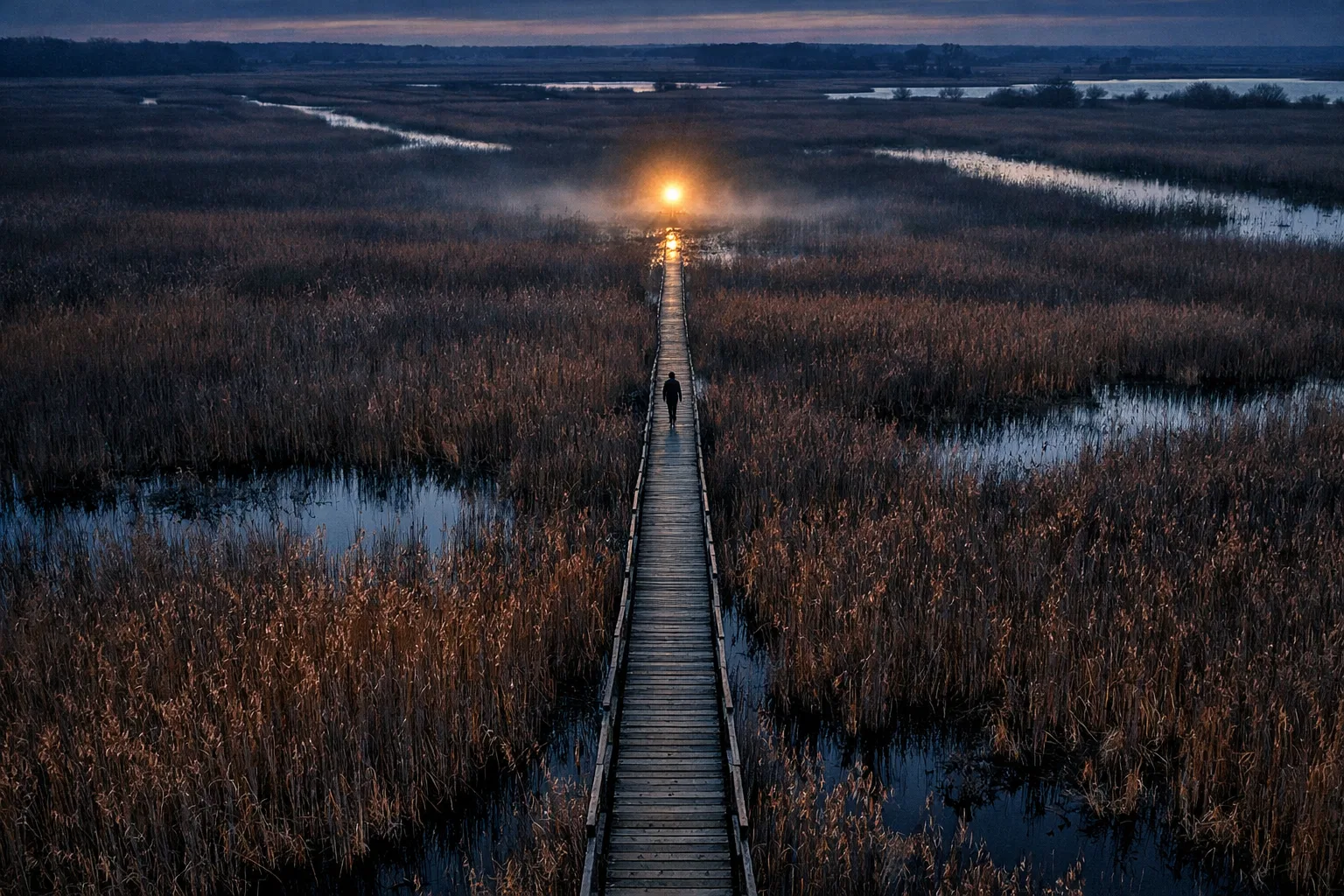
Wicken Fen’s haunted reputation is a fenland one: not a single house ghost, but a landscape of lights, sounds, paths, reeds and water. The best-known stories speak of Lantern Men or will-o’-the-wisp lights drifting over the marsh, tempting night travellers off safe ground, while the wider Cambridgeshire Fens also share East Anglia’s black dog tradition, usually known as Black Shuck. These are best read as folklore rather than evidence of literal spirits. Yet they are not random inventions. They belong to a place where darkness, waterlogged peat, reed beds, lodes, ditches and flat horizons could make distance hard to judge and danger easy to misread. Wicken Fen matters because it preserves, unusually vividly, the kind of haunted Cambridgeshire that is almost the opposite of Cambridge’s college courts: open, wet, working, lonely and deeply shaped by the fear of losing the path.[National Trust]nationaltrust.org.ukNational Trust The history of Wicken Fen | Cambridgeshire | National TrustNational Trust The history of Wicken Fen | Cambridgeshire | National Trust
Why Wicken Fen feels different from Cambridge’s urban ghosts
Cambridge’s better-known ghost stories often gather around rooms, staircases, college courts and named historical deaths. Wicken Fen works differently. Its stories are not mainly about a dead person returning to one building, but about a whole environment becoming uncanny after dusk. The National Trust describes Wicken Fen as its first nature reserve, with the first two acres bought in 1899, and as a surviving remnant of undrained fenland in a region largely altered by drainage, peat cutting and agricultural improvement. That survival is central to the folklore: Wicken gives modern visitors a rare view of the older fen landscape that once made such stories plausible.[National Trust]nationaltrust.org.ukNational Trust The history of Wicken Fen | Cambridgeshire | National TrustNational Trust The history of Wicken Fen | Cambridgeshire | National Trust
The place was never empty wilderness. Before conservation, Wicken supported fen families, sedge cutters, peat diggers, eel catchers, wildfowlers and boatmen. The National Trust’s history notes the earliest recorded sedge harvest in 1419, regular sedge cutting afterwards, peat digging for fuel, and the importance of lodes and rivers for moving heavy loads in and out of fen-side communities. This is important because the haunted stories are not simply tourist mood. They sit beside a working landscape where people moved through wet ground, waterways and reed beds in poor light because their livelihood required it.[National Trust]nationaltrust.org.ukNational Trust The history of Wicken Fen | Cambridgeshire | National TrustNational Trust The history of Wicken Fen | Cambridgeshire | National Trust
Wicken’s physical setting also helps explain why folklore here often uses moving lights and animals rather than pale ladies or monks. The reserve includes reed beds, sedge fen, wet grassland, open water and man-made waterways. Cambridgeshire Geological Society describes Sedge Fen’s peat and marl sequence as a record of changing fenland environments over thousands of years, while also noting flooded pits, lodes and remote rights of way around the fen edge. In such a landscape, a light seen across water, a dog heard but not clearly seen, or a mistaken path beside a ditch could become the seed of a warning story.[cambsgeology.org]cambsgeology.orgWicken Fen and Reach | Cambridgeshire Geological SocietyWicken Fen and Reach | Cambridgeshire Geological Society
Lantern Men and will-o’-the-wisp explanations
The most distinctive haunting associated with Wicken Fen is the Lantern Man, a local version of the will-o’-the-wisp. In fenland folklore these are not cosy fairy lights. They are usually described as ghostly or malicious lights that appear over wet ground and lure people towards reed beds, ditches or water. Modern summaries of the tradition place sightings around Wicken Fen and other parts of the East Anglian Fens, and often connect the stories with accounts collected or repeated by folklore writers, including L. F. Newman and later paranormal writers such as Peter Underwood.[Wikipedia]WikipediaLantern manLantern man
The detail that makes the Wicken version memorable is its practical strangeness. The Lantern Men are said to be attracted by whistling. One repeated account tells of a fisherman or fen traveller who threw himself down to avoid the light after realising it had noticed him; another tells of a man whistling for his dog, taking shelter in a friend’s house, and the friend hanging a horn outside on a pole to draw the light away. By morning, the horn was said to have been burned. These are not strong evidence for a supernatural event, but they are excellent folklore: specific, dramatic, easy to retell, and built around a rule that a fen traveller could remember — do not whistle in the dark.[Wikipedia]WikipediaLantern manLantern man
The obvious natural comparison is the will-o’-the-wisp, long described in Britain and beyond as a flickering light seen over bogs, marshes and swamps. Scientific explanations have usually involved gases produced by decaying organic matter, especially methane, sometimes with phosphine or related compounds proposed as possible ignition mechanisms. More cautious accounts point out that the classic marsh-gas explanation does not neatly explain every reported behaviour, especially stories in which lights seem to retreat, follow or respond to a person. That uncertainty does not prove a haunting; it shows why ambiguous lights in wet places have remained so good at generating folklore.[wikipedia.org]WikipediaOpen source on wikipedia.org.
At Wicken, the explanation need not be only chemical. Mist, reflections on water, distant lanterns, low moonlight, moving reeds, eye-level changes on flat ground and fear itself could all alter what a person thought they saw. The fen’s level horizons make distance deceptive, and water can multiply or distort a small light. The folklore turns that uncertainty into intention: the light does not merely appear; it wants you to follow. That is the key movement from natural phenomenon to ghost story.
Black dogs on fen roads and riversides
The black dog tradition around Wicken is less tightly localised than the Lantern Men, but it belongs naturally to the same fenland mental map. Black Shuck, Old Shuck or simply Shuck is one of East Anglia’s most famous supernatural animals, a great black dog said to roam lonely roads, churchyards, coasts and countryside. The tradition is usually associated most strongly with Norfolk and Suffolk, but nineteenth-century evidence explicitly extends it into Cambridgeshire. In an 1850 issue of Notes and Queries, E. S. Taylor described people in East Norfolk “and even Cambridgeshire” speaking of a huge black shaggy dog with fiery eyes visiting churchyards at midnight.[BookRags]bookrags.comBook Rags Notes and Queries, Number 29,Book Rags Notes and Queries, Number 29,
That phrase “even Cambridgeshire” matters. It suggests that Cambridgeshire was already understood as part of the East Anglian black dog zone, though perhaps less central than Norfolk and Suffolk. Later summaries of Black Shuck continue to include the Cambridgeshire Fens among the areas where the tradition belongs, and describe a figure whose meaning changes from place to place: sometimes an omen of death, sometimes a terrifying roadside apparition, and occasionally a more protective or companionable presence.[Wikipedia]WikipediaBlack ShuckBlack Shuck
For the Cambridgeshire Fens, black dog stories make most sense on roads, riverbanks and causeways: places where a walker or rider moved between dry ground and water. Nearby Littleport, also in the Cambridgeshire fen country, has separate black dog legends recorded in folklore summaries: one involving a huge black dog linked to a pre-Reformation rescue story, another associated with the A10 and the River Great Ouse after an owner’s drowning. These are not Wicken Fen stories in the narrowest sense, but they show how fenland black dogs attach themselves to routes, rivers and danger points rather than to one grand haunted building.[Wikipedia]WikipediaBlack ShuckBlack Shuck
The black dog and the Lantern Man do slightly different folklore jobs. The Lantern Man explains the treacherous light: the thing that draws you off the path. The black dog embodies the night road itself: the shape that appears where a traveller is already exposed. Both make the same social warning memorable. On the fen, do not assume that what you see in darkness is safe, ordinary or correctly understood.
Why wetland danger became folklore
Fenland folklore is unusually good at turning environmental risk into a story with a face, a light or a sound. Wicken’s history explains why. The National Trust notes that most of the surrounding Fens were drained in the seventeenth century by outside investors known as the Adventurers, while Wicken remained a remnant of undrained fenland partly because villagers resisted changes that threatened their way of life. This means Wicken was not only wet; it was culturally defined by a tension between traditional fen livelihoods and the reshaping of the landscape.[National Trust]nationaltrust.org.ukNational Trust The history of Wicken Fen | Cambridgeshire | National TrustNational Trust The history of Wicken Fen | Cambridgeshire | National Trust
Water was both life and danger. It supplied fish, eels, fowl, reeds, sedge, peat transport and seasonal work, but it also created ditches, pools, soft ground and confusing night routes. The same lodes that moved cargo could become boundaries and hazards. The same reed beds that supported thatching could hide water and reduce visibility. A ghost light story is therefore not just a superstition about a flame; it is a compact survival lesson wrapped in memorable language.
The fen’s ecology strengthens this reading. Peat forms from dead plant material in waterlogged ground, and the National Trust describes the Fens as once covering about 3,800 square kilometres of deep peat before widespread drainage. Wicken is one of the last fragments of undrained fenland, and modern restoration work focuses on keeping peat saturated by managing water levels. In plain terms, the landscape that created the stories is still physically legible: wet peat, controlled water, ditches, reeds and open sky remain part of how the place works.[National Trust]nationaltrust.org.ukNational Trust Wicken Fen Peatland Restoration | National TrustNational Trust Wicken Fen Peatland Restoration | National Trust
There is also a psychological mechanism. In a city, fear often attaches to a room where something happened. In a fen, fear attaches to orientation. Can you find the path? Is that light near or far? Is that sound a dog, wind, waterbird or something else? Is the ground firm? The folklore of Wicken Fen gives those uncertainties characters: Lantern Men, Shuck-like dogs, and hostile lights moving where no safe traveller should follow.
How credible are the Wicken Fen stories?
The Wicken Fen lights and black dog legends are credible as folklore, not as verified paranormal events. That distinction is important. The strongest evidence shows that Wicken is a historically suitable landscape for such stories: a surviving undrained fen, long worked by local people, full of reeds, peat, lodes and wet ground, and now preserved as a nationally important wetland. The National Trust, Cambridgeshire Geological Society and conservation sources strongly support that environmental context.[nationaltrust.org.uk]nationaltrust.org.ukNational Trust The history of Wicken Fen | Cambridgeshire | National TrustNational Trust The history of Wicken Fen | Cambridgeshire | National Trust
The Lantern Men themselves rest mainly on folklore and paranormal retellings rather than dated, independently verified witness records. The stories are consistent enough to show a recognised regional tradition — lights over the Fens, Wicken named as a key location, whistling as a danger, mud or silence as protection — but they are not the sort of evidence that can confirm an apparition. Their value is interpretive: they show how fen people and later storytellers made sense of frightening lights and unsafe wetland travel.[wikipedia.org]WikipediaLantern manLantern man
The black dog material has a firmer historical paper trail in the sense that the Shuck tradition appears in nineteenth-century print and explicitly includes Cambridgeshire. Even so, the evidence remains folkloric. Taylor’s 1850 note is a record of reported belief and anecdote, not a controlled investigation. Later references to Black Shuck in the Cambridgeshire Fens show continuity of a regional legend, but not proof that a spectral animal haunted a particular Wicken path.[BookRags]bookrags.comBook Rags Notes and Queries, Number 29,Book Rags Notes and Queries, Number 29,
The most balanced reading is that Wicken Fen’s legends preserve a genuine social memory of danger. They remember how frightening the fen could be when work, weather, darkness and water met. The haunting is not strongest because a ghost was proved, but because the landscape still explains the story. Stand on a fen path near reed beds and open water as the light drops, and the old warning becomes immediately understandable: the thing that leads you astray may be no more than a glow, a sound, a dog-shape, or your own mistake — but in the Fens, that could be enough.

Amazon book picks
Further Reading
Books and field guides related to What Haunted Travellers in the Cambridgeshire Fens?. Use these as the next step if you want deeper reading beyond the article.
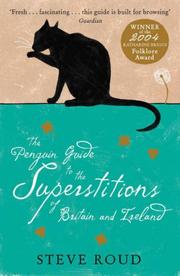
The Penguin Guide to the Superstitions of Britain and Ireland
Explains will-o'-the-wisp and black dog traditions.

The folklore of Discworld
Introduces folklore concepts including marsh lights and supernatural traditions.

Ghosts
First published 2015. Subjects: Ghosts, History, BODY, MIND & SPIRIT, Parapsychology, General.
eBay marketplace picks
Marketplace Samples
Live-tested eBay searches with available results related to this page.



Endnotes
1.
Source: cambsgeology.org
Title: Wicken Fen and Reach | Cambridgeshire Geological Society
Link:https://www.cambsgeology.org/local-sites/wicken-fen-and-reach
2.
Source: Wikipedia
Title: Lantern man
Link:https://en.wikipedia.org/wiki/Lantern_man
3.
Source: Wikipedia
Link:https://en.wikipedia.org/wiki/Will-o%27-the-wisp
4.
Source: bookrags.com
Title: Book Rags Notes and Queries, Number 29,
Link:https://www.bookrags.com/ebooks/15197/6.html
5.
Source: Wikipedia
Title: Black Shuck
Link:https://en.wikipedia.org/wiki/Black_Shuck
6.
Source: Wikipedia
Title: Wicken Fen
Link:https://en.wikipedia.org/wiki/Wicken_Fen
7.
Source: nature.com
Link:https://www.nature.com/articles/142634a0.pdf
8.
Source: nationaltrust.org.uk
Title: National Trust The history of Wicken Fen | Cambridgeshire | National Trust
Link:https://www.nationaltrust.org.uk/visit/cambridgeshire/wicken-fen-national-nature-reserve/history-of-wicken-fen
9.
Source: nationaltrust.org.uk
Title: National Trust Wicken Fen Nature Reserve | Cambs
Link:https://www.nationaltrust.org.uk/visit/cambridgeshire/wicken-fen-national-nature-reserve
10.
Source: royalsocietypublishing.org
Link:https://royalsocietypublishing.org/rsta/article/372/2030/20140206/58587/Will-o-the-Wisp-an-ancient-mystery-with
11.
Source: nationaltrust.org.uk
Title: National Trust Wicken Fen Peatland Restoration | National Trust
Link:https://www.nationaltrust.org.uk/visit/cambridgeshire/wicken-fen-national-nature-reserve/peatland-restoration
12.
Source: cambridge-news.co.uk
Link:https://www.cambridge-news.co.uk/news/local-news/lantern-man-wicken-fen-folklore-18517642
13.
Source: cambridge-news.co.uk
Title: 5 of Cambridgeshire’s spookiest folklore legends
Link:https://www.cambridge-news.co.uk/news/history/5-cambridgeshires-spookiest-folklore-legends-21399281
14.
Source: reddit.com
Title: Black Shuck
Link:https://www.reddit.com/r/folklore/comments/mop6xy/black_shuck_the_ghostly_spectral_dog_of_east/
15.
Source: nationaltrust.org.uk
Title: wicken fen vision
Link:https://www.nationaltrust.org.uk/visit/cambridgeshire/wicken-fen-national-nature-reserve/wicken-fen-vision
16.
Source: nationaltrust.org.uk
Link:https://www.nationaltrust.org.uk/visit/cambridgeshire/wicken-fen-national-nature-reserve/wicken-fen-nature-trail
17.
Source: nationaltrust.org.uk
Title: Outdoor activities on Wicken Fen
Link:https://www.nationaltrust.org.uk/visit/cambridgeshire/wicken-fen-national-nature-reserve/outdoor-activities-at-wicken-fen
18.
Source: nationaltrust.org.uk
Title: wicken fen 125th anniversary
Link:https://www.nationaltrust.org.uk/visit/cambridgeshire/wicken-fen-national-nature-reserve/wicken-fen-125th-anniversary
19.
Source: nationaltrust.org.uk
Link:https://www.nationaltrust.org.uk/visit/cambridgeshire/wicken-fen-national-nature-reserve/things-to-see-and-do-at-wicken-fen
20.
Source: nationaltrust.org.uk
Title: peat project
Link:https://www.nationaltrust.org.uk/visit/cambridgeshire/wicken-fen-national-nature-reserve/peat-project
21.
Source: cambridge-news.co.uk
Link:https://www.cambridge-news.co.uk/news/history/cambridgeshires-terrifying-lantern-men-roam-24150833
22.
Source: van-helsing-own-story.fandom.com
Title: Lantern Man
Link:https://van-helsing-own-story.fandom.com/wiki/Lantern_Man
23.
Source: creatures-of-myth.fandom.com
Title: Black Shuck
Link:https://creatures-of-myth.fandom.com/wiki/Black_Shuck
24.
Source: the-war-of-the-sword.fandom.com
Title: Black Shuck
Link:https://the-war-of-the-sword.fandom.com/wiki/Black_Shuck
25.
Source: caspar-test.fandom.com
Title: Black Shuck
Link:https://caspar-test.fandom.com/wiki/Black_Shuck
26.
Source: hiddenea.com
Link:https://www.hiddenea.com/shuckland/cambridge.htm
27.
Source: astonishinglegends.com
Title: the lantern men
Link:https://astonishinglegends.com/astonishing-legends/2024/10/14/the-lantern-men
28.
Source: juridicious.blog
Title: Wicken Fen
Link:https://juridicious.blog/tag/wicken-fen/
Additional References
29.
Source: youtube.com
Title: Black Shuck: The Chilling History Of The Demon Hound Of East Anglia
Link:https://www.youtube.com/watch?v=y7HDJRWx6To
Source snippet
Black Shuck: Britain's Most Terrifying Folklore Legend...
30.
Source: youtube.com
Title: The Lantern Men of the Fens
Link:https://www.youtube.com/watch?v=lgeceufgU0s
Source snippet
Black Shuck: The Chilling History Of The Demon Hound Of East Anglia...
31.
Source: theguardian.com
Link:https://www.theguardian.com/notesandqueries/query/0%2C5753%2C-1837%2C00.html
32.
Source: invisibleworks.co.uk
Link:https://www.invisibleworks.co.uk/fenland-dogs/
33.
Source: instagram.com
Link:https://www.instagram.com/p/DYKY328DRib/
34.
Source: facebook.com
Link:https://www.facebook.com/Thehiddenporchllc/videos/-folklore-friday-the-black-dog-at-the-crossroadscome-on-in-porch-sitters-and-let/1644060243350487/
35.
Source: lincstrust.org.uk
Link:https://www.lincstrust.org.uk/what-we-do/conservation-projects/FEPP
36.
Source: archive.org
Link:https://archive.org/stream/newmansentomolog6187273lond/newmansentomolog6187273lond_djvu.txt
37.
Source: archive.org
Link:https://archive.org/stream/entomologistsrec471935tutt/entomologistsrec471935tutt_djvu.txt
38.
Source: instagram.com
Link:https://www.instagram.com/p/CjtpWbmr53Z/
Topic Tree