Within Haunted Hertfordshire
Why St Albans Attracts Monk Ghosts
St Albans ghost stories draw power from Roman remains, abbey history, martyrdom and centuries of vanished monastic ritual.
On this page
- Alban, Verulamium and the ancient sacred landscape
- Abbey, cathedral and monastic apparition stories
- How deep history turns city streets into ghost walks
Page outline Jump by section
Introduction
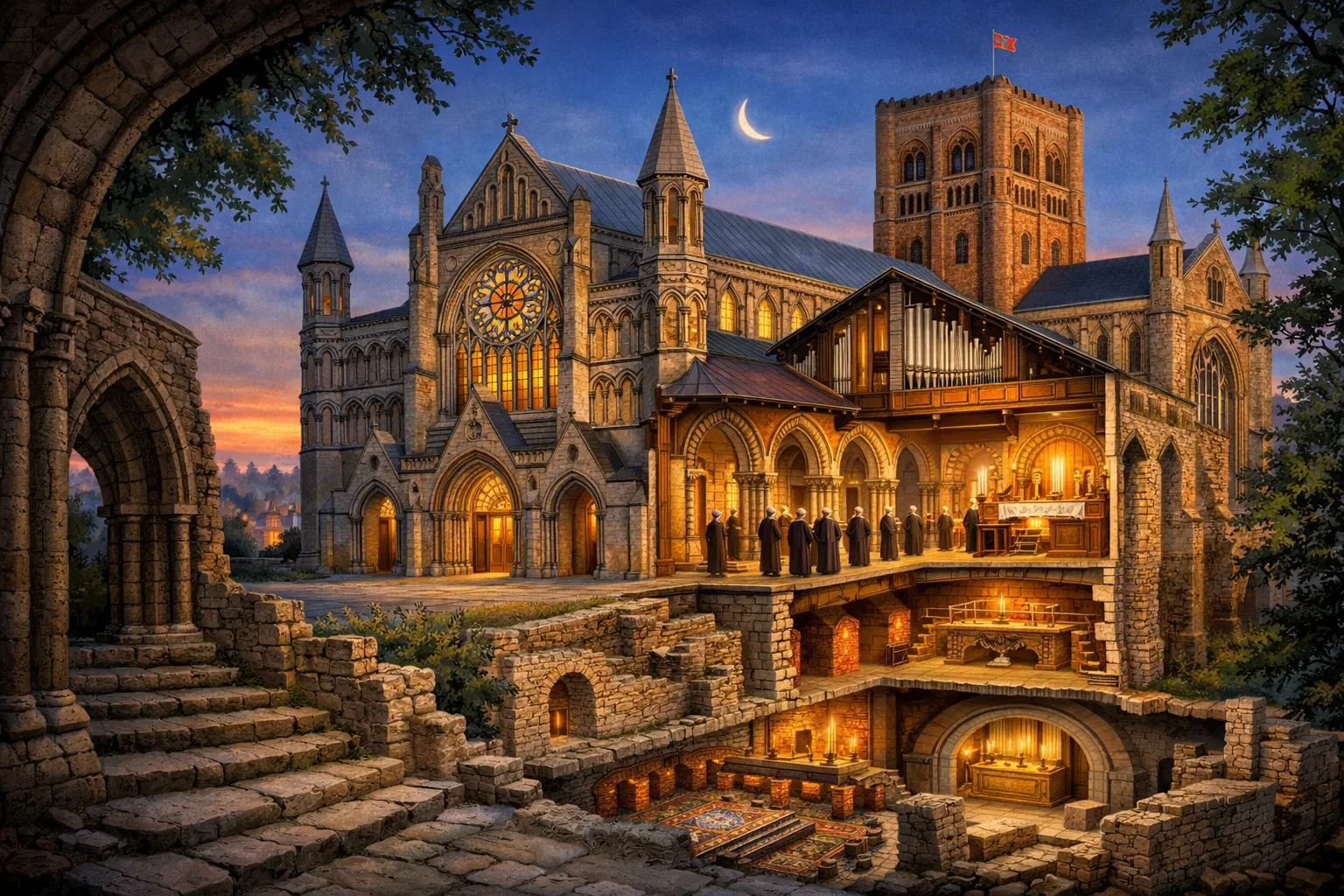
St Albans attracts monk ghosts because its haunted stories are not pinned to a single ruin or one dramatic apparition. They grow from the city’s layered memory: Roman Verulamium below the hill, the martyrdom tradition of Alban, the great Benedictine abbey, broken medieval shrines, vanished monastic buildings, and modern ghost walks that ask visitors to imagine the old city beneath the shopfronts. The most familiar stories speak of hooded figures, a ghostly monastic procession, unexplained organ music and candlelit scenes inside or around St Albans Cathedral, but the strongest evidence for them is folkloric and tour-based rather than documentary proof of an apparition. The interest lies in how powerfully the city’s real history makes such stories feel at home.
In Hertfordshire’s haunted landscape, St Albans is distinctive because its ghosts seem to come from depth rather than isolation. It is not a lonely country house or a roadside legend. It is a busy city where Roman walls, medieval worship, Reformation loss and contemporary heritage tourism all occupy the same mental map.
Alban, Verulamium and the Sacred Ground Beneath the City
The haunting atmosphere of St Albans begins before the monks. The modern city takes its name from Alban, traditionally honoured as Britain’s first martyr, whose story places him in Roman Verulamium, “just down the hill” from the present cathedral. According to the cathedral’s own account, Alban sheltered the Christian priest later known as Amphibalus, changed clothes with him to let him escape, and was led out of Verulamium to be beheaded on the hillside where his grave became a place of pilgrimage.[St Albans Cathedral]stalbanscathedral.orgWho was Alban? | St Albans Cathedral…
For ghost-story purposes, that matters because the city’s central sacred site is not merely “old”; it is built around a memory of execution, substitution, pilgrimage and burial. The cathedral describes itself as the oldest site of continual Christian worship in these Isles, shaped by a history that runs from a small pilgrim church to abbey, monastery, parish church and cathedral.[St Albans Cathedral]stalbanscathedral.orgWho was Alban? | St Albans Cathedral… That continuity gives later apparition tales a ready-made emotional setting. A hooded figure in St Albans does not have to be explained from scratch: the place already trains the imagination to expect devotion, sacrifice and return.
The Roman layer reinforces this effect. Historic England describes Verulamium as the third largest city and only municipium of Roman Britain, with visible remains including stretches of wall and gateways, a mosaic floor and a hypocaust.[Historic England]historicengland.org.ukHistoric England Verulamium, Non Civil ParishHistoric EnglandVerulamium, Non Civil Parish - 1103030 | Historic England… English Heritage adds that the Roman city wall can still be traced for most of its two-mile circuit, and that Verulamium was rebuilt after Boudicca’s attack around AD 60 before developing stone public buildings including a theatre, basilica and forum.[English Heritage]english-heritage.org.ukEnglish Heritage History of Roman Wall, St Albans | English HeritageEnglish Heritage History of Roman Wall, St Albans | English Heritage
This is why St Albans ghost walks often feel less like invented theatre than like a guided descent through layers. The visitor does not need to believe in ghosts to understand the mechanism. The city itself keeps showing older versions of itself: Roman masonry, medieval brick reused from Verulamium, a cathedral raised over a martyr cult, and streets whose modern surfaces sit over centuries of worship, burial and civic change.
Abbey and Cathedral Apparition Stories
The core St Albans monastic haunting tradition centres on the cathedral and its vanished abbey life. Modern retellings commonly mention hooded monks, ghostly chanting, a self-playing organ and figures that appear where monastic movement once made sense. A 2024 visitor-facing feature on St Albans’ haunted buildings gives the best compact version of the popular tale: in 1944, a teenage firewatcher named Basil was said to have encountered hooded figures, an organ playing by itself, candlelight, and a procession of chanting monks while stationed at the abbey during wartime firewatch duty.[Luxurious Magazine]luxuriousmagazine.comOpen source on luxuriousmagazine.com.
That account should be read carefully. It is a modern reported legend, not a verified wartime record. Its power comes from its setting and details: a teenager alone in a vast sacred building, wartime darkness, the fear of air raids, and a scene that briefly restores the lost abbey as if the Reformation had never happened. The organ, candles and chanting do not point to a random spectre; they conjure a whole vanished order of sound and movement.
The cathedral’s documented history explains why that particular kind of ghost took hold. St Albans Abbey was a Benedictine monastery traditionally founded by King Offa in 793, later rebuilt on a grand Norman scale after the Conquest. The cathedral notes that Paul of Caen began the Norman rebuilding, including the tower that still stands, and that the church was built from bricks and tiles saved from Roman Verulamium.[St Albans Cathedral]stalbanscathedral.orgOur History | St Albans Cathedral… The same official history describes the medieval abbey as a famous place of learning, where monks produced high-quality manuscripts in the scriptorium.[St Albans Cathedral]stalbanscathedral.orgOur History | St Albans Cathedral…
Then comes the rupture that makes the place hauntable in the popular imagination. In December 1539, St Albans Abbey was closed, most of its buildings were destroyed, the shrines of St Alban and St Amphibalus were demolished, and Alban’s relics disappeared.[St Albans Cathedral]stalbanscathedral.orgOur History | St Albans Cathedral… A haunting tradition does not need a single murder scene when it has this kind of institutional death: a community dissolved, ritual silenced, buildings pulled down, relics lost, and sacred objects scattered.
The shrine material deepens the point. The cathedral says the shrine base of St Amphibalus was smashed at the Reformation, rediscovered in 1872, and restored in the twenty-first century.[St Albans Cathedral]stalbanscathedral.orgThe Shrine of St Amphibalus | St Albans Cathedral… In 2021, the restored shrine returned near the shrine of St Alban, making St Albans the only British cathedral to house two medieval pedestal shrines.[St Albans Cathedral]stalbanscathedral.orgOne Cathedral, Two Shrines | St Albans Cathedral… For a haunted-history reader, this is not proof of a monk ghost. It is better than that: it shows exactly how broken sacred memory can become visible again, stone by stone.
Why Monk Ghosts Fit St Albans So Well
Monk ghosts are among the most common figures in English ecclesiastical haunting traditions, but in St Albans they feel unusually coherent. The figure of the monk connects several parts of the city’s story at once: pilgrimage to Alban’s shrine, daily Benedictine ritual, manuscript culture, Reformation destruction, and the survival of the church as a public landmark.
There are three main reasons the motif works here.
First, the lost monastery is easy to imagine. The cathedral still dominates the city, but the abbey precinct was once larger than the surviving church. When visitors hear of hooded figures moving through walls or appearing in places where buildings no longer stand, the story turns architectural absence into atmosphere. It asks the listener to imagine cloisters, processions and monastic routes that have been interrupted by demolition, rebuilding and modern streets.
Second, St Albans has a living soundscape of worship. Organ music, bells, choral singing and processional movement are not alien to the cathedral. That makes stories of ghostly music unusually plausible as folklore, because they exaggerate something the building genuinely does. A self-playing organ is uncanny precisely because organ music already belongs there.
Third, the city keeps retelling itself through guided performance. St Albans Tour Guides advertise a “Ghosts and Ghouls” walk through the haunted city, promising places noted for strange events and stories of well-known phantoms.[St Albans Tour Guides]stalbanstourguides.co.ukOpen source on stalbanstourguides.co.uk. A 2025 St Albans Times account of one such walk describes the guide urging the group to look beyond the modern buildings to the history beneath them, which is exactly how St Albans ghost storytelling works: the apparition becomes a way of seeing depth in a familiar street.[St Albans Times]stalbanstimes.co.ukSt Albans Times A journey through St Albans’ haunted historySt Albans Times A journey through St Albans’ haunted history
This is also why the St Albans monk stories should not be separated too sharply from other city hauntings. The White Hart Hotel, Fishpool Street, Sumpter Yard and other nearby locations appear in modern haunted St Albans itineraries, but the monastic and cathedral material gives the city its deeper centre of gravity. The monk is the figure who makes the ancient city feel continuous.

Ancient City Memory on Modern Ghost Walks
St Albans’ haunted reputation is now partly sustained by heritage tourism. That does not make the stories worthless; it tells us how they survive. Ghost walks turn scattered legends into a route. They give visitors a sequence: museum, street, inn, cathedral, yard, alley, hill. Each stop becomes an invitation to look at the present city and mentally peel it back.
The 2025 St Albans Times account is useful because it shows the process happening in real time. The writer begins at St Albans Museum + Gallery and notes the difficulty of embracing a ghost story while modern traffic and familiar shops remain in view; then the guide reframes the scene by pointing to the history beneath the visible buildings.[St Albans Times]stalbanstimes.co.ukSt Albans Times A journey through St Albans’ haunted historySt Albans Times A journey through St Albans’ haunted history That is the key mechanism of St Albans haunted memory. The ghost does not simply frighten. It teaches the viewer to treat the city as layered.
This is especially important in a place where the ancient and medieval layers are physically close. Verulamium Museum directs visitors from the museum to the Roman hypocaust, the Roman theatre and the city walls in Verulamium Park.[St Albans Museums]stalbansmuseums.org.ukOpen source on stalbansmuseums.org.uk. The cathedral stands uphill from that Roman landscape, while its own history says the Norman church reused Roman bricks and tiles from Verulamium.[St Albans Cathedral]stalbanscathedral.orgOur History | St Albans Cathedral… The result is a city where a walk can move from Roman civic life to Christian martyrdom to medieval monasticism without leaving the local story.
The annual public remembrance of Alban also keeps the martyr narrative visible. In 2026, the cathedral described the Alban Pilgrimage as a city-centre retelling of the story with giant puppets, Roman soldiers, brass bands and thousands of spectators, beginning at St Peter’s Church, one of the ancient churches associated with pilgrims preparing to visit Alban’s shrine.[St Albans Cathedral]stalbanscathedral.orgbritains first saint larger than lifebritains first saint larger than life This is not a ghost event, but it belongs to the same memory system. St Albans repeatedly stages its deep past in public, so its ghost stories have a ready audience and a recognisable landscape.
How Credible Are the St Albans Monk Hauntings?
The fairest assessment is that St Albans has strong historical depth and lively ghost tradition, but relatively thin publicly available evidence for specific apparitions. The cathedral’s Roman, martyr and monastic history is well supported. The ghostly monks, chanting processions and self-playing organ are best treated as local legend, reported experience and tour tradition.
That does not make the stories uninteresting. It changes the question. Instead of asking “are the monks real?”, a better Hertfordshire haunted-history question is: why did this city produce monk ghosts rather than some other figure? The answer is unusually clear. St Albans was a Roman city, a martyr shrine, a Benedictine powerhouse, a Reformation casualty and a modern heritage destination. The monk apparition compresses all of that into one recognisable image.
There are also plausible non-supernatural explanations for some reported experiences. Large churches can produce misleading acoustics, especially when distant music, footsteps, air movement or maintenance noises travel through stone spaces. Candlelight, darkness, wartime anxiety and expectation can intensify perception. Guided walks also prime people to notice cold spots, silhouettes and reflections. None of this disproves a personal experience, but it explains why careful writing should call these accounts stories, sightings or traditions rather than facts.
What makes St Albans valuable within Hertfordshire’s haunted map is not the quantity of evidence for a single ghost. It is the quality of the setting. The city gives ghost stories a rare structure: Roman remains below, martyr memory on the hill, monastic ritual in the cathedral, Reformation loss in the broken shrines, and modern walkers still being asked to look beneath the surface of the streets. In St Albans, the “monk ghost” is less a lone spectre than a shorthand for the ancient city refusing to become merely past.
Amazon book picks
Further Reading
Books and field guides related to Why St Albans Attracts Monk Ghosts. Use these as the next step if you want deeper reading beyond the article.



eBay marketplace picks
Marketplace Samples
Live-tested eBay searches with available results related to this page.

Endnotes
1.
Source: stalbanscathedral.org
Title: St Albans Cathedral
Link:https://www.stalbanscathedral.org/the-story-of-alban
Source snippet
Who was Alban? | St Albans Cathedral...
2.
Source: stalbanscathedral.org
Title: St Albans Cathedral
Link:https://www.stalbanscathedral.org/pages/category/our-history
Source snippet
Our History | St Albans Cathedral...
3.
Source: stalbanscathedral.org
Title: St Albans Cathedral
Link:https://www.stalbanscathedral.org/faqs/the-shrine-of-st-amphibalus
Source snippet
The Shrine of St Amphibalus | St Albans Cathedral...
4.
Source: stalbanscathedral.org
Title: St Albans Cathedral
Link:https://www.stalbanscathedral.org/news/st-albans-becomes-the-only-cathedral-in-britain-to-house-two-restored-medieval-pedestal-shrines
Source snippet
One Cathedral, Two Shrines | St Albans Cathedral...
5.
Source: historicengland.org.uk
Title: Historic England Verulamium, Non Civil Parish
Link:https://historicengland.org.uk/listing/the-list/list-entry/1103030
Source snippet
Historic EnglandVerulamium, Non Civil Parish - 1103030 | Historic England...
6.
Source: english-heritage.org.uk
Title: English Heritage History of Roman Wall, St Albans | English Heritage
Link:https://www.english-heritage.org.uk/visit/places/roman-wall-of-st-albans/history/
7.
Source: luxuriousmagazine.com
Link:https://www.luxuriousmagazine.com/st-albans-spooky-history/
8.
Source: stalbanstourguides.co.uk
Link:https://www.stalbanstourguides.co.uk/publicwalks
9.
Source: stalbanstimes.co.uk
Title: St Albans Times A journey through St Albans’ haunted history
Link:https://stalbanstimes.co.uk/st-albans/a-journey-through-st-albans-haunted-history/
10.
Source: stalbansmuseums.org.uk
Link:https://www.stalbansmuseums.org.uk/visit/verulamium-museum
11.
Source: stalbanscathedral.org
Title: britains first saint larger than life
Link:https://www.stalbanscathedral.org/news/britains-first-saint-larger-than-life
12.
Source: stalbanstimes.co.uk
Title: theatre review a christmas carol 3
Link:https://stalbanstimes.co.uk/st-albans/theatre-review-a-christmas-carol-3/
13.
Source: stalbanstimes.co.uk
Title: St Albans Times Issue 96
Link:https://stalbanstimes.co.uk/wp-content/uploads/2025/01/St-Albans-Times-Issue-96.pdf
14.
Source: stalbanstimes.co.uk
Link:https://stalbanstimes.co.uk/wp-content/uploads/2025/01/St-Albans-Times-Issue-6.pdf
15.
Source: stalbanscathedral.org
Link:https://www.stalbanscathedral.org/
16.
Source: stalbanscathedral.org
Title: our history new
Link:https://www.stalbanscathedral.org/our-history-new
17.
Source: stalbanscathedral.org
Link:https://www.stalbanscathedral.org/history
18.
Source: stalbanscathedral.org
Title: youth group ghost tour
Link:https://www.stalbanscathedral.org/news/youth-group-ghost-tour
19.
Source: stalbanscathedral.org
Title: the shrine of saint alban
Link:https://www.stalbanscathedral.org/faqs/the-shrine-of-saint-alban
20.
Source: stalbanscathedral.org
Title: alban britains first saint project
Link:https://www.stalbanscathedral.org/alban-britains-first-saint-project
21.
Source: stalbanscathedral.org
Title: a service of blessing for the newly restored shrine of st amphibalus
Link:https://www.stalbanscathedral.org/news/a-service-of-blessing-for-the-newly-restored-shrine-of-st-amphibalus
22.
Source: stalbanscathedral.org
Title: visitor highlights
Link:https://www.stalbanscathedral.org/pages/faqs/category/visitor-highlights
23.
Source: stalbanscathedral.org
Title: heritage lottery fund awards 39million grant to st albans cathedral
Link:https://www.stalbanscathedral.org/blog/heritage-lottery-fund-awards-39million-grant-to-st-albans-cathedral
24.
Source: stalbanscathedral.org
Title: from black death to dissolution
Link:https://www.stalbanscathedral.org/event/from-black-death-to-dissolution
25.
Source: Wikipedia
Title: St Albans
Link:https://en.wikipedia.org/wiki/St_Albans
26.
Source: Wikipedia
Title: St Albans Cathedral
Link:https://en.wikipedia.org/wiki/St_Albans_Cathedral
27.
Source: Wikipedia
Link:https://en.wikipedia.org/wiki/Verulamium
28.
Source: ovo.org.uk
Title: Roman Theatre
Link:https://ovo.org.uk/roman-theatre/
29.
Source: stalbansmuseums.org.uk
Link:https://www.stalbansmuseums.org.uk/whats-on/chroniclers-history
30.
Source: stalbansmuseums.org.uk
Link:https://www.stalbansmuseums.org.uk/
31.
Source: historyhit.com
Title: St Albans
Link:https://www.historyhit.com/locations/st-albans/
32.
Source: wikishire.co.uk
Link:https://wikishire.co.uk/wiki/St_Albans_Cathedral
33.
Source: youtube.com
Title: St Albans Cathedral | Alban & Amphibalus
Link:https://www.youtube.com/watch?v=zWfyH30Ppdo
34.
Source: gorhamburyestate.co.uk
Link:https://www.gorhamburyestate.co.uk/roman-theatre/
35.
Source: nationalchurchestrust.org
Link:https://www.nationalchurchestrust.org/church/st-albans-cathedral-st-albans
36.
Source: visitherts.co.uk
Link:https://www.visitherts.co.uk/attractions/st-albans-tour-guides-15567/
37.
Source: easterncathedrals.org.uk
Title: st albans cathedral
Link:https://easterncathedrals.org.uk/members/st-albans-cathedral.php
Additional References
38.
Source: youtube.com
Title: Most Haunted Places in St Albans: An Ancient Cathedral Town
Link:https://www.youtube.com/watch?v=I-DA7d2-KSI
Source snippet
Exploring St Albans Cathedral | England's Oldest Site of Continuous Christian Worship...
39.
Source: youtube.com
Link:https://www.youtube.com/watch?v=3XWxhGGXOCo
Source snippet
10 Extremely Haunted Places in Hertfordshire...
40.
Source: youtube.com
Title: Verulamium (St Albans)
Link:https://www.youtube.com/watch?v=_0iEoGcVvvE
Source snippet
Our visit to the historic English City of St Albans...
41.
Source: dailyoffice2019.com
Link:https://www.dailyoffice2019.com/commemorations/bc0c81aa-71f4-4c1d-9d8b-fb71979d09cd
42.
Source: saintalbans.jp
Link:https://www.saintalbans.jp/church-history
43.
Source: herts.ac.uk
Link:https://www.herts.ac.uk/uhpress/news/2023/classic-history-of-st-albans-revised-and-updated
44.
Source: facebook.com
Link:https://www.facebook.com/EnjoyStAlbans/posts/did-you-know-st-albans-was-once-one-of-the-largest-roman-cities-in-britain-today/1446362520864638/
45.
Source: instagram.com
Link:https://www.instagram.com/p/DaFmIewI8q4/
46.
Source: penn.museum
Link:https://www.penn.museum/sites/expedition/englands-premier-abbey/
47.
Source: thehistorypress.co.uk
Link:https://thehistorypress.co.uk/publication/haunted-st-albans/
Topic Tree