What Haunts Scotland's Wee County?
Clackmannanshire’s haunted history is not a long parade of famous ghosts. It is stranger, smaller and more local than that: a handful of powerful stories gathered around Alloa Tower, the Dollar glens, Castle Campbell, Sauchie, old wells, witch-trial memory and the dramatic edge of the Ochil Hills.
Page outline Jump by section
Why Clackmannanshire’s ghost stories feel different
Clackmannanshire is Britain’s smallest historic county, lying on the north bank of the River Forth, with Alloa and the lowland towns below the Ochil Hills and Dollar Glen rising steeply to Castle Campbell. That compressed geography matters. In a larger county, haunted castles, witch-trial sites, fairy hills and modern poltergeist houses might sit far apart; here they feel almost clustered, with Alloa, Sauchie, Clackmannan, Dollar and the Hillfoots all close enough to form one haunted landscape.[Historic Counties Trust]historiccountiestrust.co.ukOpen source on historiccountiestrust.co.uk.
For this project, Clackmannanshire is best read as the historic county rather than only as a modern council label. Scotland’s People notes that Clackmannan county, also known as Clackmannanshire, had boundary alterations in 1891 and that counties as local government areas were abolished in Scotland in 1975. In practice, most of the ghostly material people look for under “Clackmannanshire” still sits comfortably in the same historic-county frame: Alloa Tower, Sauchie, Castle Campbell above Dollar, and the Dollar/Glen Quey folklore belt.[Scotland's People]scotlandspeople.gov.ukOpen source on scotlandspeople.gov.uk.
What is most striking is the balance between grand and domestic settings. Alloa Tower and Castle Campbell give the county the expected medieval drama: keeps, dynastic families, dungeons, ravines and royal associations. Sauchie, by contrast, places one of Scotland’s best-known modern poltergeist stories in an ordinary Park Crescent home and schoolroom. The county’s supernatural map therefore moves from castle chambers to council-era housing, from fairy wells to newspaper reports, and from inherited legend to 20th-century witness testimony.[nts.org.uk]nts.org.ukOpen source on nts.org.uk.
Alloa Tower: the county’s main haunted landmark
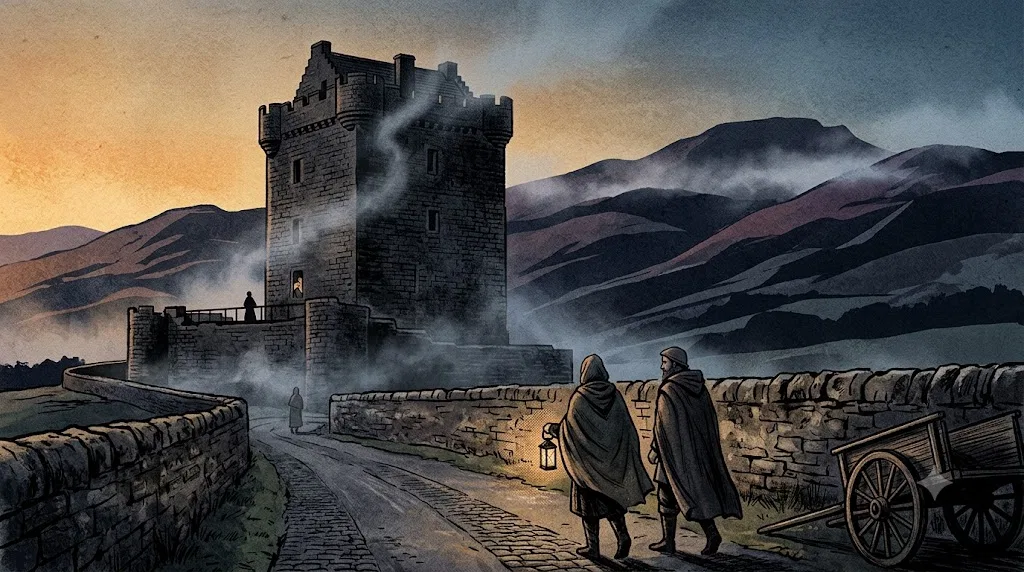
Alloa Tower is the most prominent haunted building in Clackmannanshire’s public heritage. The National Trust for Scotland describes it as a medieval keep dating back to the 14th century, built to guard a strategically important ferry crossing on the River Forth, and later the ancestral seat of the Erskine family, Earls of Mar and Kellie. Mary, Queen of Scots and James VI both spent part of their childhoods there under Erskine guardianship, while John Erskine, 6th Earl of Mar, later created an 18th-century mansion within the old tower walls.[National Trust for Scotland]nts.org.ukOpen source on nts.org.uk.
The ghost stories attached to Alloa Tower are unusually numerous for one building. The National Trust for Scotland’s own ghost-story feature calls it a 700-year-old keep and says visitors may hear of the Abbot’s Curse, a dungeon spectre of a man in chains helped by a ghostly serving girl, a young girl said to be trapped in the stone well, a black-clad woman watching over a cradle, a nervous maid near the family portrait, a crying boy, an armed man, a gaunt clergyman, and a hanging figure in the Solar Room. The same Trust account links one haunting to the 1800 fire that destroyed the adjoining mansion, with visitors reportedly smelling burning on the anniversary.[National Trust for Scotland]nts.org.ukOpen source on nts.org.uk.
The local Clackmannanshire.scot account adds about how these stories are presented to paranormal visitors. It reports footsteps above the Solar Room, the sensation of strangulation in the same room, a possible “elderly man” apparition, noises like a ball or ring bouncing down the turnpike staircase, and animal apparitions described as a black cat or white dog brushing past people’s legs. This is a secondary local/paranormal source rather than an official historical record, so the details are best read as reported traditions and visitor lore, not established fact.[Clackmannanshire]clackmannanshire.scotGhosts of Alloa TowerGhosts of Alloa Tower
Alloa Tower’s haunting stories work because the building already carries the right emotional ingredients. It has a pit dungeon, a medieval well, thick walls, dynastic politics, royal childhoods, later Jacobite associations and a vanished mansion. Clackmannanshire Council’s visitor material emphasises the tower’s medieval roof beams, groin vaulting, pit dungeon and original internal well, while the National Trust’s history frames the tower as both defensive and aristocratic. These concrete features make it easy for later stories of prisoners, servants, children, betrayal and fire to attach themselves to the rooms.[Clacks]clacks.gov.ukOpen source on clacks.gov.uk.
The most careful reading is that Alloa Tower is not “proved haunted”; it is a heritage site where ghost stories have become part of the visitor imagination. Some details are preserved by the National Trust for Scotland in accessible folklore form, while other claims come from paranormal investigators and local retellings. That distinction matters: the stories are culturally important because they show how people interpret an old building, but the evidence is mostly anecdotal and interpretive rather than documentary proof of supernatural events.[National Trust for Scotland]nts.org.ukOpen source on nts.org.uk.
Sauchie: a modern poltergeist in an ordinary street
The Sauchie poltergeist is Clackmannanshire’s strongest modern haunting case, partly because it is tied to a named place, a named child and a specific date range. Local accounts place the outbreak in Park Crescent, Sauchie, in late November and early December 1960, centred on 11-year-old Virginia Campbell. The Clackmannanshire.scot account says The Alloa Journal reported the case on Friday 2 December 1960, describing bedclothes flapping, Virginia appearing distressed, and her aunt Isabella allegedly being shoved off the bed.[Clackmannanshire]clackmannanshire.scotThe Sauchie PoltergeistThe Sauchie Poltergeist
The case is often treated as a poltergeist rather than a conventional ghost story. That matters because poltergeist narratives usually focus on noises, movements, thrown or displaced objects, disturbed beds and activity associated with a young person, rather than on a visible dead person returning. A later book listing for David Kerr’s The Sauchie Poltergeist summarises the case as involving knocking sounds, moving furniture, vibrating bedheads, disturbed bedclothes, unexplained noises and incidents said to have followed Virginia into the classroom. It also names a cluster of witnesses and investigators, including the Reverend T. W. Lund, doctors, teacher Margaret Stewart, neighbours, family members, journalists and the psychical researcher A. R. G. Owen.[Medimops]medimops.deThe Sauchie Poltergeist von David KerrThe Sauchie Poltergeist von David Kerr
The strongest reason the Sauchie story has lasted is not that it proves anything paranormal. It has lasted because it sits at the meeting point of local newspaper attention, adult witnesses, religious interpretation, psychical research and an ordinary child’s distress. The same features that make the story compelling also make it difficult to assess. A family under pressure, a child newly arrived from Ireland, a watching neighbourhood, clergy and investigators all create a situation where sincere reports, fear, suggestion, social stress and possible misinterpretation can become tightly tangled.[Medimops]medimops.deThe Sauchie Poltergeist von David KerrThe Sauchie Poltergeist von David Kerr
Later media has kept the Sauchie case alive. The Sunday Post reported in 2020 that Park Crescent had acquired a reputation as “Scotland’s most haunted neighbourhood”, 60 years after the original events, after a new book gathered further claims about the street. That kind of afterlife is common in haunting traditions: once a place becomes known for one dramatic case, later odd noises, dreams, faults, scratches or household incidents may be interpreted through the older story.[Sunday Post]sundaypost.comOpen source on sundaypost.com.
A balanced verdict is that Sauchie is more valuable as a social and psychical-history case than as a simple ghost tale. It has dates, names and a plausible paper trail, but many modern retellings rely on secondary summaries. Readers interested in credibility should separate the reported 1960 events from later street legends, and separate named contemporary witnesses from later paranormal branding.[Clackmannanshire]clackmannanshire.scotThe Sauchie PoltergeistThe Sauchie Poltergeist
Castle Campbell and Dollar Glen: gloom, ravines and romantic legend
Castle Campbell, above Dollar, is the county’s great atmospheric ruin. Historic Environment Scotland describes it as a forbidding fortress high above Dollar Glen, once belonging to the Campbell earls of Argyll, and one of Scotland’s best-preserved tower houses, built back in the 1400s. Its setting is half the story: a narrow ridge, the Ochil Hills, steep ravines and the Burns of Care and Sorrow running on either side.[Historic Environment Scotland]historicenvironment.scotOpen source on historicenvironment.scot.
Historically, the castle was originally known as Castle Glume, or Gloom, and dates from the early 1400s. Around 1465 it passed through marriage to Colin Campbell, 1st Earl of Argyll, and in 1489 the earl changed its name to Castle Campbell. Historic Environment Scotland explains the practical reason for the site: it gave a powerful Highland family a secure but impressive Lowland seat within reach of the royal court.[Historic Environment Scotland]historicenvironment.scotOpen source on historicenvironment.scot.
The legend most often attached to this landscape is the Maiden of Castle Gloom. In one version, the daughter of an early Scottish king is imprisoned at Castle Gloom as punishment for loving beneath her rank; the melancholy place-names around the castle then echo her grief. Discover Britain’s retelling treats the story as romantic folklore rather than history, noting that folklorist Katharine Briggs linked it to an international “Seven Sleepers” tale type and pointing out that some versions depend on details, such as Clan McCallum holding the castle, for which there is no record.[https://www.discoverbritain.com]discoverbritain.comOpen source on discoverbritain.com.
This is a useful example of how a haunting can be emotionally true to a place while historically doubtful. The ravines really are there. The names Burn of Care and Burn of Sorrow really do shape the atmosphere of the site. Castle Campbell really was a seat of power. But the imprisoned maiden is best understood as a landscape legend: a way of turning a dramatic castle setting into a story about grief, captivity and forbidden love.[Historic Environment Scotland]historicenvironment.scotOpen source on historicenvironment.scot.
Maiden’s Well, fairy hills and the old supernatural landscape
North of Castle Campbell and Dollar, the folklore becomes less like castle haunting and more like older fairy and water-spirit tradition. Dollar Museum’s account of Maiden’s Well and Maiden’s Castle places them in Glen Quey, giving the well at NN969013 and noting that John Rhys wrote about it in 1901 as a fine spring close to the legendary fairy hall of Maiden Castle. The same local-history account says a 1905 historian connected the well’s name with a princess held captive in Castle Campbell who was allowed to drink there.[Dollar Museum]dollarmuseum.org.ukopi 04 maidens wellopi 04 maidens well
The well also has an explicitly supernatural story: a beautiful maiden or spirit is said to appear at night, with dangerous consequences for men who try to kiss or summon her. Dollar Museum preserves the tradition in cautious local-history form, while Discover Britain interprets the water-spirit element as part of a wider pattern in Scottish folklore, where dangerous water beings and haunted pools often work as warnings, especially around children and water.[Dollar Museum]dollarmuseum.org.ukopi 04 maidens wellopi 04 maidens well
Nearby Maiden Castle is not presented as a conventional stone castle in these accounts, but as a fairy hill. Dollar Museum retells the story of the Piper of Glendevon: a piper travelling towards Dollar hears music, sees a brilliantly lit castle where only a dark knoll had been, is taken inside by fairies, plays for them, and later returns to find that far more time has passed in the human world than he realised. This is classic fairy time-distortion folklore, and it belongs more to the realm of enchanted landscape than to the ghostly dead.[Dollar Museum]dollarmuseum.org.ukopi 04 maidens wellopi 04 maidens well
The Dollar glens also contain darker witch-and-devil lore. The Deil’s Cradle, a stone near Dollar, appears in folklore sources as a rock associated with Halloween, witches and Satan. The Paranormal Database summarises the legend as a stone said to float in the air on Halloween night while the Devil sits on it, surrounded by witches, until dawn. The Northern Antiquarian traces the tale to an 1848 notice in The Scottish Journal, but also warns that the area’s witch-lore deserves more competent historical analysis.[Paranormal Database]paranormaldatabase.comParanormal Database The Paranormal DatabaseParanormal Database The Paranormal Database
These Dollar traditions are not all equally reliable, but they are thematically coherent. Wells, fairy hills, vanishing castles, piper stories, dangerous women of the water and devilish stones all belong to older Scottish supernatural grammar. They also show why Castle Campbell’s haunted reputation should not be separated from the surrounding glen. The castle gives the landmark; the landscape supplies the deeper folklore.[dollarmuseum.org.uk]dollarmuseum.org.ukopi 04 maidens wellopi 04 maidens well
Witch-trial memory around Alloa
Clackmannanshire’s haunted history is also shaped by witch-trial memory, especially around Alloa. This material should be handled carefully. Accused witches were real people caught in legal, religious and social violence; their stories should not be flattened into spooky entertainment. The University of Edinburgh’s Survey of Scottish Witchcraft describes itself as an electronic resource for the history of witchcraft and witch-hunting in Scotland, and the linked data project says its primary goal was to create a database of people accused of witchcraft in Scotland between 1563 and 1736.[witches.hca.ed.ac.uk]witches.hca.ed.ac.ukOpen source on ed.ac.uk.
One key Alloa figure is Margaret Duchill. The Survey of Scottish Witchcraft’s case entry records accusations of maleficium, including causing death of people and animals, revenge, debt and verbal insult motifs; these are charges recorded in a witch-trial context, not evidence that such acts occurred. A separate Survey trial page identifies the trial material as part of the 1563–1736 Scottish witchcraft resource produced by Julian Goodare, Lauren Martin, Joyce Miller and Louise Yeoman at the University of Edinburgh.[witches.hca.ed.ac.uk]witches.hca.ed.ac.ukOpen source on ed.ac.uk.
Local and secondary summaries describe the Alloa witch cases as involving Margaret Duchill and other accused women in 1658. Clackmannanshire.scot’s local-history article says Clackmannanshire had witch trials and identifies Margaret Duchill as the best-known case, while its source list points readers back to the Survey of Scottish Witchcraft and older historical writing. A search result for the historical article “The Witches of Alloa”, published in 1906, shows that the case has been discussed in Scottish historical scholarship for more than a century.[Clackmannanshire]clackmannanshire.scotWitches in ClackmannanshireWitches in Clackmannanshire
The connection with haunted Clackmannanshire is indirect but important. Witch trials supply the county with a memory of fear, accusation, confession, clerical authority and community pressure. Later supernatural stories about witches around stones or glens may borrow from that atmosphere, but they should not be confused with the documented persecution of accused people. A fairy well or devil stone is folklore; a witch trial is a historical tragedy. Both can haunt a place, but in very different ways.[witches.hca.ed.ac.uk]witches.hca.ed.ac.ukOpen source on ed.ac.uk.
How credible are the county’s hauntings?
Clackmannanshire’s ghost stories fall into three broad evidence levels. The first is heritage-preserved haunting tradition, especially Alloa Tower. These stories are not proof of ghosts, but they are significant because the National Trust for Scotland itself presents them as part of the tower’s folklore and visitor story. The setting and historical background are independently strong, even if individual apparitions remain anecdotal.[National Trust for Scotland]nts.org.ukOpen source on nts.org.uk.
The second level is named modern case material, represented by the Sauchie poltergeist. It has dates, a named central witness, a local newspaper hook and a later reputation in psychical and paranormal writing. That makes it more documentable than many vague “old castle ghost” stories. At the same time, poltergeist cases are notoriously hard to evaluate because stress, suggestion, misperception, hoaxing, household causes and sincere but mistaken testimony can all coexist in the same case.[Clackmannanshire]clackmannanshire.scotThe Sauchie PoltergeistThe Sauchie Poltergeist
The third level is landscape folklore: Maiden’s Well, Maiden Castle, the Deil’s Cradle and Castle Gloom legends. These are best read as traditional stories attached to named features. Their value lies in age, recurrence, local preservation and motif, not in testable evidence. Discover Britain’s treatment of the Maiden of Castle Gloom is especially useful because it both retells the legend and openly signals why it should be treated as romantic folklore rather than verifiable history.[discoverbritain.com]discoverbritain.comOpen source on discoverbritain.com.
A sceptical reading does not make the county less interesting. It makes it more legible. Alloa Tower shows how built heritage becomes haunted through rooms, fire, imprisonment and family memory. Sauchie shows how a modern community can organise unexplained domestic events into a poltergeist narrative. Dollar Glen shows how water, ravines and hills generate fairy and spirit lore. The question is not simply “are the ghosts real?” but “what anxieties, memories and landscapes made these stories stick?”[nts.org.uk]nts.org.ukOpen source on nts.org.uk.
Visiting the haunted Clackmannanshire map
For readers exploring Clackmannanshire’s haunted places, the most accessible starting point is Alloa Tower. It is a National Trust for Scotland property in Alloa, with its own public visitor interpretation and well-established ghost-story associations. The tower’s haunted rooms are meaningful because they sit inside a real medieval keep with a pit dungeon, internal well and long Erskine history.[National Trust for Scotland]nts.org.ukOpen source on nts.org.uk.
Castle Campbell is the next major stop, but its haunting is more landscape-led than room-led. Historic Environment Scotland places it north of Dollar, high above Dollar Glen, with the Burns of Care and Sorrow falling through ravines on either side. Its visitor information notes that access involves steep routes and uneven surfaces, and that the upper levels may be closed, so the eerie experience is as much about approach, setting and view as interior exploration.[Historic Environment Scotland]historicenvironment.scotOpen source on historicenvironment.scot.
The Dollar folklore sites around Maiden’s Well, Maiden Castle and the Deil’s Cradle are less formal. They are better treated as local folklore locations rather than standard haunted attractions. Accounts from Dollar Museum and folklore websites preserve the stories, but walkers should distinguish between public heritage sites and rougher landscape features, and should avoid treating uncertain or hard-to-locate places as staged paranormal venues.[Dollar Museum]dollarmuseum.org.ukopi 04 maidens wellopi 04 maidens well
Sauchie’s Park Crescent is different again. It is not a romantic ruin or a heritage attraction; it is an ordinary residential area associated with a famous 1960 poltergeist case. The respectful way to understand it is through published accounts, local newspaper history and psychical-research discussion, not intrusive ghost-hunting around people’s homes.[Clackmannanshire]clackmannanshire.scotThe Sauchie PoltergeistThe Sauchie Poltergeist
What the hauntings say about the Wee County
Clackmannanshire’s haunted reputation is compact but distinctive. It does not depend on a single famous monster or one nationally dominant ghost. Instead, it has a layered pattern: aristocratic haunting at Alloa Tower, romantic gloom at Castle Campbell, fairy and water-spirit folklore in the Dollar glens, witch-trial memory around Alloa, and a modern poltergeist case at Sauchie. That mixture gives the county a haunted identity bigger than its size.[nts.org.uk]nts.org.ukOpen source on nts.org.uk.
The most memorable stories also map neatly onto the county’s geography. Alloa’s tower and witch-trial memory sit in the lowland power centre. Sauchie brings the supernatural into a modern village street. Dollar Glen lifts the reader into ravines, burns, wells and fairy hills. Castle Campbell stands above it all as the perfect Gothic landmark: historically real, visually dramatic, and surrounded by legends that are best understood as folklore rather than fact.[historiccountiestrust.co.uk]historiccountiestrust.co.ukOpen source on historiccountiestrust.co.uk.
That is why Clackmannanshire works well as a haunted county page. The evidence is uneven, but the pattern is strong. Its ghosts and legends are not random ornaments; they grow out of place: thick-walled towers, anxious households, prosecuted women, dangerous water, narrow glens and old stories retold because the landscape seems to invite them.

eBay marketplace picks
Marketplace Samples
Live-tested eBay searches with available results related to this page.
Endnotes
1.
Source: clackmannanshire.scot
Title: The Sauchie Poltergeist
Link:https://clackmannanshire.scot/index.php/community/paranormal/sauchie-poltergeist
2.
Source: clackmannanshire.scot
Title: Ghosts of Alloa Tower
Link:https://clackmannanshire.scot/index.php/community/paranormal/ghosts-of-alloa-tower
3.
Source: medimops.de
Title: The Sauchie Poltergeist von David Kerr
Link:https://www.medimops.de/david-kerr-the-sauchie-poltergeist-paperback-M0B0H4RQNMMQ.html
4.
Source: discoverbritain.com
Link:https://www.discoverbritain.com/heritage/mythology/castle-gloom-legend/
5.
Source: witches.hca.ed.ac.uk
Link:https://witches.hca.ed.ac.uk/
6.
Source: witches.hca.ed.ac.uk
Link:https://witches.hca.ed.ac.uk/case/C/EGD/297
7.
Source: witches.hca.ed.ac.uk
Link:https://witches.hca.ed.ac.uk/trial/T/JO/1471
8.
Source: clackmannanshire.scot
Title: Witches in Clackmannanshire
Link:https://www.clackmannanshire.scot/index.php/history/witches-in-clackmannanshire
9.
Source: clackmannanshire.scot
Link:https://clackmannanshire.scot/index.php/community/paranormal
10.
Source: clackmannanshire.scot
Title: walking round the wee county
Link:https://www.clackmannanshire.scot/index.php/history/walking-round-the-wee-county
11.
Source: witches.hca.ed.ac.uk
Link:https://witches.hca.ed.ac.uk/trial/T/LA/1296
12.
Source: witches.hca.ed.ac.uk
Link:https://witches.hca.ed.ac.uk/case/C/EGD/294
13.
Source: youtube.com
Title: The Tomb and the Tower: The Ghosts of Haunted Alloa
Link:https://www.youtube.com/watch?v=wnOgisu6SZ0
Source snippet
The Sauchie Poltergeist | Scotland's History...
14.
Source: youtube.com
Title: The Sauchie Poltergeist | Scotland’s History
Link:https://www.youtube.com/watch?v=XQ-4UDD2Q64
Source snippet
Scotland's Ultimate Poltergeist Case? Sauchie: New Evidence Revealed...
15.
Source: nts.org.uk
Link:https://www.nts.org.uk/stories/scottish-ghost-stories-witches-murder-and-folklore
16.
Source: dollarmuseum.org.uk
Title: opi 04 maidens well
Link:https://dollarmuseum.org.uk/opi-04-maidens-well/
17.
Source: historiccountiestrust.co.uk
Link:https://historiccountiestrust.co.uk/countyprofiles
18.
Source: gazetteer.org.uk
Link:https://gazetteer.org.uk/place/Clackmannanshire
19.
Source: scotlandspeople.gov.uk
Link:https://www.scotlandspeople.gov.uk/content/clackmannan-county
20.
Source: wikishire.co.uk
Link:https://wikishire.co.uk/wiki/Clackmannanshire
21.
Source: nts.org.uk
Link:https://www.nts.org.uk/visit/places/alloa-tower
22.
Source: historicenvironment.scot
Link:https://www.historicenvironment.scot/visit/all/castle-campbell/history-and-stories/
23.
Source: clacks.gov.uk
Link:https://www.clacks.gov.uk/visiting/alloatower/
24.
Source: sundaypost.com
Link:https://www.sundaypost.com/fp/the-new-paranormal-60-years-after-eerie-encounter-residents-reveal-park-crescent-is-still-the-street-that-goes-bump-in-the-night/
25.
Source: historicenvironment.scot
Link:https://www.historicenvironment.scot/visit/all/castle-campbell/
26.
Source: megalithix.wordpress.com
Title: maiden castle
Link:https://megalithix.wordpress.com/2013/04/02/maiden-castle/
27.
Source: paranormaldatabase.com
Title: Paranormal Database The Paranormal Database
Link:https://www.paranormaldatabase.com/lowlands/clacdata.php
28.
Source: historicenvironment.scot
Link:https://www.historicenvironment.scot/visit/all/castle-campbell/plan-your-visit/
29.
Source: wikishire.co.uk
Link:https://wikishire.co.uk/wiki/Clackmannan
30.
Source: nts.org.uk
Title: for the love of scotland podcasts
Link:https://www.nts.org.uk/stories/for-the-love-of-scotland-podcasts
31.
Source: nts.org.uk
Link:https://www.nts.org.uk/visit/places/gladstones-land/highlights/podcast
32.
Source: nts.org.uk
Link:https://www.nts.org.uk/stories/love-scotland-podcast-season-8
33.
Source: nts.org.uk
Link:https://www.nts.org.uk/visit/places/falkland-palace/highlights/podcast
34.
Source: nts.org.uk
Link:https://www.nts.org.uk/stories/a-new-welcome-at-alloa-tower
35.
Source: Wikipedia
Link:https://en.wikipedia.org/wiki/Clackmannanshire
36.
Source: Wikipedia
Title: Alloa Tower
Link:https://en.wikipedia.org/wiki/Alloa_Tower
37.
Source: Wikipedia
Title: Margaret Duchill
Link:https://en.wikipedia.org/wiki/Margaret_Duchill
38.
Source: thenorthernantiquarian.org
Link:https://www.thenorthernantiquarian.org/category/scotland/clackmannanshire/
39.
Source: abcounties.com
Link:https://abcounties.com/counties/county-profiles/clackmannanshire/
40.
Source: artuk.org
Link:https://artuk.org/visit/venues/national-trust-for-scotland-alloa-tower-7241
41.
Source: weewalkingtours.com
Title: castle campbell
Link:https://www.weewalkingtours.com/post/castle-campbell
Additional References
42.
Source: youtube.com
Title: Scotland’s Ultimate Poltergeist Case? Sauchie: New Evidence Revealed!
Link:https://www.youtube.com/watch?v=kOxtYF7eKR4
Source snippet
Castle Campbell (Clackmannanshire Tower Trail) | Scotland's History...
43.
Source: youtube.com
Title: Castle Campbell (Clackmannanshire Tower Trail) | Scotland’s History
Link:https://www.youtube.com/watch?v=js8wEZw5Dx8
Source snippet
The Ghost of Howbog | Scotland's History...
44.
Source: britishcountyflags.com
Link:https://britishcountyflags.com/wp-content/uploads/2019/08/a-guide-to-the-historic-counties-for-the-press-and-media.pdf
45.
Source: facebook.com
Link:https://www.facebook.com/ScotlandMagazine/posts/high-in-the-ochil-hills-above-the-clackmannanshire-town-of-dollar-on-a-narrow-is/916618413800384/
46.
Source: thenorthernantiquarian.org
Link:https://www.thenorthernantiquarian.org/2013/09/15/deils-cradle/
47.
Source: hiddenscotland.com
Link:https://hiddenscotland.com/journal/doom-gloom-at-castle-campbel
48.
Source: visionofbritain.org.uk
Link:https://www.visionofbritain.org.uk/place/17334
49.
Source: researchgate.net
Link:https://www.researchgate.net/publication/304722748_Some_Findings_from_the_Survey_of_Scottish_Witchcraft
50.
Source: thenorthernantiquarian.org
Link:https://www.thenorthernantiquarian.org/tag/satan/
51.
Source: county-borders.co.uk
Link:https://www.county-borders.co.uk/
Topic Tree
Follow this branch
Related pages 91
- Haunted Antrim
- Haunted Armagh
- Haunted Durham
- Haunted Londonderry
- Haunted Buteshire
- +86 more in sidebar