Within Haunted Banffshire
Why Is Inchdrewer Castle Said To Be Haunted?
Inchdrewer's ruined walls, Lord Banff's murder and the strange white dog make it Banffshire's darkest castle story.
On this page
- Lord Banff's murder and the burning of the castle
- The white dog and later visitor lore
- How violence turns ruins into ghost stories
Page outline Jump by section
Introduction
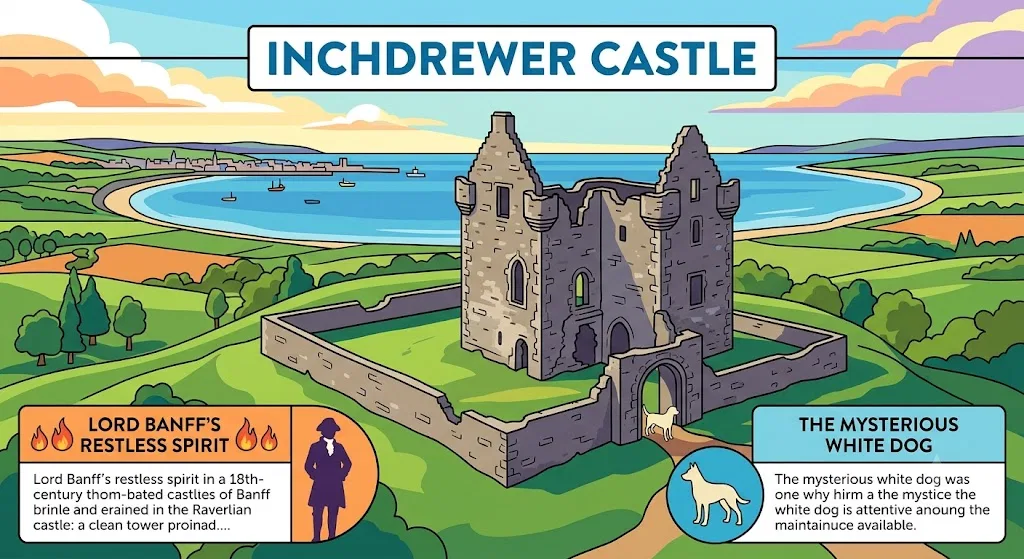
Inchdrewer Castle is said to be haunted because a real and still-unsettled death became attached to a ruined Banffshire tower house: George Ogilvy, 3rd Lord Banff, died there in 1713, with later accounts saying he was murdered and the castle set on fire to hide the crime. The haunting tradition then grew in two directions. One strand imagines Lord Banff returning to the place of his violent end; another centres on a strange white dog, sometimes described as the form taken by a ghostly lady. The result is one of Banffshire’s darkest castle stories: not a vague “old ruin” tale, but a murder-haunting rooted in a named aristocrat, a named place, and a death that older sources admit was never fully explained.[british-history.ac.uk]british-history.ac.ukBritish History Online BanffBritish History OnlineBanff - Berwick (North) | British History Online…
The castle stands near Banff, in the historic county of Banffshire, though modern administrative geography places it in Aberdeenshire. Historic Environment Scotland lists Inchdrewer as a Category A building in the parish of Banff, describes it as a compact three-storey L-plan tower house on a commanding site, and records that it was bought by the Ogilvies of Dunlugas in 1557.[Historic Environment Scotland]portal.historicenvironment.scotOpen source on historicenvironment.scot.
Where Is Inchdrewer Castle, And Why Does Its Setting Matter?
Inchdrewer Castle sits a few miles south-west of Banff, looking towards Banff Bay. That position matters for the haunting tradition because the building is not hidden deep in Highland wilderness; it is close enough to Banff’s old political and family world to be part of local memory, yet isolated enough on its rise to look like the kind of place where a violent story could cling. Historic Environment Scotland’s listing emphasises both the “commanding site” and the views over Banff Bay and the surrounding countryside.[Historic Environment Scotland]portal.historicenvironment.scotOpen source on historicenvironment.scot.
For a Banffshire haunted-history page, Inchdrewer is best understood through the older county identity. Banff is the historic county town of Banffshire, while modern visitor and heritage descriptions often place the castle in Aberdeenshire. That mismatch is not a contradiction so much as a reminder that ghost stories usually follow older estates, parishes and local memory rather than modern council boundaries. The castle belongs naturally with Banffshire’s haunted places because its title, owners, murder story and later folklore all circle around Banff and the Ogilvies of Lord Banff.[Crerar Hotels Group]crerarhotels.comCrerar Hotels Group25 Must-See Castles in Aberdeenshire, Ballater InverurieCrerar Hotels Group25 Must-See Castles in Aberdeenshire, Ballater Inverurie
The building itself also helps the story. Inchdrewer is not a romantic Victorian fantasy castle, but an altered sixteenth-century tower house. Historic Environment Scotland dates it to around 1500, with later sixteenth-century alterations, an eighteenth-century wing, and partial restoration in 1971. The listing describes small irregular windows, surviving courtyard walls, a postern gate and defensive details such as a gun loop. These architectural facts do not prove any haunting, but they explain why the place is so visually suited to one: thick walls, broken domestic space, fire damage in the historical record, and a long afterlife as a partly restored ruin.[Historic Environment Scotland]portal.historicenvironment.scotOpen source on historicenvironment.scot.

Lord Banff’s Murder And The Burning Of The Castle
The central tradition begins with George Ogilvy, 3rd Lord Banff. He inherited the lands of Inchdrewer and Montbray after his father’s death in 1668, and he was still a figure of political importance in the early eighteenth century. Accounts of his life note that he had been Roman Catholic, became Protestant in 1705, resumed his seat in the Scottish Parliament in 1706, and supported the 1707 Union of Scotland and England. His death in 1713 is the hinge on which the haunting tradition turns.[Wikipedia]WikipediaGeorge Ogilvy, 3rd Lord BanffGeorge Ogilvy, 3rd Lord Banff
The most cautious older wording is often the most revealing. The nineteenth-century Topographical Dictionary of Scotland, made available through British History Online, says Inchdrewer was “chiefly memorable” for the death of a Lord Banff who was burnt there in 1713 “under circumstances that have never been fully explained.” That line is important because it shows that the mystery was not simply a modern ghost-tour invention. Long before current haunted-castle lists, the death was already being treated as a notable, unresolved event in the castle’s history.[British History Online]british-history.ac.ukBritish History Online BanffBritish History OnlineBanff - Berwick (North) | British History Online…
Later retellings sharpen the event into a murder narrative. Banff and Macduff Heritage Trail says that in 1713 Lord Banff, George Ogilvie, was murdered and the castle set on fire; three local young men were arrested, but nobody was found guilty. Castle-focused summaries add the common version that servants or people connected with the household had been robbing him, killed him when discovered, and tried to destroy evidence by burning the castle. That more dramatic version should be treated as tradition rather than proven courtroom fact, especially because the local heritage account stresses the lack of conviction.[banffmacduffheritagetrail.co.uk]banffmacduffheritagetrail.co.ukTurbulent Towers – Banff and Macduff, 'two towns, big future’Turbulent Towers – Banff and Macduff, 'two towns, big future’
That uncertainty is exactly what gives the haunting its force. A straightforward accidental fire might become a tragedy; an unexplained death with suspected murder becomes a story that asks to be retold. Inchdrewer’s ghost-lore is not only about a dead nobleman but about a gap in the record: who killed him, what happened inside the castle, and why the fire became inseparable from the memory of the crime.
What Is Said To Haunt Inchdrewer?
The most common ghost attached to Inchdrewer is Lord Banff himself. Haunted-castle listings and modern summaries say his spirit is believed to return to the castle or walk the ruins, usually because he was murdered there and the fire was used to conceal the killing. Such accounts are folklore claims, not evidence of a supernatural event, but they show how the murder story has been converted into a classic “restless dead” narrative.[Castles & Manor Houses]castlesandmanorhouses.comOpen source on castlesandmanorhouses.com.
The more unusual element is the white dog. In the modern tradition, Inchdrewer is not only haunted by the murdered lord but also by a large white dog, sometimes explained as the manifestation of a ghostly lady. The Sunday Times, writing about the castle after its 2013 sale, reported that three ghosts were said to haunt the fort: George Ogilvy, a lady, and a large white dog. That clustering is typical of haunted-place traditions, where one strong historical event draws in other apparitions or motifs over time.[The Times]thetimes.comshe captured the castle fckxbl6r772The TimesShe captured the castle9 Mar 2014 — Three ghosts are said to haunt the fort: George Ogilvy, the 3rd Lord Banff, who was murdered…
The white dog story gained extra interest because it was linked to Nigel Tranter, the Scottish historical novelist and castle writer. Summaries of the Inchdrewer tradition say Tranter visited the castle in the 1970s with a local builder and saw a large white dog bound out of the building. He reportedly wondered how such an animal could have been confined there for several days, and was later shown a magazine reference claiming the castle was haunted by a lady in the shape of a white dog. That anecdote is more precise than many ghost stories because it has a named witness in the transmission chain, but it still sits in the realm of reported experience and later interpretation, not proof.[Wikipedia]WikipediaInchdrewer CastleInchdrewer Castle
The dog also changes the emotional tone of the haunting. Lord Banff’s ghost is tied to violence, class, betrayal and fire. The white dog is stranger, more folkloric and less easily explained by the murder alone. It suggests that Inchdrewer’s reputation grew through layers: first the recorded death, then local talk of flames and return, then a shapeshifting or apparition-like animal associated with a spectral woman.
Flames, Sunsets And The Look Of A Haunted Ruin
One of the most useful modern local interpretations comes from the Banff and Macduff Heritage Trail, which notes stories of flames lighting up the castle ruins and immediately offers a sceptical possibility: a spectacular sunset behind the castle could be read as fire. That is exactly the kind of explanation that helps rather than spoils a ghost story. It shows how landscape, weather and memory can work together without requiring anyone to invent the whole tradition from nothing.[banffmacduffheritagetrail.co.uk]banffmacduffheritagetrail.co.ukTurbulent Towers – Banff and Macduff, 'two towns, big future’Turbulent Towers – Banff and Macduff, 'two towns, big future’
Inchdrewer is especially vulnerable to that kind of visual folklore because fire is not an arbitrary image there. The historical story already says the castle burned in connection with Lord Banff’s death. When people later see red light, northern skies, evening glare or reflections around the ruin, the mind has a ready-made narrative: the castle burning again, the murder replaying itself, the dead lord returning. A sceptical reading and a folkloric reading can therefore describe the same experience in different languages.
The building’s physical condition has also shaped the haunting tradition. Country Life reported in 2013 that the castle had been bought by Robin Mirrlees’s family in 1963 in a mainly ruinous state, restored to wind- and water-tight condition by 1971, and then left without further major improvement, with deterioration to the roof and windows. Historic Environment Scotland likewise records the 1971 restoration and the plaque naming those involved. A half-restored, half-derelict tower house is fertile ground for ghost stories because it looks suspended between habitation and abandonment.[Country Life]countrylife.co.ukuntry Life Romantic Aberdeenshire castleuntry Life Romantic Aberdeenshire castle
That does not make the haunting “fake”. It makes it legible as folklore. Ruins are not blank backdrops; they invite people to supply missing rooms, missing voices and missing explanations. At Inchdrewer, the missing explanation is unusually powerful because the central death was historically remembered as obscure.
How Violence Turns Ruins Into Ghost Stories
Inchdrewer’s murder-haunting tradition follows a familiar but potent pattern in Scottish castle folklore: a real building, a named family, a violent or suspicious death, and a later apparition that appears to keep the past from settling. The difference is that Inchdrewer’s story is not simply “a lady in white was seen in a tower”. It begins with a documented aristocratic death in 1713 and an explicit statement in older topographical writing that the circumstances were never fully explained.[British History Online]british-history.ac.ukBritish History Online BanffBritish History OnlineBanff - Berwick (North) | British History Online…
The murder tradition also carries social tension. Some versions blame servants or household dependants; others mention local men arrested but not convicted. This matters because ghost stories often preserve anxieties that formal records cannot resolve: fear of betrayal inside the household, fear that status could not protect a nobleman, and fear that fire could erase evidence while leaving memory behind. The story’s power comes from the combination of intimacy and destruction: the lord is not imagined dying on a battlefield, but inside his own castle.[banffmacduffheritagetrail.co.uk]banffmacduffheritagetrail.co.ukTurbulent Towers – Banff and Macduff, 'two towns, big future’Turbulent Towers – Banff and Macduff, 'two towns, big future’
The later history deepened that atmosphere. Inchdrewer was attacked by Covenanter forces in the seventeenth century, associated with Jacobite-era conflict in 1746, occupied into the nineteenth century, and eventually abandoned or left to decline. Aberdeenshire’s Historic Environment Record summarises the castle as an early sixteenth-century tower house, notes the 1713 fire, and records later rebuilding and listing. This sequence makes the place feel repeatedly damaged: not one clean ruin, but a building struck by politics, family tragedy, neglect and incomplete restoration.[banffmacduffheritagetrail.co.uk]banffmacduffheritagetrail.co.ukTurbulent Towers – Banff and Macduff, 'two towns, big future’Turbulent Towers – Banff and Macduff, 'two towns, big future’
For readers of haunted Banffshire, that is the key point. Inchdrewer is not famous because the evidence for apparitions is unusually strong. It is famous because the history gives the folklore a hard centre. The murder, the fire, the unproven accusations, the later ruined shell and the odd white dog tradition all reinforce one another.
How Credible Is The Haunting Tradition?
The historical core is stronger than the supernatural claim. The castle is real, nationally listed, and well documented as an important tower house. Lord Banff’s death in 1713 is recorded in older historical reference material, while modern heritage accounts preserve the local murder-and-fire version. The uncertainty lies in the details: precisely who killed him, what evidence was available, why no conviction followed, and how much of the servant-robbery story reflects later reconstruction.[historicenvironment.scot]portal.historicenvironment.scotOpen source on historicenvironment.scot.
The ghost element is weaker as evidence but valuable as tradition. Reports that Lord Banff walks the castle, or that a white dog represents a spectral lady, appear mainly in modern newspaper, castle, folklore and popular-haunting retellings. These sources are useful for tracking the story’s public life, but they do not amount to independent proof of apparitions. The most careful reading is that Inchdrewer has a well-attested historical tragedy and a later haunting tradition built around it.[thetimes.com]thetimes.comshe captured the castle fckxbl6r772The TimesShe captured the castle9 Mar 2014 — Three ghosts are said to haunt the fort: George Ogilvy, the 3rd Lord Banff, who was murdered…
The white dog story sits somewhere between anecdote and folklore motif. The Tranter-linked account gives it more texture than a generic “people have seen a ghost dog” claim, but the interpretation that the animal was a ghostly lady is a later meaning attached to the sighting. A real dog, a misremembered encounter, a local joke, a magazine embellishment, and a genuine uncanny experience are all possible readings depending on how sceptical the reader wishes to be.[Wikipedia]WikipediaInchdrewer CastleInchdrewer Castle
What should not be done is to flatten Inchdrewer into either “definitely haunted” or “just a silly ghost story”. Its interest lies between those extremes. The historical death is serious; the folklore is atmospheric; the evidence for haunting is unverified; and the persistence of the tale tells us something about how Banffshire remembers violence in old houses.
Why Inchdrewer Stands Out In Banffshire’s Haunted Landscape
Banffshire has other haunted castles and old-house traditions, but Inchdrewer is distinctive because its ghost story is anchored to a murder rather than only to an unnamed apparition or vague family legend. Ballindalloch, Balvenie and other north-east sites may have better visitor infrastructure or broader tourist recognition, but Inchdrewer’s appeal is darker and narrower: a ruined tower, a burned lord, a disputed crime, and an animal apparition that refuses to fit neatly into the murder narrative.
It is also a good example of why historic county haunting pages need careful geography. Today’s map may send visitors through Aberdeenshire tourism material, yet the story’s emotional and historical centre is Banffshire: Lord Banff, the parish of Banff, Banff Bay, and the local heritage memory of the Ogilvies. Historic Environment Scotland’s official listing places the building in the parish of Banff, while modern visitor writing often describes Banff as the old county town of Banffshire.[Historic Environment Scotland]portal.historicenvironment.scotOpen source on historicenvironment.scot.
The lasting image is not simply a ghost in a window. It is the castle itself as a witness: a tower house that outlived its owners, was remembered for a death “never fully explained”, and later became a screen for firelight, white-dog sightings and stories of a murdered lord still tied to the stones. That is why Inchdrewer remains one of Banffshire’s most memorable murder-haunting traditions.
Amazon book picks
Further Reading
Books and field guides related to Why Is Inchdrewer Castle Said To Be Haunted?. Use these as the next step if you want deeper reading beyond the article.
Scottish Ghost Stories
Strong match for readers interested in haunted Scottish castles.

The secret commonwealth of elves, fauns, and fairies
Expands readers' understanding of Scottish supernatural traditions.
eBay marketplace picks
Marketplace Samples
Live-tested eBay searches with available results related to this page.
Endnotes
1.
Source: banffmacduffheritagetrail.co.uk
Title: Turbulent Towers – Banff and Macduff, ‘two towns, big future’
Link:https://banffmacduffheritagetrail.co.uk/turbulent-towers/
2.
Source: Wikipedia
Title: George Ogilvy, 3rd Lord Banff
Link:https://en.wikipedia.org/wiki/George_Ogilvy%2C_3rd_Lord_Banff
3.
Source: Wikipedia
Title: Inchdrewer Castle
Link:https://en.wikipedia.org/wiki/Inchdrewer_Castle
4.
Source: her.aberdeenshire.gov.uk
Link:https://her.aberdeenshire.gov.uk/Monument/MAB17240/
5.
Source: Wikipedia
Title: Inchdrewer Castle
Link:https://de.wikipedia.org/wiki/Inchdrewer_Castle
6.
Source: youtube.com
Title: Inchdrewer Castle. Scotland
Link:https://www.youtube.com/watch?v=DdFg-8Emmmo
Source snippet
Inchdrewer Castle...
7.
Source: youtube.com
Title: Inchdrewer Castle
Link:https://www.youtube.com/watch?v=ejiNU9IDwfs
Source snippet
Banff Scotland...
8.
Source: british-history.ac.uk
Title: British History Online Banff
Link:https://www.british-history.ac.uk/topographical-dict/scotland/pp101-123
Source snippet
British History OnlineBanff - Berwick (North) | British History Online...
9.
Source: thetimes.com
Title: she captured the castle fckxbl6r772
Link:https://www.thetimes.com/travel/destinations/uk-travel/scotland-travel/she-captured-the-castle-fckxbl6r772
Source snippet
The TimesShe captured the castle9 Mar 2014 — Three ghosts are said to haunt the fort: George Ogilvy, the 3rd Lord Banff, who was murdered...
10.
Source: portal.historicenvironment.scot
Link:https://portal.historicenvironment.scot/apex/f?p=1505%3A300%3A%3A%3A%3A%3AVIEWTYPE%2CVIEWREF%3Adesignation%2CLB3049
11.
Source: crerarhotels.com
Title: Crerar Hotels Group25 Must-See Castles in Aberdeenshire, Ballater Inverurie
Link:https://www.crerarhotels.com/inspiration/blog/aberdeenshire-castles/
12.
Source: castlesandmanorhouses.com
Link:https://www.castlesandmanorhouses.com/ghosts.php?SelectCountry=Scotland&SelectQuality=ALL&SelectType=ALL&Sort=Type
13.
Source: spottinghistory.com
Title: inchdrewer castle
Link:https://www.spottinghistory.com/view/7438/inchdrewer-castle/
14.
Source: countrylife.co.uk
Title: untry Life Romantic Aberdeenshire castle
Link:https://www.countrylife.co.uk/property/country-houses-for-sale-and-property-news/romantic-aberdeenshire-castle-with-title-7835
15.
Source: trove.scot
Link:https://www.trove.scot/place/18451
16.
Source: 1066.co.nz
Title: Inchdrewer Castle
Link:https://www.1066.co.nz/Mosaic%20DVD/whoswho/text/Inchdrewer_Castle.htm
17.
Source: engole.info
Title: Inchdrewer Castle
Link:https://engole.info/inchdrewer-castle/
18.
Source: castlesandmanorhouses.com
Link:https://www.castlesandmanorhouses.com/ghosts.php?SelectCountry=Scotland&SelectQuality=ALL&SelectType=ALL&Sort=Country&submit=
19.
Source: canmore.org.uk
Link:https://canmore.org.uk/site/18451
20.
Source: castlecore.uk
Title: inchdrewer castle
Link:https://castlecore.uk/site/inchdrewer-castle
Additional References
21.
Source: youtube.com
Link:https://www.youtube.com/watch?v=7OFp7bRnPHw
Source snippet
Whistle O'er The Lave O't with Alex Green...
22.
Source: youtube.com
Title: Inchdrewer Castle Banff Scotland
Link:https://www.youtube.com/watch?v=Kp_ASaB66dk
Source snippet
Alex Green plays 'Tam Bain's Lum' and 'The Lochaber Gathering' near Inchdrewer Castle, Banff...
23.
Source: canmore.org.uk
Link:https://canmore.org.uk/site/142163/edinburgh-colinton-road-inchdrewer-house
24.
Source: kids.kiddle.co
Link:https://kids.kiddle.co/George_Ogilvy%2C_3rd_Lord_Banff
25.
Source: paullee.com
Link:https://www.paullee.com/ghosts/ghostgeo/index.php?location=57o63506_-2o57789_Inchdrewer+Castle.txt&x=-2.57789&y=57.63506
26.
Source: kids.kiddle.co
Link:https://kids.kiddle.co/Inchdrewer_Castle
27.
Source: facebook.com
Link:https://www.facebook.com/groups/aberdeenshireincolour/posts/2944845605666043/
28.
Source: castle-finders.co.uk
Link:https://castle-finders.co.uk/Scotland/inchdrewer-castle.html
29.
Source: evendo.com
Link:https://evendo.com/locations/united-kingdom/banffshire/attraction/inchdrewer-castle
30.
Source: facebook.com
Link:https://www.facebook.com/groups/scotlandsscenery/posts/25196721576587211/
Topic Tree