Which Montgomeryshire hauntings have the strongest surviving traditions?
Montgomeryshire’s haunted history is quieter and more rural than the heavily marketed ghost trails of some Welsh counties, but it has several strong strands: the grand apparition tradition of Powis Castle, death-portent folklore around Llanidloes and the Kerry hills, eerie animal and spirit stories preserved by nineteenth-century collectors, and modern...
Page outline Jump by section
Introduction
For this page, Montgomeryshire means the historic Welsh county: the northern part of modern Powys, not the whole present-day county. That distinction matters because many “haunted Powys” lists include places in Brecknockshire or Radnorshire that fall outside Montgomeryshire’s historic county frame. Historic-county mapping places Montgomeryshire among the thirteen historic counties of Wales, and modern public records place older Montgomeryshire material within Powys services and archives.[wikimedia.org]commons.wikimedia.orgOpen source on wikimedia.org.
Where Montgomeryshire’s ghosts belong
Montgomeryshire sits in Mid Wales, with Welshpool, Newtown, Llanidloes, Montgomery and Machynlleth among its best-known towns. In historic-county terms it borders Shropshire to the east, Denbighshire to the north, Merionethshire and Cardiganshire to the west, and Radnorshire to the south. Much of the county is upland or valley country, and that geography helps explain why its ghost stories are often tied to roads, farms, funeral routes, mines, castles and isolated houses rather than to dense urban ghost-walk circuits.[Wikishire]wikishire.co.ukOpen source on wikishire.co.uk.
Administratively, Montgomeryshire was one of the Welsh counties created under the Laws in Wales legislation of the sixteenth century and later became part of Powys. The historic county is still useful for folklore because old printed collections, parish histories and local newspapers often organise stories by the older county names rather than by present council boundaries. DataMapWales summarises the creation of the thirteen historical counties, including Montgomeryshire, while Powys Archives is now the official repository for Powys records, including material relevant to former Montgomeryshire communities.[Data Map Wales]datamap.gov.walesData Map Wales Historic County Boundaries of WalesData Map Wales Historic County Boundaries of Wales
This means that a careful Montgomeryshire haunting page has to be selective. Powis Castle near Welshpool belongs firmly within the county’s haunted map; so do Llanidloes, Llawr-y-glyn, the Kerry hills, Dolfor and other places named in Montgomeryshire folklore accounts. By contrast, famous “haunted Powys” sites in Brecknockshire or Radnorshire may be useful comparisons, but they should not be treated as Montgomeryshire hauntings simply because they now sit within the modern Powys authority area.
Powis Castle: the county’s best-known haunted house
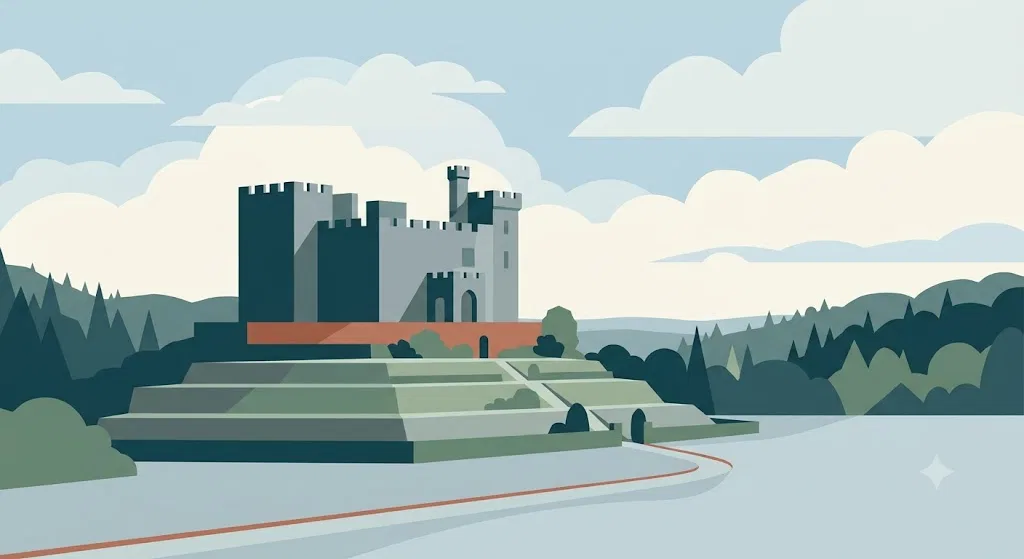
Powis Castle is the strongest single haunted-place candidate in Montgomeryshire because it combines a famous historic building, a relatively old printed ghost account, and continuing tourism recognition. The National Trust describes Powis as a medieval castle built in the thirteenth century and later transformed into the grand home of the Herbert family; it is also known for its Grade I listed garden and major historic collections.[National Trust]nationaltrust.org.ukOpen source on nationaltrust.org.uk.
The older ghost story comes through Elias Owen’s Welsh Folk-Lore, published in 1896. Owen says the tale was recorded in connection with Thomas Wright’s family papers and was told in 1780 by the Methodist preacher John Hampson, who had just arrived from Wales. The account places a poor unmarried woman, employed for spinning work, in the Earl of Powis’s country seat. While reading her small Welsh Bible before bed, she is said to have seen a gentleman enter her room wearing a gold-laced hat and waistcoat.[Project Gutenberg]gutenberg.orgProject Gutenberg Welsh Folk-LoreProject Gutenberg Welsh Folk-Lore
In the story, the apparition leads the woman to a hidden box and key, with instructions that they be sent to the Earl in London. The importance of this account is not that it proves a haunting, but that it shows how an eighteenth-century apparition story could join several powerful themes: class difference, household secrecy, hidden treasure, Methodist seriousness, and the belief that some spirits returned to settle unfinished business. Visit Wales’ haunted itinerary retells the same Powis Castle story and links it to modern reports of a locked-room piano, a lady in black by a fireside, and other “strange happenings”.[Project Gutenberg]gutenberg.orgProject Gutenberg Welsh Folk-LoreProject Gutenberg Welsh Folk-Lore
Land of Legends, a Literature Wales project, gives a compact modern version: a woman in 1780 sees a man in a gold-laced suit, and Powis’s later spooky reputation includes pianos playing by themselves, unexplained knocks, and invisible hands grabbing at people on stairs. This is a useful example of how local legend survives by being repackaged: Owen’s older antiquarian account supplies the deep source, while tourism and heritage writing make the story legible to present-day visitors.[Land of Legends]landoflegends.walesOpen source on landoflegends.wales.
The sceptical reading is equally important. The tale is not a police report, estate record or signed witness statement from the woman herself. It reaches us through layers of retelling: a preacher investigating a rumour, a family autobiography, and then a folklore collector. That does not make it worthless. It makes it folklore: a story that tells us what people in and around great houses thought ghosts might do, why a servant or poor worker might be placed in a grand room, and how anxieties about property could be expressed as a visitation.

Montgomery Castle: atmosphere, war memory and a thinner ghost trail
Montgomery Castle is one of the county’s most atmospheric ruins, but its ghost tradition is less well evidenced than Powis Castle’s. Cadw describes the site as a stone castle begun around 1223 on Henry III’s orders, replacing the nearby wooden fort of Hen Domen. It survived attacks by Llywelyn in 1228 and 1231 and by Dafydd in 1245, before its Civil War end: it fell to Parliamentarians and was demolished in 1649, leaving the crumbling towers and low walls seen today.[Cadw]cadw.gov.walesCadw Montgomery Castle | CadwCadw Montgomery Castle | Cadw
That history gives Montgomery Castle all the ingredients for ghost storytelling: border war, royal power, ruined masonry, a high crag above the town, and the memory of Civil War violence. Cadw itself stresses the castle’s “powerful atmosphere” and its commanding views across the Welsh border, which helps explain why visitors often experience it as an eerie place even without a well-attested apparition narrative.[Cadw]cadw.gov.walesCadw Montgomery Castle | CadwCadw Montgomery Castle | Cadw
A cautious haunted-history page should therefore treat Montgomery Castle differently from Powis Castle. It is central to Montgomeryshire’s eerie landscape and to the county’s military memory, but the readily available evidence for named ghosts is much thinner. Some modern local or paranormal references attach hanging-man or headless-figure traditions to the Montgomery area, but these are not as securely preserved in the accessible historical record as the Powis Castle ghost or the Llanidloes death-portent material. The most honest interpretation is that Montgomery Castle is a haunted-feeling ruin with strong historical reasons for that reputation, rather than a site with one dominant, well-sourced ghost story.
Llanidloes and the death omens of the road
Some of Montgomeryshire’s most distinctive supernatural traditions are not “haunted house” stories at all. They are death omens: ghostly signs that a death or funeral is approaching. Elias Owen records a Montgomeryshire term, Drychiolaeth, for a shadowy or spectral funeral said to precede the real one. In the Llanidloes example quoted from Edward Hamer’s parochial account, a miner working at Brynpostig claimed that, on a dark night in China Street, he saw a spectral funeral leaving the house of a sick man named Hoskiss and moving towards the church.[Project Gutenberg]gutenberg.orgProject Gutenberg Welsh Folk-LoreProject Gutenberg Welsh Folk-Lore
This is an unusually useful story because it is located in everyday geography rather than in a vague “old castle”. The apparition moves through streets, from a house towards a church, following the social route that a real funeral would take. Owen’s account also notes the effect on the witness: the miner is frightened, struggles to move out of the way, returns home, and is unable to work for several days. The story’s power lies in its realism. It makes the supernatural feel like an intrusion into ordinary labour, illness and burial custom.[Project Gutenberg]gutenberg.orgProject Gutenberg Welsh Folk-LoreProject Gutenberg Welsh Folk-Lore
Owen also links Montgomeryshire to other sound-and-light death omens. A “corpse candle” style light is described as moving along a road towards a house before a servant man dies, and the Cyhyraeth, a terrifying death sound, is said to have been heard on the Kerry hills in Montgomeryshire. These traditions are not simple “ghost sightings”; they are signs of a death route, imagined through light, procession, sound and the behaviour of frightened dogs.[Project Gutenberg]gutenberg.orgProject Gutenberg Welsh Folk-LoreProject Gutenberg Welsh Folk-Lore
For modern readers, these accounts may feel less like paranormal evidence and more like social memory. Rural communities watched illness closely, knew who was likely to die, and understood funeral paths intimately. A phantom funeral story turns that knowledge into a dramatic omen. It also gives shape to anxiety: the road, the mine, the sickroom and the churchyard are all joined into one eerie map.
The wild hunt, fairy hounds and upland sound
Montgomeryshire also appears in the Welsh tradition of uncanny hounds. Elias Owen describes beliefs about the otherworldly dogs often known in Welsh folklore as the hounds of the otherworld, and then gives a specific Montgomeryshire-border account from “Mr Chapman, Dolfor, near Newtown”. Chapman says a pack was heard on the borders of Radnorshire and Montgomeryshire, travelling from the Kerry hills towards the Llanbadarn road, and that a funeral soon followed the same route. The sound was said to resemble hounds in full cry, but softer.[Project Gutenberg]gutenberg.orgProject Gutenberg Welsh Folk-LoreProject Gutenberg Welsh Folk-Lore
This is one of the most Montgomeryshire-flavoured details in the whole folklore record: not a visible monster, but a sound moving across upland country. The story depends on landscape. In open hill districts, distant dogs, wind, hunting calls and echoes can become ambiguous, especially at night. Folklore then gives that ambiguity a meaning: the invisible pack is not merely heard, but understood as a warning of death.[Project Gutenberg]gutenberg.orgProject Gutenberg Welsh Folk-LoreProject Gutenberg Welsh Folk-Lore
The account is also a reminder that county borders are porous in folklore. The hounds are heard on the Radnorshire-Montgomeryshire border, not neatly contained by a map line. That makes the story more credible as folk tradition: roads, hills, parishes and burial routes mattered more to storytellers than tidy modern categories. For this project, the Montgomeryshire relevance is clear because the named informant is from Dolfor near Newtown and the route is explicitly tied to the county border.[Project Gutenberg]gutenberg.orgProject Gutenberg Welsh Folk-LoreProject Gutenberg Welsh Folk-Lore
Farm spirits, witches and uncanny animals
Montgomeryshire’s folklore also preserves smaller, stranger domestic stories. One example concerns Craig Wen Farm at Llawr-y-glyn, near Llanidloes. Owen says the place was rumoured to be haunted, and recounts a servant girl’s claim that a mouse ran before her in a cornfield, stopped opposite the barn, laughed at her, and vanished into a hole. The mouse was interpreted as an evil spirit and blamed for the mischief that followed.[Project Gutenberg]gutenberg.orgProject Gutenberg Welsh Folk-LoreProject Gutenberg Welsh Folk-Lore
This is not a grand apparition story, but it is valuable because it shows how haunting could be attached to ordinary farm life. A mouse, damaged clothes, a barn, a servant, a field and household misfortune are enough to create a spirit narrative. In a pre-modern rural setting, where illness, crop failure and domestic disorder could feel mysterious, an “evil spirit” explanation gave misfortune a face, even if that face was absurdly small and animal-like.[Project Gutenberg]gutenberg.orgProject Gutenberg Welsh Folk-LoreProject Gutenberg Welsh Folk-Lore
Owen also records Montgomeryshire witchcraft traditions, including a Llanidloes-area tale in which a suspected witch was believed to visit a neighbour at night in the shape of a hare. The victim placed a hammer under her pillow and struck the hare; the next day, the suspected woman was said to have a black eye. Owen notes that a similar variant was given to him by the parish clerk of Llangadfan, a mountainous Montgomeryshire parish.[Project Gutenberg]gutenberg.orgProject Gutenberg Welsh Folk-LoreProject Gutenberg Welsh Folk-Lore
These stories belong on a haunted Montgomeryshire page because they sit on the same boundary between fear, rumour and local explanation. They are not “ghosts” in the narrow sense, but they are part of the county’s spectral imagination: animals as omens, witches as night visitors, and domestic spaces as places where unseen forces might break through.
Winged serpents and haunted folklore beyond ghosts
Not every eerie Montgomeryshire legend involves the dead. Owen records traditions of a winged serpent or dragon-like creature associated with Moel Bentyrch and with Llanrhaiadr-yn-Mochnant. In one Dolanog-linked account, an elderly woman remembered seeing smoke and fire from a hole on Moel Bentyrch, where the creature was believed to live. Another tradition says the serpent was destroyed by luring it against a scarlet-covered, spike-studded post.[Project Gutenberg]gutenberg.orgProject Gutenberg Welsh Folk-LoreProject Gutenberg Welsh Folk-Lore
This kind of story widens the county’s haunted landscape from apparitions to supernatural ecology. Hills, holes, stones, posts and lanes become marked by danger. The creature is less a ghost than a legendary presence, but it belongs to the same reader interest: eerie local history attached to a named place. It also shows how Montgomeryshire folklore overlaps with wider Welsh motifs of dragons, serpents and uncanny beings, while remaining rooted in very specific localities.[Project Gutenberg]gutenberg.orgProject Gutenberg Welsh Folk-LoreProject Gutenberg Welsh Folk-Lore
For a modern visitor, these legends are best read as place-lore rather than zoology. They preserve the way communities explained odd landscape features, dangerous routes, flashes of light, smoke, fear of snakes, and the moral drama of defeating a destructive force. They also make good internal links to wider Welsh dragon legends, old roads, sacred stones and hill folklore.
Gregynog and the modern ghost-event tradition
Gregynog, near Tregynon, is not as securely represented in old printed ghost collections as Powis Castle or Llanidloes, but it has a clear place in modern Montgomeryshire spooky culture. Gregynog’s own events page advertised “Ghost Stories with Rory” in February 2025, including ghost stories and a tour around the hall, and said Gregynog had been seen on Britain’s Most Haunted. A later listing promoted another “Ghost Stories With Rory” event in November 2025, suggesting continuing public demand for the site’s spooky interpretation.[Gregynog]gregynog.orgGhost Stories with RoryGhost Stories with Rory
Gregynog’s wider history helps explain why it lends itself to ghost storytelling. It is a large country mansion at Tregynon, associated over centuries with the Blayney and Hanbury-Tracy families and later with the Davies sisters and the University of Wales. The hall and grounds are also part of a living heritage venue with events, gardens, accommodation and arts programming, which makes it a natural setting for seasonal ghost tours and atmospheric storytelling.[Wikipedia]WikipediaGregynog HallGregynog Hall
The evidential status here is different from Powis Castle. The accessible sources confirm that ghost-story events take place and that the venue has been presented in a paranormal-entertainment context. They do not, on their own, supply a detailed nineteenth-century witness account. Gregynog is therefore best treated as part of Montgomeryshire’s modern haunted-tourism layer: a historic house where ghost stories are performed, shared and refreshed for contemporary audiences.
How credible are Montgomeryshire’s haunted sources?
The strongest Montgomeryshire haunting sources are not equal in type. Powis Castle has an old folkloric account, later repeated by modern heritage and tourism sources. Llanidloes and the Kerry hills have nineteenth-century folklore-collection material tied to named localities and informants. Gregynog has modern event evidence. Montgomery Castle has major historical atmosphere and strong official history, but a thinner accessible ghost record.[gutenberg.org]gutenberg.orgProject Gutenberg Welsh Folk-LoreProject Gutenberg Welsh Folk-Lore
A sensible credibility scale looks like this:
Best-preserved as folklore: Powis Castle’s gold-laced gentleman and Llanidloes’ spectral funeral. These are old, place-specific and preserved in recognised folklore or antiquarian sources, though still not proof of ghosts.[Project Gutenberg]gutenberg.orgProject Gutenberg Welsh Folk-LoreProject Gutenberg Welsh Folk-Lore
Strong as regional belief: The Kerry hills hounds, corpse-candle style lights, the Cyhyraeth, witch-hares and uncanny farm animals. These stories show repeated patterns in Welsh and Montgomeryshire belief, but individual cases often depend on oral testimony and later transcription.[Project Gutenberg]gutenberg.orgProject Gutenberg Welsh Folk-LoreProject Gutenberg Welsh Folk-Lore
Strong as atmosphere, weaker as documented haunting: Montgomery Castle. Its official history is rich in conflict and ruin, but the best-evidenced ghost narratives for the county lie elsewhere.[Cadw]cadw.gov.walesCadw Montgomery Castle | CadwCadw Montgomery Castle | Cadw
Strong as modern haunted culture: Gregynog. Its ghost events show living public interest, but event listings should not be confused with early witness documentation.[Gregynog]gregynog.orgGhost Stories with RoryGhost Stories with Rory
The likely explanations vary by story. Some accounts may be moral tales about property, death and wrongdoing. Some may preserve genuine witness experiences interpreted through the beliefs of the time. Some may arise from misperception: distant dogs, lights on roads, illness in a household, the fear of walking alone at night, or the suggestive power of a ruin. The best haunted history does not have to choose between “true” and “false” too quickly. It asks what the story did for the people who told it.
What makes Montgomeryshire’s hauntings distinctive
Montgomeryshire’s ghost lore is not dominated by one celebrity phantom. Its character is more dispersed and more rural. The county’s strongest stories often move: a funeral procession down a street, hounds across the hills, a light along a road, a spirit leading a woman through a castle, a serpent flying between lurking places. The haunted geography is active rather than static.[Project Gutenberg]gutenberg.orgProject Gutenberg Welsh Folk-LoreProject Gutenberg Welsh Folk-Lore
It is also a borderland tradition. Montgomery Castle looks towards England; Powis Castle reflects Welsh princely power, Herbert family ambition and later aristocratic display; the Kerry hills and Radnorshire border stories ignore administrative neatness. This makes Montgomeryshire a useful county for linking haunted castles, Welsh Marches history, old roads, funeral customs and wider Welsh death-omen folklore.[gov.wales]cadw.gov.walesCadw Montgomery Castle | CadwCadw Montgomery Castle | Cadw
The most memorable point for readers is that Montgomeryshire’s ghosts are often about social memory. Powis Castle’s ghost worries about a hidden box and a great household’s secrets. Llanidloes’ spectral funeral follows the route from sickbed to churchyard. The Kerry hounds turn upland sound into a warning. Craig Wen’s laughing mouse gives household misfortune a supernatural culprit. These are eerie stories, but they are also records of how people made sense of class, death, landscape and fear.



eBay marketplace picks
Marketplace Samples
Live-tested eBay searches with available results related to this page.
Endnotes
1.
Source: gutenberg.org
Title: Project Gutenberg Welsh Folk-Lore
Link:https://www.gutenberg.org/files/20096/20096-h/20096-h.htm
2.
Source: commons.wikimedia.org
Link:https://commons.wikimedia.org/wiki/File%3AWales_Historic_Counties_map_Montgomeryshire.svg
3.
Source: gregynog.org
Title: Ghost Stories with Rory
Link:https://gregynog.org/whats-on/ghost-stories-with-rory/
4.
Source: gregynog.org
Link:https://gregynog.org/whats-on/ghost-stories-with-rory-4/
5.
Source: Wikipedia
Title: Gregynog Hall
Link:https://en.wikipedia.org/wiki/Gregynog_Hall
6.
Source: Wikipedia
Title: Relief of Montgomery Castle
Link:https://en.wikipedia.org/wiki/Relief_of_Montgomery_Castle
7.
Source: Wikipedia
Title: Historic counties of Wales
Link:https://en.wikipedia.org/wiki/Historic_counties_of_Wales
8.
Source: Wikipedia
Link:https://en.wikipedia.org/wiki/Montgomeryshire
9.
Source: Wikipedia
Title: Elias Owen (priest)
Link:https://en.wikipedia.org/wiki/Elias_Owen_%28priest%29
10.
Source: Wikipedia
Title: Powis Castle
Link:https://en.wikipedia.org/wiki/Powis_Castle
11.
Source: gutenberg.org
Link:https://www.gutenberg.org/cache/epub/36595/pg36595-images.html
12.
Source: gutenberg.org
Link:https://www.gutenberg.org/ebooks/20096.txt.utf-8
13.
Source: gregynog.org
Link:https://gregynog.org/cy/beth-sy-mlaen/spooky-sleepover-with-witch-of-the-willows/
14.
Source: upload.wikimedia.org
Title: Archaeologia cambrensis (IA archaeologiacamb1875unse)
Link:https://upload.wikimedia.org/wikipedia/commons/6/63/Archaeologia_cambrensis_%28IA_archaeologiacamb1875unse%29.pdf
15.
Source: youtube.com
Title: The story of Montgomery Castle
Link:https://www.youtube.com/watch?v=Rpi0rJGxSH0
Source snippet
Gregynog Hall | Colour Point Cloud Flythrough...
16.
Source: youtube.com
Title: Gregynog Hall | Colour Point Cloud Flythrough
Link:https://www.youtube.com/watch?v=9ZRBcDtsk_s
17.
Source: landoflegends.wales
Link:https://www.landoflegends.wales/location/powis-castle
18.
Source: datamap.gov.wales
Title: Data Map Wales Historic County Boundaries of Wales
Link:https://datamap.gov.wales/layers/geonode%3Ahistoric_counties_bng_rcahmw_ply
19.
Source: en.powys.gov.uk
Title: Powys County Council Archives and Family History
Link:https://en.powys.gov.uk/article/1869/Archives-and-Family-History
20.
Source: wikishire.co.uk
Link:https://wikishire.co.uk/wiki/Montgomeryshire
21.
Source: nationaltrust.org.uk
Link:https://www.nationaltrust.org.uk/visit/wales/powis-castle-and-garden
22.
Source: nationaltrust.org.uk
Link:https://www.nationaltrust.org.uk/visit/wales/powis-castle-and-garden/history-of-powis-castle
23.
Source: cadw.gov.wales
Title: Cadw Montgomery Castle | Cadw
Link:https://cadw.gov.wales/visit/places-to-visit/montgomery-castle
24.
Source: landoflegends.wales
Link:https://www.landoflegends.wales/theme/ghosts
25.
Source: nationaltrust.org.uk
Title: history of the garden at powis castle
Link:https://www.nationaltrust.org.uk/visit/wales/powis-castle-and-garden/history-of-the-garden-at-powis-castle
26.
Source: nationaltrust.org.uk
Title: The Clive Museum collection at Powis Castle
Link:https://www.nationaltrust.org.uk/visit/wales/powis-castle-and-garden/the-clive-museum-collection-at-powis-castle
27.
Source: scoobydoo.fandom.com
Title: Montgomery Castle
Link:https://scoobydoo.fandom.com/wiki/Montgomery_Castle
28.
Source: facebook.com
Link:https://www.facebook.com/groups/143520235831162/posts/2394979944018502/
29.
Source: midwalesmyway.com
Link:https://www.midwalesmyway.com/montgomery
30.
Source: scolarcardiff.wordpress.com
Link:https://scolarcardiff.wordpress.com/tag/wales/
31.
Source: mistermoftelford.wordpress.com
Title: herbert family
Link:https://mistermoftelford.wordpress.com/tag/herbert-family/
32.
Source: keithblayney.com
Title: GREGYNO G
Link:https://www.keithblayney.com/Blayney/Gregynog.html
33.
Source: historyhit.com
Title: Powis Castle
Link:https://www.historyhit.com/locations/powis-castle/
34.
Source: castlecrawlcymru.co.uk
Title: montgomery castle
Link:https://www.castlecrawlcymru.co.uk/castles/montgomery-castle
35.
Source: crazyaboutcastles.com
Link:https://crazyaboutcastles.com/welsh-castles/montgomery-castle/
36.
Source: shutterstock.com
Title: montgomery castle
Link:https://www.shutterstock.com/search/montgomery-castle
Additional References
37.
Source: youtube.com
Title: Montgomery Castle History / Welsh Border Battles & A Dangerous Love Affair
Link:https://www.youtube.com/watch?v=2k7h2LfRvw4
Source snippet
Exploring Montgomery Castle: Historic Documentary walkaround...
38.
Source: valleyforge.org
Link:https://www.valleyforge.org/history/the-places/haunted-historic-sites/
39.
Source: instagram.com
Link:https://www.instagram.com/p/DLo_RxXMnDf/
40.
Source: archiuk.com
Link:https://www.archiuk.com/cgi-bin/build_nls_historic_map.pl?latitude=52.561497&longitude=-3.146084&os_series=1&postcode=SY15+6PU&search_location=SY15+6PU%2C+SY156PU+in+MONTGOMERY%2C+Powys%2C+Wales
41.
Source: facebook.com
Link:https://www.facebook.com/groups/975168676933642/posts/1113013683149140/
42.
Source: facebook.com
Link:https://www.facebook.com/groups/260827821738102/posts/1214562529697955/
43.
Source: facebook.com
Link:https://www.facebook.com/groups/281886105961506/posts/1854641895352578/
44.
Source: archive.org
Link:https://archive.org/stream/collectionshist08unkngoog/collectionshist08unkngoog_djvu.txt
45.
Source: archive.org
Link:https://archive.org/stream/collectionshisto22powyuoft/collectionshisto22powyuoft_djvu.txt
46.
Source: archive.org
Link:https://archive.org/stream/transactionsofsh34shro/transactionsofsh34shro_djvu.txt
Topic Tree
Follow this branch
Related pages 91
- Haunted Clackmannanshire
- Haunted Antrim
- Haunted Armagh
- Haunted Durham
- Haunted Londonderry
- +86 more in sidebar