Within Haunted Cardiganshire
Why Do Cardiganshire Roads Glow in Legend?
Devil's Bridge, corpse candles and remote churchways show how Cardiganshire turned dangerous landscapes into supernatural warnings.
On this page
- The Devil's Bridge bargain story
- Corpse candles and death warning lights
- Churchways, ruins and remote haunted thresholds
Page outline Jump by section
Introduction
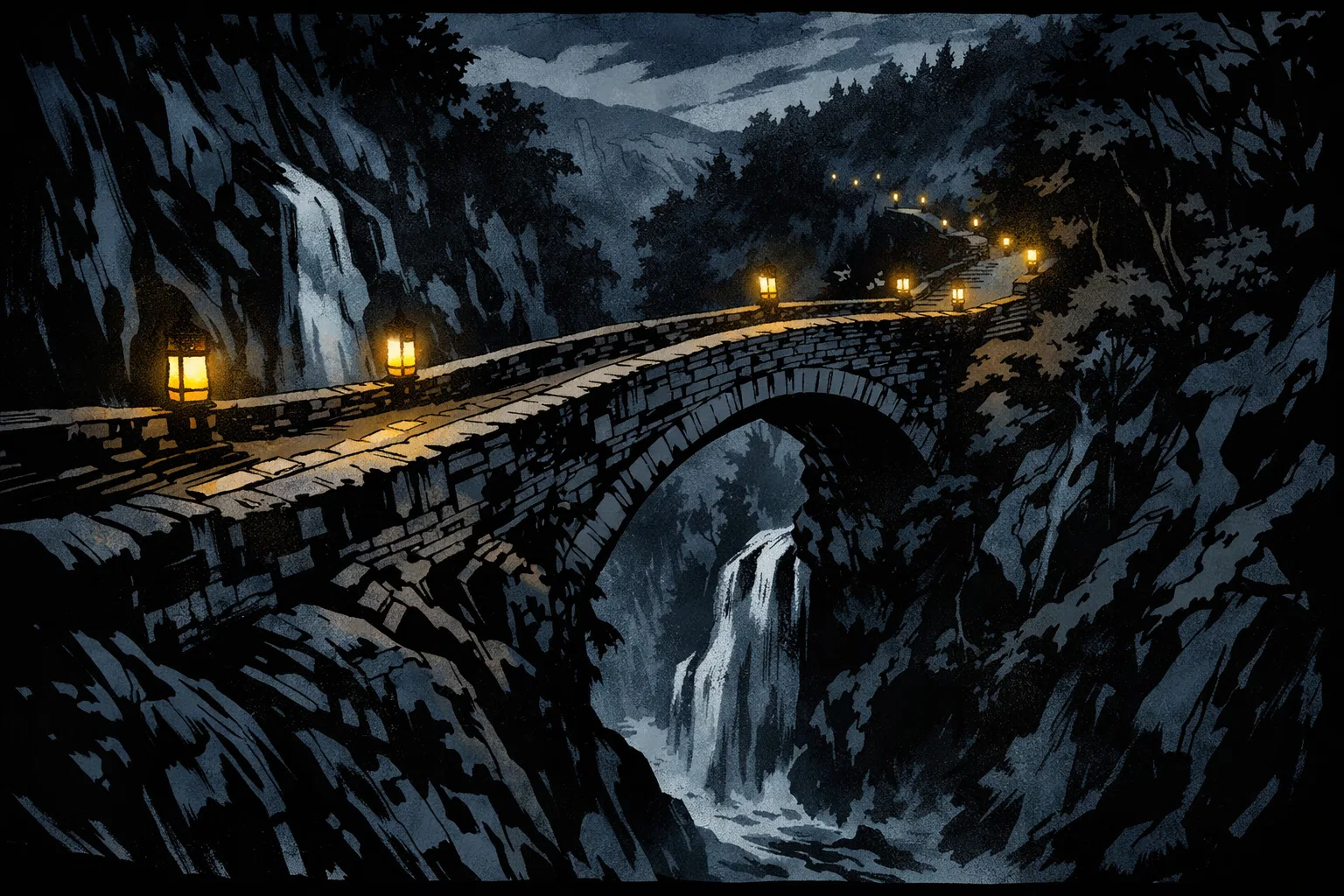
Devil’s Bridge and the corpse-candle traditions of Cardiganshire are not “haunted house” stories in the usual sense. They are landscape legends: stories attached to bridges, roads, rivers, churchways, ruined abbeys and isolated farms, where danger, death and distance were made visible through supernatural warning. At Devil’s Bridge, near Aberystwyth, the famous tale says the Devil built the first crossing over the Mynach gorge, only to be tricked by a canny local woman who sent a dog across first. In the corpse-candle stories recorded around Ysbyty Ystwyth, Ffair-rhos, Pontrhydfendigaid and Ystrad Fflur, eerie lights were said to travel before a death or funeral. Together, these traditions show how rural Cardiganshire turned difficult terrain into memorable warnings: cross carefully, travel wisely, respect funeral ways, and do not treat lonely places as empty.[Discover Ceredigion]discoverceredigion.walesDiscover Ceredigion Devil's BridgeDiscover Ceredigion Devil's Bridge
Why Devil’s Bridge Became a Supernatural Crossing
Devil’s Bridge stands at Pontarfynach, where the river Mynach cuts through a steep gorge before joining the Rheidol. The place is famous because three bridges stand one above another: an early lower bridge, a second bridge of 1753, and a top bridge of 1901. Discover Ceredigion describes the site as three separate bridges spanning the Mynach, built one on top of another between the medieval period and the modern age; it also notes the traditional view that the earliest bridge may have been made by monks of Strata Florida on the route towards Ysbyty Cynfyn.[Discover Ceredigion]discoverceredigion.walesDiscover Ceredigion Devil's BridgeDiscover Ceredigion Devil's Bridge
The legend gives a supernatural explanation for a very real engineering puzzle. In the common version, an old woman sees her cow stranded across the ravine. The Devil offers to build a bridge, but demands the soul of the first living being to cross it. When the bridge is complete, the woman throws bread across; her dog runs after it, and the Devil is cheated of the human soul he expected. The tourist authority’s version keeps the essentials of the bargain, the trick and the dog, while Ceredigion County Council’s trails page preserves a local variant in which a farmer sends a goat across first.[Discover Ceredigion]discoverceredigion.walesDiscover Ceredigion Devil's BridgeDiscover Ceredigion Devil's Bridge
The story works because the place already feels improbable. A bridge over a deep wooded gorge is the sort of structure that invites the question, “How did anyone build that?” Wirt Sikes, the nineteenth-century collector of Welsh folklore, called Devil’s Bridge in Cardiganshire the best-known Welsh natural feature connected with the Devil, and he treated the tale as part of a wider European pattern of “Devil as bridge-builder” legends. In his version, the old woman, the lost cow, the crust of bread and the little black dog are already the recognisable elements of the story.[Project Gutenberg]gutenberg.orgThe Project Gutenberg eBook of British Goblins: Welsh Folk-lore, Fairy Mythology, Legends and Traditions, by Wirt Sikes…
That wider pattern matters for credibility. The Devil’s Bridge tale is not a witness report of an apparition at a named time; it is a traditional explanatory legend. Its purpose is not to prove that a demonic builder appeared in Cardiganshire, but to make a dangerous crossing memorable. The Devil promises convenience at a price; the local woman survives by wit. In haunted-history terms, the story belongs less to evidence of a haunting than to the folklore of thresholds: the gorge is a boundary, the bridge is a risk, and the first crossing must be paid for.

The Landscape Behind the Bargain
The bridge legend became locally famous not only because of the tale, but because the site sat on important routes through upland Cardiganshire. Ceredigion Historical Society, drawing on historic landscape characterisation work, describes the area as marginal land with steep wooded slopes, while also noting that Devil’s Bridge lay on an important north–south routeway. In 1770 it became the junction of two turnpike roads: one from Aberystwyth towards Cwmystwyth and eventually London, and another running northwards towards Shrewsbury.[CEREDIGION HISTORICAL SOCIETY]ceredigionhistory.walesOpen source on ceredigionhistory.wales.
This route history helps explain why Devil’s Bridge became more than a local curiosity. By the late eighteenth and nineteenth centuries, visits to the Mynach waterfalls and Devil’s Bridge were considered a vital part of many tourists’ itineraries, helped by the turnpike roads, the Hafod estate, the Hafod Arms Hotel and the popularity of the picturesque landscape. The same historical account notes the many paintings, drawings and engravings of the falls, while the modern waterfalls attraction still presents the site as a long-established destination visited since the eighteenth century.[CEREDIGION HISTORICAL SOCIETY]ceredigionhistory.walesOpen source on ceredigionhistory.wales.
The result is a layered haunted landscape. At the bottom is a practical crossing, probably connected with medieval travel, monastic estates and local movement. Above that is the picturesque tourist site, shaped by Hafod, the inn, road travel, railway visitors and the experience of looking down into a dramatic gorge. Around both sits the Devil story, giving the place a supernatural personality. It is not a ghost story in the narrow sense, but it performs the same cultural work as many hauntings: it makes a place feel charged with memory.
There is also a useful sceptical reading. The story is attached to a structure whose earliest phase is hard for a casual visitor to date or explain. Where documentary certainty is limited, legend supplies a memorable cause. The visible stack of bridges makes the place seem almost too strange to be ordinary, and folklore turns that strangeness into a bargain tale.
Corpse Candles and Death-Warning Lights
Corpse-candle folklore gives Cardiganshire a different kind of haunting. Instead of the Devil appearing at one famous landmark, small lights were said to move through fields, along roads, near houses or before funeral routes. The National Library of Wales describes the tradition as mysterious lights thought to foretell death or misfortune, and quotes the Aberystwyth schoolmaster David Samuel, writing in the 1890s, as saying he had been forced over many years to believe in such lights as portents preceding a burial or funeral procession.[Library Wales]library.walesWales One dark night: Tales of the ‘Cannwyll Corff’Wales One dark night: Tales of the ‘Cannwyll Corff’
The strongest Cardiganshire evidence is not a polished tourist legend but an oral-history account preserved by Amgueddfa Cymru. In a recording made in 1979, Mary Thomas told stories from Ffair-rhos and the surrounding area about her grandfather, Thomas Jones of Ysbyty Ystwyth, who was said to see corpse candles repeatedly. In one account, he saw a light by a hedge moving through a gap towards a house; a couple of days later, the woman of that house died after a stroke and fall by the fire.[Museum Wales]museum.walesWales Folk Tales from Wales | Museum WalesWales Folk Tales from Wales | Museum Wales
The same Museum Wales record gives the tradition its local texture. Mary Thomas connected the stories with Ysbyty Ystwyth, Ffair-rhos, Pontrhydfendigaid and Ystrad Fflur, not with an abstract “Welsh folklore” setting. The notes say the conversation followed an anecdote about seeing a funeral on the road from Pontrhydfendigaid to Ystrad Fflur, and the speakers called the portent a “corpse light”. They also described beliefs about seeing, in water or through a hat placed near water, the person who was going to die.[Museum Wales]museum.walesWales Folk Tales from Wales | Museum WalesWales Folk Tales from Wales | Museum Wales
These details matter because corpse-candle lore is a landscape mechanism. The light is not merely a floating omen; it maps death onto the routes people already used. It moves down a field, through a hedge-gap, along a road, towards a house, or ahead of a funeral. In a rural society where illness, burial and travel were shared community experiences, the supernatural light made the future funeral visible before it happened.
How the Lights Were Said to Work
The traditional rules of corpse candles were unusually specific. Sikes described the corpse candle as one of the most picturesque Welsh death omens, usually a death-warning, sometimes a blue-flamed light, sometimes a small tallow-like candle held by a ghost, and sometimes a light issuing from the mouth or nostrils of a person near death. He also recorded the belief that the size of the candle could indicate the age of the person expected to die: large for an adult, small for a child, and smaller still for an infant.[Project Gutenberg]gutenberg.orgThe Project Gutenberg eBook of British Goblins: Welsh Folk-lore, Fairy Mythology, Legends and Traditions, by Wirt Sikes…
Mary Thomas’s Cardiganshire account preserves almost the same logic in oral form. Asked what kind of light it was, she said she thought its size varied according to the age of the person: a small candle for a child and a bigger one for a grown-up. She also recalled her grandfather seeing a lighted candle on the bed the night before his wife died, and seeing it go out of the house.[Museum Wales]museum.walesWales Folk Tales from Wales | Museum WalesWales Folk Tales from Wales | Museum Wales
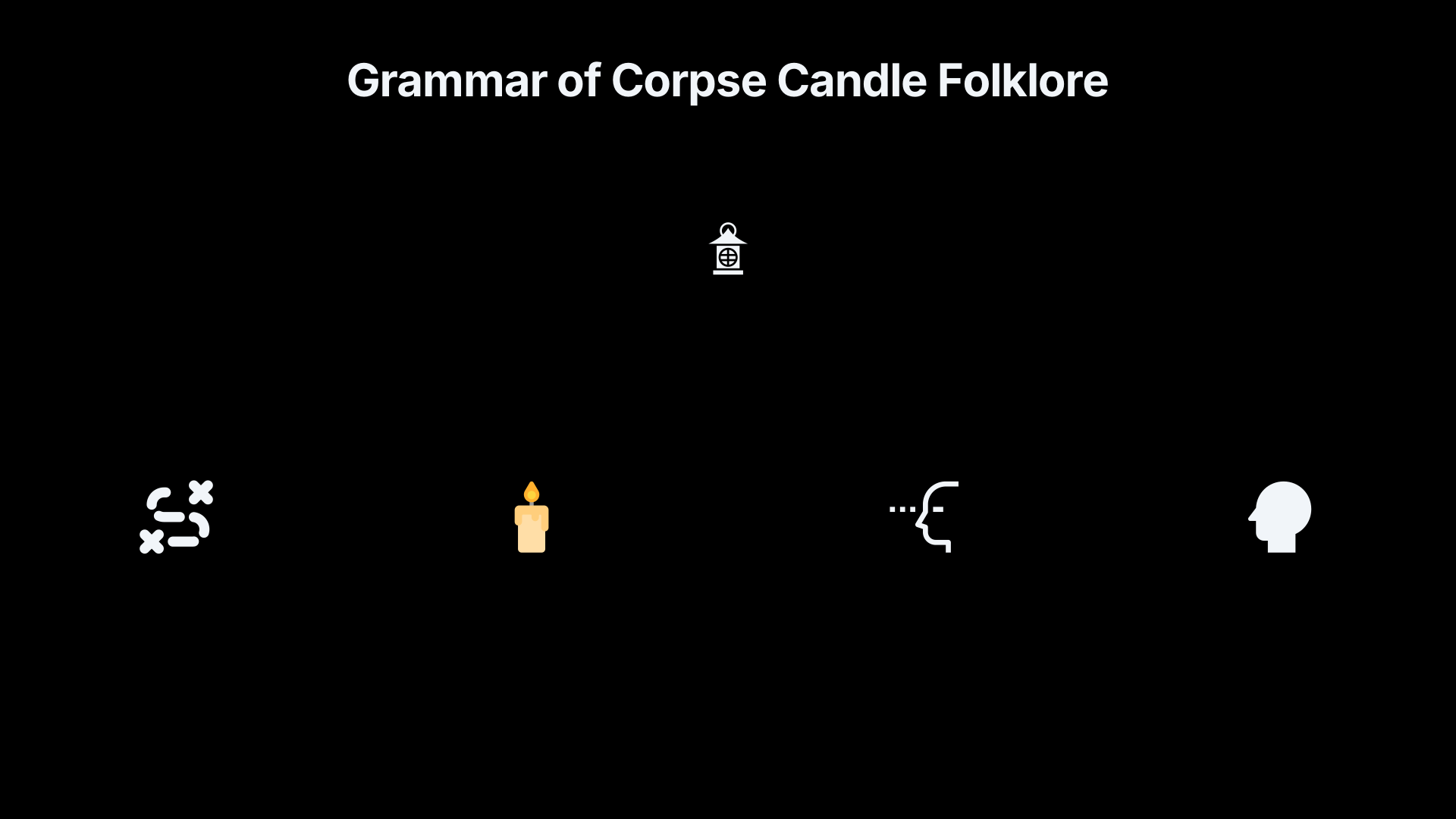
For readers, the important point is that these were not random spooky glimmers. They had a grammar. A corpse candle could indicate:
- A death about to happen, especially when the light moved towards a house.
- A funeral route, when it travelled before the later procession.
- The age or status of the dying person, by the light’s size or appearance.
- A special kind of sight, because some people in the stories could see the light while companions standing beside them could not.
That last feature is crucial. In the Museum Wales account, Thomas Jones asks his daughter whether she can see the light by the hedge; she says she cannot. The story therefore turns second sight into a burden. The “seer” is not simply frightened by a strange light; he is marked as someone who knows what others do not want to know.[Museum Wales]museum.walesWales Folk Tales from Wales | Museum WalesWales Folk Tales from Wales | Museum Wales
Churchways, Roads and Haunted Thresholds
Corpse-candle stories belong naturally to churchways and funeral routes. In the Cardiganshire material, the road from Pontrhydfendigaid to Ystrad Fflur is important because Ystrad Fflur is the Welsh name for Strata Florida, the great Cistercian abbey site that shaped the religious and cultural geography of this part of the county. The Museum Wales notes explicitly connect the corpse-candle conversation with seeing a funeral on that road.[Museum Wales]museum.walesWales Folk Tales from Wales | Museum WalesWales Folk Tales from Wales | Museum Wales
This does not mean every old lane near Strata Florida was believed to be haunted in a modern ghost-tour sense. The atmosphere is subtler. The road, the ford, the abbey ruins, the farm, the sickroom and the burial place are all thresholds between ordinary life and death. A candle moving through them gives the community a visible sign that one household is about to cross from one state into another: from illness to death, from home to grave, from private grief to public funeral.
Devil’s Bridge fits the same pattern from the other direction. It is a crossing rather than a funeral road, but the supernatural warning is again attached to a dangerous threshold. The Devil’s bargain asks who will cross first. The corpse candle asks who will be carried next. Both legends make movement through the landscape morally charged.
The practical setting reinforces the supernatural one. Devil’s Bridge sits among steep rivers, woodland and upland roads; the waterfalls attraction still warns visitors not to begin the walk after dusk because the trail is unlit. That modern safety warning is not folklore, but it shows why older stories grew so naturally in such places: darkness, water, steep paths and isolation were real hazards long before they became eerie atmosphere.[Devils Bridge Trail]devilsbridgewaterfalls.co.ukDevils Bridge Trail Home pageDevils Bridge Trail Home page
Why These Legends Lasted
These stories lasted because they solved several human problems at once. They made frightening places memorable, gave grief a pattern, and turned unexplained sights into socially meaningful signs. A dangerous bridge became the scene of a bargain; a light in the dark became a warning that someone was near death; a road to church became the preview of a funeral procession.
They also suited Cardiganshire’s geography. This was not only a county of castles and houses, but of remote uplands, river crossings, farms, chapels, abbey lands and long journeys between settlements. Ceredigion Historical Society’s account of Devil’s Bridge emphasises marginal land, steep wooded slopes, routeways, turnpikes, tourism and a small settlement that grew around the hotel, railway and visitor trade. Such a landscape is ideal for legends that cling to movement: crossing, walking, riding, carrying the dead and travelling after dark.[CEREDIGION HISTORICAL SOCIETY]ceredigionhistory.walesOpen source on ceredigionhistory.wales.
At the same time, the sources show different levels of reliability. Devil’s Bridge is a stable place with a visible structure, official tourism material, local-history discussion and a long-published legend; the supernatural bargain, however, is plainly a folktale. Corpse candles are preserved in nineteenth-century folklore collections and twentieth-century oral-history recordings, but they remain reports of belief, memory and family testimony rather than verifiable evidence of paranormal events. Sikes himself offered both folklore description and occasional naturalistic comparison, including discussion of bluish flame and possible physical explanations in one medical context.[Project Gutenberg]gutenberg.orgThe Project Gutenberg eBook of British Goblins: Welsh Folk-lore, Fairy Mythology, Legends and Traditions, by Wirt Sikes…
That uncertainty is part of their value. If treated as literal proof, the stories become fragile. If read as folklore landscapes, they become richer: they reveal how people in Cardiganshire imagined death moving through fields, roads and houses before anyone could officially announce it.
How to Read This Haunted Landscape Today
For a modern visitor, Devil’s Bridge is the easiest entry point. The three bridges, the Mynach gorge, the waterfalls, the Hafod Arms setting and the old bargain tale are all concentrated in one dramatic place. The legend should be read as a classic trickster story attached to a striking engineering site: the Devil is powerful enough to build the bridge, but not clever enough to beat local common sense.[Discover Ceredigion]discoverceredigion.walesDiscover Ceredigion Devil's BridgeDiscover Ceredigion Devil's Bridge
The corpse-candle landscape is quieter and more dispersed. Its anchors are not ticketed attractions so much as remembered routes: Ysbyty Ystwyth, Ffair-rhos, Pontrhydfendigaid, Ystrad Fflur and the roads, fields and houses between them. The Museum Wales recording is especially valuable because it preserves the voice of family memory rather than a simplified tourist version. It shows how the belief was explained, questioned, laughed about and still half-defended within living conversation.[Museum Wales]museum.walesWales Folk Tales from Wales | Museum WalesWales Folk Tales from Wales | Museum Wales
The best way to understand these traditions is to see them as warnings shaped by place. Devil’s Bridge asks what price must be paid to cross a ravine. Corpse candles ask what path death will take through a community. Churchways, ruins and remote thresholds give those questions a physical map. In Cardiganshire, the haunted landscape does not always need a named ghost; sometimes it is enough for a road to glow, a bridge to demand a bargain, or a light to move silently towards a house.


eBay marketplace picks
Marketplace Samples
Live-tested eBay searches with available results related to this page.



Endnotes
1.
Source: museum.wales
Title: Wales Folk Tales from Wales | Museum Wales
Link:https://museum.wales/collections/folktales/?story=15
2.
Source: gutenberg.org
Title: Project Gutenberg
Link:https://www.gutenberg.org/files/34704/34704-h/34704-h.htm
Source snippet
The Project Gutenberg eBook of British Goblins: Welsh Folk-lore, Fairy Mythology, Legends and Traditions, by Wirt Sikes...
3.
Source: ceredigionhistory.wales
Link:https://ceredigionhistory.wales/devils-bridge-history/
4.
Source: library.wales
Title: Wales One dark night: Tales of the ‘Cannwyll Corff’
Link:https://www.library.wales/news/article/one-dark-night-tales-of-the-cannwyll-corff
5.
Source: museum.wales
Link:https://museum.wales/collections/folktales/?author=1
6.
Source: discoverceredigion.wales
Title: Discover Ceredigion Devil’s Bridge
Link:https://www.discoverceredigion.wales/areas-of-ceredigion/cambrian-mountains/communities-of-the-cambrian-mountains/devils-bridge/
7.
Source: devilsbridgewaterfalls.co.uk
Title: Devils Bridge Trail Home page
Link:https://www.devilsbridgewaterfalls.co.uk/
8.
Source: devilsbridgewaterfalls.co.uk
Link:https://www.devilsbridgewaterfalls.co.uk/devils-bridge-village/history/
9.
Source: devilsbridgewaterfalls.co.uk
Title: Once upon a time…
Link:https://www.devilsbridgewaterfalls.co.uk/legend/once-upon-a-time/
10.
Source: devilsbridgewaterfalls.co.uk
Link:https://www.devilsbridgewaterfalls.co.uk/legend/
11.
Source: devilsbridgewaterfalls.co.uk
Link:https://www.devilsbridgewaterfalls.co.uk/wp-content/uploads/2024/03/DEVILS-BRIDGE-GUIDE-BOOK-REPRINT.pdf
12.
Source: facebook.com
Link:https://www.facebook.com/groups/563855813990883/posts/2843813539328421/
13.
Source: facebook.com
Title: Devil’s Bridge
Link:https://www.facebook.com/allgreatbritain/photos/devils-bridge-three-bridges-in-wales-built-over-each-otherit-is-likely-that-the-/122137299566269902/
14.
Source: firesidehorror.co.uk
Title: Welsh Folklore
Link:https://www.firesidehorror.co.uk/blog-2/fjyp816xikl0pi5adzl7v4ynq99e8g
15.
Source: peoplescollection.wales
Link:https://www.peoplescollection.wales/collections/606474
16.
Source: ceredigionhistory.wales
Link:https://ceredigionhistory.wales/ysbyty-ystwyth-history/
17.
Source: zipworld.co.uk
Link:https://www.zipworld.co.uk/the-adventure-highway/devils-bridge
18.
Source: historyhit.com
Title: Devil’s Bridge
Link:https://www.historyhit.com/locations/devils-bridge/
19.
Source: visitmidwales.co.uk
Link:https://www.visitmidwales.co.uk/information/product-catch-all/pontarfynach-devils-bridge-p1725411
20.
Source: burialsandbeyond.com
Title: Corpse Candles
Link:https://burialsandbeyond.com/2021/05/09/corpse-candles/
21.
Source: pantheon.org
Title: corpse candles
Link:https://pantheon.org/articles/c/corpse_candles.html
22.
Source: welsh-cottages.co.uk
Title: devils bridge
Link:https://www.welsh-cottages.co.uk/blog/devils-bridge
Additional References
23.
Source: youtube.com
Title: The Devil Built This Bridge?! Devil’s Bridge Wales Story + How to Get There
Link:https://www.youtube.com/watch?v=bzUTUJPH-3o
Source snippet
"Corpse Candles & Goblin Funerals: Wales's Most Terrifying Death Omens[https://www.youtube.com/watch?v=CQxM8MgTDbM..."](https://www.youtube.com/watch?v=CQxM8MgTDbM...")...
24.
Source: youtube.com
Title: The Legend of the Devil’s Bargain and the Black Dog of Pontarfynach
Link:https://www.youtube.com/watch?v=sRgAygNhjRY
Source snippet
The Devil Built This Bridge?! Devil's Bridge Wales Story + How to Get There...
25.
Source: youtube.com
Link:https://www.youtube.com/watch?v=I0v78dR3pSE
Source snippet
The Story of Devil's Bridge, Wales...
26.
Source: instagram.com
Link:https://www.instagram.com/p/DTFImMckqVq/
27.
Source: tracyburton.co.uk
Link:https://tracyburton.co.uk/an-outline-of-the-route/
28.
Source: scribd.com
Link:https://www.scribd.com/document/771787745/British-Goblins
29.
Source: ceredigion.gov.uk
Link:https://www.ceredigion.gov.uk/resident/coast-countryside/exploring-ceredigion/devils-bridge-trails/
30.
Source: instagram.com
Link:https://www.instagram.com/p/DYPqWuvibGt/
31.
Source: facebook.com
Link:https://www.facebook.com/groups/815883248934810/posts/1225897414600056/
32.
Source: reddit.com
Link:https://www.reddit.com/r/interestingasfuck/comments/1owtsip/devils_bridge_in_wales_a_single_canyon_is_spanned/
Topic Tree