Within Haunted Down
What Haunts the Roads Through the Mournes?
The Mourne roads give County Down a wilder folklore strand of headless riders, phantom coaches and death-warning apparitions.
On this page
- The Dullahan as a death omen figure
- Roadside apparitions, coaches and dusk encounters
- Why mountain passes and old routes attract warning legends
Page outline Jump by section
Introduction
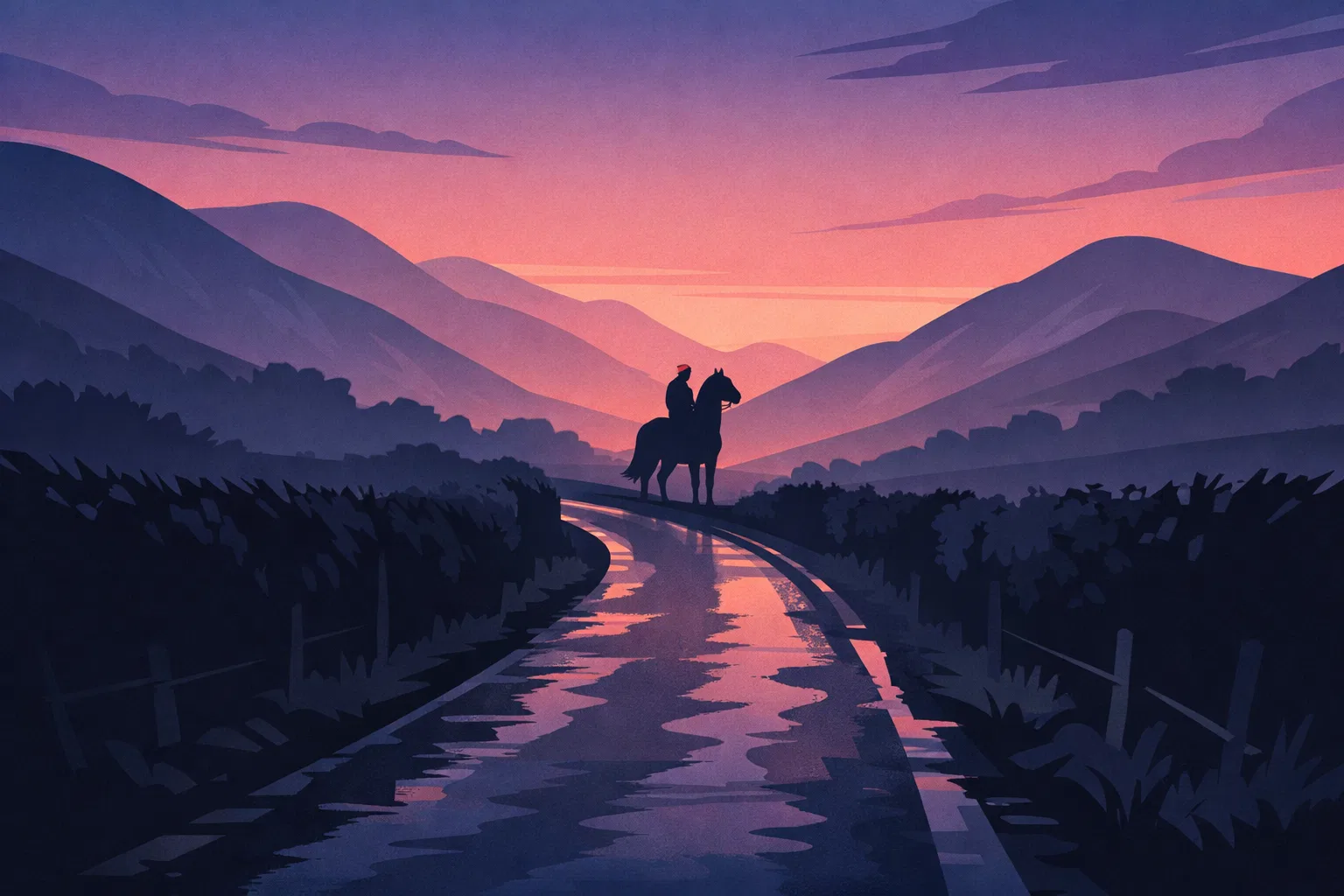
The Mourne road-omen tradition is one of County Down’s wilder haunted strands: not a single verified ghost story, but a cluster of travelling death warnings attached to mountain roads, dusk journeys and the Irish headless-rider figure usually called the Dullahan. The most specific Mourne version places a headless rider on the hill road between Bryansford and Moneyscalp, where a storyteller named W. J. Fitzpatrick is said to have seen the figure at sunset, holding up its own head and calling a name before a fatal road accident followed. That story is memorable, but its source trail is thin and late, so it is best read as folklore rather than evidence of an event. The real value of the tale is how it shows the Mournes as a County Down threshold landscape: roads between settlements, uplands and coast become places where danger, death and warning could be imagined in dramatic form.[irelandseye.com]irelandseye.comIreland's Eye Hidden Ireland | The DullahanIreland's Eye Hidden Ireland | The Dullahan
Where the Mourne road omen is located
The strongest place-marker in the County Down Dullahan tradition is the road landscape between Bryansford and Moneyscalp, on the northern side of the Mournes near Tollymore, Castlewellan and Newcastle. A Geograph entry for Moneyscalp Road describes it as linking the B8 near Bryansford with the A25 east of Kilcoo, which fits the kind of upland connector road that lends itself to tales of dusk encounters, sudden bends and lonely movement between settlements.[Geograph Ireland]geograph.ieIreland The descent along Moneyscalp Road © Eric Jones:: Geograph IrelandIreland The descent along Moneyscalp Road © Eric Jones:: Geograph Ireland
That setting matters. The Mournes are not just a scenic backdrop but a compact mountain range on the County Down coast, with peaks, valleys, lakes, rivers, reservoirs, steep paths and roads that move quickly from village edge to open upland. The National Trust describes the Mournes as Northern Ireland’s highest and most dramatic mountain range, while the Department of Agriculture, Environment and Rural Affairs notes that the Mourne Area of Outstanding Natural Beauty was designated in 1986 and includes a rich mix of natural, cultural and built heritage.[National Trust]nationaltrust.org.ukNational Trust Explore the Mourne mountains | County Down | National TrustNational Trust Explore the Mourne mountains | County Down | National Trust
For a ghost-story reader, the key point is not simply that the area is beautiful. It is that Mourne routes feel transitional. They pass from lowland to upland, farm to moor, road to pass, daylight to mist. In folklore, such in-between places often attract warnings: a rider at a brow of a hill, a coach heard before it is seen, or a call from the road that seems to belong neither to the living world nor to the dead.
The Dullahan as a death-omen figure
The Dullahan is usually presented in modern retellings as a headless rider or coachman who carries his own head and appears when death is near. The older printed tradition is more complicated. Thomas Crofton Croker’s nineteenth-century Fairy Legends and Traditions of the South of Ireland includes a whole section headed “The Dullahan”, with stories titled “The Good Woman”, “Hanlon’s Mill”, “The Death Coach” and “The Headless Horseman”. Croker’s contents alone show how quickly the figure became entangled with headless riders, headless coaches and comic-macabre fairy lore rather than one neat, stable creature.[Project Gutenberg]gutenberg.orgOpen source on gutenberg.org.
Croker’s “Death Coach” material is especially important for understanding the road-omen side of the tradition. His text describes a coach, driver, horses and passengers as headless, and his note says the Death Coach or Headless Coach and Horses was called “Coach a bower” in Ireland, with its appearance generally treated as a sign of death or misfortune.[Project Gutenberg]gutenberg.orgOpen source on gutenberg.org.
Later ghost-story collectors kept the same distinction between a death-warning coach and a more ordinary phantom carriage. In True Irish Ghost Stories, compiled by St John D. Seymour and Harry L. Neligan in 1914, the chapter on “Banshees, and other death-warnings” includes the Headless Coach as a portent; one account has a dark coach heard and seen at a County Limerick house shortly before a death, while another passage explicitly distinguishes the Headless Coach, which portends death, from a Phantom Coach that may be merely an apparition of a vehicle.[Project Gutenberg]gutenberg.orgProject Gutenberg The Project Gutenberg e Book of True Irish Ghost Stories, byProject Gutenberg The Project Gutenberg e Book of True Irish Ghost Stories, by
That distinction is useful in County Down. The Mourne Dullahan story is not just “a ghost on a road”. It belongs to the death-warning family of tales: the apparition does not haunt a ruin or repeat a murder scene; it travels, calls, passes, and is interpreted after the fact as a sign that someone was doomed.
The Bryansford and Moneyscalp sighting
The most direct Mourne version comes from an online text headed “The Dullahan”, which attributes an account to W. J. Fitzpatrick, described as a storyteller from the Mourne Mountains in County Down. In that version, Fitzpatrick says he saw the Dullahan on the brow of the hill between Bryansford and Moneyscalp late one evening at sunset. The figure is headless, holds up its own head, calls out a name, and disappears; afterwards, the story says, a young man is killed in a car accident on that hill.[Ireland's Eye]irelandseye.comIreland's Eye Hidden Ireland | The DullahanIreland's Eye Hidden Ireland | The Dullahan
As folklore, it is a very well-shaped tale. It has a precise road, a liminal time of day, a protective gesture — the witness covers his ears in case the name is his own — and a later death that appears to confirm the warning. It also updates an older horse-and-coach motif for a modern road culture: the death omen no longer only visits a great house or a family avenue, but is linked to a car accident on a hill road.
As evidence, however, the story needs caution. Folklore researcher Doris V. Sutherland has examined this modern Dullahan material and describes the Crom Dubh origin story often attached to the Dullahan as “extremely dubious” as folklore scholarship. She also notes that the Fitzpatrick sighting is one of the alleged first-hand accounts in this later source chain, not a well-documented archival case with a named accident report, date, newspaper corroboration or independent witness statements.[Doris V. Sutherland]dorisvsutherland.comDoris V. Sutherland More on the Dullahan in Irish Folklore – Doris V. SutherlandDoris V. Sutherland More on the Dullahan in Irish Folklore – Doris V. Sutherland
That does not make the Mourne story worthless. It means it should be read in the right category. It is not a court-like record of a supernatural event. It is a localised road-omen legend that borrows older Irish death-warning machinery and fixes it to a recognisable County Down route.

Roadside apparitions, coaches and dusk encounters
Mourne road omens sit between two related traditions: the rider who warns by calling a name, and the coach whose sound or appearance foretells death. The Dullahan may appear mounted, driving, or associated with a coach; Croker’s material includes headless horsemen, headless coachmen and headless horses, while Seymour and Neligan treat the Headless Coach as one of several Irish death-warnings.[Project Gutenberg]gutenberg.orgOpen source on gutenberg.org.
The coach tradition is especially road-based. It is heard rumbling, rushing, cracking a whip or passing gates. Croker’s notes describe the Headless Coach as a general superstition and a sign of death or misfortune, while Sutherland’s discussion of Croker points out that the motif involves roads, gates, houses and the terrifying idea that the vehicle travels hard when death is coming.[Project Gutenberg]gutenberg.orgOpen source on gutenberg.org.
The Mourne version compresses that wider tradition into a single roadside apparition. There is no ancestral avenue, no old mansion and no family deathbed. Instead, the key elements are the hill, the evening, the name and the later accident. That makes it feel distinctively modern and local. The old death coach belongs to a world of horses, estates and midnight approaches; the Bryansford–Moneyscalp Dullahan belongs to a world of rural roads where a fatal bend or brow of a hill can become part of the supernatural map.
This is why the tale works so well as a County Down haunting. It is not simply imported Irish mythology placed on a map. It adapts the Dullahan mechanism to Mourne terrain: steep roads, darkening evenings, isolated stretches and the unease of travelling through a landscape that can be both beautiful and dangerous.
Why mountain passes and old routes attract warning legends
Mountain roads are natural homes for omen stories because they concentrate uncertainty. Before modern lighting, phones and fast emergency response, an upland road after dusk could mean weather, darkness, poor visibility, tired horses, poor surfaces, isolation and the risk of accident. The Mournes still carry that sense of exposure: the National Trust warns visitors to research routes, watch sunset times and be alert to changing weather, while DAERA describes a landscape of peaks, cliffs, moorland, woodland, field and farm meeting the coast.[National Trust]nationaltrust.org.ukNational Trust Explore the Mourne mountains | County Down | National TrustNational Trust Explore the Mourne mountains | County Down | National Trust
Folklore turns that practical danger into a story with a message. A sudden death on a road is hard to make sense of, especially in small communities where the place remains familiar after the person is gone. A death omen gives the event a pattern: the road did not merely happen to be dangerous; something was seen or heard there first. The warning may be frightening, but it also makes death feel less random.
The Mourne Dullahan also carries an older moral charge. In many death-warning tales, the living cannot prevent the death, but they can recognise the sign. The witness who covers his ears in the Fitzpatrick story is not heroic; he is vulnerable. He fears that the name might be his. That small human reaction is one reason the tale survives in retelling. The terror lies not in gore, but in hearing death become personal.
How credible is the Mourne Dullahan tradition?
The credibility of the Mourne road-omen material depends on what question is being asked. As a record of a verified apparition, the evidence is weak. The Bryansford–Moneyscalp account is vivid, but the available online source gives no date for the sighting, no full biographical context for Fitzpatrick, no named victim, and no independent documentation of the alleged accident. Sutherland’s critique is important because it shows that some widely repeated Dullahan claims rest on modern retellings and shaky source chains rather than deep, clearly traceable oral archives.[Ireland's Eye]irelandseye.comIreland's Eye Hidden Ireland | The DullahanIreland's Eye Hidden Ireland | The Dullahan
As folklore, the evidence is stronger. The Mourne story fits a well-attested Irish pattern in which headless riders, headless coaches and supernatural vehicles operate as death omens. Croker’s nineteenth-century collection preserves the headless-coach and Dullahan complex in print, and Seymour and Neligan’s 1914 ghost-story collection shows that Irish readers and contributors still recognised death-warning apparitions, including the Headless Coach, as a distinct class of ghostly report.[Project Gutenberg]gutenberg.orgOpen source on gutenberg.org.
The most careful reading is therefore layered. The County Down Dullahan should not be presented as a proven Mourne ghost. It should be presented as a localised form of a wider Irish death-omen tradition, attached in modern telling to a real road between Bryansford and Moneyscalp. Its importance lies in how it explains the emotional geography of the Mournes: roads are not just routes through scenery, but places where danger, memory and warning can gather.
What this adds to County Down’s haunted map
County Down’s better-known haunted stories often attach themselves to buildings: Gill Hall, castles, old houses, ruins and estate landscapes. The Mourne road-omen tradition adds a different kind of haunting. It is mobile, not domestic. It belongs to the road rather than the room, to the mountain edge rather than the locked chamber, and to the moment of passing rather than the long-term occupation of a haunted place.
That makes it a useful bridge between County Down’s ghost stories and its broader folklore. The Dullahan is not quite a conventional ghost, not quite a fairy, and not simply a monster. In the Mourne telling, it is a mechanism for warning: a headless figure appears at the edge of day, names the doomed, and leaves the living to interpret what they have heard. The phantom coach tradition works the same way at a larger scale, making the road itself seem to carry news from the border between life and death.
For visitors and readers, the Bryansford–Moneyscalp story is best approached as atmospheric folklore tied to a real Mourne route, not as a verified paranormal case. Its power comes from fit: a headless rider belongs naturally to a landscape of darkening roads, mountain brows and sudden descents. In that sense, the Dullahan tradition gives County Down’s haunted geography something its castles and houses cannot provide — the sense that the road through the Mournes may itself be the haunted place.
Amazon book picks
Further Reading
Books and field guides related to What Haunts the Roads Through the Mournes?. Use these as the next step if you want deeper reading beyond the article.
The Mammoth Book of Haunted House Stories
Useful broader paranormal reading despite the roadside focus.
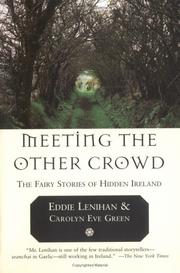
Meeting the Other Crowd
Covers supernatural beings and oral traditions related to death omens.
Irish ghost stories of Sheridan Le Fanu
First published 1973. Subjects: Ghost stories.
eBay marketplace picks
Marketplace Samples
Live-tested eBay searches with available results related to this page.
Endnotes
1.
Source: geograph.ie
Title: Ireland The descent along Moneyscalp Road © Eric Jones:: Geograph Ireland
Link:https://www.geograph.ie/photo/2918013
2.
Source: daera-ni.gov.uk
Title: DAERAMourne AONB | Department of Agriculture, Environment and Rural Affairs
Link:https://www.daera-ni.gov.uk/articles/mourne-aonb
3.
Source: gutenberg.org
Link:https://www.gutenberg.org/files/39752/39752-h/39752-h.htm
4.
Source: gutenberg.org
Title: Project Gutenberg The Project Gutenberg e Book of True Irish Ghost Stories, by
Link:https://www.gutenberg.org/cache/epub/14099/pg14099-images.html
5.
Source: ireland.com
Link:https://www.ireland.com/en-gb/destinations/regions/mourne-mountains/
6.
Source: youtube.com
Link:https://www.youtube.com/watch?v=sqbDsK2zFDE
Source snippet
Legend of The Dullahan...
7.
Source: irelandseye.com
Title: Ireland’s Eye Hidden Ireland | The Dullahan
Link:https://www.irelandseye.com/paddy3/preview.htm
8.
Source: dorisvsutherland.com
Title: Doris V. Sutherland More on the Dullahan in Irish Folklore – Doris V. Sutherland
Link:https://dorisvsutherland.com/2020/06/23/more-on-the-dullahan-in-irish-folklore/
9.
Source: nationaltrust.org.uk
Title: National Trust Explore the Mourne mountains | County Down | National Trust
Link:https://www.nationaltrust.org.uk/visit/northern-ireland/the-mournes/explore-the-mournes-mountain-range
10.
Source: dorisvsutherland.com
Link:https://dorisvsutherland.com/2020/06/19/the-history-of-the-dullahan-in-irish-folklore/
11.
Source: Wikipedia
Link:https://en.wikipedia.org/wiki/Dullahan
12.
Source: Wikipedia
Title: Headless Horseman
Link:https://en.wikipedia.org/wiki/Headless_Horseman
13.
Source: Wikipedia
Title: Death coach
Link:https://en.wikipedia.org/wiki/Death_coach
14.
Source: Wikipedia
Title: Thomas Crofton Croker
Link:https://en.wikipedia.org/wiki/Thomas_Crofton_Croker
15.
Source: theirishplace.com
Title: the dullahan
Link:https://www.theirishplace.com/heritage/the-dullahan/
16.
Source: clarelibraries.ie
Title: the death coach
Link:https://clarelibraries.ie/localstudies/folklore/a-folklore-survey-of-county-clare-by-thomas-johnson-westropp/the-death-coach/
17.
Source: nationaltrust.org.uk
Link:https://www.nationaltrust.org.uk/visit/northern-ireland/the-mournes
18.
Source: catalog.hathitrust.org
Link:https://catalog.hathitrust.org/Record/008974030
19.
Source: mythos-and-legends.fandom.com
Link:https://mythos-and-legends.fandom.com/wiki/Dullahan
Additional References
20.
Source: youtube.com
Title: Northern Ireland’s Ghost Road
Link:https://www.youtube.com/watch?v=7f9E5LJqu0E
Source snippet
"Cars Roll UPHILL Here? | The Magic Road (Mourne Mountains)[https://www.youtube.com/watch?v=1uc_NEuuhx0..."](https://www.youtube.com/watch?v=1uc_NEuuhx0...")...
21.
Source: facebook.com
Link:https://www.facebook.com/CelticBardJeff/photos/dullahanthe-dullahan-is-one-of-the-most-spectacular-creatures-in-the-irish-fairy/2627469094007407/
22.
Source: facebook.com
Link:https://www.facebook.com/100044276087249/posts/the-dullahanthe-dullahan-is-one-of-the-most-spectacular-creatures-in-the-irish-f/1719794491648657/
23.
Source: fromthewordghost.buzzsprout.com
Link:https://fromthewordghost.buzzsprout.com/2025848/episodes/15591036-066-exploring-northern-ireland-s-haunted-landscapes-the-mysteries-of-the-mourne-mountains-and-tollymore-forest
24.
Source: facebook.com
Link:https://www.facebook.com/scoilbheanfeasa/posts/an-c%C3%B3iste-bodhar-the-death-coach-in-irish-folklorein-old-irish-mythology-there-a/388470369454050/
25.
Source: facebook.com
Link:https://www.facebook.com/rteradio1/posts/anne-doyle-tells-brendan-courtney-about-the-time-she-met-her-fetch-in-irish-folk/838082378323478/
26.
Source: discovernorthernireland.com
Link:https://discovernorthernireland.com/listing/bryansford-cottage/73278101/
27.
Source: agoda.com
Link:https://www.agoda.com/en-ca/bryansford/maps/newcastle-gb.html
28.
Source: facebook.com
Link:https://www.facebook.com/groups/UndergroundDarkness/posts/2579216552284101/
29.
Source: facebook.com
Link:https://www.facebook.com/theprimitivehare/posts/31-ghost-whispers-%EF%B8%8F%EF%B8%8F-%EF%B8%8F-31ghostwhispers%EF%B8%8Fthe-phantom-coach-of-ardagh-true-ghost-st/24670743012547108/
Topic Tree