Within Haunted Surrey
Which Haunted Surrey Places Still Stand?
Guildford Castle, Newark Priory and Ham House anchor Surrey's haunted reputation in visible historic places readers can still visit.
On this page
- Guildford Castle and town ghost traditions
- Newark Priory, monks and ruined religion
- Ham House and historic Surrey's London edge
Page outline Jump by section
Introduction
Surrey’s ghost-tour landscape works best when it has stone, brick and ruined arches to hold on to. Guildford Castle, Newark Priory and Ham House are not simply “spooky places” in a list: they are visible historic sites where stories of apparitions, monks, unexplained footsteps and old household presences have attached themselves to real architecture. Guildford gives Surrey a town-centre castle and Friday-night ghost-walk tradition; Newark Priory gives it a ruined religious house by the River Wey, with monk legends shaped by Reformation memory; Ham House gives historic Surrey’s Thames edge one of Britain’s best-known haunted-house reputations. None of these stories proves a haunting. Their value lies in how they show Surrey’s eerie history becoming public, walkable and marketable: ruins and houses turn local folklore into something readers can still visit, photograph, question and remember.
Why standing places make Surrey’s ghost stories last
Ghost stories survive more easily when they are tied to a place that can still be seen. A vanished cottage or unnamed lane may keep a legend for a generation; a castle keep, priory ruin or great house can keep it for centuries because visitors continue to encounter the setting. Surrey’s haunted reputation is therefore not only a matter of reported apparitions, but of heritage infrastructure: public gardens, riverside footpaths, listed buildings, visitor routes, guided walks and local-history books.
The geography also matters. For haunted history, Surrey should be read partly as a historic county rather than only as the present administrative county. Surrey History Centre notes that the ancient county once extended north to the Thames and included places later moved into London government: Lambeth, Southwark and Wandsworth in 1889, and further places including Richmond, Kingston, Merton, Sutton and Croydon in 1965. That is why Ham House, now in the London Borough of Richmond upon Thames, still belongs naturally to historic Surrey’s haunted-house map.[Surrey County Council]surreycc.gov.ukadministrative boundariesThis affects the records held at Surrey History Centre.Read more…
The three sites on this page also show three different ways a haunted place becomes famous. Guildford Castle is made ghostly by public performance and the night-time re-reading of a town centre. Newark Priory is made ghostly by ruin, distance and monastic memory. Ham House is made ghostly by preserved interiors, aristocratic biography and long-running visitor tradition. Together, they explain why Surrey ghost tours often feel less like a parade of random scares and more like a walk through layers of local memory.
Guildford Castle and town ghost traditions
Guildford Castle is the most obvious anchor for haunted Guildford because it gives the town a dramatic medieval centrepiece. Historic England describes the castle as developing over several centuries from a Norman motte-and-bailey into a shell keep and then a tower keep; Guildford Borough Council says it is thought to have been built soon after the Norman Conquest and later served as a royal palace, prison and private residence. The castle and grounds were sold to Guildford Corporation in 1885, and the grounds opened as public gardens in 1888 for Queen Victoria’s Golden Jubilee.[Historic England]historicengland.org.ukHistoric England Guildford Castle, Non Civil ParishHistoric England Guildford Castle, Non Civil Parish
That history matters for ghost-tour storytelling because the castle is not a sealed archaeological object. It is a civic space: a ruin, garden, viewpoint and town landmark. A visitor can move from shopping streets to castle grounds in minutes, which makes Guildford especially suitable for a guided evening route. Visit Surrey lists The Ghost Tour of Guildford as a Friday-night walk lasting about one and three-quarter hours and covering around 20 haunted and mysterious sites, while the tour’s own description identifies its guide, Philip Hutchinson, as a professional actor and life member of The Ghost Club.[Visit Surrey]visitsurrey.comOpen source on visitsurrey.com.
The castle’s haunting claims are best treated as tour tradition rather than as firmly documented early folklore. Modern haunted-place summaries often refer to a female apparition at Guildford Castle, sometimes described as a woman in a blue dress or period clothing, but these accounts tend to circulate in local ghost writing, tour promotion and paranormal round-ups rather than in early primary sources. That does not make them worthless; it changes how they should be read. The story is part of Guildford’s public ghost culture, not a well-attested medieval record.
What gives the castle legend its staying power is the fit between story and setting. A Norman keep already carries associations of imprisonment, authority, decay and surveillance. Guildford’s own official history gives the site a sequence of uses — palace, prison, residence, public garden — that makes it easy for ghost walks to move between social worlds: royal power, punishment, private life and civic leisure.[Guildford Borough Council]guildford.gov.ukAbout Guildford CastleAbout Guildford Castle
A careful reader should separate three layers:
The building’s verified history: Norman origins, later royal use, prison associations and public restoration are well supported by heritage sources.[Historic England]historicengland.org.ukHistoric England Guildford Castle, Non Civil ParishHistoric England Guildford Castle, Non Civil Parish
The ghost-tour layer: Guildford has an active, long-running ghost-walk tradition that uses the castle and other town sites as part of a performed route.[Visit Surrey]visitsurrey.comOpen source on visitsurrey.com.
The apparition layer: claims of figures seen at or near the castle are folkloric and secondary, best understood as local storytelling attached to a highly suggestive ruin.
This distinction is important because it makes the castle more interesting, not less. Guildford Castle is not only “haunted” in the narrow sense of someone claiming to have seen a figure. It is haunted in the cultural sense: an old power structure has become a public garden, and the town repeatedly reanimates it through night walks, local tales and the eerie pleasure of standing under medieval stone after dark.

Newark Priory, monks and ruined religion
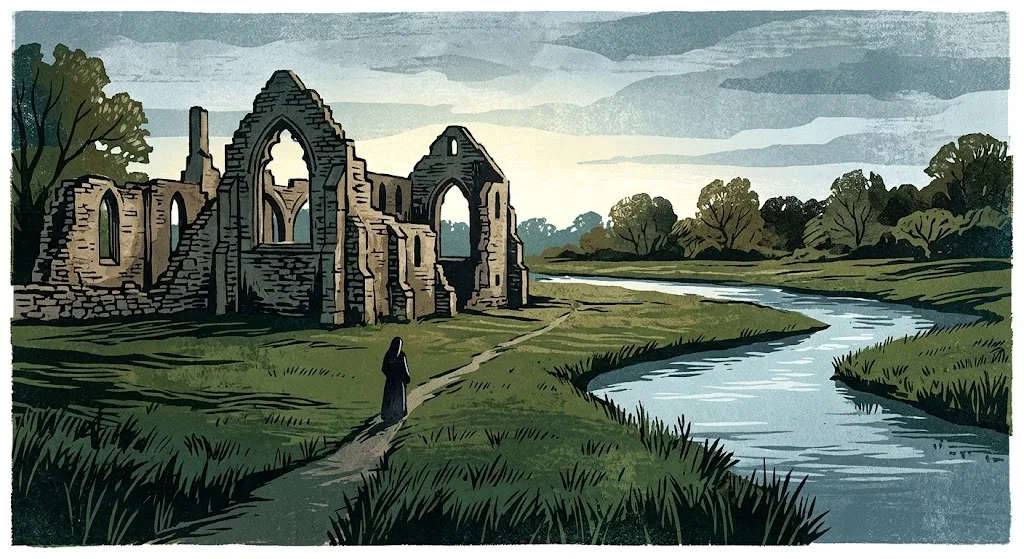
Newark Priory supplies a different kind of Surrey haunting: quieter, more remote and more ruin-led. The site lies north of the River Wey, near Ripley and Pyrford, and survives as upstanding and buried remains of an Augustinian priory. Historic England describes it as the priory of St Thomas, situated on the flood plain of the River Wey, with the north-east part of the complex still partially standing. The priory was finally dissolved in 1538, and archaeological work in 1928 revealed the plan of the main complex, including the 12th-century cruciform church.[Historic England]historicengland.org.ukOpen source on historicengland.org.uk.
The verified history is already atmospheric. British History Online’s Victoria County History account places Newark among Surrey’s Austin canon houses, while Exploring Surrey’s Past describes it as founded in the late 12th century by Ruald de Clane and Beatrice of Send and dedicated to the Virgin Mary and Thomas Becket. The Becket dedication matters because it places the priory within the devotional world of medieval England, where pilgrimage, saintly memory and religious patronage shaped local landscapes.[British History Online]british-history.ac.ukOpen source on british-history.ac.uk.
Newark’s ghost tradition is the classic ruined-monastery pattern: reported monks, religious figures and a sense that the Dissolution of the Monasteries left more than broken walls behind. The History Press’s listing for Haunted Surrey specifically includes “ghostly monks at Newark Priory” among the county’s better-known stories, while paranormal gazetteers preserve a related account of a vicar who reportedly saw a monk-like figure by a fireplace before it vanished.[The History Press]thehistorypress.co.ukOpen source on thehistorypress.co.uk.
That last point is worth handling carefully. The monk story is not supported in the same way as the priory’s foundation, dedication or dissolution. It belongs to ghost-lore transmission: local report, later collection, retelling and thematic fit. The motif is familiar across Britain because ruined abbeys and priories are exceptionally easy to imagine as haunted. They are religious places violently repurposed by history; their missing roofs and broken arches create the visual grammar of absence. Newark’s setting on the Wey flood plain adds to that effect, especially when seen from nearby paths rather than entered as a managed visitor attraction.
The priory also shows how access affects haunting. Visit Surrey notes Newark Priory as a Grade I ancient monument, but it is not a conventional staffed attraction with rooms, interpretation panels and a gift shop. The result is a more distant kind of folklore. Visitors often encounter it across fields, from rights of way or near the Wey navigation landscape, so the ruin appears as a silhouette rather than an explained museum object.[Visit Surrey]visitsurrey.comOpen source on visitsurrey.com.
That distance helps the ghost story. A house haunting often depends on rooms: stairs, bedrooms, mirrors, corridors, servants’ spaces. A ruined-priory haunting depends on outline: arches, grass, water, weather and the knowledge that a community once prayed there daily. At Newark, the reported monks are less like named characters than expressions of a broken religious landscape. The story asks the visitor to imagine routine abruptly ended — bells, offices, processions and enclosed lives replaced by ruin, private land and passing walkers.
Ham House and historic Surrey’s London edge
Ham House is the most polished and nationally recognisable haunted-house case in this Surrey cluster. It stands on the Thames at Richmond, now administratively in London, but it belongs to historic Surrey’s northern edge. The National Trust describes Ham as a rare and atmospheric 17th-century house on the banks of the Thames, transformed by Elizabeth, Duchess of Lauderdale, and the Duke into one of the grandest Stuart houses in England.[National Trust]nationaltrust.org.ukOpen source on nationaltrust.org.uk.
Its architectural survival is central to the haunting tradition. Historic England records Ham House as Grade I listed, and its registered park and garden entry states that the principal building was constructed in 1609–10 for Sir Thomas Vavasour and extended and remodelled in 1672–4 for the Duke and Duchess of Lauderdale. This is not a ruin where imagination fills in missing walls; it is a preserved elite interior where visitors can move through rooms that still strongly evoke 17th-century status, privacy and display.[Historic England]historicengland.org.ukHistoric England Ham House, Non Civil ParishHistoric England Ham House, Non Civil Parish
Ham’s ghost reputation usually centres on Elizabeth Murray, later Duchess of Lauderdale, along with other reported presences such as footsteps, cold spots, a dog, servants or figures associated with particular rooms. Visitor and local-history accounts often describe it as one of Britain’s most haunted houses, and Visit Richmond repeats that reputation while also grounding the house in Elizabeth Murray’s Civil War and Restoration political world.[Visit Richmond]visitrichmond.co.ukVisit Richmond Ham House and GardenVisit Richmond Ham House and Garden
The most useful way to read Ham’s haunting is as a meeting point between biography and building. Elizabeth Murray was not just a picturesque former owner. She was politically connected, socially powerful and deeply associated with the house’s grandest phase. The National Trust frames Ham as the creation of the Duchess and Duke of Lauderdale, with major collections of paintings, furniture and textiles brought together around 400 years ago. That gives ghost stories about the Duchess a strong narrative home: the alleged presence is attached to the person most visibly responsible for the house’s identity.[National Trust]nationaltrust.org.ukOpen source on nationaltrust.org.uk.
Ham also has a stronger psychical-research and organised-investigation afterlife than most Surrey haunted sites. The Ghost Club records an investigation at Ham House and notes that the earliest written haunting account it found was by Augustus Hare, who visited in 1879 and later wrote about the house. A Financial Times feature on The Ghost Club also mentions Ham House as one of the grander haunted houses investigated by the group and notes that the National Trust acknowledges the haunting tradition as part of the property’s appeal.[Ghost Club]ghostclub.org.ukOpen source on ghostclub.org.uk.
This does not make Ham’s ghosts objectively proven. It means the tradition is unusually layered: an early literary account, later visitor stories, organised paranormal interest, National Trust heritage presentation and popular travel writing all reinforce one another. Compared with Newark Priory’s monk legends, Ham’s haunting is more room-specific and personality-driven. Compared with Guildford Castle’s town-tour role, Ham is more immersive: the visitor does not merely pass a stop on a walk, but enters a preserved domestic world where silence, old textiles, dark wood and controlled light do much of the storytelling.
What these places reveal about Surrey ghost tours
Guildford Castle, Newark Priory and Ham House work because they give ghost stories different kinds of credibility. Not proof, but plausibility as stories. Each place makes a haunting feel locally rooted rather than imported.
At Guildford, the attraction is civic and performative. The castle stands in the town centre, and the ghost walk turns familiar streets into a stage. The visitor’s question is not only “did something happen here?” but “what changes when this ordinary town is narrated after dark?” The castle’s verified history as fortress, palace, prison and public garden gives the tour enough historical weight to carry more fragile apparition claims.[Guildford Borough Council]guildford.gov.ukAbout Guildford CastleAbout Guildford Castle
At Newark, the attraction is ruin and religious rupture. The monk stories are thinly documented compared with the priory’s medieval and Reformation history, but they fit a site whose broken architecture visibly marks the end of a religious community. The haunting is less about a named ghost than about the unease of looking at a sacred institution reduced to remains.[Historic England]historicengland.org.ukOpen source on historicengland.org.uk.
At Ham, the attraction is preservation and personality. The house is famous because it still looks capable of containing its former owners. Elizabeth, Duchess of Lauderdale, remains legible through the rooms, collections and historical interpretation, so stories of her continued presence feel narratively coherent even to sceptical visitors.[National Trust]nationaltrust.org.ukOpen source on nationaltrust.org.uk.
These three models also help explain why some Surrey haunted places become tourist staples while others remain local curiosities. A durable haunted site usually needs at least two of the following: a visible historic structure, a memorable figure or group, a repeatable route, a clear historical trauma or transition, and a modern institution willing to preserve or retell the story. Guildford has the route and ruin. Newark has the ruin and religious rupture. Ham has the house, the personality and the visitor machinery.
How credible are the stories?
The safest answer is mixed. The buildings and ruins are historically real and well documented; the hauntings are traditions, reports and interpretations rather than verified facts. That distinction should not be treated as a disappointment. In haunted history, the question is rarely just “is the ghost real?” It is also “why did this particular place attract this particular story?”
For Guildford Castle, the strongest evidence is architectural and civic: the castle’s Norman development, later uses and public opening are supported by official and heritage sources. The ghostly material is mostly modern tour culture and local paranormal retelling. For Newark Priory, the medieval history is strong, while the monk apparitions are folkloric and depend on later collections and reported experiences. For Ham House, the haunting tradition is better developed in print and visitor culture, with 19th-century literary reference and later investigation, but it still remains a set of claims rather than proof.[historicengland.org.uk]historicengland.org.ukHistoric England Guildford Castle, Non Civil ParishHistoric England Guildford Castle, Non Civil Parish
Sceptical explanations vary by site. At castles and ruins, darkness, expectation, weather, partial sightlines and the power of a guide’s narration can make ambiguous impressions feel meaningful. At country houses, creaking floors, draughts, old plumbing, restricted light, polished surfaces and the emotional pressure of preserved rooms can create memorable experiences without requiring a supernatural cause. None of that cancels the folklore. It explains why the folklore is so effective.
The real value of these Surrey places is that they let readers hold both ideas at once. Guildford Castle, Newark Priory and Ham House are historically significant even before any ghost is mentioned. Their hauntings are best understood as afterlives of place: stories that gather around stone, water, rooms and ruins because people keep returning to them and asking what, if anything, has been left behind.

Amazon book picks
Further Reading
Books and field guides related to Which Haunted Surrey Places Still Stand?. Use these as the next step if you want deeper reading beyond the article.

The vanishing hitchhiker
First published 1981. Subjects: History and criticism, Legends, Urban folklore, Légendes, Folklore urbain.
eBay marketplace picks
Marketplace Samples
Live-tested eBay searches with available results related to this page.


Endnotes
1.
Source: surreycc.gov.uk
Title: administrative boundaries
Link:https://www.surreycc.gov.uk/culture-and-leisure/history-centre/researchers/guides/administrative-boundaries
Source snippet
This affects the records held at Surrey History Centre.Read more...
2.
Source: historicengland.org.uk
Title: Historic England Guildford Castle, Non Civil Parish
Link:https://historicengland.org.uk/listing/the-list/list-entry/1012340
3.
Source: guildford.gov.uk
Title: About Guildford Castle
Link:https://www.guildford.gov.uk/article/25594/About-Guildford-Castle
4.
Source: visitsurrey.com
Link:https://www.visitsurrey.com/listing/the-ghost-tour-of-guildford/40476101/
5.
Source: ghosttourofguildford.co.uk
Link:https://www.ghosttourofguildford.co.uk/about.html
6.
Source: historicengland.org.uk
Link:https://historicengland.org.uk/listing/the-list/list-entry/1008303
7.
Source: british-history.ac.uk
Link:https://www.british-history.ac.uk/vch/surrey/vol2/pp102-105
8.
Source: thehistorypress.co.uk
Link:https://thehistorypress.co.uk/publication/haunted-surrey/
9.
Source: visitsurrey.com
Link:https://www.visitsurrey.com/listing/newark-priory/105361101/
10.
Source: walkswithrena.co.uk
Title: newark priory
Link:https://walkswithrena.co.uk/2022/04/04/newark-priory/
11.
Source: nationaltrust.org.uk
Link:https://www.nationaltrust.org.uk/visit/london/ham-house-and-garden
12.
Source: historicengland.org.uk
Title: Historic England Ham House, Non Civil Parish
Link:https://historicengland.org.uk/listing/the-list/list-entry/1080832
13.
Source: historicengland.org.uk
Title: Historic England Ham House, Non Civil Parish
Link:https://historicengland.org.uk/listing/the-list/list-entry/1000282
14.
Source: visitrichmond.co.uk
Title: Visit Richmond Ham House and Garden
Link:https://www.visitrichmond.co.uk/outdoor-activities/ham-house-and-garden-p1581221
15.
Source: mauritshuis.nl
Title: National Trust
Link:https://www.mauritshuis.nl/en/what-s-on/exhibitions/exhibitions-from-the-past/national-trust/ham-house
16.
Source: ghostclub.org.uk
Link:https://www.ghostclub.org.uk/ham_house.html
17.
Source: tripadvisor.com
Title: Newark Priory
Link:https://www.tripadvisor.com/Attraction_Review-g3380117-d8783305-Reviews-Newark_Priory-Ripley_Woking_Surrey_England.html
18.
Source: nationaltrust.org.uk
Link:https://www.nationaltrust.org.uk/visit/nottinghamshire-lincolnshire/the-workhouse-and-infirmary
19.
Source: haunted-britain.com
Title: Haunted Surrey
Link:https://www.haunted-britain.com/haunted-surrey.htm
20.
Source: historicengland.org.uk
Link:https://historicengland.org.uk/local/locations/guildford/
21.
Source: historicengland.org.uk
Link:https://historicengland.org.uk/listing/the-list/list-entry/1177988
22.
Source: historicengland.org.uk
Title: Guildford War Memorial, Non Civil Parish
Link:https://historicengland.org.uk/listing/the-list/list-entry/1447488
23.
Source: historicengland.org.uk
Link:https://historicengland.org.uk/listing/the-list/list-entry/1029306
24.
Source: historicengland.org.uk
Title: 19 remarkable places granted protection in 2025
Link:https://historicengland.org.uk/whats-new/news/19-remarkable-places-granted-protection-in-2025/
25.
Source: historicengland.org.uk
Title: The Castle Keep, Non Civil Parish
Link:https://historicengland.org.uk/listing/the-list/list-entry/1377881
26.
Source: historicengland.org.uk
Link:https://historicengland.org.uk/local/locations/surrey/
27.
Source: historicengland.org.uk
Title: heritage at risk 2020
Link:https://historicengland.org.uk/whats-new/in-your-area/south-east/heritage-at-risk-2020/
28.
Source: historicengland.org.uk
Title: passchendaele memorials listed
Link:https://historicengland.org.uk/whats-new/news/passchendaele-memorials-listed/
29.
Source: guildford.org.uk
Title: guildford castle
Link:https://www.guildford.org.uk/guildford-castle/
30.
Source: Wikipedia
Title: Newark Priory
Link:https://en.wikipedia.org/wiki/Newark_Priory
31.
Source: Wikipedia
Title: Guildford Castle
Link:https://en.wikipedia.org/wiki/Guildford_Castle
32.
Source: Wikipedia
Title: Ham House
Link:https://en.wikipedia.org/wiki/Ham_House
33.
Source: Wikipedia
Link:https://en.wikipedia.org/wiki/Surrey
34.
Source: youtube.com
Title: Newark Priory
Link:https://www.youtube.com/watch?v=a-3AZiMHe9U
35.
Source: presenthistory.co.uk
Title: Guildford Castle
Link:https://www.presenthistory.co.uk/guildford-castle-a-royal-residence-fortress-and-prison.html
36.
Source: visitsurrey.com
Title: guildford castle and grounds
Link:https://www.visitsurrey.com/listing/guildford-castle-and-grounds/4441301/
37.
Source: guildford.gov.uk
Link:https://guildford.gov.uk/article/25593/Visit-Guildford-s-heritage-and-history
38.
Source: history.ac.uk
Link:https://www.history.ac.uk/research/victoria-county-history/counties-z/surrey/vch-surrey-publications
39.
Source: museumsuk.com
Title: ham house
Link:https://museumsuk.com/museums/richmond/ham-house.html
40.
Source: thehauntedhub.co.uk
Title: guildford castle
Link:https://thehauntedhub.co.uk/surrey/guildford-castle/
41.
Source: abandonedin360.com
Title: newark priory
Link:https://abandonedin360.com/abandoned-commercial-properties/newark-priory/
42.
Source: surreycc.gov.uk
Link:https://www.surreycc.gov.uk/culture-and-leisure/history-centre/researchers/guides/council-records
43.
Source: britishcastle.co.uk
Title: guildford castle
Link:https://britishcastle.co.uk/guildford-castle/
44.
Source: richmond.gov.uk
Title: conarea23 a3 rgb
Link:https://www.richmond.gov.uk/media/13256/conarea23_a3_rgb.pdf
45.
Source: solosophie.com
Title: ham house
Link:https://www.solosophie.com/ham-house/
46.
Source: nationaltrustscones.com
Title: ham house
Link:https://www.nationaltrustscones.com/2013/08/ham-house.html
Additional References
47.
Source: surreyarchives.org.uk
Title: SHCOL CC1070
Link:https://www.surreyarchives.org.uk/collections/getrecord/SHCOL_CC1070
Source snippet
Surrey ArchivesFILES RELATING TO THE COUNTY BOUNDARYIn 1965, as a result of the Commission, Surrey lost Kingston, Richmond, Barnes, Mitch...
48.
Source: youtube.com
Title: The Haunting Of Ham House
Link:https://www.youtube.com/watch?v=I83FfmTddjg
Source snippet
Inside London's Most Underrated Historic House...
49.
Source: facebook.com
Link:https://www.facebook.com/groups/260827821738102/posts/1470361317451407/
50.
Source: instagram.com
Link:https://www.instagram.com/p/C29WkzlsOJX/
51.
Source: facebook.com
Link:https://www.facebook.com/thedailystar/posts/english-heritage-has-shared-an-image-of-an-unexplained-ghostly-apparition/1287305023438414/
52.
Source: ft.com
Link:https://www.ft.com/content/8986be33-be1b-4f75-9a79-0b417fecfc5c
53.
Source: experienceguildford.com
Link:https://www.experienceguildford.com/directory/heritage/guildford-castle/
54.
Source: facebook.com
Link:https://www.facebook.com/theukguide/posts/guildford-castle-is-thought-to-have-been-built-by-william-the-conqueror-or-one-o/1074417244722576/
55.
Source: letsroam.com
Link:https://www.letsroam.com/ghost-tour/guildford-united-kingdom?srsltid=AfmBOopLUceR3RCjRkKb_xmDwpR4AvSlVjLtG-tfagNevtTmSZxCItKJ
56.
Source: letsroam.com
Link:https://www.letsroam.com/ghost-tour/guildford-united-kingdom?srsltid=AfmBOoqoKmjTMTaVR7fGzZ3OR_7Irr6u9wvL8HZ81CpmR4ZcgiUL5zop
Topic Tree