Within Haunted Oxfordshire
Do Oxford's Colleges Remember Their Dead?
Oxford's college ghost stories turn libraries, chapels and old quadrangles into folklore about scholars, martyrs and memory.
On this page
- Library ghosts and Cuthbert Shields
- Chapel legends, martyrs and headless figures
- How students, guides and colleges preserve stories
Page outline Jump by section
Introduction
Oxford’s college ghosts are not simply “spooky Oxford” tales with gowns added. They belong to a very particular academic landscape: silent libraries, chapels, staircases, enclosed quadrangles, college archives and stories passed between students, librarians, guides and local writers. The best-known traditions are usually attached to people whose historical presence is real — Cuthbert Shields at The Queen’s College, Archbishop William Laud at St John’s, Francis Windebank beside Merton, or a headless figure at Exeter — while the supernatural part remains folklore, anecdote or guidebook tradition rather than proven fact. That mixture is what makes them useful as haunted history. They show how Oxford, at the centre of historic Oxfordshire, turns scholarship, religious conflict, execution, memory and institutional ritual into stories that feel as if the buildings themselves are remembering the dead. Oxfordshire’s historic county frame places Oxford at the county’s cultural centre, with the city’s university buildings forming one of its densest haunted clusters.[Wikishire]wikishire.co.ukOxfordshire26 Sept 2024 — The County of Oxford is a shire bound by the River Thames to the south, the Chiltern Hills, stretching…
Why Oxford’s College Ghosts Feel Different
A country-house ghost often belongs to a family tragedy; an inn ghost to a murder, a traveller or a room where something dreadful is said to have happened. Oxford college ghosts work differently. They are usually tied to institutions that preserve names, rooms, collections and ceremonies for centuries. A Fellow’s papers remain catalogued; a chapel keeps a tomb or vestment; a staircase still has a number; a library remembers which room held which manuscripts. That gives even a doubtful ghost story a kind of architectural memory.
This is why Oxford’s academic folklore so often returns to three settings: libraries, chapels and old college courts. Libraries make excellent haunted spaces because they are quiet, rule-bound and full of the dead in textual form. Chapels bring in sin, confession, martyrdom, burial and disputed religion. Quadrangles and staircases create enclosed routes where a figure can appear, vanish or be glimpsed at the edge of lamplight. Modern walking tours lean into exactly this geography, advertising Oxford’s ghosts through college corners, executions, priests, lost heads, Dead Man’s Walk and more than a thousand years of city history.[Oxford Official Walking Tours]oxfordofficialwalkingtours.orgoxford ghosts walking touroxford ghosts walking tour
The important caution is that “Oxford college ghost” does not mean “well-evidenced haunting”. Many stories survive through local folklore books, ghost tours, student journalism or institutional seasonal writing. Some are attached to strong historical anchors; others are memorable precisely because they are inconsistent, late, theatrical or impossible to verify. Their value is not as proof of the paranormal, but as evidence of how Oxford tells stories about learning, power, punishment and the dead.
Library Ghosts and Cuthbert Shields
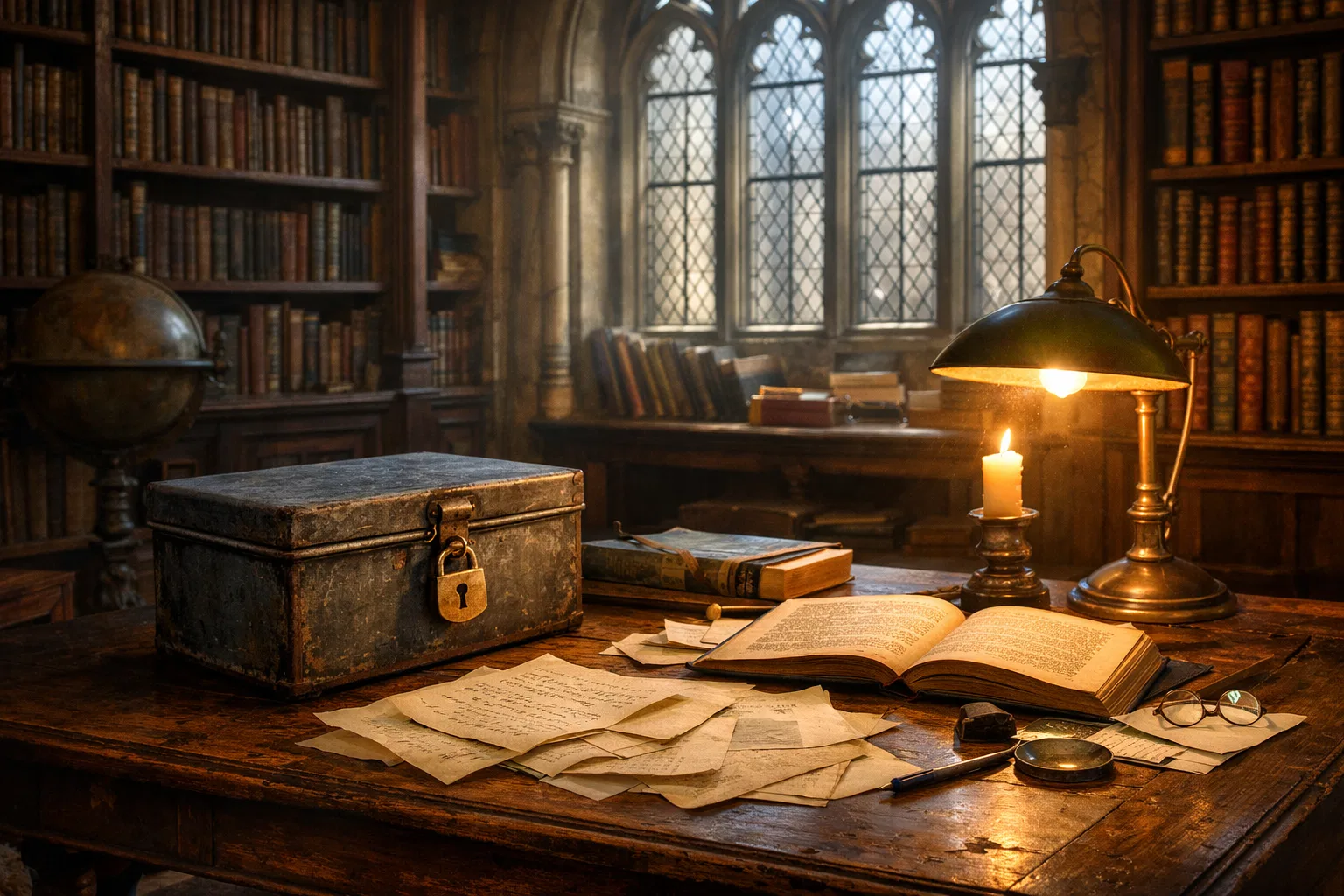
The strongest college-library example is the Cuthbert Shields tradition at The Queen’s College. The college’s own library blog gives the fullest modern institutional account. Shields, a Fellow of Corpus Christi College, died in 1908 and left a key and locked tin box to The Queen’s College Library, with instructions that it was not to be opened for fifty years. In 1958, the embargo expired and the box was opened in the seventeenth-century Upper Library by college officers, revealing bundles of letters in a difficult hand.[The Queen's College, Oxford]queens.ox.ac.ukThe Queen's College, Oxford'If the dead can haunt usThe Queen's College, Oxford'If the dead can haunt us
The ghostly turn comes after the opening. In the Queen’s account, as the party left the library, one witness asked about an old white-haired man who had apparently accompanied them; others had seen no such person. Dark Oxfordshire’s version gives a closely related tradition, adding that a librarian later noticed an unknown figure bending over the box, only for the man to disappear before he could be challenged. The figure was then identified with Shields, and later sightings were said to centre on the upper floors of the library, especially near the place where the box had been opened.[The Queen's College, Oxford]queens.ox.ac.ukThe Queen's College, Oxford'If the dead can haunt usThe Queen's College, Oxford'If the dead can haunt us
What makes this story especially Oxford-like is that the haunting is not built around bloodshed. It is built around paperwork, deferred reading and institutional obedience. The fifty-year delay matters more than any dramatic death scene. Shields had changed his name from Robert Laing and became known for unusual religious and personal beliefs; Dark Oxfordshire summarises the tradition that he believed himself to be the reincarnation of St Cuthbert, while The Queen’s account treats him as an eccentric figure whose afterlife in college memory was bound to a box of papers.[The Queen's College, Oxford]queens.ox.ac.ukThe Queen's College, Oxford'If the dead can haunt usThe Queen's College, Oxford'If the dead can haunt us
This is academic folklore at its purest: a sealed archive becomes a haunted object. The moment the papers are opened, the dead scholar is imagined as returning to supervise the reading of his own remains. The story also shows how a college can preserve a ghost without necessarily endorsing it as fact. The Queen’s blog frames the tale as “legend” and “mystery”, while also grounding it in real archival labels, dates and library spaces. That careful tone is helpful: the historical box existed; the reported apparition belongs to tradition.[The Queen's College, Oxford]queens.ox.ac.ukThe Queen's College, Oxford'If the dead can haunt usThe Queen's College, Oxford'If the dead can haunt us
Cuthbert Shields also fits a wider British haunted-library pattern. Oxford University Press’s blog on haunted libraries notes that St John’s College Library is associated in guidebooks with Archbishop Laud’s headless ghost, but adds an important sceptical detail: library staff had not reported that story in living memory. In other words, Oxford’s libraries can be haunted in print and performance even when the living institution is more cautious.[OUPblog]blog.oup.comhaunted libraries uk great britainhaunted libraries uk great britain
Chapel Legends, Martyrs and Headless Figures
Oxford’s chapel and execution stories carry a darker historical charge than the Cuthbert Shields tale. They tend to arise from religious conflict, civil war and punishment: events that really did shape Oxford and its colleges, even when the apparitions themselves remain legendary.
The most famous headless academic ghost is William Laud at St John’s College. Historically, Laud was a major churchman and political figure: he became Archbishop of Canterbury, served as Chancellor of Oxford University, and was executed in 1645 after years of conflict with Parliament. St John’s College records his importance to the college through its collections and buildings; its history of the Laudian Library says the library was built between 1631 and 1635 by Laud, who had been President of St John’s from 1611 to 1621.[St John's College]sjc.ox.ac.ukSt John's College History of the LibrarySt John's College History of the Library
The ghost story gives that historical figure a grotesque afterlife. Local and guidebook tradition says Laud’s ghost appears in St John’s College Library, sometimes bowling, kicking or otherwise moving his severed head across the floor. Dark Oxfordshire repeats the story and anchors it in Laud’s beheading and burial at St John’s, while Oxford University Press’s haunted-libraries piece points out that the tale is perpetuated by guidebooks rather than by recent staff testimony.[Dark Oxfordshire]darkoxfordshire.co.ukghost of archbishop laudghost of archbishop laud
That distinction matters. Laud’s execution is historical; the head-bowling apparition is folklore. The story’s power comes from the collision between reverence and ridicule. Laud was a serious, controversial religious authority, linked to ceremony, church ornament and royal power. The ghost story turns him into a restless headless figure in an academic library — a symbolic punishment repeated in the very institution he helped shape.
A related headless tale belongs to Exeter College. Dark Oxfordshire recounts a 1916 story attributed to Dr Thomas Wood, a lecturer in choral music, who allegedly opened his college-room door on Halloween and saw a headless figure standing outside with an arm raised as if to knock. Excavations then uncovered a broken seventeenth-century statue, also missing its head, which was later thought likely to represent John Crocker, an Exeter alumnus. The same account notes Richard Holland’s caution that the story should perhaps be taken “with a pinch of salt”, especially because Wood was reportedly on his way to a meeting of a student society called “The Unbelievers Club”.[Dark Oxfordshire]darkoxfordshire.co.ukheadless ghosts at exeter collegeheadless ghosts at exeter college
That Exeter story is almost too neat, which is part of its charm. A headless apparition appears; a headless statue is unearthed; a sceptical society hovers in the background. It reads like a college anecdote shaped for retelling. But it also reveals how Oxford folklore often works: a physical object, a named witness, a precise date and a comic academic setting combine to keep a supernatural story alive without making it fully secure.
The Oxford Martyrs add another layer to the city’s haunted religious geography, though their story is not simply a college ghost tale. Hugh Latimer, Nicholas Ridley and Thomas Cranmer were executed in Oxford during the reign of Mary I, and the Martyrs’ Memorial stands near Balliol College to commemorate them. Oxford ghost tours and local dark-history storytelling often fold such burnings into the city’s atmosphere of martyrdom, punishment and religious trauma, but the historical event should not be confused with a specific, well-attested college apparition unless a particular source makes that claim.[Wikipedia]WikipediaMartyrs' Memorial, OxfordMartyrs' Memorial, Oxford
Civil War Memory at the Edge of College Walls
Some Oxford academic hauntings sit just at the boundary between college space and city space. Dead Man’s Walk, running beside Merton College, is the clearest example. The path has a much older historical association with Oxford’s medieval Jewish community: it is described as the route between the medieval Jewish quarter and burial ground, and its name is bound to that long funerary memory. Later folklore, however, attached one of Oxford’s best-known Civil War ghost stories to the same route.[Wikipedia]WikipediaDead Man's Walk, OxfordDead Man's Walk, Oxford
The ghost is usually identified as Colonel Francis Windebank, a Royalist officer executed in 1645 after the surrender of Bletchingdon Park. Local accounts say his apparition walks Dead Man’s Walk or appears near Merton, sometimes visible only from the knees upward because the ground level has risen since the seventeenth century. Dark Oxfordshire gives two variants: one places his execution outside the town hall against a wall near Merton; another says he was shot in the Fellows’ Garden at Merton College, with his ghost then wandering the garden and nearby college spaces.[Dark Oxfordshire]darkoxfordshire.co.ukcivil war ghosts in dead mans walkcivil war ghosts in dead mans walk
This is a good example of how Oxford college ghosts can absorb broader county history. Windebank’s story begins outside the city at Bletchingdon Park in Oxfordshire, moves into Civil War Oxford, and ends in a haunting attached to a college wall, garden or library. The apparition is not merely a wandering soldier; he becomes part of the university’s built environment because the place of punishment lies against college ground.
The story is also useful because it shows how haunted folklore handles injustice. Windebank is often remembered as a man punished for surrendering, perhaps to protect his wife and child, and his ghost is said to linger because he felt the sentence was unjust. Whether or not the apparition reports can be trusted, the legend keeps alive a moral argument about loyalty, cowardice, chivalry and military discipline during the Civil War.[Dark Oxfordshire]darkoxfordshire.co.ukcivil war ghosts in dead mans walkcivil war ghosts in dead mans walk
A sceptical reading does not spoil the tale; it explains why it works. A place already called Dead Man’s Walk, running beside an old college and town wall, almost invites ghost stories. Later writers have noted that the evocative name itself makes haunting reports unsurprising, and that recent sightings appear sparse. The folklore may therefore tell us as much about place-names, atmosphere and expectation as about any single witness encounter.[Wikipedia]WikipediaDead Man's Walk, OxfordDead Man's Walk, Oxford

Student Stories and the Folklore of Repetition
Oxford’s college ghost stories survive because they are retold in several overlapping worlds. One is the formal or semi-formal world of libraries and college communications. The Queen’s College can publish the Cuthbert Shields story as a library mystery; Balliol College Library can run seasonal ghost-story events; St John’s can preserve Laud’s material legacy in its collections without necessarily promoting the wilder apparition claims.[ox.ac.uk]queens.ox.ac.ukThe Queen's College, Oxford'If the dead can haunt usThe Queen's College, Oxford'If the dead can haunt us
Balliol is especially revealing because its modern tradition is not just about inherited ghosts; it actively creates ghostly academic culture. In 2023, Balliol College Library recorded a Halloween ghost-story evening in the Old Dean’s Room, combining early printed book exhibits, readings of classic stories and a ghost-story competition. In 2025, the library again advertised annual Halloween readings and invited students and Old Members to submit their own chilling tales.[Balliol College, University of Oxford]balliol.ox.ac.ukBalliol College, University of Oxford Ghost stories from the LibraryBalliol College, University of Oxford Ghost stories from the Library
That matters because academic folklore is not only old legend. It is also a practice: gathering in a historic room, dimming the lights, displaying old books, reading stories aloud, and inviting new writing from the college community. A library that preserves old texts becomes a stage for new ghost stories. This is one reason Oxford’s haunted reputation remains alive even when individual apparition reports are thin.
Student journalism and local folklore writing form another layer. The Oxford Student has reported or repeated college haunting traditions, including Trinity College chapel rumours revived after a 1966 incident in which an organist reportedly collapsed and died at a new organ during a service, with the official cause said to be a heart attack but ghostly explanations later growing around it. That is not strong evidence for a haunting, but it is good evidence for how sudden death in a chapel can quickly become supernaturalised in student memory.[The Oxford Student]oxfordstudent.comThe Oxford Student Oxford's most haunted – The Oxford StudentThe Oxford Student Oxford's most haunted – The Oxford Student
Trinity also has a stranger “ghostly twins” tradition. Dark Oxfordshire summarises a story from Richard Holland’s Oxfordshire ghost collection in which a student reportedly saw two similar-looking clerical figures in Kettell Hall and later identified them as Noel and Christopher Chavasse. The identification is awkward: Christopher died in the First World War aged thirty, while Noel was apparently still alive at the time of the reported sighting. The contradiction weakens the identification but strengthens the folkloric interest, because it shows how witnesses or later tellers try to fit an uncanny sight into college biography, even when the fit is poor.[Dark Oxfordshire]darkoxfordshire.co.ukghostly twins at trinity collegeghostly twins at trinity college
Oxford college folklore therefore survives through a chain of preservation: a sighting is told to friends; a student paper gives it seasonal life; a local writer collects it; a guide retells it; a college library reframes another tale through archives and Halloween events. By the time a story reaches a visitor on a night walk, it may carry several kinds of authority at once — historical, institutional, anecdotal and theatrical.
How Credible Are the College Ghost Stories?
The most honest answer is that Oxford’s college ghosts are unevenly evidenced but unusually well anchored. Many have real people, real buildings and real historical tensions behind them. That does not make the apparitions factual, but it does make the stories more interesting than anonymous “grey lady” folklore.
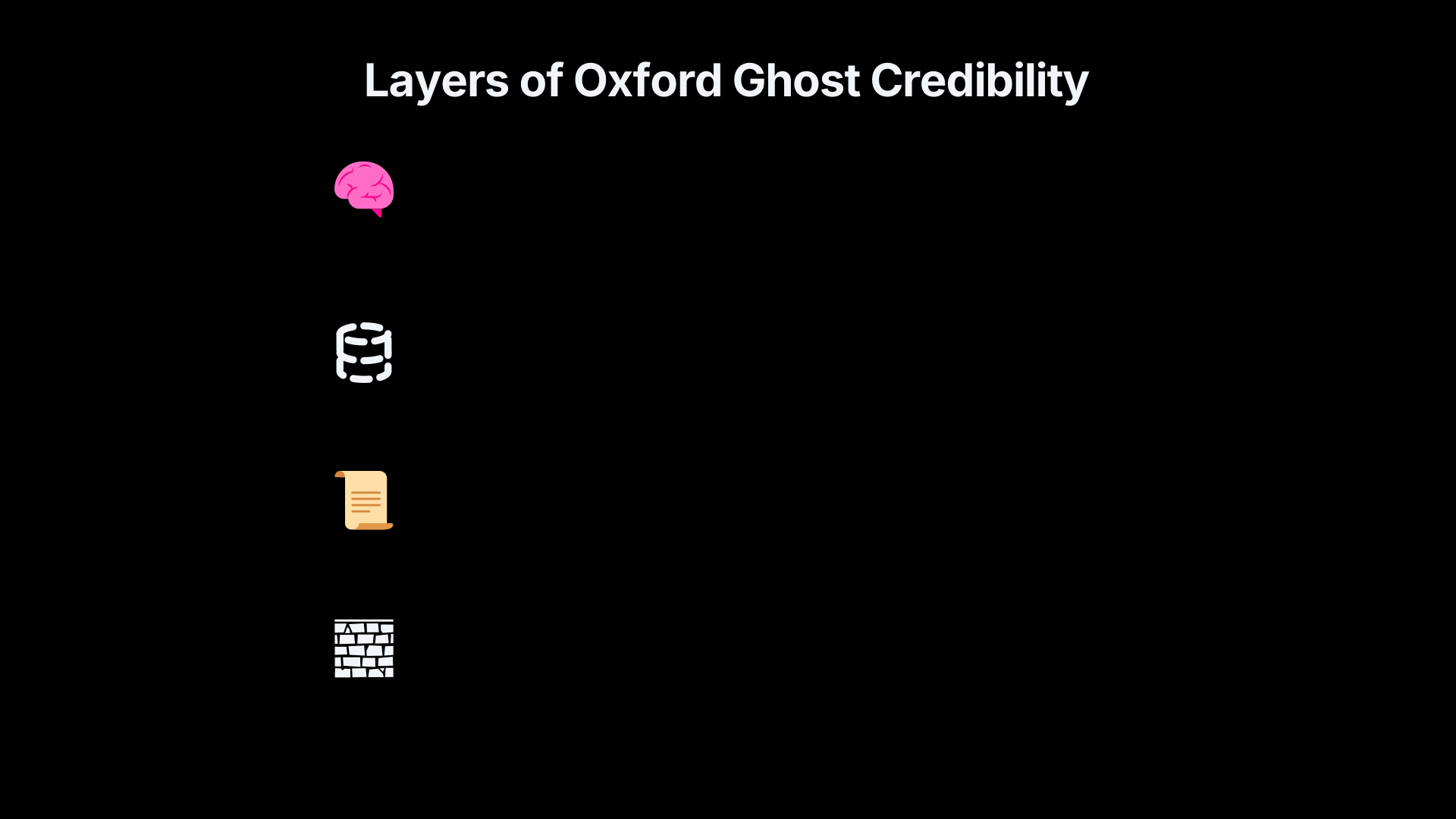
A practical way to judge them is to separate three layers:
The historical layer is often strong. William Laud really was connected to St John’s, really was executed in 1645, and really shaped the college’s built and intellectual legacy. Cuthbert Shields really left a sealed box to The Queen’s College Library, and it really was opened after a fifty-year delay. Dead Man’s Walk really is an old route with deep funerary associations, and the Civil War context around Windebank belongs to Oxfordshire’s seventeenth-century history.[ox.ac.uk]sjc.ox.ac.ukSt John's College History of the LibrarySt John's College History of the Library
The apparition layer is much weaker. Claims of Laud bowling his head, Shields appearing after the box was opened, Windebank walking knee-high beside Merton, or a headless figure knocking at Exeter are reported traditions. They usually come through folklore books, guidebooks, institutional storytelling or local-history websites rather than contemporary signed witness files tested against alternative explanations.[oup.com]blog.oup.comhaunted libraries uk great britainhaunted libraries uk great britain
The meaning layer is the richest. The stories reveal what Oxford finds hard to forget: severed heads, locked papers, disputed religion, executed Royalists, chapels, old libraries and the uneasy presence of the dead in institutions dedicated to memory. This is why the same motifs return again and again. A headless man is not just a shock image; he is a way of remembering execution. A library ghost is not just a shape in the dark; it is a way of imagining that the authors, owners and donors of books have not entirely left the room.
The best sceptical explanations are therefore cultural as well as physical. Old buildings creak, shadows distort, college staircases confuse perspective and night-time expectation can sharpen ordinary sounds into signs. But ghost stories also form where a place already has a narrative charge. A path called Dead Man’s Walk beside an ancient wall does not need much help to feel haunted. A sealed box opened after fifty years in a seventeenth-century library almost writes its own apparition.
Why These Stories Matter in Oxfordshire’s Haunted Map
Within Oxfordshire’s wider haunted landscape, Oxford’s colleges form a distinct “academic folklore” cluster. They are not as openly theatrical as Oxford Castle’s prison stories, not as rural as stone-circle legends, and not as domestic as haunted inns or manor houses. Their atmosphere comes from continuity: colleges that still teach, chapels that still hold services, libraries that still preserve books, and rooms whose past users are recorded with unusual care.
That continuity gives Oxford college ghosts a special public appeal. Visitors can stand near a college gate and hear a story about a beheaded archbishop; students can sit in a library where an eccentric scholar is said to have returned to his papers; alumni can write new ghost stories in rooms lined with old books. The stories work because the academic setting makes the past feel unusually close.
They also show why Oxfordshire’s haunted history should be read carefully rather than swallowed whole. The county’s best ghost stories are rarely simple claims of “this place is haunted”. They are layered traditions, made from history, architecture, memory, repetition and performance. Oxford’s college ghosts ask a subtler question: not whether the dead literally walk the quadrangles, but why scholars, librarians, students and guides keep finding ways to let them back in.
Amazon book picks
Further Reading
Books and field guides related to Do Oxford's Colleges Remember Their Dead?. Use these as the next step if you want deeper reading beyond the article.
The Mammoth Book of Haunted House Stories
Complements interest in haunted buildings and traditions.
eBay marketplace picks
Marketplace Samples
Live-tested eBay searches with available results related to this page.
Endnotes
1.
Source: hab.bodleian.ox.ac.uk
Link:https://hab.bodleian.ox.ac.uk/en/collections/
2.
Source: Wikipedia
Title: Martyrs’ Memorial, Oxford
Link:https://en.wikipedia.org/wiki/Martyrs%27_Memorial%2C_Oxford
3.
Source: Wikipedia
Title: Dead Man’s Walk, Oxford
Link:https://en.wikipedia.org/wiki/Dead_Man%27s_Walk%2C_Oxford
4.
Source: Wikipedia
Title: William Laud
Link:https://en.wikipedia.org/wiki/William_Laud
5.
Source: Wikipedia
Link:https://en.wikipedia.org/wiki/Oxfordshire
6.
Source: Wikipedia
Title: History of Oxfordshire
Link:https://en.wikipedia.org/wiki/History_of_Oxfordshire
7.
Source: wikishire.co.uk
Link:https://wikishire.co.uk/wiki/Oxfordshire
Source snippet
Oxfordshire26 Sept 2024 — The County of Oxford is a shire bound by the River Thames to the south, the Chiltern Hills, stretching...
8.
Source: oxfordofficialwalkingtours.org
Title: oxford ghosts walking tour
Link:https://www.oxfordofficialwalkingtours.org/oxford-ghosts-walking-tour/
9.
Source: queens.ox.ac.uk
Title: The Queen’s College, Oxford’If the dead can haunt us’
Link:https://www.queens.ox.ac.uk/blog/if-the-dead-can-haunt-us/
10.
Source: darkoxfordshire.co.uk
Title: ghosts of queens college library
Link:https://www.darkoxfordshire.co.uk/explore/ghosts-of-queens-college-library/
11.
Source: blog.oup.com
Title: haunted libraries uk great britain
Link:https://blog.oup.com/2017/10/haunted-libraries-uk-great-britain/
12.
Source: sjc.ox.ac.uk
Title: St John’s College History of the Library
Link:https://www.sjc.ox.ac.uk/discover/library/history-library/
13.
Source: darkoxfordshire.co.uk
Title: ghost of archbishop laud
Link:https://www.darkoxfordshire.co.uk/explore/ghost-of-archbishop-laud/
14.
Source: darkoxfordshire.co.uk
Title: headless ghosts at exeter college
Link:https://www.darkoxfordshire.co.uk/explore/headless-ghosts-at-exeter-college/
15.
Source: darkoxfordshire.co.uk
Title: civil war ghosts in dead mans walk
Link:https://www.darkoxfordshire.co.uk/explore/civil-war-ghosts-in-dead-mans-walk/
16.
Source: darkoxfordshire.co.uk
Link:https://www.darkoxfordshire.co.uk/lists/english-civil-war-ghosts-and-hauntings-in-oxfordshire/
17.
Source: balliol.ox.ac.uk
Title: Balliol College, University of Oxford Ghost stories from the Library
Link:https://www.balliol.ox.ac.uk/news/2023/november/ghost-stories-library-video
18.
Source: sjc.ox.ac.uk
Title: St John’s College The Laudian vestments
Link:https://www.sjc.ox.ac.uk/discover/about-college/history/laudian-vestments/
19.
Source: balliol.ox.ac.uk
Title: halloween ghost story competition
Link:https://www.balliol.ox.ac.uk/news/2025/october/halloween-ghost-story-competition
20.
Source: oxfordstudent.com
Title: The Oxford Student Oxford’s most haunted – The Oxford Student
Link:https://www.oxfordstudent.com/2012/11/07/oxfords-most-haunted-2/
21.
Source: darkoxfordshire.co.uk
Title: ghostly twins at trinity college
Link:https://www.darkoxfordshire.co.uk/explore/ghostly-twins-at-trinity-college/
22.
Source: sjc.ox.ac.uk
Title: ox.ac.uk The Chapel and Choir
Link:https://www.sjc.ox.ac.uk/discover/about-college/chapel-and-choir/
23.
Source: sjc.ox.ac.uk
Link:https://www.sjc.ox.ac.uk/discover/about-college/did-you-know/
24.
Source: balliol.ox.ac.uk
Title: evening ghost stories
Link:https://www.balliol.ox.ac.uk/news/2025/november/evening-ghost-stories
25.
Source: balliol.ox.ac.uk
Title: ghost stories library
Link:https://www.balliol.ox.ac.uk/events/2023/november/08/ghost-stories-library
26.
Source: darkoxfordshire.co.uk
Link:https://www.darkoxfordshire.co.uk/explore/?tag=queens-college
27.
Source: darkoxfordshire.co.uk
Link:https://www.darkoxfordshire.co.uk/explore/?tag=dead-mans-walk
28.
Source: gazetteer.org.uk
Link:https://gazetteer.org.uk/place/Oxfordshire
29.
Source: terribletours.co.uk
Link:https://terribletours.co.uk/st-johns-college-headless-bowler-oxford-ghost-story/
30.
Source: oxfordstudent.com
Title: exploring queens abandoned underground library
Link:https://www.oxfordstudent.com/2019/01/15/exploring-queens-abandoned-underground-library/
31.
Source: oxfordstudent.com
Title: oxfords most haunted
Link:https://www.oxfordstudent.com/2010/05/13/oxfords-most-haunted/
32.
Source: oxfordstudent.com
Title: Who wants to hear a ghost story?
Link:https://www.oxfordstudent.com/2012/10/15/who-wants-to-hear-a-ghost-story-oxford-ghost-tour/
33.
Source: wikishire.co.uk
Link:https://wikishire.co.uk/wiki/Oxford
34.
Source: wikishire.co.uk
Title: Great Britain and Ireland
Link:https://wikishire.co.uk/map/
35.
Source: monarchies.fandom.com
Link:https://monarchies.fandom.com/wiki/Oxfordshire
36.
Source: stjohnscollegelibraryoxford.org
Title: William Laud
Link:https://stjohnscollegelibraryoxford.org/tag/william-laud/
37.
Source: britainexpress.com
Link:https://www.britainexpress.com/cities/oxford/st-johns.htm
38.
Source: lewisham.borrowbox.com
Title: ghost stories
Link:https://lewisham.borrowbox.com/ebooks/young-adult/genres/1314/ghost-stories
39.
Source: charlieonthemove.com
Link:https://charlieonthemove.com/en/city-trips/oxford/
40.
Source: spiritedisle.ie
Link:https://spiritedisle.ie/explore/listing/trinity-college/
Additional References
41.
Source: youtube.com
Title: 15 Most Haunted Libraries in the UK | The ghost of the library & Real Hauntings
Link:https://www.youtube.com/watch?v=I5MjYl6Hz1Q
Source snippet
2 Ghost Stories from Balliol College Library 2023...
42.
Source: wrightandwright.co.uk
Link:https://www.wrightandwright.co.uk/studio/journal/a-story-of-stone-libraries-and-the-canterbury-quad
43.
Source: instagram.com
Link:https://www.instagram.com/p/DBZI6YRNO1h/?hl=en
44.
Source: vanbrughhousehotel.co.uk
Link:https://vanbrughhousehotel.co.uk/haunted-oxford-meet-the-ghosts-of-the-university-of-oxford/
45.
Source: facebook.com
Link:https://www.facebook.com/queenscollegeoxford/posts/-haunted-queens-did-you-know-that-the-college-has-its-own-ghostly-legends-one-ta/1347499110083231/
46.
Source: facebook.com
Link:https://www.facebook.com/RealCounties/posts/the-county-of-oxford-is-a-shire-on-the-north-bank-of-the-river-thamesthe-county-/896770025939899/
47.
Source: oxfordshire.gov.uk
Link:https://www.oxfordshire.gov.uk/residents/museums-and-history/oxfordshire-history-centre/start-researching/local-history
48.
Source: thelittlehouseofhorrors.com
Link:https://thelittlehouseofhorrors.com/most-haunted-colleges-and-campuses-in-the-world/
49.
Source: amazon.de
Link:https://www.amazon.de/-/en/Varios-Autores/dp/019423066X?tag=searcht-20
50.
Source: gbmaps.com
Link:https://www.gbmaps.com/free-county-maps/Oxfordshire.php
Topic Tree