Within Haunted Brecknockshire
What Haunted Brecknockshire Before Ghost Tours?
Brecknockshire's older supernatural stories centre on strange lights, goblin figures, chapel roads and journeys through uncanny uplands.
On this page
- Corpse candles and death omens on dark roads
- The Pwca, Puck Valley and Welsh goblin tradition
- Chapels, lakes, passes and the logic of old folklore
Page outline Jump by section
Introduction
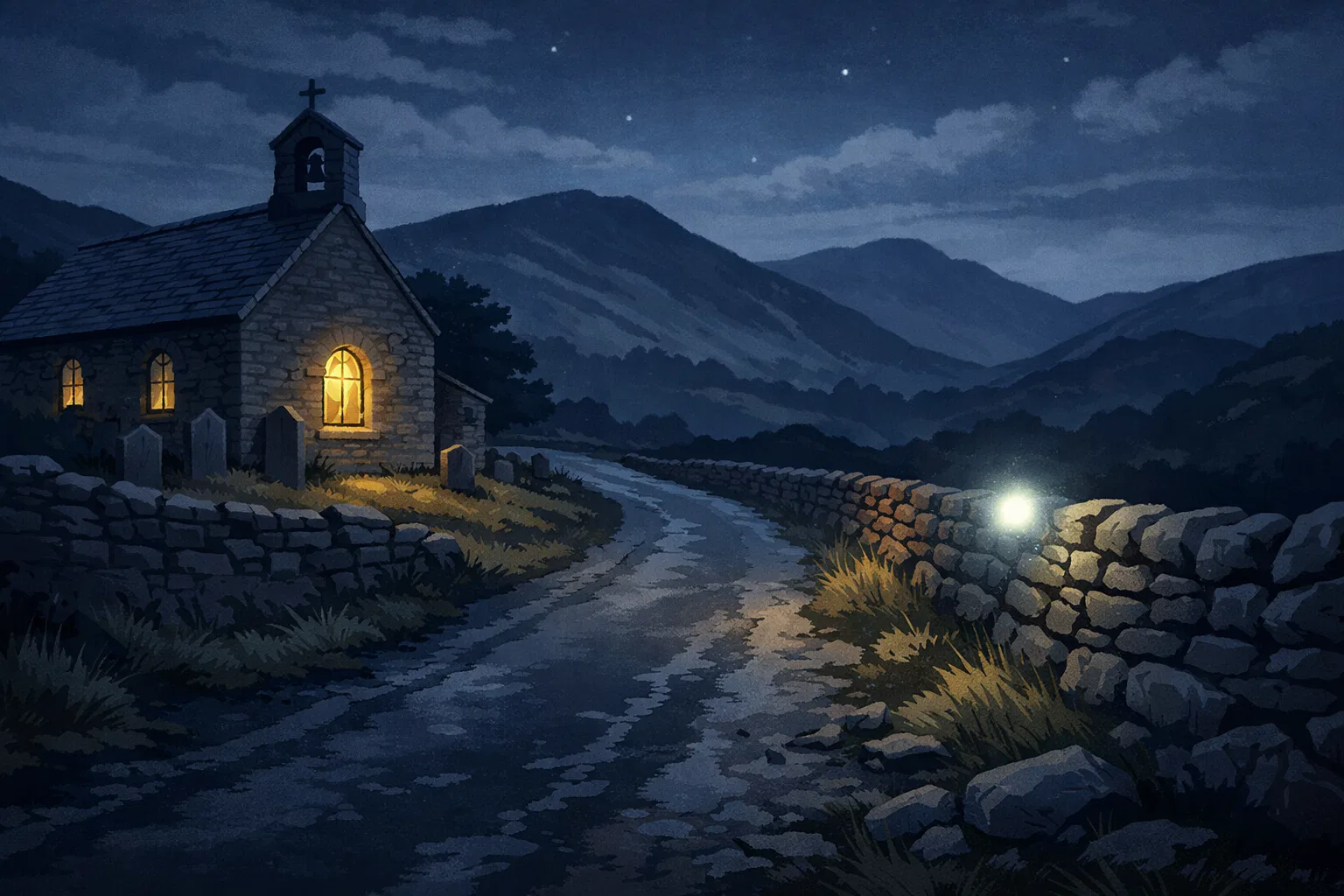
Before Brecknockshire’s haunted reputation gathered around castles, hotels and organised ghost tours, its older supernatural map was made of lights, roads and troublesome beings in the dark. The county’s folklore was not only about seeing the dead, but about being warned before death, misled on lonely paths, or made uneasy by a landscape where chapels, passes, lakes and mountain tracks carried more than practical meaning. The most distinctive older motifs are corpse-candles, the Pwca and stories attached to uncanny journeys through the uplands.
These traditions belong especially well to historic Brecknockshire because the county is inland, rural and mountainous, with Brecon, the Usk valley, the Black Mountains, Fforest Fawr and the central Beacons shaping how people moved, worked, worshipped and told stories. Modern maps often place these places within Powys or Bannau Brycheiniog National Park, but the older county frame still helps explain why the folklore clusters around roads, chapels, valleys and thresholds rather than only named haunted buildings.[Wikishire]wikishire.co.ukBrecknockshire8 Dec 2019 — Brecon County signpost to the south-west of Builth Wells. Brecknockshire is an inland county bounded…
Corpse-candles and death omens on dark roads
The corpse-candle was one of the most important older death omens in Welsh supernatural belief: a small, mysterious light said to appear before a death and trace the route a future funeral would take. In Brecknockshire, this was not just a general Welsh motif imported from elsewhere. The county historian Theophilus Jones, writing in his history of Brecknockshire, described the corpse-candle as a common topic among local peasantry, believed to precede the death of someone nearby and to mark the funeral route from the house of the dead to the church.[Internet Archive]archive.orgOpen source on archive.org.
That detail matters. The corpse-candle was not merely “a ghost light” in the modern sense. It was a map in miniature. It joined a house, a road, a church and a grave before the funeral had happened. To a community living with long walks to parish churches, poor lighting, rough tracks and strong religious habits around burial, the story made death visible in the landscape before it arrived.
Wirt Sikes, the nineteenth-century collector whose British Goblins remains one of the best-known English-language compilations of Welsh folklore, called the corpse-candle among the most picturesque Welsh death omens and said it was widely believed in his day. He described variations: sometimes a blue flame, sometimes a candle held by a ghost, sometimes a light associated with the living person who was soon to die.[Project Gutenberg]gutenberg.orgThe Project Gutenberg eBook of British Goblins: Welsh Folk-lore, Fairy Mythology, Legends and Traditions, by Wirt Sikes…
For Brecknockshire readers, the key point is that Jones’s county history places the belief inside everyday local talk rather than a distant literary tradition. The omen belonged to lanes and churchways, to neighbours discussing illness, and to the old expectation that the final journey to burial followed a known route. The candle’s terror came from its specificity. It did not simply mean “death is near”; it seemed to say where death would travel.
The National Museum Wales archive preserves later oral material from another part of Wales showing how such beliefs worked in practice. In one account, a corpse-candle was described as a light seen on the road, sometimes interpreted through water or a hat placed near water so that the identity of the person in the coffin might be revealed. The teller also explained that the candle’s size could vary with the age of the person expected to die.[Museum Wales]museum.walesWales Folk Tales from Wales | Museum WalesWales Folk Tales from Wales | Museum Wales This is not Brecknockshire evidence, but it helps clarify the mechanism that Jones was recording: the light was read as a sign, route-marker and social warning, not just as a strange glow.
Why corpse-candles suited Brecknockshire’s roads
Corpse-candle folklore makes most sense in a county where travel was difficult and where religious geography shaped ordinary movement. Historic Brecknockshire was bounded by other old counties and broken by uplands, valleys and river routes; even today its older identity is tied to Brecon, Builth Wells, Crickhowell, Hay-on-Wye, Ystradgynlais and the mountain country around them.[Wikishire]wikishire.co.ukBrecknockshire8 Dec 2019 — Brecon County signpost to the south-west of Builth Wells. Brecknockshire is an inland county bounded… In such a setting, a funeral road was not just a line on a map. It was a remembered path through weather, darkness, mud, water and social obligation.
Theophilus Jones’s account connects the corpse-candle directly to the route “from the house of the deceased to the church”.[Internet Archive]archive.orgOpen source on archive.org. That makes the belief different from a floating will-o’-the-wisp story in a marsh. The Brecknockshire version, as preserved by Jones, is tied to the parish and to burial. The supernatural light belongs to the community’s final act for the dead.
This also explains why corpse-candles were frightening without needing a dramatic apparition. A light moving where no person should be walking, especially along a known funeral route, turned the ordinary road into a prophecy. The omen used local knowledge: who lived at the far end of that lane, which church served that district, which track would be taken if a coffin had to be carried.
There are possible natural explanations for some sightings. Folklore writers and later commentators have often compared corpse-candles with will-o’-the-wisp traditions, glow-worms, marsh gas, reflections, lanterns seen at distance, or the way tired travellers misjudge small lights in dark country. But a purely physical explanation misses the cultural work of the story. The light mattered because people already understood roads, water, chapels and burial paths as morally charged places. A flicker in the wrong place could become a message because the route already had meaning.
The Pwca, Puck Valley and Welsh goblin tradition
The Pwca belongs to a different but related layer of Brecknockshire folklore. Rather than warning of death, this being misleads, tricks and unsettles. It is the Welsh cousin of Puck: a goblin or shape-shifting figure associated with mischief, false lights, animal forms and the unsettling of travellers.
Brecknockshire has a particularly strong claim on this tradition through Cwm Pwca, or Puck Valley, in the Clydach gorge area. A discussion of Welsh Puck traditions records Maria Jane Williams’s 1827 note that the goblin was known widely in Wales but “most especially in Breconshire”, where Cwm Pwca formed part of the Vale of Clydach near Merthyr. The same account says that industrial activity was thought to have frightened the pucks away, though they still played tricks by behaving like wills-o’-the-wisp and leading people astray.[British Fairies]britishfairies.wordpress.comBritish Fairiespwca | British FairiesBritish Fairiespwca | British Fairies
That last point is the bridge between the Pwca and corpse-candle material. Both traditions turn light into intention. In the corpse-candle story, the light warns of death and follows a funeral logic. In the Pwca story, the light deceives. It draws a person away from the safe road, towards bog, brake, water or bewilderment.
The Shakespeare connection is famous but should be handled cautiously. Older writers claimed that Cwm Pwca, in the romantic glen of the Clydach in Breconshire, was linked to the imaginative background of A Midsummer Night’s Dream. One account even repeats the tradition that Shakespeare may have received knowledge of Welsh fairies through Richard Price of the Priory, Brecon. But the same source notes that Sir Sidney Lee could not find a firm foundation for the claim that Richard Price was Shakespeare’s friend, and that the theory seems to rest on uncertain ground.[TOTA]tota.worldShakespeare's "Puck" and the Welsh "Pwcca" | TOTAShakespeare's "Puck" and the Welsh "Pwcca" | TOTA
So the useful conclusion is not that Brecknockshire “proves” the origin of Shakespeare’s Puck. It is that Brecknockshire preserved a strong local Pwca tradition vivid enough for later writers to connect it with Puck. The valley name, the Breconshire association and the repeated motif of leading travellers astray all make the tradition locally important even when the Shakespeare theory remains speculative.

What the Pwca did to travellers
The Pwca’s importance lies in behaviour. It does not need a castle, a murder or a named victim. Its story begins when someone is alone, late, tired, crossing rough ground or unsure of the road. The being appears as a trickster force: sometimes animal-like, sometimes fiery, sometimes invisible except through the confusion it causes.
The Cwm Pwca tradition places this figure in a landscape that suited such stories: a gorge, wooded slopes, difficult approaches and routes between upland and industrial districts. Later descriptions of the tradition emphasise that the goblin could behave like a will-o’-the-wisp, leading people away from the path.[British Fairies]britishfairies.wordpress.comBritish Fairiespwca | British FairiesBritish Fairiespwca | British Fairies In practical terms, that is exactly the sort of warning story a rural community would tell about unsafe night travel.
This makes the Pwca different from a simple “evil spirit”. In many Welsh and British fairy traditions, trickster beings are morally unstable rather than wholly demonic. They punish arrogance, mock the unwary, disturb domestic order, and expose how fragile human confidence becomes after dark. The traveller who thinks he knows the road may find himself turned around. The person who follows the light may be made ridiculous or endangered.
That mechanism is why the Pwca belongs on a haunted Brecknockshire page even though it is not always a ghost. Haunted history is not only about dead people appearing in corridors. In older folklore, a place could be haunted by rules: do not follow lights, do not mock warnings, do not assume the road is the same at night as by day.
Chapels, lakes, passes and the logic of old folklore
The older supernatural geography of Brecknockshire is best understood as a network of thresholds. Roads crossed from farm to church, passes carried travellers through exposed mountain country, lakes and pools gathered stories of depth and danger, and chapels marked the boundary between ordinary life and burial memory.
This is why corpse-candles and Pwca tales feel so at home here. Both are movement stories. The corpse-candle moves from house to church. The Pwca moves the traveller away from certainty. Neither tradition depends on a single room where something happened once. They depend on repeated routes: the road to market, the road to chapel, the way over the hill, the dark lane home.
Brecknockshire’s wider landscape strengthens this pattern. The county’s central and southern uplands are part of the Bannau Brycheiniog/Brecon Beacons region, whose peaks, rolling hills and dark skies remain part of its public identity. Pen y Fan rises to 886 metres, and the area’s night skies are recognised as remarkable enough for International Dark Sky Reserve status.[National Parks]nationalparks.ukNational Parks Brecon Beacons Mountains // BreconNational ParksIt gets its name from the Central Bannau (Beacons), which dominate the skyline south of Brecon. They rise to 886 metres at… Such facts do not prove folklore, but they help modern readers understand the conditions in which light-based stories had force: darkness was real, distances were felt, and a small moving glow could command attention.
The chapel element is equally important. In corpse-candle belief, the church or chapel is the destination: the place where the light’s prophecy ends. In Pwca and mountain-road lore, the chapel or settlement may be the safe point the traveller is trying to reach. Between home and chapel lies the dangerous middle space where ordinary rules weaken.
How old are these accounts?
The Brecknockshire corpse-candle evidence is early nineteenth-century in its local printed form, because Theophilus Jones’s county history records the belief as current among local people. The Internet Archive catalogue identifies Jones as the author of A History of the County of Brecknock, with later editions preserving the county-history text and notes.[Internet Archive]archive.orgOpen source on archive.org. His statement does not read like a modern ghost-tour claim; it reads like a county historian noting a belief he considered common among rural people.
The Pwca material is also nineteenth-century in its collected and discussed form, though it clearly claims older roots. Maria Jane Williams’s 1827 correspondence, later discussed by folklore writers, placed the Pwca especially strongly in Breconshire and connected it with Cwm Pwca.[British Fairies]britishfairies.wordpress.comBritish Fairiespwca | British FairiesBritish Fairiespwca | British Fairies Later writers then folded that local tradition into debates about Shakespeare, Welsh fairy lore and the English Puck.[TOTA]tota.worldShakespeare's "Puck" and the Welsh "Pwcca" | TOTAShakespeare's "Puck" and the Welsh "Pwcca" | TOTA
That matters for credibility. These are not modern viral hauntings with a single dramatic photograph or a commercial night tour. They are older folklore motifs preserved through antiquarian writing, county history, oral recollection and later folklore scholarship. Their strength is not evidential proof of supernatural events, but continuity: multiple writers record the same kinds of belief, and the beliefs fit the geography and social habits of rural Wales.
What might explain the lights?
A careful haunted-history page should leave room for both atmosphere and scepticism. Corpse-candles and Pwca-lights may have drawn on real experiences of light in dark country: lanterns glimpsed at distance, reflections in water, phosphorescence, glow-worms, marshy ground, weather effects, or simple misperception on lonely roads. Later folklore discussion often groups corpse-candles with will-o’-the-wisp traditions, where a light appears to move and tempts interpretation.
But explanation is not the same as dismissal. A light on a road becomes a corpse-candle only when a community has a story ready for it. The same glow might be read as a death omen near a churchway, a trickster lure in a valley associated with the Pwca, or a harmless lantern if seen near a farmyard. Folklore is the act of fitting an ambiguous experience into a shared pattern.
In Brecknockshire, the shared pattern was shaped by terrain. Mountain roads and chapel routes gave people a practical reason to fear losing the way. Burial customs gave them a reason to imagine death travelling along known paths. The Pwca supplied a personality for misdirection. The corpse-candle supplied a ritual meaning for unexplained light.
Why these stories still matter
Corpse-candles, the Pwca and mountain-road folklore show a side of haunted Brecknockshire that can be missed if attention goes only to famous buildings. They are not stories of a single room, owner or tragedy. They are stories of how a whole county could feel haunted after dark.
They also explain why Brecknockshire’s older supernatural identity is quieter and stranger than a standard ghost catalogue. Its folklore asks different questions. Who is walking ahead on the road? Why is there a light where no light should be? Is the route to the chapel being shown before a death, or is something trying to lead the traveller away? In these stories, haunting is not a performance inside a destination. It is a pressure in the landscape.
That makes the tradition especially useful for visitors and readers trying to understand the county’s eerie history. Craig-y-Nos Castle and other haunted heritage sites give Brecknockshire a modern ghost-tour presence, but the older folklore belongs to lanes, valleys and uplands. It is the haunted logic of a place where roads mattered, darkness was deep, and the boundary between warning and misdirection could be as small as a moving flame.
Amazon book picks
Further Reading
Books and field guides related to What Haunted Brecknockshire Before Ghost Tours?. Use these as the next step if you want deeper reading beyond the article.

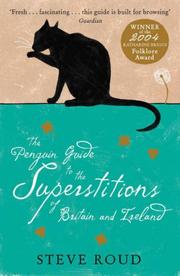
The Penguin Guide to the Superstitions of Britain and Ireland
Excellent background for corpse-candle beliefs.

eBay marketplace picks
Marketplace Samples
Live-tested eBay searches with available results related to this page.
Endnotes
1.
Source: archive.org
Link:https://archive.org/stream/historyofcountyo02jone/historyofcountyo02jone_djvu.txt
2.
Source: gutenberg.org
Title: Project Gutenberg
Link:https://www.gutenberg.org/files/34704/34704-h/34704-h.htm
Source snippet
The Project Gutenberg eBook of British Goblins: Welsh Folk-lore, Fairy Mythology, Legends and Traditions, by Wirt Sikes...
3.
Source: museum.wales
Title: Wales Folk Tales from Wales | Museum Wales
Link:https://museum.wales/collections/folktales/?story=15
4.
Source: tota.world
Title: Shakespeare’s “Puck” and the Welsh “Pwcca” | TOTA
Link:https://www.tota.world/article/2695/
5.
Source: archive.org
Link:https://archive.org/details/b31366727
6.
Source: archive.org
Link:https://archive.org/stream/literaryremainso02pric/literaryremainso02pric_djvu.txt
7.
Source: archive.org
Link:https://archive.org/stream/historyofcountyo01jone/historyofcountyo01jone_djvu.txt
8.
Source: ia800109.us.archive.org
Link:https://ia800109.us.archive.org/21/items/britishgoblinswe00sikerich/britishgoblinswe00sikerich.pdf
9.
Source: archive.org
Link:https://archive.org/details/historyofcountyo02jone
10.
Source: wikishire.co.uk
Link:https://wikishire.co.uk/wiki/Brecknockshire
Source snippet
Brecknockshire8 Dec 2019 — Brecon County signpost to the south-west of Builth Wells. Brecknockshire is an inland county bounded...
11.
Source: nationalparks.uk
Title: National Parks Brecon Beacons Mountains // Brecon
Link:https://www.nationalparks.uk/park/brecon-beacons/
Source snippet
National ParksIt gets its name from the Central Bannau (Beacons), which dominate the skyline south of Brecon. They rise to 886 metres at...
12.
Source: britishfairies.wordpress.com
Title: British Fairiespwca | British Fairies
Link:https://britishfairies.wordpress.com/tag/pwca/
13.
Source: firesidehorror.co.uk
Title: Welsh Folklore
Link:https://www.firesidehorror.co.uk/blog-2/fjyp816xikl0pi5adzl7v4ynq99e8g
14.
Source: Wikipedia
Link:https://en.wikipedia.org/wiki/Brecknockshire
15.
Source: Wikipedia
Link:https://simple.wikipedia.org/wiki/Brecknockshire
16.
Source: books.google.com
Title: British Goblins
Link:https://books.google.com/books/about/British_Goblins.html?id=_iXaAAAAMAAJ
17.
Source: scribd.com
Link:https://www.scribd.com/document/771787745/British-Goblins
18.
Source: britishfairies.wordpress.com
Title: compwcca | British Fairies
Link:https://britishfairies.wordpress.com/tag/pwcca/
19.
Source: britishfairies.wordpress.com
Title: gnomes without frontiers puck the pwcca
Link:https://britishfairies.wordpress.com/2024/10/06/gnomes-without-frontiers-puck-the-pwcca/
20.
Source: wikishire.co.uk
Title: Historic Counties Standard
Link:https://wikishire.co.uk/wiki/Historic_Counties_Standard
21.
Source: whitewolf.fandom.com
Title: Cwm Pwca
Link:https://whitewolf.fandom.com/wiki/Cwm_Pwca
22.
Source: en.wikisource.org
Link:https://en.wikisource.org/wiki/1911_Encyclop%C3%A6dia_Britannica/Breconshire
23.
Source: visitmidwales.co.uk
Link:https://www.visitmidwales.co.uk/things-to-do/bannau-brycheiniog-brecon-beacons-national-park-p1722521
Additional References
24.
Source: youtube.com
Link:https://www.youtube.com/watch?v=mKiafZOX8ao
Source snippet
Corpse Candle Chronicles: Secrets of the Ghostly Harbingers of Death (Ghosts and Folklore of Wales with Mark Rees)...
25.
Source: youtube.com
Link:https://www.youtube.com/watch?v=LUDNf2lZdYw
Source snippet
Monsters and Mythical Creatures of Celtic Mythology and Legends...
26.
Source: youtube.com
Title: Monsters and Mythical Creatures of Celtic Mythology and Legends
Link:https://www.youtube.com/watch?v=-2cGIsDi9vg
Source snippet
"Will O' The Wisp ~ What Really Are They?[https://www.youtube.com/watch?v=3tpWj81eVUQ..."](https://www.youtube.com/watch?v=3tpWj81eVUQ...")...
27.
Source: amazon.de
Link:https://www.amazon.de/History-County-Brecknock-Ii/dp/9354441858?tag=searcht-20
28.
Source: library.wales
Link:https://www.library.wales/discover-learn/digital-exhibitions/books/history-books/a-history-of-the-county-of-brecknock
29.
Source: amazon.de
Link:https://www.amazon.de/History-County-Brecknock-Two-Volumes/dp/1313737232?tag=searcht-20
30.
Source: instagram.com
Link:https://www.instagram.com/p/DXPZJu9jJKp/
31.
Source: beacons-npa.gov.uk
Link:https://beacons-npa.gov.uk/
32.
Source: landscapeswales.org.uk
Link:https://landscapeswales.org.uk/location/brecon-beacons-national-park/
33.
Source: abcounties.com
Link:https://abcounties.com/counties/county-profiles/brecknockshire/
Topic Tree