Within Haunted Cheshire
Why Chester Feels So Haunted
Chester's ghost stories draw power from Roman walls, medieval streets, old inns and the memory of Rowton Heath.
On this page
- The city walls and ghost tour geography
- Rowton Heath and Civil War memory
- The Blue Bell, King Charles' Tower and Chester Castle
Page outline Jump by section
Introduction
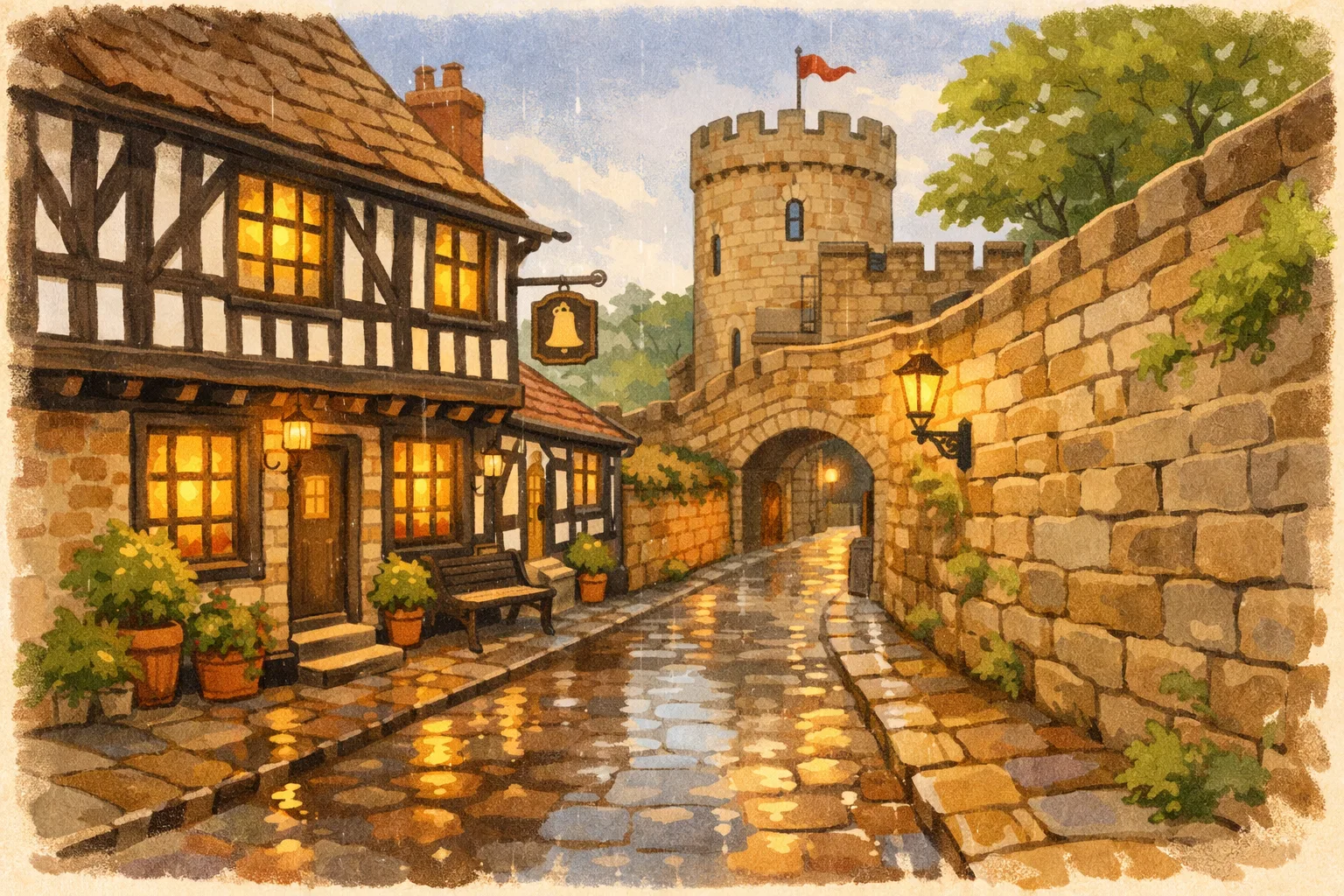
Chester feels haunted because its ghost stories are not scattered curiosities: they sit on a walkable historical stage. The city walls, the Rows, Northgate Street, King Charles’ Tower, the Blue Bell and Chester Castle all give storytellers fixed places where Roman, medieval and Civil War memory can be made visible. The strongest Chester haunting traditions are therefore less about one single “most haunted” building and more about a cityscape where old streets, enclosed passages, cellars, towers and battlefield associations keep inviting eerie interpretation.
The Civil War is the darker thread. On 24 September 1645, the Battle of Rowton Heath took place just outside Chester while the city was under siege, ending in a serious Royalist defeat and leaving Charles I unable to relieve the city. Historic England records Rowton Heath as a registered battlefield of special historic interest, while local and visitor-facing accounts still link the defeat with Phoenix Tower, better known in this context as King Charles’ Tower.[Historic England]historicengland.org.uklist entrylist entry
Why Chester’s streets suit ghost stories
Chester’s haunted reputation begins with geography. Unlike many towns where old buildings survive as isolated fragments, Chester still has an unusually legible historic core: walls, gates, towers, rows, undercrofts, timber-framed buildings and tight medieval street-lines all remain part of an ordinary walk through the city. The walls, towers, gates and posterns of Chester are a scheduled monument, while Cheshire West and Chester Council describes the city walls as a scheduled monument whose full circuit is currently available by means of a temporary walkway near Eastgate Clock.[Historic England]historicengland.org.ukOpen source on historicengland.org.uk.
This matters for haunted history because ghost stories need routes. Chester supplies them naturally. A guide can move a group from the Town Hall and Northgate Street towards the Rows, up to the walls, across to King Charles’ Tower and down towards older inns and castle remains without needing to invent a setting. Chester Ghost Tour markets the city as “Ghost City” and presents the night-time walk as a journey through Chester’s “mysterious and murky past”, while also making the familiar promotional claim that Chester can be counted among Britain’s most haunted cities. That is a tourism claim rather than a measured ranking, but it shows how strongly the city has adopted haunted walking as part of its public identity.[Chester Ghost Tour]chesterghosttour.co.ukOpen source on chesterghosttour.co.uk.
The Rows add another layer. These two-tiered medieval shopping galleries are among Chester’s most distinctive features, with covered first-floor walkways, street-level premises below and many surviving or remembered undercrofts. Visit Cheshire presents the Rows as places where people have traded, eaten, drunk and met across much of the city’s history, while Historic England’s Chester hub notes multiple Row buildings and medieval undercrofts among the city’s protected heritage.[Visit Chester & Cheshire]visitcheshire.comOpen source on visitcheshire.com. For ghost-story purposes, the Rows are almost ideal: they create shadows, changes of level, hidden stairs, half-seen figures above and below the street, and the strong sense that the modern shopper is moving through an older city still layered beneath the present one.
That does not prove any apparition. It does explain why Chester’s ghost stories have survived so well. In many places, a haunting depends on a vanished building or vague “old lane”. In Chester, the route itself is the evidence of age. Even sceptical readers can see why stories would cling to these streets: stonework narrows the view, footsteps echo, undercrofts pull the eye downward, and the elevated walls turn the city into a theatre of looking, remembering and imagining.

The city walls and ghost-tour geography
Chester’s walls are central to the city’s haunted feel because they let visitors walk above the streets while still being inside the story. They are not simply a backdrop. They connect the Roman fortress, medieval defences, Civil War damage, later promenading and modern tourism in one continuous circuit. Historic England’s local Chester pages group the walls with nationally significant remains such as Roman structures, gates, towers and medieval buildings; the council’s wall information also makes clear that the monument needs regular inspection and conservation, reminding visitors that the “old city” is a maintained historic structure rather than a frozen ruin.[Historic England]historicengland.org.ukHistoric England ChesterHistoric England Chester
This elevated circuit shapes Chester’s ghost-tour geography in three ways.[youtube.com]youtube.comChester Ghost TourChester Ghost Tour
First, it gives the city a boundary. Haunted places often work best where there is a threshold: a gate, wall, bridge, stair or cellar door. Chester has all of these in abundance. The four principal medieval gates, later road crossings, towers and wall-walks make the city feel both open and enclosed, which is one reason stories of figures glimpsed, heard or followed work so well here.
Second, the walls create vantage points. A visitor can stand where military observers once looked outward and where modern tourists now look inward across streets, roofs and church towers. This overlap is especially important at King Charles’ Tower, where the traditional story says Charles I watched his army’s defeat at Rowton Heath. Even where historians debate the precise viewing point, the tower still acts as a public memory site.[Chester.com]chester.comOpen source on chester.com.
Third, the walls make Chester’s haunted tourism unusually compact. The city can offer old inns, streets, towers, castle remains and Civil War associations within a short walk. That density helps explain why Chester’s haunted reputation feels stronger than a simple list of ghost stories would suggest. The visitor does not have to travel across the county to feel the pattern; the pattern is underfoot.
Rowton Heath and Civil War memory
The Battle of Rowton Heath is the most important historical shadow behind Chester’s Civil War hauntings. It took place on 24 September 1645, about two miles south-east of Chester, while the city was under siege. The Battlefields Trust describes it as a mainly cavalry action lasting intermittently across the day and spreading over several locations as Royalist forces were forced back towards the city.[Battlefields Trust]battlefieldstrust.comBattlefields Trust Battle of Rowton HeathBattlefields Trust Battle of Rowton Heath
The battle’s emotional power comes from its timing. By September 1645, Charles I’s cause was already in severe trouble after the Royalist defeat at Naseby and the wider collapse of effective Royalist campaigning. The English Heritage battlefield report for Rowton Heath notes that the tide of war was running swiftly against the Royalists by this point.[Historic England]historicengland.org.ukrowton heathrowton heath Chester mattered because it was still a crucial Royalist stronghold and port, linked to hopes of support from Ireland and North Wales. When Charles tried to relieve the city, the battle instead became another decisive setback.
The ghostly interest lies less in a single well-documented battlefield apparition than in the way the battle turns Chester into a place of remembered defeat. Royalist horsemen were driven back towards the city; the fight extended across a wide area; and the final stages came close enough to the walls for the city itself to become part of the theatre of war. The Battlefields Trust says Charles viewed the battlefield from Phoenix Tower on the walls of Chester, while other accounts preserve the same tradition through the later name King Charles’ Tower.[Battlefields Trust]battlefieldstrust.comBattlefields Trust Battle of Rowton HeathBattlefields Trust Battle of Rowton Heath
For a careful haunted-history page, it is important not to overstate the evidence. Rowton Heath is a registered battlefield, not a proven ghost site. Its value in Chester’s haunted landscape is as a memory engine: a real battle, a besieged city, defeated cavalry, a king watching or said to be watching, and later generations turning that visible tower into a place where the past seems to repeat itself. That is exactly the kind of historical pressure from which battlefield hauntings often grow.
The battlefield itself is also awkwardly modern. Historic England’s battlefield material notes that parts of the final area of fighting are now covered by the outskirts of modern Chester, while the Battlefields Trust says the preserved initial stage survives largely as agricultural land but is affected by roads, a railway line and other disturbance.[Historic England]historicengland.org.ukrowton heathrowton heath This partial survival may actually strengthen the haunting mood for some visitors. The battle is both present and missing: officially mapped, historically important, but no longer experienced as a single open seventeenth-century landscape.
King Charles’ Tower and the watched defeat
King Charles’ Tower, also known as Phoenix Tower, is one of Chester’s most powerful haunted-history landmarks because it turns a military defeat into a single viewpoint. Historic England lists Phoenix Tower as a Grade I building on the city walls, and local heritage interpretation describes it as a medieval watchtower at the north-east corner of the walls, with parts dating back to the thirteenth century.[Historic England]historicengland.org.ukHistoric England Phoenix Tower, Non Civil ParishHistoric England Phoenix Tower, Non Civil Parish
The famous inscription says that King Charles stood on the tower on 24 September 1645 and saw his army defeated at Rowton Moor. Heritage Chester repeats this as the association behind the modern name King Charles Tower, while Chester.com similarly presents the belief that Charles watched the defeat from this point.[Heritage Chester]heritagechester.co.ukHeritage Chester King Charles TowerHeritage Chester King Charles Tower The story is simple, visual and emotionally strong: a doomed king above the city, looking out as his last hopes collapse.
There is, however, a historical caution. Some historians have questioned whether Charles watched from this exact tower rather than another vantage point, such as the cathedral tower. That uncertainty does not make the tradition worthless. It changes how it should be read. The tower is not valuable to haunted Chester because every detail of the plaque can be treated as courtroom evidence; it is valuable because the city has repeatedly used this tower to remember the siege, the battle and the collapse of Royalist hope.
This is where folklore and urban memory meet. Ghost stories often favour the place that makes a historical trauma easiest to picture. King Charles’ Tower gives Chester a dramatic image: the city walls, the battlefield beyond, the king’s gaze, and a defeat that could not be undone. Whether a particular apparition is claimed there or not, the tower helps make the Civil War feel like a presence rather than a paragraph in a history book.
The Blue Bell and the haunted inn tradition
The Blue Bell on Northgate Street is one of Chester’s most useful examples of how a building becomes haunted through the combination of age, intimacy and a named story. Historic England’s Chester hub identifies numbers 63 and 65 Northgate Street, formerly the Blue Bell, as a notable medieval building; other architectural summaries describe it as a Grade I former inn and one of Chester’s important surviving medieval domestic structures.[Historic England]historicengland.org.ukHistoric England ChesterHistoric England Chester
The building’s own history page preserves the haunting claim most closely associated with it: a resident ghost named Henrietta. According to the Blue Bell’s account, the building was used during the English Civil War by Loyalist forces and their families, and Henrietta’s story is tied to that wartime setting.[The Blue Bell Chester]thebluebellchester.comThe Blue Bell Chester Our HistoryThe Blue Bell Chester Our History A Cheshire Live feature from 2013 gives the more romantic version of the legend: Henrietta is said to have waited at the window for more than 350 years, hoping for her lover’s return.[Cheshire Live]cheshire-live.co.ukCheshire Live Portrait of a love that has never diedCheshire Live Portrait of a love that has never died
The story has the features of classic inn folklore. It is emotionally direct, attached to a visible window or room, and rooted in separation caused by war. It also fits the building’s public-facing identity: a very old inn, a narrow street, timber, beams, changing uses and a named female apparition. Readers should treat Henrietta as a local legend rather than a documented historical person unless stronger archival evidence is produced. Even so, the legend is revealing. It shows how Chester’s Civil War memory is not only battlefield memory; it also enters domestic and commercial spaces, turning the waiting woman at the window into a softer, sadder counterpart to the king watching from the tower.
The Blue Bell also shows why old inns are so important in Cheshire’s haunted map. Inns gather strangers, rumours and departures. They sit between public and private life. In Chester, that ordinary inn folklore is intensified by the city’s siege history: soldiers lodged nearby, families feared news from outside the walls, and later storytellers had a ready explanation for a melancholy figure who never left.
Chester Castle and modern ghost evidence
Chester Castle brings a different kind of haunting into the picture: not a long-preserved romantic legend, but a recent institutional ghost story attached to a major historic site. English Heritage describes Chester Castle’s 13th-century Agricola Tower as the first stone gateway to a castle founded by William the Conqueror in 1070, with the chapel of St Mary de Castro and wall paintings dating from around 1240.[English Heritage]english-heritage.org.ukEnglish Heritage Chester Castle: Agricola Tower and Castle WallsEnglish Heritage Chester Castle: Agricola Tower and Castle Walls Its official history adds that the Flag Tower and Agricola Tower are key survivors from Ranulf de Blondeville’s rebuilding of the defences in stone from about 1189.[English Heritage]english-heritage.org.ukOpen source on english-heritage.org.uk.
In 2025, English Heritage publicised a strange CCTV image from Chester Castle. Its account says security cameras recorded a mysterious figure in front of the main gates, directly where the medieval gatehouse used to be; when a security guard investigated, the area was empty and his usually fearless dog refused to enter.[English Heritage]english-heritage.org.ukOpen source on english-heritage.org.uk. The Guardian reported the same episode as part of a wider set of eerie accounts from English Heritage sites, noting that the guard felt intensely watched, found no intruder and discovered no sign of forced entry.[The Guardian]theguardian.comMichael Carter of English Heritage sees these stories not merely as spooky myths, but as part of a cultural practice of storytelling that…
This is one of the more interesting Chester cases because it sits between modern evidence and seasonal storytelling. CCTV gives the account a contemporary hook, but it does not settle the explanation. A camera image can be affected by lighting, weather, movement, distance, lens distortion, compression or ordinary human presence. English Heritage did not present the image as proof of a ghost; its wider framing placed such reports within a long tradition of supernatural storytelling around historic sites.[The Guardian]theguardian.comMichael Carter of English Heritage sees these stories not merely as spooky myths, but as part of a cultural practice of storytelling that…
For Chester’s haunted streets, the castle case matters because it refreshes the city’s ghost map. The story is not merely an old tale repeated by guides; it is a recent report from a managed heritage site, connected to the medieval gatehouse area and amplified through national coverage. It shows how haunted Chester continues to be made in the present, not only inherited from the past.
How credible are Chester’s hauntings?
The credible core of Chester’s haunted reputation is historical, architectural and folkloric, not evidential proof of ghosts. The city genuinely has Roman and medieval remains, a major walled historic centre, protected buildings, a registered Civil War battlefield nearby, an old inn tradition, and recent institutional reports of unexplained experiences. Those are strong grounds for a serious haunted-history page. They are not the same as proof that apparitions exist.
The strongest claims are the place-based ones. King Charles’ Tower is a real Grade I structure with a long public association with Rowton Heath. Rowton Heath is a registered battlefield. The Blue Bell is a real medieval building with a named resident-ghost tradition. Chester Castle is an English Heritage site where a recent CCTV-linked account was publicised and reported.[historicengland.org.uk]historicengland.org.ukHistoric England Phoenix Tower, Non Civil ParishHistoric England Phoenix Tower, Non Civil Parish These claims are worth discussing because their locations and historical contexts can be checked.
The weaker claims are the precise supernatural details. Henrietta’s identity, the exact nature of the Chester Castle figure, and any broader claim that Chester is objectively “one of Britain’s most haunted cities” are harder to verify. They belong to tourism, witness testimony, local memory and folklore. That does not make them meaningless. It means they should be read as stories people tell about old places, grief, war, fear and continuity.
Sceptical explanations also deserve space. Chester’s architecture encourages misperception: dim passages, uneven levels, echoing stone, crowds thinning after dark, old glass, CCTV glare, weather, reflections and expectation can all turn ordinary stimuli into eerie experiences. Ghost tours also prime visitors to notice shadows and sounds as possible signs of haunting. Yet scepticism does not remove the value of the stories. In Chester, the interesting question is often not “is this ghost real?” but “why did this particular place become the right place for this particular story?”
What makes Chester distinct within haunted Cheshire
Within Cheshire, Chester is the county’s densest haunted setting. Other places in the historic county have strong individual legends: old halls, country houses, roads, ruins, churches and battlefield memories. Chester is different because it gathers many of the county’s haunting ingredients into one walkable urban landscape. It has old inns, Roman and medieval street patterning, towers, castle remains, Civil War memory and an active ghost-tour economy.
That density explains why Chester should be treated as a pillar of Cheshire’s haunted history rather than just another stop on a ghost map. The Blue Bell links inn folklore to Civil War separation. King Charles’ Tower links the walls to Rowton Heath. Chester Castle brings medieval architecture into modern ghost reporting. The Rows and undercrofts give the whole city a layered, below-and-above quality that makes even ordinary movement feel historical.
The Civil War shadow is the thread that gives this page its distinct shape. Chester’s haunted streets are not only picturesque; they are streets within a city that endured siege, watched troops fall back and preserved a tradition of royal defeat on its walls. Rowton Heath may lie outside the tight city-centre route, but its memory returns to Chester through the tower, the old inns and the stories told after dark. That is why Chester feels so haunted: the city does not merely display history. It gives the impression that history is still looking back.
Amazon book picks
Further Reading
Books and field guides related to Why Chester Feels So Haunted. Use these as the next step if you want deeper reading beyond the article.
Haunted Britain and Ireland
Places Chester among Britain's best-known haunted destinations.
The Penguin Guide to the Superstitions of Britain and Ireland
Provides wider context for supernatural beliefs found in Chester.
Chester: A History
Explains the Roman, medieval and Civil War setting behind Chester's ghost stories.
eBay marketplace picks
Marketplace Samples
Live-tested eBay searches with available results related to this page.



Endnotes
1.
Source: chester.com
Link:https://chester.com/listing/king-charles-tower/
2.
Source: history.com
Title: Gettysburg: Ghost Stories From the Civil War Battlefield
Link:https://www.history.com/articles/gettysburg-battlefield-ghosts
3.
Source: chester.com
Link:https://chester.com/listing/chester-castle-agricola-tower-and-castle-walls/
4.
Source: historicengland.org.uk
Title: list entry
Link:https://historicengland.org.uk/listing/the-list/list-entry/1000031
5.
Source: battlefieldstrust.com
Title: Battlefields Trust Battle of Rowton Heath
Link:https://www.battlefieldstrust.com/resource-centre/battleview.asp?BattleFieldId=38
6.
Source: historicengland.org.uk
Link:https://historicengland.org.uk/listing/the-list/list-entry/1006785
7.
Source: chesterghosttour.co.uk
Link:https://chesterghosttour.co.uk/
8.
Source: visitcheshire.com
Link:https://visitcheshire.com/the-rows
9.
Source: historicengland.org.uk
Title: Historic England Chester
Link:https://historicengland.org.uk/local/locations/chester/
10.
Source: heritagechester.co.uk
Title: Heritage Chester King Charles Tower
Link:https://www.heritagechester.co.uk/event-details/king-charles-tower
11.
Source: historicengland.org.uk
Title: rowton heath
Link:https://historicengland.org.uk/content/docs/listing/battlefields/rowton-heath/
12.
Source: historicengland.org.uk
Title: Historic England Phoenix Tower, Non Civil Parish
Link:https://historicengland.org.uk/listing/the-list/list-entry/1376157
13.
Source: thebluebellchester.com
Title: The Blue Bell Chester Our History
Link:https://thebluebellchester.com/our-history/
14.
Source: cheshire-live.co.uk
Title: Cheshire Live Portrait of a love that has never died
Link:https://www.cheshire-live.co.uk/news/chester-cheshire-news/portrait-love-never-died-5297901
15.
Source: english-heritage.org.uk
Title: English Heritage Chester Castle: Agricola Tower and Castle Walls
Link:https://www.english-heritage.org.uk/visit/places/chester-castle-agricola-tower-and-castle-walls/
16.
Source: english-heritage.org.uk
Link:https://www.english-heritage.org.uk/visit/places/chester-castle-agricola-tower-and-castle-walls/history/
17.
Source: english-heritage.org.uk
Link:https://www.english-heritage.org.uk/about/search-news/english-heritage-unveils-mysterious-cctv-image-and-haunting-new-tales-from-historic-sites/
18.
Source: theguardian.com
Link:https://www.theguardian.com/uk-news/2025/oct/24/ghost-stories-english-heritage-faceless-figure-chester-castle
Source snippet
Michael Carter of English Heritage sees these stories not merely as spooky myths, but as part of a cultural practice of storytelling that...
19.
Source: wired-gov.net
Title: English Heritage unveils mysterious CCTV image and haunting new
Link:https://www.wired-gov.net/wg/news.nsf/articles/english%2Bheritage%2Bunveils%2Bmysterious%2Bcctv%2Bimage%2Band%2Bhaunting%2Bnew%2Btales%2Bfrom%2Bhistoric%2Bsites%2B24102025152500?open=
20.
Source: youtube.com
Title: Chester Castle
Link:https://www.youtube.com/watch?v=zD_P3xiUktY
21.
Source: cheshire-live.co.uk
Title: Inside Chester’s historic King Charles Tower that sits atop the city walls
Link:https://www.cheshire-live.co.uk/news/chester-cheshire-news/inside-chesters-historic-king-charles-25202360
22.
Source: youtube.com
Title: Battle Of Rowton Heath
Link:https://www.youtube.com/watch?v=8xpbu8E0xqc
23.
Source: youtube.com
Title: Chester Ghost Tour
Link:https://www.youtube.com/watch?v=m0gBDB5vNJM
24.
Source: historicengland.org.uk
Title: [PDF] National Heritage Protection Plan
Link:https://historicengland.org.uk/research/results/reports/7008/HistoricRailwayBuildingsandStructuresoverviewofdevelopmentpressureandreviewofsignificanceVol2
25.
Source: tripadvisor.com
Title: Chester Ghost Tours
Link:https://www.tripadvisor.com/Attraction_Review-g186233-d10197263-Reviews-Chester_Ghost_Tours-Chester_Cheshire_England.html
26.
Source: tripadvisor.com
Title: Phoenix Tower
Link:https://www.tripadvisor.com/Attraction_Review-g186233-d20895218-Reviews-Phoenix_Tower-Chester_Cheshire_England.html
27.
Source: tripadvisor.com
Title: Chester Castle
Link:https://www.tripadvisor.com/Attraction_Review-g186233-d12804461-Reviews-Chester_Castle-Chester_Cheshire_England.html
28.
Source: historicengland.org.uk
Title: [PDF] The Brewing Industry
Link:https://historicengland.org.uk/images-books/publications/brewing-industry/bhs-brewing-ind-shier/
29.
Source: mapservices1.historicengland.org.uk
Title: HLE A4L No Grade|HLE A3L No Grade
Link:https://mapservices1.historicengland.org.uk/printwebservicehle/StatutoryPrint.svc/32/HLE_A4L_NoGrade%7CHLE_A3L_NoGrade.pdf
30.
Source: historicengland.org.uk
Title: 100Industrial Places Reviewofthelistingof Industrialbuildings appendix
Link:https://historicengland.org.uk/research/results/reports/8775/100IndustrialPlaces_ReviewofthelistingofIndustrialbuildings-appendix
31.
Source: historicengland.org.uk
Title: [PDF] CONSERVATION BULLETIN INDEX
Link:https://historicengland.org.uk/images-books/publications/conservation-bulletin-index/conservationbulletin1-56index/
32.
Source: historicengland.org.uk
Title: [XLS] Cheshire Building Stones
Link:https://historicengland.org.uk/content/docs/advice/building-stones-england/bse-excel-cheshire/
33.
Source: historicengland.org.uk
Title: [XLS] C20 Conservation Areas Report
Link:https://historicengland.org.uk/content/docs/planning/c20-conservation-areas-appdx5-2-xlsx/
34.
Source: historicengland.org.uk
Title: [XLS] Shropshire Building Stones
Link:https://historicengland.org.uk/content/docs/advice/building-stones-england/bse-excel-shropshire/
35.
Source: historicengland.org.uk
Link:https://historicengland.org.uk/listing/the-list/list-entry/1010959
36.
Source: historicengland.org.uk
Title: Grosvenor Park, Non Civil Parish
Link:https://historicengland.org.uk/listing/the-list/list-entry/1001577
37.
Source: historicengland.org.uk
Title: Overleigh Road Cemetery, Non Civil Parish
Link:https://historicengland.org.uk/listing/the-list/list-entry/1001607
38.
Source: historicengland.org.uk
Link:https://historicengland.org.uk/listing/the-list/list-entry/1001637
39.
Source: historicengland.org.uk
Title: Congleton Park
Link:https://historicengland.org.uk/listing/the-list/list-entry/1001530
40.
Source: historicengland.org.uk
Title: The Plantation Garden, Norwich, Non Civil Parish
Link:https://historicengland.org.uk/listing/the-list/list-entry/1001012
41.
Source: historicengland.org.uk
Title: The Top Rank Club (Former Essoldo Cinema)
Link:https://historicengland.org.uk/listing/the-list/list-entry/1240376
42.
Source: historicengland.org.uk
Title: Highgate Cemetery, Non Civil Parish
Link:https://historicengland.org.uk/listing/the-list/list-entry/1000810
43.
Source: historicengland.org.uk
Link:https://historicengland.org.uk/listing/the-list/list-entry/1449625
44.
Source: historicengland.org.uk
Title: Newnham Paddox, Monks Kirby
Link:https://historicengland.org.uk/listing/the-list/list-entry/1001191
45.
Source: historicengland.org.uk
Link:https://historicengland.org.uk/education/schools-resources/educational-images/agricola-tower-at-chester-castle-chester-cheshire-ioe01-03254-07
46.
Source: Wikipedia
Title: Chester Castle
Link:https://en.wikipedia.org/wiki/Chester_Castle
47.
Source: Wikipedia
Title: Battle of Rowton Heath
Link:https://en.wikipedia.org/wiki/Battle_of_Rowton_Heath
48.
Source: opendata-historicengland.hub.arcgis.com
Link:https://opendata-historicengland.hub.arcgis.com/datasets/historicengland%3A%3Anational-heritage-list-for-england-nhle/about?layer=6
49.
Source: historic-uk.com
Title: The Battle of Rowton Heath
Link:https://www.historic-uk.com/HistoryMagazine/DestinationsUK/The-Battle-of-Rowton-Heath/
50.
Source: battlefieldstrust.com
Link:https://www.battlefieldstrust.com/resource-centre/printer/battleview.asp?BattleFieldId=38&Trail=Home+%26gt%3BThe+Civil+Wars%26nbsp%3B%26gt%3BThe+Campaign+for+Chester%26nbsp%3B%26gt%3BThe+Battle+of+Battle+of+Rowton+Heath
51.
Source: chester.shoutwiki.com
Title: Northgate Street
Link:https://chester.shoutwiki.com/wiki/Northgate_Street
52.
Source: thebluebellchester.com
Title: History Hall
Link:https://thebluebellchester.com/history-hall/
53.
Source: crazyaboutcastles.com
Link:https://crazyaboutcastles.com/english-castles/chester-castle/
54.
Source: iwm.org.uk
Title: Battle of Rowton
Link:https://www.iwm.org.uk/memorials/item/memorial/66436
55.
Source: deadlive.co.uk
Link:https://www.deadlive.co.uk/blue-bell-chester-history-ghost-stories/
56.
Source: heritagegateway.org.uk
Link:https://www.heritagegateway.org.uk/gateway/chr/herdetail.aspx?crit=&ctid=90&id=4718
57.
Source: recclesia.com
Title: Chester Castle
Link:https://recclesia.com/our-work/chester-castle
Additional References
58.
Source: cheshirewestandchester.gov.uk
Link:https://www.cheshirewestandchester.gov.uk/residents/planning-and-building-control/total-environment/cheshire-historic-environment-record
59.
Source: discoverchester.co.uk
Link:https://discoverchester.co.uk/Rows.html
60.
Source: thehotelchester.co.uk
Link:https://www.thehotelchester.co.uk/ghost-tours-in-chester-why-should-you-explore-the-citys-haunted-history/
61.
Source: voicemap.me
Link:https://voicemap.me/tour/chester/haunted-chester-a-spooky-stroll-around-the-roman-walled-city/sites
62.
Source: daisyjoy.co.uk
Link:https://www.daisyjoy.co.uk/is-chester-the-most-haunted-city-in-the-uk/
63.
Source: legislation.gov.uk
Link:https://www.legislation.gov.uk/uksi/1993/493/made
64.
Source: facebook.com
Link:https://www.facebook.com/groups/1706748102970911/posts/3005318809780494/
65.
Source: aubreyresearch.com
Link:https://www.aubreyresearch.com/monuments/the-walls-towers-gates-and-posterns-of-the-city-of-chester-1006785
66.
Source: thehotelchester.co.uk
Link:https://www.thehotelchester.co.uk/why-should-you-not-miss-the-chester-rows/
67.
Source: kids.kiddle.co
Link:https://kids.kiddle.co/Phoenix_Tower%2C_Chester
Topic Tree