Within Haunted Londonderry
Did a Disturbed Grave Haunt St Columb's?
The story of Bishop Higgins turns church restoration, locked galleries and organ music into one of Derry's most memorable hauntings.
On this page
- Who Bishop Higgins was
- The 1867 disturbance story
- Footsteps, organ music and church folklore
Page outline Jump by section
Introduction
St Columb’s Cathedral, inside Derry’s historic walls, carries one of County Londonderry’s best-known church-haunting traditions: the story that the restless presence of Bishop William Higgin, usually called Bishop Higgins in ghost accounts, followed the disturbance of his grave during nineteenth-century restoration work. The legend is not a proven haunting, but a compact and memorable piece of local folklore. It joins three elements that make a cathedral ghost story especially powerful: a moved burial, locked upper spaces, and unexplained music from an organ. Tourism Ireland summarises the tradition as beginning after the bishop’s grave was disturbed in 1867, followed by reports of footsteps in a locked gallery and an organ sounding before power had been switched on.[Ireland.com]ireland.comTales from Ireland’s crypts | Ireland.comTales from Ireland’s crypts | Ireland.com
The story matters because it is not merely a generic “haunted church” tale. It is tied to a real building, a real bishop who died in Derry in 1867, and a cathedral whose fabric has repeatedly been altered, repaired and restored. St Columb’s is one of the oldest surviving buildings in the walled city, built in 1633 and deeply associated with Derry’s religious, civic and siege history.[National Churches Trust]nationalchurchestrust.orgOpen source on nationalchurchestrust.org. The disturbed bishop legend turns that architectural history into something more intimate: a story about what happens when a sacred place changes, and when the dead are thought not to approve.
Where the legend is set
St Columb’s Cathedral stands on London Street within Derry’s walls, in the historic county of Londonderry. The National Churches Trust places it in Derry/Londonderry, County Derry, gives its address as London Street, and notes that it was constructed between 1628 and 1633 for the Honourable The Irish Society, less than two decades after the Plantation of Ulster.[National Churches Trust]nationalchurchestrust.orgOpen source on nationalchurchestrust.org. Visit Derry describes it as situated inside the city walls and calls it the city’s most historic building, holding Siege artefacts and the original lock and keys of the City Gates.[Visit Derry]visitderry.comVisit Derry St Columb's Cathedral is the city's most historic buildingVisit DerrySt Columb's Cathedral is the city's most historic building - Visit Derry…
That setting is important to the ghost story. St Columb’s is not a remote ruin but a working Church of Ireland cathedral at the civic and symbolic heart of Derry. Its spire, bells, memorials, flags, old stonework and enclosed galleries all give the legend a strong sense of place. The National Churches Trust also describes the cathedral as perched on a commanding hill and closely bound up with the Siege of Derry in 1688–89, when the spire was damaged and its lead was used for musket balls.[National Churches Trust]nationalchurchestrust.orgOpen source on nationalchurchestrust.org.
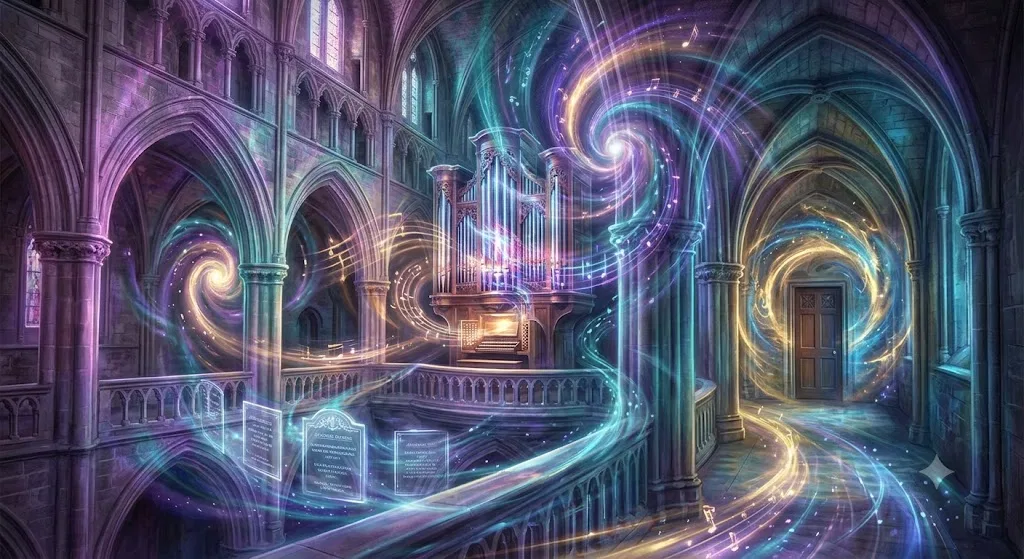
For a haunted-history reader, this makes St Columb’s different from a story that could be moved anywhere. The supposed sounds are not just “noises in a church”. They are said to happen in a locked gallery and around the organ of a building already loaded with public memory. The legend works because the cathedral is both sacred and civic: a place of worship, burial, commemoration and city identity.
Who Bishop Higgin was
The figure behind the haunting was William Higgin, though the ghost tradition often gives his name as William Higgins. Trinity College Cambridge’s archival authority record identifies him as “Higgin, William (1793–1867), Bishop of Derry and Raphoe”.[Trinity College Manuscripts]trin-2.maxarchiveservices.co.ukhiggin william 1793 1867 bishop of derry and raphoehiggin william 1793 1867 bishop of derry and raphoe A nineteenth-century biographical entry gives: he was born at Greenfield, Lancaster, in 1793, educated at Lancaster and Manchester grammar schools and at Trinity College, Cambridge, and graduated in 1817. His Church of Ireland career included service as chaplain to the Richmond Penitentiary, chaplain to the Magdalen Asylum, rector of Roscrea, vicar-general of Killaloe, dean of Limerick, bishop of Limerick from 1849, and bishop of Derry from 1853.[McClintock & Strong Cyclopedia]biblicalcyclopedia.comMc Clintock & Strong Cyclopedia Higgins, William, DdMc Clintock & Strong Cyclopedia Higgins, William, Dd
The same biographical source records that he died at Derry on 12 July 1867.[McClintock & Strong Cyclopedia]biblicalcyclopedia.comMc Clintock & Strong Cyclopedia Higgins, William, DdMc Clintock & Strong Cyclopedia Higgins, William, Dd That date is striking because the haunting tradition also fixes the grave disturbance to 1867. This does not by itself prove the folklore: it simply means the legend has attached itself to a genuine episcopal death in the right place and period. The “disturbed bishop” is not an invented gothic character, but a remembered churchman whose burial became folded into local supernatural storytelling.
The slight name difference is worth noticing. Archival and biographical records use “Higgin”, while popular ghost accounts tend to say “Higgins”. That is common in oral and tourist folklore, where names are regularised, simplified or repeated in the form that sounds most familiar. It does not destroy the story’s value, but it does remind us to separate the documented person from the later legend built around him.
The 1867 disturbance story
The central claim is simple: during restoration or renovation work at St Columb’s, Bishop Higgin’s grave was disturbed or moved, and strange activity followed. Tourism Ireland’s version says the cathedral is “said to be haunted” by William Higgins ever since his grave was disturbed in 1867, and gives two main examples: footsteps crossing a locked gallery and an organ producing sound before the power was switched on.[Ireland.com]ireland.comTales from Ireland’s crypts | Ireland.comTales from Ireland’s crypts | Ireland.com History Hit gives a similar summary, saying that renovations in 1867 disturbed the former bishop’s grave, that the tomb was moved inside the cathedral, and that workers then heard footsteps in the locked gallery, saw alleged photographic apparitions, and heard the organ sound without anyone nearby.[History Hit]historyhit.comOpen source on historyhit.com.
A locally flavoured account on Twisted Limbs and Crooked Branches gives a related version: Bishop Higgins was originally buried outside the cathedral, but after the extensive restoration of 1867 his tomb ended up inside the building; in completing the renovation, his resting place was “apparently disturbed”, giving rise to the folklore that he still frequents the church.[TWISTED LIMBS & CROOKED BRANCHES]twistedlimbsandcrookedbranches.comTWISTED LIMBS & CROOKED BRANCHESSt. Columb's Cathedral – “My Granny's Church”!TWISTED LIMBS & CROOKED BRANCHESSt. Columb's Cathedral – “My Granny's Church”! Spirited Isle, a recent haunted-place gazetteer, also presents the story as dating from the 1860s, with the bishop’s remains reportedly moved from their original burial site during renovations and tales soon circulating of footsteps in the upper gallery after the doors were locked.[Spirited Isle]spiritedisle.ieSpirited Isle St Columb’s Cathedral | Explore Haunted IrelandSpirited Isle St Columb’s Cathedral | Explore Haunted Ireland
There is a complication. Standard architectural summaries of St Columb’s highlight several nineteenth-century changes, but they do not all isolate 1867 as the main building date. Visit Derry notes the spire was added in 1821, the chancel in 1887 and the chapter house in 1910, with a complete restoration finished in 2011.[Visit Derry]visitderry.comVisit Derry St Columb's Cathedral is the city's most historic buildingVisit DerrySt Columb's Cathedral is the city's most historic building - Visit Derry… The National Churches Trust more broadly says Victorian renovations gave the cathedral its current form.[National Churches Trust]nationalchurchestrust.orgNational Churches Trust Walled city pilgrims | National Churches TrustNational Churches Trust Walled city pilgrims | National Churches Trust This means the ghost tradition’s “1867 restoration” should be treated carefully: the year may preserve a local memory of works around the bishop’s burial and death rather than a fully documented architectural campaign in the brief public summaries.
That uncertainty does not make the legend useless. It tells us where the story’s emotional centre lies. The haunting is not primarily about a battle, a murder, or a demonic apparition. It is about disturbance: a grave moved or interfered with, a tomb transferred, and a sacred building altered. In church folklore, that is a powerful trigger because it suggests a breach in the proper relationship between the living, the dead and holy ground.
Footsteps, organ music and locked-space folklore
The two most memorable motifs are footsteps and music. Footsteps in a locked gallery are a classic haunted-building detail because they create an immediate test: someone hears movement, checks the place, and finds that no ordinary person should have been there. Tourism Ireland’s account specifically says people working at the cathedral heard footsteps crossing a locked gallery.[Ireland.com]ireland.comTales from Ireland’s crypts | Ireland.comTales from Ireland’s crypts | Ireland.com History Hit repeats the locked-gallery element, while Spirited Isle expands it into a more atmospheric pattern of a measured stride in the upper gallery after closing.[History Hit]historyhit.comOpen source on historyhit.com.
The organ story gives the haunting a more distinctive cathedral character. Tourism Ireland says the original organ had been vandalised and an electric replacement installed, but the replacement began to emit a noise before the power had been switched on.[Ireland.com]ireland.comTales from Ireland’s crypts | Ireland.comTales from Ireland’s crypts | Ireland.com A similar version appears in the Twisted Limbs and Crooked Branches account, where the electric replacement is said to have produced noise when the power was off.[TWISTED LIMBS & CROOKED BRANCHES]twistedlimbsandcrookedbranches.comTWISTED LIMBS & CROOKED BRANCHESSt. Columb's Cathedral – “My Granny's Church”!TWISTED LIMBS & CROOKED BRANCHESSt. Columb's Cathedral – “My Granny's Church”! In folklore terms, this is a strong image: an instrument associated with worship and ceremony appears to speak by itself, as though the building has found a voice.
A cautious reading is needed. Public retellings rarely give named witnesses, dates for each incident, maintenance records, or technical details about the organ mechanism involved. That matters because churches are acoustically strange buildings. Sound can travel along galleries, stairwells, roofs and heating systems; timber can creak after temperature changes; wind can move through cavities; electrical equipment can hum, discharge or behave unexpectedly; and a large, resonant nave can make small noises seem deliberate. The modern organ context also matters: Derry City and Strabane District Council describes current St Columb’s organ recitals by noting that the visible pipes are only part of a much larger instrument, with nearly four thousand pipes and a four-manual console, making the cathedral’s musical apparatus itself an impressive and complex presence.[Derry City & Strabane]derrystrabane.comOpen source on derrystrabane.com.
The folklore survives because technical explanations do not fully exhaust the story’s appeal. The footsteps and organ are not random effects; they are attached to the idea of a disturbed bishop inspecting or reclaiming his church. That narrative frame turns ambiguous sounds into a character-led haunting.
Why this became one of County Londonderry’s memorable church ghosts
The Bishop Higgin story is memorable because it is tidy, local and repeatable. It can be told in a few sentences on a tour: a bishop dies, his grave is disturbed during restoration, footsteps are heard in locked spaces, and the organ sounds by itself. It has a clear location, a named figure, a date, a cause and two eerie symptoms. Many ghost stories fade because they are too vague; this one persists because it gives the listener enough detail to imagine the scene.
It also fits Derry’s broader haunted geography. County Londonderry’s strongest supernatural traditions often cluster around places where public history and private unease overlap: walled thresholds, old houses, graveyards, roads, estate gates, ruins and church interiors. St Columb’s is especially well suited to that pattern because it is both a landmark and a repository of memory. It contains memorials, stained glass, regimental flags, Siege objects, bells and civic relics, while its fabric records centuries of alteration. Visit Derry notes its fine stained glass, regimental flags, memorials and historical items from the Siege, as well as the original lock and keys of the City Gates.[Visit Derry]visitderry.comVisit Derry St Columb's Cathedral is the city's most historic buildingVisit DerrySt Columb's Cathedral is the city's most historic building - Visit Derry…
The legend also benefits from the cathedral’s status in public tourism. National Churches Trust calls St Columb’s the first Protestant cathedral built in the British Isles after the Reformation and places it firmly within the story of Derry’s walls and the Plantation period.[National Churches Trust]nationalchurchestrust.orgOpen source on nationalchurchestrust.org. Tourism Ireland includes the haunting in a wider piece on eerie church and crypt stories, which has helped keep the bishop’s ghost visible to visitors who may know little about local ecclesiastical history.[Ireland.com]ireland.comTales from Ireland’s crypts | Ireland.comTales from Ireland’s crypts | Ireland.com
This is how a local legend becomes durable. It is not preserved only by one antiquarian footnote or one sensational website. It appears in tourism writing, haunted-place roundups, local-history blogs and visitor storytelling. The details vary, but the core remains stable: disturbed grave, bishop, gallery, organ.

What the evidence can and cannot show
The strongest evidence for the legend is not evidence of a ghost, but evidence of a tradition. Several independent public-facing sources repeat the same basic account: Bishop Higgin or Higgins, a disturbed or moved grave in 1867, footsteps in a locked gallery, and anomalous organ sounds. Tourism Ireland, History Hit, Spirited Isle and local blog retellings all preserve versions of that pattern.[ireland.com]ireland.comTales from Ireland’s crypts | Ireland.comTales from Ireland’s crypts | Ireland.com
The documented historical base is firmer for the man and the building than for the supernatural incidents. William Higgin is securely identifiable as Bishop of Derry and Raphoe, with a recorded lifespan of 1793–1867, and a biographical source records his death at Derry on 12 July 1867.[Trinity College Manuscripts]trin-2.maxarchiveservices.co.ukhiggin william 1793 1867 bishop of derry and raphoehiggin william 1793 1867 bishop of derry and raphoe St Columb’s is securely identifiable as a major seventeenth-century cathedral within Derry’s walls, constructed between 1628 and 1633 and later reshaped by Victorian and modern restoration.[National Churches Trust]nationalchurchestrust.orgOpen source on nationalchurchestrust.org.
The weaker part is the paranormal claim itself. The commonly available accounts do not provide a chain of primary testimony: no signed statement from a named verger, no dated maintenance log for the organ incident, no contemporary 1867 newspaper report surfaced in the accessible summaries, and no clear documentary record proving exactly how and when the grave was disturbed. The story should therefore be presented as folklore attached to a documented person and place, not as a verified haunting.
That distinction makes the tale more interesting, not less. As folklore, the disturbed bishop legend shows how communities explain unease around restoration, burial and sacred continuity. The bishop may not need to be literally walking the gallery for the story to reveal something true about the cathedral’s atmosphere. It expresses a common anxiety: old religious buildings are never just architecture, and changing them can feel like disturbing more than stone.
How to read the legend today
A fair reading of the St Columb’s haunting keeps two ideas in balance. First, the story is one of County Londonderry’s most distinctive ecclesiastical ghost traditions, with a named bishop, a precise cathedral setting and memorable reported phenomena. Secondly, the evidence remains folkloric and secondary, with the supernatural claims repeated rather than conclusively documented.
For visitors, the most rewarding way to approach the legend is to see it as part of the cathedral’s layered history. The building was raised in the Plantation era, damaged in the conflicts surrounding the Siege, altered in the nineteenth century, restored in the twenty-first, and kept alive as a place of worship and tourism.[National Churches Trust]nationalchurchestrust.orgOpen source on nationalchurchestrust.org. The ghost story condenses that long history into a single image: an old bishop whose rest was disturbed and whose presence is imagined in the very parts of the building that make a cathedral feel haunted — the gallery above, the echoing nave, the organ, the locked door, the hush after closing.
That is why the legend endures. It is spooky, but not wildly extravagant. It does not require monsters, curses or spectacle. It only asks the reader to picture St Columb’s after the visitors have gone, with the city walls outside, the old memorials in the dim light, and the sound of slow footsteps crossing a gallery that should be empty.
Amazon book picks
Further Reading
Books and field guides related to Did a Disturbed Grave Haunt St Columb's?. Use these as the next step if you want deeper reading beyond the article.
The Mammoth Book of Haunted House Stories
Appeals to readers interested in classic ghost narratives.
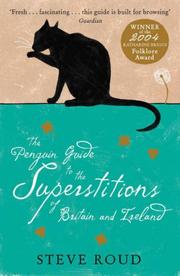
The Penguin Guide to the Superstitions of Britain and Ireland
Explains church folklore, burial beliefs and ghost traditions.

eBay marketplace picks
Marketplace Samples
Live-tested eBay searches with available results related to this page.

Endnotes
1.
Source: ireland.com
Title: Tales from Ireland’s crypts | Ireland.com
Link:https://www.ireland.com/magazine/built-heritage/attractions-crypts/
2.
Source: twistedlimbsandcrookedbranches.com
Title: TWISTED LIMBS & CROOKED BRANCHESSt. Columb’s Cathedral – “My Granny’s Church”!
Link:https://twistedlimbsandcrookedbranches.com/2014/02/21/st-columbs-cathedral-my-grannys-church/
3.
Source: nationalchurchestrust.org
Link:https://www.nationalchurchestrust.org/church/derry-londonderry-derry-cathedral
4.
Source: visitderry.com
Title: Visit Derry St Columb’s Cathedral is the city’s most historic building
Link:https://www.visitderry.com/blog/read/2021/03/st-columbs-cathedral-is-the-citys-most-historic-building-b217
Source snippet
Visit DerrySt Columb's Cathedral is the city's most historic building - Visit Derry...
5.
Source: nationalchurchestrust.org
Title: National Churches Trust Walled city pilgrims | National Churches Trust
Link:https://www.nationalchurchestrust.org/explore/story/walled-city
6.
Source: trin-2.maxarchiveservices.co.uk
Title: higgin william 1793 1867 bishop of derry and raphoe
Link:https://trin-2.maxarchiveservices.co.uk/index.php/higgin-william-1793-1867-bishop-of-derry-and-raphoe
7.
Source: biblicalcyclopedia.com
Title: Mc Clintock & Strong Cyclopedia Higgins, William, Dd
Link:https://www.biblicalcyclopedia.com/H/higgins-william-dd.html
8.
Source: historyhit.com
Link:https://www.historyhit.com/guides/most-haunted-churches-in-the-uk/
9.
Source: spiritedisle.ie
Title: Spirited Isle St Columb’s Cathedral | Explore Haunted Ireland
Link:https://spiritedisle.ie/explore/listing/st-columbs-cathedral/
10.
Source: derrystrabane.com
Link:https://www.derrystrabane.com/what-s-on/events-%28sv%29/organ-recitals-at-st-columb-s-cathedral/970751
11.
Source: nationalchurchestrust.org
Title: derry londonderry long tower st columba
Link:https://www.nationalchurchestrust.org/church/derry-londonderry-long-tower-st-columba
12.
Source: nationalchurchestrust.org
Link:https://www.nationalchurchestrust.org/get-support/support-organisations/national-pipe-organ-register
13.
Source: derrystrabane.com
Link:https://www.derrystrabane.com/getattachment/b391d730-7f00-4cda-9721-a701cbdf3581/DCSDC-Heritage-Plan_Appendix-3-Historic-Assets-in-the-Derry-City-and-Strabane-Council-Area-%281%29.pdf?lang=en-GB
Additional References
14.
Source: youtube.com
Title: St Columb’s Cathedral: Disturbed Graves and Footsteps in the Gallery
Link:https://www.youtube.com/watch?v=uyViMIiGc5k
Source snippet
Haunted Churches Of Ireland: Bishop Higgins of St Columb's Cathedral...
15.
Source: youtube.com
Title: Haunted Churches Of Ireland: Bishop Higgins of St Columb’s Cathedral
Link:https://www.youtube.com/watch?v=7aw1GeWz4IU
Source snippet
St Columb's Cathedral: Rare Macabre Grave Mortuary Symbols 1633...
16.
Source: youtube.com
Link:https://www.youtube.com/watch?v=42xjlRyK7Cg
Source snippet
Haunted Derry: The Ghost of St Columb's Cathedral...
17.
Source: tripadvisor.co.uk
Link:https://www.tripadvisor.co.uk/Attraction_Review-g186482-d189979-Reviews-St_Columb_s_Cathedral-Derry_County_Londonderry_Northern_Ireland.html
18.
Source: facebook.com
Link:https://www.facebook.com/beautyinsoundMUSIC/posts/check-this-out-what-an-incredible-building-for-an-equally-incredible-organ-find-/1406257738186781/
19.
Source: facebook.com
Link:https://www.facebook.com/stcolumbsmusic/videos/st-columbs-cathedral-boys-choir-documentary/972692220900494/
20.
Source: saintcolumbshall.com
Link:https://www.saintcolumbshall.com/history-of-st-columbs-hall-published/
21.
Source: facebook.com
Link:https://www.facebook.com/groups/355269498442029/posts/1606128273356139/
22.
Source: facebook.com
Link:https://www.facebook.com/StEugenesCathedral/videos/let-me-introduce-the-extremely-talented-organist-luke-boyle-luke-is-a-former-pup/5051270344884152/
23.
Source: derriedanders.co.uk
Link:https://derriedanders.co.uk/blog/my-favourite-places-in-the-city
Topic Tree