Where East Lothian Feels Most Haunted
East Lothian’s haunted reputation is not built around one single famous ghost. It is a landscape of overlapping traditions: ruined castles on sea cliffs, witch-trial memories at North Berwick and Dirleton, an underground “Goblin Ha’” near Gifford, country-house ghost tours at Newhailes, and battlefields where history already feels half-spectral.
Page outline Jump by section
Introduction
For a reader looking for haunted East Lothian, the essential answer is this: the county’s most substantial supernatural traditions cluster around Tantallon Castle, Dirleton Castle, Yester Castle and Goblin Ha’, Hailes Castle, Newhailes House, and the North Berwick witch-trial landscape. Some are preserved in official heritage interpretation, some in local-history sources, some in tourism copy, and some in modern paranormal retellings. The result is atmospheric, but uneven: East Lothian has excellent historical depth, while many individual ghost claims remain folkloric, modern, or difficult to trace to named witnesses.
Where East Lothian’s ghost stories sit on the map
East Lothian is both a modern Scottish council area and a historic county, though its boundaries and administrative meaning have changed over time. The county was officially called Haddingtonshire until 1921; Scotland’s counties were abolished as local government areas in 1975, and a modern unitary East Lothian council area was created in 1996. A key boundary wrinkle for haunted-place research is Musselburgh and Inveresk: they became part of the East Lothian district in the 1975 reforms after previously belonging to Midlothian, so older sources may place some western “East Lothian” stories differently.[Wikipedia]WikipediaEast LothianEast Lothian
Geographically, the haunted pattern makes sense. The county runs from Musselburgh and Prestonpans in the west through Haddington, North Berwick and Dunbar towards the Berwickshire border, with the Lammermuir Hills rising inland. Its castles guarded approaches by coast, river and road; its ports and kirks were tied into national politics; and its battlefield sites were repeatedly caught up in wars between Scotland, England and competing Scottish factions. That gives East Lothian the raw material ghost traditions often need: old buildings, visible ruins, violent episodes, named families, public memory and dramatic scenery.[Wikishire]wikishire.co.ukEast LothianEast Lothian
Tantallon Castle: East Lothian’s most photographed “ghost”
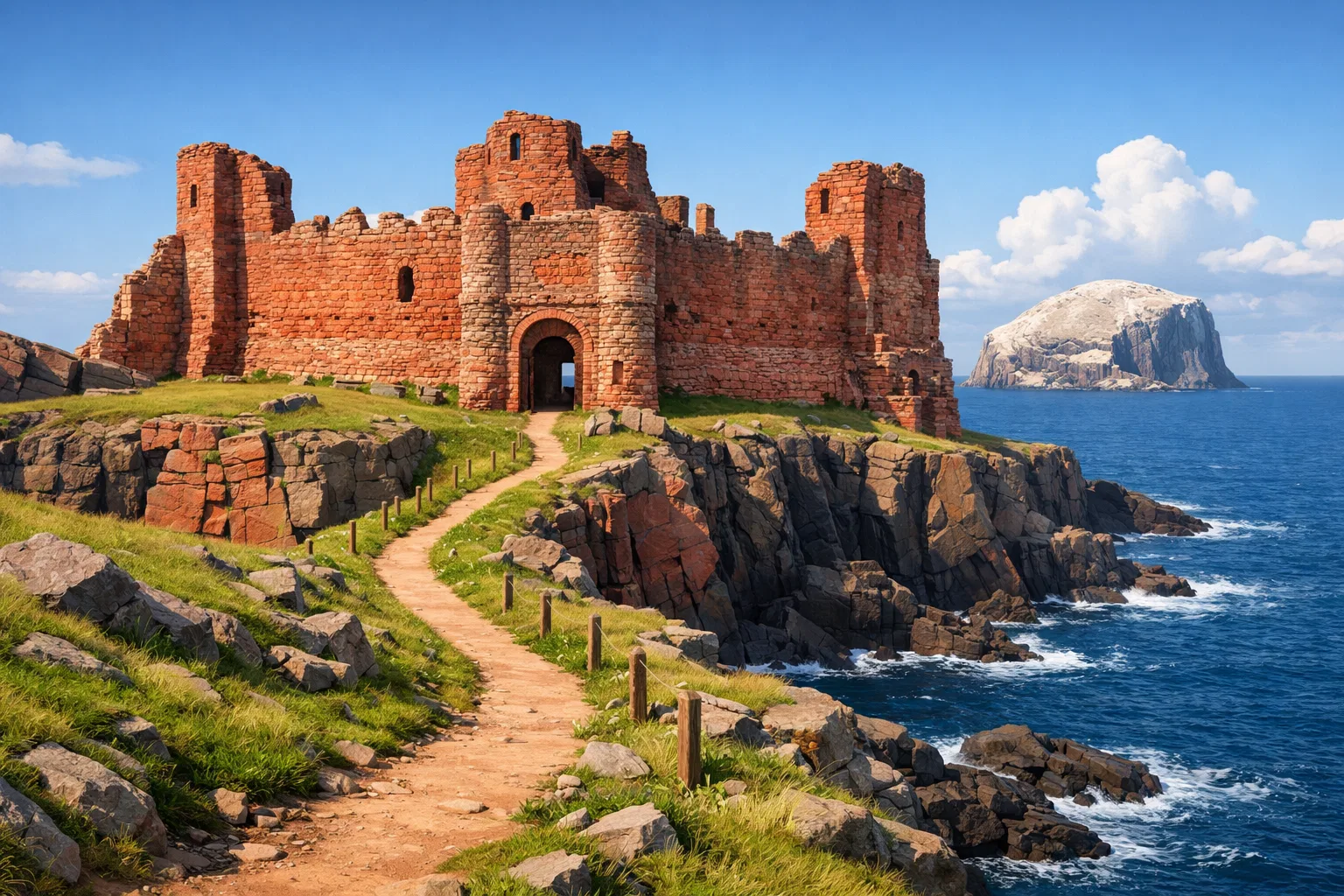
Tantallon Castle, near North Berwick, is probably East Lothian’s best-known modern ghost site because of a photograph rather than a centuries-old apparition. Historic Environment Scotland describes Tantallon as a mighty cliff-edge stronghold of the Red Douglas dynasty, abandoned after more than 300 years when Oliver Cromwell’s army besieged it. Its setting opposite the Bass Rock is so theatrical that it almost invites supernatural interpretation: a huge red sandstone curtain wall, sea cliffs, wind, gulls, and a ruin whose history includes conflict with the Crown.[Historic Environment Scotland]historicenvironment.scotOpen source on historicenvironment.scot.
The famous ghost claim centres on an image taken at Tantallon in the late 2000s, showing what some viewers interpreted as a figure in old-fashioned dress at a window or opening. Psychologist Richard Wiseman, known for research into hauntings and belief, later noted that in an online study the Tantallon image was the photograph most often judged by participants to be a genuine ghost. He also recorded the more cautious possibilities: an unnoticed visitor, a lighting effect, reflection, or manipulation.[Richard Wiseman]richardwiseman.wordpress.comRichard Wiseman Ghosts and HauntingsRichard Wiseman Ghosts and Hauntings
That is what makes Tantallon useful as a case study. It is not a straightforward old legend with a named white lady and a stable oral tradition. It is a modern “evidence” story, spread through photography, press interest and paranormal debate. Edinburgh Guide reported in 2009 that web users in a study found the Tantallon image especially compelling, while later local and tabloid retellings continued to frame it as mysterious rather than proven.[Edinburgh Guide]edinburghguide.com3139 tantallon castle photo is most compelling evidence for ghosts says study3139 tantallon castle photo is most compelling evidence for ghosts says study
The sceptical reading is just as important as the spooky one. Tantallon is open to visitors, and old ruins naturally create blocked sightlines, shadowed openings and partial figures. In ghost photography, a viewer’s first impression often does much of the work: a distant person, stone edge, colour patch or blur becomes “period dress” once the castle’s history has primed the imagination. Tantallon’s haunting, then, is less a settled apparition tradition than a modern folklore object — a photograph that people keep returning to because the place feels capable of producing it.

Dirleton Castle: witch-trial memory and the darker side of haunting
Dirleton Castle’s supernatural reputation is rooted less in a roaming ghost than in documented witch-hunt history. Historic Environment Scotland’s account of the Dirleton witch hunts states that around 370 years ago the castle became a prison for women accused of witchcraft. Across Scotland between 1550 and 1700, nearly 4,000 people were accused of witchcraft, around 85% of them women, and between a third and a half were executed. During the panic of 1649–50, more than 600 people were accused across southern and eastern Scotland; six were from Dirleton parish.[Historic Environment Scotland Blog]blog.historicenvironment.scotHistoric Environment Scotland Blog The Dirleton Witch HuntsHistoric Environment Scotland Blog The Dirleton Witch Hunts
The Dirleton cases give the castle a very different kind of eeriness from Tantallon. The horror is not a floating figure on a stair but the machinery of accusation, confession and punishment. Sources record Agnes Clarkson, Manie Halieburton, Patrick Watson, Bessie Hogge, Marione Meik and Margaret Goodfellow among the Dirleton accused. The accusations involved supposed meetings with the Devil, “devil’s marks” searched for by the witch-pricker John Kincaid, and confessions extracted in a culture where sleep deprivation, imprisonment and religious pressure were part of the system.[Historic Environment Scotland Blog]blog.historicenvironment.scotHistoric Environment Scotland Blog The Dirleton Witch HuntsHistoric Environment Scotland Blog The Dirleton Witch Hunts
Local-history summaries add that several accused people were imprisoned at the castle and that some accounts place interrogation and inspection in the Great Hall. The John Gray Centre, East Lothian’s local history and archive hub, also notes Dirleton Castle’s reputation for haunting and links it to Alexander Hamilton, a beggar accused of witchcraft.[John Gray Centre]johngraycentre.orgcastle of east lothiancastle of east lothian
For a haunted-history page, Dirleton needs careful handling. Calling these people “witches” without qualification repeats the logic that endangered them. The stronger interpretation is that Dirleton is haunted by memory: by the record of vulnerable people accused, examined and probably executed under a legal and religious system later recognised as a grave injustice. In 2022, Scotland’s First Minister Nicola Sturgeon issued a formal apology for the persecution of people accused of witchcraft, a modern political act that has changed how many visitors now read sites like Dirleton.[Wikipedia]WikipediaDirleton CastleDirleton Castle
North Berwick: the witch-trial landscape behind the legend
North Berwick’s witch trials are among the most famous witchcraft episodes in Scottish history, and they are central to East Lothian’s supernatural identity. The trials began around 1590 and were tied to fears that witches had raised storms against King James VI and Anne of Denmark. The surviving tradition places alleged meetings at St Andrew’s Auld Kirk, near the modern harbour area, and links the panic to torture, forced confession, royal anxiety and printed propaganda.[Historic UK]historic-uk.comOpen source on historic-uk.com.
The University of Edinburgh’s Survey of Scottish Witchcraft is especially useful because it grounds the story in accused people rather than vague legend. Its case record for Agnes Sampson describes her as a folk healer who implicated 59 people. Other accounts of the North Berwick panic name Geillis Duncan, Dr John Fian, Agnes Sampson and others, while the 1591 pamphlet Newes from Scotland helped spread the image of a diabolical coven meeting at North Berwick.[Witches]witches.hca.ed.ac.ukOpen source on ed.ac.uk.
The haunting here is partly architectural and partly cultural. Visitors may look for a “witches’ kirk” or a ghostly coven site, but the more powerful story is how a coastal town became the stage for elite paranoia. James VI was not a distant bystander: the trials fed into his thinking about witchcraft and demonology, and his personal involvement gave the North Berwick panic unusual national significance.[JSTOR]jstor.orgJames VI's Demonology and the North Berwick WitchesJames VI's Demonology and the North Berwick Witches
North Berwick also shows why haunted tourism and historical responsibility can pull in different directions. The coven image is dramatic, but the evidence points to coercion, torture and social fear rather than supernatural conspiracy. The best way to read the place is not as a proven witches’ gathering ground, but as one of Scotland’s most important landscapes of witch-hunt memory.
Yester Castle and the Goblin Ha’: East Lothian’s strangest medieval legend
If Tantallon is the county’s photo-ghost and Dirleton its witch-hunt memory, Yester Castle near Gifford is its purest piece of medieval folklore. The surviving underground chamber is known as the Goblin Ha’, Hobgoblin Ha’ or Goblin Hall. The John Gray Centre records Yester Castle and Goblin Ha’ as a medieval site, while Trove, Scotland’s heritage portal, lists it under those alternative names.[John Gray Centre]johngraycentre.orgOpen source on johngraycentre.org.
The legend centres on Sir Hugo de Giffard, remembered as the “Wizard of Yester”. The tradition says he practised sorcery or necromancy and that the underground hall was made, or helped, by magical forces. The University of Edinburgh Archives blog traced the story through Walter Bower’s Scotichronicon, which preserved an old tale that Yester’s cellar or keep had been wrought by witchcraft and that a remarkable underground cavern there was popularly associated with supernatural making.[Library & University Collections]libraryblogs.is.ed.ac.ukOpen source on ed.ac.uk.
This is not a standard ghost story. There is no single recurring apparition with a named witness and a date. Instead, the place is haunted by an origin myth: a lord so powerful, learned or feared that later tradition made him a magician, with goblins or demonic helpers as the builders of his hidden hall. Sir Walter Scott later helped keep the legend alive in Marmion, which refers to the founder of the Goblin Hall.[Wikipedia]WikipediaYester CastleYester Castle
Yester also shows how folklore can attach to unusual architecture. A subterranean vaulted chamber in a wooded ruin is already suggestive; the story supplies a supernatural explanation for its atmosphere. Modern access has also become part of the site’s eerie status: reports in 2021 said stone had been stolen from supporting walls and the protected ruin was closed pending investigation, turning the Goblin Ha’ from a hidden curiosity into a fragile heritage site.[Wikipedia]WikipediaYester CastleYester Castle
Hailes Castle: Mary, Bothwell and the White Lady tradition
Hailes Castle, hidden in the valley of the River Tyne near East Linton, is one of the most atmospheric ruins in East Lothian. Historic Environment Scotland describes it as one of Scotland’s oldest stone castles, dating from the early 1200s, with major extensions in the 1300s and 1400s. It is associated with the de Gourlay and Hepburn families, and with James Hepburn, 4th Earl of Bothwell, the third husband of Mary, Queen of Scots.[Historic Environment Scotland]historicenvironment.scothailes castlehailes castle
The historical core is strong. HES says Bothwell was probably born at Hailes in 1535, and that Mary and Bothwell stayed there on 5 May 1567 on their way from Dunbar to their wedding at Holyroodhouse. The marriage was deeply unpopular; Mary was forced to abdicate only a little over two months later, and Bothwell fled into exile. Cromwell’s forces later attacked Hailes in 1650, effectively ending its life as a noble residence.[Historic Environment Scotland]historicenvironment.scotOpen source on historicenvironment.scot.
The ghost tradition is less securely sourced but widely repeated: Hailes is said to have a White Lady, sometimes linked to Mary Queen of Scots, and stories also attach to its pit prisons. Wee Walking Tours, drawing on modern haunted-site interest, frames Bothwell’s spirit as speculative and says the more commonly reported figure is a Lady in White believed by some to be Mary. Castle-focused sources also repeat tales of a pit-prison ghost and of a White Lady haunting the site.[weewalkingtours.com]weewalkingtours.comWee Walking Tours The Haunting of Hailes CastleWee Walking Tours The Haunting of Hailes Castle
The sensible reading is that Hailes is haunted by association. Mary’s brief presence, Bothwell’s notoriety, the ruin’s riverside seclusion and the castle’s prison spaces make it easy for later tellers to project a white apparition onto the site. That does not make the ghost “true” in a literal sense, but it explains why the story persists: Hailes has the right combination of documented drama and visual melancholy.
Newhailes House: a living ghost-tour tradition in Musselburgh
Newhailes House, on the edge of Musselburgh, represents a more modern form of haunted East Lothian: the curated country-house ghost tour. The National Trust for Scotland describes Newhailes as a Palladian mansion and estate with woodland walks, café, bookshop and family attractions. The house was long associated with the Dalrymple family, an influential legal and political dynasty, and is now cared for by the Trust.[National Trust for Scotland]nts.org.ukOpen source on nts.org.uk.
The Trust’s own event listing for “Haunted Newhailes” says residents, staff, volunteers and visitors have reported things they could not explain over the years. The reported phenomena include whistling in corridors, ghostly music, footsteps in empty rooms and shadowy figures. The tour also distinguishes between “intelligent”, “residual” and poltergeist hauntings — terms used in paranormal-tour culture rather than formal historical research.[National Trust for Scotland]nts.org.ukOpen source on nts.org.uk.
Newhailes is therefore one of the county’s clearest examples of haunting as visitor experience. Unlike Yester or North Berwick, the emphasis is not an old chronicle or a witch-trial archive; it is a managed after-dark encounter in a historic house. That does not make the reports meaningless, but it does change how they should be weighed. They are best treated as recent witness traditions preserved through staff, visitors and events rather than as a long-documented ghost legend.
There is also a boundary note. Musselburgh is now firmly in East Lothian, but older county frameworks may place it differently because of historic administrative changes. For a modern visitor, Newhailes belongs naturally on an East Lothian haunted itinerary; for historic-county purists, it needs a short explanation rather than silent inclusion.[Undiscovered Scotland]undiscoveredscotland.co.ukOpen source on undiscoveredscotland.co.uk.
Dunbar, Prestonpans and the battlefield imagination
East Lothian’s battlefields do not have the same dense ghostlore as some Scottish sites, but they matter because they shape the county’s haunted atmosphere. Haddington was the focus of a major siege during the Rough Wooing: Historic Environment Scotland notes that in July 1548 an army of 12,000 troops laid siege to the town, where an English garrison of around 2,000 men held out in what became the longest siege in Scottish history. The same account links Tantallon and Hailes to the wider campaign.[Historic Environment Scotland Blog]blog.historicenvironment.scotHistoric Environment Scotland Blog The Story of Scotland's Longest SiegeHistoric Environment Scotland Blog The Story of Scotland's Longest Siege
Prestonpans, fought on 21 September 1745, is another major memory site. The Battle of Prestonpans Heritage Trust places the battlefield between Prestonpans, Tranent and Cockenzie and stresses that it was not an empty moor but a lived-in landscape of agriculture and industry. Its “Beyond the Battle” project is working to map the community that lived on the battlefield in 1745 and how the landscape changed afterwards.[battleofprestonpans1745.org]battleofprestonpans1745.orgOpen source on battleofprestonpans1745.org.
In ghost-story terms, that distinction matters. Battlefield hauntings often reduce history to phantom soldiers and spectral drums, but the stronger East Lothian story is social memory: routes, ditches, farms, villages, monuments and local families caught in conflict. Prestonpans may not provide the county’s most famous apparition, yet it gives haunted-history readers something more durable — a landscape where the past remains mapped into the present.
Dunbar Castle and Dunbar’s battle associations add another coastal layer. Popular ghost directories repeat claims of spectral figures or bagpipes at Dunbar Castle, but these sources are much thinner than the official history available for Tantallon, Hailes or Dirleton. The ruins are historically important and dramatically placed, yet the ghost claims should be treated as late, lightly sourced folklore unless stronger local newspaper or archive evidence is found.[Castles & Manor Houses]castlesandmanorhouses.comOpen source on castlesandmanorhouses.com.
How credible are East Lothian’s hauntings?
East Lothian’s haunted material falls into three broad evidence levels. The first is strong historical record with supernatural belief attached to it. North Berwick and Dirleton sit here: the witchcraft accusations, interrogations and named accused are historically grounded, while the diabolical claims themselves reflect early modern belief, coercion and propaganda rather than reliable evidence of magic.[historicenvironment.scot]blog.historicenvironment.scotHistoric Environment Scotland Blog The Dirleton Witch HuntsHistoric Environment Scotland Blog The Dirleton Witch Hunts
The second level is durable folklore tied to unusual places. Yester’s Goblin Ha’ is the best example. The underground chamber is real, the medieval and later literary tradition is traceable, and the “Wizard of Yester” legend is old enough to matter as folklore. It is not evidence of goblins; it is evidence that people have long used supernatural language to explain, dramatise and remember the site.[Library & University Collections]libraryblogs.is.ed.ac.ukOpen source on ed.ac.uk.
The third level is modern paranormal report and tourism tradition. Tantallon’s ghost photograph, Newhailes’ after-dark tour reports and Hailes Castle’s White Lady sit here. These stories are vivid and reader-relevant, but they depend heavily on interpretation, atmosphere and retelling. The strongest approach is neither to debunk them flatly nor to present them as fact. They are claims, experiences and legends that reveal how historic places continue to generate uncanny stories.[wordpress.com]richardwiseman.wordpress.comRichard Wiseman Ghosts and HauntingsRichard Wiseman Ghosts and Hauntings
What makes East Lothian feel especially haunted?
East Lothian’s haunted character comes from compression. In a relatively small coastal county, a visitor can move from North Berwick’s witch-trial memory to Tantallon’s sea-cliff ruin, from Dirleton’s witch-hunt prison to Hailes Castle’s Mary-and-Bothwell associations, and from Yester’s Goblin Ha’ to the battlefield landscape around Prestonpans. The stories are not identical, but they share a mood: visible ruins, contested power, old accusations, and places where the natural setting intensifies the tale.
The county is also close to Edinburgh, one of Britain’s most heavily marketed haunted cities, which means East Lothian can be overshadowed. That may actually help its stories. They feel less like a single commercial ghost brand and more like a scattered map of local memory. Some sites are famous, others half-hidden; some are managed by national bodies, others survive in local-history centres, walking blogs, ghost directories and tour listings.
The most trustworthy haunted East Lothian page should therefore resist two temptations. It should not flatten everything into “proof of ghosts”, and it should not strip away the atmosphere until only administrative history remains. East Lothian’s ghosts are most interesting when read as folklore attached to real places: a photographed figure at Tantallon, accused witches at Dirleton and North Berwick, goblins beneath Yester, a White Lady at Hailes, unexplained sounds at Newhailes, and battlefield landscapes where history itself does much of the haunting.
Amazon book picks
Further Reading
Books and field guides related to Where East Lothian Feels Most Haunted. Use these as the next step if you want deeper reading beyond the article.
The Folklore of Scotland
Provides historical and cultural context for East Lothian traditions.
eBay marketplace picks
Marketplace Samples
Live-tested eBay searches with available results related to this page.
Endnotes
1.
Source: Wikipedia
Title: East Lothian
Link:https://en.wikipedia.org/wiki/East_Lothian
2.
Source: Wikipedia
Title: Dirleton Castle
Link:https://en.wikipedia.org/wiki/Dirleton_Castle
3.
Source: historic-uk.com
Link:https://www.historic-uk.com/HistoryUK/HistoryofScotland/North-Berwick-Witch-Trials/
4.
Source: Wikipedia
Title: North Berwick witch trials
Link:https://en.wikipedia.org/wiki/North_Berwick_witch_trials
5.
Source: jstor.org
Title: James VI’s Demonology and the North Berwick Witches
Link:https://www.jstor.org/stable/j.ctt5vjmvw
6.
Source: trove.scot
Link:https://www.trove.scot/place/56062
7.
Source: Wikipedia
Title: Yester Castle
Link:https://en.wikipedia.org/wiki/Yester_Castle
8.
Source: great-castles.com
Link:https://great-castles.com/hailesghost.html
9.
Source: Wikipedia
Title: Newhailes House
Link:https://en.wikipedia.org/wiki/Newhailes_House
10.
Source: battleofprestonpans1745.org
Link:https://www.battleofprestonpans1745.org/
11.
Source: battleofprestonpans1745.org
Link:https://www.battleofprestonpans1745.org/beyond-the-battle/
12.
Source: Wikipedia
Title: Tantallon Castle
Link:https://en.wikipedia.org/wiki/Tantallon_Castle
13.
Source: Wikipedia
Title: Hailes Castle
Link:https://en.wikipedia.org/wiki/Hailes_Castle
14.
Source: great-castles.com
Link:https://great-castles.com/tantallonghost.html
15.
Source: youtube.com
Title: 8 Most Haunted Places in East Lothian
Link:https://www.youtube.com/watch?v=nx_ojbCD7aw
Source snippet
Witches of Dirleton Castle...
16.
Source: youtube.com
Title: Witches of Dirleton Castle
Link:https://www.youtube.com/watch?v=iCbExZGDIx0
Source snippet
Yester Castle- A Warlock, Necromancer, and Castle Built by Goblins...
17.
Source: wikishire.co.uk
Title: East Lothian
Link:https://wikishire.co.uk/wiki/East_Lothian
18.
Source: wikishire.co.uk
Link:https://wikishire.co.uk/wiki/Haddington
19.
Source: undiscoveredscotland.co.uk
Link:https://www.undiscoveredscotland.co.uk/usfeatures/areas/eastlothian.html
20.
Source: johngraycentre.org
Title: battlefields of east lothian ad 800–1745
Link:https://www.johngraycentre.org/times/2-early-history-and-the-middle-ages-ad-410%E2%80%931484/battlefields-of-east-lothian-ad-800%E2%80%931745/
21.
Source: historicenvironment.scot
Link:https://www.historicenvironment.scot/visit/all/tantallon-castle/
22.
Source: richardwiseman.wordpress.com
Title: Richard Wiseman Ghosts and Hauntings
Link:https://richardwiseman.wordpress.com/research/psychology-of-ghosts-and-hauntings/
23.
Source: edinburghguide.com
Title: 3139 tantallon castle photo is most compelling evidence for ghosts says study
Link:https://edinburghguide.com/news/3139-tantallon-castle-photo-is-most-compelling-evidence-for-ghosts-says-study
24.
Source: blog.historicenvironment.scot
Title: Historic Environment Scotland Blog The Dirleton Witch Hunts
Link:https://blog.historicenvironment.scot/2020/03/dirleton-witch-hunts/
25.
Source: witches.hca.ed.ac.uk
Link:https://witches.hca.ed.ac.uk/case/C/EGD/166
26.
Source: johngraycentre.org
Title: castle of east lothian
Link:https://www.johngraycentre.org/collections/local-history-centre/castle-of-east-lothian/
27.
Source: witches.hca.ed.ac.uk
Link:https://witches.hca.ed.ac.uk/case/C/EGD/63
28.
Source: johngraycentre.org
Link:https://www.johngraycentre.org/collections/getrecord/ELHER_MEL663/
29.
Source: libraryblogs.is.ed.ac.uk
Link:https://libraryblogs.is.ed.ac.uk/edinburghuniversityarchives/2020/10/30/the-scotichronicon-and-the-goblin-ha-witchcraft-and-hobgoblins-in-our-manuscripts/
30.
Source: historicenvironment.scot
Title: hailes castle
Link:https://www.historicenvironment.scot/visit/all/hailes-castle/
31.
Source: historicenvironment.scot
Link:https://www.historicenvironment.scot/visit/all/hailes-castle/history-and-stories/
32.
Source: weewalkingtours.com
Title: Wee Walking Tours The Haunting of Hailes Castle
Link:https://www.weewalkingtours.com/post/hailes-castle
33.
Source: nts.org.uk
Link:https://www.nts.org.uk/visit/places/newhailes
34.
Source: nts.org.uk
Link:https://www.nts.org.uk/visit/places/newhailes/events/379117870757
35.
Source: blog.historicenvironment.scot
Title: Historic Environment Scotland Blog The Story of Scotland’s Longest Siege
Link:https://blog.historicenvironment.scot/2022/07/the-story-of-scotlands-longest-siege/
36.
Source: castlesandmanorhouses.com
Link:https://www.castlesandmanorhouses.com/ghosts.php?SelectCountry=Scotland&SelectQuality=ALL&SelectType=Ghost+Haunting&submit=
37.
Source: johngraycentre.org
Link:https://www.johngraycentre.org/?s=Dirleton+Castle+
38.
Source: johngraycentre.org
Link:https://www.johngraycentre.org/?s=Innerwick+East+Lothian
39.
Source: johngraycentre.org
Link:https://www.johngraycentre.org/east-lothian-subjects/society/witchcraft-in-east-lothian/
40.
Source: johngraycentre.org
Title: 100 years of east lothian 2
Link:https://www.johngraycentre.org/archive-exhibitions/100-years-of-east-lothian-2/
41.
Source: johngraycentre.org
Link:https://www.johngraycentre.org/east-lothian-subjects/war-battles-military/a-prince-in-prestonpans/
42.
Source: nts.org.uk
Link:https://www.nts.org.uk/stories/scottish-ghost-stories-witches-murder-and-folklore
43.
Source: nts.org.uk
Link:https://www.nts.org.uk/stories/scary-tales-from-our-properties
44.
Source: nts.org.uk
Link:https://www.nts.org.uk/visit/places/newhailes/events/1544691526939
45.
Source: nts.org.uk
Link:https://www.nts.org.uk/stories/scottish-ghost-stories-witches-murder-and-folklore-part-2
46.
Source: graveyardsofscotland.com
Title: the battle of prestonpans
Link:https://graveyardsofscotland.com/2022/08/20/the-battle-of-prestonpans/
47.
Source: witches.hca.ed.ac.uk
Link:https://witches.hca.ed.ac.uk/trial/T/LA/934
48.
Source: witches.is.ed.ac.uk
Title: ed.ac.uk Isobel Young’s story
Link:https://witches.is.ed.ac.uk/story-isobel-young/
49.
Source: evil.fandom.com
Title: Yester Castle
Link:https://evil.fandom.com/wiki/Yester_Castle
50.
Source: portal.historicenvironment.scot
Link:https://portal.historicenvironment.scot/apex/f?p=1505%3A300%3A%3A%3A%3A%3AVIEWTYPE%2CVIEWREF%3Adesignation%2CSM13330
51.
Source: atlasobscura.com
Title: yester castle
Link:https://www.atlasobscura.com/places/yester-castle
52.
Source: borderlandscotland.wordpress.com
Link:https://borderlandscotland.wordpress.com/category/witchcraft/
53.
Source: blosslynspage.wordpress.com
Title: ghosts at tantallon castle scotland perhaps
Link:https://blosslynspage.wordpress.com/2014/01/24/ghosts-at-tantallon-castle-scotland-perhaps/
54.
Source: coastwalkblog.wordpress.com
Title: coast stories 4 the north berwick witch trials
Link:https://coastwalkblog.wordpress.com/2018/03/31/coast-stories-4-the-north-berwick-witch-trials/
55.
Source: dearscotia.wordpress.com
Title: yester castle goblin ha
Link:https://dearscotia.wordpress.com/2019/03/12/yester-castle-goblin-ha/
56.
Source: mysearchformagic.wordpress.com
Title: yester castle east lothian
Link:https://mysearchformagic.wordpress.com/2013/01/03/yester-castle-east-lothian/
57.
Source: kids.kiddle.co
Title: East Lothian
Link:https://kids.kiddle.co/East_Lothian
58.
Source: historyhit.com
Title: Hailes Castle
Link:https://www.historyhit.com/locations/hailes-castle/
59.
Source: tripadvisor.com
Title: John Gray Centre
Link:https://www.tripadvisor.com/Attraction_Review-g190922-d6776133-Reviews-John_Gray_Centre-Haddington_East_Lothian_Scotland.html
Additional References
60.
Source: facebook.com
Link:https://www.facebook.com/groups/1161079373938058/posts/7211417572237511/
61.
Source: visitscotland.com
Link:https://www.visitscotland.com/things-to-do/attractions/haunted-sites
62.
Source: eastlothian.gov.uk
Link:https://www.eastlothian.gov.uk/libraries-leisure-and-tourism/archaeology
63.
Source: facebook.com
Link:https://www.facebook.com/100088539433942/posts/around-370-years-ago-dirleton-castle-became-a-prison-for-people-accused-of-witch/933168552977784/
64.
Source: sobt.co.uk
Link:https://sobt.co.uk/battle-of-prestonpans-viewpoint/
65.
Source: crazyaboutcastles.com
Link:https://crazyaboutcastles.com/scottish-castles/dunbar-castle/
66.
Source: app-hes-pubs-prod-neu-01.azurewebsites.net
Link:https://app-hes-pubs-prod-neu-01.azurewebsites.net/api/file/250fbe94-f2f9-4202-9cd9-aa9b00df57cd
67.
Source: facebook.com
Link:https://www.facebook.com/groups/scotlandsscenery/posts/27226430290282986/
68.
Source: facebook.com
Link:https://www.facebook.com/groups/2294171370814843/posts/3137638236468148/
69.
Source: scottisharchives.org.uk
Link:https://www.scottisharchives.org.uk/archives-map/east-lothian-council-archives-local-history-centre/
Topic Tree
Follow this branch
Related pages 91
- Haunted Clackmannanshire
- Haunted Antrim
- Haunted Armagh
- Haunted Durham
- Haunted Londonderry
- +86 more in sidebar