Within Haunted Cumberland
Was the Croglin Vampire Ever Real?
The Croglin Vampire is Cumberland's strangest legend, famous less for proof than for its tangled mix of place, Gothic fiction and folklore.
On this page
- The vampire tale as later writers told it
- Problems with Croglin Grange and the source trail
- Why the legend still belongs to Cumberland
Page outline Jump by section
Introduction
The Croglin Vampire is almost certainly better understood as a Cumberland folklore problem than as a proven supernatural case. The story places a night-feeding, corpse-like intruder at “Croglin Grange”, in or near the small fellside parish of Croglin, and later writers made it one of England’s best-known vampire legends. Yet the evidence is awkward from the start: the main account was not a local court record, parish entry or newspaper report, but a story printed by Augustus J. C. Hare in his memoirs, said to have been told to him by Captain Fisher and connected with Fisher’s own family. Hare’s version is vivid, but it arrives as an after-dinner anecdote, not as documented testimony.[Project Gutenberg]gutenberg.orgThe Project Gutenberg eBook of Story of My Life, volumes 4-6, by Augustus J. C. Hare…
That does not make the legend worthless. It makes it more interesting. Croglin’s vampire belongs to Cumberland because it has attached itself to a real parish, a real historic landscape, and a real old house often identified with Croglin Low Hall. But the case is famous less because it proves vampires existed than because its details keep slipping: the house, the chapel, the churchyard, the date, the supposed witnesses and even the literary shape of the attack all raise questions.[Cumbria County History Trust]cumbriacountyhistory.org.ukCumbria County History Trust Croglin | Cumbria County History TrustCumbria County History Trust Croglin | Cumbria County History Trust
The vampire tale as later writers told it
In Hare’s printed account, Captain Fisher introduces Croglin Grange as an old Cumberland family place, “never at any period” more than one storey high, with a terrace looking towards a church in a hollow. The Fisher family, having moved south to Thorncombe near Guildford, let the house to “two brothers and a sister”. The siblings settle happily into the district through winter and spring, becoming liked by poorer neighbours and local society alike.[Project Gutenberg]gutenberg.orgThe Project Gutenberg eBook of Story of My Life, volumes 4-6, by Augustus J. C. Hare…
The haunting begins on a suffocating summer night. The sister, unable to sleep in her ground-floor room, watches moonlight over the lawn and notices two lights moving near the trees between the house and the churchyard. The shape approaches, disappears into shadow, and comes close enough for her to see a “hideous brown face with flaming eyes” at the window. It scratches, then pecks at the lead around a diamond pane, removes the glass, reaches in, opens the window and attacks her in bed.[Project Gutenberg]gutenberg.orgThe Project Gutenberg eBook of Story of My Life, volumes 4-6, by Augustus J. C. Hare…
This is the scene that lodged the story in British supernatural writing: the old house, the hot night, the churchyard beyond the trees, the small pane being picked out, the long bony fingers and the wound at the throat. In Hare’s version the brothers break into the locked room after hearing her scream; one chases the creature as it escapes towards the churchyard. The injured woman, notably, is made to sound rational rather than hysterical. She suggests that the attacker may be an escaped lunatic, and the family go abroad for her recovery before returning to Croglin.[Project Gutenberg]gutenberg.orgThe Project Gutenberg eBook of Story of My Life, volumes 4-6, by Augustus J. C. Hare…
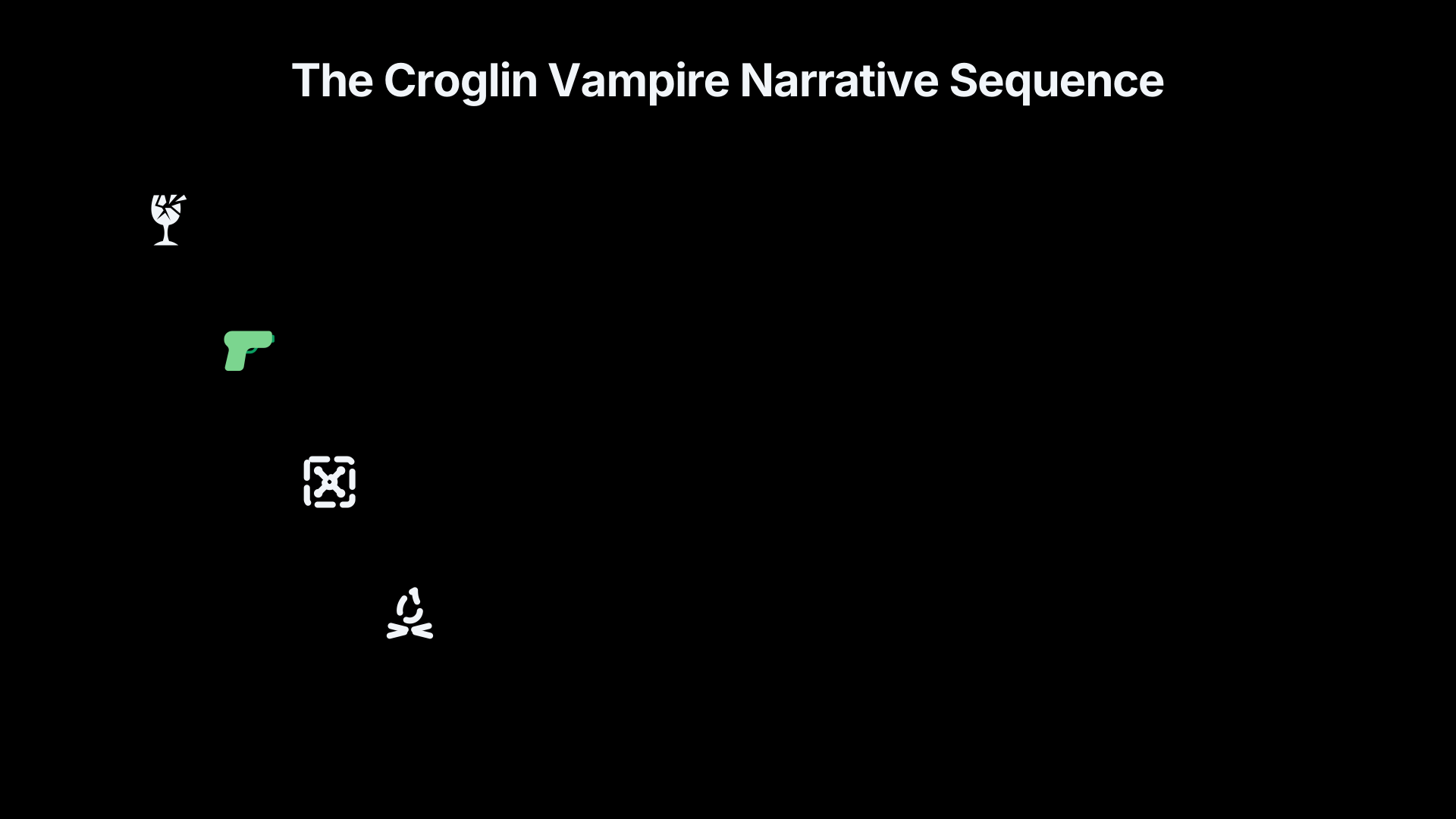
The second attack is more decisive. In the following March the same scratching comes at the window. This time the brothers are ready with loaded pistols. They pursue the fleeing figure, shoot it in the leg, and see it vanish into a vault belonging to an extinct family. The next day, in front of tenants, the vault is opened. Hare’s account describes disturbed coffins, a single intact coffin, and inside it the same shrivelled figure, now bearing a fresh pistol wound. The body is then burnt, because, as Hare’s story says, that is “the only thing that can lay a vampire”.[Project Gutenberg]gutenberg.orgThe Project Gutenberg eBook of Story of My Life, volumes 4-6, by Augustus J. C. Hare…
For haunted-Cumberland readers, this is the complete dramatic machine of the legend. It is not a vague rumour of a ghost seen in a window, but a structured vampire narrative: attack, wound, recovery, return, armed watch, pursuit, tomb, corpse and destruction. That very neatness is part of its appeal, but it is also one of the reasons sceptical readers have long been uneasy with it.
Why the printed source is a problem
The first major difficulty is that the story reaches us through Hare’s memoir, not through direct local evidence. Hare records that Captain Fisher “also told us” the story, connecting it with Fisher’s family, but he does not provide a sworn statement, named tenants in the original passage, a police report, a medical report, a parish record of the opened vault, or a dated local newspaper item. The result is a classic folklore-source problem: the account is attributed, but the chain is still oral, social and literary.[Project Gutenberg]gutenberg.orgThe Project Gutenberg eBook of Story of My Life, volumes 4-6, by Augustus J. C. Hare…
Hare was also writing in a context full of ghost stories. The Croglin passage appears among other supernatural anecdotes: death omens, apparitions and family legends told in conversation. That setting matters because it tells the reader how the material is being presented. It is not a parish history of Croglin; it is part of a memoir in which alarming stories circulate among guests, friends and acquaintances.[Project Gutenberg]gutenberg.orgThe Project Gutenberg eBook of Story of My Life, volumes 4-6, by Augustus J. C. Hare…
There is also a timing issue. Hare’s journal entry immediately after the Croglin story is dated 30 June 1874, but the story itself is not the same thing as an event record for Croglin in 1874. It shows when Hare placed the anecdote in his memoir material, not when a vampire attack can be independently shown to have happened. Later retellings often turn the tale into a neat 1870s case, but the stronger statement is more cautious: the best-known printed version belongs to Hare’s late nineteenth-century memoir, and its internal framing is an anecdote said to have been told by Captain Fisher.[Project Gutenberg]gutenberg.orgThe Project Gutenberg eBook of Story of My Life, volumes 4-6, by Augustus J. C. Hare…
That is why the Croglin Vampire is a poor “proof” story but an excellent case study in how haunted legends become respectable. It has a named literary transmitter, a named county, a plausible rural stage, and just enough family framing to sound inherited. What it lacks is the ordinary paperwork one would expect if tenants, neighbours, a doctor, armed men and a desecrated vault had all been involved in a sensational assault.
Problems with Croglin Grange and the source trail
The second difficulty is place. Croglin itself is real: the Cumbria County History Trust describes it as an ancient parish in Leath ward, Cumberland, comprising the townships of Croglin and Newbiggin, later mostly absorbed into Ainstable civil parish in 1934. It was a small rural place, with farming, commons, quarrying and a medieval parish church later rebuilt in 1878.[Cumbria County History Trust]cumbriacountyhistory.org.ukCumbria County History Trust Croglin | Cumbria County History TrustCumbria County History Trust Croglin | Cumbria County History Trust
The house in the story is harder. Modern discussions often identify “Croglin Grange” with Croglin Low Hall, but that identification is a compromise rather than a clean match. Historic England records Croglin Low Hall as a Grade II* listed farmhouse, formerly a tower house and hall, probably with a fifteenth-century tower and early sixteenth-century hall, later altered in the seventeenth and eighteenth centuries. It was associated with the de Croglin, Dacre and Howard families, not simply the straightforward Fisher family seat implied by the story.[Historic England]historicengland.org.ukHistoric England Croglin Low Hall, KirkoswaldHistoric England Croglin Low Hall, Kirkoswald
The architecture also causes friction. Hare’s story emphasises a house that had never been more than one storey high. The heritage record for Croglin Low Hall describes a much-altered building, including the lower storey of an original tower, later rebuilt and extended, with multiple phases of windows and alterations. That does not make the identification impossible, especially if an earlier form of the building or a different part of the complex was meant, but it does mean the printed description should not be treated as a simple architectural match.[Heritage Gateway]heritagegateway.org.ukHeritage Gateway
The churchyard is another sticking point. Hare’s version needs the house, lawn, trees, churchyard and vault to sit in a tight Gothic arrangement. Croglin’s actual church history is real and deep: North Pennines National Landscape notes that the current church was built in 1878, while the site is recorded in the Wetheral Priory Register of 1133–47. The same account points to older graveyard traditions, medieval survivals and the fortified rectory nearby.[North Pennines National Landscape]northpennines.org.ukOpen source on northpennines.org.uk.
But a real medieval church site does not automatically prove Hare’s vampire vault. It only gives the legend a convincing local frame. The more one tries to pin the story to exact buildings, distances, tombs and dates, the more it begins to behave like folklore attached to a place rather than a well-documented crime or medical event.
The Varney problem: folklore, fiction or borrowed Gothic machinery?
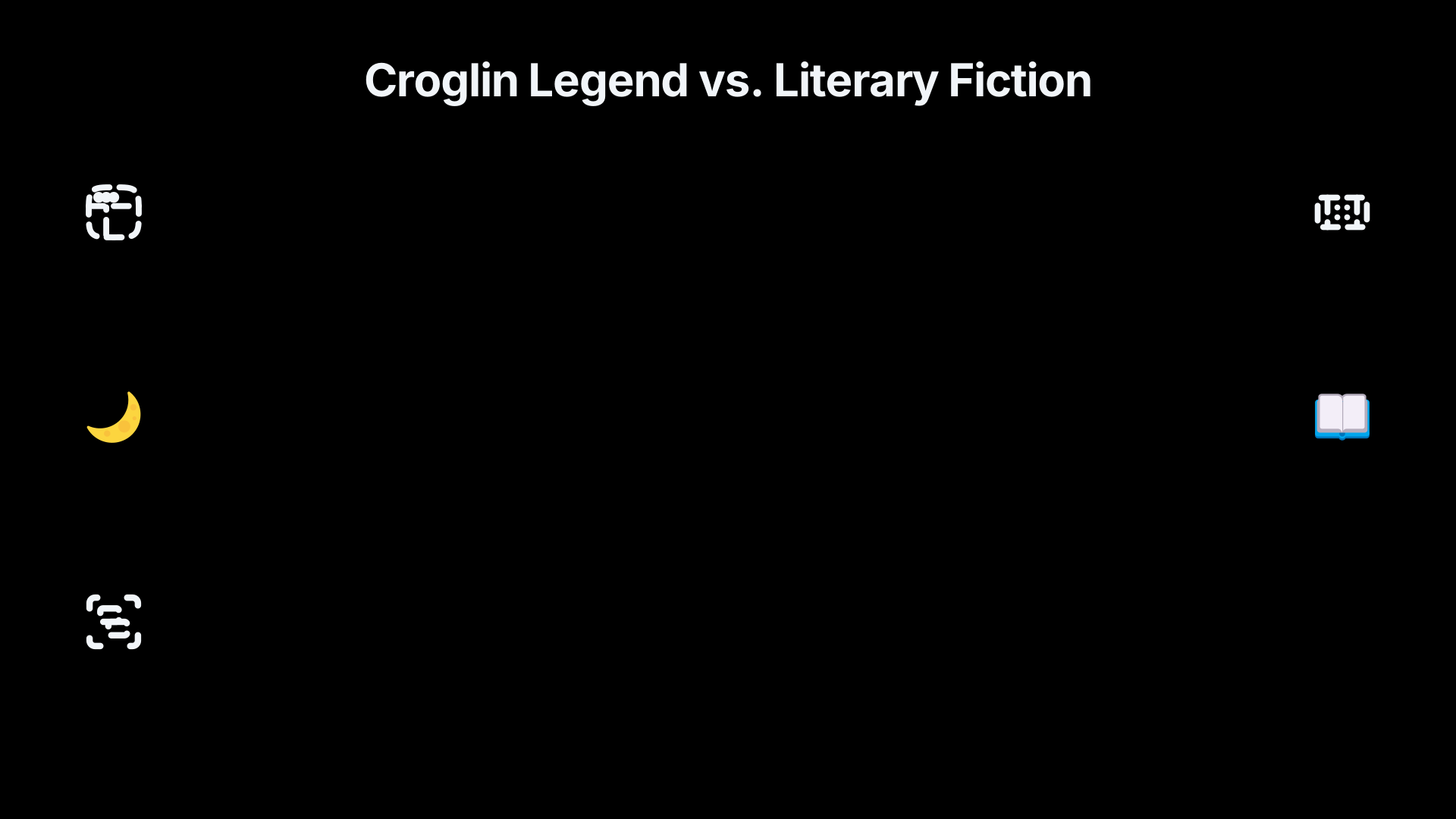
The most damaging literary problem is the resemblance between the Croglin attack and the opening of Varney the Vampyre, the long penny dreadful published in the 1840s. In Varney, the night visitor breaks a small pane of glass and introduces a long gaunt hand through the window. The scene involves a young woman in her chamber, a terrifying intruder, the forced window, a throat attack and melodramatic pursuit.[Project Gutenberg]gutenberg.orgProject Gutenberg Varney, the Vampyre | Project GutenbergProject Gutenberg Varney, the Vampyre | Project Gutenberg
This does not prove that Hare consciously copied Varney. Folklore can share motifs without direct plagiarism, and vampire stories often repeat a limited set of actions: nocturnal visitation, window entry, paralysis, blood at the throat, retreat to a grave. But the Croglin episode is unusually close to Victorian Gothic staging. The small pane, the long hand, the helpless woman, the throat wound and the domestic bedroom all feel less like an awkward witness statement and more like a scene already shaped by popular fiction.
That matters because Croglin is sometimes promoted as an “English vampire case”, as though it were a rare survival of old native belief. In reality, the printed account sits after decades of British Gothic vampire writing. Varney the Vampyre predates Hare’s published memoir and was a major source of popular vampire imagery, while Bram Stoker’s Dracula appeared in 1897, before Hare’s later memoir volumes were published in 1900. Modern claims that Croglin directly inspired Dracula should therefore be handled carefully unless evidence is supplied that Stoker knew the Croglin story through some earlier route.[Project Gutenberg]gutenberg.orgOpen source on gutenberg.org.
The better reading is that Croglin sits at a crossroads. It may preserve some local or family tale of an assault, a frightening intruder, a disturbed grave or a malign corpse legend. But the form in which the public inherited it is strongly Gothic. The story does not merely report fear; it performs fear in a recognisably Victorian way.
What local history can and cannot rescue
Local history does rescue part of the legend: it keeps it rooted in Cumberland rather than floating away as generic vampire fiction. Croglin was not invented for a cheap horror story. It was a small ancient parish with a medieval church site, a landed and manorial history, and old defensive buildings in a landscape shaped by agriculture and border insecurity.[Cumbria County History Trust]cumbriacountyhistory.org.ukCumbria County History Trust Croglin | Cumbria County History TrustCumbria County History Trust Croglin | Cumbria County History Trust
Croglin Low Hall also gives the tradition a tangible anchor. The building is not a fantasy castle, but an actual listed historic structure with medieval and early modern fabric. Its survival helps explain why visitors and writers keep returning to the story: the vampire may not be evidentially secure, but the setting feels physically credible. A lonely old hall on the Cumberland fellside, a churchyard with medieval associations, and a small community where stories could be passed around are exactly the materials from which haunted topography is made.[Historic England]historicengland.org.ukHistoric England Croglin Low Hall, KirkoswaldHistoric England Croglin Low Hall, Kirkoswald
At the same time, local history weakens the case if it is used too literally. The more precisely one asks “which window?”, “which vault?”, “which doctor?”, “which tenants?”, “which newspaper covered the burning?”, the less stable the tale becomes. Official heritage entries can confirm Croglin Low Hall’s age and importance; they cannot confirm a vampire attack. Parish history can confirm Croglin’s antiquity; it cannot turn Hare’s anecdote into a documented event.
The chapel question is a good example of this tension. Later investigators and retellings have tried to reconcile Hare’s “church in the hollow” with the physical landscape, sometimes by pointing to a lost chapel or to older religious sites near the hall. A lost chapel could help explain why a family or local version shifted between churchyard, chapel and burial place. But it still would not verify the central claim that a wounded undead corpse was found and burnt. It would only make the story’s geography less impossible.

Why the vampire still belongs to Cumberland
The Croglin Vampire belongs to Cumberland not because it is the county’s most reliable supernatural report, but because it reveals how Cumberland’s eerie history is made. Like many strong haunted-place legends, it joins three things: an old building, a charged landscape and a story that later writers could not resist retelling. Croglin provides the geography; Croglin Low Hall provides the architectural lure; Hare provides the literary launch.[cumbriacountyhistory.org.uk]cumbriacountyhistory.org.ukCumbria County History Trust Croglin | Cumbria County History TrustCumbria County History Trust Croglin | Cumbria County History Trust
It is also unusual within English haunted tradition. England has many ghosts, black dogs, boggarts, corpse roads and crisis apparitions, but full vampire legends are rarer. Croglin’s creature is not a suave aristocratic count. It is closer to a revenant: a shrivelled, grave-associated body that leaves its resting place, attacks the living, is discovered in a vault and is destroyed by burning. That makes it fit older corpse-fear traditions better than the romantic vampire image popularised by later fiction.
For a haunted Cumberland page, that distinction matters. The Croglin story is not just “a vampire in Cumbria”. It is a localised case where a rural churchyard legend, a fortified northern landscape and Victorian vampire fiction have become entangled. Its value lies in the tangle. A confident believer’s version strips away the problems and leaves only a monster. A dismissive version strips away the atmosphere and leaves only a hoax. The more useful reading keeps both in view: Croglin is a doubtful case, but a powerful legend.
How credible is the Croglin Vampire?
As evidence for a literal vampire, the case is very weak. The main problems are serious and cumulative:
- Late, literary transmission: the famous account comes through Hare’s memoir and an attributed conversation, not from direct official records.[Project Gutenberg]gutenberg.orgThe Project Gutenberg eBook of Story of My Life, volumes 4-6, by Augustus J. C. Hare…
- Unverified witnesses: the original printed passage does not give the tenants’ names, and later names and details come through secondary retellings.
- Geographical strain: the house, church, chapel, vault and landscape have been debated because the printed description does not sit effortlessly on the known local setting.[Heritage Gateway]heritagegateway.org.ukHeritage Gateway
- Architectural mismatch: Croglin Low Hall is real and old, but its recorded building history is more complex than Hare’s one-storey Grange.[Heritage Gateway]heritagegateway.org.ukHeritage Gateway
- Literary resemblance: key attack details resemble earlier Gothic vampire fiction, especially Varney the Vampyre.[Project Gutenberg]gutenberg.orgProject Gutenberg Varney, the Vampyre | Project GutenbergProject Gutenberg Varney, the Vampyre | Project Gutenberg
- Missing corroboration: a violent attack, armed pursuit, opened vault and burning of a corpse should have left some local trace beyond a polished anecdote, but the commonly cited evidence does not provide that level of confirmation.
As folklore, however, the case is strong. It has a memorable setting, repeatable scenes, a clear monster, an apparent method of destruction, and enough uncertainty to invite investigation. It also has the sort of place-name power that makes legends travel: “Croglin Grange” sounds like somewhere a Gothic event ought to happen, even before the reader knows anything about Cumberland.
The fairest verdict is that the Croglin Vampire was probably not “real” in the literal sense usually meant by paranormal retellings. It may have grown from a family story, a local assault memory, a churchyard rumour, a revenant tradition, a Gothic borrowing, or some mixture of these. What is real is the legend’s hold on Cumberland’s haunted map. Croglin remains one of the county’s strangest supernatural traditions precisely because the evidence does not settle down.
Amazon book picks
Further Reading
Books and field guides related to Was the Croglin Vampire Ever Real?. Use these as the next step if you want deeper reading beyond the article.

Bram Stoker's Dracula omnibus
First published 1897. Subjects: Fiction, horror, Children: Grades 3-4, Dracula, count (fictitious character), fiction, Frankenstein (fict...

The Vampire, His Kith and Kin
First published 2011. Subjects: Curiosities and wonders.
The Essential Dracula
An essay on the history of the vampire myth in literature accompanies an annotated version of the classic vampire tale.
eBay marketplace picks
Marketplace Samples
Live-tested eBay searches with available results related to this page.
Endnotes
1.
Source: gutenberg.org
Title: Project Gutenberg
Link:https://www.gutenberg.org/files/42770/42770-h/42770-h.htm
Source snippet
The Project Gutenberg eBook of Story of My Life, volumes 4-6, by Augustus J. C. Hare...
2.
Source: heritagegateway.org.uk
Title: Heritage Gateway
Link:https://www.heritagegateway.org.uk/Gateway/Results_Single.aspx?resourceID=19191&uid=12367
3.
Source: gutenberg.org
Link:https://www.gutenberg.org/ebooks/42770
4.
Source: gutenberg.org
Title: Project Gutenberg Varney, the Vampyre | Project Gutenberg
Link:https://www.gutenberg.org/files/14833/14833-h/14833-h.htm
5.
Source: gutenberg.org
Link:https://www.gutenberg.org/ebooks/14833
6.
Source: gutenberg.org
Link:https://www.gutenberg.org/ebooks/35589
7.
Source: gutenberg.org
Title: pg35589 images
Link:https://www.gutenberg.org/cache/epub/35589/pg35589-images.html
8.
Source: gutenberg.org
Link:https://www.gutenberg.org/ebooks/author/2896
9.
Source: gutenberg.org
Title: pg62873 images
Link:https://www.gutenberg.org/cache/epub/62873/pg62873-images.html
10.
Source: vampires.com
Title: the vampire of croglin grange
Link:https://www.vampires.com/the-vampire-of-croglin-grange/
11.
Source: vampires.com
Title: croglin grange did it really happen
Link:https://www.vampires.com/croglin-grange-did-it-really-happen/
12.
Source: cumbriacountyhistory.org.uk
Title: Cumbria County History Trust Croglin | Cumbria County History Trust
Link:https://www.cumbriacountyhistory.org.uk/township/croglin
13.
Source: historicengland.org.uk
Title: Historic England Croglin Low Hall, Kirkoswald
Link:https://historicengland.org.uk/listing/the-list/list-entry/1327062
14.
Source: northpennines.org.uk
Link:https://northpennines.org.uk/croglin_church_history/
15.
Source: historicengland.org.uk
Link:https://historicengland.org.uk/listing/the-list/
16.
Source: cumbriacountyhistory.org.uk
Link:https://www.cumbriacountyhistory.org.uk/sites/default/files/he_croglin.pdf
17.
Source: cumbriacountyhistory.org.uk
Link:https://www.cumbriacountyhistory.org.uk/resource/historic-england-croglin
18.
Source: Wikipedia
Title: Croglin Grange
Link:https://en.wikipedia.org/wiki/Croglin_Grange
19.
Source: Wikipedia
Link:https://en.wikipedia.org/wiki/Croglin
20.
Source: genuki.org.uk
Link:https://www.genuki.org.uk/big/eng/CUL/Croglin
21.
Source: esmeraldamac.wordpress.com
Title: the croglin vampire
Link:https://esmeraldamac.wordpress.com/2010/10/27/the-croglin-vampire/
22.
Source: nwf.org
Title: The Vampire
Link:https://www.nwf.org/~/media/PDFs/GABC/The%20Vampire.pdf
23.
Source: projectgutenbergproject.blogspot.com
Title: review varney vampire by thomas
Link:https://projectgutenbergproject.blogspot.com/2012/10/review-varney-vampire-by-thomas.html
24.
Source: matthewb447.sg-host.com
Title: croglin vampire
Link:https://matthewb447.sg-host.com/case_file/croglin-vampire/
25.
Source: soilstonebone.co.uk
Title: The Croglin Vampire
Link:https://soilstonebone.co.uk/the-croglin-vampire
Additional References
26.
Source: youtube.com
Link:https://www.youtube.com/watch?v=Garhmhis3cU
Source snippet
Vampire of Croglin Grange | The Legend.. The History.. The Theories...
27.
Source: youtube.com
Title: Vampire of Croglin Grange | The Legend.. The History.. The Theories
Link:https://www.youtube.com/watch?v=DW6T5AnvrVY
Source snippet
Croglin Grange Vampire | The Dark Record | Ep. 42...
28.
Source: youtube.com
Title: The Vampire of Croglin Grange | Spooky Folklore from the Folk Bus
Link:https://www.youtube.com/watch?v=fYcMqvLcEo0
Source snippet
The Haunted Landscape: The Croglin Grange Vampire...
29.
Source: youtube.com
Title: Croglin Grange Vampire | The Dark Record | Ep. 42
Link:https://www.youtube.com/watch?v=9t6YV8H7W-I
Source snippet
The Vampire of Croglin Grange | Spooky Folklore from the Folk Bus...
30.
Source: facebook.com
Link:https://www.facebook.com/thetudorintruders/posts/a-little-bedtime-story-for-you-allin-the-1890s-augustus-hare-wrote-an-account-of/1344196984016718/
31.
Source: talesofmytery.blogspot.com
Link:https://talesofmytery.blogspot.com/2013/12/augustus-hare-vampire-of-croglin-grange.html
32.
Source: visitcumbria.com
Link:https://www.visitcumbria.com/churches/croglin-st-johns-church/
33.
Source: history.ac.uk
Link:https://www.history.ac.uk/research/victoria-county-history/counties-z/cumberland
34.
Source: archive.org
Link:https://www.archive.org/stream/varneythevampire14833gut/14833.txt
35.
Source: scribd.com
Link:https://www.scribd.com/document/857004137/Vampires-Among-Us-Guiley-Rosemary
Topic Tree