Within Haunted Radnorshire
Radnorshire's Haunted Ruins and Lost Places
Cefnllys and Abbey Cwmhir show how ruined settlements, monastic mystery and vanished communities can haunt Radnorshire without a single famous apparition.
On this page
- Cefnllys as a ghost village
- Abbey Cwmhir's unresolved memory
- How absence becomes haunting
Page outline Jump by section
Introduction
Cefnllys and Abbey Cwmhir are among Radnorshire’s most haunting places because they are not built around a neat, repeated apparition story. Their ghostliness comes from absence: a vanished borough with a church standing almost alone in pasture, and a broken Cistercian abbey tied to the unresolved memory of Llywelyn ap Gruffudd, the last native Prince of Wales. Cefnllys is sometimes described as a “ghost village”, but the phrase is more historical than paranormal: the settlement failed, shrank and left only earthworks, ruins and St Michael’s Church to mark where a medieval community once stood. Abbey Cwmhir, meanwhile, is haunted less by a named spectre than by a national wound: tradition says Llywelyn’s headless body was buried there after his death at Cilmeri in 1282.[Wikipedia]WikipediaOpen source on wikipedia.org.
That makes these ruins useful for understanding Radnorshire’s eerie reputation. The county’s supernatural atmosphere often depends on lost places, lonely approaches and old political violence rather than on well-documented ghost sightings. Cefnllys and Abbey Cwmhir show how a landscape can feel haunted when history has left just enough behind to invite questions, but not enough to answer them.
Cefnllys as a ghost village
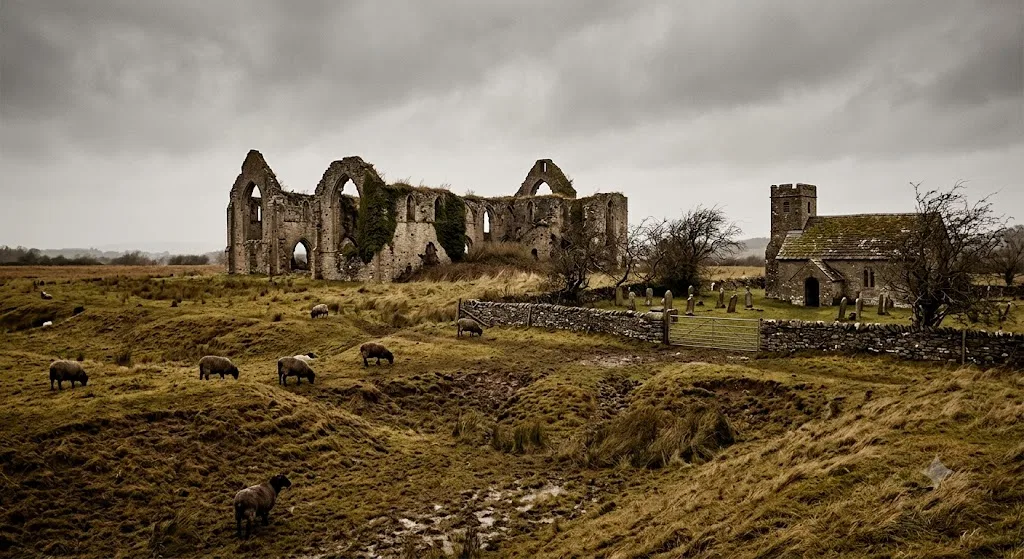
Cefnllys lies just over 2 km east of Llandrindod Wells, where a high isolated hill rises inside a loop of the River Ithon. The Clwyd-Powys Archaeological Trust describes the earthwork remains of Cefnllys Castle on the hill, with the church and associated settlement on a lower spur projecting towards the river. That geography matters: the place reads almost theatrically, with castle earthworks above, St Michael’s Church below, and the modern visitor crossing towards a site that looks as if its village has slipped out of sight.[Heneb]heneb.org.ukHeneb Microsoft WordHeneb Microsoft Word
The “ghost village” label has a factual core. Cefnllys was a medieval borough associated with the Mortimers and the lordship of Maelienydd. A market charter had been granted by 1297, and by 1304 there were 25 tenants and a mill; yet by 1332 only 20 burgesses were recorded, and fifty years later ten burgages had been abandoned. The Trust’s historic-settlement report presents Cefnllys as a short-lived borough whose intended role as a chief town never truly took hold.[Heneb]heneb.org.ukHeneb Microsoft WordHeneb Microsoft Word
Its decline is usually explained through practical history rather than through legend. The settlement was militarily useful but commercially awkward: isolated, exposed to Marcher conflict, and poorly placed for long-term urban success once its strategic purpose faded. Later summaries also point to plague outbreaks, economic isolation and insecurity in the Welsh Marches as likely contributors to its failure. The result is not a haunted village in the sense of nightly apparitions, but a place where the visible landscape is out of proportion to what once happened there: borough, market, castle, church, court and road have collapsed into a scattering of earthworks and memory.[Wikipedia]WikipediaOpen source on wikipedia.org.
St Michael’s Church sharpens that effect. The church is remote today, yet it was not built for emptiness. A Radnorshire churches survey describes it as a basically medieval structure, substantially restored after the Middle Ages, with a fifteenth-century screen and pre-Reformation fittings such as a font, piscina and aumbry. The church therefore acts like a surviving witness: not a ruin itself in the ordinary sense, but a standing remnant of a settlement that has largely vanished around it.[Heneb]heneb.org.ukHeneb Radnorshire Churches SurveyHeneb Radnorshire Churches Survey
Why Cefnllys feels haunted without a famous ghost
The most striking thing about Cefnllys is the mismatch between its old importance and its present quiet. A castle was built by Roger Mortimer in the thirteenth century, a second keep was developed later in the century, and the site was repeatedly involved in the struggle between Marcher power and Welsh rule. The castle was burnt by forces associated with Owain Glyndŵr in 1406, rebuilt or repaired at different points, and was ruinous by the time John Leland passed the area around 1540.[Heneb]heneb.org.ukHeneb Microsoft WordHeneb Microsoft Word
That layered violence does not produce a single canonical Cefnllys ghost, at least not in the stronger historical sources. Instead, it gives the site a more archaeological kind of haunting. The visitor sees a church, paths, river crossing and castle banks, then has to imagine the missing crowd: burgesses, soldiers, market traffic, court business, parishioners and people trying to live under unstable border politics. In folklore terms, this is a haunting by social memory rather than by a named apparition.
Modern travel and landscape writing often reinforces that mood. A Guardian country diary described St Michael’s as serving a “long-lost borough” and placed the church amid earthworks, bracken, shadow and the River Ithon crossing near Shaky Bridge. Such writing is not ghost evidence, but it shows why the site lends itself to eerie interpretation: Cefnllys is encountered as a place where the ordinary signs of settlement have been stripped away, leaving the church and castle remains to carry the emotional weight.[The Guardian]theguardian.comThe Guardian Country diary: A remote church in a long-lost boroughThe Guardian Country diary: A remote church in a long-lost borough
The approach also matters. Local church information directs visitors from Llandrindod Wells along Cefnllys Lane to the picnic area at Shaky Bridge, then onwards towards the church. That small act of crossing from road to field helps create the atmosphere: the place is close to a town, yet it feels separated from it, as if the visitor has stepped sideways into an older Radnorshire.[Penybont Community Centre]penybontcc.co.ukPenybont Community Centre Llanfihangel Cefnllys Church, Llandrindod WellsPenybont Community Centre Llanfihangel Cefnllys Church, Llandrindod Wells
Abbey Cwmhir’s unresolved memory
Abbey Cwmhir is more explicitly tied to death, burial and national loss. The abbey was a Cistercian house in Radnorshire, founded in 1176 by Cadwallon ap Madog and colonised from Whitland Abbey. Monastic Wales notes that Cwmhir stood between rival powers: native Welsh rulers on one side and the Mortimer family on the other. That divided patronage placed the abbey in a dangerous political landscape, not merely a secluded religious one.[Monastic Wales]monasticwales.orgSite details: Cwmhir…
Cadw describes the abbey as a daughter house of Whitland which underwent a major thirteenth-century building programme under the support of Llywelyn ap Iorwerth, but was never completed. The same Cadw account says it is reputed to be the final resting place of Llywelyn ap Gruffudd after his death at Cilmeri in 1282; Cadw also explains that Llywelyn’s head was taken to London, while his body is said to have been taken to Cwmhir by his followers.[Cadw]cadw.gov.walesCadw Castles of the Princes of Wales | CadwCadw Castles of the Princes of Wales | Cadw
That tradition is the core of Abbey Cwmhir’s ghostly power. It is not simply that a prince died; it is that the story separates head from body, public humiliation from private burial, conquest from remembrance. The ruin becomes a place where a broken political order is imagined as a broken body. Even when the language stays historical rather than supernatural, the emotional structure is close to a haunting: something unfinished remains attached to the ground.
The physical remains deepen that feeling because the abbey itself is fragmentary. Cadw’s listed-building record says work did not continue after Llywelyn the Great’s death in 1240, that the size of the church may have reflected his political ambitions, and that the abbey was damaged by Owain Glyndŵr in 1402 and probably never fully restored. At the Dissolution in 1537 it had only three monks, and part of its nave arcade was later removed and re-erected at Llanidloes parish church.[Cadw Public API]cadwpublic-api.azurewebsites.netCadw Public APIListed BuildingsCadw Public APIListed Buildings
The headless prince and the limits of the ghost story
Abbey Cwmhir does attract supernatural retellings, especially around the idea of Llywelyn’s headless body. A modern local-news Halloween piece reported the 2017 story of an Australian visitor who returned a stone taken from the abbey, saying they had suffered bad luck after removing it. The report framed the episode as an unusual Powys ghost story connected with Llywelyn and the abbey’s thirteenth-century walls.[Brecon & Radnor Express]brecon-radnor.co.ukBrecon & Radnor Express B&R Halloween: Ghost stories from around PowysBrecon & Radnor Express B&R Halloween: Ghost stories from around Powys
That story is memorable, but it is not the same as a long, well-attested apparition tradition. It is a modern curse-like anecdote: a stolen fragment, a guilty return, and a historic figure powerful enough to make the act feel dangerous. The more cautious reading is that Abbey Cwmhir’s “ghost” is partly a moral mechanism. Removing stone from a ruin feels like disturbing a grave, and the legend of Llywelyn gives that unease a face.
There is also uncertainty around the burial tradition itself. Cadw uses careful wording, saying the abbey is “reputed” to be Llywelyn’s final resting place and that his body is “said” to have been taken there. Abbey Cwmhir Heritage Trust similarly presents the place through mysteries and memories, including the unresolved questions surrounding the abbey’s foundation, construction and burial associations. This does not make the tradition worthless; it makes it more haunting. A confirmed grave can become a monument, but an uncertain grave remains a question.[Cadw]cadw.gov.walesCadw Castles of the Princes of Wales | CadwCadw Castles of the Princes of Wales | Cadw
For readers of haunted Radnorshire, that distinction is important. Abbey Cwmhir should not be presented as a site where a ghost is proven to walk. Its stronger claim is subtler: it is a ruin where historical violence, incomplete architecture, national memory and later supernatural retellings gather around the same absence.
How absence becomes haunting
Cefnllys and Abbey Cwmhir work as ghostly ruins because they leave the imagination with gaps to fill. At Cefnllys, the missing thing is a borough: the market, houses and civic life that once justified a castle-town. At Abbey Cwmhir, the missing thing is resolution: the completed abbey that never fully emerged, the community that dwindled, the body said to be buried without its head, and the grave whose certainty remains contested.[heneb.org.uk]heneb.org.ukHeneb Microsoft WordHeneb Microsoft Word
The mechanism is different from a classic haunted inn or manor-house story. These places do not depend on a recurring white lady, a named room, or a chain of signed witness statements. They become eerie through four overlapping features:
- A visible remnant: St Michael’s Church at Cefnllys and the surviving abbey ruins at Cwmhir give the imagination something concrete to attach to.
- A vanished community: Cefnllys’s lost borough and Cwmhir’s reduced monastic house make absence feel human rather than abstract.
- A violent border history: both places sit within the Marcher world of Mortimer power, Welsh resistance and unstable lordship.
- An unresolved story: Cefnllys leaves questions about where the town lay and why it failed; Abbey Cwmhir leaves questions about Llywelyn’s burial and the abbey’s unfinished ambition.
This is why both places belong in Radnorshire’s haunted-history map even when the evidence for apparitions is thin. They show a form of haunting that is common in rural Wales and the Marches: not spectacle, but residue. A road ends at a lonely church. A great abbey survives as a broken outline. A prince’s body is remembered more vividly because the story is incomplete.
What these ruins reveal about haunted Radnorshire
Radnorshire’s ghostly character is often quieter than the better-known haunted circuits of Wales. Cefnllys and Abbey Cwmhir are not best understood as attractions built around paranormal certainty. They are places where history has become atmospheric because settlement, worship and political power have ebbed away, leaving ruins in landscapes that still feel charged.
Cefnllys gives Radnorshire its clearest example of the “ghost village” mechanism: a medieval planned or semi-planned borough whose failure is now legible through emptiness. Abbey Cwmhir gives the county a deeper national resonance: a monastic ruin tied to the death of Llywelyn ap Gruffudd and the end of independent native rule in Wales. Together they show how Radnorshire can be haunted without needing a single famous apparition to dominate the story.[Wikipedia]WikipediaOpen source on wikipedia.org.
Their credibility, therefore, has to be judged in two layers. As paranormal evidence, the material is sparse and should be treated cautiously. As haunted folklore and eerie historic landscape, it is much stronger. The ruins preserve the kinds of absence that ghost stories often grow from: abandoned settlement, damaged sacred space, political trauma, uncertain burial and the feeling that a place has not quite finished speaking.
Amazon book picks
Further Reading
Books and field guides related to Radnorshire's Haunted Ruins and Lost Places. Use these as the next step if you want deeper reading beyond the article.

British Goblins : Welsh Folk-Lore, Fairy Mythology, Legends a...
Provides historical context for haunted Welsh landscapes.
The Mammoth Book of Haunted House Stories
Appeals to readers of atmospheric historic settings.

Ghostland: An American History in Haunted Places
Explores why abandoned places become haunted in public imagination.
The world's most haunted places
Places Welsh ruins within a broader haunted-place tradition.
eBay marketplace picks
Marketplace Samples
Live-tested eBay searches with available results related to this page.
Endnotes
1.
Source: Wikipedia
Link:https://en.wikipedia.org/wiki/Cefnllys
2.
Source: monasticwales.org
Title: Monastic Wales
Link:https://www.monasticwales.org/site/26
Source snippet
Site details: Cwmhir...
3.
Source: cadwpublic-api.azurewebsites.net
Title: Cadw Public APIListed Buildings
Link:https://cadwpublic-api.azurewebsites.net/reports/listedbuilding/FullReport?id=8717
4.
Source: Wikipedia
Title: Cwmhir Abbey
Link:https://en.wikipedia.org/wiki/Cwmhir_Abbey
5.
Source: Wikipedia
Title: Cefnllys Castle
Link:https://en.wikipedia.org/wiki/Cefnllys_Castle
6.
Source: cadw.gov.wales
Title: Cadw Castles of the Princes of Wales | Cadw
Link:https://cadw.gov.wales/visit/best-history/castles-princes-wales
7.
Source: heneb.org.uk
Title: Heneb Microsoft Word
Link:https://heneb.org.uk/archive/cpat/ycom/radnor/cefnllys.pdf
8.
Source: heneb.org.uk
Title: Heneb Radnorshire Churches Survey
Link:https://heneb.org.uk/archive/cpat/Archive/churches/radnor/16743.htm
9.
Source: theguardian.com
Title: The Guardian Country diary: A remote church in a long-lost borough
Link:https://www.theguardian.com/uk-news/2023/mar/11/country-diary-a-remote-church-in-a-long-lost-borough
10.
Source: penybontcc.co.uk
Title: Penybont Community Centre Llanfihangel Cefnllys Church, Llandrindod Wells
Link:https://www.penybontcc.co.uk/_UserFiles/Files/Church/Llanfihangel%20Cefnllys%20Church%20final.pdf
11.
Source: brecon-radnor.co.uk
Title: Brecon & Radnor Express B&R Halloween: Ghost stories from around Powys
Link:https://www.brecon-radnor.co.uk/news/br-halloween-ghost-stories-from-around-powys-83788
12.
Source: heneb.org.uk
Link:https://heneb.org.uk/archive/cpat/ycom/radnor/abbeycwmhir.pdf
13.
Source: heneb.org.uk
Link:https://heneb.org.uk/archive/cpat/ycom/radnor/CPAT1088int.pdf
14.
Source: yumpu.com
Title: Cefnllys Castle
Link:https://www.yumpu.com/en/document/view/40275830/cefnllys-castle-royal-commission-on-the-ancient-and-historical-
15.
Source: peoplescollection.wales
Title: Abbey Cwmhir Heritage Trust
Link:https://www.peoplescollection.wales/users/45941
16.
Source: rcahmw.gov.uk
Link:https://rcahmw.gov.uk/discover/coflein/
17.
Source: medievalheritage.eu
Link:https://medievalheritage.eu/en/main-page/heritage/wales/cefnllys-st-michaels-church/
18.
Source: castlewales.com
Link:https://www.castlewales.com/cefnllys.html
19.
Source: archive.org
Link:https://archive.org/stream/cistercianabbey00willgoog/cistercianabbey00willgoog_djvu.txt
20.
Source: myplaceformystery.com
Link:https://myplaceformystery.com/tag/wales/
21.
Source: coflein.gov.uk
Link:https://coflein.gov.uk/en/sites/305798?fbclid=IwAR0xl6eCC7CBbGDqc6TRFFoaprJDK-rW-3GaqdSHS-mNL2cEfWJptNJz8Gw%2F
22.
Source: coflein.gov.uk
Title: English – Coflein Cefnllys Castle;Castell Glan Iethon;Castle Bank · AP
Link:https://coflein.gov.uk/en/archives/6519198/sites
23.
Source: en.unionpedia.org
Link:https://en.unionpedia.org/i/Powys
24.
Source: churchinwales.org.uk
Link:https://www.churchinwales.org.uk/en/structure/church/5544/
Additional References
25.
Source: youtube.com
Title: Cefnllys Castle Radnorshire Wales
Link:https://www.youtube.com/watch?v=YvVE9NnaIpw
Source snippet
Castle Bank/Cefnllys Castle Llandrindod Wells 4K Drone...
26.
Source: youtube.com
Title: Castle Bank/Cefnllys Castle Llandrindod Wells 4K Drone
Link:https://www.youtube.com/watch?v=OxDHHbL0MHg
Source snippet
Is This the Most Beautiful Bluebell Wood in Wales?...
27.
Source: churchmonumentssociety.org
Link:https://churchmonumentssociety.org/monument-of-the-month/15629
28.
Source: facebook.com
Link:https://www.facebook.com/groups/35809823308/posts/10161054127658309/
29.
Source: facebook.com
Link:https://www.facebook.com/groups/590505444386356/posts/3956694911100709/
30.
Source: abbeycwmhir.org
Link:https://abbeycwmhir.org/mysteries-and-memories/
31.
Source: nationaltrail.co.uk
Link:https://www.nationaltrail.co.uk/en_GB/attraction/abbey-cwmhir-ruins-cadw-ehibition-room/
32.
Source: castlewales.com
Link:https://www.castlewales.com/cwmhir.html
33.
Source: abbeycwmhir.org
Link:https://abbeycwmhir.org/aboutus/
34.
Source: cbawales.org
Link:https://cbawales.org/volunteers/
Topic Tree