Within Haunted Kirkcudbrightshire
Was Ringcroft Scotland's Strangest Poltergeist Case?
Ringcroft is Kirkcudbrightshire's strongest haunting because its strange disturbances were recorded by a local minister and witnesses.
On this page
- The Mackie household at Ringcroft of Stocking
- Stones, fire and ministerial witnesses
- Religious fear, folklore and sceptical readings
Page outline Jump by section
Introduction
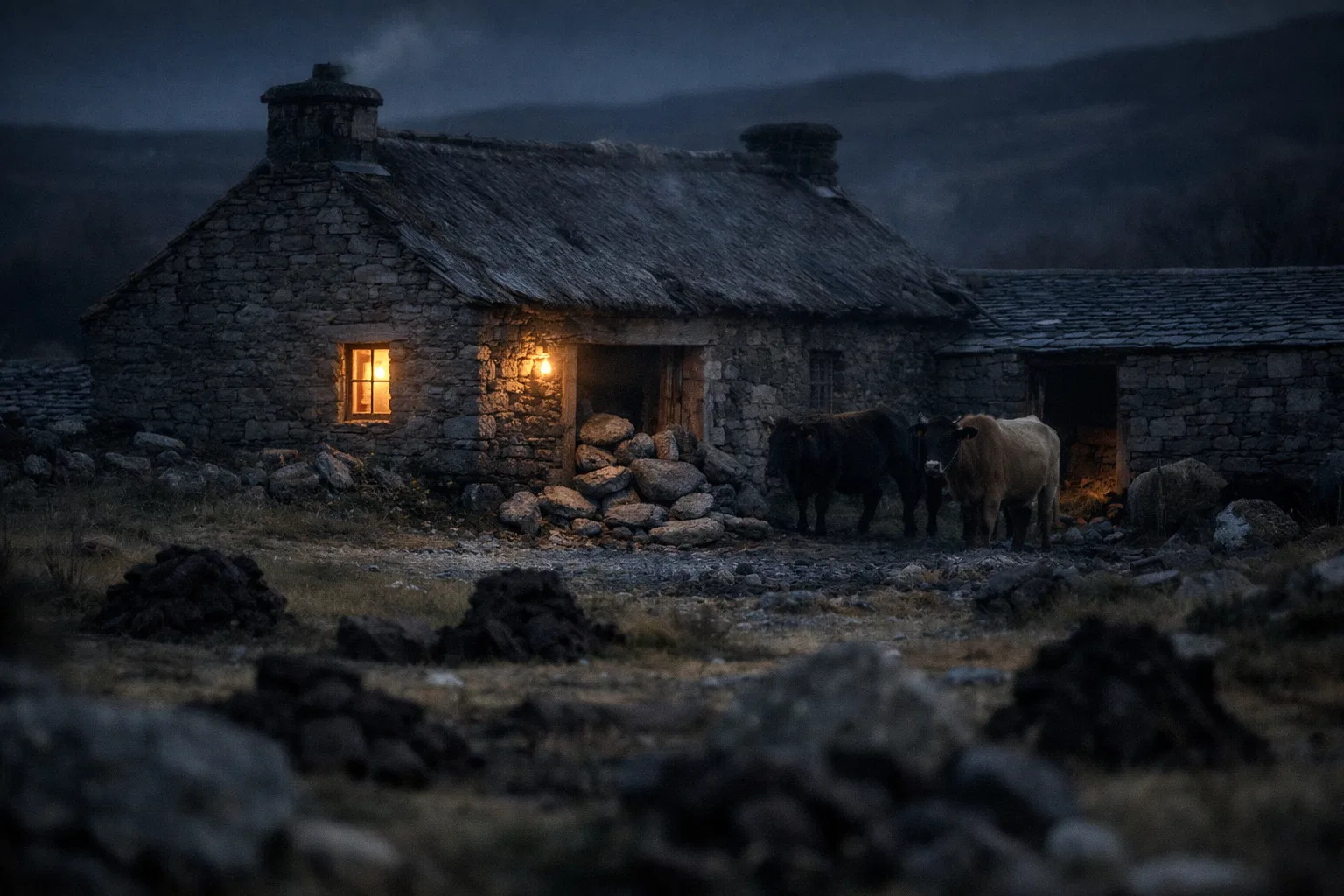
The Ringcroft Poltergeist is usually treated as Kirkcudbrightshire’s strongest haunting tradition because it is not just a vague tale attached to a ruined farm. It rests on a named 1695 household, a named parish minister, a printed 1696 pamphlet, and a trail of people who said they had seen, heard or felt the disturbances for themselves. The case centred on Andrew Mackie, a mason and farmer, at Ring-Croft of Stocking in Rerrick parish, near Auchencairn in the historic county of Kirkcudbrightshire. The alleged activity included loosened cattle, stones thrown indoors, fires started in outbuildings, blows from unseen forces, strange voices, a “letter” said to be written in blood, and a final ministerial response of fasting and prayer. None of this proves a ghost or spirit was present. What makes Ringcroft remarkable is that the story was framed from the start as evidence: a public, signed, religiously charged witness account from south-west Scotland at the end of the seventeenth century.[wellcomecollection.org]wellcomecollection.orgOpen source on wellcomecollection.org.
Where Ringcroft was, and why the place matters
Ring-Croft of Stocking belonged to the old parish of Rerrick, a Solway-side parish in southern Kirkcudbrightshire that included Auchencairn and Dundrennan. In modern terms the area sits within Dumfries and Galloway, but the older county setting matters for this project because the pamphlet itself places the affair in the “Stewartry of Kirkcudbright”, the historic frame through which local ministers, lairds and neighbours understood the event. Rerrick is described by historic-county sources as a parish on the Solway Firth coast, south-east of Kirkcudbright, with Auchencairn lying within it.[Wikishire]wikishire.co.ukOpen source on wikishire.co.uk.
The exact farmstead is no longer an obvious visitor landmark. Local-history summaries place Ring Croft of Stocking just west of Auchencairn, near present Collin Farm, while later discussion of nineteenth-century mapping suggests the name “The Ring” survived as a ruined site below Stocking Hill rather than as a standing haunted house.[Goblinshead]goblinshead.co.ukOpen source on goblinshead.co.uk.
That lost-location quality is part of the story’s atmosphere. Ringcroft is not a restored castle with a ticket desk and a tidy ghost legend. It is a vanished rural household: a byre, a hearth, a barn, peat fuel, livestock, neighbours walking in from nearby farms, and ministers travelling through the parishes of Kirkcudbrightshire. The haunting, as preserved, is domestic rather than theatrical. Its terror lies in ordinary things becoming hostile: cattle unfastened, peats burning on the floor, stones falling in prayer, straw catching fire, and household tools moving as if under someone else’s hand.[Jardine's Book of Martyrs]drmarkjardine.wordpress.comOpen source on wordpress.com.

The Mackie household at Ringcroft of Stocking
The principal witness-account was written by Alexander Telfair, minister of Rerrick. The Wellcome Collection catalogue records the 1696 work under the title A true relation of an apparition: expressions and actings of a spirit which infected the house of Andrew Mackie in Ring-Croft of Stocking, in the paroch of Kerrick, in the stewartry of Kirkcudbright, in Scotland, printed in Edinburgh by George Mosman. It is a very small publication, only 15 pages plus an unnumbered page, but its survival gives the Ringcroft case a firmer documentary base than most rural haunting traditions.[Wellcome Collection]wellcomecollection.orgOpen source on wellcomecollection.org.
Telfair did not present Andrew Mackie as a suspicious outsider or obvious villain. On the contrary, he described him as outwardly moral, honest, civil and harmless, and he explicitly said he knew no ground for blaming Mackie’s wife or children for the trouble. That matters because early modern haunting stories often turn quickly into accusations: witchcraft, hidden sin, covenant with the Devil, secret murder, or household fraud. Telfair records rumours but does not treat them all as proven.[Jardine's Book of Martyrs]drmarkjardine.wordpress.comOpen source on wordpress.com.
The rumours are still revealing. Telfair says it was “given out” that Mackie, as a mason, had somehow devoted his first child to the Devil when taking the “mason-word”, a claim Telfair rejected. He also investigated a story that clothes left by a woman of bad reputation had been kept back by the family, and he repeats a strange tale from an earlier tenant’s time: a “tooth” supposedly hidden beneath the threshold and later burned because no one in the house would thrive until it was destroyed. Telfair finally admits that the true cause of the disturbance remained unknown.[Jardine's Book of Martyrs]drmarkjardine.wordpress.comOpen source on wordpress.com.
For a modern reader, this opening is as important as the flying stones. It shows the story being turned into an inquiry. The minister is not simply saying, “a ghost was seen”. He is collecting rumours, cross-examining the family, weighing local explanations, and then moving into a day-by-day account. The assumptions behind that inquiry are seventeenth-century religious assumptions, not modern forensic ones, but the shape is still recognisably evidential.
Stones, fire and ministerial witnesses
The disturbances were said to begin in February 1695 with the livestock. Mackie found young beasts loose in the night, their bindings broken even after he made the tethers stronger. When he moved the animals, one was allegedly found tied by a hair tether to a beam of the house, its feet just touching the ground. Soon afterwards, the family woke to smoke from peats piled and lit in the middle of the house floor.[Jardine's Book of Martyrs]drmarkjardine.wordpress.comOpen source on wordpress.com.
By 7 March, the story had shifted from nuisance to assault. Telfair records stones thrown inside the house from no visible source, especially at night. On 9 March, the children saw what they thought was a body sitting by the fireside with a blanket over it; when the youngest boy pulled the blanket away, it proved to be a stool set upright. That scene is one of the most memorable in the whole case because it sits exactly between ghost story and prank: frightening in the moment, but physically explainable once touched.[Jardine's Book of Martyrs]drmarkjardine.wordpress.comOpen source on wordpress.com.
Telfair’s own claimed experience made the case more than hearsay. He says he went to the house, prayed there, saw stones fall outside, and later had stones thrown at him indoors. On another night he reported being struck on the sides and shoulders with a staff while witnesses heard the blows. He also described feeling pressure on his arm and seeing a small white hand and arm vanish. Even within the pamphlet, this is treated as exceptional: Telfair says almost nothing was seen throughout the affair except that hand, a figure glimpsed at a window, a boy-like apparition reported by others, and the children’s fireside shape.[Jardine's Book of Martyrs]drmarkjardine.wordpress.comOpen source on wordpress.com.
The witness trail widened in April. Charles Macklelane of Collin, Mackie’s landlord, went with Mackie to ministers meeting at Buittle, and two ministers, Andrew Ewart of Kells and John Murdoch of Crossmichael, came to Ringcroft for fasting and prayer. Telfair says the unseen force threw heavy stones, wounded Ewart in the head, struck Murdoch, threw a fiery peat among the people, and poured stones down as the group rose from prayer. Later, five ministers were appointed at Kirkcudbright to go to the house with Telfair for further fasting and prayer.[Jardine's Book of Martyrs]drmarkjardine.wordpress.comOpen source on wordpress.com.
This is why Ringcroft stands out in Kirkcudbrightshire’s haunted history. Many ghost traditions depend on “someone once saw” or “it is said”. Ringcroft gives names, dates, places and repeated attestations. The final list includes five ministers besides Telfair, along with local men from Collin, Millhouse, Torr, Hardhills and elsewhere. That does not make the story objectively true; signed belief is not the same as proof. It does mean the case became a documented social event rather than a private family anecdote.[Jardine's Book of Martyrs]drmarkjardine.wordpress.comOpen source on wordpress.com.

The “blood” letter and the warning to Scotland
One of the strangest episodes came on 8 April, when Andrew Mackie was said to have found a sealed letter written in blood. According to the pamphlet transcription, the message warned Scotland to repent, claimed that the “door of heaven” was already barred, and predicted that Mackie would be troubled for 23 days. The letter and some bones found beneath a loose stone were sent to the ministers, who had gathered at Kirkcudbright.[Jardine's Book of Martyrs]drmarkjardine.wordpress.comOpen source on wordpress.com.
This episode pulls the story away from a simple haunted-house narrative and into the religious fear of the 1690s. The “spirit” does not merely throw stones; it preaches, threatens, interrupts prayer, whistles, groans, and demands attention. Later in April, it allegedly said that God had given it a commission to warn the land to repent, and that if Scotland did not do so it might return with worse forces to trouble every family in the land.[Jardine's Book of Martyrs]drmarkjardine.wordpress.comOpen source on wordpress.com.
For Telfair, this mattered because he was not writing a neutral ghost report. His preface says he published the account to counter what he saw as a spirit of atheism and infidelity that denied the existence of spirits, heaven, hell, God and devils. He also urged household prayer, warning that neglect might allow Satan to trouble families with voices, apparitions and harm.[Jardine's Book of Martyrs]drmarkjardine.wordpress.comOpen source on wordpress.com.
That religious purpose does not invalidate the document, but it must shape how it is read. Telfair wanted the Ringcroft disturbances to do moral work. He presented them as a warning, not merely as a curiosity. The case therefore sits at a crossroads: part local haunting, part anti-sceptical tract, part parish crisis, part printed sermon in narrative form.
Religious fear, folklore and sceptical readings
Ringcroft belongs to a south-west Scottish world where witchcraft belief, Covenanting memory, parish discipline and fears about irreligion were still powerful. Historian Lizanne Henderson’s work on witch belief in south-west Scotland places Rerrick alongside other late seventeenth-century cases in which spirits, witchcraft suspicions and church authority remained socially potent. Her discussion notes Telfair’s pamphlet as evidence from Rerrick and sets it within a wider regional climate of spiritual anxiety.[Enlighten Publications]eprints.gla.ac.ukOpen source on gla.ac.uk.
Modern sceptical readings usually focus on three possibilities. The first is practical joking or deliberate fraud, especially because several episodes involve objects that could be moved by human hands: stools, blankets, stones, staves, straw, peats and household tools. A later nineteenth-century critic in The Saturday Review, quoted in modern summaries, dismissed the affair as a mixture of folklore and obvious imposture, complaining that the witnesses never seriously considered a practical joke.[Wikipedia]WikipediaOpen source on wikipedia.org.
The second is child-centred mischief or ventriloquism. Some later writers have suggested that one of Mackie’s children could have produced the voices or helped stage parts of the disturbance. The argument gains some force from the fireside stool scene and from the fact that poltergeist narratives often cluster around households with children or adolescents. It does not easily explain every claimed injury, every adult witness, or every fire; but those details are themselves mediated through a pamphlet written to persuade.[Wikipedia]WikipediaOpen source on wikipedia.org.
The third reading is social contagion: once the farm was understood as spiritually troubled, ordinary sounds, accidents, animal movement, weather, fear, rumour and expectation may have been interpreted as part of one escalating pattern. Telfair’s own text shows how quickly the story moved through the neighbourhood. Visitors came, neighbours were struck or frightened, ministers were called, and the household became the centre of a public drama.[Jardine's Book of Martyrs]drmarkjardine.wordpress.comOpen source on wordpress.com.
The most careful position is therefore neither to accept the “spirit” as fact nor to flatten the whole affair into a simple hoax. The source is too motivated to be treated as plain observation, but too detailed to be dismissed as a late-invented legend. It records what a minister and his circle wanted others to believe had happened at a particular Kirkcudbrightshire farm in 1695.
Why Ringcroft became Kirkcudbrightshire’s key haunting case
Ringcroft became locally famous because it has three strengths that many haunted-place stories lack. First, it is anchored to a precise event window, from February to May 1695. Secondly, it has a printed near-contemporary source, published the following year in Edinburgh. Thirdly, it offers a witness structure: named ministers, named neighbours, named nearby places, and repeated claims that particular incidents were attested by those present.[Wellcome Collection]wellcomecollection.orgOpen source on wellcomecollection.org.
The case also has unusually vivid “poltergeist” texture. A typical apparition story may involve a figure on a road or a face at a window. Ringcroft is more physical and chaotic. Its alleged phenomena include moved animals, broken bindings, hidden objects, thrown stones, blows from staves, pulled clothing, fires in thatch and straw, voices in prayer, and the eventual burning of a sheep-house on 1 May, after which Telfair says the trouble ceased.[Jardine's Book of Martyrs]drmarkjardine.wordpress.comOpen source on wordpress.com.
For readers exploring haunted Kirkcudbrightshire, that makes Ringcroft the natural evidential centre of the county’s supernatural folklore. MacLellan’s Castle, Dundrennan district legends, lonely roads and later ghost-tour stories may be more visible to visitors, but Ringcroft has the stronger paper trail. Its power comes not from a surviving ruin but from a document: a compact, unsettling witness pamphlet that lets the reader follow the fear as it spreads from one household to a parish network.
The result is a haunting that feels both eerie and historically revealing. Whether the disturbances were fraud, panic, misread accidents, religious theatre, deliberate mischief, or something that witnesses genuinely could not explain, the Ringcroft case shows how a small Kirkcudbrightshire farm could become, for a few months in 1695, a stage on which ordinary rural life, ministerial authority, witchcraft memory and fear of unseen forces all collided.
Amazon book picks
Further Reading
Books and field guides related to Was Ringcroft Scotland's Strangest Poltergeist Case?. Use these as the next step if you want deeper reading beyond the article.
Witchcraft and superstitious record in the south-western dist...
Discusses the Ringcroft tradition within regional folklore.
The Haunting of Borley Rectory
Natural companion for readers interested in famous poltergeist cases.
eBay marketplace picks
Marketplace Samples
Live-tested eBay searches with available results related to this page.
Endnotes
1.
Source: Wikipedia
Link:https://en.wikipedia.org/wiki/Auchencairn
2.
Source: kirkcudbright.co
Title: The Parish of Rerrick
Link:https://www.kirkcudbright.co/rerrick.asp
3.
Source: Wikipedia
Link:https://sco.wikipedia.org/wiki/Auchencairn
4.
Source: wellcomecollection.org
Link:https://wellcomecollection.org/works/rtdpja9r
5.
Source: drmarkjardine.wordpress.com
Link:https://drmarkjardine.wordpress.com/2017/01/12/the-rerrick-apparition-a-true-and-attested-account-of-satans-methods-in-scotland-history/
6.
Source: wikishire.co.uk
Link:https://wikishire.co.uk/wiki/Rerrick
7.
Source: goblinshead.co.uk
Link:https://www.goblinshead.co.uk/bogles/ring-croft-of-stocking/
8.
Source: eprints.gla.ac.uk
Link:https://eprints.gla.ac.uk/7706/1/Lizanne2.pdf
9.
Source: drmarkjardine.wordpress.com
Title: thomas kilpatrick of closeburn
Link:https://drmarkjardine.wordpress.com/category/by-name/thomas-kilpatrick-of-closeburn/
10.
Source: drmarkjardine.wordpress.com
Title: buittle parish
Link:https://drmarkjardine.wordpress.com/category/by-parish/buittle-parish/
11.
Source: drmarkjardine.wordpress.com
Link:https://drmarkjardine.wordpress.com/category/by-parish/irongray-parish/page/2/
12.
Source: vamzzz.com
Link:https://vamzzz.com/blog/poltergeist/
Additional References
13.
Source: youtube.com
Link:http://www.youtube.com/watch?v=sJuc02OyQwc
Source snippet
Ringcroft Poltergeist The Ringcroft Poltergeist: Scotland’s Most Terrifying Haunting (True Story) Residual Fear...
14.
Source: youtube.com
Title: Tales From Wyrd Scotland | Episode 19
Link:http://www.youtube.com/watch?v=CJkHWB52lkQ
Source snippet
The Rerrick Poltergeist — 14 Witnesses. Never Explained...
15.
Source: youtube.com
Title: Ringcroft of Stocking & The Mackie Poltergeist by Dark Histories
Link:http://www.youtube.com/watch?v=pDRWOrB9UH4
Source snippet
Tales From Wyrd Scotland | Episode 19 - The Ringcroft Poltergeist, an Infestation of Evil...
16.
Source: youtube.com
Title: The Ringcroft Poltergeist: Scotland’s Most Terrifying Haunting (True Story)
Link:http://www.youtube.com/watch?v=1s45KH7Ck1U
Source snippet
Ringcroft of Stocking & The Mackie Poltergeist by Dark Histories...
17.
Source: youtube.com
Title: The Rerrick Poltergeist — 14 Witnesses. Never Explained
Link:http://www.youtube.com/watch?v=Uo5VP4I3OLA
Source snippet
The Ghost Librarian's Ghastly Tales of Galloway -The True Account of the Rerrick Apparition...
18.
Source: tumgik.com
Link:https://www.tumgik.com/tag/Richard%20Telfair
19.
Source: amazon.co.uk
Link:https://www.amazon.co.uk/confutation-Sadducism-narrative-wonderful-expressions/dp/1240781601?tag=searcht-20
20.
Source: openlibrary.org
Link:https://openlibrary.org/works/OL11352747W/A_true_relation_of_an_apparition
21.
Source: facebook.com
Link:https://www.facebook.com/groups/NovaScotiaMemoriesOfDaysGoneBy/posts/3186205951613714/
22.
Source: trove.scot
Link:https://www.trove.scot/image/1615944
Topic Tree