Where Does Wigtownshire Feel Most Haunted?
Wigtownshire’s haunted reputation is quieter than that of Edinburgh, Glencoe, or the better-advertised castles of the Highlands, but it has a distinct flavour of its own: sea cliffs, drowned sands, ruined abbeys, old tower houses, smuggling coasts, Covenanting memory, and stories passed through local antiquarian books rather than glossy ghost-tour lists.
Page outline Jump by section
Introduction
The historic county matters here. Wigtownshire is the western part of Galloway, bounded by the North Channel, Luce Bay, Wigtown Bay, Ayrshire, and Kirkcudbrightshire; its main landscapes include the Rhinns of Galloway, the Machars, the Mull of Galloway, Loch Ryan, the River Bladnoch, the Water of Luce, and the Wigtown Bay coast. Modern local government folds it into Dumfries and Galloway, but historic-county mapping keeps the focus on the old shire: Stranraer, Wigtown, Whithorn, Glenluce, Portpatrick, Leswalt, Kirkmaiden, Sorbie, Glasserton, and the surrounding farms and ruins.[Wikishire]wikishire.co.ukWikishire WigtownshireWikishire Wigtownshire
Where Wigtownshire’s ghost map begins
Wigtownshire’s stories are shaped by geography. The Rhinns thrust into the North Channel; the Machars lie between Wigtown Bay and Luce Bay; Stranraer looks over Loch Ryan; Portpatrick faces Ireland from a cliff-fringed coast; and the old county is crossed by rivers, bays, mosses, farms and old church sites. This matters because many of the county’s ghost stories are not indoor drawing-room tales. They are attached to thresholds: a castle on a cliff, a cave below the tide line, a road to Portpatrick, a grave near Bladnoch, a ruined church by Luce Bay, a drowned stake in the mudflats.[Wikishire]wikishire.co.ukWikishire WigtownshireWikishire Wigtownshire
The county boundary also helps avoid a common confusion. Modern “Dumfries and Galloway” ghost articles often mix Wigtownshire with Dumfriesshire and Kirkcudbrightshire. Stories such as the A75 “ghost road” or the Ringcroft of Stocking poltergeist are important to the wider region, but they do not all sit within the historic county. Ringcroft, for example, is usually located in the old Stewartry of Kirkcudbright, not Wigtownshire, even though it is often presented in broad Dumfries and Galloway round-ups.[goblinshead.co.uk]goblinshead.co.ukOpen source on goblinshead.co.uk.
For Wigtownshire itself, the best older printed concentration is J. Maxwell Wood’s Witchcraft and Superstitious Record in the South-Western District of Scotland, a 1911 collection now freely available via Project Gutenberg. Wood’s chapter on “Ghost Lore and Haunted Houses” deliberately moves from western Galloway eastwards, beginning with Dunskey Castle and then listing Galdenoch Tower, High Ardwell, Auchabrick, Glenluce, Wigtown, Bladnoch, Sorbie, Whithorn, Glasserton, and Kirkmaiden. That makes it unusually useful for this county page, though it still needs to be read as folklore collection, not as verified paranormal evidence.[Project Gutenberg]gutenberg.orgWitchcraft and Superstitious Record in the South-Western District of Scotland, by J. Maxwell Wood—A Project Gutenberg eBook…
Dunskey Castle: the piper under the cliffs
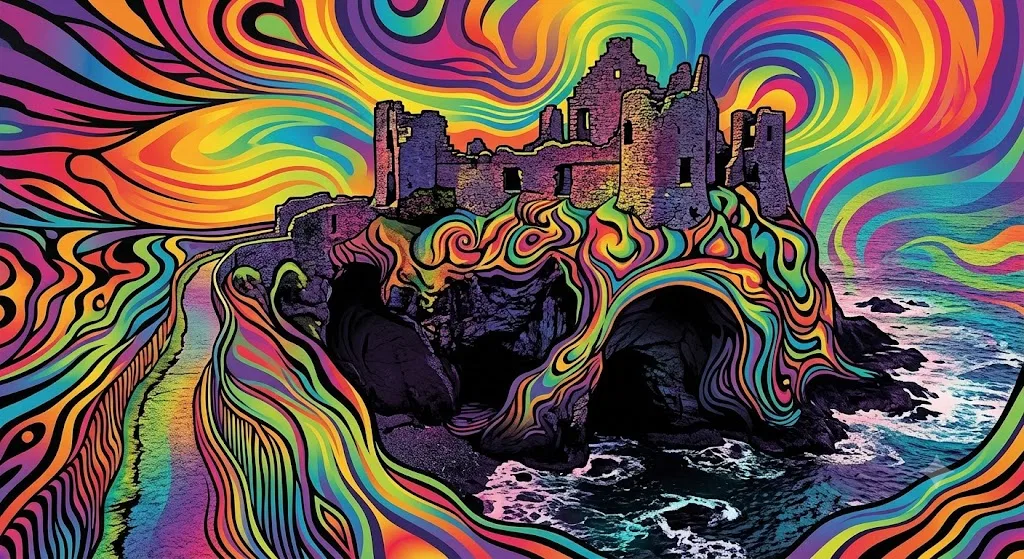
The most memorable Wigtownshire haunting is probably Dunskey Castle, a ruined tower house just south of Portpatrick on the west coast of the Rhinns. Historic Environment Scotland describes Dunskey as an early 16th-century L-plan castle on a cliff-edge promontory, cut off on the landward side by a moat and approached by a causeway; Trove, the national historic environment portal, places it in the parish of Portpatrick and the former county of Wigtownshire.[Historic Environment Scotland]portal.historicenvironment.scotOpen source on historicenvironment.scot.
The ghost story is older in tone than the surviving building’s main fabric. Wood records the tradition of Walter de Curry, a violent sea-rover said to have imprisoned an Irish piper or minstrel in Dunskey’s dungeons. The piper supposedly escaped into a secret passage leading towards a cave below the castle, but failed to find his way out and died there. Afterwards, local tradition said his troubled ghost marched back and forth through the hidden way, playing eerie pipe music that marked the course of the underground passage.[Project Gutenberg]gutenberg.orgWitchcraft and Superstitious Record in the South-Western District of Scotland, by J. Maxwell Wood—A Project Gutenberg eBook…
Modern retellings add or emphasise other figures. Atlas Obscura summarises two common Dunskey legends: a nursemaid who dropped a baby from a window to the beach below, and a piper who entered the caves beneath the castle and was never seen again, though his pipes are still said to be heard. The Castles of Scotland site similarly lists a brownie or “hairy man”, the nursemaid, and a spectral piper or jester trapped in the caves.[Atlas Obscura]atlasobscura.comAtlas Obscura Dunskey Castle in PortpatrickAtlas Obscura Dunskey Castle in Portpatrick
The Dunskey legend works because the setting makes the story feel plausible without proving it. A cliff castle, caves, sea noise, wind, ruin, and dangerous paths give the mind plenty to work with. The alleged pipe music may be a supernatural claim, but it is also a classic coastal explanation for strange sounds: waves in caves, wind through broken masonry, birds, and echoes can all create uncanny effects. The value of the story is not that it proves a ghost, but that it binds Dunskey’s architecture, coastline and older fears of imprisonment, drowning and piracy into one memorable local myth.

Galdenoch Tower and the Covenanting dead
Galdenoch Tower, in the parish of Leswalt, carries what Wood calls “perhaps the best-known Galloway ghost story”. His account says the tower had once belonged to the Agnews of Galdenoch and later became a farmhouse, but was abandoned because it was believed to be haunted. The tradition, attributed to Sir Andrew Agnew, links the haunting to the Covenanting wars: a young soldier from the house supposedly killed a Royalist host after a battle and later returned home, only to be followed by the ghost of the slain man.[Project Gutenberg]gutenberg.orgWitchcraft and Superstitious Record in the South-Western District of Scotland, by J. Maxwell Wood—A Project Gutenberg eBook…
The power of the Galdenoch story lies in its moral structure. The young man may have been a fugitive and may have acted from fear, but the tale does not simply celebrate his escape. Instead, the dead host comes after him and makes the tower unliveable. The haunting becomes a way of saying that political and religious violence did not end when the rider reached home. It crossed the threshold and stayed there.
This is a recurring Wigtownshire pattern. The county’s ghost lore often returns to the later 17th century, when Covenanting repression left a heavy mark on south-west Scotland. Wigtownshire’s best-known historical memory from that period is not a ghost story at all, but the Wigtown Martyrs; yet even non-ghost traditions from the same era feed the county’s atmosphere of restless memory, wrongful death, and moral reckoning.
Wigtown, the Martyrs’ Stake, and the haunting of memory
Wigtown’s most powerful “haunting” is historical before it is paranormal. The Martyrs’ Stake east of the town commemorates Margaret Maclauchlan and Margaret Wilson, the two Covenanter women traditionally said to have been tied to stakes on the mudflats and drowned by the incoming tide in 1685. Scotland Starts Here states that the monument was erected in 1858 to commemorate the two women and locates it east of Wigtown; Undiscovered Scotland describes the wider Wigtown Martyrs group as five Covenanters executed in 1685, including three men who were hanged and the two women who were drowned.[Scotland Starts Here]scotlandstartshere.comwigtown martyrs stakewigtown martyrs stake
The story has also been debated. Some later writers questioned details of the martyrdom tradition, while more recent historical discussion has tried to weigh Presbyterian sources against government records and the named military officers in Wigtownshire at the time. Mark Jardine’s detailed History Scotland-linked discussion argues that the Presbyterian sources’ naming of Major George Winram is striking because he appears in government records at Wigtown later in 1685, making simple fabrication less likely, though the case remains historically complex.[Jardine's Book of Martyrs]drmarkjardine.wordpress.comOpen source on wordpress.com.
For a haunted-history page, the important point is not to turn the Martyrs’ Stake into a ghost sighting. Rather, it is a place where historical trauma has repeatedly invited supernatural and literary treatment. In 2020, Wigtown Book Festival published Karen Campbell’s “The Ghosts of Wigtown”, a contemporary supernatural story set “down by the Martyrs’ Stake”, explicitly framing Wigtown as a place where “history never sleeps”. That is modern fiction, not folklore evidence, but it shows how the stake continues to act as an imaginative pressure point in the town.[Wigtown Book Festival]wigtownbookfestival.comthe ghosts of wigtownthe ghosts of wigtown
Wigtown’s martyr tradition is also tied to landscape. The mudflats, the River Bladnoch, Wigtown Bay, the shifting relation between land and tide, and the physical walk to the memorial all contribute to the atmosphere. A reader looking for an “apparition” may find the evidence thin; a reader interested in haunted memory will find one of the strongest examples in the county.
Glenluce: abbey ruins, monastic quiet and the “Devil of Glenluce”
Glenluce Abbey is one of the county’s most atmospheric ruins. Historic Environment Scotland describes it as a place to learn about 400 years of monastic life in the valley of the Water of Luce, with the last monks living through the Reformation and ending their days in the cloister. HES also notes the surviving south transept as a well-preserved fragment of 13th-century Cistercian architecture.[Historic Environment Scotland]historicenvironment.scotHistoric Environment Scotland Glenluce Abbey | Historic ScotlandHistoric Environment Scotland Glenluce Abbey | Historic Scotland
Older history gives the ruin more depth than a generic “haunted abbey” label. The HES Statement of Significance says Glenluce was probably founded in 1191/2 by Roland, Lord of Galloway, and identifies it as a Cistercian house with monastic buildings around a cloister. The abbey’s modern appeal is partly visual and partly emotional: a secluded valley, broken stone, religious change, and the sense of a disciplined community reduced to ruins.[HES Publications]app-hes-pubs-prod-neu-01.azurewebsites.netHES Publications Glenluce Abbey Statement of SignificanceHES Publications Glenluce Abbey Statement of Significance
Wood’s folklore collection points readers from the Rhinns to the Machars through Glenluce and notes the “surprising story of the Devil of Glenluce”, which he says appears in Satan’s Invisible World, published in 1685. This tale belongs more to demonological and witchcraft literature than to a simple castle ghost tradition. It should be treated cautiously, because 17th-century demonological texts were written in a world where ministers, printers and readers often interpreted unexplained disturbances through religious fear and the language of Satan.[Project Gutenberg]gutenberg.orgWitchcraft and Superstitious Record in the South-Western District of Scotland, by J. Maxwell Wood—A Project Gutenberg eBook…
That sceptical caution does not make the story worthless. It tells us how people in and around Wigtownshire made sense of disorder: fire, voices, movement, illness, sudden fear, or family misfortune might be explained as demonic agency. In modern terms, Glenluce sits at the meeting point of ruined religious architecture, Reformation history, and early modern supernatural explanation.
Stranraer and the Castle of St John
Stranraer’s Castle of St John is less famous as a ghost site than Dunskey, but it belongs naturally in Wigtownshire’s haunted-history map. Undiscovered Scotland describes the castle as standing in the heart of Stranraer, built by the Adairs of Kilhilt around 1510 near an earlier chapel dedicated to St John. The same account traces its later uses as a government garrison during Covenanting unrest, then as a prison with cells for criminals, rooms for debtors, and a courthouse.[Undiscovered Scotland]undiscoveredscotland.co.ukUndiscovered Scotland Castle of St John Feature Page on Undiscovered ScotlandUndiscovered Scotland Castle of St John Feature Page on Undiscovered Scotland
The building’s afterlife is important. A tower house that became a garrison, prison, court and wartime lookout has the ingredients that ghost tours often use: confinement, military occupation, punishment, and layered civic memory. Dumfries and Galloway Council’s culture listing flags “spooky October” at the castle, while local coverage from DGWGO reported that Mostly Ghostly Tours used the Castle of St John as the setting for “Secret Stranraer”, an evening of hidden history and haunting tales covering Stranraer and nearby places including Glenluce, Leswalt and Portpatrick.[DGCulture]dgculture.co.ukOpen source on dgculture.co.uk.
This is a case where the public-facing haunting tradition appears to be strongest in performance and local storytelling rather than in a single old named apparition. That does not make it less relevant. It shows how Wigtownshire’s ghost culture survives today: not only in antiquarian books, but in guided walks, festival events, seasonal programming, and the reuse of old civic spaces as stages for unsettling history.

Whithorn, Craigdhu and the Machars’ uneasy lanes
Whithorn is one of the oldest sacred landscapes in Scotland. Historic Environment Scotland states that Whithorn Priory stood at the heart of Christian worship for more than 1,000 years, drawing pilgrims and worshippers from across Scotland to St Ninian’s shrine. That long religious past gives Whithorn a different atmosphere from Dunskey or Stranraer: less cliff-gothic, more graveyard, crypt, pilgrimage and ruined ecclesiastical authority.[Historic Environment Scotland]historicenvironment.scotHistoric Environment Scotland Whithorn Priory and Museum | Historic ScotlandHistoric Environment Scotland Whithorn Priory and Museum | Historic Scotland
Wood’s ghost-lore chapter records that the old parish manse of Whithorn, beside the churchyard, had an uncanny reputation and was avoided after dark, although he admits that “nothing very definite” could be gathered to explain it. This is a useful example of honest folklore handling: not every spooky site has a clear story, and some reputations survive as mood rather than narrative.[Project Gutenberg]gutenberg.orgWitchcraft and Superstitious Record in the South-Western District of Scotland, by J. Maxwell Wood—A Project Gutenberg eBook…
More developed is the story of Craigdhu, in Glasserton parish, on the shore road from Whithorn to Port William. Wood records conflicting rumours of something seen there: some described it as human-shaped, others as a huge unknown quadruped. He then gives three witness-linked reminiscences: a farm servant who claimed repeated sightings, a wood-sawyer who heard the sound of a lady’s silk dress and was then struck in bed by an unseen force, and an ex-magistrate of Whithorn who said he was chased to a farmhouse door.[Project Gutenberg]gutenberg.orgWitchcraft and Superstitious Record in the South-Western District of Scotland, by J. Maxwell Wood—A Project Gutenberg eBook…
Craigdhu is one of the better Wigtownshire examples of a “localised fear zone”: a place where the details vary, but the reputation is fixed. From a sceptical angle, the conflicting forms weaken the claim that a single apparition was observed. From a folklore angle, that very instability is revealing. The story’s function is not to identify one ghost with a neat biography; it is to mark a stretch of road and shore as unsafe after dark.
White women, spectral riders and haunted farm roads
Several Wigtownshire stories are not attached to grand ruins but to routes between settlements. Wood records a “woman in white” on the Portpatrick road in the days when the mail packet crossed from Portpatrick to Ireland. A carrier from High Ardwell, who regularly travelled to Portpatrick for supplies, was said to have been stopped by a white woman who frightened his horse, broke down his cart, and once appeared seated behind him after he abandoned the load and rode home.[Project Gutenberg]gutenberg.orgWitchcraft and Superstitious Record in the South-Western District of Scotland, by J. Maxwell Wood—A Project Gutenberg eBook…
The same passage includes Auchabrick House in Kirkmaiden, near Port Logan, where a young man connected with privateering was said to have sent home a silk dress and money to his beloved, only for an unscrupulous brother to intercept them. After the man died abroad, his ghost supposedly returned, entering despite locked doors and making the sound of a pen rewriting the stolen letters. A variation turns the ghost into a booted and spurred rider on a grey horse.[Project Gutenberg]gutenberg.orgWitchcraft and Superstitious Record in the South-Western District of Scotland, by J. Maxwell Wood—A Project Gutenberg eBook…
At Cardrain, again in the same general locality, Wood notes another apparition on horseback: a figure that rode up, fastened its horse, and wandered through the house. At Tirally, the shade of a dead medical man was said to wander the shore, while the house he had occupied was reportedly abandoned by a later tenant because of persistent disturbing noises.[Project Gutenberg]gutenberg.orgWitchcraft and Superstitious Record in the South-Western District of Scotland, by J. Maxwell Wood—A Project Gutenberg eBook…
These are small stories, but they are valuable because they show Wigtownshire’s haunted geography at human scale. The county’s ghosts are not only noble ladies and murdered prisoners. They are carriers, riders, lovers, privateers, doctors, farm tenants and people moving between coast, road and house. The repeated motifs are also familiar across British folklore: the white woman, the spectral rider, the haunted former dwelling, the returning wronged lover, and the noise that makes a house uninhabitable.
Bladnoch, Sorbie and the ghosts of moral panic
Near Bladnoch, Wood records the grim tradition of the Packman’s Grave at Kirkwaugh. The story says a travelling packman had cloth aboard a plague-stricken vessel that came into a local port. Fearing infection, people in the district seized both the man and his goods, buried them together, and left the packman alive in the grave. Later tradition claimed that lights and knocks were heard at the spot.[Project Gutenberg]gutenberg.orgWitchcraft and Superstitious Record in the South-Western District of Scotland, by J. Maxwell Wood—A Project Gutenberg eBook…
This story is especially revealing because it is less about a named ghost than about communal fear. Whether or not anything like the event occurred, the tale preserves a nightmare of contagion, scapegoating and live burial. In modern terms, it reads as a plague legend: a story about the terrible things a frightened community might do when disease arrives from the sea.
Near Sorbie, at Claunch, Wood records a spectral carriage and pair of horses seen in a moonlit farmyard by a blacksmith and a farmer. The account gives no secure origin for the apparition, and the farmer’s warning not to speak too freely about it feels like part of the folklore itself: silence becomes a protective habit.[Project Gutenberg]gutenberg.orgWitchcraft and Superstitious Record in the South-Western District of Scotland, by J. Maxwell Wood—A Project Gutenberg eBook…
These tales are harder to verify than monument-based traditions, but they are exactly the kind of story that made rural ghost lore work. They attach fear to specific places; they give ordinary travellers a reason to remember a bend, yard, grave or shore; and they turn social anxieties — plague, secrecy, guilt, bad luck — into visible or audible signs.
Fairies, caves and the older supernatural layer
Not all Wigtownshire supernatural tradition is ghostly. Some of the older material belongs to fairy lore, sea-lore and stories of hidden passages. Wigtown Book Festival’s “Galloway Tales” series, drawing on Hugh McMillan’s work inspired by John McTaggart’s 1824 Scottish Gallovidian Encyclopedia, records that sailors once threw bread ashore at the Cove of the Grennan near Luce Bay to keep the fairies favourable for the voyage round the Mull of Galloway. It also preserves a cave story in which a piper entered a fairy cave said to run through to Clonyard Bay; the sound of his pipes went deeper and deeper, then stopped.[Wigtown Book Festival]wigtownbookfestival.comgalloway tales fairies and plaguesgalloway tales fairies and plagues
This matters because the Dunskey piper legend is not isolated. The lost piper in a cave is a wider British and Irish motif, especially common around castles, underground passages and coastal caves. Wigtownshire’s version gains local force from the Rhinns and Luce Bay landscape, but its structure is shared: music enters the earth, sound marks a hidden route, and silence signals disappearance.
Wood’s older collection also places the Mull of Galloway in a fairy-haunted legendary landscape, describing it as the traditional scene of the last stand of the Picts and listing fairy-related places around the Rhinns and Wigtownshire coast. Again, this is not evidence for fairies. It is evidence for how the county’s lonely headlands, caves and sea passages were given supernatural meaning.[Project Gutenberg]gutenberg.orgWitchcraft and Superstitious Record in the South-Western District of Scotland, by J. Maxwell Wood—A Project Gutenberg eBook…
How credible are the Wigtownshire hauntings?
The honest answer is that Wigtownshire has strong folklore, moderate historical anchoring, and very little modern evidential material that would satisfy a sceptical investigator. Its best stories survive through antiquarian collection, local tradition, visitor writing, ghost-tour performance, and modern retellings. That is typical of many rural British haunting traditions.
The most source-grounded elements are the places themselves. Dunskey Castle, Glenluce Abbey, Whithorn Priory, the Castle of St John, the Martyrs’ Stake, Wigtown, Portpatrick, Glenluce, Leswalt and the Machars are real, historically documented locations. Their architecture, religious history, prison history, Covenanting associations and coastal setting can be checked against heritage bodies and local-history sources.[historicenvironment.scot]portal.historicenvironment.scotOpen source on historicenvironment.scot.
The ghost claims are thinner. Dunskey’s piper, Galdenoch’s revenant, the High Ardwell white woman, Craigdhu’s shape, the Packman’s Grave lights, and the Claunch carriage are best read as traditions preserved in print rather than as independently verified events. Wood’s book is valuable because it names places, collectors and some informants, but it was still written in an antiquarian mode and often relays “tradition” rather than documentary proof.[Project Gutenberg]gutenberg.orgWitchcraft and Superstitious Record in the South-Western District of Scotland, by J. Maxwell Wood—A Project Gutenberg eBook…
The most careful reading is therefore neither credulous nor dismissive. Wigtownshire’s hauntings are credible as folklore: they show what local people feared, remembered and repeated. They are not credible as confirmed proof of apparitions. Their real value is cultural, historical and atmospheric — a way of reading the county’s ruins, roads, bays and churchyards through the stories that clung to them.
Why Wigtownshire feels haunted even when the evidence is fragmentary
Wigtownshire’s haunted character comes from accumulation. A single Dunskey piper tale might be just another castle legend. But place it beside the Wigtown Martyrs, Glenluce’s demonological inheritance, Whithorn’s millennium of worship, Galdenoch’s Covenanting revenant, the Packman’s Grave, the white woman of High Ardwell, the roads around Kirkmaiden and the caves of Luce Bay, and a pattern appears.
The county’s stories repeatedly return to four themes:
Tide and drowning. Dunskey’s cave, the lost pipers, the Wigtown mudflats, Luce Bay, Portpatrick and the Mull of Galloway all use the sea as a boundary between life and disappearance.
Religious conflict. The Covenanting period, the Martyrs’ Stake, Galdenoch, Glenluce’s Reformation setting, and Whithorn’s older sacred status give the county’s ghost lore a moral and spiritual charge.
Roads after dark. High Ardwell, Craigdhu, Claunch, Cardrain and other rural traditions make movement itself uncanny. The ghost is often met on the way home.
Unsettled houses. Galdenoch Tower, Auchabrick, Tirally, Whithorn’s old manse and other dwellings become haunted because something morally unresolved is believed to have entered the building.
This is why Wigtownshire is best approached not as a county of headline “most haunted” attractions, but as a landscape of low-voiced supernatural memory. Its ghost stories are often fragmentary, but the fragments fit the place: sea wind, ruined stone, old religion, difficult roads, and the suspicion that some histories do not stay buried.

eBay marketplace picks
Marketplace Samples
Live-tested eBay searches with available results related to this page.
Endnotes
1.
Source: goblinshead.co.uk
Link:https://www.goblinshead.co.uk/bogles/ring-croft-of-stocking/
2.
Source: gutenberg.org
Title: Project Gutenberg
Link:https://www.gutenberg.org/files/43966/43966-h/43966-h.htm
Source snippet
Witchcraft and Superstitious Record in the South-Western District of Scotland, by J. Maxwell Wood—A Project Gutenberg eBook...
3.
Source: trove.scot
Title: Scot Dunskey Castle | Place | trove.scot
Link:https://www.trove.scot/place/60632
4.
Source: dgwgo.com
Title: secret stranraer revealed
Link:https://www.dgwgo.com/out-and-about-in-dg/secret-stranraer-revealed/
5.
Source: trove.scot
Title: Dunskey Castle
Link:https://www.trove.scot/designation/SM2017
6.
Source: trove.scot
Link:https://www.trove.scot/place/61214
7.
Source: dunskey.com
Link:https://www.dunskey.com/
8.
Source: whithorn.com
Title: ruaridhs notes from the crypt
Link:https://www.whithorn.com/ruaridhs-notes-from-the-crypt/
9.
Source: dgwgo.com
Title: scariest places in dumfries and galloway
Link:https://www.dgwgo.com/out-and-about-in-dg/scariest-places-in-dumfries-and-galloway/
10.
Source: wigtown.scot
Link:https://wigtown.scot/xtra-seeanddo/the-wigtown-martyrs/
11.
Source: wikishire.co.uk
Title: Wikishire Wigtownshire
Link:https://wikishire.co.uk/wiki/Wigtownshire
12.
Source: Wikipedia
Link:https://en.wikipedia.org/wiki/Wigtownshire
13.
Source: portal.historicenvironment.scot
Link:https://portal.historicenvironment.scot/apex/f?p=1505%3A300%3A%3A%3A%3A%3AVIEWTYPE%2CVIEWREF%3Adesignation%2CLB16777
14.
Source: atlasobscura.com
Title: Atlas Obscura Dunskey Castle in Portpatrick
Link:https://www.atlasobscura.com/places/dunskey-castle
15.
Source: scotlandstartshere.com
Title: wigtown martyrs stake
Link:https://scotlandstartshere.com/point-of-interest/wigtown-martyrs-stake/
16.
Source: undiscoveredscotland.co.uk
Link:https://www.undiscoveredscotland.co.uk/wigtown/martyrs/index.html
17.
Source: drmarkjardine.wordpress.com
Link:https://drmarkjardine.wordpress.com/2020/06/28/the-wigtown-martyrs-touching-the-void-between-the-reprieve-and-execution-in-1685-history-scotland/
18.
Source: wigtownbookfestival.com
Title: the ghosts of wigtown
Link:https://www.wigtownbookfestival.com/library/the-ghosts-of-wigtown
19.
Source: historicenvironment.scot
Title: Historic Environment Scotland Glenluce Abbey | Historic Scotland
Link:https://www.historicenvironment.scot/visit/all/glenluce-abbey/
20.
Source: app-hes-pubs-prod-neu-01.azurewebsites.net
Title: HES Publications Glenluce Abbey Statement of Significance
Link:https://app-hes-pubs-prod-neu-01.azurewebsites.net/api/file/1fc924a6-954e-49c8-99d5-aaff00fb8072
21.
Source: undiscoveredscotland.co.uk
Title: Undiscovered Scotland Castle of St John Feature Page on Undiscovered Scotland
Link:https://www.undiscoveredscotland.co.uk/stranraer/castleofstjohn/index.html
22.
Source: dgculture.co.uk
Link:https://www.dgculture.co.uk/venue/castle-of-st-john-stranraer/
23.
Source: historicenvironment.scot
Title: Historic Environment Scotland Whithorn Priory and Museum | Historic Scotland
Link:https://www.historicenvironment.scot/visit/all/whithorn-priory-and-museum/
24.
Source: wigtownbookfestival.com
Title: galloway tales fairies and plagues
Link:https://www.wigtownbookfestival.com/library/galloway-tales-fairies-and-plagues
25.
Source: wigtownbookfestival.com
Title: read galloway tales fairies and plagues
Link:https://www.wigtownbookfestival.com/blog/read-galloway-tales-fairies-and-plagues
26.
Source: portal.historicenvironment.scot
Link:https://portal.historicenvironment.scot/apex/f?p=1505%3A300%3A%3A%3A%3A%3AVIEWTYPE%2CVIEWREF%3Adesignation%2CSM2017
27.
Source: historicenvironment.scot
Link:https://www.historicenvironment.scot/visit/all/glenluce-abbey/history-and-stories/
28.
Source: historicenvironment.scot
Link:https://www.historicenvironment.scot/publications/all/publication/?publicationId=1fd27c06-bbcd-447c-ad17-a78c00d8ed53
29.
Source: historicenvironment.scot
Link:https://www.historicenvironment.scot/publications/all/
30.
Source: historicenvironment.scot
Title: plan your visit
Link:https://www.historicenvironment.scot/visit/all/glenluce-abbey/plan-your-visit/
31.
Source: historicenvironment.scot
Title: Culross Abbey
Link:https://www.historicenvironment.scot/publications/all/publication/?publicationId=a51cb775-d1c8-41a6-aa79-a75300d1d52a
32.
Source: wikishire.co.uk
Link:https://wikishire.co.uk/wiki/Glenluce
33.
Source: Wikipedia
Title: Dunskey Castle
Link:https://en.wikipedia.org/wiki/Dunskey_Castle
34.
Source: Wikipedia
Title: Glenluce Abbey
Link:https://en.wikipedia.org/wiki/Glenluce_Abbey
35.
Source: Wikipedia
Title: Dunskey Castle
Link:https://de.wikipedia.org/wiki/Dunskey_Castle
36.
Source: Wikipedia
Title: Wigtown Martyrs
Link:https://en.wikipedia.org/wiki/Wigtown_Martyrs
37.
Source: Wikipedia
Title: Dumfries and Galloway
Link:https://en.wikipedia.org/wiki/Dumfries_and_Galloway
38.
Source: Wikipedia
Title: Whithorn Priory
Link:https://en.wikipedia.org/wiki/Whithorn_Priory
39.
Source: bookshop.wigtownbookfestival.com
Title: who were the martyrs of wigtown
Link:https://bookshop.wigtownbookfestival.com/products/who-were-the-martyrs-of-wigtown?srsltid=AfmBOoopdIwwm7ixbfzMV7nMViGfwPAv8bN_en5xFyZlBMbsR1HfAZ_h
40.
Source: youtube.com
Title: The Wigtown Martyrs
Link:https://www.youtube.com/watch?v=OXbZr-Xlw60
41.
Source: genuki.org.uk
Link:https://www.genuki.org.uk/big/sct/WIG/Stranraer
42.
Source: undiscoveredscotland.co.uk
Link:https://www.undiscoveredscotland.co.uk/glenluce/glenluceabbey/index.html
43.
Source: undiscoveredscotland.co.uk
Link:https://www.undiscoveredscotland.co.uk/usfeatures/areas/wigtownshire.html
44.
Source: undiscoveredscotland.co.uk
Link:https://www.undiscoveredscotland.co.uk/usfeatures/areas/wigtown.html
45.
Source: darkgalloway.wordpress.com
Link:https://darkgalloway.wordpress.com/?query-8-page=2
46.
Source: clugstonfamilytree.wordpress.com
Title: the wigtown matryrs the story doesnt add up
Link:https://clugstonfamilytree.wordpress.com/2023/07/27/the-wigtown-matryrs-the-story-doesnt-add-up/
47.
Source: darkgalloway.wordpress.com
Link:https://darkgalloway.wordpress.com/
48.
Source: dgplacenames.wordpress.com
Title: folklore and traditions
Link:https://dgplacenames.wordpress.com/folklore-and-traditions/
49.
Source: esmeraldamac.wordpress.com
Link:https://esmeraldamac.wordpress.com/2011/02/09/corpse-roads-faerie-and-ghostly-goings-on/
50.
Source: wigtown-booktown.co.uk
Title: wigtown martyrs
Link:https://www.wigtown-booktown.co.uk/wigtown-martyrs/
51.
Source: app-hes-pubs-prod-neu-01.azurewebsites.net
Link:https://app-hes-pubs-prod-neu-01.azurewebsites.net/api/file/7fe025ff-8e5c-4fcd-82f5-b19900deab92
52.
Source: app-hes-pubs-prod-neu-01.azurewebsites.net
Link:https://app-hes-pubs-prod-neu-01.azurewebsites.net/api/file/5d991392-b833-4380-a1e8-a8b800fd5ff4
53.
Source: coastalkippford.com
Link:https://www.coastalkippford.com/wigtown-plan-your-visit-to-scotlands-historical-book-town/
54.
Source: secret-scotland.com
Title: glenluce abbey
Link:https://www.secret-scotland.com/place/glenluce-abbey
55.
Source: explore-dumfries-galloway.com
Link:https://www.explore-dumfries-galloway.com/regions/wigtownshire/
56.
Source: britainexpress.com
Title: wigtown martyrs
Link:https://www.britainexpress.com/scotland/Dumfries-Galloway/properties/wigtown-martyrs.htm
57.
Source: travelling-britain.com
Title: glenluce abbey
Link:https://www.travelling-britain.com/glenluce-abbey/
58.
Source: scotlandstartshere.com
Link:https://scotlandstartshere.com/point-of-interest/glenluce-abbey/
Additional References
59.
Source: ellismack.co.uk
Link:https://ellismack.co.uk/haunted-castles-in-scotland/
60.
Source: visitscotland.com
Link:https://www.visitscotland.com/things-to-do/attractions/haunted-sites
61.
Source: facebook.com
Link:https://www.facebook.com/groups/VisitScotland/posts/1939253096523574/
62.
Source: landmarktrust.org.uk
Link:https://www.landmarktrust.org.uk/properties/castle-of-park/
63.
Source: paranormaldatabase.com
Link:https://www.paranormaldatabase.com/lowlands/dumfdata.php?pageNum_paradata=3
64.
Source: aubreyresearch.com
Link:https://www.aubreyresearch.com/monuments/dunskey-castle-sm2017
65.
Source: facebook.com
Link:https://www.facebook.com/GreatCastles/posts/a-new-ghost-story-is-now-online-for-dunstaffnage-castle-in-scotland/1630514349077393/
66.
Source: facebook.com
Link:https://www.facebook.com/ruthaisling/posts/exploring-the-cliffs-at-portpatrick-brought-me-to-the-ruins-of-dunskey-castle-an/806235265879362/
67.
Source: ssdalliance.com
Link:https://www.ssdalliance.com/faces-from-the-past-revealed-at-whithorn/
68.
Source: facebook.com
Link:https://www.facebook.com/groups/Welovedumfriesandgalloway/posts/8048909395184501/
Topic Tree
Follow this branch
Related pages 91
- Haunted Clackmannanshire
- Haunted Antrim
- Haunted Armagh
- Haunted Durham
- Haunted Londonderry
- +86 more in sidebar