Within Haunted West Lothian
Who Haunts Linlithgow Palace Beside the Loch?
Linlithgow Palace turns royal memory, ruined architecture and queenly legends into West Lothian's most recognisable haunting.
On this page
- The royal ruin beside Linlithgow Loch
- Mary of Guise, Margaret Tudor and the blue gowned figure
- Folklore, tourism and what the sources can prove
Page outline Jump by section
Introduction
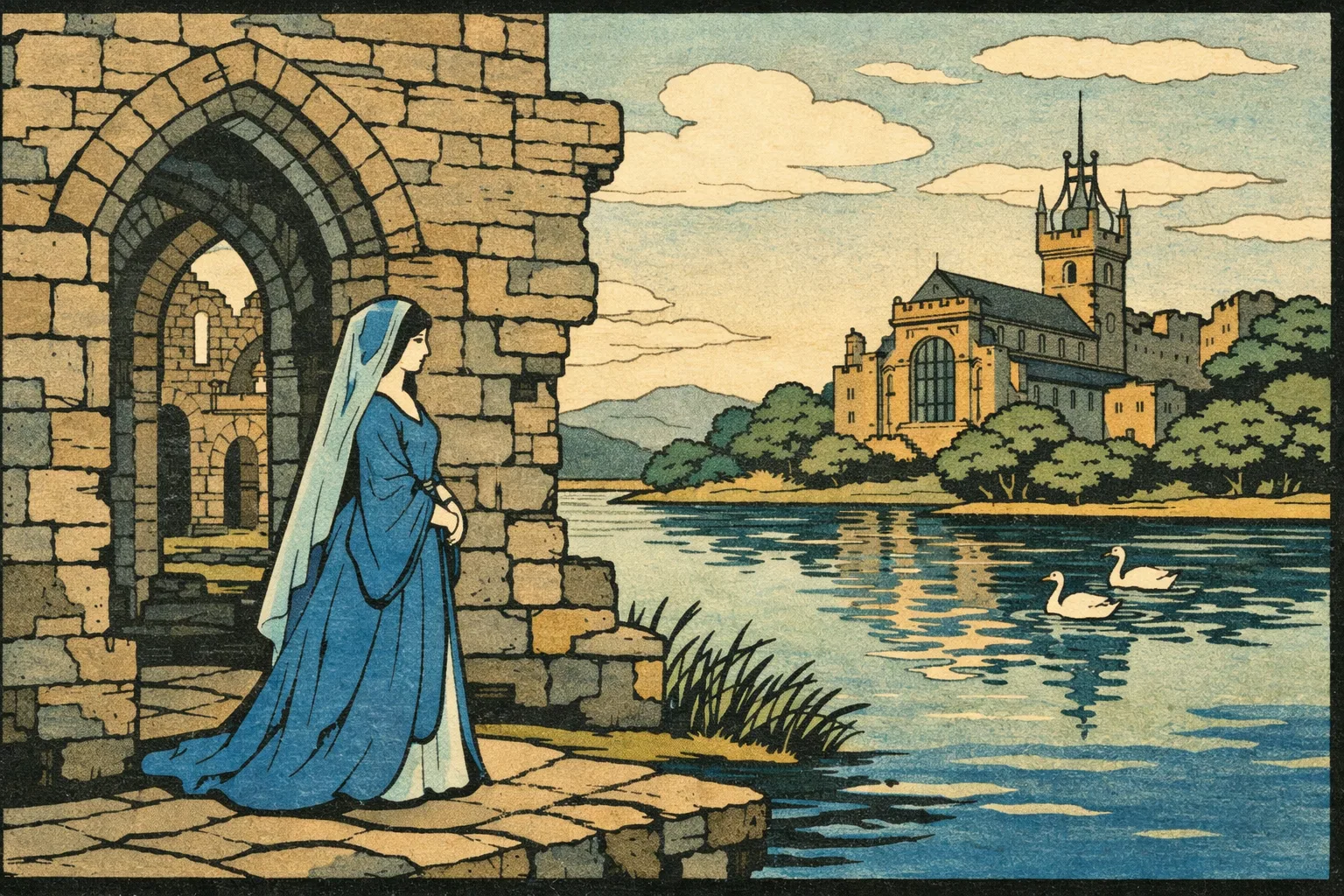
Linlithgow Palace is West Lothian’s most recognisable royal haunting because its ghost stories grow directly out of the place itself: a roofless Stewart palace, a lochside setting, a neighbouring medieval church and a long memory of queens waiting, praying or mourning. The best-known tradition is a royal female apparition, usually described either as Mary of Guise, mother of Mary, Queen of Scots, or as Margaret Tudor, wife of James IV. In popular versions she appears as a blue- or white-robed woman, sometimes near Queen Margaret’s Bower, sometimes moving between the palace entrance and St Michael’s Church. The evidence is folkloric rather than archival: strong as local haunted heritage, weak as documented witness history. The story matters because it shows how Linlithgow turns real dynastic trauma into a haunting that feels inseparable from West Lothian’s royal landscape. Historic Environment Scotland identifies the palace as a major Stewart royal residence and the birthplace of Mary, Queen of Scots, while modern haunted-place accounts preserve the apparition tradition in several overlapping forms.[historicenvironment.scot]historicenvironment.scotHistoric Environment ScotlandLinlithgow PalaceExplore the ruins of Mary Queen of Scots' birthplace. Linlithgow Palace was once a superb R…
The royal ruin beside Linlithgow Loch
Linlithgow Palace stands beside Linlithgow Loch, close to St Michael’s Parish Church, and that compact arrangement is central to its ghost tradition. This is not a lonely moorland ruin or a remote Highland castle; it is a civic and royal landmark in the historic county of West Lothian, formerly Linlithgowshire, where town, church, palace and water sit almost on top of one another. Historic Environment Scotland describes the palace as a Renaissance residence built and enlarged by Stewart kings over about two centuries, and as an ideal stopping place for royalty travelling between Edinburgh Castle and Stirling Castle.[Historic Environment Scotland]historicenvironment.scotHistoric Environment ScotlandLinlithgow PalaceExplore the ruins of Mary Queen of Scots' birthplace. Linlithgow Palace was once a superb R…
That matters because the apparition stories are spatially precise. The most repeated modern version places a female figure in blue moving from the palace entrance towards the adjacent church of St Michael. The Castles of Scotland gives a particularly specific form of the tradition: a “Blue Lady” seen walking from the entrance of the palace to the door of the nearby parish church, with sightings said to cluster around nine o’clock in the morning in April or September. The Fairytale Traveler gives a similar route, adding the detail that witnesses have heard the rustle of silk skirts and that the figure disappears near the church wall.[The Castles of Scotland]thecastlesofscotland.co.ukThe Castles of Scotland Linlithgow PalaceThe palace is said to be haunted by a 'Blue Lady', who walks from the entrance of the palace to by the door of the nearby parish…Read…
The palace’s material history also helps explain why it attracts these stories. Historic Environment Scotland says Stewart queens valued Linlithgow’s peace and fresh air, and that the palace served as a royal nursery for James V, Mary, Queen of Scots and Princess Elizabeth. The same official account notes that the palace declined rapidly after James VI moved the royal court to London in 1603. Its later ruinous state gives the haunting its atmosphere: a place built for dynastic display now survives as a shell, open to wind, weather and imagination.[Historic Environment Scotland]historicenvironment.scotHistoric Environment ScotlandHistory and stories | Linlithgow PalaceThe Stewart queens especially liked the peace and fresh air, and Linl…
The 1746 fire is another important layer, though it should not be overstated as the origin of the royal ghost story. The Castles of Scotland summarises the common account that government troops, retreating after the Jacobite rising period, accidentally set the palace alight with fires used to dry themselves; the building was not restored afterwards. Whether visitors come for Mary, Queen of Scots, Outlander locations, palace architecture or ghost lore, they encounter the same dramatic contrast: a royal residence whose windows, stairways and wall-walks now frame absence as much as history.[The Castles of Scotland]thecastlesofscotland.co.ukThe Castles of Scotland Linlithgow PalaceThe palace is said to be haunted by a 'Blue Lady', who walks from the entrance of the palace to by the door of the nearby parish…Read…
Mary of Guise, Margaret Tudor and the blue-gowned figure
The central difficulty with Linlithgow Palace’s royal apparition tradition is that the same ghost is not always given the same identity. Some accounts call her Mary of Guise; others suggest Margaret Tudor; some describe a Blue Lady or White Lady without forcing a definite name. That uncertainty is not a flaw in the folklore so much as the point of it. Linlithgow is thick with royal women whose lives were shaped by marriage, childbirth, widowhood, diplomacy and waiting for news from elsewhere.
Mary of Guise is the most emotionally direct candidate. National Museums Scotland records that Mary, Queen of Scots was born at Linlithgow Palace on 8 December 1542 to James V and Marie de Guise, and that James V died only days later. The National Library of Scotland similarly notes that Mary became Queen of Scots at six days old, with Marie de Guise later ruling as regent in her daughter’s name from 1554 to 1560. Linlithgow Museum’s local-history account explicitly connects Mary of Guise with palace legend, saying rumour has her ghost seen in Queen Margaret’s Bower, awaiting James V’s return from Falkland Palace after his death in December 1542.[nms.ac.uk]nms.ac.ukNational Museums Scotland Life and deathline of Mary, Queen of ScotsNational Museums Scotland Life and deathline of Mary, Queen of Scots
That version has a powerful narrative shape: a foreign-born queen gives birth to the future Mary, Queen of Scots, loses her husband, and is left with an infant monarch in a politically dangerous kingdom. The local ghost story compresses all that into a single image of a woman waiting in a tower. It is historically rooted in real crisis, but the apparition itself is not proved by the same kind of evidence as the birth, death and regency dates. The story works as royal memory turned into place-lore.
Margaret Tudor gives the tradition a second queenly identity. She was the wife of James IV, mother of James V, and sister of Henry VIII. The relevant Linlithgow tradition centres on Queen Margaret’s Bower, the small high room associated with the story that she waited there for James IV’s return from the Battle of Flodden in 1513. Historic Scotland education material preserves the bower story for pupils and notes that Sir Walter Scott’s lines about Margaret sitting lonely in Linlithgow’s bower are carved above the door.[Glow Blogs]blogs.glowscotland.org.ukGlow Blogs InvestigatingGlow Blogs Investigating
The Flodden association gives Margaret’s version a different emotional charge. Instead of Mary of Guise waiting after childbirth and dynastic emergency, Margaret Tudor is imagined waiting for a husband who will not return from war. Undiscovered Scotland repeats the familiar visitor version: Margaret’s wait was in vain because James IV was killed at Flodden, and the bower now offers some of the best views over Linlithgow and the countryside. The location itself therefore becomes part lookout, part memorial, part legend-machine.[Undiscovered Scotland]undiscoveredscotland.co.ukOpen source on undiscoveredscotland.co.uk.
The Blue Lady tradition may blur these women together. One account asks whether the blue-gowned apparition is Mary of Guise, the wife of James V, or Margaret Tudor going to pray for her husband. Another distinguishes a Blue Lady route from the palace to St Michael’s Church, a White Lady in or near Queen Margaret’s Bower, and even a reported apparition of Mary, Queen of Scots praying in the chapel. The multiplication of names suggests a living tourist-folklore tradition rather than a single stable, early source.[The Fairytale Traveler]thefairytaletraveler.comThe Fairytale TravelerLinlithgow Palace: Ghosts of Scotland's castles17 Feb 2015 — Is this Mary of Guise, the French wife of James V… or…
Why St Michael’s Church matters to the haunting
St Michael’s Church is more than background scenery in the Linlithgow haunting. In the Blue Lady version, the apparition’s route runs from the palace towards the church, as though the ghost story is following an old path of royal devotion. The Fairytale Traveler notes that the royal door on the north side of the church is now closed, but that the spectral woman is said to disappear near the church wall. The Castles of Scotland likewise places the Blue Lady’s movement between the palace entrance and St Michael’s.[The Fairytale Traveler]thefairytaletraveler.comThe Fairytale TravelerLinlithgow Palace: Ghosts of Scotland's castles17 Feb 2015 — Is this Mary of Guise, the French wife of James V… or…
This church connection also pulls Linlithgow into a wider royal-warning tradition. The Castles of Scotland recounts a separate legend in which a blue-robed apparition in St Michael’s warned James IV not to march into England before Flodden; he ignored the warning and was killed in 1513. That story is adjacent to, rather than identical with, the palace’s queenly apparition tradition, but the two naturally reinforce each other. Both involve blue-robed supernatural warning, royal disaster and the same palace-church precinct.[The Castles of Scotland]thecastlesofscotland.co.ukThe Castles of Scotland Linlithgow PalaceThe palace is said to be haunted by a 'Blue Lady', who walks from the entrance of the palace to by the door of the nearby parish…Read…
For a reader or visitor, this is one of the most useful ways to understand the haunting. Linlithgow’s royal ghosts are not simply “inside the palace”. They are attached to a small sacred-and-royal landscape: the palace, the church, the bower, the lochside approach and the high viewpoints over the town. The apparition’s route makes the place feel haunted as a precinct rather than as a single room.
The church setting also helps explain why the figures are so often imagined as women in formal dress rather than as anonymous shadows. A queen moving from palace to church suggests prayer, mourning, duty and public ritual. The detail of rustling silk, reported in popular haunted accounts, belongs to that courtly register: it is less a monster story than a memory of ceremony moving through a ruin.[The Fairytale Traveler]thefairytaletraveler.comThe Fairytale TravelerLinlithgow Palace: Ghosts of Scotland's castles17 Feb 2015 — Is this Mary of Guise, the French wife of James V… or…
Folklore, tourism and what the sources can prove
The most careful reading is that Linlithgow Palace has a strong royal apparition tradition but limited hard evidence for early, documented sightings. The official heritage sources are excellent for the palace’s royal history, architecture, nursery role and decline, but they do not present the ghost story as an established historical event. Historic Environment Scotland’s visitor pages foreground the Stewart residence, the lochside setting, the royal nursery and the birth of Mary, Queen of Scots; the ghost material appears mainly in local-history, castle-guide, travel and paranormal sources.[historicenvironment.scot]historicenvironment.scotHistoric Environment ScotlandLinlithgow PalaceExplore the ruins of Mary Queen of Scots' birthplace. Linlithgow Palace was once a superb R…
That does not make the tradition worthless. For haunted history, the key question is not “can the apparition be proved?” but “what has the story preserved?” At Linlithgow, the answer is remarkably coherent: the stories preserve royal female memory. Mary of Guise and Margaret Tudor were not interchangeable historically, but both fit the emotional architecture of the palace. Both were Stewart queens or queen-consorts associated with dynastic uncertainty. Both can be placed in stories of waiting, loss and political danger. Both make sense in a ruin famous for royal birth and royal absence.
The evidence is strongest where history and place can be independently confirmed. Linlithgow Palace was a major Stewart residence, a royal nursery and the birthplace of Mary, Queen of Scots. Mary was born there in December 1542, and James V died days later. Queen Margaret’s Bower is a recognised visitor feature with a longstanding romantic association with Margaret Tudor and Flodden, supported by Historic Scotland education material and visitor accounts. These facts make the haunting intelligible even if they do not prove the apparition.[historicenvironment.scot]historicenvironment.scotHistoric Environment ScotlandHistory and stories | Linlithgow PalaceThe Stewart queens especially liked the peace and fresh air, and Linl…
The evidence is weaker where the story depends on repeated but lightly sourced sighting details. The nine o’clock timing, April and September clustering, blue or white clothing, perfume, silk-rustling and movement towards St Michael’s all appear in modern haunted-place retellings. They are valuable as folklore motifs, especially because they are consistent enough to be recognisable, but they should be treated as tradition rather than verified record.[thecastlesofscotland.co.uk]thecastlesofscotland.co.ukThe Castles of Scotland Linlithgow PalaceThe palace is said to be haunted by a 'Blue Lady', who walks from the entrance of the palace to by the door of the nearby parish…Read…
Tourism has helped keep the legend alive. Linlithgow Palace is already a major heritage destination because of Mary, Queen of Scots, its Stewart architecture, its lochside setting and its use as a screen location. Haunted storytelling adds another layer to the visitor experience, but the best versions do not need exaggeration. The ruin is atmospheric because its documented history is already dramatic: royal births, widowed queens, Flodden grief, courtly display, political danger, abandonment and fire.[Historic Environment Scotland]historicenvironment.scotHistoric Environment ScotlandLinlithgow PalaceExplore the ruins of Mary Queen of Scots' birthplace. Linlithgow Palace was once a superb R…
How to read the legend on site
The most rewarding way to read Linlithgow Palace’s apparition traditions is to follow the geography of the story. Begin with the palace as a royal residence, not as a generic haunted ruin. Its courtyards, stairways and surviving rooms belong to a building shaped by Stewart monarchy. Historic Environment Scotland’s description of the palace as a Renaissance residence and royal stopping place between Edinburgh and Stirling explains why the haunting has a courtly rather than rustic character.[Historic Environment Scotland]historicenvironment.scotHistoric Environment ScotlandLinlithgow PalaceExplore the ruins of Mary Queen of Scots' birthplace. Linlithgow Palace was once a superb R…
Then look towards Queen Margaret’s Bower. Whether one imagines Margaret Tudor after Flodden or Mary of Guise after James V’s death, the bower gives the legend its most memorable visual anchor: a high, exposed place for looking outward. The story of Margaret waiting for news of James IV is historically romanticised, and the Scott association shows how nineteenth-century literary culture helped fix the mood of the place. But it remains an effective haunted image because the room’s position makes waiting physically legible.[Glow Blogs]blogs.glowscotland.org.ukGlow Blogs InvestigatingGlow Blogs Investigating
Finally, connect the palace to St Michael’s Church. The Blue Lady route is important because it gives the apparition purpose. She is not merely drifting through ruins; she appears to move between royal residence and sacred space. That small journey, repeated in modern accounts, turns the palace precinct into a stage for grief, prayer and unfinished royal business.[The Castles of Scotland]thecastlesofscotland.co.ukThe Castles of Scotland Linlithgow PalaceThe palace is said to be haunted by a 'Blue Lady', who walks from the entrance of the palace to by the door of the nearby parish…Read…
A sceptical reading need not flatten the story. The Blue Lady may be a blend of tourist memory, romantic literature, local retelling, architectural atmosphere and genuine witness claims that cannot now be tested. A folklore reading allows all of those to coexist. Linlithgow Palace is haunted, in the public imagination, because it makes royal absence visible. The queens are gone, the court has gone, the roof has gone, but the route from palace to church, the bower above the loch and the memory of Mary of Guise and Margaret Tudor remain.
Amazon book picks
Further Reading
Books and field guides related to Who Haunts Linlithgow Palace Beside the Loch?. Use these as the next step if you want deeper reading beyond the article.

Mary, Queen of Scots
Provides historical background to Linlithgow's royal associations.

eBay marketplace picks
Marketplace Samples
Live-tested eBay searches with available results related to this page.
Endnotes
1.
Source: historicenvironment.scot
Link:https://www.historicenvironment.scot/visit/all/linlithgow-palace/
Source snippet
Historic Environment ScotlandLinlithgow PalaceExplore the ruins of Mary Queen of Scots' birthplace. Linlithgow Palace was once a superb R...
2.
Source: historicenvironment.scot
Link:https://www.historicenvironment.scot/visit/all/linlithgow-palace/history-and-stories/
Source snippet
Historic Environment ScotlandHistory and stories | Linlithgow PalaceThe Stewart queens especially liked the peace and fresh air, and Linl...
3.
Source: thecastlesofscotland.co.uk
Title: The Castles of Scotland Linlithgow Palace
Link:https://www.thecastlesofscotland.co.uk/the-best-castles/magnificent-ruins/linlithgow-palace/
Source snippet
The palace is said to be haunted by a 'Blue Lady', who walks from the entrance of the palace to by the door of the nearby parish...Read...
4.
Source: thefairytaletraveler.com
Link:https://thefairytaletraveler.com/2015/02/17/haunted-linlithgow-palace/
Source snippet
The Fairytale TravelerLinlithgow Palace: Ghosts of Scotland's castles17 Feb 2015 — Is this Mary of Guise, the French wife of James V… or...
5.
Source: nms.ac.uk
Title: National Museums Scotland Life and deathline of Mary, Queen of Scots
Link:https://www.nms.ac.uk/discover-catalogue/life-and-deathline-of-mary-queen-of-scots
6.
Source: nls.uk
Link:https://www.nls.uk/collections/stories/scottish-history/mary-queen-of-scots-last-letter/
7.
Source: blogs.glowscotland.org.uk
Title: Glow Blogs Investigating
Link:https://blogs.glowscotland.org.uk/wl/public/Carmondean/uploads/sites/1550/2020/05/14082238/investigating-linlithgow-palace.pdf
8.
Source: undiscoveredscotland.co.uk
Link:https://www.undiscoveredscotland.co.uk/linlithgow/linlithgowpalace/index.html
9.
Source: historicenvironment.scot
Link:https://www.historicenvironment.scot/visit-a-place/places/linlithgow-palace/history/
10.
Source: historicenvironment.scot
Link:https://www.historicenvironment.scot/visit-a-place/places/linlithgow-palace/overview/
11.
Source: blog.historicenvironment.scot
Title: royal connections hidden gems collections
Link:https://blog.historicenvironment.scot/2017/02/royal-connections-hidden-gems-collections/
12.
Source: blog.historicenvironment.scot
Title: 3 great winter days
Link:https://blog.historicenvironment.scot/2016/11/3-great-winter-days/
13.
Source: nms.ac.uk
Link:https://www.nms.ac.uk/discover-catalogue/the-life-death-and-legacy-of-mary-queen-of-scots
14.
Source: Wikipedia
Link:https://en.wikipedia.org/wiki/Linlithgow
15.
Source: Wikipedia
Title: Linlithgow Palace
Link:https://en.wikipedia.org/wiki/Linlithgow_Palace
16.
Source: Wikipedia
Title: Mary, Queen of Scots
Link:https://en.wikipedia.org/wiki/Mary%2C_Queen_of_Scots
17.
Source: Wikipedia
Title: Mary of Guise
Link:https://en.wikipedia.org/wiki/Mary_of_Guise
18.
Source: facebook.com
Link:https://www.facebook.com/visithistoricscotland/photos/have-you-ever-stood-in-queen-margarets-bower-at-linlithgow-palace-and-wondered-a/829114582588788/
19.
Source: facebook.com
Link:https://www.facebook.com/photo.php?fbid=660683636098551&id=100064707609363&set=a.650059190494329
20.
Source: historyhit.com
Title: Linlithgow Palace
Link:https://www.historyhit.com/locations/linlithgow-palace/
21.
Source: reign-cw.fandom.com
Title: Linlithgow Palace
Link:https://reign-cw.fandom.com/wiki/Linlithgow_Palace
22.
Source: thedudleywomen.com
Title: The Birth of Mary, Queen of Scots
Link:https://www.thedudleywomen.com/post/the-birth-of-mary-queen-of-scots
23.
Source: mylinlithgow.com
Title: Mary, Queen of Scots
Link:https://mylinlithgow.com/visit-linlithgow/mary-queen-of-scots/
24.
Source: royal.uk
Title: mary queen scots r1542 1567
Link:https://www.royal.uk/mary-queen-scots-r1542-1567
25.
Source: youtube.com
Title: Linlithgow Palace
Link:https://www.youtube.com/watch?v=FMbnY1Hs_Hw
26.
Source: youtube.com
Title: The Haunting History of Linlithgow Palace | A Virtual Tour & Ghost Stories
Link:https://www.youtube.com/watch?v=eeJHIxFKRVc
Source snippet
Historic Environment Scotland: Linlithgow Palace BSL Tour...
27.
Source: youtube.com
Title: Historic Environment Scotland: Linlithgow Palace BSL Tour
Link:https://www.youtube.com/watch?v=CFv43y2rdBA
Source snippet
The Full Story of Linlithgow Palace | Mary Queen of Scots & Her Mother's Ghost...
Additional References
28.
Source: youtube.com
Title: The Full Story of Linlithgow Palace | Mary Queen of Scots & Her Mother’s Ghost
Link:https://www.youtube.com/watch?v=zCSIR-BnCNM
Source snippet
Haunted West Lothian: Linlithgow Palace’s Royal Apparition Traditions...
29.
Source: youtube.com
Title: 8 Most Haunted Places in West Lothian
Link:https://www.youtube.com/watch?v=go9keeNokO4
Source snippet
The Haunting History of Linlithgow Palace | A Virtual Tour & Ghost Stories...
30.
Source: hiddenscotland.com
Link:https://hiddenscotland.com/journal/a-royal-warning-at-linlithgow-palace
31.
Source: instagram.com
Link:https://www.instagram.com/reel/DU-hlEziDi-/
32.
Source: canmore.org.uk
Link:https://canmore.org.uk/collection/1681595
33.
Source: janetredlertravelandtourism.co.uk
Link:https://www.janetredlertravelandtourism.co.uk/news/birthplace-mary-queen-scots-reopens-visitors/
34.
Source: rabbies.com
Link:https://www.rabbies.com/en-us/blog/guide-places-connected-mary-queen-scots
35.
Source: facebook.com
Link:https://www.facebook.com/outlanderpastlives/posts/did-we-capture-a-ghost-at-linlithgow-palace-or-should-i-call-it-wentworth-prison/1606970246043673/
36.
Source: scottishtours.co.uk
Link:https://www.scottishtours.co.uk/blog/in-the-footsteps-of-mary-queen-of-scots/
37.
Source: marie-stuart.co.uk
Link:https://www.marie-stuart.co.uk/Castles/Linlithgow.htm
Topic Tree