Within Haunted Norfolk
Is Raynham Hall's Brown Lady Photograph Evidence?
Raynham Hall's Brown Lady turns one country-house legend into Norfolk's most famous disputed ghost photograph.
On this page
- The hall, the staircase and the Walpole legend
- How the 1936 photograph became famous
- Sceptical explanations and lasting appeal
Page outline Jump by section
Introduction
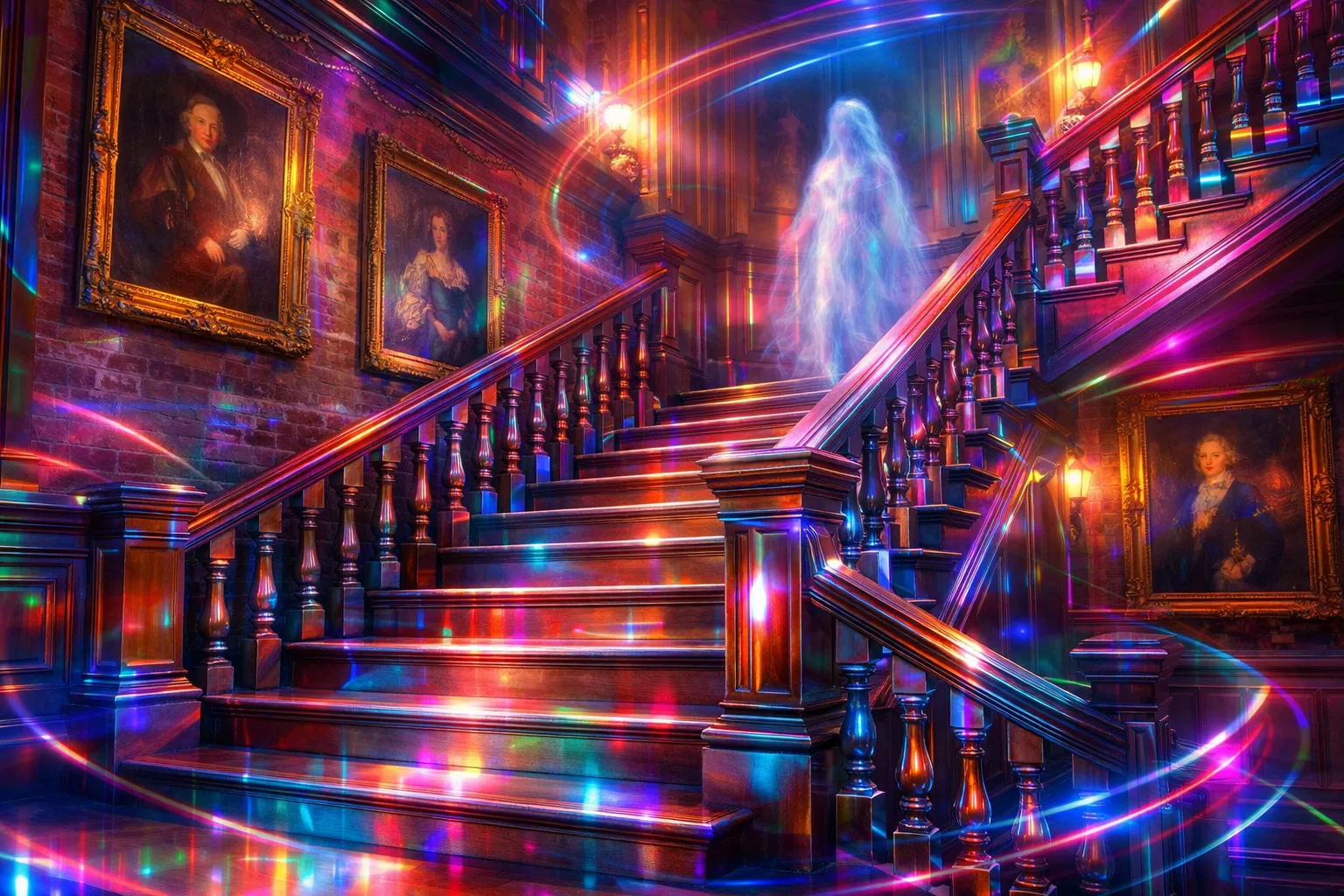
Raynham Hall’s Brown Lady photograph matters because it turns a Norfolk country-house ghost story into a debate about evidence. The story says that a veiled female figure, usually identified in legend as Lady Dorothy Walpole, haunts the grand staircase at Raynham Hall near Fakenham. The famous image, taken on 19 September 1936 and first published by Country Life in December that year, appears to show a misty figure descending the stairs. It has been reproduced for decades as one of Britain’s best-known “ghost photographs”, but it is not accepted proof of a haunting. Its value is more interesting than that: it shows how family legend, aristocratic architecture, early twentieth-century photography and public appetite for the supernatural combined to make one Norfolk staircase internationally famous.[Country Life]countrylife.co.ukuntry LifeThe day a Country Life photographer captured an image of a ghost, a picture that's become one of the most famous 'spirit phot…
The strongest reading is careful rather than dismissive. The photograph is a genuine cultural object, and the witnesses’ account became part of Raynham’s modern folklore. Yet later investigations and photographic critiques have raised ordinary explanations, including camera movement, light effects, double exposure, staged imagery or later misreadings of the staircase itself. That tension is why the Brown Lady remains so durable: it is not just a ghost story, but a case study in what people want a haunting image to prove.[Norfolk Record Office]norfolkrecordofficeblog.orgTHE BROWN LADY OF RAYNHAM HALL: The World’s Most Infamous Ghost (continued) | Norfolk Record Office…
The hall, the staircase and the Walpole legend
Raynham Hall is not a generic “haunted mansion” invented for a fireside tale. It is a major Norfolk country house, listed at Grade I by Historic England, and its parkland listing describes a large red-brick, five-storey house with Classical and Palladian influences. The estate’s own history places the house in a long Townshend family story, with construction beginning under Sir Roger Townshend in 1619 and later eighteenth-century remodelling associated with Charles “Turnip” Townshend, 2nd Viscount Townshend.[Historic England]historicengland.org.ukHistoric England Raynham Hall, North East Service Wing and Wall, RaynhamHistoric England Raynham Hall, North East Service Wing and Wall, Raynham
That architectural setting matters because the Brown Lady is a staircase ghost. The legend is tied to movement through a grand interior: a figure seen descending, a portrait nearby, guests going to bed, photographers setting up a shot. Raynham’s own estate history notes that the 2nd Viscount introduced a grand entrance and staircase during the early eighteenth-century transformation of the hall, giving the later ghost story a visually memorable stage rather than a vague haunted room.[Norfolk Glamping Raynham]raynham.co.ukOpen source on raynham.co.uk.
The apparition is usually identified as Lady Dorothy Walpole, later Viscountess Townshend. A specialist country-house art catalogue identifies Dorothy as the daughter of Robert Walpole of Houghton and Mary Burwell, sister of Sir Robert Walpole, and wife of Charles, 2nd Viscount Townshend, whom she married in 1713. It also notes the political relationship between her brother Sir Robert Walpole and her husband Charles Townshend, who were allies and later rivals.[artandthecountryhouse.com]artandthecountryhouse.comdorothy walpole 2nd wife of the 2nd viscount townshend 16861726dorothy walpole 2nd wife of the 2nd viscount townshend 16861726
The folklore version adds a darker domestic story. In many retellings, Dorothy is said to have been confined at Raynham after scandal or suspicion, and to have died there in 1726. The historical details are much less secure than the legend suggests: the biographical record supports her connection to the Walpole and Townshend families, but the imprisonment story belongs to gossip, family tradition and later ghost literature rather than to firm documentary proof. For a haunted-history page, that distinction is crucial. The Brown Lady is best treated as a named legend attached to a real woman, not as verified biography.[artandthecountryhouse.com]artandthecountryhouse.comdorothy walpole 2nd wife of the 2nd viscount townshend 16861726dorothy walpole 2nd wife of the 2nd viscount townshend 16861726
The pre-photograph sightings gave the story its shape before the camera made it famous. Later accounts refer to an 1830s tradition involving guests at Raynham and to Captain Frederick Marryat, the naval officer and novelist, whose alleged encounter was recorded by his daughter Florence Marryat decades afterwards. The Norfolk Record Office blog summarises this strand of the tradition, while Tom Ruffles’ re-examination of the case notes that reports of the haunting date back at least to the 1830s and that the Marryat story is mediated through later family testimony.[Norfolk Record Office]norfolkrecordofficeblog.orgTHE BROWN LADY OF RAYNHAM HALL: The World’s Most Infamous Ghost (continued) | Norfolk Record Office…
That gap between event and preservation is one reason the Brown Lady is better understood as folklore than as a clean witness file. The story had already gathered the right ingredients for a powerful country-house haunting: a named aristocratic woman, a troubled marriage legend, a portrait, a staircase, repeated house-party sightings and a great Norfolk estate with enough status to attract national attention. The 1936 photograph did not create the Brown Lady from nothing, but it transformed a localised family-and-house legend into a public image.
How the 1936 photograph became famous
The central episode took place on 19 September 1936. According to the now-standard account, Captain Hubert C. Provand and Indre Shira were photographing Raynham Hall when Shira saw what he described as an ethereal or veiled form on the staircase. Provand, working with the camera, took the exposure; the resulting negative appeared to contain the famous descending figure. Country Life’s retrospective states that its photographers captured the image at Raynham Hall and that the photograph was first published in December 1936.[Country Life]countrylife.co.ukuntry LifeThe day a Country Life photographer captured an image of a ghost, a picture that's become one of the most famous 'spirit phot…
The detail that gives the case its drama is the timing. Ruffles’ re-examination, drawing on the earlier published account and archival discussion, describes the photographers working during the day and photographing the staircase at about 4pm. Provand had already taken one staircase photograph; while he prepared another exposure under the black cloth, Shira reportedly saw a veiled form coming slowly down the stairs and called out, prompting the exposure and flash.[Academia]academia.eduOpen source on academia.edu.
This is why the Brown Lady photograph is often discussed differently from casual ghost snapshots. It was not a modern digital blur, a tourist phone image or a photograph found without provenance. It appeared in a respected lifestyle and country-house magazine, was associated with named photographers, and entered print culture quickly. Ruffles notes that the photograph appeared in Country Life on 26 December 1936 and then in the relaunched American magazine Life on 4 January 1937, helping it cross from Norfolk legend into international ghost lore.[Academia]academia.eduOpen source on academia.edu.
The image also benefited from its composition. A country-house staircase already carries theatrical force: height, shadow, banisters, panelling and the suggestion of someone descending from a private upper world into public view. The figure’s blurred, veiled appearance is just human enough to invite recognition, but indistinct enough to resist closure. Readers could project onto it either Lady Dorothy Walpole, an accidental exposure, a staged shape, or a classic “spirit photograph”. That ambiguity is the photograph’s engine.
The timing of publication helped too. A ghost photograph printed on 26 December sat naturally in the Christmas season, when British ghost stories traditionally found a receptive audience. The Norfolk Record Office blog also notes the awkwardly useful publicity value of the image, observing that sceptics have seen the photograph and story as helping put the house back on the cultural map. That does not prove fraud, but it explains why the image spread so successfully: it served both as mystery and as country-house mythology.[Norfolk Record Office]norfolkrecordofficeblog.orgTHE BROWN LADY OF RAYNHAM HALL: The World’s Most Infamous Ghost (continued) | Norfolk Record Office…
What the photograph can and cannot show
The photograph can show that by late 1936 there was a printed image, attached to named photographers and a named Norfolk house, which appeared to contain a translucent figure on a staircase. It can also show that the Brown Lady legend had become publishable as a serious curiosity for a national readership. It cannot, by itself, show that Lady Dorothy Walpole appeared after death, that Raynham Hall is literally haunted, or that the object on the negative had no ordinary cause.
Harry Price, one of Britain’s best-known paranormal investigators of the period, gave the image an early boost. The Norfolk Record Office blog quotes Price as saying he was impressed after speaking to the photographers, that he could not shake their story, and that “only collusion” would explain a fake if the image were fraudulent. He also described the negative as free of faking.[Norfolk Record Office]norfolkrecordofficeblog.orgTHE BROWN LADY OF RAYNHAM HALL: The World’s Most Infamous Ghost (continued) | Norfolk Record Office…
Price’s response is important, but it is not the final word. It tells us that a prominent investigator found the men’s account difficult to dismiss and saw no obvious tampering on the negative as presented. It does not eliminate staging before development, accidental photographic effects, camera movement, double exposure, or mistaken interpretation of what appears in a murky print. The distinction between “the negative does not look retouched” and “the image proves a ghost” is the heart of the case.
Later investigation made the problem sharper. The Norfolk Record Office blog reports that Alan Murdie, associated with the Society for Psychical Research, found a file at Cambridge University Library relating to a 1937 SPR investigation, and that the file concluded there was “almost certainly a mundane explanation” for the spectral image.[Norfolk Record Office]norfolkrecordofficeblog.orgTHE BROWN LADY OF RAYNHAM HALL: The World’s Most Infamous Ghost (continued) | Norfolk Record Office…
Ruffles’ re-examination complicates matters further. He notes technical details from the SPR-related material, including an old stand camera, Kodak S.S. Ortho film, a Rapid-Rectilinear type lens, an exposure of about six seconds and a large flashbulb. Those details make the photograph more vulnerable to ordinary explanations than a simple “instant capture” story might suggest, because a long exposure, flash, reflective surfaces and a dark staircase all create room for artefacts and ambiguity.[Academia]academia.eduOpen source on academia.edu.
The sceptical case has several strands rather than one universally agreed solution. Some critics have argued for double exposure; others for camera movement, light leak, flash reflection, deliberate staging, or a rephotographed composite. Ruffles is cautious about some of those claims. He challenges parts of the camera-shake interpretation by arguing that supposed duplicate objects may actually be panelling, a landing and foreshortened banisters, while also pointing out that a chemist’s statement about seeing the figure during fixing does not rule out manipulation at an earlier stage.[Academia]academia.eduOpen source on academia.edu.
That makes the Brown Lady stronger as a mystery of evidence than as proof of survival after death. The photograph remains unresolved in the popular imagination because no single explanation has defeated all others in a way that satisfies believers and sceptics alike. But unresolved is not the same as supernatural. For readers weighing credibility, the safest conclusion is that the image is historically famous, visually powerful and evidentially weak.
Sceptical explanations and lasting appeal
The main sceptical explanations are not mutually exclusive in spirit: they all treat the image as a product of photographic conditions, human agency or later interpretation rather than a paranormal event. The double-exposure argument sees the ghostly shape as one image superimposed on another. The camera-movement argument points to the length of the exposure and possible doubling or displacement. The staging argument imagines a person, cloth or prepared image used to create a ghost-like form. The light-and-reflection argument focuses on flash, shiny panelling, stair geometry and the visual confusion of a dark interior.[Wikipedia]WikipediaBrown Lady of Raynham HallBrown Lady of Raynham Hall
The case is especially vulnerable because the image people know is often a reproduced version, not a fresh examination of all original materials. Ruffles notes that the photograph has appeared in many ghost books “in various states of murkiness”, obscuring fine detail. He also notes that two prints of the ghost photograph once included in the SPR file had vanished by the time of later discussion, leaving investigators to work around a damaged evidential chain.[Academia]academia.eduOpen source on academia.edu.
At the same time, some quick debunkings can be too neat. Ruffles argues that certain alleged anomalies on the staircase are better explained by the actual layout: panelling, a short landing, foreshortened rails and reflections. That does not prove a ghost, but it does show why the case is more interesting than simply saying “old photo equals fake”. The most trustworthy scepticism is patient and architectural, asking what the staircase, camera, flash and print process could actually produce.[Academia]academia.eduOpen source on academia.edu.
For Norfolk’s haunted landscape, the Brown Lady endures because it gives the county a rare thing: a ghost story with an iconic image. Many local legends survive as oral tradition, guidebook paragraphs or newspaper anecdotes. Raynham has all that, plus a photograph that can be printed, shared and argued over. The image lets people feel they are not merely reading a tale but looking at the moment where the tale entered modern media.
Its appeal also lies in the social story behind the haunting. Lady Dorothy Walpole’s legend is entangled with marriage, confinement, reputation, inheritance and the power of great houses to control private lives. Whether or not the imprisonment story is historically secure, it gives the apparition emotional force: the Brown Lady is imagined not as a random spook but as a woman trapped in a grand house that still displays the authority of the family into which she married. That is why the story fits Raynham so well. The haunting is architectural, familial and class-bound.
There is also a tourism-and-memory dimension. Country-house ghosts often help old estates remain vivid in public imagination, especially when the families, politics and architectural phases behind them are too complex for casual visitors. A veiled woman on a staircase is easier to remember than a full account of Walpole-Townshend politics, Palladian remodelling or the agricultural revolution. The Brown Lady compresses those histories into an image that can be understood at a glance.
Why Raynham’s Brown Lady is still Norfolk’s key ghost photograph
Raynham Hall’s Brown Lady photograph is not the strongest evidence that ghosts exist. It is one of the strongest examples of how a haunting becomes famous. The place is real and historically significant; the woman named in the legend was real; the photograph was really published in 1936; the investigators and sceptics who debated it were real. The uncertain part is the crucial part: whether the form on the staircase was an apparition, an accident, a trick, or a misread photographic effect.
That uncertainty is why the case belongs at the centre of Norfolk’s haunted history. It connects a major house near Fakenham with the county’s aristocratic past, the Walpole and Townshend families, interwar magazine culture and the long British fascination with ghosts at Christmas. It is local in setting but national in reputation, a Norfolk story that travelled because the camera seemed to offer what ghost stories usually lack: a visible trace.[countrylife.co.uk]countrylife.co.ukuntry LifeThe day a Country Life photographer captured an image of a ghost, a picture that's become one of the most famous 'spirit phot…
For a careful reader, the best way to approach the Brown Lady is neither credulous nor smug. The photograph should not be treated as proof, and the legend should not be treated as straightforward biography. But it should also not be dismissed as meaningless. It is a compact example of how haunted places work: a real building, a dramatic interior, a family tragedy or rumour, a witness tradition, a contested artefact and a public eager to decide what it sees in the shadows.
Amazon book picks
Further Reading
Books and field guides related to Is Raynham Hall's Brown Lady Photograph Evidence?. Use these as the next step if you want deeper reading beyond the article.
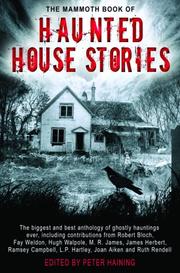
The Mammoth Book of Haunted House Stories
Explores classic haunted house traditions similar to Raynham Hall.

Haunted Castles of Britain and Ireland
Covers the wider tradition of haunted British country houses.
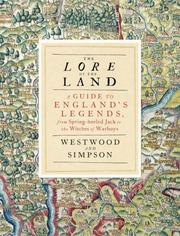
The lore of the land
First published 2005. Subjects: Tales, Legends, British Mythology, Legends, great britain.

eBay marketplace picks
Marketplace Samples
Live-tested eBay searches with available results related to this page.
Endnotes
1.
Source: academia.edu
Link:https://www.academia.edu/33522992/The_Brown_Lady_of_Raynham_Hall_Re_examination_of_a_Classic_Ghost_Photograph_and_a_Possible_Explanation
2.
Source: norfolkrecordofficeblog.org
Title: Norfolk Record Office
Link:https://norfolkrecordofficeblog.org/2024/08/14/the-brown-lady-of-raynham-hall-the-worlds-most-infamous-ghost-continued/
Source snippet
THE BROWN LADY OF RAYNHAM HALL: The World’s Most Infamous Ghost (continued) | Norfolk Record Office...
3.
Source: artandthecountryhouse.com
Title: dorothy walpole 2nd wife of the 2nd viscount townshend 16861726
Link:https://artandthecountryhouse.com/catalogues/catalogues-index/dorothy-walpole-2nd-wife-of-the-2nd-viscount-townshend-16861726
4.
Source: Wikipedia
Title: Brown Lady of Raynham Hall
Link:https://en.wikipedia.org/wiki/Brown_Lady_of_Raynham_Hall
5.
Source: Wikipedia
Link:https://en.wikipedia.org/wiki/Brown
6.
Source: Wikipedia
Title: Raynham Hall
Link:https://en.wikipedia.org/wiki/Raynham_Hall
7.
Source: dictionary.cambridge.org
Link:https://dictionary.cambridge.org/dictionary/english/brown
8.
Source: brown.edu
Link:https://www.brown.edu/
9.
Source: countrylife.co.uk
Link:https://www.countrylife.co.uk/nature/the-day-a-country-life-photographer-captured-an-image-of-a-ghost-234642
Source snippet
untry LifeThe day a Country Life photographer captured an image of a ghost, a picture that's become one of the most famous 'spirit phot...
10.
Source: historicengland.org.uk
Title: Historic England Raynham Hall, North East Service Wing and Wall, Raynham
Link:https://historicengland.org.uk/listing/the-list/list-entry/1049270
11.
Source: historicengland.org.uk
Title: Historic England Raynham Park, Raynham
Link:https://historicengland.org.uk/listing/the-list/list-entry/1001015
12.
Source: raynham.co.uk
Link:https://raynham.co.uk/the-estate/history/
13.
Source: norfolkrecordofficeblog.org
Title: the brown lady of raynham hall the worlds most infamous ghost
Link:https://norfolkrecordofficeblog.org/2024/07/31/the-brown-lady-of-raynham-hall-the-worlds-most-infamous-ghost/
14.
Source: jspr.spr.ac.uk
Link:https://jspr.spr.ac.uk/index.php/jspr/article/view/24/25
15.
Source: historichouses.org
Title: raynham hall
Link:https://www.historichouses.org/house/raynham-hall/
16.
Source: collegeofpsychicstudies.co.uk
Title: Alan Murdie
Link:https://www.collegeofpsychicstudies.co.uk/about-us/our-consultants/alan-murdie/
17.
Source: homesseenontv.com
Title: Raynham Hall
Link:https://homesseenontv.com/raynham-hall/
18.
Source: thelittlehouseofhorrors.com
Title: raynham hall
Link:https://thelittlehouseofhorrors.com/raynham-hall/
Additional References
19.
Source: youtube.com
Link:https://www.youtube.com/watch?v=QWTw3xoGhg4
Source snippet
England's Most Famous Ghost? The Brown Lady of Raynham Hall...
20.
Source: youtube.com
Title: England’s Most Famous Ghost? The Brown Lady of Raynham Hall
Link:https://www.youtube.com/watch?v=mlX5D2warOY
Source snippet
Norfolk Ghost Stories | King's Lynn Witches, Hauntings & The Devil...
21.
Source: youtube.com
Title: Norfolk Ghost Stories | King’s Lynn Witches, Hauntings & The Devil
Link:https://www.youtube.com/watch?v=oxQF1rPzBBE
Source snippet
Weird Norfolk -The Witch's Heart of Kings Lynn...
22.
Source: vocal.media
Link:https://vocal.media/fyi/brown-lady-of-raynham-hall-in-norfolk-england
23.
Source: instagram.com
Link:https://www.instagram.com/reel/DNaPgSvKw1r/
24.
Source: archive.org
Link:https://archive.org/stream/RufflesTheBrownLadyOfRaynhamHall/Ruffles%2B-%2BThe%2BBrown%2BLady%2Bof%2BRaynham%2BHall_djvu.txt
25.
Source: reddit.com
Link:https://www.reddit.com/r/ParanormalEncounters/comments/1fkrwi2/is_the_brown_lady_photo_real_or_fake/
26.
Source: facebook.com
Link:https://www.facebook.com/groups/513995116436286/posts/645622353273561/
27.
Source: facebook.com
Link:https://www.facebook.com/groups/704609660332475/posts/2171241860335907/
28.
Source: facebook.com
Link:https://www.facebook.com/groups/1040870849707443/posts/1890494348078418/
Topic Tree