Where Banffshire Keeps Its Ghost Stories
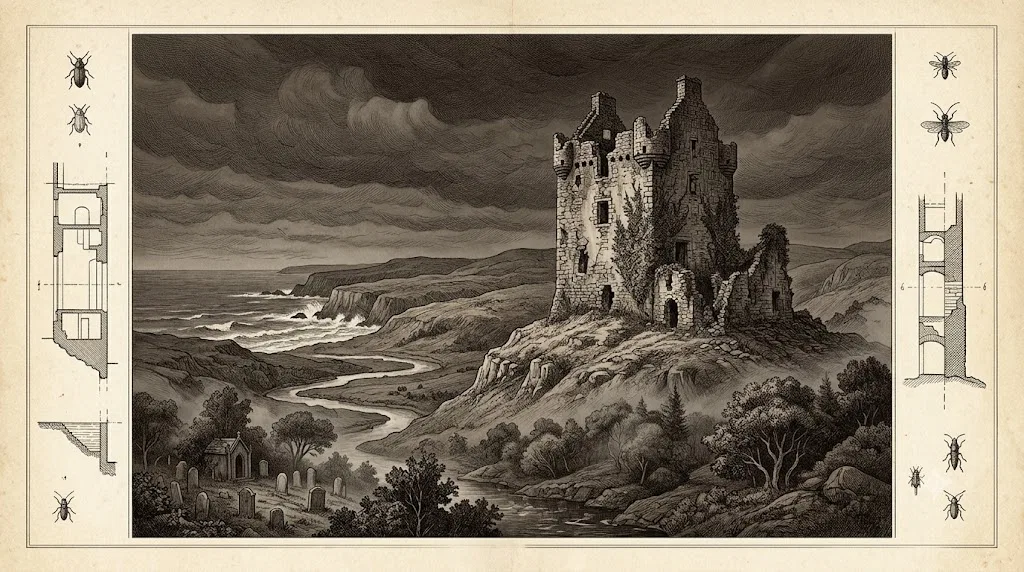
Banffshire’s haunted history is less a neat catalogue of “most haunted” tourist sites than a scattered north-east Scottish folklore landscape: ruined tower houses, old family seats, rivers, wells, kirkyards, mausoleums and stories preserved in local memory.
Page outline Jump by section
Introduction
For this page, Banffshire means the historic county on the Moray Firth, not just the modern council geography. That matters because Banffshire now overlaps modern Aberdeenshire and Moray, while older stories still follow parish, estate and county identities. The county stretches from the Moray Firth inland towards the Spey, the Grampian and Cairngorm country, with Banff, Cullen, Buckie, Dufftown, Keith and Macduff among its historic towns.[Gazetteer]gazetteer.org.ukOpen source on gazetteer.org.uk.
Where Banffshire’s ghost stories sit on the map
Historic Banffshire is a long, awkwardly shaped county: coastal at one end, mountainous and river-cut at the other. Wikishire describes it as running from the Moray Firth up into the mountains, bordered by Morayshire to the west, Aberdeenshire along much of the east, and Inverness-shire to the south.[Wikishire]wikishire.co.ukWikishire BanffshireWikishire Banffshire That geography helps explain the kinds of supernatural stories that survive here. Coastal Banff and Macduff lend themselves to mausoleum, harbour and old-town tales; Dufftown and Speyside bring castle and whisky-estate lore; upland Banffshire feeds into wider Highland and north-east traditions of kelpies, wells, fairies and uncanny roads.
The historic county boundary is also not the same as the modern map. The Lord Lieutenant of Banffshire notes that the county emerged from a twelfth-century sheriffdom, that its boundaries moved more than once, and that it once included detached portions within Aberdeenshire.[LordLieutenantBanff]lordlieutenantbanffshire.co.ukOpen source on lordlieutenantbanffshire.co.uk. For a haunted-history page, that means places now labelled “Moray” or “Aberdeenshire” in visitor guides may still belong naturally to Banffshire’s older story-world. Balvenie Castle near Dufftown and Ballindalloch Castle are good examples: modern visitors may encounter them through Moray or Speyside tourism, but their older county identity is Banffshire.
The castles people most often ask about
Banffshire’s best-known haunted-place material is castle-centred, but the quality of evidence varies sharply. Some claims are preserved by the houses themselves or by heritage bodies; others come from castle-guide literature, whisky marketing, local heritage pages or paranormal websites. The useful approach is to separate “the building is real and historically important” from “the ghost story is an attributed tradition”.
Ballindalloch Castle is one of the strongest Banffshire anchors because the haunting tradition is acknowledged in reputable visitor material. Historic Houses identifies Ballindalloch as a Banffshire house, calls it “the pearl of the north”, and notes that it has been the Macpherson-Grants’ family home since 1546. The same page is careful: it says none of the current family have been aware of a ghost, though several are reputed, with the “Pink Lady” of the Pink Tower Bedroom singled out as probably the best-known.[Historic Houses]historichouses.orgHistoric Houses Ballindalloch Castle – Historic Houses | Historic HousesHistoric Houses Ballindalloch Castle – Historic Houses | Historic Houses
The castle’s own visitor information gives another story, attached not to a tragic lady but to appetite and memory. Beneath the original sixteenth-century castle lies a former dungeon later used as a wine cellar; Ballindalloch’s guide says this was once a favourite room of General James Grant, whose ghost is said to walk the corridors at night in search of his beloved cellar.[Ballindalloch Castle]ballindallochcastle.co.ukBallindalloch Castle Tour the CastleBallindalloch Castle Tour the Castle This is a good example of a house legend that is atmospheric without being especially lurid: the ghost is not a shrieking spectre but a remembered resident tied to a room, a habit and a social identity.
Inchdrewer Castle, south-west of Banff, is a darker case. The National Record of the Historic Environment places it in the parish of Banff and gives its former county as Banffshire.[Canmore]canmore.org.ukCanmore Inchdrewer Castle | Place | trove.scotCanmore Inchdrewer Castle | Place | trove.scot Historic Environment Scotland describes the castle as standing on a rise with commanding views over Banff Bay and records its partial restoration in 1971 by Robin Mirrlees de la Lanne.[Historic Environment Scotland]portal.historicenvironment.scotOpen source on historicenvironment.scot. The ghost tradition centres on George Ogilvy, 3rd Lord Banff, whose murder and the burning of the castle in 1713 have fed later claims that his spirit haunts the ruin. A second motif, the mysterious white dog, is usually told as a story associated with Nigel Tranter’s twentieth-century visit and later speculation that the animal was no ordinary dog. The historical violence is much firmer than the apparition; the haunting reads like folklore trying to make sense of a ruined aristocratic house with a violent break in its story.
Balvenie Castle, near Dufftown, is different again: it sits at the edge of castle ruin, whisky branding and local legend. Historic Environment Scotland presents Balvenie as one of Scotland’s oldest stone castles and gives practical visitor information for the site.[Historic Environment Scotland]historicenvironment.scotOpen source on historicenvironment.scot. Castle historian Martin Coventry’s site records the castle’s turbulent ownership, Royalist associations, Jacobite-era use and abandonment after William Duff’s suicide in 1718, then adds that it is said to be haunted by a White Lady, a groom, two horses and other disturbances.[The Castles of Scotland]thecastlesofscotland.co.ukOpen source on thecastlesofscotland.co.uk. The Balvenie whisky tradition adapts the story into a distillery haunting: the “Green Lady” is said to have followed stones from the old castle into the maltings. That is less an independent historical witness trail than a good example of how ghost lore can move with reused building material, brand memory and workplace storytelling.
Duff House, the mausoleum and a very early local ghost joke
Duff House in Banff is not, on the strongest available evidence, a classic heavily documented haunted house. Its verified history is dramatic enough without needing exaggeration: Historic Environment Scotland describes it as William Adam’s ambitious baroque mansion for William Duff, Lord Braco, begun in 1735 and halted in 1741 amid a bitter dispute over money. Lord Braco, later 1st Earl Fife, is said never to have slept there after the court case, and the house later became a hotel, sanatorium, wartime internment camp, prisoner-of-war camp and military headquarters before restoration and reopening as a gallery in 1995.[Historic Environment Scotland]historicenvironment.scotOpen source on historicenvironment.scot.
The more precise ghostly scrap belongs not to the mansion’s grand rooms but to the Duff House Mausoleum and the figure of Provost Alexander Douglas. A Banff and Macduff heritage trail page quotes George Imlach, writing in the early nineteenth century, saying he had made Lord Fife’s people believe “the Provost’s ghost” turned a vase containing “monkish bones” into the river.[banffmacduffheritagetrail.co.uk]banffmacduffheritagetrail.co.ukThe Provost’s Ghost – Banff and Macduff, 'two towns, big future’The Provost’s Ghost – Banff and Macduff, 'two towns, big future’ That is valuable because it shows a ghost story in circulation around 200 years ago, but it also shows humour and mischief. The “Provost’s Ghost” is not presented as a solemnly witnessed apparition; it is a local anecdote about belief, performance and the spooky power of a mausoleum in the landscape.
That distinction matters for Banffshire as a whole. Many haunted-place claims become sharper, older and more dramatic as they circulate online. The Duff House material is more interesting when kept modest: an imposing unfinished mansion, an eighteenth-century family mausoleum, human remains treated as antiquarian curiosities, and a nineteenth-century writer playing with the idea that a ghost could still unsettle powerful people.
Older folklore: water, horses, wells and fair neighbours
Banffshire’s haunted atmosphere does not depend only on named ghosts. The older north-east tradition includes supernatural horses, water spirits, healing wells and fairy places, often collected before the modern paranormal-tourism style took hold. The University of Aberdeen’s Elphinstone Institute describes Rev. Walter Gregor’s 1881 Notes on the Folk-Lore of the North-East as the first field collection issued by the Folklore Society, an important reminder that this region’s uncanny traditions were being gathered as folklore, not as modern ghost-hunt evidence.[The University of Aberdeen]abdn.ac.ukOpen source on abdn.ac.uk.
One of the clearest motifs is the water-kelpie: a dangerous supernatural horse associated with rivers, fords, lochs and drowning. In an 1890 Banffshire Field Club paper, Gregor described horses as creatures believed able to see spirits, then described the water-kelpie as usually appearing as a black horse, sometimes white, which lured benighted travellers to mount before plunging into deep water.[banffshirefieldclub.org.uk]banffshirefieldclub.org.ukOpen source on banffshirefieldclub.org.uk. For Banffshire, with the Spey, Deveron, Avon, Isla and many burns shaping travel and work, such stories are not random fantasy. They encode real danger: night journeys, swollen crossings, children near water and the old fear that a familiar-looking animal or helpful offer might be fatal.
Holy and healing wells add another layer. Folklore of Scottish Lochs and Springs records older beliefs around Banffshire wells, including Tobir-Chalaich, the Old Wife’s Well near a stone circle in the parish of Keith, and Fergan Well on Knock-Fergan by the River Avon, where people came at Easter and on the first Sunday of May to drink and wash for skin diseases and running sores.[Project Gutenberg]gutenberg.orgProject Gutenberg Folklore of Scottish Lochs and SpringsProject Gutenberg Folklore of Scottish Lochs and Springs These are not ghost stories in the narrow sense, but they belong to the same haunted geography: places where water, illness, ritual timing and inherited belief made the landscape feel charged.

Why Banffshire’s hauntings feel different from famous city ghost tours
Banffshire does not have the dense, theatrical ghost-tour profile of Edinburgh, York or London. Its stories are more dispersed and more rural. The same themes recur, but in quieter forms: a ruined tower house overlooking a bay, a pink bedroom in a family castle, footsteps in maltings, a white dog at an abandoned castle, a healing well visited on calendar days, a kelpie lurking at water crossings.
That makes the county’s haunted history especially dependent on source quality. A few points are well supported by heritage records: the locations, dates, ownership histories, listed status, wartime use and restoration histories of places such as Duff House, Ballindalloch, Balvenie and Inchdrewer. The hauntings themselves are usually traditions, house stories or later retellings. Ballindalloch’s own and Historic Houses’ wording is a model of careful phrasing: “is said to”, “reputedly”, and, importantly, acknowledgement that the current family has not experienced the ghosts.[Ballindalloch Castle]ballindallochcastle.co.ukBallindalloch Castle Tour the CastleBallindalloch Castle Tour the Castle
The strongest sceptical explanation is not that the stories are worthless, but that they do cultural work. They make old ownership memorable. They turn ruins into moral landscapes. They attach violence to place. They warn against water. They make social tension visible: aristocratic ambition at Duff House, violent lordship at Inchdrewer, domestic memory at Ballindalloch, and labour lore at Balvenie’s maltings. In that sense, Banffshire’s hauntings are credible as folklore even when they are not credible as evidence of the supernatural.
A careful haunted itinerary for Banffshire readers
A reader exploring Banffshire’s haunted history would do best to treat it as eerie local history rather than a checklist of guaranteed apparitions.
Ballindalloch Castle is the most polished house-legend stop: a lived-in family seat with traditions of the Pink Lady and General Grant, plus the older building legend and the atmospheric cellar story. Its value lies in the contrast between grand domestic continuity and the little spectral tales that cling to particular rooms.[Ballindalloch Castle]ballindallochcastle.co.ukBallindalloch Castle Tour the CastleBallindalloch Castle Tour the Castle
Inchdrewer Castle is the darker ruin: historically Banffshire, physically connected to Banff Bay, and haunted in modern retellings by murder, fire and the strange white dog. It should be approached first as a fragile historic building and only second as a ghost site.[Historic Environment Scotland]portal.historicenvironment.scotOpen source on historicenvironment.scot.
Balvenie Castle and Dufftown bring together ruined medieval power, Royalist and Jacobite-era memory, and the unusual overlap between castle ghosts and whisky folklore. The White Lady, groom and phantom horses belong to castle tradition; the Green Lady of the maltings shows how a legend can travel into industrial and brand storytelling.[Historic Environment Scotland]historicenvironment.scotOpen source on historicenvironment.scot.
Duff House and its mausoleum are best understood as a haunted-history landscape rather than a straightforward ghost house. The verified story of ambition, unfinished architecture, war damage and restoration is strong; the Provost’s Ghost anecdote adds a small but telling glimpse of early nineteenth-century local supernatural play.[Historic Environment Scotland]historicenvironment.scotOpen source on historicenvironment.scot.
Keith, Kirkmichael and the old well traditions widen the frame beyond castles. Banffshire’s supernatural map includes water, healing, calendar customs and fear of dangerous crossings, not only apparitions in corridors.[Project Gutenberg]gutenberg.orgProject Gutenberg Folklore of Scottish Lochs and SpringsProject Gutenberg Folklore of Scottish Lochs and Springs
What the evidence really supports
The safest conclusion is that Banffshire has a rich haunted folklore tradition, but not a large body of independently verified apparition evidence. Its stories survive in a mix of heritage interpretation, local history, field-collected folklore, castle-guide literature, visitor-facing house material and later paranormal retellings. The most reliable sources establish the places and historical contexts; the ghost elements usually remain claims, traditions or motifs.
That does not make the stories unimportant. Banffshire’s ghost lore is a way of remembering what ordinary historical summaries often flatten: murder in a tower house, abandoned rooms, dangerous rivers, contested family status, old healing practices, and the feeling that a landscape of castles, wells and burns has kept some of its older meanings. The county’s haunted appeal lies in that borderland between record and rumour, where the eerie detail may not prove a ghost, but it does reveal what people feared, valued and kept telling.
Amazon book picks
Further Reading
Books and field guides related to Where Banffshire Keeps Its Ghost Stories. Use these as the next step if you want deeper reading beyond the article.

The secret commonwealth of elves, fauns, and fairies
Relevant to fairy belief and traditional supernatural culture.
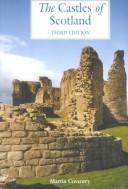
The Lore of Scotland
Excellent overview of Scottish legends matching Banffshire's themes.
eBay marketplace picks
Marketplace Samples
Live-tested eBay searches with available results related to this page.


Endnotes
1.
Source: banffmacduffheritagetrail.co.uk
Title: The Provost’s Ghost – Banff and Macduff, ‘two towns, big future’
Link:https://banffmacduffheritagetrail.co.uk/provosts-ghost/
2.
Source: banffshirefieldclub.org.uk
Link:https://banffshirefieldclub.org.uk/PDFs/BOOK_3/Banffshire_Field_Club_Transactions_1887-1893_-_1890_The_Horse_in_Scottish_Folklore_WM.pdf
3.
Source: gutenberg.org
Title: Project Gutenberg Folklore of Scottish Lochs and Springs
Link:https://www.gutenberg.org/files/56034/56034-h/56034-h.htm
4.
Source: gutenberg.org
Title: 43049 tei.tei
Link:https://www.gutenberg.org/files/43049/43049-tei/43049-tei.tei
5.
Source: gutenberg.org
Link:https://www.gutenberg.org/cache/epub/56034/pg56034-images.html
6.
Source: banffshirefieldclub.org.uk
Title: Banffshire Field Club Transactions 1935 1946 1937 Surnames in the North east WM
Link:https://banffshirefieldclub.org.uk/PDFs/BOOK_13/Banffshire_Field_Club_Transactions_1935-1946_-_1937_Surnames_in_the_North-east_WM.pdf
7.
Source: youtube.com
Title: The Many Lives of Duff House
Link:https://www.youtube.com/watch?v=xEmm3wiGdgU
Source snippet
Banff - The End of the Line for a Scottish Seaside Gem | Lost Railway Towns 28...
8.
Source: youtube.com
Link:https://www.youtube.com/watch?v=xmIdj7OX4_I
9.
Source: gazetteer.org.uk
Link:https://gazetteer.org.uk/place/Banffshire
10.
Source: lordlieutenantbanffshire.co.uk
Link:https://www.lordlieutenantbanffshire.co.uk/historic-county-of-banffshire
11.
Source: wikishire.co.uk
Title: Wikishire Banffshire
Link:https://wikishire.co.uk/wiki/Banffshire
12.
Source: historichouses.org
Title: Historic Houses Ballindalloch Castle – Historic Houses | Historic Houses
Link:https://www.historichouses.org/house/ballindalloch-castle/
13.
Source: ballindallochcastle.co.uk
Title: Ballindalloch Castle Tour the Castle
Link:https://www.ballindallochcastle.co.uk/tour-the-castle/
14.
Source: canmore.org.uk
Title: Canmore Inchdrewer Castle | Place | trove.scot
Link:https://canmore.org.uk/site/18451
15.
Source: portal.historicenvironment.scot
Link:https://portal.historicenvironment.scot/apex/f?p=1505%3A300%3A%3A%3A%3A%3AVIEWTYPE%2CVIEWREF%3Adesignation%2CLB3049
16.
Source: historicenvironment.scot
Link:https://www.historicenvironment.scot/visit/all/balvenie-castle/plan-your-visit/
17.
Source: thecastlesofscotland.co.uk
Link:https://www.thecastlesofscotland.co.uk/the-best-castles/magnificent-ruins/balvenie-castle/
18.
Source: historicenvironment.scot
Link:https://www.historicenvironment.scot/visit/all/duff-house/history-and-stories/
19.
Source: abdn.ac.uk
Link:https://www.abdn.ac.uk/elphinstone/resources/northern-folk/part-iii/
20.
Source: scottish-paranormal.co.uk
Title: ballindalloch castle
Link:https://www.scottish-paranormal.co.uk/post/ballindalloch-castle
21.
Source: Wikipedia
Title: Ballindalloch Castle
Link:https://en.wikipedia.org/wiki/Ballindalloch_Castle
22.
Source: Wikipedia
Title: Inchdrewer Castle
Link:https://en.wikipedia.org/wiki/Inchdrewer_Castle
23.
Source: Wikipedia
Title: Inchdrewer Castle
Link:https://de.wikipedia.org/wiki/Inchdrewer_Castle
24.
Source: Wikipedia
Link:https://en.wikipedia.org/wiki/Banffshire
25.
Source: Wikipedia
Title: Green Lady
Link:https://en.wikipedia.org/wiki/Green_Lady
26.
Source: portal.historicenvironment.scot
Link:https://portal.historicenvironment.scot/apex/f?p=1505%3A300%3A%3A%3A%3A%3AVIEWTYPE%2CVIEWREF%3Adesignation%2CLB3051
27.
Source: wikishire.co.uk
Link:https://wikishire.co.uk/wiki/Ballindalloch_Castle
28.
Source: flickr.com
Link:https://www.flickr.com/photos/opsblock/3880050375/
29.
Source: ia601704.us.archive.org
Link:https://ia601704.us.archive.org/30/items/gazetteerofscov11838cham/gazetteerofscov11838cham.pdf
30.
Source: engole.info
Title: Inchdrewer Castle
Link:https://engole.info/inchdrewer-castle/
31.
Source: lordlieutenantbanffshire.co.uk
Link:https://www.lordlieutenantbanffshire.co.uk/banffshire-lieutenancy-area
32.
Source: mythfolks.com
Title: scottish folklore
Link:https://www.mythfolks.com/scottish-folklore
33.
Source: crazyaboutcastles.com
Link:https://crazyaboutcastles.com/scottish-castles/ballindalloch-castle/
34.
Source: crazyaboutcastles.com
Title: balvenie castle
Link:https://crazyaboutcastles.com/scottish-castles/balvenie-castle/
35.
Source: localfolklore.weebly.com
Title: duff house
Link:https://localfolklore.weebly.com/duff-house.html
36.
Source: euansguide.com
Link:https://www.euansguide.com/reviews/scotland/aberdeenshire
37.
Source: thenorthernantiquarian.org
Link:https://www.thenorthernantiquarian.org/category/scotland/moray/
38.
Source: scottishgenealogy.uk
Link:https://www.scottishgenealogy.uk/banffshire.html
39.
Source: historica.fandom.com
Link:https://historica.fandom.com/wiki/Banffshire
Additional References
40.
Source: youtube.com
Title: Findlater Castle and Doocot, Portsoy, Banff, Exploring Scotland’s History
Link:https://www.youtube.com/watch?v=074704oiB7I
Source snippet
The Many Lives of Duff House - The Weird & Wonderful Story of an Iconic Stately Home...
41.
Source: documentacatholicaomnia.eu
Link:https://www.documentacatholicaomnia.eu/03d/sine-data%2C_Folklore_of_the_North%2C_East_Of_Scotland_%5BGregor._Walter%5D%2C_EN.doc
42.
Source: visitscotland.com
Link:https://www.visitscotland.com/nl-nl/things-to-do/attractions/castles/haunted
43.
Source: querndust.co.uk
Link:https://www.querndust.co.uk/PDFs/333Kelpie.pdf
44.
Source: visitscotland.com
Link:https://www.visitscotland.com/things-to-do/attractions/haunted-sites
45.
Source: thenorthernantiquarian.org
Link:https://www.thenorthernantiquarian.org/category/scotland/aberdeenshire/
46.
Source: joanaimages.com
Link:https://joanaimages.com/mini-travel-guides/balvenie
47.
Source: instagram.com
Link:https://www.instagram.com/reel/DUWHKEggOso/
48.
Source: hauntedhosts.com
Link:https://hauntedhosts.com/haunted-places/highland/location/1218-banff-castle-ghost/
49.
Source: scotlandspeople.gov.uk
Link:https://www.scotlandspeople.gov.uk/content/banff-county
Topic Tree
Follow this branch
Related pages 91
- Haunted Clackmannanshire
- Haunted Antrim
- Haunted Armagh
- Haunted Durham
- Haunted Londonderry
- +86 more in sidebar