Where Durham's Ghost Stories Still Gather
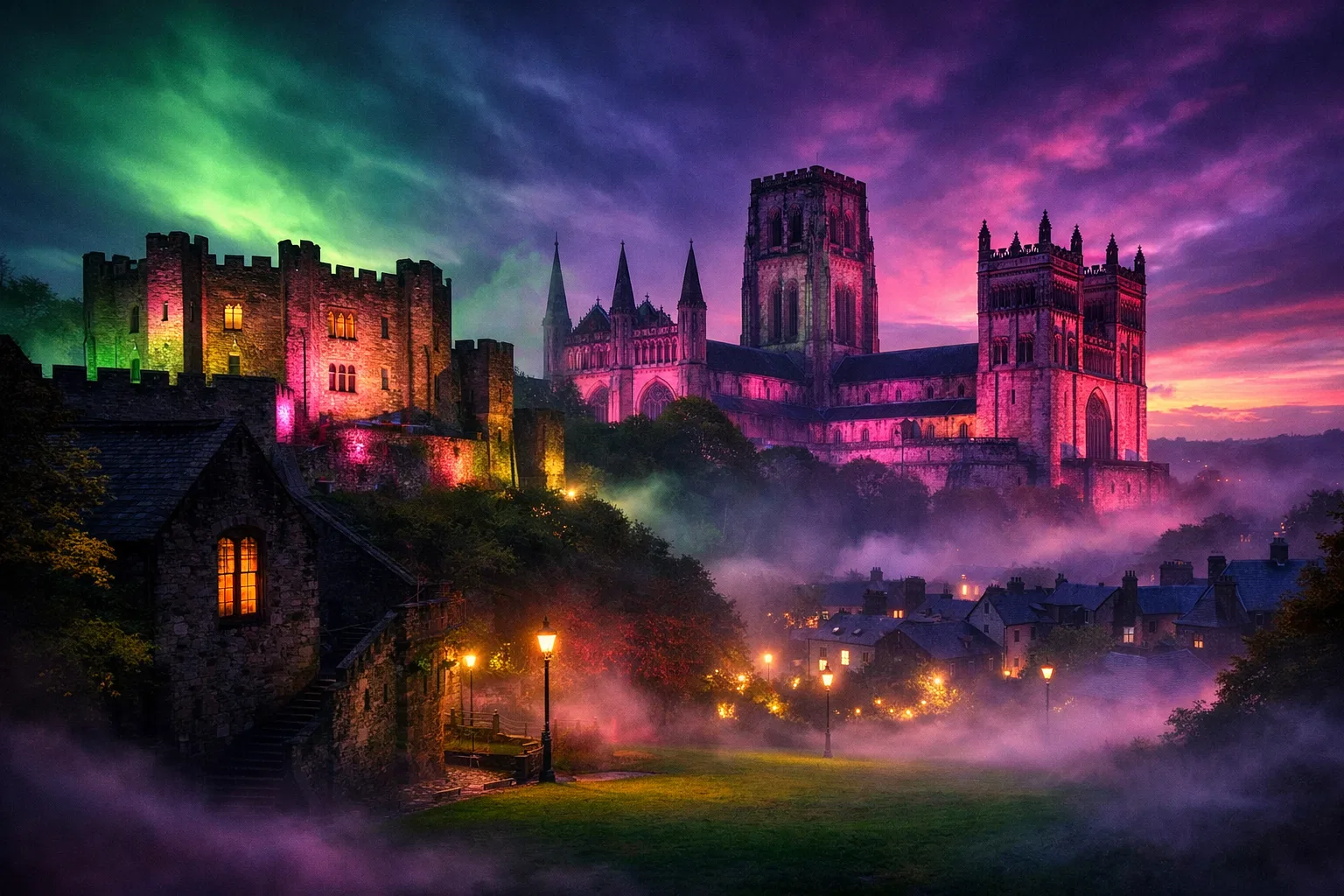
County Durham’s haunted reputation is strongest where old power still has stone walls around it: Durham Castle above Palace Green, Lumley Castle near Chester-le-Street, Raby Castle near Staindrop, Barnard Castle above the Tees, and Hylton Castle in historic Wearside.
Page outline Jump by section
What counts as County Durham here?
This page follows the historic-county frame used by the project’s county map, so County Durham is treated more broadly than the present County Durham unitary authority. Historic Durham includes places now often thought of through modern administrative labels, including parts of Tyne and Wear and Teesside, while the current visitor brand “County Durham” usually centres on Durham city, the Dales, the coast, Bishop Auckland, Barnard Castle, and nearby market towns. The Wikimedia Commons historic-county map identifies County Durham as one of England’s historic counties, and local record-office mapping resources still preserve older Durham coverage for towns such as Hartlepool, Gateshead, Bishop Auckland, Darlington and Barnard Castle.[Wikimedia Commons]commons.wikimedia.orgFile:England Historic Counties County Durham map.svgFile:England Historic Counties County Durham map.svg
That matters for haunted history because legends do not respect modern council boundaries. Hylton Castle, for example, is now in Sunderland, but its famous Cauld Lad belongs to the old County Durham folklore world. Similarly, Durham’s coast, Wearside, Teesdale, Weardale and the castle towns of the south all sit within overlapping tourist, historic, parish and folklore geographies. A careful reading keeps County Durham as the centre of gravity while recognising that stories travel along rivers, roads, estates and media markets.
Why Durham’s ghost map clusters around castles
Durham’s haunted places are unusually castle-heavy because the county’s historic identity is tied to fortified power. Durham Castle and Cathedral formed a UNESCO World Heritage Site in 1986; UNESCO describes the cathedral as a late 11th- and early 12th-century building created to house the relics of St Cuthbert and the Venerable Bede, with the castle behind it serving as the residence of the Prince-Bishops of Durham.[UNESCO World Heritage Centre]whc.unesco.orgWorld Heritage Centre Durham Castle and CathedralWorld Heritage Centre Durham Castle and Cathedral
That setting gives Durham’s ghost stories their particular mood. They are not merely tales of “spooky rooms”; they are stories attached to authority, punishment, inheritance, family scandal and religious change. Castles invite this kind of storytelling because they are physically dramatic and socially charged. Staircases, wells, dungeons, battlements, chapels, libraries and gatehouses become ready-made stages for tales about falls, murders, hidden bodies and restless aristocrats.
The county’s official tourism material leans into this atmosphere, listing ghost stories such as Lily of Lumley, the Grey Lady of Durham Castle, Barnard Castle’s darker legends, Crossgate’s young woman, Raby’s Old Hell Cat and Peg Powler of the Tees. These are useful as evidence of what the county now presents to visitors, but they are tourism retellings rather than primary proof of supernatural events.[This is Durham]thisisdurham.comOpen source on thisisdurham.com.
Durham Castle: the Grey Lady on the Black Staircase
The most prominent Durham city haunting is the Grey Lady of Durham Castle. The story usually places her on the Black Staircase, where she is said to be the wife of a 19th-century Bishop of Durham who fell to her death from the top of the stairs. Visit County Durham presents the tale as one of the city’s best-known ghost stories and notes that the staircase can be seen on guided castle tours.[This is Durham]thisisdurham.comThis is Durham Five Frightful Durham ghost storiesThis is Durham Five Frightful Durham ghost stories
The setting is more secure than the apparition. Durham Castle is not a ruin but a living building, now associated with Durham University and University College. Its place opposite the cathedral on Palace Green gives the Grey Lady story a powerful visual frame: a university residence inside a former seat of episcopal power, with students sleeping in a building whose history reaches back to Norman rule. Historic England describes the wider Castle and Cathedral site as including a castle first constructed in the late 11th century under William the Conqueror’s orders.[Historic England]historicengland.org.ukHistoric England Durham Castle and Cathedral, City of DurhamHistoric England Durham Castle and Cathedral, City of Durham
There are also student-centred variants. Local and student writing has repeated stories of other castle ghosts, including a student associated with exam failure and a room inside the castle, but these accounts are much less firmly evidenced than the broad Grey Lady tradition. They show how old buildings generate new folklore: each generation of residents adds its own anxieties, especially around study, isolation, night-time noises and institutional ritual.[Palatinate]palatinate.org.ukPalatinate A guide to the ghosts of DurhamPalatinate A guide to the ghosts of Durham
The most cautious interpretation is that Durham Castle’s haunting is a classic “place ghost” tradition. The alleged fall gives the story a neat origin; the staircase gives it a precise location; the university setting keeps it alive through repeated telling. What it lacks, at least in easily available public evidence, is a firm documentary chain linking a named bishop’s wife, a recorded death on the staircase and early witness testimony.
Lumley Castle: Lily, the well, and a legend that refuses to stay quiet
Lumley Castle near Chester-le-Street is probably County Durham’s most famous haunted hotel. Its signature story is Lily of Lumley, usually described as a woman murdered by priests and thrown down a well after a religious dispute. Modern retellings often make her the wife of Ralph Lumley, builder or lord of the castle, and say that her ghost rises from the well or wanders the rooms and corridors.[This is Durham]thisisdurham.comThis is Durham Five Frightful Durham ghost storiesThis is Durham Five Frightful Durham ghost stories
The historical difficulty is important. Local-history summaries point out that Ralph Lumley’s known wife was Eleanor Neville and that there is no secure record of a wife called Lily. England’s North East, a regional history site, states plainly that Lily’s true name and identity are unknown and that there is no actual record of a Lily of Lumley. That does not kill the legend, but it changes how it should be read: not as a verified medieval murder case, but as a romance-like family legend attached to a real aristocratic site.[England's North East]englandsnortheast.co.ukOpen source on englandsnortheast.co.uk.
The building itself gives the story staying power. Lumley Castle is a 14th-century castle at Chester-le-Street, now operated as a hotel, and its combination of guest rooms, old masonry, a surviving well tradition and night-time hospitality has made the haunting easy to market and easy to retell.[Haunted Hotels UK]hauntedhotels.ukHaunted Hotels UKLumley Castle HotelHaunted Hotels UKLumley Castle Hotel
A striking modern twist is the castle’s cricket folklore. Reports from 2005 said members of the Australian cricket team were unsettled while staying at the castle, and ESPN Cricinfo later revisited the episode as part of Ashes lore. This is a useful example of how a local ghost story becomes nationally visible: not because the evidence suddenly improves, but because famous guests, sport journalism and a memorable setting carry the tale to a wider audience.[Cricinfo]cricinfo.comhaunted house adds to australia s woes 211645haunted house adds to australia s woes 211645
Raby Castle: the Old Hell Cat and aristocratic anger
Raby Castle’s best-known ghost is the “Old Hell Cat”, usually identified with Elizabeth, Lady Barnard. The story says she haunts the battlements or corridors while furiously knitting with red-hot needles, enraged by family conflict and social disapproval. Visit County Durham’s account links the legend to Christopher and Elizabeth’s disapproval of Gilbert and Mary’s marriage and says the furious Elizabeth became known locally by that memorable nickname.[This is Durham]thisisdurham.comOpen source on thisisdurham.com.
Raby is a fitting home for such a legend because it was never a minor country house. Historic England lists Raby Castle as Grade I, and Raby’s own history explains that the Bishop of Durham granted John, 3rd Baron Neville of Raby, a licence to fortify the building in the late 14th century. The castle later passed through the powerful Neville and Vane families, making it a place where inheritance, rank, marriage and political allegiance were not private matters but public forces.[Historic England]historicengland.org.ukHistoric England Raby Castle, Raby with KeverstoneHistoric England Raby Castle, Raby with Keverstone
The Old Hell Cat tale is vivid because it turns domestic anger into a visible haunting. The red-hot needles are not just a spooky detail; they symbolise a woman whose rage has outlived her household. Whether the story preserves a distorted memory of a real family dispute or is simply a moralising aristocratic legend, it fits a wider pattern in British castle folklore: women who are remembered less for what they governed than for how they supposedly loved, raged, disobeyed or punished.
Raby continues to use its ghost traditions in public programming, including torchlit haunted tours that present “reported hauntings” and unexplained phenomena as part of the visitor experience. That does not make the tales factual, but it shows that they remain active heritage, not forgotten footnotes.[Raby Estates]raby.co.ukOpen source on raby.co.uk.
Hylton Castle: the Cauld Lad, between ghost and brownie
The Cauld Lad of Hylton is one of historic County Durham’s richest supernatural traditions because it is not just a ghost story. In common retellings, the Cauld Lad is the spirit of a stable boy, often named Roger or Robert Skelton, killed by a Baron Hylton after oversleeping, failing to prepare a horse, or becoming entangled in some household scandal. After death, he troubles the castle: smashing crockery, moving objects, making noises and crying that he is cold.[Hypnogoria]hypnogoria.comOpen source on hypnogoria.com.
The older folklore is more complicated. Antiquarian accounts connected the Cauld Lad with a “brownie” or domestic spirit: a household being who could help or hinder servants depending on how it was treated. In that version, leaving out clothing releases or dismisses the spirit, which is why the famous cloak-and-hood motif matters. The tale therefore sits on the border between haunting, fairy lore, poltergeist activity and moral legend.[Hypnogoria]hypnogoria.comOpen source on hypnogoria.com.
This is a good example of why County Durham folklore should not be flattened into a list of ghosts. The Cauld Lad may preserve memory of a suspicious death, but it also preserves an older northern belief-world in which household spirits were not always dead humans. Later ghost-story culture appears to have pulled the tale towards the murdered-servant version because that is easier to narrate: a victim, a guilty master, a restless return, and a possible laying to rest.
For readers following the historic county map, Hylton also shows why modern administrative boundaries can mislead. The castle is now generally discussed in relation to Sunderland, but the legend belongs naturally within Durham’s older Wearside folklore.
Barnard Castle, Teesdale and the uncanny south-west
Barnard Castle is better evidenced as a historic site than as a single, dominant ghost location. English Heritage explains that the castle’s continuous history begins after the Norman Conquest and that its site commanded a crossing over the River Tees on a major Roman road across the Pennines. The town and ruined fortress therefore sit at a natural threshold: river crossing, road corridor, borderland route and market-town stage.[English Heritage]english-heritage.org.ukOpen source on english-heritage.org.uk.
That threshold quality matters for ghost lore. Visit County Durham’s Halloween material associates Barnard Castle with illicit weddings performed by the 18th-century bogus parson Cuthbert Hilton and with darker local stories in the town. English Heritage also preserves the very different tale of Frank Shields, the 19th-century “hermit” of Barnard Castle, who lived in the keep and became part of the visitor experience. He was not a ghost, but his story shows how the castle became a place where performance, eccentricity, ruin and tourism already overlapped.[This is Durham]thisisdurham.comOpen source on thisisdurham.com.
Nearby Egglestone Abbey adds another kind of atmosphere. English Heritage describes it as the remains of a small monastery of Premonstratensian “white canons”, set above a bend in the River Tees. Ruined religious houses often attract ghost stories because they combine abandonment, silence, broken ritual and picturesque decay, even where the specific haunting evidence is thin.[English Heritage]english-heritage.org.ukOpen source on english-heritage.org.uk.
The strongest Teesdale supernatural figure, however, is not a castle ghost but Peg Powler.

Peg Powler and the dangerous river
Peg Powler is a water spirit associated with the River Tees, especially around Upper Teesdale in modern visitor retellings. Visit County Durham describes her as a figure lurking in the dark waters of the Tees, with long green hair and a link to froth or disturbed water on the river’s surface. The story is often framed as a warning to children and adults to stay away from dangerous water.[This is Durham]thisisdurham.comThis is Durham Five Frightful Durham ghost storiesThis is Durham Five Frightful Durham ghost stories
This is folklore with a practical edge. Like many British water spirits, Peg Powler gives a face to real hazards: deep pools, sudden currents, slippery banks, cold water and the deceptive beauty of upland rivers. The tale is eerie because it is useful. It turns a safety warning into a memorable character, making the river feel watched, inhabited and morally charged.
Within County Durham’s haunted geography, Peg Powler broadens the map beyond castles. She belongs to riverbanks, reservoirs, upland routes and family warnings rather than aristocratic chambers. Her presence reminds readers that the county’s supernatural imagination is not only about grand buildings; it is also about landscape, weather, water and risk.
How credible are County Durham’s hauntings?
The fairest answer is that County Durham has strong folklore but mixed evidence. Some places are historically robust: Durham Castle and Cathedral, Raby Castle, Barnard Castle, Egglestone Abbey and Lumley Castle are real, well-documented heritage sites. Their architecture, ownership and public histories can be checked through UNESCO, Historic England, English Heritage and official site histories.[unesco.org]whc.unesco.orgWorld Heritage Centre Durham Castle and CathedralWorld Heritage Centre Durham Castle and Cathedral
The ghost claims themselves are usually weaker. They are often preserved through tourism pages, local journalism, antiquarian folklore, hotel storytelling, oral tradition and seasonal ghost tours. That does not make them worthless. Folklore is evidence of what communities remember, fear, enjoy and repeat. But it does mean that a reader should separate three things:
- The place: usually verifiable, often very old, and sometimes nationally important.
- The story: often long-lived, locally meaningful and repeated across several tellings.
- The apparition claim: usually anecdotal, disputed and difficult to test.
Lumley Castle shows the pattern clearly. The castle is real and historic; the Lily story is locally famous; the identity of Lily is historically uncertain. Hylton shows another pattern: a possible historical death and legal memory may have fused with older brownie or household-spirit folklore. Durham Castle’s Grey Lady shows a third: a precise location and repeated tradition, but a thin public paper trail for the alleged fatal fall.
Why the stories became locally famous
County Durham’s hauntings have survived because they attach memorable images to places people can still visit. A woman on a black staircase, a murdered lady in a well, an old aristocrat knitting with burning needles, a shivering household spirit crying for warmth, and a river hag waiting in the Tees are all easy to remember and easy to retell.
They also speak to recognisable human tensions. Durham Castle’s Grey Lady centres on a fall inside a seat of religious authority. Lily of Lumley turns religious conflict and marital secrecy into a well-haunting. Raby’s Old Hell Cat dramatises family control and class anxiety. The Cauld Lad of Hylton gives a wronged servant a supernatural afterlife. Peg Powler gives dangerous water a personality.
Modern tourism has helped keep these tales alive. County Durham promotes ghost stories as part of its visitor appeal, Raby runs haunted tours, Lumley Castle has used the Lily legend in hotel and escape-room experiences, and Durham city ghost walks package local tales for evening audiences.[thisisdurham.com]thisisdurham.comOpen source on thisisdurham.com.
The best way to read Durham’s haunted county
County Durham is not best understood as a place where every old building has a proven ghost. It is better understood as a county where history has left unusually strong settings for supernatural storytelling. The Prince-Bishops gave Durham city grandeur and authority; the castles of Lumley, Raby, Barnard and Hylton gave the wider county towers, wells, halls and family legends; the River Tees and the uplands gave it older landscape spirits and cautionary tales.
The result is a haunted map with several layers. There is the official heritage layer of listed buildings, castles, abbeys and World Heritage status. There is the folklore layer of brownies, river hags, grey ladies and wronged servants. There is the modern visitor layer of ghost walks, hotel stories, Halloween tours and local press round-ups. The most rewarding approach is to let those layers sit together: atmospheric enough to enjoy after dark, but grounded enough to see how each story grew from a particular place, social memory and tradition.

Amazon book picks
Further Reading
Books and field guides related to Where Durham's Ghost Stories Still Gather. Use these as the next step if you want deeper reading beyond the article.
The lore of the land
Explains how local legends become attached to landscapes and historic places.
The Penguin Guide to the Superstitions of Britain and Ireland
Places County Durham ghost traditions within the wider folklore of Britain.


Haunted Castles of Britain and Ireland
Includes the wider tradition of haunted castles that frames Durham's stories.
eBay marketplace picks
Marketplace Samples
Live-tested eBay searches with available results related to this page.
Endnotes
1.
Source: commons.wikimedia.org
Title: File:England Historic Counties County Durham map.svg
Link:https://commons.wikimedia.org/wiki/File%3AEngland_Historic_Counties_County_Durham_map.svg
2.
Source: whc.unesco.org
Title: World Heritage Centre Durham Castle and Cathedral
Link:https://whc.unesco.org/en/list/370/
3.
Source: hauntedhotels.uk
Title: Haunted Hotels UKLumley Castle Hotel
Link:https://hauntedhotels.uk/hotel/lumley-castle-hotel
4.
Source: cricinfo.com
Title: haunted house adds to australia s woes 211645
Link:https://www.cricinfo.com/story/haunted-house-adds-to-australia-s-woes-211645?platform=amp
5.
Source: hypnogoria.com
Link:https://hypnogoria.com/folklore_cauld.html
6.
Source: commons.wikimedia.org
Title: Category:Old maps of County Durham
Link:https://commons.wikimedia.org/wiki/Category%3AOld_maps_of_County_Durham
7.
Source: commons.wikimedia.org
Title: Category:Historic counties of England
Link:https://commons.wikimedia.org/wiki/Category%3AHistoric_counties_of_England
8.
Source: commons.wikimedia.org
Title: File:England and Wales Historic Counties HCT map.svg
Link:https://commons.wikimedia.org/wiki/File%3AEngland_and_Wales_Historic_Counties_HCT_map.svg
9.
Source: commons.wikimedia.org
Title: File:Historic counties within Cumbria.svg
Link:https://commons.wikimedia.org/wiki/File%3AHistoric_counties_within_Cumbria.svg
10.
Source: commons.wikimedia.org
Title: Category:Old county maps of County Durham
Link:https://commons.wikimedia.org/wiki/Category%3AOld_county_maps_of_County_Durham
11.
Source: youtube.com
Title: We Survived a Night at One of The UK’s Most Haunted Castles Lumley Castle
Link:https://www.youtube.com/watch?v=stfONXWWMqQ
Source snippet
THE CAULD LAD OF HYLTON | A Haunting North East Folk Ballad...
12.
Source: youtube.com
Title: THE CAULD LAD OF HYLTON | A Haunting North East Folk Ballad
Link:https://www.youtube.com/watch?v=xKbOQ1XJwXI
Source snippet
Something Was Watching Us...The Spirits of Durham's Haunted Inns...
13.
Source: thisisdurham.com
Link:https://www.thisisdurham.com/inspire-me/durhams-unmissable-highlights/ghost-stories
14.
Source: thisisdurham.com
Title: This is Durham Five Frightful Durham ghost stories
Link:https://www.thisisdurham.com/blog/read/2021/10/five-frightful-durham-ghost-stories-b356
15.
Source: historicengland.org.uk
Title: Historic England Durham Castle and Cathedral, City of Durham
Link:https://historicengland.org.uk/listing/the-list/list-entry/1000089
16.
Source: palatinate.org.uk
Title: Palatinate A guide to the ghosts of Durham
Link:https://www.palatinate.org.uk/things-that-go-bump-in-the-night-a-guide-to-the-ghosts-of-durham/
17.
Source: chroniclelive.co.uk
Title: ghosts stories legends county durham 19194068
Link:https://www.chroniclelive.co.uk/news/north-east-news/ghosts-stories-legends-county-durham-19194068
18.
Source: englandsnortheast.co.uk
Link:https://englandsnortheast.co.uk/lumley/
19.
Source: Wikipedia
Title: Lumley Castle
Link:https://en.wikipedia.org/wiki/Lumley_Castle
20.
Source: chroniclelive.co.uk
Title: lumley castle open escape room 15547878
Link:https://www.chroniclelive.co.uk/whats-on/whats-on-news/lumley-castle-open-escape-room-15547878
21.
Source: thisisdurham.com
Link:https://www.thisisdurham.com/inspire-me/durhams-unmissable-highlights/ghost-stories/the-old-hell-cat-of-raby
22.
Source: historicengland.org.uk
Title: Historic England Raby Castle, Raby with Keverstone
Link:https://historicengland.org.uk/listing/the-list/list-entry/1338625
23.
Source: raby.co.uk
Link:https://www.raby.co.uk/raby-castle/discover/history/
24.
Source: raby.co.uk
Link:https://www.raby.co.uk/events/haunted-raby-tour-by-torchlight/
25.
Source: Wikipedia
Title: Cauld Lad of Hylton
Link:https://en.wikipedia.org/wiki/Cauld_Lad_of_Hylton
26.
Source: english-heritage.org.uk
Link:https://www.english-heritage.org.uk/visit/places/barnard-castle/history/
27.
Source: english-heritage.org.uk
Link:https://www.english-heritage.org.uk/visit/places/barnard-castle/
28.
Source: english-heritage.org.uk
Link:https://www.english-heritage.org.uk/members-area/past-lives/barnard-hermit/
29.
Source: english-heritage.org.uk
Link:https://www.english-heritage.org.uk/visit/places/egglestone-abbey/
30.
Source: tripadvisor.co.uk
Link:https://www.tripadvisor.co.uk/Attraction_Review-g190832-d26528479-Reviews-Walking_with_the_Ghosts_of_Durham-Durham_County_Durham_England.html
31.
Source: historicengland.org.uk
Link:https://historicengland.org.uk/profile/312102/PennyMiddleton
32.
Source: historicengland.org.uk
Title: County Durham
Link:https://historicengland.org.uk/local/locations/county-durham/
33.
Source: Wikipedia
Title: County Durham
Link:https://en.wikipedia.org/wiki/County_Durham
34.
Source: Wikipedia
Title: Raby Castle
Link:https://en.wikipedia.org/wiki/Raby_Castle
35.
Source: instagram.com
Link:https://www.instagram.com/reel/DPRqnhrjHzw/
36.
Source: english-heritage.org.uk
Link:https://www.english-heritage.org.uk/search?page=2&searchTerm=Egglestone+Abbey&type=
37.
Source: english-heritage.org.uk
Link:https://www.english-heritage.org.uk/visit/places/bowes-castle/
38.
Source: english-heritage.org.uk
Title: past lives
Link:https://www.english-heritage.org.uk/members-area/past-lives/
39.
Source: english-heritage.org.uk
Title: small sites
Link:https://www.english-heritage.org.uk/about/search-news/small-sites/
40.
Source: english-heritage.org.uk
Link:https://www.english-heritage.org.uk/visit/inspire-me/jmw-turner-quiz/
41.
Source: english-heritage.org.uk
Title: 100 meadows
Link:https://www.english-heritage.org.uk/about/search-news/100-meadows/
42.
Source: englandsnortheast.co.uk
Title: broken counties tyne wear tees
Link:https://englandsnortheast.co.uk/2018/03/02/broken-counties-tyne-wear-tees/
43.
Source: chroniclelive.co.uk
Title: ugly dwarves blood thirsty trolls 12860400
Link:https://www.chroniclelive.co.uk/news/history/ugly-dwarves-blood-thirsty-trolls-12860400
44.
Source: ebsco.com
Link:https://www.ebsco.com/research-starters/architecture/durham-castle-and-cathedral
45.
Source: baseview.uk
Title: north east
Link:https://www.baseview.uk/region/north-east
Additional References
46.
Source: youtube.com
Title: The Grey Lady and the Ghosts of Dunster Castle | English Folklore
Link:https://www.youtube.com/watch?v=QuiFX5dCses
Source snippet
We Survived a Night at One of The UK's Most Haunted Castles Lumley Castle...
47.
Source: youtube.com
Title: 8 Extremely Haunted Places in County Durham
Link:https://www.youtube.com/watch?v=q4JK5Y0AlWU
Source snippet
The Grey Lady and the Ghosts of Dunster Castle | English Folklore...
48.
Source: verdantleisure.co.uk
Link:https://www.verdantleisure.co.uk/our-journal/5-haunted-places-to-visit-in-the-uk/
49.
Source: aucklandproject.org
Link:https://aucklandproject.org/visit-us/stay/accommodation-partners/
50.
Source: facebook.com
Link:https://www.facebook.com/groups/uncannyfan/posts/2322279291582022/
51.
Source: en-academic.com
Link:https://en-academic.com/dic.nsf/enwiki/1174936
52.
Source: gazetteer.org.uk
Link:https://gazetteer.org.uk/County_Durham_Portrait.pdf
53.
Source: instagram.com
Link:https://www.instagram.com/p/DQcb-fhgfIi/
54.
Source: facebook.com
Link:https://www.facebook.com/groups/438951189559140/posts/8116570795130436/
55.
Source: fabulousnorth.com
Link:https://fabulousnorth.com/durham-castle/
Topic Tree
Follow this branch
Related pages 91
- Haunted Clackmannanshire
- Haunted Antrim
- Haunted Armagh
- Haunted Londonderry
- Haunted Buteshire
- +86 more in sidebar