Within Haunted Northamptonshire
Does Mary's Staircase Still Hold the Story?
The Mary Queen of Scots haunting links Fotheringhay Castle's execution history with the Talbot Hotel's staircase tradition.
On this page
- Fotheringhay Castle and the execution story
- The Talbot Hotel staircase tradition
- How relics turn history into haunting
Page outline Jump by section
Introduction
Mary Queen of Scots is not said to haunt Northamptonshire because of a vague Tudor mood. The county’s strongest Mary tradition is much more specific: Fotheringhay Castle is the documented place of her imprisonment and execution, while the Talbot Hotel at nearby Oundle preserves the famous staircase reputedly taken from the castle after its demolition. The haunting story belongs mainly to that staircase. Mary’s ghost is said to descend it, and local legend even claims her hand or ring left a mark as she steadied herself on the way to death. Historic records can firmly place Mary at Fotheringhay on 8 February 1587; they can also show that the Talbot is an old inn rebuilt in 1626 and long associated with reused Fotheringhay stone. What they cannot prove is the ghost. That gap between fact, relic and folklore is exactly why “Mary’s Staircase” remains one of Northamptonshire’s most memorable haunted-history traditions.[Historic England]historicengland.org.ukHistoric EnglandFotheringhay motte and bailey castleMary Queen of Scots was imprisoned in the castle in 1586, and eventually executed the…
Why Fotheringhay Gives the Story Its Weight
Fotheringhay Castle, at the edge of the village near the River Nene, survives today chiefly as earthworks rather than a standing royal fortress. Historic England describes it as a substantial motte-and-bailey castle with a motte about 7 metres high and 70 metres across, inner and outer baileys, ditches and traces of the earlier castle layout. Its national importance is not only architectural. The official listing stresses its royal connections and its “particular historical significance” as the prison and execution place of Mary Queen of Scots.[Historic England]historicengland.org.ukHistoric EnglandFotheringhay motte and bailey castleMary Queen of Scots was imprisoned in the castle in 1586, and eventually executed the…
That matters for the haunting tradition because the Mary story begins with unusually solid history. Mary was held at Fotheringhay in 1586–87 and was executed in the castle’s great hall in 1587. National Galleries Scotland summarises the political background: after nineteen years in English captivity, she was found guilty of plotting against Elizabeth I, and the execution took place at Fotheringhay Castle in Northamptonshire on 8 February 1587.[Historic England]historicengland.org.ukHistoric EnglandFotheringhay motte and bailey castleMary Queen of Scots was imprisoned in the castle in 1586, and eventually executed the…
The castle itself does not now offer a grand haunted interior. Its emotional force comes from absence. The great hall is gone; the royal apartments are gone; the visible remains are earthwork, memory and fragment. That disappearance helps explain why the ghost story migrated so powerfully to Oundle. A ruin can mark the event, but an inn staircase gives the story something a visitor can still see, touch and imagine in human scale.
What Happened at Fotheringhay Castle?
Mary’s final hours are unusually well documented compared with many ghost-story origins. The National Library of Scotland holds Mary’s last letter, written from Fotheringhay in the early hours of Wednesday 8 February 1587 to Henri III of France. The library describes it as her last ever letter, written at about 2 a.m., in which she told him she was to be executed that morning.[National Library of Scotland]nls.ukOpen source on nls.uk.
The execution itself was quickly turned into image, report and political memory. National Galleries Scotland notes that a 1613 watercolour of the execution, although not architecturally accurate in every detail, reflects eyewitness accounts of the event. The same institutional account places the execution plainly at Fotheringhay Castle and connects it to Mary’s conviction for plotting against Elizabeth I.[National Galleries of Scotland]nationalgalleries.orgNational Galleries of ScotlandThe Execution of Mary, Queen of Scots, 1542 - 1587Mary, Queen of Scots, was executed on 8 February 1587 at…
For a haunted-history page, the key point is not to retell Mary’s whole life. It is that Northamptonshire’s Mary tradition rests on a rare combination: a named person, a known date, a named building, a known room type — the great hall — and later physical fragments said to have travelled from that demolished castle into a still-working hotel. Many local ghost stories begin with “it is said”; this one begins with a state execution and only later becomes a haunting.

The Talbot Hotel Staircase Tradition
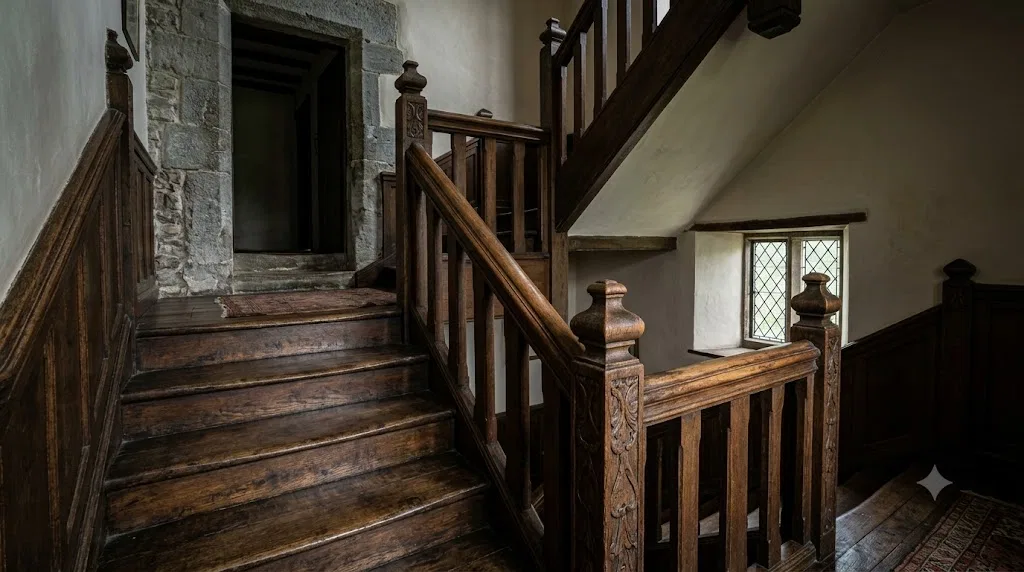
The Talbot Hotel in Oundle is the place where the story becomes visible. Historic England’s listed-building entry records that the inn was established in 1552 on an earlier site and rebuilt in 1626. It also says it is “popularly believed” that stone from Fotheringhay Castle was used in the rebuilding and that the fine sixteenth-century staircase was brought from there too. That phrase matters: “popularly believed” is not the same as documentary proof, but it shows the tradition is old and established enough to appear in heritage description.[Historic England]historicengland.org.ukEstablished in 1552 on earlier site and rebuilt 1626. It is popularly believed that stone from Fotheringhay Castle was used in the rebuil…
A separate Historic England education page repeats the same core tradition in plainer form: the Talbot was rebuilt in 1626, stone from Fotheringhay Castle is believed to have been used, and the staircase is also believed to have come from the castle. It adds the historical sequence that Fotheringhay was sold into private hands in 1603 and then gradually robbed of stone until only the earthworks remained.[Historic England]historicengland.org.ukOpen source on historicengland.org.uk.
The hotel’s own public history leans into the same legend. It describes the Talbot as rebuilt in 1626 using stone from Fotheringhay Castle and presents the oak staircase as the one Mary Queen of Scots reputedly descended before her execution. As hotel storytelling, that is promotional and atmospheric, but it is important evidence for how the tradition is preserved for visitors today.[The Talbot, Oundle]talbothotel.co.ukabout usabout us
What Is Said to Haunt the Staircase?
The haunting attached to the Talbot is usually not a complicated many-ghost legend. Its centre is Mary herself, imagined as returning to the staircase associated with her last walk. Historic England’s ghost-story feature says Mary’s ghost has reportedly been seen walking down the Talbot staircase and adds a second, more theatrical detail: a picture of her execution has allegedly been known to jump from the wall.[Historic England]historicengland.org.ukHistoric EnglandGhost StoriesThe staircase at the hotel is thought to have come from the castle and it's said that Mary walked to her exe…
The best-known version of the staircase legend says Mary gripped the rail or newel as she descended, leaving a mark. Some retellings make this even more precise, claiming that a crown-shaped ring or signet left an indentation in the wood. This is the kind of detail that makes the story memorable: it turns a huge political event into a bodily gesture, the pressure of a condemned woman’s hand on a stair. Historic England records the more restrained version, that Mary left her mark by gripping the staircase to keep her balance; commercial haunted-hotel accounts often elaborate it into the crown-ring indentation.[Historic England]historicengland.org.ukHistoric EnglandGhost StoriesThe staircase at the hotel is thought to have come from the castle and it's said that Mary walked to her exe…
As evidence, the ghost reports are much weaker than the history of the execution or the architectural tradition. They are usually preserved in heritage features, hotel lore, paranormal listings and visitor retellings rather than in formal witness statements or contemporary records. That does not make them worthless as folklore. It tells us what sort of story this is: not a proved apparition case, but a relic-haunting, where an object believed to have witnessed trauma becomes the stage on which the past is imagined to repeat.
How Strong Is the Evidence for Mary’s Staircase?
The evidence is strongest at Fotheringhay, moderate for the movement of building material, and weakest for the ghost.
The firmest facts are these: Fotheringhay Castle existed; Mary was imprisoned there in 1586–87; she was executed there on 8 February 1587; the Talbot Hotel is a Grade I listed building rebuilt in 1626; and heritage records preserve the tradition that stone and a sixteenth-century staircase came from Fotheringhay.[Historic England]historicengland.org.ukHistoric EnglandFotheringhay motte and bailey castleMary Queen of Scots was imprisoned in the castle in 1586, and eventually executed the…
The uncertain part is whether the Talbot staircase is truly the exact staircase Mary descended on the way to execution. Historic England’s wording is careful: “popularly believed” and “believed” rather than “documented”. The hotel’s own wording is also cautious in places, using “reputedly” for Mary’s descent. That caution is important because Fotheringhay was dismantled after Mary’s death, and reused stone is plausible, but the precise biography of a timber staircase is harder to prove without surviving purchase records or architectural certainty.[Historic England]historicengland.org.ukOpen source on historicengland.org.uk.
There is also a practical historical tension. The Talbot was rebuilt in 1626, nearly forty years after Mary’s execution. Reused material from Fotheringhay fits the timeline, especially as the castle was sold into private hands in 1603 and later stripped. But a staircase can be moved, altered, repaired or reinterpreted over time. The most responsible reading is that the Talbot preserves a long-standing Fotheringhay relic tradition, not a courtroom-level proof that Mary’s feet touched those exact treads.
Why the Story Moved from Castle to Inn
The Talbot tradition works because it solves a problem created by demolition. Fotheringhay is the historical scene, but the castle’s disappearance left visitors with little built fabric through which to experience the story. Oundle’s Talbot supplies what the ruin lacks: enclosed rooms, old timber, stone, a named staircase and the atmosphere of an inn where guests can still stay.
This is a common mechanism in haunted places. Ghost stories often attach themselves not only to where an event happened, but to whatever object or building seems to have carried the event forward. In this case, the supposed relocation of castle stone and staircase turns the Talbot into a kind of afterlife for Fotheringhay. The castle becomes the source of the trauma; the inn becomes the container of the relic.
The story is also easy to navigate geographically. Fotheringhay and Oundle sit close enough that a visitor can imagine the connection without effort. The Talbot is not a random hotel borrowing a famous name from far away. It belongs to the same Northamptonshire landscape of river villages, market-town routes, reused stone and Tudor memory. That local closeness gives the haunting a stronger hold than it would have if the staircase had supposedly travelled across the country.
The Power of a Relic Haunting
Mary’s Staircase is best understood as a relic haunting: a ghost story built around a physical object believed to have touched a decisive historical moment. The staircase does not merely decorate the tale. It does almost all the work.
A relic haunting depends on three linked ideas. First, the object must seem old enough to have “been there”. Second, it must be portable or plausibly reused, so it can survive after the original building is lost. Third, it must invite repeated movement: a stair, doorway, bed, chair, mirror or corridor. The Talbot staircase fits that pattern perfectly. Stairs are already dramatic spaces in ghost lore because they suggest footsteps, descent, hesitation and return.
Mary’s story adds another layer. She is not a nameless victim or a generic lady in white. She was an anointed queen, a Catholic martyr to some later admirers, a political danger to Elizabethan England, and eventually the mother of James VI and I. Westminster Abbey’s account of her later burial history shows how long her memory remained politically and ceremonially charged: first buried at Peterborough Cathedral, she was reburied at Westminster Abbey in 1612 by order of her son James.[Westminster Abbey]westminster-abbey.orgOpen source on westminster-abbey.org.
That afterlife in public memory helps explain why Northamptonshire’s Mary legend endured. The ghost is not just a spooky hotel figure. She is the local form of a national argument about queenship, religion, legitimacy and pity.
Fotheringhay Still Remembers Mary Without Needing a Ghost
The haunting at Oundle should not obscure the quieter memorial culture at Fotheringhay itself. The village remains a place of annual remembrance for Mary, not merely paranormal tourism. A 2019 account by historian Francis Young records an annual service of commemoration for Mary Queen of Scots at St Mary and All Saints Church, Fotheringhay, attended by representatives of Mary-related societies and linked to the anniversary of her beheading in the castle’s great hall.[Francis Young]drfrancisyoung.comFrancis Young Commemoration of Mary, Queen of Scots at FotheringhayFrancis Young Commemoration of Mary, Queen of Scots at Fotheringhay
The Marie Stuart Society has also publicised church services and flower-laying at the castle mound, again showing that Fotheringhay’s Mary memory is active and ritualised rather than simply a tourist label.[The Mary Queen of Scots Society]mariestuartsociety.wordpress.comOpen source on wordpress.com.
That distinction matters. Oundle gives the story its haunted staircase; Fotheringhay gives it solemnity. The two places work together, but they do different things. At the castle mound, the story is historical memory and commemoration. At the Talbot, it becomes architectural folklore and atmospheric encounter.
What a Careful Visitor Should Notice
A visitor interested in Northamptonshire’s haunted history should treat Mary’s Staircase as a layered site rather than a yes-or-no ghost claim.
The first layer is documented history: Mary’s imprisonment and execution at Fotheringhay. The second is architectural tradition: the Talbot’s rebuilt fabric and the belief that Fotheringhay materials were reused there. The third is folklore: the apparition on the stairs, the hand or ring mark, and the picture said to leap from the wall. The fourth is modern heritage performance: hotel publicity, ghost features, paranormal listings, visitor reviews and anniversary remembrance.
That layered reading makes the story more interesting, not less. If the staircase tradition were simply invented yesterday, it would be weak. If the ghost were presented as proven fact, it would be misleading. Its real value lies between those extremes: a local tradition attached to a real execution, a real vanished castle, a real Grade I listed inn and a long public fascination with Mary’s final hours.
Why This Is One of Northamptonshire’s Strongest Haunted Traditions
Northamptonshire has older buildings, battlefields, abbeys and roadside legends, but the Fotheringhay–Oundle Mary tradition stands out because it links three kinds of evidence unusually well. There is a documented historical event at Fotheringhay; there is a surviving building at Oundle with an established Fotheringhay-material tradition; and there is a clear ghost narrative attached to one named feature inside that building.[Historic England]historicengland.org.ukHistoric EnglandFotheringhay motte and bailey castleMary Queen of Scots was imprisoned in the castle in 1586, and eventually executed the…
The story is also emotionally efficient. A queen walks down a staircase. She knows she is going to die. The castle later disappears. The staircase, perhaps, survives. Centuries later, people say she still descends it. Whether read as haunting, heritage, legend or imaginative memory, the tale gives Northamptonshire one of its most compact and powerful examples of how history becomes ghost story.
Mary’s Staircase does not need to be treated as proven supernatural evidence to matter. Its importance is that it shows how a county remembers violence when the original room has vanished: through a rebuilt inn, a reputed relic, a mark in the wood, and the recurring image of a queen who never quite leaves the stairs.
Amazon book picks
Further Reading
Books and field guides related to Does Mary's Staircase Still Hold the Story?. Use these as the next step if you want deeper reading beyond the article.

Mary, Queen of Scots
Definitive background to Mary's imprisonment and execution at Fotheringhay.


eBay marketplace picks
Marketplace Samples
Live-tested eBay searches with available results related to this page.

Endnotes
1.
Source: westminster-abbey.org
Link:https://www.westminster-abbey.org/abbey-commemorations/royals/mary-queen-of-scots/
2.
Source: history.com
Title: mary queen of scots beheaded
Link:https://www.history.com/this-day-in-history/february-8/mary-queen-of-scots-beheaded
3.
Source: historicengland.org.uk
Link:https://historicengland.org.uk/listing/the-list/list-entry/1012072
Source snippet
Historic EnglandFotheringhay motte and bailey castleMary Queen of Scots was imprisoned in the castle in 1586, and eventually executed the...
4.
Source: historicengland.org.uk
Link:https://historicengland.org.uk/listing/the-list/list-entry/1372145
Source snippet
Established in 1552 on earlier site and rebuilt 1626. It is popularly believed that stone from Fotheringhay Castle was used in the rebuil...
5.
Source: historicengland.org.uk
Link:https://historicengland.org.uk/whats-new/features/halloween/ghost-stories/
Source snippet
Historic EnglandGhost StoriesThe staircase at the hotel is thought to have come from the castle and it's said that Mary walked to her exe...
6.
Source: nationalgalleries.org
Link:https://www.nationalgalleries.org/art-and-artists/3237
Source snippet
National Galleries of ScotlandThe Execution of Mary, Queen of Scots, 1542 - 1587Mary, Queen of Scots, was executed on 8 February 1587 at...
Published: February 1587
7.
Source: nls.uk
Link:https://www.nls.uk/collections/stories/scottish-history/mary-queen-of-scots-last-letter/
8.
Source: historicengland.org.uk
Link:https://historicengland.org.uk/education/schools-resources/educational-images/the-talbot-hotel-oundle-northamptonshire-ioe01-13379-13
9.
Source: talbothotel.co.uk
Title: about us
Link:https://talbothotel.co.uk/about-us/
10.
Source: drfrancisyoung.com
Title: Francis Young Commemoration of Mary, Queen of Scots at Fotheringhay
Link:https://drfrancisyoung.com/2019/02/03/commemoration-of-mary-queen-of-scots-at-fotheringhay/
11.
Source: mariestuartsociety.wordpress.com
Link:https://mariestuartsociety.wordpress.com/2023/01/
12.
Source: Wikipedia
Title: Fotheringhay Castle
Link:https://en.wikipedia.org/wiki/Fotheringhay_Castle
13.
Source: historicengland.org.uk
Title: heag250 pre 1500 military sites ssg
Link:https://historicengland.org.uk/images-books/publications/dssg-pre1500-military/heag250-pre-1500-military-sites-ssg/
14.
Source: historicengland.org.uk
Title: North Northamptonshire
Link:https://historicengland.org.uk/local/locations/north-northamptonshire/
15.
Source: historicengland.org.uk
Link:https://historicengland.org.uk/content/docs/advice/building-stones-england/bse-excel-northamptonshire/
16.
Source: talbothotel.co.uk
Title: The Talbot Hotel, Eatery and Coffee House
Link:https://talbothotel.co.uk/
17.
Source: marie-stuart.co.uk
Link:https://www.marie-stuart.co.uk/Society/Society.htm
18.
Source: tripadvisor.com
Title: Fotheringhay Castle
Link:https://www.tripadvisor.com/Attraction_Review-g1746224-d15749773-Reviews-or10-Fotheringhay_Castle-Fotheringhay_Northamptonshire_England.html
19.
Source: nls.uk
Title: mary queen of scots last letter transcription
Link:https://www.nls.uk/collections/stories/scottish-history/mary-queen-of-scots-last-letter-transcription/
20.
Source: historyhit.com
Title: Fotheringhay Castle
Link:https://www.historyhit.com/locations/fotheringhay-castle/
21.
Source: voyagerofhistory.wordpress.com
Link:https://voyagerofhistory.wordpress.com/2022/01/29/home-of-the-yorks-and-the-death-of-a-queen-fotheringhay-castle-a-guest-post-by-laura-adkins/
22.
Source: elizabethfiles.com
Title: mary queen of scots
Link:https://www.elizabethfiles.com/category/mary-queen-of-scots/
Additional References
23.
Source: youtube.com
Title: Fotheringhay History Walk (The execution of Mary Queen of Scots)
Link:https://www.youtube.com/watch?v=gYQEmJ5XK6I
Source snippet
Mary, Queen of Scots - Haunted Staircase - The Talbot Hotel...
24.
Source: youtube.com
Title: Mary, Queen of Scots
Link:https://www.youtube.com/watch?v=jVpmeDKpQHk
Source snippet
I STAYED IN BRITAINS MOST HAUNTED HOTEL All ALONE...
25.
Source: youtube.com
Title: I STAYED IN BRITAINS MOST HAUNTED HOTEL All ALONE
Link:https://www.youtube.com/watch?v=4PkszywVs9U
Source snippet
Fotheringhay Castle: The Execution of Mary, Queen of Scots...
26.
Source: britainexpress.com
Link:https://www.britainexpress.com/counties/northants/castles/fotheringhay.htm
27.
Source: discoverbuxton.co.uk
Link:https://discoverbuxton.co.uk/remembering-mary-queen-scots/
28.
Source: facebook.com
Link:https://www.facebook.com/61560033785587/posts/i-visited-the-talbot-hotel-oundle-yesterday-to-see-this-haunted-oak-staircase-wh/122218254950334459/
29.
Source: nms.ac.uk
Link:https://www.nms.ac.uk/discover-catalogue/life-and-deathline-of-mary-queen-of-scots
30.
Source: facebook.com
Link:https://www.facebook.com/groups/735389799823006/posts/26307301982205103/
31.
Source: facebook.com
Link:https://www.facebook.com/groups/664157424630796/posts/1422769658769565/
32.
Source: facebook.com
Link:https://www.facebook.com/groups/oundlechatter/posts/2146115276133204/
Topic Tree