Within Haunted Cambridgeshire
Why Do Village Roads Keep Their Ghosts?
Cambridgeshire's village hauntings often cling to roads, bridges, inns and remembered deaths rather than grand ruined castles.
On this page
- White Ladies and roadside apparitions
- Old inns, bridges and parish memory
- How oral folklore fixes a haunting to a place
Page outline Jump by section
Introduction
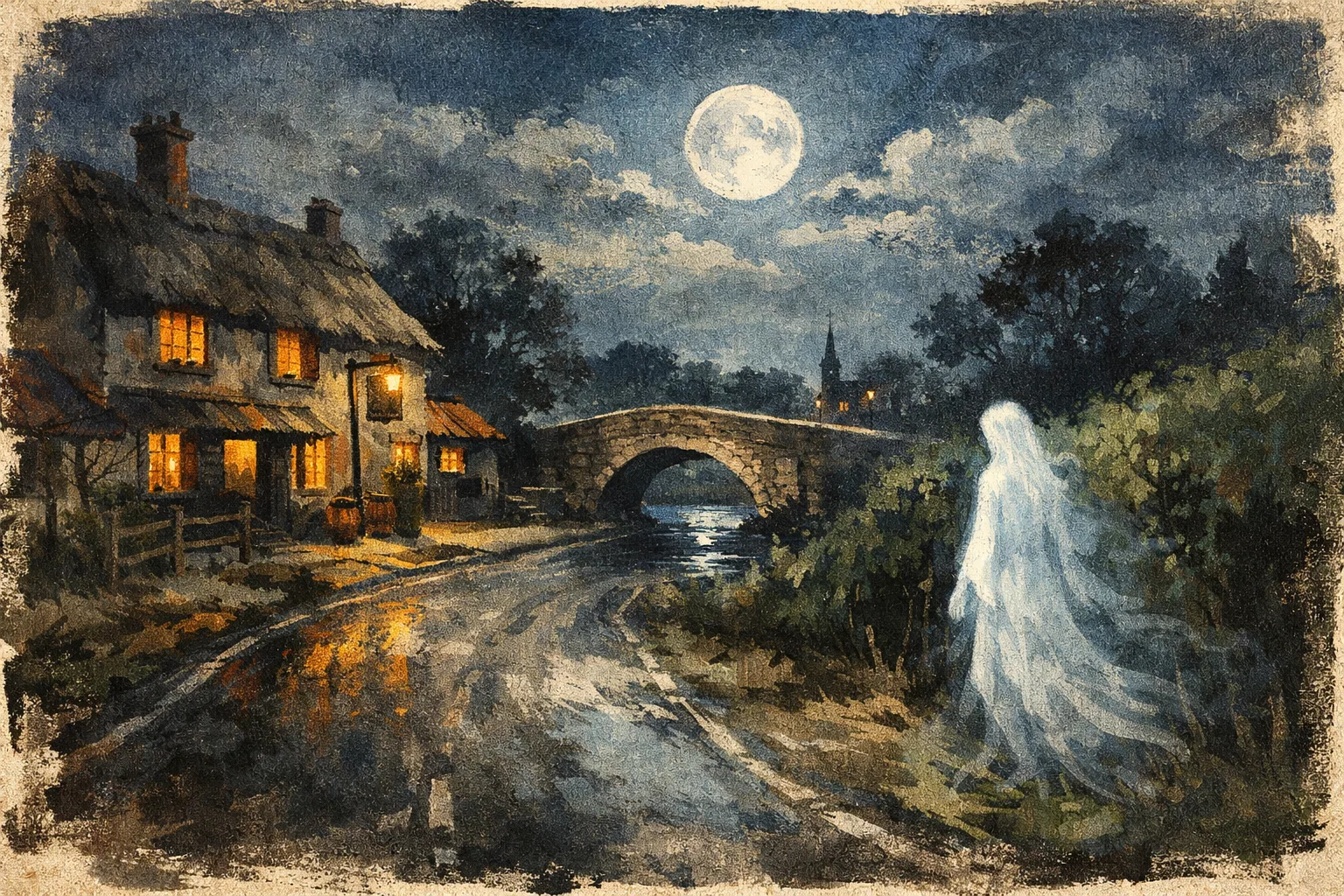
Cambridgeshire’s village ghost stories often behave like old parish directions: start at the inn, follow the road, cross the bridge, and stop where someone is said to have died. The county’s “White Lady” traditions are not best read as hard evidence for apparitions, but as local folklore fixed to practical places — roads used after dark, river crossings, public houses, lonely farms and memories repeated by village groups. The clearest Cambridgeshire example is Harston, where a White Lady was recorded in 1935 as walking from the Queen’s Head towards Mill Road and as being seen near the bridge towards Haslingfield, apparently throwing herself into the river. That small pattern — inn, road, bridge, repeated sighting — tells us a great deal about how village hauntings survive.[Capturing Cambridge]capturingcambridge.orgCapturing Cambridge Queen's Head, HarstonCapturing Cambridge Queen's Head, Harston
This page keeps to the historic Cambridgeshire centre of gravity. The project’s county frame follows the historic-county map tradition, where Cambridgeshire is treated as a historic English county; modern “Cambridgeshire” ghost lists sometimes pull in Huntingdonshire material, especially around Huntingdon and Hinchingbrooke, which is useful for comparison but should be signposted rather than blurred into the older county boundary.[Wikimedia Commons]commons.wikimedia.orgCommons File:England Historic Counties Cambridgeshire map.svgCommons File:England Historic Counties Cambridgeshire map.svg
Why village roads keep their ghosts
A village road ghost is rarely just “a figure seen on a road”. In Cambridgeshire folklore, the road often acts as a memory line: it joins a pub to a bridge, a village centre to fields, or a house to a churchyard. That matters because oral stories need landmarks. A ghost that “walks from the Queen’s Head along to Mill Road” is easier to remember, retell and test against local knowledge than a vague apparition somewhere in the countryside. The route gives the story a body.
The Harston case shows this clearly. Capturing Cambridge, drawing on Enid Porter’s Cambridgeshire Customs and Folklore, records that members of Harston Women’s Institute noted the White Lady in 1935. She was said to walk from the Queen’s Head to Mill Road, and the same village informants also knew a related story of a woman seen throwing herself into the river near the bridge towards Haslingfield. The story is modest, but unusually useful: it names a collector, a village recording group, a date of collection, an inn, a road and a river crossing.[Capturing Cambridge]capturingcambridge.orgCapturing Cambridge Queen's Head, HarstonCapturing Cambridge Queen's Head, Harston
That does not make the apparition factual. It does make the tradition traceable. The source is not a single modern paranormal list repeating itself; it points back to local testimony collected before the Second World War and preserved through Porter’s county folklore work. Porter matters because she was curator of the Cambridge & County Folk Museum, now the Museum of Cambridge, from 1947 to 1976, and is described by the museum as a key recorder of local stories and memories.[Capturing Cambridge]capturingcambridge.orgOpen source on capturingcambridge.org.

White Ladies and roadside apparitions
The “White Lady” is one of the most familiar figures in British ghost lore: usually a female apparition, often linked to grief, betrayal, suicide, murder, drowning, lost love or a religious house. Cambridgeshire’s village examples fit that wider pattern, but their local force comes from geography. The Harston White Lady is not floating around an unnamed mansion. She belongs to a walking route and a bridge.
Harston’s tradition has two linked movements. First, the White Lady walks from the Queen’s Head along to Mill Road. Second, a woman is said to have been seen at the river near the bridge towards Haslingfield, throwing herself into the water. The story therefore connects the social centre of village life — the inn — with the dangerous edge-place of the river crossing. That combination is typical of rural hauntings: the supernatural figure appears where ordinary movement becomes risky, especially at night or in poor weather.[Capturing Cambridge]capturingcambridge.orgCapturing Cambridge Queen's Head, HarstonCapturing Cambridge Queen's Head, Harston
The local landscape supports why such a story would cling. Harston’s landscape appraisal describes the parish in relation to older fields, watercourses, drainage patterns, the Rhee, the mill area and changing roads. It notes that traffic to Cambridge increased in the 18th century, bringing inns and turnpike influence, and that by the later 19th century a new bridge over the Rhee created Haslingfield Road, shifting vehicle movement away from the older mill crossing. A ghost story tied to the Queen’s Head, Mill Road and a bridge is therefore not floating over empty space: it is attached to a landscape of changing routes, water management and village travel.[Greater Cambridge Shared Planning]greatercambridgeplanning.orgGreater Cambridge Shared Planning
There is also a useful caution here. Modern retellings of the Harston Bridge White Lady sometimes present the story as a series of “sightings” by locals and travellers, but often without dates, named witnesses or archival detail. Those accounts help show how the legend circulates today, but the strongest evidence for the tradition remains the 1935 Women’s Institute material as preserved through Porter and Capturing Cambridge.[Haunted Hosts]hauntedhosts.comHaunted Hosts The White Lady of Harston BridgeHaunted Hosts The White Lady of Harston Bridge
Old inns, bridges and parish memory
Inns are natural anchors for ghost stories because they are places of arrival, gossip, strangers, drink, weather, horses, road traffic and sudden news. A village pub can preserve a story even when the event behind it has become unclear. The Queen’s Head at Harston is valuable for exactly that reason: the ghost is not merely “near Harston”, but attached to a named public house and a route through the village.[Capturing Cambridge]capturingcambridge.orgCapturing Cambridge Queen's Head, HarstonCapturing Cambridge Queen's Head, Harston
The historical setting makes the link plausible as folklore, even if the ghost itself remains unproved. Harston was not an isolated hamlet frozen in time; it sat on routes affected by traffic, turnpike development, inns, labour movement, railway-era change and river crossings. The 2024 landscape appraisal notes that 18th-century traffic growth on the main road to Cambridge contributed to the appearance of inns and turnpike activity, while later mapping shows the Haslingfield Road bridge changing how vehicles crossed the Rhee. These are precisely the sorts of physical changes that can sharpen local memory: people remember where the old road went, where the new bridge came in, and where a story was said to happen.[Greater Cambridge Shared Planning]greatercambridgeplanning.orgGreater Cambridge Shared Planning
The inn-and-bridge pairing also tells us why these stories can survive better than more dramatic legends. Castles need dynastic history; village hauntings need repeatable directions. A local could say: she walked from the Queen’s Head; she was seen by the bridge; she went into the river. The tale is portable because it is mapped.
Cambridgeshire has other inn-related ghost traditions, though not all sit within this village-road pattern. The Pickerel Inn on Magdalene Street in Cambridge, for instance, has a reported tradition that a former landlady threw herself into the Cam and that her ghost haunts the pub; Capturing Cambridge also notes reported presences felt by staff and stories of two landlords hanging themselves on the premises, citing The Cambridge Ghost Book. This is urban rather than village folklore, but it shows the same mechanism: an inn becomes a container for remembered deaths, staff experience and riverside unease.[Capturing Cambridge]capturingcambridge.orgOpen source on capturingcambridge.org.
When the “White Lady” becomes a boundary problem
Not every “Cambridgeshire White Lady” belongs straightforwardly to historic Cambridgeshire. This matters for a county-based haunted-history project because modern administrative Cambridgeshire includes areas historically treated as Huntingdonshire, and local media often uses “Cambs” in the modern sense.
The clearest example is Nun’s Bridge at Huntingdon. Modern articles describe a ghostly nun linked to Hinchingbrooke House and the bridge over Alconbury Brook. The legend says a nun from Hinchingbrooke had a secret relationship with a monk and was executed after discovery; the spirit is then said to step in front of vehicles near Nun’s Bridge, sometimes accompanied by other ghostly figures. Reports are said to have begun with a couple in 1965, with later retellings adding details such as a nurse-like apparition or silent burning cars.[Cambridge News]cambridge-news.co.ukOpen source on cambridge-news.co.uk.
For this page, Nun’s Bridge is best treated as a neighbouring comparison, not the core Cambridgeshire village case. Capturing Cambridge’s own Hinchingbrooke page places it under Huntingdonshire and records the site’s history as a Benedictine nunnery from at least 1087 until dissolution in 1536, later granted to Sir Richard Williams in 1538 and developed by the Cromwells. That real religious-house history helps explain why a nun legend found a ready home there, but the story’s county placement needs careful handling in a historic-county structure.[Capturing Cambridge]capturingcambridge.orgOpen source on capturingcambridge.org.
The comparison is still useful because it shows how “White Lady” and “ghostly nun” traditions behave in the same landscape logic. The apparition appears at a bridge. The story is attached to a religious institution, a sexual transgression, violence or punishment, and a dangerous encounter with traffic. Harston’s White Lady is quieter and better rooted in village collection; Nun’s Bridge is more sensational and more heavily modernised by media retelling. Read together, they show the spectrum between parish folklore and regional ghost-story amplification.[Capturing Cambridge]capturingcambridge.orgCapturing Cambridge Queen's Head, HarstonCapturing Cambridge Queen's Head, Harston

How oral folklore fixes a haunting to a place
Oral folklore does not preserve the past like a court transcript. It preserves what people found worth repeating. That can include old crimes, suicides, drowned women, frightening noises, unsafe roads, family secrets, religious ruins and places where the social order once felt fragile. In village ghost stories, the question is often not “did a ghost objectively appear?” but “why did this place become the one people pointed to?”
Enid Porter’s value is that she collected those pointers before many local traditions thinned out. The Museum of Cambridge says Porter recorded people’s stories and memories and helped shape modern English folklore studies; Capturing Cambridge describes her as a pioneer of oral history and a leading authority on Cambridgeshire culture, history, customs, stories and beliefs. For hauntings, that makes her work especially important: she captured stories as social memory, not as proof of the paranormal.[The Museum of Cambridge]museumofcambridge.org.ukThe Museum of Cambridge About – The Museum of CambridgeThe Museum of Cambridge About – The Museum of Cambridge
The Harston Women’s Institute record is a good example of community memory being formalised. Women’s Institute members were not ghost hunters in the modern entertainment sense. They were local recorders, participating in the broader 20th-century effort to document village life, customs and stories. When they noted the White Lady in 1935, they were fixing a spoken tradition to place: Queen’s Head, Mill Road, the bridge towards Haslingfield.[Capturing Cambridge]capturingcambridge.orgCapturing Cambridge Queen's Head, HarstonCapturing Cambridge Queen's Head, Harston
This is also why “thin evidence” does not make the story worthless. We do not have a named eyewitness diary, a coroner’s report matching the apparition, or a securely identified drowned woman. What we do have is a local tradition with a date of collection, preserved by a known county folklorist and tied to a changing village landscape. For folklore, that is meaningful evidence of belief and retelling, even if it is not evidence that a ghost exists.
Death, noise and the village murder memory
Cambridgeshire village haunting is not limited to White Ladies. Some stories attach to remembered violence rather than roads or bridges, and they help explain why apparitions often settle around ordinary rural buildings.
At Moco Farm, Steeple Morden, Porter recorded the story of Elizabeth Pateman, who was buried at Steeple Morden parish church in 1734; her tomb was said to show the implements used in her killing: a pea hook, a knife and a coulter, or plough blade. Capturing Cambridge also preserves a 1901 Cambridge Daily News report that a “ghost” at the cottages caused a sensation after a gamekeeper heard agonising noises, a thud and a gunshot-like sound, with the report noting that one or two murders were said to have happened there years before.[Capturing Cambridge]capturingcambridge.orgCapturing Cambridge Moco Farm, Steeple Morden | Capturing CambridgeCapturing Cambridge Moco Farm, Steeple Morden | Capturing Cambridge
The Museum of Cambridge’s later discussion of ghost stories returns to Moco Farm and adds a modern layer: a 2022 account from a family story about footsteps, an oppressive sensation and the farmhouse’s unsettling feel. The museum’s framing is careful rather than credulous, but it shows how a place-specific haunting can keep renewing itself when later family memories are added to older printed and oral traditions.[The Museum of Cambridge]museumofcambridge.org.ukOpen source on museumofcambridge.org.uk.
Moco Farm is not a White Lady road ghost, but it belongs on this page because it shows the same village mechanism. A violent death becomes attached to a specific rural site; later noises are interpreted through that memory; newspapers amplify the sensation; collectors and museums preserve the chain. The ghost, whether believed or doubted, becomes a way of keeping the place’s troubling story in circulation.

How credible are these stories?
The most credible part of Cambridgeshire’s village ghost lore is not the supernatural claim itself. It is the evidence that such stories were locally told, collected and attached to named places. Harston’s White Lady is stronger than many ghost-list entries because it has a 1935 village collection point and a named preservation route through Enid Porter’s work. Moco Farm is stronger still as a social-memory case because it combines an 18th-century murder tradition, a parish burial memory, a 1901 newspaper report and later family retelling.[Capturing Cambridge]capturingcambridge.orgCapturing Cambridge Queen's Head, HarstonCapturing Cambridge Queen's Head, Harston
The weaker parts are the usual ones. Witnesses are often unnamed. Exact dates of apparitional sightings are vague. Later websites can repeat older stories without adding sources. Some modern accounts increase drama by turning a quiet parish tradition into a more cinematic haunting. In the case of Nun’s Bridge, the story’s modern “Cambridgeshire” label can obscure its Huntingdonshire setting, and the legend’s elements — forbidden nun, monk lover, bridge, apparition startling drivers — are familiar motifs found in many British haunting traditions.[Cambridge News]cambridge-news.co.ukOpen source on cambridge-news.co.uk.
A sensible reading gives each source its proper weight. Historic Environment Records and official heritage sources can confirm buildings, routes, archaeological context and protected sites, but they do not validate ghosts. Local-history projects such as Capturing Cambridge can preserve community memory and cite older books or newspapers. Museum material can explain the collector and the social value of the tradition. Paranormal listings can show how the story is retold now, but they should not outrank earlier local or archival evidence.[cambridgeshire.gov.uk]cambridgeshire.gov.ukOpen source on cambridgeshire.gov.uk.
What these hauntings reveal about Cambridgeshire
The lasting interest of Cambridgeshire’s village road ghosts is that they are so local. They are not grand national legends with a single polished plot. They are small, place-bound accounts that preserve how people moved through the county: from pub to lane, from road to bridge, from farm to church, from village memory into folklore collection.
Harston’s White Lady is the best compact example. She belongs to a public house, a road and a river crossing; she was recorded through village memory in 1935; and her landscape was one where inns, roads, bridges, drainage and traffic had real historical importance. The tale does not need to be treated as proof of a haunting to be valuable. It shows how an ordinary Cambridgeshire village could turn a route into a story and a story into a local landmark.[Capturing Cambridge]capturingcambridge.orgCapturing Cambridge Queen's Head, HarstonCapturing Cambridge Queen's Head, Harston
That is why village roads keep their ghosts. Roads are where the living repeatedly pass the same remembered danger. Inns are where stories are exchanged. Bridges are where movement narrows and water, darkness and accident become imaginable. In Cambridgeshire, the White Lady is less a castle spectre than a figure of parish geography: a pale memory walking the old line between social life and the river’s edge.
Amazon book picks
Further Reading
Books and field guides related to Why Do Village Roads Keep Their Ghosts?. Use these as the next step if you want deeper reading beyond the article.
The lore of the land
Explores roadside legends, white ladies and place-based folklore.
The Penguin Guide to the Superstitions of Britain and Ireland
Explains traditional beliefs behind village ghost stories.

Ghosts
First published 2015. Subjects: Ghosts, History, BODY, MIND & SPIRIT, Parapsychology, General.

The folklore of Discworld
First published 2008. Subjects: Themes, motives, Discworld (Imaginary place), Folklore in literature, Discworld (imaginary place), fictio...
eBay marketplace picks
Marketplace Samples
Live-tested eBay searches with available results related to this page.
Endnotes
1.
Source: greatercambridgeplanning.org
Title: Greater Cambridge Shared Planning
Link:https://www.greatercambridgeplanning.org/media/s34hrvrr/harston-landscape-character-appraisal-april-2024.pdf
2.
Source: commons.wikimedia.org
Title: Commons File:England Historic Counties Cambridgeshire map.svg
Link:https://commons.wikimedia.org/wiki/File%3AEngland_Historic_Counties_Cambridgeshire_map.svg
3.
Source: capturingcambridge.org
Title: Capturing Cambridge Queen’s Head, Harston
Link:https://capturingcambridge.org/places-in-south-cambridgeshire/harston/queens-head-harston/
4.
Source: capturingcambridge.org
Link:https://capturingcambridge.org/huntingdonshire/huntingdon/hinchingbrooke-house-st-james-nunnery-huntingdon/
5.
Source: capturingcambridge.org
Link:https://capturingcambridge.org/online-exhibitions-of-prior-years/herstory/enidporter/
6.
Source: museumofcambridge.org.uk
Title: The Museum of Cambridge About – The Museum of Cambridge
Link:https://www.museumofcambridge.org.uk/about/
7.
Source: hauntedhosts.com
Title: Haunted Hosts The White Lady of Harston Bridge
Link:https://hauntedhosts.com/haunted-places/cambridge/location/6275-the-white-lady-of-harston-bridge
8.
Source: capturingcambridge.org
Link:https://capturingcambridge.org/museum-of-cambridge/museum-exhibit-stories/30-magdalene-street-pickerel-inn/
9.
Source: cambridge-news.co.uk
Link:https://www.cambridge-news.co.uk/news/history/ghost-vengeful-huntingdon-nun-whose-23592674
10.
Source: cambridge-news.co.uk
Link:https://www.cambridge-news.co.uk/news/local-news/haunted-cambs-road-murdered-nun-19160537
11.
Source: capturingcambridge.org
Title: Capturing Cambridge Moco Farm, Steeple Morden | Capturing Cambridge
Link:https://capturingcambridge.org/places-in-south-cambridgeshire/steeple-morden/moco-farm-steeple-morden/
12.
Source: museumofcambridge.org.uk
Link:https://www.museumofcambridge.org.uk/2024/10/ghosts-should-we-embrace-them/
13.
Source: cambridgeshire.gov.uk
Link:https://www.cambridgeshire.gov.uk/residents/libraries-leisure-culture/archaeology/cambridgeshire-historic-environment-record-cher
14.
Source: cambridge-news.co.uk
Title: The famous Cambridge bridge haunted by a heartbroken drowned
Link:https://www.cambridge-news.co.uk/news/history/famous-cambridge-bridge-haunted-heartbroken-33790088
15.
Source: facebook.com
Link:https://www.facebook.com/groups/1026849820769556/posts/8549532135167916/
16.
Source: cambridge-news.co.uk
Title: The historian who travelled all over Cambs to collect the region’s
Link:https://www.cambridge-news.co.uk/news/history/historian-who-travelled-over-cambs-27358754
17.
Source: wikishire.co.uk
Link:https://wikishire.co.uk/wiki/Cambridgeshire
18.
Source: youtube.com
Title: Enid Porter
Link:https://www.youtube.com/watch?v=m4l4KvcMiO4
19.
Source: gruts.com
Title: Ghost story
Link:https://gruts.com/20051031/
20.
Source: capturingcambridge.org
Title: 2 castle street cambridge
Link:https://capturingcambridge.org/museum-of-cambridge/museum-exhibit-stories/2-castle-street-cambridge/
21.
Source: capturingcambridge.org
Title: 13 – 15 Sidney Street | Capturing Cambridge History of 13
Link:https://capturingcambridge.org/centre/sidney-street/13-15-sidney-street/
22.
Source: capturingcambridge.org
Title: [PDF] folk museum
Link:https://capturingcambridge.org/wp-content/uploads/2024/05/Folk-Museum-Guide-Book-2012.pdf
23.
Source: capturingcambridge.org
Title: 20 22 trinity street heffers
Link:https://capturingcambridge.org/centre/trinity-street/20-22-trinity-street-heffers/
24.
Source: capturingcambridge.org
Link:https://capturingcambridge.org/wp-content/uploads/2020/07/River-Trade.pdf
25.
Source: capturingcambridge.org
Link:https://capturingcambridge.org/museum-of-cambridge/museum-exhibit-stories/gothic-conduit/
26.
Source: capturingcambridge.org
Link:https://capturingcambridge.org/barnwell/abbey-road/abbey-house/
27.
Source: capturingcambridge.org
Link:https://capturingcambridge.org/wp-content/uploads/2019/01/May-Day.pdf
28.
Source: capturingcambridge.org
Link:https://capturingcambridge.org/tag/hanging/feed/
29.
Source: capturingcambridge.org
Title: 30 sidney street
Link:https://capturingcambridge.org/centre/sidney-street/30-sidney-street/
30.
Source: capturingcambridge.org
Title: [PDF] Witchcraft & Longstanton
Link:https://capturingcambridge.org/wp-content/uploads/2020/07/Witchcraft-Longstanton.pdf
31.
Source: capturingcambridge.org
Link:https://capturingcambridge.org/centre/st-johns-street/st-johns-hospital/
32.
Source: capturingcambridge.org
Link:https://capturingcambridge.org/museum-of-cambridge/museum-exhibit-stories/mystery-of-6-gun/
33.
Source: capturingcambridge.org
Link:https://capturingcambridge.org/projects/queen-ediths/babraham-road/feed/
34.
Source: capturingcambridge.org
Title: parkers pieces
Link:https://capturingcambridge.org/centre/st-andrews-street/parkers-pieces/
35.
Source: capturingcambridge.org
Link:https://capturingcambridge.org/centre/jesus-lane/jesus-college/
36.
Source: capturingcambridge.org
Link:https://capturingcambridge.org/tag/allan-brigham/feed/?album_gallery_id_0=10&type_0=gallery
37.
Source: capturingcambridge.org
Link:https://capturingcambridge.org/mill-road-area/mill-road/109-mill-road-the-white-swan/
38.
Source: Wikipedia
Title: Enid Porter
Link:https://en.wikipedia.org/wiki/Enid_Porter
39.
Source: Wikipedia
Title: White Lady
Link:https://en.wikipedia.org/wiki/White_Lady
40.
Source: Wikipedia
Link:https://en.wikipedia.org/wiki/Cambridgeshire
41.
Source: Wikipedia
Title: Hinchingbrooke House
Link:https://en.wikipedia.org/wiki/Hinchingbrooke_House
42.
Source: museumofcambridge.org.uk
Title: Tracing Traditions
Link:https://www.museumofcambridge.org.uk/projects/tracing-traditions/
43.
Source: oxfordreference.com
Title: Enid Porter
Link:https://www.oxfordreference.com/display/10.1093/oi/authority.20110803100338225?d=%2F10.1093%2Foi%2Fauthority.20110803100338225&p=emailAIjXQJJ7lqnYs
44.
Source: queensheadkingston.co.uk
Link:https://www.queensheadkingston.co.uk/history
45.
Source: cambridgeppf.org
Title: enid porter
Link:https://cambridgeppf.org/enid-porter/
46.
Source: thelittlehouseofhorrors.com
Title: Hinchingbrooke House
Link:https://thelittlehouseofhorrors.com/hinchingbrooke-house/
47.
Source: spatial.falkirk.gov.uk
Link:https://spatial.falkirk.gov.uk/datasets/6242337402d448349fb74f699b1a68f3
Additional References
48.
Source: youtube.com
Title: The Lamplighter’s Dream: Fen Folklore, Ghosts and Portals to the Past
Link:https://www.youtube.com/watch?v=pvRv1jnKNBY
Source snippet
The Cross Keys - Haunted Pub - Paranormal Investigation...
49.
Source: harstonvillage.uk
Link:https://harstonvillage.uk/about-harston/history-of-harston/
50.
Source: amazon.com
Link:https://www.amazon.com/Cambridgeshire-Customs-Folklore-Routledge-Editions/dp/1138842567?tag=searcht-20
51.
Source: researchgate.net
Link:https://www.researchgate.net/figure/Enid-Porter-1909-84-no-date-image-supplied-by-the-Museum-of-Cambridge-and-reproduced_fig2_323638902
52.
Source: discoverhuntingdon.co.uk
Link:https://discoverhuntingdon.co.uk/history/hinchingbrooke-house/
53.
Source: facebook.com
Link:https://www.facebook.com/FortPerchRockTours/posts/the-white-lady-of-dibbinsdale-bridge-have-you-seen-hershe-haunts-the-ancient-hum/795674137270156/
54.
Source: british-history.ac.uk
Link:https://www.british-history.ac.uk/vch/cambs/vol3/pp115-116
55.
Source: history.ac.uk
Link:https://www.history.ac.uk/research/victoria-county-history
56.
Source: d38vbsx6n244kd.cloudfront.net
Link:https://d38vbsx6n244kd.cloudfront.net/wp-content/uploads/2015/10/Harstons-proposed-buildings-of-interest-list-selected-by-HRG-30-Sep-2019-updated-June-2021-criteria.doc.pdf
57.
Source: harstonvillage.uk
Link:https://harstonvillage.uk/wp-content/uploads/2024/02/Harstons-local-heritage-assets-Feb-2024.pdf
Topic Tree