Within Haunted Peeblesshire
Why Peeblesshire's Hauntings Follow the Tweed
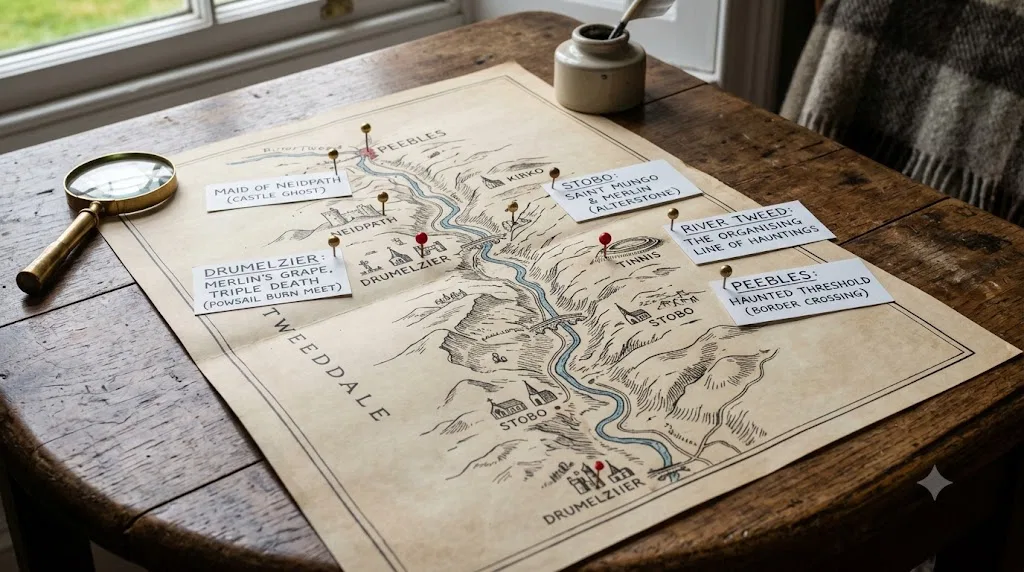
Peeblesshire's eerie stories make most sense as a mapped landscape of castles, kirkyards, roads, rivers and old county boundaries.
On this page
- Historic county boundaries and modern confusion
- Rivers, kirkyards and tower houses
- How local legends cross Border landscapes
Page outline Jump by section
Introduction
Peeblesshire’s haunted landscape is best read as a map of the Tweed valley rather than as a simple list of ghost stories. The old county, also called Tweeddale, is shaped by the upper River Tweed: the river rises in the southern hills, runs through a steep valley, reaches Peebles, then turns east towards Innerleithen and the wider Borders. That geography explains why the county’s eerie traditions gather around river bends, tower houses, kirkyards, burns and old parish routes rather than around one modern town centre.[Wikishire]wikishire.co.ukWikishire PeeblesshireWikishire Peeblesshire
The most useful folklore map has three main layers. First is the historic county frame: Peeblesshire as a small shire with Peebles as its county town, not merely a corner of today’s Scottish Borders. Second is the river-and-burn pattern, especially around Neidpath, Stobo, Drumelzier, Tinnis Castle and the Powsail Burn. Third is the way local legends cross ordinary categories: a castle ghost becomes a literary memory, a kirkyard tradition becomes Arthurian folklore, and a river prophecy becomes part of the story of Scotland and England under one monarch. None of this proves hauntings as fact, but it does show why the Tweed valley became such a strong container for Peeblesshire’s supernatural imagination.
Historic county boundaries and modern confusion
A Peeblesshire folklore map should begin with the historic county, because the stories were collected, named and repeated in the older landscape of Tweeddale. Wikishire identifies Peeblesshire as the County of Peebles, a southern Scottish shire also known as Tweeddale, where the River Tweed “rises and begins to grow”. It describes a small county of few towns, with Peebles as the county town and Innerleithen behind it in size, while most of the land is hill and dale.[Wikishire]wikishire.co.ukWikishire PeeblesshireWikishire Peeblesshire
That matters because modern administrative wording can blur the map. A visitor will often see Neidpath Castle, Stobo Kirk or Drumelzier described as being in the Scottish Borders, which is true for present-day local government. But the older stories are usually more precise when read through Peeblesshire and Tweeddale. Historic Environment records for Neidpath, for example, place the castle in the parish of Peebles and the former county of Peebles-shire, with the former district given as Tweeddale.[Trove Scot]trove.scotScot Neidpath Castle | Place | trove.scotScot Neidpath Castle | Place | trove.scot
The project’s wider county index also fits this approach. Wikimedia Commons maintains a category for SVG maps of the historic counties of the United Kingdom, listing 93 files in that set; the Peeblesshire location maps sit within this historic-county mapping tradition rather than within today’s council geography.[Wikimedia Commons]commons.wikimedia.orgCommons Category:SVG maps of historic counties of the United KingdomCommons Category:SVG maps of historic counties of the United Kingdom For a haunted-county page, that is more than cartographic tidiness. It prevents Peeblesshire’s lore being swallowed by the much broader “Scottish Borders” label, where better-known sites in Selkirkshire, Roxburghshire and Berwickshire can easily crowd it out.
The practical rule is simple: use modern Scottish Borders for travel, access and council services, but use historic Peeblesshire when asking why the stories sit where they do. The old county’s supernatural pattern follows the upper Tweed from the southern hills towards Peebles and eastwards, with smaller side-valleys and burns feeding into the story-map.
Why the hauntings follow the river
The River Tweed is not just scenery in Peeblesshire folklore. It is the organising line. Wikishire notes that the Tweed takes the first 36 miles of its course through Peeblesshire, “almost a third of its length”, and that the county’s alternative name, Tweeddale, comes from the river. It also lists the tributaries that help structure the county’s local geography, including the Drummelzier, Manor, Quair, Eddlestone and Leithen waters.[Wikishire]wikishire.co.ukWikishire PeeblesshireWikishire Peeblesshire
That helps explain the distribution of haunted and legendary places. Peeblesshire’s most memorable traditions are rarely detached indoor apparitions. They are place-bound narratives in which a river crossing, a burn-mouth, a haugh, a hillfort, a castle crag or a churchyard gives the story its shape. The “haunting” is often less a repeated modern sighting than a charged location where old memory has become fixed to the land.
A useful mental map runs like this:
Upper Tweed and Drumelzier: Merlin or Lailoken traditions cluster around the Powsail Burn, the River Tweed, Drumelzier Church, Merlin’s Grave and Tinnis Castle. The key drama is riverine: prophecy, burial, drowning and the meeting of waters.
Stobo and the sacred route: Stobo Kirk sits in the same wider Merlin landscape, linking the wild man of the woods to Saint Mungo, conversion, the “alterstone” and church memory.[Go Tweed Valley, Scotland]gotweedvalley.co.ukGo Tweed Valley, Scotland TVW: Stobo Kirk — Go Tweed Valley, ScotlandGo Tweed Valley, Scotland TVW: Stobo Kirk — Go Tweed Valley, Scotland
Peebles and Neidpath: Neidpath Castle stands above the Tweed west of Peebles. Its ghost tradition, the Maid of Neidpath, belongs to the castle’s river-crag setting as much as to the tower itself.[Trove Scot]trove.scotScot Neidpath Castle | Place | trove.scotScot Neidpath Castle | Place | trove.scot
Manor Valley and outlying memory: The Manor Valley story of David Ritchie, later transformed by Sir Walter Scott into The Black Dwarf, is not a ghost in the strictest sense, but it is part of the same Peeblesshire pattern: a solitary figure, a valley setting, a graveyard marker and a literary afterlife.[Tweed Valley Tourist Consortium]visittweedvalley.co.ukOpen source on visittweedvalley.co.uk.
This is why “folklore map” is a better frame than “haunted places list”. The stories become clearer when the reader sees how they sit beside water, churches, old seats of power and routes through the hills.
Rivers, kirkyards and tower houses
Peeblesshire’s eerie map is especially strong where three things meet: water, burial and authority. Drumelzier is the clearest example. Historic Environment Scotland describes Drumelzier Castle as the remains of a 16th-century tower house incorporating an older structure, set within Drumelzier Place farm on a low but prominent rise south of the River Tweed. The same record stresses the castle’s connection with the Tweedies of Drumelzier, a significant Border family, and its place in the wider medieval landscape of tower houses and landholding.[Historic Environment Scotland]portal.historicenvironment.scotOpen source on historicenvironment.scot.
That is the historical frame behind the legend. The supernatural version does not float free of the place: it uses the same elements. Tinnis Castle, also known as Dun Meldred, stands above Drumelzier on a steep hill. Scotland Starts Here describes it as a multi-period site where medieval castle ruins top the ramparts of an Iron Age hillfort, with local lore placing Merlin’s prophesied “triple death” along the burn flowing past the castle to the Tweed.[Scotland Starts Here]scotlandstartshere.comScotland Starts Here Tinnis Castle | History & HeritageScotland Starts Here Tinnis Castle | History & Heritage
Stobo Kirk adds the church layer. A local heritage account presents Stobo as one of the Tweed Valley’s oldest legendary places, with origins traditionally linked to Saint Mungo in the late 500s. The same account says Merlin is associated with the kirk through a story in which the wild man of the woods was converted to Christianity by Saint Mungo at an “alterstone” near Drumelzier, an event shown in a stained-glass window at Stobo Kirk.[Go Tweed Valley, Scotland]gotweedvalley.co.ukGo Tweed Valley, Scotland TVW: Stobo Kirk — Go Tweed Valley, ScotlandGo Tweed Valley, Scotland TVW: Stobo Kirk — Go Tweed Valley, Scotland
The pattern is not accidental. In folklore, churchyards and old kirks often preserve stories because they act as public memory sites. Tower houses preserve stories because they carry family power, imprisonment, feud and inheritance. Rivers preserve stories because they are dangerous, changeable and symbolically rich. In Peeblesshire, these three forces overlap along a compact stretch of the upper Tweed.
Drumelzier is the densest point on the folklore map
Drumelzier is the most important single point on the Peeblesshire folklore map because it gathers medieval literature, local topography, antiquarian memory and recent archaeology into one landscape. The story is usually presented as a Merlin legend, but the older figure is Lailoken, a wild prophetic man later drawn into the Merlin tradition.
GUARD Archaeology summarises the tradition as a tale in which Merlin was imprisoned by a Dark Age king, killed and buried by the banks of the Tweed, according to the Vita Merlini Sylvestris, a medieval tale probably written in Glasgow during the 12th century.[guard-archaeology.co.uk]guard-archaeology.co.ukUnearthing Ancient TweeddaleUnearthing Ancient Tweeddale Current Archaeology gives: the text survives in a 15th-century manuscript, though the story was probably composed earlier, and it places Lailoken around Dunmeller, the Powsail Burn and the Tweed.[Current Archaeology]archaeology.co.ukCurrent Archaeology Unearthing Ancient TweeddaleCurrent Archaeology Unearthing Ancient Tweeddale
The death-story is unusually geographical. Lailoken foretells that he will die in three ways: by stones and cudgels, by a sharp stake and by drowning. In the Drumelzier version, this becomes a route through the landscape. He is attacked near Dunmeller, falls into the Tweed, is impaled on a fish-trap stake and drowns. He asks to be buried on the east side of the Tweed near its meeting with the Powsail Burn.[Current Archaeology]archaeology.co.ukCurrent Archaeology Unearthing Ancient TweeddaleCurrent Archaeology Unearthing Ancient Tweeddale
That is why the grave matters on a map, even if the archaeology remains cautious. Current Archaeology notes that Merlin’s Grave is formally documented in Scotland’s National Record of the Historic Environment, but describes the visible site as little more than a corner of a field preserved by local tradition. It also records Alexander Pennecuik’s 1689 statement that the supposed grave lay “a little below the church yeard”, and that the place had been shown to him by the old minister of Drumelzier.[Current Archaeology]archaeology.co.ukCurrent Archaeology Unearthing Ancient TweeddaleCurrent Archaeology Unearthing Ancient Tweeddale
Recent investigation complicates the story without turning legend into proof. GUARD Archaeology reports that a 2022 geophysical survey found no remains exactly on the spot marked as Merlin’s Grave, but did identify an archaeological feature resembling a grave nearby. Excavations at Tinnis Fort found occupation around the late sixth and early seventh centuries AD, the period in which the story is set, and work at the Thirlestane Barrows across the Tweed found elite early medieval burial evidence added to an older Bronze Age barrow landscape.[guard-archaeology.co.uk]guard-archaeology.co.ukUnearthing Ancient TweeddaleUnearthing Ancient Tweeddale
The careful conclusion is more interesting than a sensational one. The evidence does not prove that Merlin died at Drumelzier. It does suggest that the legend is not a random imported tale casually pinned to the valley. GUARD’s interpretation is that the Drumelzier story contains pre-Christian customs and ancient Cumbric names, and is attached to local sites whose archaeology could credibly have helped generate the tradition.[guard-archaeology.co.uk]guard-archaeology.co.ukUnearthing Ancient TweeddaleUnearthing Ancient Tweeddale
Neidpath shows how a castle ghost becomes a valley landmark
Neidpath Castle anchors the Peebles end of the haunted map. Its position is precise: the National Record of the Historic Environment entry gives the site in the parish of Peebles, former county of Peebles-Shire, at OS grid reference NT 23618 40487.[Trove Scot]trove.scotScot Neidpath Castle | Place | trove.scotScot Neidpath Castle | Place | trove.scot The castle’s folklore is inseparable from that setting, because the tower overlooks the River Tweed just west of Peebles.
The popular ghost story is the Maid of Neidpath. The Tweed Valley Tourist Consortium describes the apparition as Jean Douglas, daughter of William Douglas, Earl of March, who is said to have loved the laird of Tushielaw against her father’s wishes. In the familiar version, the lover is sent away, Jean declines in grief, and when he returns he fails to recognise her. She dies of a broken heart and is said to wander the castle in sorrow.[Tweed Valley Tourist Consortium]visittweedvalley.co.ukOpen source on visittweedvalley.co.uk.
The story’s map-value is not simply that a ghost is “at Neidpath”. It is that the castle marks the western approach to Peebles as a haunted threshold: a fortified house on a crag above the Tweed, preserved by photography, tourism, private ownership and literary association. The same visitor-facing account notes that Sir Walter Scott stayed at Neidpath and wrote a poem about the legend, helping to make the story better known.[Tweed Valley Tourist Consortium]visittweedvalley.co.ukOpen source on visittweedvalley.co.uk.
Compared with Drumelzier, Neidpath is less archaeologically complicated and more literary-romantic. Its credibility lies not in repeated modern witness documentation, but in the way a family tragedy motif became attached to a visible historic building and then strengthened by Scott’s Borders imagination. On a folklore map, Neidpath is the place where Peeblesshire’s haunted landscape looks most like the classic Scottish castle ghost: a woman, a tower, a lost lover and a river below.
Local legends cross Border landscapes
Peeblesshire’s haunted map does not stop neatly at parish lines, even when the page’s centre of gravity remains the old county. The Tweed is a route, not a wall. Its legends move along the valley through churches, towers, roads and later tourism circuits. This is why a Peeblesshire page may mention wider Border culture without turning into a general Scottish Borders ghost guide.
The Merlin material is the clearest case. The local story sits at Drumelzier, Stobo and Tinnis, but it belongs to a larger body of northern British and Welsh tradition about Lailoken, Myrddin and Merlin. Current Archaeology connects the Drumelzier tale to early medieval Welsh poetry about Myrddin Wyllt and to Geoffrey of Monmouth’s 12th-century reshaping of Merlin for the Arthurian tradition.[Current Archaeology]archaeology.co.ukCurrent Archaeology Unearthing Ancient TweeddaleCurrent Archaeology Unearthing Ancient Tweeddale The result is a story that feels both intensely local and widely recognisable.
The same crossing happens through prophecy. Destination Tweed retells the tradition that Merlin’s death was linked to a prophecy about the River Tweed: when the burn and Tweed waters met at his grave, Scotland and England would have one king. The account associates the fulfilment with 1603, the year James VI of Scotland became James I of England.[Destination Tweed]destinationtweed.orgDestination Tweed MerlinDestination Tweed Merlin The Tweed Valley Tourist Consortium gives a similar version, naming the Powsail Burn and Merlin’s grave as the meeting point.[Tweed Valley Tourist Consortium]visittweedvalley.co.ukOpen source on visittweedvalley.co.uk.
This is not a claim that the prophecy should be treated as historical fact. It is a good example of how landscape folklore works. A political event of national scale is localised through a flood, a burn, a grave and a remembered phrase. The valley becomes a way of imagining the nation.
Peeblesshire’s boundaries also meet neighbouring story-worlds. The old county borders Midlothian, Lanarkshire, Dumfriesshire and Selkirkshire, and the Tweed continues east into other historic counties.[Wikishire]wikishire.co.ukWikishire PeeblesshireWikishire Peeblesshire That makes cross-linking natural: a reader interested in Peeblesshire’s Merlin traditions may also care about wider Scottish Arthurian lore, Border tower houses, reiver landscapes, St Mungo traditions and haunted castles elsewhere along the Tweed. But the Peeblesshire page should keep returning to its own map: upper Tweed, Peebles, Stobo, Drumelzier, Tinnis and Neidpath.
How to read the folklore map without overclaiming
A careful Peeblesshire haunted map should distinguish three kinds of evidence. The first is hard place evidence: castles, kirks, river junctions, mapped sites and archaeological records. Drumelzier Castle, for instance, is a scheduled monument with surviving remains and a documented relationship to the Tweedies of Drumelzier.[Historic Environment Scotland]portal.historicenvironment.scotOpen source on historicenvironment.scot. Neidpath has a National Record of the Historic Environment entry with precise location data and former county context.[Trove Scot]trove.scotScot Neidpath Castle | Place | trove.scotScot Neidpath Castle | Place | trove.scot
The second is tradition evidence: stories preserved in medieval texts, antiquarian accounts, local heritage interpretation, tourism writing and oral memory. Merlin’s Grave is powerful because it appears in antiquarian reporting, on maps from at least the 18th century, and in modern heritage discussion, even though no visible grave structure has been confirmed at the marked spot.[Current Archaeology]archaeology.co.ukCurrent Archaeology Unearthing Ancient TweeddaleCurrent Archaeology Unearthing Ancient Tweeddale
The third is interpretation evidence: attempts to explain why a legend took root where it did. The strongest recent example is the Drumelzier’s Hidden Heritage work. Its value is not that it proves a wizard’s grave. Its value is that it tests whether the story’s landscape details correspond to real early medieval sites, and finds that some of them plausibly do.[guard-archaeology.co.uk]guard-archaeology.co.ukUnearthing Ancient TweeddaleUnearthing Ancient Tweeddale
That distinction keeps the map atmospheric without becoming credulous. A reader can enjoy Neidpath as a haunted castle story while recognising that the Maid of Neidpath is a romantic tradition shaped by literature. A reader can visit Drumelzier as a Merlin landscape while understanding that archaeology supports the depth of the local setting, not the literal truth of every legendary event. A reader can follow the Tweed as a supernatural route without treating every apparition or prophecy as confirmed history.
The Peeblesshire pattern
The reason Peeblesshire’s hauntings follow the Tweed is that the river gathers the county’s memory into a narrow, legible corridor. The upper Tweed carries the old county name of Tweeddale; its burns and haughs give Merlin’s death and burial story a physical script; its kirks hold conversion and burial traditions; its tower houses preserve the power of Border families; and its castle crags turn private grief into public legend.
This makes the county’s folklore map quieter than places with famous ghost tours or long lists of hotel sightings, but also more coherent. Peeblesshire’s haunted geography is not built from isolated scares. It is built from a landscape where water, stone, church and story repeatedly meet.

Amazon book picks
Further Reading
Books and field guides related to Why Peeblesshire's Hauntings Follow the Tweed. Use these as the next step if you want deeper reading beyond the article.

Scottish Myths and Legends
Introduces the folklore traditions reflected across Tweeddale.
The Mammoth Book of Celtic Myths and Legends
Explains broader Celtic themes behind local stories.
The Lore of Scotland
Covers legends attached to landscapes, rivers and historic places.
Scottish Ghost Stories
First published 1996. Subjects: Ghost stories, Tales, scotland, Ghosts.
eBay marketplace picks
Marketplace Samples
Live-tested eBay searches with available results related to this page.
Endnotes
1.
Source: trove.scot
Title: Scot Neidpath Castle | Place | trove.scot
Link:https://www.trove.scot/place/51539
2.
Source: commons.wikimedia.org
Title: Commons Category:SVG maps of historic counties of the United Kingdom
Link:https://commons.wikimedia.org/wiki/Category%3ASVG_maps_of_historic_counties_of_the_United_Kingdom
3.
Source: commons.wikimedia.org
Title: Commons File:Peeblesshire
Link:https://commons.wikimedia.org/wiki/File%3APeeblesshire_-_British_Isles.svg
4.
Source: guard-archaeology.co.uk
Title: Unearthing Ancient Tweeddale
Link:https://www.guard-archaeology.co.uk/GALNews/?p=655
5.
Source: archaeology.co.uk
Title: Current Archaeology Unearthing Ancient Tweeddale
Link:https://archaeology.co.uk/articles/features/unearthing-ancient-tweeddale.htm
6.
Source: guard-archaeology.co.uk
Link:https://www.guard-archaeology.co.uk/GALNews/?m=202501
7.
Source: commons.wikimedia.org
Title: Category:Maps of Peeblesshire
Link:https://commons.wikimedia.org/wiki/Category%3AMaps_of_Peeblesshire
8.
Source: commons.wikimedia.org
Link:https://commons.wikimedia.org/wiki/Category%3APeeblesshire
9.
Source: commons.wikimedia.org
Link:https://commons.wikimedia.org/wiki/Category%3APeeblesshire?uselang=ku-latn
10.
Source: commons.wikimedia.org
Title: Category:SVG maps of historic counties of Scotland
Link:https://commons.wikimedia.org/wiki/Category%3ASVG_maps_of_historic_counties_of_Scotland
11.
Source: commons.wikimedia.org
Title: File:PEEBLESSHIRE Civil Parish map.jpg
Link:https://commons.wikimedia.org/wiki/File%3APEEBLESSHIRE_Civil_Parish_map.jpg
12.
Source: commons.wikimedia.org
Title: Category:Maps of traditional counties of Scotland
Link:https://commons.wikimedia.org/wiki/Category%3AMaps_of_traditional_counties_of_Scotland
13.
Source: commons.wikimedia.org
Title: File:Peeblesshire Scotland.svg
Link:https://commons.wikimedia.org/wiki/File%3APeeblesshire-Scotland.svg
14.
Source: wikishire.co.uk
Title: Wikishire Peeblesshire
Link:https://wikishire.co.uk/wiki/Peeblesshire
15.
Source: gotweedvalley.co.uk
Title: Go Tweed Valley, Scotland TVW: Stobo Kirk — Go Tweed Valley, Scotland
Link:https://www.gotweedvalley.co.uk/stobo-kirk-words
16.
Source: visittweedvalley.co.uk
Link:https://www.visittweedvalley.co.uk/myths-and-legends
17.
Source: portal.historicenvironment.scot
Link:https://portal.historicenvironment.scot/apex/f?p=1505%3A300%3A%3A%3A%3A%3AVIEWTYPE%2CVIEWREF%3Adesignation%2CSM3149
18.
Source: scotlandstartshere.com
Title: Scotland Starts Here Tinnis Castle | History & Heritage
Link:https://scotlandstartshere.com/point-of-interest/tinnis-castle/
19.
Source: destinationtweed.org
Title: Destination Tweed Merlin
Link:https://destinationtweed.org/story/merlin-the-man-the-myth-the-magic/
20.
Source: neidpathcastle.com
Title: Neidpath Castle
Link:https://www.neidpathcastle.com/
21.
Source: wikishire.co.uk
Link:https://wikishire.co.uk/wiki/Drumelzier
22.
Source: wikishire.co.uk
Title: River Tweed
Link:https://wikishire.co.uk/wiki/River_Tweed
23.
Source: facebook.com
Link:https://www.facebook.com/Neidpath/
24.
Source: Wikipedia
Link:https://en.wikipedia.org/wiki/Peeblesshire
25.
Source: Wikipedia
Link:https://en.wikipedia.org/wiki/Drumelzier
26.
Source: Wikipedia
Title: Neidpath Castle
Link:https://en.wikipedia.org/wiki/Neidpath_Castle
27.
Source: gotweedvalley.co.uk
Title: neidpath a castle in pictures
Link:https://www.gotweedvalley.co.uk/stories-master/neidpath-a-castle-in-pictures
28.
Source: tripadvisor.com
Title: Neidpath Castle
Link:https://www.tripadvisor.com/Attraction_Review-g186508-d318614-Reviews-Neidpath_Castle-Peebles_Scottish_Borders_Scotland.html
29.
Source: themodernantiquarian.com
Link:https://www.themodernantiquarian.com/site/8685/drumelzier
Additional References
30.
Source: youtube.com
Title: New Evidence Hints Merlin May Have Actually Existed | WION Podcast
Link:https://www.youtube.com/watch?v=EeY8KlwKVzQ
Source snippet
The Peebles Witches | Scotland's History...
31.
Source: geotourist.com
Link:https://geotourist.com/tours/5863/Tweed_Valley_Tales__Nature_History_and_Stories/point/20373/Stobo_Kirk__Merlin
32.
Source: facebook.com
Link:https://www.facebook.com/groups/2003881253140331/posts/2463788163816302/
33.
Source: goodreads.com
Link:https://www.goodreads.com/en/book/show/4944942-albion-a-guide-to-legendary-britain
34.
Source: instagram.com
Link:https://www.instagram.com/p/DUFqBH4DRor/
35.
Source: facebook.com
Link:https://www.facebook.com/groups/281886105961506/posts/1614371999379570/
36.
Source: facebook.com
Link:https://www.facebook.com/discoverscottishborders/videos/locals-whisper-of-a-standing-stone-marking-merlins-grave-once-dismissed-as-myth-/1330070548893104/
37.
Source: facebook.com
Link:https://www.facebook.com/groups/114917455315320/posts/2062029437270769/
38.
Source: merlintrail.com
Link:https://merlintrail.com/merlindale/
39.
Source: thecastleguide.co.uk
Link:https://thecastleguide.co.uk/castle/neidpath-castle/
Topic Tree