Within Haunted Westmorland
Why Do Westmorland's Ruins Feel Haunted?
Pendragon Castle and Shap Abbey show how ruined places gather stories of monks, Arthurian legend, treasure and unease.
On this page
- Pendragon Castle and Arthurian legend
- Shap Abbey and the White Monks
- How ruins turn history into folklore
Page outline Jump by section
Introduction
Westmorland’s ruined places feel haunted because they sit where three kinds of memory overlap: medieval power, religious loss and older legend. Pendragon Castle in Mallerstang gathers stories of Uther Pendragon, a poisoned well, buried treasure and restless figures around a real 12th-century fortified tower. Shap Abbey gathers quieter unease around white-clad canons, Dissolution, remoteness and the afterlife of monastic ruins beside the River Lowther. Neither place proves a haunting, but both show how Westmorland turns broken stone into folklore: a ruin leaves enough evidence to feel historical, and enough absence to invite stories.
The historic county matters here. These are Westmorland traditions, even when modern guidebooks describe them as Cumbrian, Lake District or Yorkshire Dales-edge sites. Pendragon belongs to Mallerstang and the upper Eden landscape; Shap Abbey belongs to the Lowther valley near Shap. Together they form one of the county’s strongest “legendary ruins” clusters: not a busy ghost-tour circuit, but a set of atmospheric places where local history, border violence, Arthurian romance and religious memory have been compressed into place-name, rhyme and rumour.
Pendragon Castle and Arthurian legend
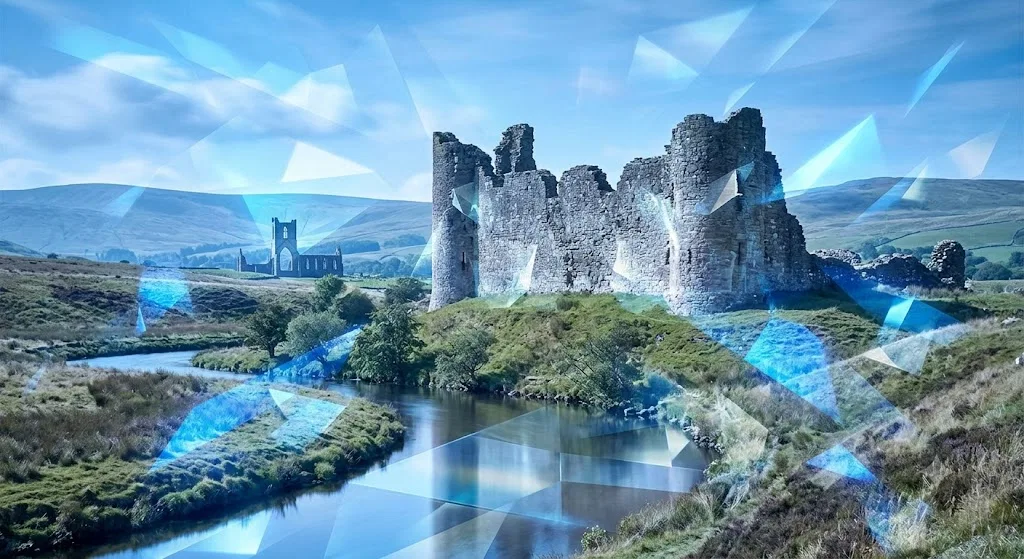
Pendragon Castle stands north of Outhgill in Mallerstang, above the River Eden and overlooked by Wild Boar Fell and Mallerstang Edge. Historic England lists it as a Grade I building and describes it as a fortified tower-house dating from the 12th century, with later alterations and a major restoration in 1660 for Lady Anne Clifford before it was dismantled around 1685. The same official entry places it in Mallerstang beside the B6259, which helps explain why the ruin feels both accessible and remote: it is on a route, but still held in a narrow, high-sided dale.[Historic England]historicengland.org.ukHistoric England Pendragon Castle, MallerstangGrade I Listing: Pendragon Castle. May include summary, reasons for designation and history… Scheduled Ancient Monument. Listing NGR…
The famous story is much older in mood than the surviving masonry. Local legend says the original castle was built by Uther Pendragon, father of King Arthur, and that Uther died there with many of his men after enemies poisoned the well. A related rhyme remembers his supposed failure to force the Eden into a defensive moat: “Let Uther Pendragon do what he can / Eden will run where Eden ran.” The Yorkshire Dales National Park’s heritage account repeats the legend but is careful about the evidence: there is no current support for a castle here before the 12th century.[Yorkshire Dales]yorkshiredales.org.ukYorkshire DalesA legendary home, fit for a king?November 30, 2017 — 30 Nov 2017 — It is rumoured to have been the site of Uther's death –…
That gap between legend and archaeology is what gives Pendragon its peculiar charge. The Arthurian story does not need to be historically sound to shape how visitors read the ruin. A broken tower in a lonely dale is easily imagined as the last refuge of a wounded war-leader; a dry moat becomes proof of a failed heroic labour; a well becomes a place of treachery. The story is not just “there was a ghost here”. It is a full legendary explanation of why the place looks and feels unfinished.
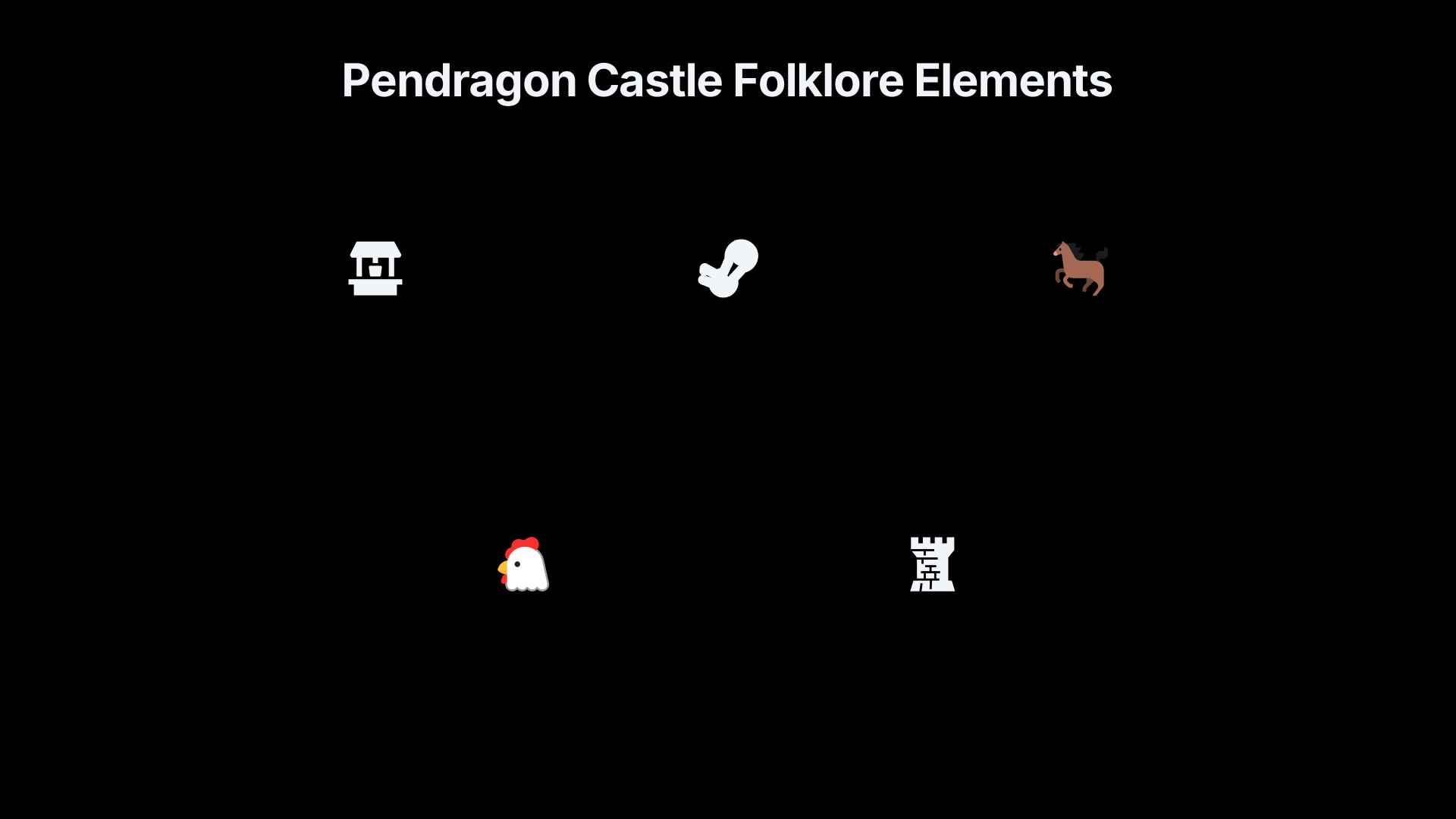
There are also later, more conventional haunting motifs attached to the castle. Haunted-castle summaries preserve stories of white female figures flying or moving around the ruins at night, a mysterious horseman galloping towards the castle, and buried treasure guarded by a black chicken that scratches at disturbed ground until it is refilled. These accounts are difficult to treat as reliable witness evidence, because they circulate in modern ghost-story form rather than as a clearly dated local deposition. They are still valuable folklore, however, because they show Pendragon collecting the stock figures of haunted ruins: the white apparition, the spectral rider, the treasure guardian and the warning against disturbing old ground.[Great Castles]great-castles.comOpen source on great-castles.com.
The castle’s documented history gives those legends a hard edge. It was associated with powerful northern families, including the Vieuxponts and Cliffords, and one of its notable owners was Hugh de Morville, one of the four knights who murdered Thomas Becket in 1170. The historic county gazetteer notes both the Uther legend and de Morville connection while stressing that there is no evidence for a pre-12th-century castle.[Gazetteer]gazetteer.org.ukOpen source on gazetteer.org.uk. For a haunted-history reader, that matters: Pendragon does not depend only on Arthurian fantasy. It also carries the memory of border lordship, violence, ecclesiastical scandal and aristocratic abandonment.
Lady Anne Clifford’s restoration adds another layer. The Yorkshire Dales National Park records that she rebuilt the castle after destruction by a Scottish raiding party and added domestic buildings including a brewhouse. A separate National Park article notes that after Lady Anne’s time the castle was partially dismantled by her successors because of the cost of maintaining several castles, and later drawings show its progressive collapse into ruin.[Yorkshire Dales]yorkshiredales.org.ukOpen source on yorkshiredales.org.uk. The “haunting” atmosphere is therefore partly architectural: Pendragon is not a simple medieval survival, but a place repeatedly built, damaged, restored, stripped and left open to weather.
Shap Abbey and the White Monks
Shap Abbey offers a different kind of unease. It is not dominated by heroic battle legend, but by religious absence. English Heritage describes it as a remote Premonstratensian house founded in the late 12th century in the secluded Lowther valley. The Premonstratensians were canons rather than monks in the strictest sense, but they were known as “white canons” because of their white woollen habits.[English Heritage]english-heritage.org.ukOpen source on english-heritage.org.uk. In local storytelling, that visual fact becomes powerful: white-robed religious figures are exactly the sort of image that later visitors expect ruins to produce.
Visit Eden’s “Myths and Legends of Eden” material presents the Shap community as the “White Monks of Shap Abbey”, explaining that the canons were known locally by that name because of their clothing. It also frames the abbey as the last abbey to be founded in England, with its first buildings set up beside the River Lowther while the church and living quarters were being constructed.[Visiteden]visiteden.co.ukOpen source on visiteden.co.uk. The language is more legendary than technical, but it is rooted in a real historical feature: a small, white-clad religious community in a remote valley.
The abbey’s documented history helps explain why such a site attracts ghostly interpretation. English Heritage says Shap was never a large community, with around 12 canons under an abbot, but it was wealthy, with lands donated by northern families including the Vieuxponts and Cliffords. It suffered some damage during Scottish raids in the 14th century, then surrendered during Henry VIII’s Suppression of the Monasteries on 14 January 1540. The last abbot and 14 canons received pensions, and parts of the buildings were later incorporated into farm structures while stone was reused elsewhere.[English Heritage]english-heritage.org.ukOpen source on english-heritage.org.uk.
That is a strong basis for folklore even without a single spectacular ghost. A religious house is founded in seclusion, its white-clad community becomes locally memorable, it is dissolved by royal authority, its buildings are dismantled, and its remaining tower stands above a valley where silence does much of the imaginative work. English Heritage’s broader discussion of haunted monasteries notes that many monastic ruins acquired supernatural stories, some medieval in origin and many shaped by 18th- and 19th-century Gothic taste for ivy-clad remains.[English Heritage]english-heritage.org.ukOpen source on english-heritage.org.uk. Shap fits that national pattern, but in a distinctly Westmorland key: quieter, rural and more mournful than theatrical.
The “White Monks” tradition should therefore be read carefully. It is not strong evidence that apparitions have been repeatedly witnessed and recorded at Shap Abbey. It is stronger as a place-memory: the real white clothing of the Premonstratensians has become the visual language through which later generations imagine the abbey’s lost religious life. When people describe Shap as haunted, the haunting often feels less like a named ghost story and more like an afterimage of community, ritual and erasure.
Why these ruins gather uneasy stories
Pendragon Castle and Shap Abbey work differently, but they both show how ruins turn history into folklore. A complete building tells visitors what it is for; a ruin leaves the question open. Missing roofs, broken towers, empty chambers, dry moats and reused stone make people ask what happened here, who left, and what might remain.
At Pendragon, the central mechanism is legendary overloading. The site has a documented medieval core, but its name and landscape invite older stories. The Arthurian association probably owes more to later medieval and local romance than to provable early history, yet the setting is persuasive: a river bend, a defensible spur, a bleak dale and a name that sounds as if it should belong to Britain’s mythic past. The National Park’s heritage material makes the useful distinction: Pendragon is genuinely medieval, but the Uther story is not supported by evidence before the known 12th-century castle.[sedbergh.org.uk]sedbergh.org.ukPendragon Castle and the Mallerstang ValleyPendragon Castle and the Mallerstang Valley
At Shap, the mechanism is religious afterlife. The abbey’s visible remains are not merely picturesque; they stand for a dissolved institution. The White Canons once held land, served parishes and lived by a religious rule, then the community was pensioned off and the buildings were broken up or absorbed into later farm use. English Heritage’s account of the west tower, precinct, mill, fishponds and later dismantling gives the physical frame for that sense of interruption.[English Heritage]english-heritage.org.ukOpen source on english-heritage.org.uk.
A third mechanism is remoteness. Both sites sit outside the urban ghost-story pattern of inns, theatres and crowded streets. Pendragon’s valley narrows between high ground; Shap Abbey lies in a secluded river valley. Remote ruins encourage a different kind of fear: not the sudden apparition in a corridor, but the feeling that a place is older, lonelier and less fully explained than the path that brought the visitor there.
A fourth mechanism is repetition through tourism and local retelling. Pendragon’s couplet about the Eden is memorable because it is short, place-specific and physically testable: the river still runs where it runs, and the moat remains dry. The White Monks of Shap are memorable because the image is simple and visual. These stories survive because they are easy to retell at the site itself.

What is credible, and what is folklore?
The safest reading is to separate three layers: the historic site, the place-legend and the ghost claim. Pendragon Castle’s existence, medieval date, Grade I status, Lady Anne Clifford restoration and later dismantling are well supported by heritage records. Its Uther Pendragon legend is an old and locally important tradition, but heritage bodies explicitly note the lack of evidence for a pre-12th-century castle. Its white ladies, spectral horseman and treasure-guarding black chicken belong to ghost folklore rather than securely documented haunting evidence.[historicengland.org.uk]historicengland.org.ukHistoric England Pendragon Castle, MallerstangGrade I Listing: Pendragon Castle. May include summary, reasons for designation and history… Scheduled Ancient Monument. Listing NGR…
Shap Abbey’s foundation, Premonstratensian identity, white habits, Dissolution and remaining tower are also well supported. The “White Monks” label has a clear historical basis in clothing, but that does not automatically turn every later story of white figures into a reliable sighting. It is better understood as the natural ghost-language of a monastic ruin: white robes, lost ritual, silence and broken stone.[English Heritage]english-heritage.org.ukOpen source on english-heritage.org.uk.
This does not make the folklore worthless. For haunted Westmorland, the question is not simply “Did this happen?” but “Why did this place produce this kind of story?” Pendragon’s legends attach to power, siege, poisoned water and heroic failure. Shap’s attach to prayer, dissolution, whiteness and absence. Both are credible as folklore because they fit their settings so closely.
How to read Westmorland’s legendary ruins today
A visitor interested in haunted history should approach these ruins as layered places rather than paranormal attractions. At Pendragon, the most revealing details are the river, the dry moat, the exposed tower-house plan and the sense of a stronghold watching a narrow route. The Uther legend becomes more interesting, not less, when set beside the official record of a 12th-century fortified tower and a later aristocratic restoration. It shows how a real medieval ruin can be pulled backwards into a much older mythic past.
At Shap Abbey, the key is to imagine scale and silence together. English Heritage describes a walled precinct that once contained monastic buildings, an abbey mill and fishponds, while today the great tower and lower remains carry most of the visual force.[English Heritage]english-heritage.org.ukOpen source on english-heritage.org.uk. The haunting feeling comes from subtraction: the community is gone, the roofs are gone, much of the stone has gone, but the valley still holds the shape of religious life.
These sites also connect naturally with other Westmorland haunted-place traditions. Pendragon belongs with castle and road legends across the Eden and Mallerstang landscape, where danger, raiding and isolation shape the mood. Shap Abbey belongs with church, chapel and monastic memories, where the supernatural often appears as a residue of worship or disrupted burial. Together they show that Westmorland’s most atmospheric ruins are not frightening because they are crowded with ghosts. They are unsettling because their histories are incomplete in exactly the places where imagination enters.

Amazon book picks
Further Reading
Books and field guides related to Why Do Westmorland's Ruins Feel Haunted?. Use these as the next step if you want deeper reading beyond the article.
The Penguin Guide to the Superstitions of Britain and Ireland
Explains enduring beliefs surrounding ruins and ghosts.
The Mammoth Book of Haunted House Stories
First published 2000. Subjects: ghost stories, haunted house stories, ghost story anthology, Ghost stories.
eBay marketplace picks
Marketplace Samples
Live-tested eBay searches with available results related to this page.

Endnotes
1.
Source: great-castles.com
Link:https://great-castles.com/pendragonghost.html
2.
Source: sedbergh.org.uk
Title: Pendragon Castle and the Mallerstang Valley
Link:https://www.sedbergh.org.uk/locations/pendragon-mallerstang/
3.
Source: historicengland.org.uk
Title: Historic England Pendragon Castle, Mallerstang
Link:https://historicengland.org.uk/listing/the-list/list-entry/1144890
Source snippet
Grade I Listing: Pendragon Castle. May include summary, reasons for designation and history... Scheduled Ancient Monument. Listing NGR...
4.
Source: yorkshiredales.org.uk
Link:https://www.yorkshiredales.org.uk/a-legendary-home-fit-for-a-king/
Source snippet
Yorkshire DalesA legendary home, fit for a king?November 30, 2017 — 30 Nov 2017 — It is rumoured to have been the site of Uther's death –...
Published: November 30, 2017
5.
Source: outofoblivion.org.uk
Link:https://outofoblivion.org.uk/gazetteer/6905/
6.
Source: gazetteer.org.uk
Link:https://gazetteer.org.uk/place/Pendragon_Castle%2C_Westmorland_303756
7.
Source: yorkshiredales.org.uk
Link:https://www.yorkshiredales.org.uk/places/pendragon_castle/
8.
Source: english-heritage.org.uk
Link:https://www.english-heritage.org.uk/visit/places/shap-abbey/history/
9.
Source: english-heritage.org.uk
Link:https://www.english-heritage.org.uk/visit/places/shap-abbey/
10.
Source: visiteden.co.uk
Link:https://www.visiteden.co.uk/explore-eden/myths-and-legends-of-eden/
11.
Source: english-heritage.org.uk
Link:https://www.english-heritage.org.uk/members-area/members-magazine/haunted-monasteries/
12.
Source: facebook.com
Title: Shap Abbey
Link:https://www.facebook.com/NorthernPerspectivesUK/posts/shap-abbey-one-of-those-places-that-makes-you-drop-your-voice-without-even-reali/122180730596388567/
13.
Source: facebook.com
Title: Pendragon Castle
Link:https://www.facebook.com/wendsphotography/videos/pendragon-castle-mallerstang-dale/2471712376556403/
14.
Source: historicengland.org.uk
Title: Pendragon Castle, Mallerstang
Link:https://historicengland.org.uk/listing/the-list/list-entry/1007156
15.
Source: historicengland.org.uk
Link:https://historicengland.org.uk/research/results/reports/7330/PendragonCastle_archaeologicalsurveyreport
16.
Source: historicengland.org.uk
Link:https://historicengland.org.uk/listing/the-list/list-entry/1144889
17.
Source: historicengland.org.uk
Title: Keld Chapel, Shap
Link:https://historicengland.org.uk/listing/the-list/list-entry/1020669
18.
Source: Wikipedia
Title: Pendragon Castle
Link:https://en.wikipedia.org/wiki/Pendragon_Castle
19.
Source: Wikipedia
Title: Pendragon Castle
Link:https://de.wikipedia.org/wiki/Pendragon_Castle
20.
Source: Wikipedia
Title: Shap Abbey
Link:https://en.wikipedia.org/wiki/Shap_Abbey
21.
Source: tripadvisor.com
Title: Shap Abbey
Link:https://www.tripadvisor.com/Attraction_Review-g499560-d3531320-Reviews-Shap_Abbey-Shap_Penrith_Eden_District_Lake_District_Cumbria_England.html
22.
Source: visiteden.co.uk
Link:https://www.visiteden.co.uk/media/2784/mythsandlegends.pdf
23.
Source: wikishire.co.uk
Title: Pendragon Castle
Link:https://wikishire.co.uk/wiki/Pendragon_Castle
24.
Source: lakedistrictgems.co.uk
Title: shap abbey
Link:https://lakedistrictgems.co.uk/2017/09/13/shap-abbey/
25.
Source: kentsbankholiday.co.uk
Title: Shap Abbey
Link:https://kentsbankholiday.co.uk/shap-abbey/
26.
Source: crazyaboutcastles.com
Link:https://crazyaboutcastles.com/english-castles/pendragon-castle/
Additional References
27.
Source: youtube.com
Title: I Slept in a 900-Year-Old Castle – Discovering the History of Appleby Castle
Link:https://www.youtube.com/watch?v=jR9QQz0BEEQ
Source snippet
Lowther Medieval Castle and Village: BBC Digging for Britain...
28.
Source: laurelkallenbach.com
Link:https://www.laurelkallenbach.com/laurels-compass-travel-blog/exploring-myth-and-prehistory-at-englands-rollright-stones/
29.
Source: facebook.com
Link:https://www.facebook.com/groups/704609660332475/posts/1599600907500008/
30.
Source: facebook.com
Link:https://www.facebook.com/groups/332717031876407/posts/702238811590892/
31.
Source: castellogy.com
Link:https://castellogy.com/sites/sites-north-west/pendragon-castle
32.
Source: facebook.com
Link:https://www.facebook.com/groups/735389799823006/posts/6208657909162807/
33.
Source: facebook.com
Link:https://www.facebook.com/yorkshiredales/posts/pendragon-castle-in-the-mallerstang-valley-close-to-the-river-eden-and-the-peaks/1435717981932655/
34.
Source: visituppereden.org.uk
Link:https://visituppereden.org.uk/pendragon-castle-mallerstang/
35.
Source: edenriverstrust.org.uk
Link:https://edenriverstrust.org.uk/library/pendragon-castle/
36.
Source: fabulousnorth.com
Link:https://fabulousnorth.com/shap-abbey/
Topic Tree