Within Haunted Durham
Who Haunts Durham Castle's Black Staircase?
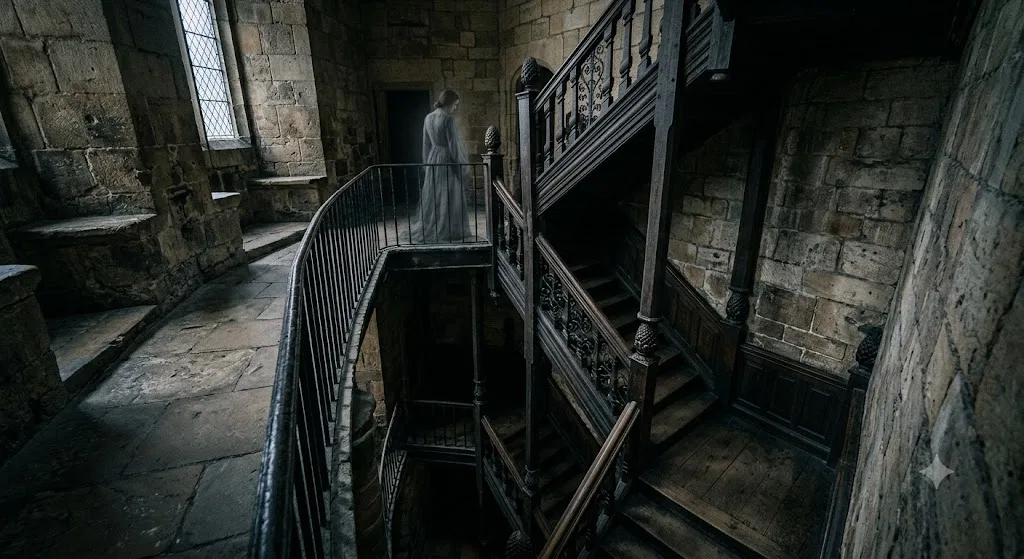
The Grey Lady story turns Durham Castle's Black Staircase into one of the county's most recognisable haunted settings.
On this page
- The Black Staircase story
- Castle, cathedral and Prince Bishop power
- Student folklore and cautious evidence
Page outline Jump by section
Introduction
Durham Castle’s Grey Lady is one of County Durham’s most recognisable haunting traditions because the story has a precise stage: the Black Staircase, a dark oak showpiece inside the castle on Palace Green. The usual version says that a bishop’s wife fell from the staircase and now appears there as a grey-clad figure. It is a compelling local legend, but the evidence is thin: modern tourism, student memory and ghost gazetteers preserve the tale more clearly than old documentary records do. That makes the Grey Lady best understood as a haunted-building tradition attached to a real architectural oddity, rather than as a proven historical death.
The story matters because Durham Castle is not a ruin or a museum shell. It is a working university building, part of Durham’s UNESCO World Heritage landscape, and the home of University College. Its ghost story survives in a setting where students, visitors, guides and local writers keep retelling the same unsettling image: a woman on a staircase whose own structure looks slightly wrong.
The Black Staircase story
The core tradition is simple. Start up Durham Castle’s Black Staircase, and the story says you may encounter the Grey Lady. Visit County Durham describes her as the wife of a 19th-century Bishop of Durham who fell to her death from the staircase’s “topmost heights”; the same tourism account notes that the staircase can be seen on a guided castle tour.[This is Durham]thisisdurham.comThis is Durham Five Frightful Durham ghost storiesThis is Durham Five Frightful Durham ghost stories
That version has become the public-facing form of the legend. It is repeated in local visitor writing and student-facing accounts: the Grey Lady is linked to the Black Staircase, her death is usually framed as a fall, and her identity is kept either vague or attached to a bishop’s wife. Palatinate, Durham University’s student newspaper, calls her perhaps the castle’s most common reported apparition, again placing her on the staircase from which she is believed to have fallen in the 19th century.[Palatinate]palatinate.org.ukPalatinate A guide to the ghosts of DurhamPalatinate A guide to the ghosts of Durham
A more specific version identifies the woman as “Isabella”, supposedly the wife of Bishop William Van Mildert, and says she broke her neck after falling down the stairs. That form of the story also claims she has been seen in the Norman Gallery, “only from the knees up” because later floor levels have changed.[Paul Lee]paullee.comOpen source on paullee.com. The problem is that this identifying detail clashes with stronger biographical evidence: Van Mildert’s wife was Jane Douglas, not Isabella, and the Dictionary of National Biography records that Jane died at Harrogate on 19 December 1837 and was buried with the bishop in Durham Cathedral.[Wikisource]en.wikisource.orgVan Mildert, WilliamVan Mildert, William
That contradiction does not kill the legend, but it changes how it should be read. The Grey Lady is not supported, on the evidence available in open sources, by a clean historical trail from named woman to fatal accident to apparition report. Instead, she looks like a classic castle ghost tradition: a dramatic death story placed on a memorable architectural feature, later sharpened by retelling, local tourism and student folklore.
The most interesting detail is that the ghost is not attached to a generic corridor. She belongs to a staircase with its own peculiar history, appearance and physical unease. Even before the ghost is mentioned, the Black Staircase already has the ingredients of a haunting: dark timber, height, instability, confined movement, and a visible sense that something has shifted out of true.
Why the staircase feels haunted before the ghost appears
The Black Staircase was built for Bishop John Cosin in the late 17th century, after the upheavals of the English Civil War. Durham World Heritage Site describes it as the “piece de resistance” of Cosin’s refurbishment of the castle, part of a wider programme of carved woodwork in both castle and cathedral.[Durham World Heritage Site]durhamworldheritagesite.comOpen source on durhamworldheritagesite.com.
Its name is slightly misleading. The timber is not literally black, but very dark brown. The staircase was designed as a “flying staircase”, meaning it was intended to have no vertical supports: each stair was embedded into the wall, with the load carried through the structure. The builders miscalculated, and the staircase began to lean soon after construction, so wooden posts were added to stabilise it. Those posts remain in place today.[Durham World Heritage Site]durhamworldheritagesite.comOpen source on durhamworldheritagesite.com.
That architectural history gives the Grey Lady tradition much of its force. A ghost said to haunt a perfectly ordinary staircase would be easier to dismiss as stock scenery. A ghost said to haunt a tall, dark, leaning, visibly propped staircase has a stronger local logic. The setting itself invites a story about falling, dislocation and repeated movement between levels.
The staircase was also meant to impress. Modern Durham heritage interpretation notes that the Black Stairs were the crowning achievement of Cosin’s refurbishment, with ornate pineapple carvings used as signs of wealth and refinement at a time when the fruit was rare and prized.[Durham Stories]stories.durham.ac.ukdurham castle historydurham castle history This mixture of grandeur and structural anxiety is important. The Black Staircase is not a servants’ back stair or a hidden passage. It is a ceremonial, status-laden feature that went wrong enough to require support.
That may help explain why the haunting has stuck. The Grey Lady turns a technical architectural problem into a human story. The leaning staircase becomes not just a misjudged piece of 17th-century engineering, but a place where a woman is imagined to have fallen, died and remained.
Castle, cathedral and Prince-Bishop power
Durham Castle stands within one of the most symbolically charged historic landscapes in northern England. UNESCO describes the castle as the stronghold and residence of the Prince-Bishops of Durham, who held both religious and secular power and were granted unusual autonomy in return for guarding England’s northern frontier.[UNESCO World Heritage Centre]whc.unesco.orgOpen source on unesco.org.
That matters for the Grey Lady because the story depends on the social world of the bishops. It is not simply “a woman fell down some stairs”. It is usually “a bishop’s wife” who fell inside a building that embodied palatine power, ceremony and hierarchy. The Black Staircase linked spaces of authority within a castle-palace, not merely rooms in a domestic house.
Durham’s World Heritage setting also gives the tale its visual frame. Castle, cathedral and Palace Green sit on the defended peninsula above the River Wear, a site associated with worship, learning, residence and political power for around a millennium. Historic England’s World Heritage entry emphasises the visual drama of the cathedral and castle, the physical expression of the bishops’ spiritual and secular authority, and the continuity of use over the past 1,000 years.[Historic England]historicengland.org.ukHistoric England Durham Castle and Cathedral, City of DurhamHistoric England Durham Castle and Cathedral, City of Durham
The Grey Lady is therefore part of a wider County Durham pattern in which hauntings cluster around places of old authority. Lumley Castle has Lily of Lumley; Raby Castle has its aristocratic and household legends; Hylton Castle has the Cauld Lad. Durham Castle’s version is more restrained than some of these, but it is arguably more spatially precise. Its haunting is not spread across the whole building so much as concentrated on one named architectural feature.
The tradition also bridges the castle’s two identities. Before the 19th century, it was the bishops’ residence and stronghold. Since 1837, it has been the home of University College, Durham. Durham Castle’s own history material says the building was formally handed over to the university in 1837, after which the castle became a living student community rather than a frozen monument.[Durham Stories]stories.durham.ac.ukdurham castle historydurham castle history The Grey Lady belongs to that overlap: a bishop’s-wife story preserved in a student-inhabited castle.

Student folklore and cautious evidence
The Grey Lady’s modern life is bound up with the fact that Durham Castle is still occupied. Durham World Heritage Site notes that student guides take visitors around the castle, explaining both its long history and how it functions today; Durham University also describes the castle as a guided-tour venue rather than a freely accessible building.[Durham World Heritage Site]durhamworldheritagesite.comOpen source on durhamworldheritagesite.com.
That living use gives the legend a continuing audience. Students sleep, eat, study and socialise inside spaces that visitors experience as medieval and ceremonial. A creak, shadow, half-seen movement or unsettling walk along the Black Staircase has a different emotional effect at night in a residential college than it would in a daytime museum.
Modern accounts often say students have reported unnerving sightings within the castle walls. Visit County Durham uses that framing in its ghost-story material, and Palatinate presents the castle as a place with “many rumours” and multiple reported ghosts.[This is Durham]thisisdurham.comThis is Durham Five Frightful Durham ghost storiesThis is Durham Five Frightful Durham ghost stories These are useful as evidence that the tradition circulates in university and visitor culture, but they are not the same as named, dated witness statements checked against archival records.
The evidence base is therefore uneven. The strongest sources confirm the staircase’s existence, date, design problem and prominence within the castle. The strongest public sources for the ghost confirm the modern tradition, its location and its usual wording. What is missing, at least in readily available open material, is a robust early account of the Grey Lady: a dated newspaper report, inquest record, diary entry, castle register or parish burial record that firmly identifies a bishop’s wife dying from a fall on the Black Staircase.
The Van Mildert identification is especially shaky. William Van Mildert was Bishop of Durham from 1826 to 1836 and was central to the foundation of Durham University, but the biographical record names his wife as Jane Douglas and gives her death as occurring at Harrogate in 1837.[Wikisource]en.wikisource.orgVan Mildert, WilliamVan Mildert, William That makes the “Isabella Van Mildert” version look like a later folkloric embellishment or confusion, not a reliable historical identification.
This does not make the story worthless. Folklore often preserves feeling better than fact. The Grey Lady may reflect the emotional charge of a building where aristocratic, clerical and student histories sit on top of one another. She may also be a way of explaining the oddness of the Black Staircase itself: why it leans, why it feels precarious, why it seems to pull the imagination upwards and downwards at once.
What a careful visitor should take from the legend
A good reading of Durham Castle’s Grey Lady keeps two ideas in balance. First, the story is a genuine part of the castle’s modern haunted reputation. It is repeated by local tourism, student media and ghost writers, and it is strongly tied to a specific feature that visitors may encounter on tours. Secondly, the historical claim behind the apparition is not securely proven.
The most credible core is this:
- The Black Staircase is real, prominent and historically significant.
- It was built for Bishop John Cosin in the 17th century and later needed supporting posts because its flying-staircase design proved unstable.
- A Grey Lady tradition is now firmly attached to it.
- The common explanation says she was a bishop’s wife who died after falling from the staircase.
- Attempts to name her, especially as Van Mildert’s wife “Isabella”, are contradicted by better biographical evidence.
That makes the Black Staircase tradition more interesting, not less. It is not just a claim about a ghostly woman. It is a case study in how haunted places are made: a striking architectural object, an atmosphere of age and authority, a dangerous-sounding physical feature, a living student community, and repeated public storytelling.
For County Durham’s haunted map, the Grey Lady is valuable because she is so localised. She belongs to Durham Castle, but more precisely to the Black Staircase: the dark, leaning, propped, ceremonial stair that Cosin meant as a display of power and refinement. Whether or not anyone accepts the apparition as supernatural, the tradition reveals how one architectural feature can gather fear, memory and explanation around itself until it becomes one of the county’s most memorable haunted settings.

Amazon book picks
Further Reading
Books and field guides related to Who Haunts Durham Castle's Black Staircase?. Use these as the next step if you want deeper reading beyond the article.

Haunted Castles of Britain and Ireland
Strong thematic fit for Durham Castle's Grey Lady tradition.
The lore of the land
Explains how haunted-place traditions evolve around historic buildings.
The time traveller's guide to medieval England
Provides rich background for understanding Durham Castle's historic setting.
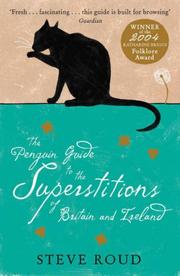
The Penguin Guide to the Superstitions of Britain and Ireland
Adds context for enduring ghost beliefs.
eBay marketplace picks
Marketplace Samples
Live-tested eBay searches with available results related to this page.


Endnotes
1.
Source: en.wikisource.org
Title: Van Mildert, William
Link:https://en.wikisource.org/wiki/Dictionary_of_National_Biography%2C_1885-1900/Van_Mildert%2C_William
2.
Source: whc.unesco.org
Link:https://whc.unesco.org/en/list/370/
3.
Source: unesco.org
Title: document 1503
Link:https://www.unesco.org/archives/multimedia/document-1503
4.
Source: thisisdurham.com
Title: This is Durham Five Frightful Durham ghost stories
Link:https://www.thisisdurham.com/blog/read/2021/10/five-frightful-durham-ghost-stories-b356
5.
Source: thisisdurham.com
Link:https://www.thisisdurham.com/inspire-me/durhams-unmissable-highlights/ghost-stories
6.
Source: palatinate.org.uk
Title: Palatinate A guide to the ghosts of Durham
Link:https://www.palatinate.org.uk/things-that-go-bump-in-the-night-a-guide-to-the-ghosts-of-durham/
7.
Source: paullee.com
Link:https://www.paullee.com/ghosts/ghostgeo/extractghostdata.php?location=54o775504_-1o576935_Durham+Castle.txt
8.
Source: durhamworldheritagesite.com
Link:https://www.durhamworldheritagesite.com/learn/architecture/castle/intro/black-staircase
9.
Source: stories.durham.ac.uk
Title: durham castle history
Link:https://stories.durham.ac.uk/durham-castle-history/
10.
Source: historicengland.org.uk
Title: Historic England Durham Castle and Cathedral, City of Durham
Link:https://historicengland.org.uk/listing/the-list/list-entry/1000089
11.
Source: durhamworldheritagesite.com
Link:https://www.durhamworldheritagesite.com/architecture/castle/university-college
12.
Source: durham.ac.uk
Link:https://www.durham.ac.uk/things-to-do/venues/durham-castle/
13.
Source: durham.ac.uk
Title: History and Architecture
Link:https://www.durham.ac.uk/things-to-do/venues/durham-castle/history-and-architecture/
14.
Source: durham.ac.uk
Title: The Decline of the Bishops
Link:https://www.durham.ac.uk/things-to-do/venues/durham-castle/history-and-architecture/the-decline-of-the-bishops/
15.
Source: durham.ac.uk
Title: Durham Castle Tickets and Times
Link:https://www.durham.ac.uk/things-to-do/venues/durham-castle/visit/tickets-and-times/
16.
Source: durham.ac.uk
Title: UNESC O World Heritage Site
Link:https://www.durham.ac.uk/research/institutes-and-centres/medieval-early-modern-studies/research/unesco-and-world-heritage/unesco-world-heritage-site/
17.
Source: Wikipedia
Title: University College, Durham
Link:https://en.wikipedia.org/wiki/University_College%2C_Durham
18.
Source: Wikipedia
Title: William Van Mildert
Link:https://en.wikipedia.org/wiki/William_Van_Mildert
19.
Source: facebook.com
Link:https://www.facebook.com/durham.castle.museum/photos/happy-halloween-our-object-of-the-week-is-a-little-different-this-week-as-were-c/3453868881504122/
20.
Source: library.eshikshya.org
Title: William Van Mildert
Link:https://library.eshikshya.org/kiwix/content/wikipedia_en_all_maxi_2023-05/A/William_Van_Mildert
21.
Source: kenbradshawnetourguide.co.uk
Title: Durham | My Site
Link:https://www.kenbradshawnetourguide.co.uk/copy-of-bishop-auckland
22.
Source: popuppopin.co.uk
Title: Durham Castle
Link:https://popuppopin.co.uk/durham-castle/
23.
Source: kids.kiddle.co
Title: William Van Mildert
Link:https://kids.kiddle.co/William_Van_Mildert
24.
Source: thisisdurham.com
Title: durham the land of the prince bishops b462
Link:https://www.thisisdurham.com/blog/read/2024/08/durham-the-land-of-the-prince-bishops-b462
25.
Source: thisisdurham.com
Link:https://www.thisisdurham.com/things-to-do/durham-castle-p22901
26.
Source: castlealumni.uk
Link:https://www.castlealumni.uk/about/history
27.
Source: durhamworldheritagesite.com
Link:https://www.durhamworldheritagesite.com/
28.
Source: changehere.wordpress.com
Title: durham castle
Link:https://changehere.wordpress.com/2010/07/07/durham-castle/
29.
Source: eventbrite.co.uk
Title: Durham Castle
Link:https://www.eventbrite.co.uk/e/durham-castle-guided-tours-tickets-1987832543649
Additional References
30.
Source: youtube.com
Title: County Durham’s Most Haunted Castle ~ Ghosts of Lumley Castle
Link:https://www.youtube.com/watch?v=oSgwRL2ajQQ
Source snippet
Something Was Watching Us...The Spirits of Durham's Haunted Inns...
31.
Source: youtube.com
Title: Durham Castle Tour | Learn All The History & Ghosts
Link:https://www.youtube.com/watch?v=8lMS4hs-pvI
Source snippet
County Durham's Most Haunted Castle ~ Ghosts of Lumley Castle...
32.
Source: youtube.com
Link:https://www.youtube.com/watch?v=8mgdKreDbhY
Source snippet
Haunted Brancepeth Castle, County Durham...
33.
Source: historytoday.com
Link:https://www.historytoday.com/archive/death-isabella-i-castile
34.
Source: fabulousnorth.com
Link:https://fabulousnorth.com/durham-castle/
35.
Source: ericsatlas.co.uk
Link:https://ericsatlas.co.uk/listing/durham-castle/
36.
Source: unesco.org.uk
Link:https://unesco.org.uk/our-network/world-heritage-sites/durham-castle-and-cathedral
37.
Source: worldheritageuk.org
Link:https://worldheritageuk.org/world-heritage-sites-uk-list/england/durham-castle-cathedral/
38.
Source: englandsnortheast.co.uk
Link:https://englandsnortheast.co.uk/durham-castle/
39.
Source: instagram.com
Link:https://www.instagram.com/p/DWTRW2YDXUQ/
Topic Tree