Within Haunted Buteshire
Who Is Rothesay Castle's Green Lady?
Rothesay Castle's Green Lady turns Norse violence, a fatal stairway and local memory into Bute's strongest castle ghost story.
On this page
- The Bloody Stairs legend
- Norse siege history and local memory
- Why female castle ghosts endure
Page outline Jump by section
Introduction
Rothesay Castle’s Green Lady is the best-known castle ghost tradition on Bute: a spectral woman, usually named Lady Isabel or Isobel, linked to the “Bloody Stairs” inside the ruined medieval stronghold at Rothesay. The story is not a proven event record. It is a local haunting tradition built around a real place, real Norse attacks on the castle, and a later literary memory of violence, refusal and death. Bute Museum preserves the core version: Lady Isabel is said to have thrown herself down the open stairway to escape a marauding Viking invader, and her ghost became known as the Green Lady.[butemuseum.org.uk]butemuseum.org.ukOpen source on butemuseum.org.uk.
What makes the tale linger is the way it fuses three things visitors can still understand on site: Rothesay Castle’s unusually intimate ruined interior, the historical fact of 13th-century Norwegian sieges, and the old Scottish habit of giving traumatic places a female apparition who embodies loss, fear and local memory. Historic Environment Scotland records that Norwegian forces besieged and captured Rothesay twice, in 1230 and 1263, which gives the legend a convincing historical backdrop even if Lady Isabel herself remains folkloric rather than documented.[Historic Environment Scotland]historicenvironment.scothistory and storiesRead our Statement of Significance to learn more about what makes Rothesay Castle so…Read more…
The Bloody Stairs legend
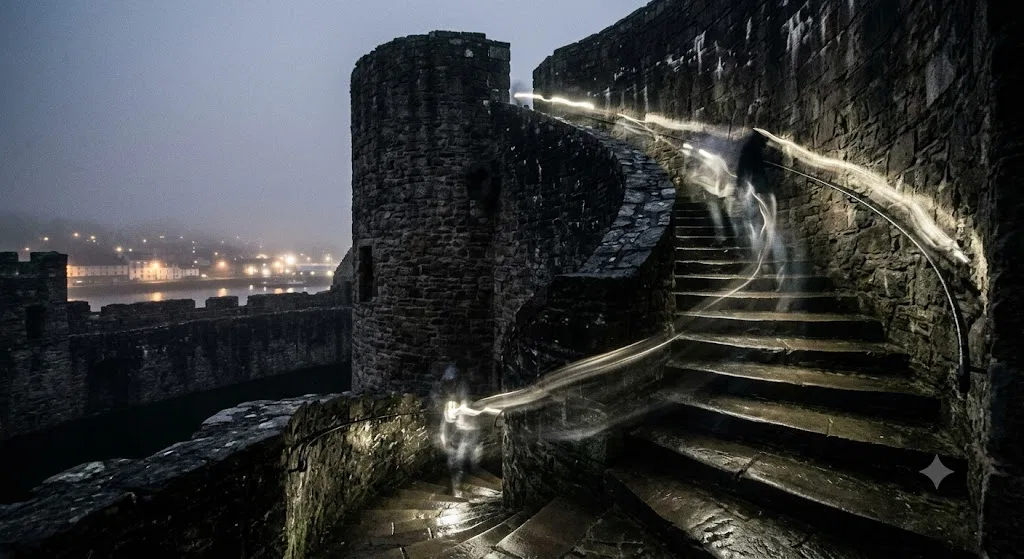
The simplest form of the story is stark. During a violent Norse attack on Rothesay Castle, a young noblewoman named Lady Isabel is threatened by an invader. Rather than submit, marry him, or be taken by force, she dies on or near the castle stair. In Bute Museum’s account, the open stairway is called the “Bloody Stairs” because Lady Isabel threw herself down it while fleeing a Viking attacker; the castle is then said to be haunted by her ghost, the Green Lady.[butemuseum.org.uk]butemuseum.org.ukOpen source on butemuseum.org.uk.
Other retellings change the details. Historic Environment Scotland’s Halloween and Valentine’s Day pieces preserve a darker literary version in which Lady Isabel refuses the man who murdered her father and brothers, and either stabs herself or is slain after rejecting forced marriage. In that version, the haunting is not merely a fall on a stair but a scene of resistance, family killing and sexual threat.[Historic Environment Scotland Blog]blog.historicenvironment.scotHistoric Environment Scotland BlogIn the mirk and midnicht hourOctober 31, 2016 — 31 Oct 2016 — The morning woke on the lady's bower, But…
This variation matters. It shows that Rothesay’s Green Lady is not a neat witness case with one stable testimony. She is a tradition with several narrative shapes:
- The escape version: Isabel throws herself down the stair to avoid capture by a Viking invader.
- The forced-marriage version: she is to be married to an enemy leader as part of a brutal political settlement.
- The revenge-and-refusal version: she rejects the man who has killed her kin, and blood is left on the stair.
- The haunting version: her ghost is seen or heard near the stair, chapel wall, parapet or tower.
Britain Express, a heritage travel site, gives one visitor-facing version in which Isobel is to be forced to marry a Norse king and dies on the stairs behind the chapel; it also notes another version in which she stabs herself rather than marry a Viking who killed her family.[Britain Express]britainexpress.comOpen source on britainexpress.com. The differences are exactly what one expects from a castle ghost legend: the same emotional core survives, while the mechanism of death shifts according to teller, period and audience.

Where the story sits inside Rothesay Castle
Rothesay Castle stands in the town of Rothesay on the Isle of Bute, within historic Buteshire, and is now cared for as a major medieval monument. Historic Environment Scotland describes it as a medieval castle, chapel and moat surviving as upstanding walls and earthworks, only about 150 metres from the harbour.[Historic Environment Scotland]portal.historicenvironment.scotOpen source on historicenvironment.scot. Trove, Historic Environment Scotland’s heritage record platform, identifies the site as Rothesay Castle in the former county of Buteshire, with National Record of the Historic Environment ID 40395.[Trove]trove.scotOpen source on trove.scot.
The geography is important because this is not a lonely Highland ruin hidden in remote moorland. Rothesay Castle is embedded in a town, close to the harbour, ferry routes, streets, museum and everyday life. That gives the Green Lady a different feel from some castle ghosts: she belongs not only to a ruin but to a public, visited civic landmark on Bute.
The “Bloody Stairs” are generally associated with the stair near the chapel area rather than with a grand ceremonial staircase. Historic Environment Scotland’s poem feature directs visitors to look for the stairs “tucked behind the chapel wall”, connecting the literary version of the tale to a specific feature in the castle interior.[Historic Environment Scotland Blog]blog.historicenvironment.scotHistoric Environment Scotland BlogIn the mirk and midnicht hourOctober 31, 2016 — 31 Oct 2016 — The morning woke on the lady's bower, But… That precise placement helps the tradition work as a haunted-site story. A ghost tied to a named stair is easier to remember than a ghost said vaguely to wander “somewhere in the castle”.
The castle’s form also helps the tale. Rothesay is famous for its rounded curtain wall, moat and compact interior. Historic Environment Scotland says the first stone castle was probably built in the early 1200s by Walter, 3rd High Steward, as a defence against attacks from Norway.[Historic Environment Scotland]historicenvironment.scothistory and storiesRead our Statement of Significance to learn more about what makes Rothesay Castle so…Read more… A visitor moving through the ruin is therefore not only seeing a later picturesque shell; they are walking inside a fortress whose earliest purpose was bound up with Norse-Scottish conflict.
Norse siege history and local memory
The strongest historical anchor behind the Green Lady tradition is not evidence for Isabel herself, but evidence that Rothesay Castle really was caught in violent 13th-century conflict between Scottish and Norwegian power in the western seaways. Historic Environment Scotland states plainly that Norwegian forces besieged and captured the castle twice, first in 1230 and again in 1263.[Historic Environment Scotland]historicenvironment.scothistory and storiesRead our Statement of Significance to learn more about what makes Rothesay Castle so…Read more…
The 1230 attack is especially vivid in later summaries of the saga material. Undiscovered Scotland describes a three-day siege in which Norwegian attackers hacked through the castle wall with axes while defenders used boiling pitch from above.[Undiscovered Scotland]undiscoveredscotland.co.ukOpen source on undiscoveredscotland.co.uk. Britain Express similarly describes Norse forces under Uspak, King of Man and the Isles, cutting through the soft stone wall despite defensive measures from the castle.[Britain Express]britainexpress.comOpen source on britainexpress.com.
Those details make the Green Lady story more than decorative folklore. They show why a tradition about fear, invasion and death could plausibly attach itself to Rothesay. Medieval Bute was not merely “atmospheric”; it stood in a contested maritime zone where Norwegian, Gaelic and Scottish interests overlapped. The official castle history notes that after the second Norse capture in 1263, a storm scattered the longships, the later skirmish at Largs proved inconclusive, and the Hebrides were handed back to Alexander III three years later.[Historic Environment Scotland]historicenvironment.scothistory and storiesRead our Statement of Significance to learn more about what makes Rothesay Castle so…Read more…
The problem is that the surviving historical framework does not confirm the ghost’s personal story. The sieges are historically grounded; Lady Isabel is not presented in the official castle history as a documented casualty. That gap is not a reason to dismiss the tradition as worthless. It is a reason to read it correctly. Rothesay’s Green Lady is best understood as a memory-shape: a later story that translates siege warfare, threatened women, kin violence and forced marriage into one unforgettable figure.
Sir Walter Scott and the making of a memorable ghost
The Green Lady tradition is strengthened by a literary strand associated with Sir Walter Scott. Historic Environment Scotland reproduces verses from Scott’s “In the Mirk and Midnicht Hour”, a ballad-like poem in which Isabel rejects the killer of her family and a struggle is heard on the chapel stair. The poem ends by making the haunting explicit: in the dark midnight hour, a shriek is heard and a lady is seen on the steps of the bloody stair.[Historic Environment Scotland Blog]blog.historicenvironment.scotHistoric Environment Scotland BlogIn the mirk and midnicht hourOctober 31, 2016 — 31 Oct 2016 — The morning woke on the lady's bower, But…
Scott’s role is important because he did not simply record dry local antiquarian detail. He helped give Scottish ruins a romantic, dramatic language that later visitors could feel. In the Rothesay poem, the stair becomes a stage: murder has happened, blood remains, and the ghost returns through sound as much as sight. That is why the story can survive even where hard evidence is thin. It has a compact emotional script.
The poem also shifts the centre of the legend. In some tourist retellings, Isabel’s death is a tragic leap. In Scott’s version, it is a moral confrontation. She refuses a man marked by the blood of her father and brothers; the “Bloody Stair” becomes the place where private violence and national hostility meet.[Historic Environment Scotland Blog]blog.historicenvironment.scotHistoric Environment Scotland BlogIn the mirk and midnicht hourOctober 31, 2016 — 31 Oct 2016 — The morning woke on the lady's bower, But…
That literary inheritance should make readers cautious as well as interested. A poem is not a court record. It can preserve an older oral tale, reshape it, or make a local tradition more famous than it had been before. For Rothesay Castle, Scott’s value lies in showing that the Bloody Stairs story had become legible as Scottish romantic folklore: a tale of kin, honour, invasion, blood and a woman who will not be possessed.
How credible is the Green Lady tradition?
The most balanced answer is that Rothesay Castle’s Green Lady is credible as folklore, not as verified paranormal evidence. The place is real, the castle’s Norse siege history is real, the stair tradition is preserved by Bute Museum, and the Lady Isabel story has been repeated by Historic Environment Scotland in public interpretation.[butemuseum.org.uk]butemuseum.org.ukOpen source on butemuseum.org.uk. What is missing is a contemporary medieval record proving that a named Lady Isabel died on that stair in the manner described.
There are several signs that the story belongs to legend rather than firm history. The first is narrative variation: Isabel throws herself down the stairs in one version, stabs herself in another, is slain in another, or dies resisting forced marriage in yet another.[Britain Express]britainexpress.comOpen source on britainexpress.com. The second is the lack of a stable documentary identity for Isabel. The third is the way the story follows a familiar haunted-castle pattern: a threatened young woman, a violent male aggressor, a fatal interior feature, a stain or bloody place-name, and a recurring apparition.
That does not make the legend unimportant. Folklore often preserves what formal records omit: fear of invasion, the vulnerability of women in wartime, the trauma of family killing, and the moral need to remember a victim rather than only the men who fought. The Green Lady gives Rothesay Castle a human centre that siege dates alone cannot provide.
A sceptical reading would see the “Bloody Stairs” as a named feature whose story developed over time to dramatise the castle’s violent past. A sympathetic folklore reading would say that the legend keeps local memory alive by attaching it to a place a visitor can still stand beside. Both readings can coexist. The story does not need to be treated as literal proof of a ghost to be worth taking seriously.

Why female castle ghosts endure
Rothesay’s Green Lady belongs to a wider pattern of female castle apparitions in Scottish and British folklore. “Green Lady” is not unique to Bute: Crathes Castle in Aberdeenshire has a famous Green Lady tradition, and Historic Environment Scotland has also used Green Lady material in wider Halloween storytelling about Scottish castles.[National Trust for Scotland]nts.org.ukOpen source on nts.org.uk. The colour green often gives such figures an otherworldly or old-fashioned quality without needing much explanation.
Female castle ghosts endure because they make large histories intimate. A siege, dynasty or treaty can feel remote. A woman on a stair feels immediate. In Rothesay’s case, the Green Lady turns the castle’s Norse violence into a story about one body, one refusal and one place where blood supposedly would not wash away.
These stories also often carry social tensions that official military history smooths over. Rothesay Castle’s documented history is about Stewarts, Norwegian kings, sieges, fortifications and later royal use.[Historic Environment Scotland]historicenvironment.scothistory and storiesRead our Statement of Significance to learn more about what makes Rothesay Castle so…Read more… The Green Lady tradition asks a different question: what did war mean inside the walls, especially for someone with little control over the political bargain being made around her?
That is why the Lady Isabel tale is still effective for modern visitors. It does not require belief in ghosts. It asks the reader or visitor to imagine the castle not as masonry alone, but as a place where fear, coercion and memory could settle into a stair-name and stay there.
What to remember at Rothesay Castle
The Green Lady and the Bloody Stairs tradition should be approached as a layered local legend. Its strongest historical layer is Rothesay Castle’s genuine role in the Norse-Scottish struggle of the 1200s. Its strongest folkloric layer is the Lady Isabel story preserved by Bute Museum and echoed in heritage interpretation. Its strongest literary layer is the ballad-like treatment associated with Sir Walter Scott, where the stair becomes a permanent mark of blood and midnight haunting.[butemuseum.org.uk]butemuseum.org.ukOpen source on butemuseum.org.uk.
For Buteshire’s haunted map, Rothesay Castle matters because it gives Bute a compact, memorable castle ghost with local roots rather than a borrowed generic spectre. The story is not a verified apparition report, and it should not be inflated into one. Its value lies in how precisely it binds place, history and feeling: a moated castle in Rothesay, a stair near the chapel, a remembered Norse threat, and a woman in green who carries the violence of the past into local imagination.
Amazon book picks
Further Reading
Books and field guides related to Who Is Rothesay Castle's Green Lady?. Use these as the next step if you want deeper reading beyond the article.
The Penguin Book of Ghost Stories
Supports readers interested in classic ghost literature.
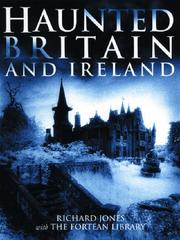
Haunted Britain and Ireland
Places Rothesay within the wider haunted heritage of Britain.
eBay marketplace picks
Marketplace Samples
Live-tested eBay searches with available results related to this page.

Endnotes
1.
Source: butemuseum.org.uk
Link:https://www.butemuseum.org.uk/project/rothesay-castle/
2.
Source: trove.scot
Link:https://www.trove.scot/place/40395
3.
Source: story.com
Link:https://www.story.com/ai-stories/ai-other-stories/the-ghostly-tale-of-lady-isobel
4.
Source: butemuseum.org.uk
Link:https://www.butemuseum.org.uk/rothesay-castle/
5.
Source: youtube.com
Title: A Stewart Stronghold
Link:https://www.youtube.com/watch?v=HGd2DK5Mxa8
Source snippet
Rothesay Castle...
6.
Source: youtube.com
Title: Rothesay Castle
Link:https://www.youtube.com/watch?v=tn1KfWkcNJQ
Source snippet
ROTHESAY - Voyage to the Tomb of a King...
7.
Source: historicenvironment.scot
Title: history and stories
Link:https://www.historicenvironment.scot/visit/all/rothesay-castle/history-and-stories/
Source snippet
Read our Statement of Significance to learn more about what makes Rothesay Castle so...Read more...
8.
Source: blog.historicenvironment.scot
Link:https://blog.historicenvironment.scot/2016/10/mirk-midnicht-hour/
Source snippet
Historic Environment Scotland BlogIn the mirk and midnicht hourOctober 31, 2016 — 31 Oct 2016 — The morning woke on the lady's bower, But...
Published: October 31, 2016
9.
Source: blog.historicenvironment.scot
Title: valentines antidote
Link:https://blog.historicenvironment.scot/2020/02/valentines-antidote/
10.
Source: britainexpress.com
Link:https://www.britainexpress.com/scotland/castles/rothesay-castle.htm
11.
Source: portal.historicenvironment.scot
Link:https://portal.historicenvironment.scot/apex/f?p=1505%3A300%3A%3A%3A%3A%3AVIEWTYPE%2CVIEWREF%3Adesignation%2CSM12970
12.
Source: undiscoveredscotland.co.uk
Link:https://www.undiscoveredscotland.co.uk/bute/rothesaycastle/index.html
13.
Source: nts.org.uk
Link:https://www.nts.org.uk/stories/scottish-ghost-stories-witches-murder-and-folklore-part-2
14.
Source: blog.historicenvironment.scot
Title: 13 days halloween
Link:https://blog.historicenvironment.scot/2018/10/13-days-halloween/
15.
Source: Wikipedia
Title: Rothesay Castle
Link:https://en.wikipedia.org/wiki/Rothesay_Castle
16.
Source: historyhit.com
Title: Rothesay Castle
Link:https://www.historyhit.com/locations/rothesay-castle/
17.
Source: seaviewcottageholiday.co.uk
Link:https://www.seaviewcottageholiday.co.uk/blog/castle
18.
Source: poemhunter.com
Title: Sir Walter Scott
Link:https://www.poemhunter.com/sir-walter-scott/ebooks/?ebook=0&filename=sir_walter_scott_2004_9.pdf
19.
Source: argyll-bute.gov.uk
Title: Historic Environment Scotland
Link:https://www.argyll-bute.gov.uk/moderngov/documents/s108665/Historic%20Environment%20Scotland.pdf
20.
Source: britainexpress.com
Link:https://www.britainexpress.com/scotland/Bute/rothesay.htm
Additional References
21.
Source: canmore.org.uk
Link:https://canmore.org.uk/site/111545/bute-rothesay-castle-street-town-hall-and-sheriff-court
22.
Source: canmore.org.uk
Link:https://canmore.org.uk/site/143167/bute-rothesay-gallowgate-general
23.
Source: facebook.com
Link:https://www.facebook.com/groups/scotlandsscenery/posts/8025509647468338/
24.
Source: archive.org
Link:https://archive.org/stream/poeticalworksofs00scot/poeticalworksofs00scot_djvu.txt
25.
Source: wikishire.co.uk
Link:https://wikishire.co.uk/wiki/Rothesay_Castle
26.
Source: sobt.co.uk
Link:https://sobt.co.uk/rothesay-castle/
27.
Source: facebook.com
Link:https://www.facebook.com/groups/2089437891184119/posts/6894183827376144/
28.
Source: canmore.org.uk
Link:https://canmore.org.uk/en/site/257726/
29.
Source: gutenberg.org
Link:https://www.gutenberg.org/files/54980/54980-h/54980-h.htm
30.
Source: facebook.com
Title: rothesay castle on the isle of bute was built in the early 13th century to defen
Link:https://www.facebook.com/100081142576688/posts/rothesay-castle-on-the-isle-of-bute-was-built-in-the-early-13th-century-to-defen/919416990773045/
Topic Tree