Within Haunted Essex
Are Colchester Castle's Ghosts Really History?
Colchester Castle's ghost stories draw power from prison cells, Quaker martyrdom and Essex's witch-trial history.
On this page
- Prison sounds and museum ghost stories
- James Parnell and religious persecution
- Witch trials, accusations and public fear
Page outline Jump by section
Introduction
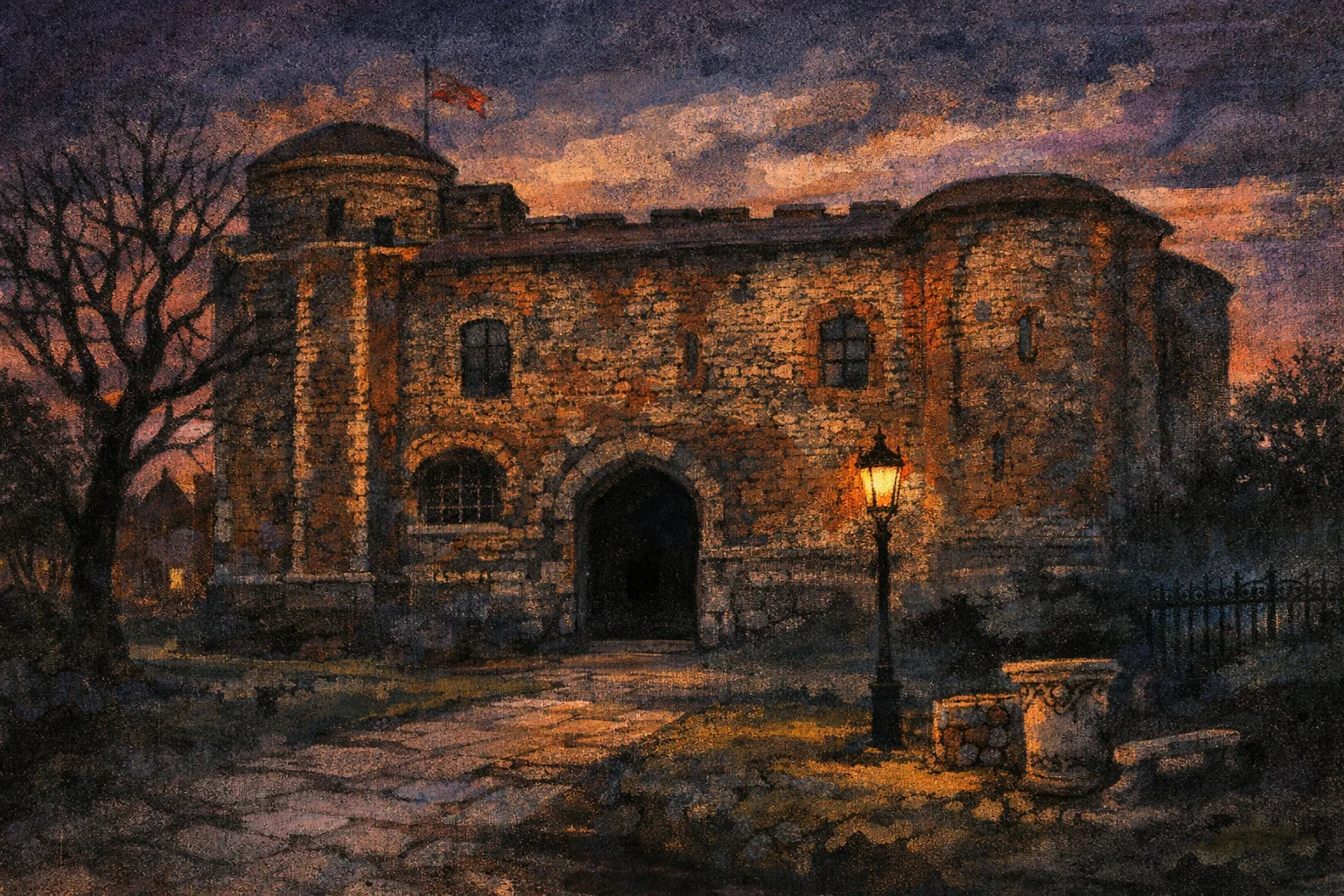
Colchester Castle’s ghosts are best understood as haunted history rather than proven supernatural fact. The castle is said to carry ghost stories because it was not only a Norman fortress and museum, but also a long-used prison where prisoners, religious dissenters and people accused of witchcraft were held in grim conditions. Its most powerful legends gather around prison sounds, cries from cells, the death of the young Quaker James Parnell, and the memory of Essex’s witch trials, especially the 1645 panic linked with Matthew Hopkins and the Manningtree accusations. The evidence for apparitions is folkloric and anecdotal; the evidence for imprisonment, persecution and death is much stronger. That is why Colchester Castle matters in Essex’s haunted landscape: its eerie reputation grows from a real record of confinement and fear.[cimuseums.org.uk]colchester.cimuseums.org.ukColchester Museums The history of Colchester Castle | Colchester MuseumsColchester Museums The history of Colchester Castle | Colchester Museums
Why Colchester Castle became a haunted place
Colchester Castle stands in Castle Park at the centre of Colchester, in historic Essex. It is a huge Norman keep built over the foundations of the Roman Temple of Claudius, which gives the site an unusually deep sense of layered history: Roman religion, Norman power, medieval imprisonment, Civil War violence, museum display and modern ghost tourism all meet in one building. Historic England records the castle as a Grade I listed keep and scheduled monument, and its account notes that from the fourteenth century onwards the castle’s main function declined from military stronghold to prison and later county gaol.[Historic England]historicengland.org.ukHistoric England Colchester Castle and the Temple of Claudius, Non Civil ParishHistoric EnglandColchester Castle and the Temple of Claudius, Non Civil Parish - 1002217 | Historic England…
That prison history is the core of the haunting tradition. Colchester Museums states that by the thirteenth century the castle was being used as a prison, with “many hundreds” of prisoners of war at times confined there in appalling conditions; it continued as a county gaol until 1668 and remained in prison use until 1835. Historic England adds that prison-cell fittings survive on the ground floor of the keep, which matters because the modern visitor is not just hearing a vague legend about “old walls”, but encountering a building where incarceration is physically built into the surviving fabric.[Colchester Museums]colchester.cimuseums.org.ukColchester Museums The history of Colchester Castle | Colchester MuseumsColchester Museums The history of Colchester Castle | Colchester Museums
The castle’s ghost stories therefore do not float free of history. They attach to specific spaces: the cells, vaults, stairways, museum rooms and the wider castle grounds. Like many castle hauntings in Essex and beyond, the stories work because the building has changed use without losing its older atmosphere. A royal fortress became a gaol; a gaol became a museum; a museum now interprets witch trials, Roman religion and prison life. The result is a place where visitors can easily read ordinary creaks, echoes and cold spaces through the memory of suffering.
Prison sounds and museum ghost stories
Colchester Museums itself preserves a public-facing page of ghost stories from its museums, describing them as accounts from former staff and visitors. The page is not limited to the castle alone, but it is important because it shows how the city’s museum service acknowledges local ghost storytelling without presenting it as proof. One story, “The Ticking Sound”, tells of a staff member opening the Natural History Museum and hearing an unexplained clock-like noise apparently centred on the grave of John Smorthwaite, a Colchester clockmaker; another, “An Extra Guest for Tea”, describes an unexpected figure apparently appearing during a staff tea break at Hollytrees Museum.[Colchester Museums]colchester.cimuseums.org.ukColchester Museums Ghost Stories | Colchester MuseumsColchester Museums Ghost Stories | Colchester Museums
For Colchester Castle specifically, the most common haunted claims tend to involve prison-like sensations: cries, footsteps, oppressive rooms, cell areas and the idea that those who suffered there have left an emotional trace. Commercial ghost-hunt listings and local haunted-place summaries often amplify these claims, naming the medieval male prison, table-tipping sessions, a headless nun, a lady in red or the screams of James Parnell. Those sources are useful as evidence of modern folklore and tourism, but they are weaker as historical evidence because they usually do not provide dated witness statements, archival references or independently checked testimony.[hauntedhappenings.co.uk]hauntedhappenings.co.ukOpen source on hauntedhappenings.co.uk.
A careful reading separates three things. First, the castle really was a prison for centuries. Secondly, staff, visitors and ghost-tour operators have preserved stories of strange sounds, figures and sensations in Colchester’s museum landscape. Thirdly, the leap from an eerie experience to a named ghost is usually interpretive. A sound in an old building may be a haunting story, a structural noise, a memory shaped by what the visitor already knows, or simply an experience no one has yet explained. The castle’s reputation depends on that uncertainty.
This is why Colchester Castle is stronger as haunted history than as a tidy ghost case. There is no single famous apparition with a clean paper trail comparable to a named psychical-research investigation. Instead, the castle’s atmosphere is cumulative: prison architecture, witch-trial interpretation, Quaker martyrdom, Civil War memories, museum storytelling and ghost walks all reinforce one another. The haunting is as much about what the building makes people remember as what they claim to see.

James Parnell and the memory of persecution
One of the most emotionally charged stories attached to Colchester Castle is that of James Parnell, the young Quaker preacher who died there in 1656. Quaker Tapestry describes Parnell as a fifteen-year-old from Retford who became a Quaker, travelled to visit George Fox in prison in Carlisle, preached in eastern England, was accused of causing a riot, and died after eight months of cruel treatment in Colchester. Friends Library’s account says he was arrested after a debate with a priest on charges of being an “idle and disorderly person”, imprisoned at Colchester Castle, confined in a small hole in the castle wall above the ground, and died after sickness and ill-treatment.[Quaker Tapestry]quaker-tapestry.co.ukQuaker Tapestry James Parnell: Meeting for SufferingsQuaker Tapestry James Parnell: Meeting for Sufferings
The ghost tradition turns Parnell’s death into an acoustic haunting: screams or cries heard around the cells, often interpreted as the lingering pain of the “Boy Martyr”. The historical record does not prove those sounds are supernatural, but it does explain why Parnell’s story has such power. He was young, religiously marginal, imprisoned in a harsh gaol and remembered by the Society of Friends as an early martyr. A castle cell linked to a documented death is exactly the kind of place where later folklore can gather.
Parnell also broadens the castle’s haunted meaning beyond witchcraft. Colchester Castle is not only a “witch prison” in popular imagination; it is also a site of religious persecution. In the mid-seventeenth century, the same wider world of civil war, sectarian anxiety, punishment and local authority shaped both Quaker suffering and witch-trial violence. The two histories should not be collapsed into one another, but they do explain why the castle’s ghost stories feel darker than a simple “lady in white” legend. They are attached to people who were imprisoned because their neighbours, ministers or magistrates saw them as socially or spiritually dangerous.
That makes Parnell a bridge between history and haunting. Visitors may come looking for ghostly screams, but the more substantial story is about a society that punished dissent and used old prison spaces to enforce conformity. In Essex’s haunted geography, Colchester Castle becomes memorable because its ghosts are often less like theatrical spectres and more like troubled memories of confinement.
Witch trials, accusations and public fear
Colchester Castle’s strongest claim within Essex haunted history is its connection with witch-trial memory. Colchester Museums describes the castle as a key landmark in the Essex witch trials, stating that in the sixteenth and seventeenth centuries hundreds of people were imprisoned within its walls on suspicion of witchcraft. The museum’s “Wicked Spirits?” exhibition, produced with the Museum of Witchcraft and Magic in Boscastle, was designed to bring the stories of people who suffered and died into public view, rather than allowing them to be overshadowed by the fame of Matthew Hopkins.[Colchester Museums]colchester.cimuseums.org.ukColchester Museums Wicked Spirits | Colchester MuseumsColchester Museums Wicked Spirits | Colchester Museums
Historic England gives a national frame: in the sixteenth and seventeenth centuries witchcraft was widely believed in across England, and the Elizabethan statute of 1562 made witchcraft a felony. Its Colchester Castle section states that Matthew Hopkins, the self-proclaimed Witchfinder General, used the castle as a place where women and men believed to be witches were jailed and interrogated in dark cells, with some believed to have died from incarceration before reaching court.[Historic England]historicengland.org.ukHistoric England Witchcraft and Witch Trials in England | Historic EnglandHistoric England Witchcraft and Witch Trials in England | Historic England
This is the central reason the castle’s haunting reputation feels different from a generic castle ghost. The fear attached to Colchester was not merely fear of the dead, but fear produced by living communities: neighbours accusing neighbours, magistrates examining suspects, prisoners waiting in cells, and stories of familiars, secret meetings and devilish marks being treated as evidence. Colchester Museums notes that accusations ranged from using animal familiars to kill neighbours to meeting secretly and reading mysterious books; it also points out that many accusations have rational explanations today, while others were fabricated to secure guilt.[Colchester Museums]colchester.cimuseums.org.ukColchester Museums Wicked Spirits | Colchester MuseumsColchester Museums Wicked Spirits | Colchester Museums
The numbers are sobering, but they need careful handling. Colchester Museums says that in Essex alone around 1,000 people were accused of witchcraft from the 1500s to the 1800s, with some spending time in Colchester Castle cells awaiting trial. Historic England states that Hopkins is considered responsible for at least 100 deaths, while modern researchers often stress that he was one figure in a wider legal, religious and social machinery of accusation rather than a lone monster acting in isolation.[cimuseums.org.uk]colchester.cimuseums.org.ukColchester Museums Wicked Spirits | Colchester MuseumsColchester Museums Wicked Spirits | Colchester Museums
The East Anglian Witch Project gives a more focused account of the 1645 moment, describing Elizabeth Clarke, Anne and Rebecca West and other women from Manningtree and nearby villages being imprisoned at the castle in March or April 1645, eventually reaching thirty-six people held on suspicion of witchcraft. It describes dire gaol conditions, including exposure, shackling, poor food, straw or bare stone sleeping, and deaths from exposure, malnutrition or disease. As a secondary project, it should be read alongside museum, Historic England and academic sources, but it is valuable because it keeps attention on named accused people rather than turning the story into a Hopkins-centred legend.[East Anglian Witch Project]eastanglianwitchproject.co.ukOpen source on eastanglianwitchproject.co.uk.
The Manningtree link and the people behind the legend
The best-known seventeenth-century Essex witch panic began around Manningtree and the Tendring Hundred, not inside Colchester Castle itself. That distinction matters. The castle was the place of imprisonment and interrogation; the accusations arose in towns and villages where local tensions, illness, poverty, gender, religion and neighbourly suspicion turned into legal danger. The University of Essex’s “Revisiting the Essex Witch Trials” project explicitly frames the story as one about superstition, scapegoating, fear and intolerance, and it aims to move attention away from witchfinders and towards the women accused in 1645.[University of Essex]essex.ac.ukOpen source on essex.ac.uk.
One concrete example is Elizabeth Gibson of Thorpe-le-Soken. The University of Essex project states that records show she died of plague in Colchester Castle gaol in July 1645 before her trial could take place; she was never indicted and died an innocent woman. This is exactly the sort of detail that gives Colchester Castle its haunted force. The tragedy is not simply that someone may have been executed after conviction, but that imprisonment itself could kill before the law had reached any verdict.[University of Essex]essex.ac.ukOpen source on essex.ac.uk.
Anne West and Rebecca West show another cruel mechanism. Rebecca West of Lawford became a Crown witness against other women, including her mother Anne; Anne West was hanged in 1645. The East Anglian Witch Project describes Rebecca’s confession as coerced and says that Hopkins used her as a weak point to implicate the Manningtree women, while the University of Essex project treats these women as people with lives, families and voices rather than as stock figures in a witchfinder story.[University of Essex]essex.ac.ukOpen source on essex.ac.uk.
For a haunted-place reader, this changes the emotional geography of Colchester Castle. The “witches” in the story were not gothic villains. They were accused women and men, some of whom never reached trial, some of whom were pressured into confession, and some of whom became witnesses under terrifying circumstances. The castle’s ghosts, in that sense, are better read as the memory of a panic than as a roster of supernatural characters.
Why Elizabeth Lowys matters to the castle’s memory
Colchester Castle’s witch-trial interpretation also reaches back before Hopkins. Colchester Museums highlights Elizabeth Lowys of Great Waltham as the first person in England to be executed under a Witchcraft Act, while legal historians urge caution about the “first witch” claim because surviving records are patchy. Krista Kesselring’s Legal History Miscellany discussion explains that Elizabeth Lowys, a cunning woman and healer tried for killing a child by occult means, was hanged in Chelmsford in March 1565, but that too many records have been lost to identify the first person executed under the 1563 Act with certainty.[Colchester Museums]colchester.cimuseums.org.ukColchester Museums Wicked Spirits | Colchester MuseumsColchester Museums Wicked Spirits | Colchester Museums
That nuance matters for public memory. Popular haunted history often likes clean firsts: the first witch, the worst prison, the most haunted cell. The historical record is usually messier. Lowys remains important because her case helps show how early Essex became associated with witchcraft prosecution, but her story should not be reduced to a trivia answer. It belongs to a longer county pattern in which accusations of harmful magic were treated as criminal realities.
Colchester Castle is not necessarily the setting for every Essex witch case, and it should not swallow the whole county history. Chelmsford, Manningtree, St Osyth, Great Waltham, Tendring villages and other Essex places all have their own roles. What makes the castle distinct is that it became one of the physical containers of the panic: a place where accused people could be held, examined, displayed in memory and later interpreted for museum visitors.
How credible are the ghost stories?
The strongest evidence at Colchester Castle is historical, architectural and archival: the castle’s long use as a prison, its surviving cell fittings, its documented role in witch-trial imprisonment, its association with James Parnell, and its modern museum interpretation. Those claims are supported by Colchester Museums, Historic England, Quaker sources and recent public-history projects.[cimuseums.org.uk]colchester.cimuseums.org.ukColchester Museums The history of Colchester Castle | Colchester MuseumsColchester Museums The history of Colchester Castle | Colchester Museums
The ghost claims are more fragile. They are usually preserved as staff anecdotes, visitor experiences, ghost-tour material, paranormal-event advertising or local folklore. That does not make them worthless. Folklore is evidence of what people feel a place means, and ghost stories often preserve emotional truths about injustice, fear and grief. But they are not the same as proof that a dead prisoner, Quaker martyr or accused witch is literally present.
A fair assessment would put Colchester Castle in three layers:[crazyaboutcastles.com]crazyaboutcastles.comSource details in endnotes.
- Well evidenced: the castle’s prison use, its role as a gaol, its connection to accused witches, and James Parnell’s death in custody.
- Plausible as memory: the way prison cells, witch-trial displays and Quaker martyrdom have shaped modern stories of cries, presences and unease.
- Unproven as paranormal claim: named apparitions, screams and figures that circulate in ghost tourism without a clear chain of dated, independently verified testimony.
That layered approach does not make the castle less interesting. It makes it more interesting, because the haunting is not simply a question of whether a ghost exists. It is a question of why this building, among all Essex buildings, became such a powerful container for stories about suffering.
Visiting the castle with the stories in mind
For visitors, Colchester Castle works best when approached as both a historic site and a haunted-memory site. The castle museum interprets more than 2,000 years of local history, but the prison and witch-trial material gives the building a darker emotional centre. Historic England notes that the crypt of the keep opened as a museum in 1860 and that the whole building later became occupied by the museum; Colchester Museums records the major modern refurbishment of 2013–14, which helped reshape the visitor experience.[Historic England]historicengland.org.ukHistoric England Colchester Castle and the Temple of Claudius, Non Civil ParishHistoric EnglandColchester Castle and the Temple of Claudius, Non Civil Parish - 1002217 | Historic England…
The most relevant areas for this story are the ground-floor prison spaces, the vaults, the displays connected with the East Anglian witch trials, and the wider Castle Park setting. The East Anglian Witch Project notes that the museum includes interpretation of the 1645–47 trials, a recreation of a cell and a dramatic presentation of Rebecca West’s interrogation; it also mentions a protective “witch’s mark” shown on some Roman Vaults and Castle Roof tours, though its exact date is unknown and it is not part of the general display.[East Anglian Witch Project]eastanglianwitchproject.co.ukOpen source on eastanglianwitchproject.co.uk.
The 2018 memorial plaque in front of the castle, noted by the East Anglian Witch Project, is especially important because it shows how the site’s meaning has shifted. Earlier haunted storytelling might have treated accused witches as spooky figures. More recent interpretation asks visitors to remember them as victims of fear, legal violence and social exclusion. That change does not erase the eerie atmosphere; it makes it more responsible.[East Anglian Witch Project]eastanglianwitchproject.co.ukOpen source on eastanglianwitchproject.co.uk.
Colchester also has ghost walks and “ghosts and witches” tours promoted through visitor channels, which shows that the castle sits within a wider haunted tourism map of the city. These tours can be atmospheric introductions, but the most trustworthy reading of the castle comes from holding the entertainment layer together with the documented history. The better question is not simply “is Colchester Castle haunted?” but “what histories are being made haunting here?”[Visit Colchester]visitcolchester.comOpen source on visitcolchester.com.
What the ghosts really preserve
Colchester Castle’s ghost stories preserve three overlapping memories. The first is the memory of imprisonment: centuries of confinement, rough conditions and bodies held in spaces never designed for comfort. The second is the memory of persecution: James Parnell and other religious dissenters punished for belief, and accused witches imprisoned because fear had become law. The third is the memory of public storytelling itself: museum accounts, local tours, paranormal nights, plaques, exhibitions and research projects all continually reshape what the castle means.
That is why the castle remains one of Essex’s most compelling haunted places. Its stories are spooky, but they are not only spooky. They ask what happens when a community turns fear into accusation, when a prison becomes a museum, and when later generations try to name the people who were once reduced to rumours. The ghosts of Colchester Castle are not confirmed facts; they are traditions, claims and experiences gathered around a building with more than enough real darkness to explain why people still listen for voices in its cells.

Amazon book picks
Further Reading
Books and field guides related to Are Colchester Castle's Ghosts Really History?. Use these as the next step if you want deeper reading beyond the article.

Haunted Castles of Britain and Ireland
Closely matches Colchester Castle's ghost traditions.
The time traveller's guide to medieval England
Explains the social world of castles, prisons and justice.

The Penguin Guide to the Superstitions of Britain and Ireland
Adds broader context to local ghost beliefs.
eBay marketplace picks
Marketplace Samples
Live-tested eBay searches with available results related to this page.
Endnotes
1.
Source: colchester.cimuseums.org.uk
Title: Colchester Museums The history of Colchester Castle | Colchester Museums
Link:https://colchester.cimuseums.org.uk/visit/colchester-castle/history/
2.
Source: historicengland.org.uk
Title: Historic England Colchester Castle and the Temple of Claudius, Non Civil Parish
Link:https://historicengland.org.uk/listing/the-list/list-entry/1002217
Source snippet
Historic EnglandColchester Castle and the Temple of Claudius, Non Civil Parish - 1002217 | Historic England...
3.
Source: colchester.cimuseums.org.uk
Title: Colchester Museums Wicked Spirits | Colchester Museums
Link:https://colchester.cimuseums.org.uk/wickedspirits/
4.
Source: historicengland.org.uk
Link:https://historicengland.org.uk/listing/the-list/list-entry/1123674
5.
Source: colchester.cimuseums.org.uk
Title: Colchester Museums Ghost Stories | Colchester Museums
Link:https://colchester.cimuseums.org.uk/ghoststories/
6.
Source: hauntedhappenings.co.uk
Link:https://www.hauntedhappenings.co.uk/colchester-castle/
7.
Source: roseandcrowncolchester.co.uk
Title: Rose and Crown Colchester Haunted Hotel in Essex
Link:https://www.roseandcrowncolchester.co.uk/haunted-hotel-in-essex/
8.
Source: quaker-tapestry.co.uk
Title: Quaker Tapestry James Parnell: Meeting for Sufferings
Link:https://www.quaker-tapestry.co.uk/panels/james-parnell-meeting-for-sufferings/
9.
Source: historicengland.org.uk
Title: Historic England Witchcraft and Witch Trials in England | Historic England
Link:https://historicengland.org.uk/whats-new/features/halloween/witchcraft-and-witch-trials-in-england/
10.
Source: eastanglianwitchproject.co.uk
Link:https://www.eastanglianwitchproject.co.uk/blog/colchester1
11.
Source: essex.ac.uk
Link:https://www.essex.ac.uk/research-projects/snapping-the-stiletto/manningtree
12.
Source: visitcolchester.com
Link:https://www.visitcolchester.com/listing/ghost-and-witches-tour-by-colchester-history-tours/216113101/
13.
Source: facebook.com
Link:https://www.facebook.com/hauntedhappeningsuk/posts/haunted-happenings-ghost-hunters-at-colchester-castle-saturday-7th-february-2026/1334016888770016/
14.
Source: facebook.com
Title: The Essex
Link:https://www.facebook.com/essexwitchmuseum/photos/on-30th-march-1565-elizabeth-lowys-of-great-waltham-became-the-first-person-in-e/122210295656061043/
15.
Source: colchester.cimuseums.org.uk
Link:https://colchester.cimuseums.org.uk/exhibitions/wickedspirits/
16.
Source: colchester.cimuseums.org.uk
Link:https://colchester.cimuseums.org.uk/wp-content/uploads/2022/09/WS-Visitor-Guide-lower-res.pdf
17.
Source: Wikipedia
Title: James Parnell
Link:https://en.wikipedia.org/wiki/James_Parnell
18.
Source: Wikipedia
Title: Colchester Castle
Link:https://en.wikipedia.org/wiki/Colchester_Castle
19.
Source: Wikipedia
Title: Elizabeth Clarke
Link:https://en.wikipedia.org/wiki/Elizabeth_Clarke
20.
Source: eastanglianwitchproject.co.uk
Link:https://www.eastanglianwitchproject.co.uk/blog/colchester2
21.
Source: visitcolchester.com
Link:https://www.visitcolchester.com/listing/walking-with-witches/132663101/
22.
Source: crazyaboutcastles.com
Link:https://crazyaboutcastles.com/english-castles/colchester-castle/
23.
Source: engole.info
Title: Elizabeth Lowys
Link:https://engole.info/elizabeth-lowys/
24.
Source: catalog.hathitrust.org
Link:https://catalog.hathitrust.org/Record/100870409
Additional References
25.
Source: hauntedrooms.co.uk
Link:https://www.hauntedrooms.co.uk/haunted-places/colchester
26.
Source: instagram.com
Link:https://www.instagram.com/p/DPzZtacEYYt/
27.
Source: catuk.org
Link:https://catuk.org/building/castle-keep-including-excavated-remains-of-forebuilding-in-moat-castle-park/
28.
Source: facebook.com
Link:https://www.facebook.com/hauntingnightsoffical/posts/colchester-castle-in-essex-has-so-many-areas-to-investigate-all-with-their-own-g/781340460841146/
29.
Source: facebook.com
Link:https://www.facebook.com/groups/133106515620754/posts/1260067746257953/
30.
Source: reddit.com
Link:https://www.reddit.com/r/watcherentertainment/comments/14wzrxo/mostleast_convincing_place_the_boys_have_visited/
31.
Source: paranormaldatabase.com
Link:https://www.paranormaldatabase.com/hotspots/colchester.php
32.
Source: ghostlypostcodes.co.uk
Link:https://www.ghostlypostcodes.co.uk/listing/red-lion-colchester/
33.
Source: essexvoicespast.com
Link:https://www.essexvoicespast.com/tag/colchester-castle/
34.
Source: instagram.com
Link:https://www.instagram.com/reel/DWHN1JlDTi7/
Topic Tree