Within Haunted Tyrone
Was the Cookstown Ghost a Poltergeist?
The Cookstown Ghost is Tyrone's strongest older case because newspapers recorded the household disturbances in 1874.
On this page
- Old Town Hill and Mr Allen's household
- Broken crockery, damaged clothes and public embarrassment
- Newspapers, superstition and sceptical readings
Page outline Jump by section
Introduction
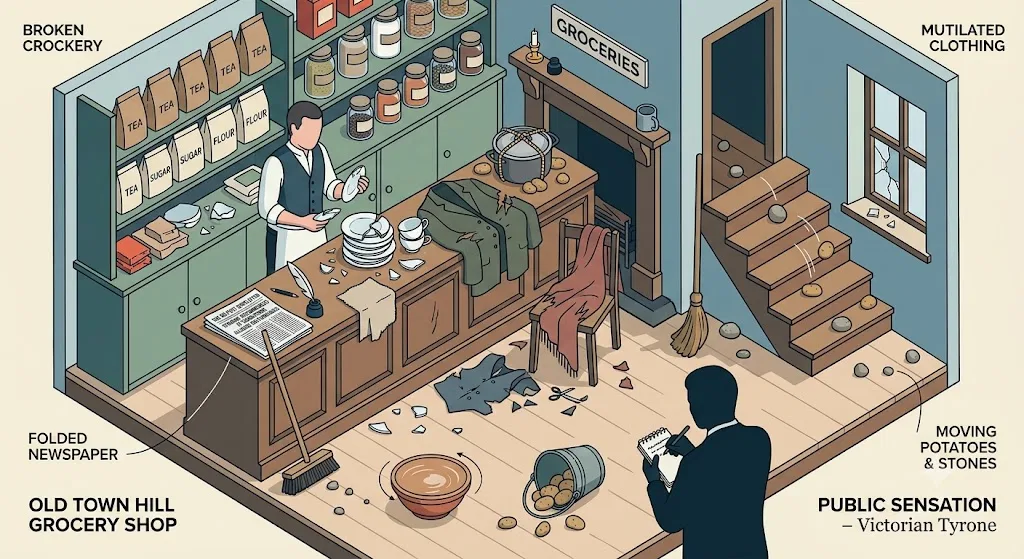
The Cookstown Ghost is one of Tyrone’s strongest older haunting cases because it was not merely a later fireside tale: it was reported as a live disturbance in the newspapers of 1874. The story centred on Mr Allen’s grocery shop and household on Old Town Hill, Cookstown, where clothing was allegedly cut, crockery broken, potatoes displaced, stones rolled downstairs, windows smashed and a family’s private trouble became a public sensation. The case reads less like a classic apparition story and more like what later readers would call a poltergeist case: disruptive, domestic, embarrassing, and centred on damaged objects rather than a visible ghost. The best surviving value of the story is not proof of a haunting, but a sharp glimpse of Victorian Tyrone at the meeting point of household anxiety, newspaper excitement, spiritualist debate and local scepticism.[Ulster University]ulster.ac.ukOpen source on ulster.ac.uk.
Old Town Hill and Mr Allen’s household
Cookstown sits in historic County Tyrone, now within modern Mid Ulster, but the ghost story belongs to the older market-town world of shopkeepers, close neighbours and local reputation. The town itself had grown from Plantation-era origins into a nineteenth-century linen and market centre, and modern official census material still treats Cookstown as a distinct Northern Ireland settlement.[Wikishire]wikishire.co.ukOpen source on wikishire.co.uk.
The reported haunting took place at Old Town Hill, in premises occupied by Mr Allen, a grocer. Later summaries drawing on the 1874 press describe him as an elderly and respected local tradesman, living above and behind the shop with his wife, children and a grandson. That social detail matters. A haunting in a lonely ruin can remain safely picturesque; a disturbance in a working grocery shop threatened business, standing and family dignity.[Belfast Entries]belfastentries.comcookstown ghostcookstown ghost
The Allen household also gave the story its first sceptical problem. One young male relative was reportedly thought by some to have skill in legerdemain, meaning conjuring or sleight of hand. That made him an obvious candidate for suspicion, especially when objects seemed to move or be damaged without a visible culprit. Yet the newspaper-derived account says the disturbances were claimed to have continued when he was away working on a farm, which allowed believers to argue that ordinary trickery had not solved the case.[Ulster University]ulster.ac.ukOpen source on ulster.ac.uk.
This is why the Cookstown Ghost belongs in Tyrone’s haunted history even though no spectral figure was seen. Its location was specific, its family was named in the press, its events were reported as repeated rather than one-off, and its fame came from a recognisable Victorian pattern: a respectable home becomes the scene of a baffling domestic nuisance, and the public gathers around the story to decide whether it is fraud, folly, mischief or something stranger.
Broken crockery, damaged clothes and public embarrassment
The most memorable feature of the Cookstown case is not a white lady, a death omen or a ghostly face at a window. It is damage. The reported activity began with household and personal items being spoiled: coats, trousers, vests, blankets and shawls were said to be cut or destroyed, with losses later put at more than £60, a serious sum for a working household. The press extracts preserved in an Ulster folklore reader describe the damage as continuing “at intervals” before shifting into more public and dramatic forms.[Ulster University]ulster.ac.ukOpen source on ulster.ac.uk.
Food and kitchen objects then entered the story. The best-known episode concerns potatoes: Mrs Allen reportedly tied down the lid of a pot after counting eleven potatoes into it, only to find six when she opened it. The same interview account has her say that potatoes had been moved behind the fire and even carried into a field. These are not grand Gothic images, but they are exactly the sort of domestic oddities that make a poltergeist story unsettling: the ordinary rules of the household appear to fail.[Ulster University]ulster.ac.ukOpen source on ulster.ac.uk.
Other reported incidents were more aggressive. Later summaries of the newspaper material describe spinning bowls, cream overturned, stones rolling downstairs when nobody was upstairs, windows broken despite precautions, and boots or clothing mutilated under seemingly controlled conditions. The detail about stones is especially important because stone-throwing and object movement are common features in many reported poltergeist traditions; they shift a story from “someone saw something” to “something interfered with the house”.[Belfast Entries]belfastentries.comcookstown ghostcookstown ghost
The disturbances also made the Allens publicly vulnerable. The case brought visitors, scoffers, spiritualists, charmers and amateur explainers to the household. One report mentions a “spirit charmer” whose clothing and boot were allegedly cut while on the premises, an episode that reads almost like dark comedy but also shows how quickly the affair became a public performance. The family were no longer only sufferers; they were hosts to an argument.[Belfast Entries]belfastentries.comcookstown ghostcookstown ghost
Why the newspapers made the ghost famous
The Cookstown Ghost became famous because newspapers turned a local disturbance into a serial mystery. The Belfast Newsletter printed pieces on the case in November and December 1874, including reports dated 16, 19, 23 and 30 November and an interview with Mr Allen on 5 December. The preserved extracts show the story developing almost episode by episode: first the house, then the theories, then the crowd reaction, then the more sceptical visit to the family.[Ulster University]ulster.ac.ukOpen source on ulster.ac.uk.
The reporting style is part of the evidence. The 19 November account admitted that calling it a ghost was not strictly accurate, because nobody had seen an apparition. Instead, it described an “unseen agency” and noted the absence of the usual ghost-story machinery: no white figure, no shadowy form, no blood-freezing noises. That is a remarkably useful Victorian distinction. The case was being marketed and discussed as a ghost, but the facts reported by the paper better fit a disruptive haunting or poltergeist-like outbreak.[Ulster University]ulster.ac.ukOpen source on ulster.ac.uk.
The press also amplified the social argument around the case. Some people treated it as a supernatural warning; others thought superstition was returning after a century of supposed progress; still others wanted a detective or a practical investigator to take control of the house. One report says a public meeting of nearly a thousand people had heard a chairman claim he could purge the house if given possession of it for a week. Whether that claim was serious bravado or local theatre, it shows how far the Cookstown Ghost had moved beyond one family’s kitchen.[Ulster University]ulster.ac.ukOpen source on ulster.ac.uk.
This was also the age of spiritualist newspapers and public séances. The National Library of Scotland describes The Spiritualist, published in London from 1869 to 1882, as a key title of the UK spiritualist movement, and the Cookstown case was noticed in that wider print culture. The Belfast Newsletter extract of 30 November 1874 says The Spiritualist had carried a long account and suggested a committee of scientific figures to investigate, partly in a tone that appears satirical.[National Library of Scotland Blog]blog.nls.ukthe spiritualist newspaperthe spiritualist newspaper

Was it really a poltergeist?
“Poltergeist” is a useful label for the Cookstown Ghost, but it should be used carefully. The word usually points to noisy, physical disturbances: knocks, thrown objects, broken goods, moved furniture or household disorder, often without a visible apparition. On that descriptive level, the Cookstown case fits very well. The reported phenomena were material and repetitive: broken windows, cut garments, damaged boots, moving food, rolling stones and smashed objects.[Ulster University]ulster.ac.ukOpen source on ulster.ac.uk.
What the case does not provide is a secure answer. The surviving material is mostly mediated through newspapers, later extracts and modern local-history retellings. We do not have a modern controlled investigation, full witness transcripts, a police file proving the impossibility of human involvement, or a final confession. Even the 1874 interview preserved in the Ulster reader contains sceptical texture: the visitor observed that holes in lace curtains looked like scissor cuts, asked why the family had not simply placed others in charge of the house while they left, and ended with the Latin observation that people readily believe what they wish to be true.[Ulster University]ulster.ac.ukOpen source on ulster.ac.uk.
A fair reading leaves several possibilities open. The disturbances may have involved trickery by someone inside or close to the household. They may have combined real vandalism with rumour, exaggeration and the pressure of an excited crowd. They may also have been remembered as stranger than they were because newspapers selected the most puzzling incidents. None of that makes the case worthless. It makes it historically interesting, because the Cookstown Ghost shows how a haunting could be built out of reported facts, local trust, uncertainty, public curiosity and a Victorian appetite for the uncanny.
Newspapers, superstition and sceptical readings
The strongest sceptical point is simple: a ghost was never seen. The newspaper material itself admits this. There were no luminous figures, no dead person identified, no clear motive from beyond the grave and no satisfying ending. What existed were damaged objects and competing interpretations. That makes the title “Cookstown Ghost” slightly misleading, but in a revealing way: nineteenth-century readers often used “ghost” as a broad public label for unexplained household disturbances, even where the alleged phenomena were closer to poltergeist activity.[Ulster University]ulster.ac.ukOpen source on ulster.ac.uk.
The second sceptical point is the social setting. The household had many moving parts: family members, customers, visitors, neighbours, investigators and curious onlookers. Once a case becomes famous, every new breakage or oddity is easier to interpret through the ghost story already in circulation. Public attention can preserve evidence, but it can also contaminate it. In Cookstown, the crowd around the story became part of the story.
The third point is that Victorian spiritualism gave people ready-made explanations. Periodicals, séances and talk of mediums were already part of British and Irish public culture in the 1860s and 1870s, and The Spiritualist’s interest in the Cookstown affair placed a Tyrone shop within a much wider debate over spirits, science and evidence.[Old Operating Theatre]oldoperatingtheatre.comseeing is believing spiritualism in the victorian era part 2seeing is believing spiritualism in the victorian era part 2
Yet it would be too easy to dismiss the case as mere silliness. The reports repeatedly stress Mr Allen’s respectability and the family’s distress. For a grocer, repeated damage to clothing, shop-front glass and household goods was not harmless theatre. The human core of the case is a family caught between fear, ridicule and unwanted fame. That is why the Cookstown Ghost still feels more substantial than a decorative legend attached to a picturesque ruin.

Why the Cookstown Ghost still matters in Tyrone’s haunted history
The Cookstown Ghost stands out in Tyrone because it is a documented newspaper case rather than a loose modern rumour or a vague old tale. It also broadens what “haunted Tyrone” means. The county’s ghost stories are not only roadside apparitions, ruined castles, old hotels or battlefield memories; they also include ordinary urban interiors where a shop, parlour and kitchen became the stage for public argument.
For readers following Tyrone’s wider haunted geography, Cookstown offers a useful contrast with later roadside cases such as the white lady traditions near Coalisland. The Coalisland-style haunting depends on sightings in landscape; the Cookstown case depends on repeated domestic disruption. One is a figure glimpsed outside; the other is an unseen nuisance inside. Together, they show how Tyrone’s supernatural folklore can attach itself both to open roads and to the most practical rooms of a working home.
The case also remains valuable because it resists a neat ending. No ghost was identified, no culprit was publicly exposed, and no single explanation settled the matter. The result is not a failed story but a revealing one: a Victorian Tyrone haunting preserved at the moment when local belief, newspaper culture, spiritualism and scepticism were all trying to claim the same broken crockery.
Amazon book picks
Further Reading
Books and field guides related to Was the Cookstown Ghost a Poltergeist?. Use these as the next step if you want deeper reading beyond the article.
The Mammoth Book of Haunted House Stories
Poltergeist-style hauntings and classic haunted-house cases closely match the article.
The Penguin Book of Ghost Stories
Provides wider historical context for classic British and Irish ghost traditions.

Ghosts: A Haunted History
Explains how ghost beliefs evolved, including Victorian attitudes reflected in the case.
Ghosts
First published 2015. Subjects: Ghosts, History, BODY, MIND & SPIRIT, Parapsychology, General.
eBay marketplace picks
Marketplace Samples
Live-tested eBay searches with available results related to this page.

Endnotes
1.
Source: ulster.ac.uk
Link:https://www.ulster.ac.uk/__data/assets/pdf_file/0011/226595/MAGUS.pdf
2.
Source: belfastentries.com
Title: cookstown ghost
Link:https://www.belfastentries.com/stories/cookstown-ghost/
3.
Source: wikishire.co.uk
Link:https://wikishire.co.uk/wiki/Cookstown
4.
Source: blog.nls.uk
Title: the spiritualist newspaper
Link:https://blog.nls.uk/the-spiritualist-newspaper/
5.
Source: oldoperatingtheatre.com
Title: seeing is believing spiritualism in the victorian era part 2
Link:https://oldoperatingtheatre.com/seeing-is-believing-spiritualism-in-the-victorian-era-part-2/
6.
Source: Wikipedia
Link:https://en.wikipedia.org/wiki/Cookstown
7.
Source: belfastentries.com
Link:https://www.belfastentries.com/posts-list/
8.
Source: belfastentries.com
Link:https://www.belfastentries.com/category/places/
9.
Source: belfastentries.com
Title: Places to see Archives Portaferry, County Down
Link:https://www.belfastentries.com/tag/places-to-see/
10.
Source: kids.kiddle.co
Link:https://kids.kiddle.co/Cookstown
11.
Source: victorianweb.org
Link:https://victorianweb.org/victorian/religion/spirit.html
12.
Source: newspapers.com
Link:https://www.newspapers.com/article/26772801/cookstown_ghost/
13.
Source: trips.ie
Link:https://trips.ie/cookstown/
14.
Source: en.wikivoyage.org
Link:https://en.wikivoyage.org/wiki/Cookstown
Additional References
15.
Source: youtube.com
Title: Northern Ireland’s Greatest Haunts
Link:https://www.youtube.com/watch?v=KYRyH0njTVw
Source snippet
Step back in time and visit Lissan House and Springhill House...
16.
Source: youtube.com
Title: Step back in time and visit Lissan House and Springhill House
Link:https://www.youtube.com/watch?v=UYbCmtr0RYs
Source snippet
Real Life Ghost Stories - #192 The Cooneen Poltergeist...
17.
Source: youtube.com
Title: Real Life Ghost Stories
Link:https://www.youtube.com/watch?v=ET9hF_Sc-rM
Source snippet
#259 Corney the Dublin Poltergeist...
18.
Source: youtube.com
Title: Ghosts in Britain and Ireland Ulster University
Link:https://www.youtube.com/watch?v=jEJuZyk7qFo
Source snippet
Northern Ireland's Greatest Haunts - The Cooneen Poltergeist...
19.
Source: cotyrone.com
Link:https://cotyrone.com/~inthenews/cookstown-history-hearth-and-rent/
20.
Source: nihe.gov.uk
Link:https://www.nihe.gov.uk/getattachment/358ff1ce-79c4-4fb4-9c92-8116970181ca/mid-western-strategic-housing-market-analysis-report-%28pdf-7mb%29.pdf
21.
Source: 6lieprojects.com
Link:https://6lieprojects.com/Data-Challenge-19th-Century-Spiritualist-Newspapers
22.
Source: researchgate.net
Link:https://www.researchgate.net/publication/360765738_Bringing_Ghosts_Down_to_Earth_Depictions_of_Spiritualism_in_the_Victorian_Popular_Press
23.
Source: facebook.com
Link:https://www.facebook.com/groups/283566876803190/posts/927912385701966/
24.
Source: facebook.com
Link:https://www.facebook.com/BBCNI/posts/is-this-the-most-haunted-house-in-ireland-lissan-house-in-cookstown-has-over-50-/2301956269912737/
Topic Tree