Within Haunted Morayshire
Why Brodie Castle Became Morayshire's Best Known Haunt
Brodie Castle's apparitions stand out because they are tied to named rooms, family tragedy and National Trust preservation.
On this page
- Lady Margaret and the burned bedroom
- The soldier, the dog and room specific sightings
- Why institutional records matter
Page outline Jump by section
Introduction
Brodie Castle is Morayshire’s most clearly documented haunted house tradition because its stories are attached to named rooms, named family members and objects still interpreted by the National Trust for Scotland. The best-known figure is Lady Margaret Brodie, wife of the 21st Brodie of Brodie, who is said to visit the Best Bedchamber where she died after a fire in 1786. The castle also has reports of a uniformed soldier in the Blue Sitting Room and a small dog moving towards the children’s nursery. None of this proves a haunting, but it does show why Brodie has become the county’s standout example of a ghost story preserved through family memory, room-by-room interpretation and institutional care.[National Trust for Scotland]nts.org.ukOpen source on nts.org.uk.
The place matters as much as the apparition. Brodie Castle stands near Forres, in the parish of Dyke and Moy, within historic Morayshire, even though visitors today usually encounter it through modern Moray tourism. Wikishire places it explicitly in Morayshire, while the National Trust describes the rose-coloured castle as the ancestral home of the Brodie clan for over 400 years, with the family seat on the site since the 12th century.[Wikishire]wikishire.co.ukBrodie CastleBrodie Castle
Why Brodie Castle Became Morayshire’s Best-Known Haunt
Brodie Castle’s ghost traditions are unusually easy for a visitor to locate. Many haunted-house stories float vaguely around “the old tower”, “the corridor” or “the grounds”. Brodie’s principal accounts are different: the Blue Sitting Room, the children’s nursery, the Best Bedchamber and the Dining Room portrait all act as fixed points in the narrative. That makes the haunting feel less like a loose rumour and more like a map of remembered family space.
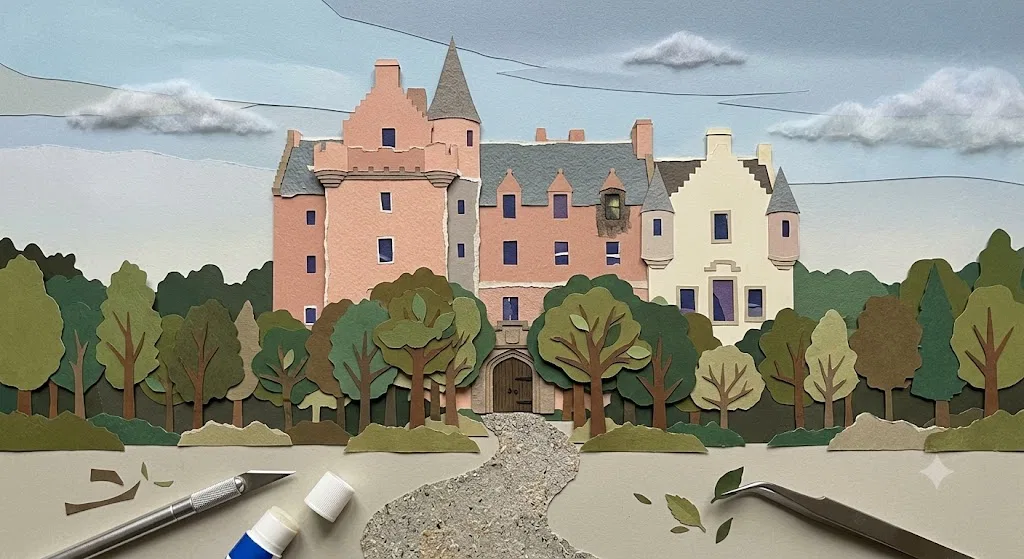
The castle is also a strong haunted-place candidate because it has remained visibly layered. Historic Environment Scotland describes Brodie Castle as a tower-house with Scottish Baronial alterations and additions, dating variously from 1567 to 1852, incorporating the original 16th-century Z-plan tower and later 19th-century work by William Burn and James Wylson.[portal.historicenvironment.scot]portal.historicenvironment.scotOpen source on historicenvironment.scot. Trove’s historic-place record adds that the mansion was originally on the Z-plan, was burned by Lord Lewis Gordon in 1645, restored afterwards, and has belonged to the Brodie family since at least the 14th century.[Trove Scot]trove.scotScot Brodie Castle | Place | trove.scotScot Brodie Castle | Place | trove.scot
That long domestic continuity is crucial. The ghosts are not presented as random medieval spectres drifting through a ruin. They belong to a lived-in country house: sitting rooms, bedrooms, nurseries, portraits, collections, guided tours and family objects. The National Trust’s education material makes the same point in non-paranormal terms, noting that generations of the Brodie family altered, redecorated and furnished the castle in ways that reflected their times.[National Trust for Scotland]nts.org.ukOpen source on nts.org.uk. The haunting tradition grows out of that same sense of accumulated presence.
Lady Margaret and the Burned Bedroom
The heart of Brodie Castle’s ghost tradition is Lady Margaret Duff Brodie, wife of James Brodie, the 21st Brodie of Brodie. The National Trust records that Lady Margaret is said to visit the Best Bedchamber, where she died in a fire in 1786.[National Trust for Scotland]nts.org.ukOpen source on nts.org.uk. A more object-focused Trust account identifies the room directly above her portrait as the Green Bedroom, also known as the Best Bedchamber, and states that Margaret was accidentally burned to death there in 1786.[National Trust for Scotland]nts.org.ukOpen source on nts.org.uk.
The story has the structure of a classic house haunting: a sudden death, a named aristocratic woman, a specific bedroom and a later tradition of return. Yet what makes the Brodie version especially memorable is the portrait. The painting of Lady Margaret hangs in the Dining Room and shows her pointing upwards. According to the National Trust, the room above the portrait is the bedroom where she died, and the pointing hand is thought to have been added after the event.[National Trust for Scotland]nts.org.ukOpen source on nts.org.uk.
That detail turns a family likeness into a piece of visual folklore. Even for a sceptical visitor, the portrait helps explain how the story persisted. It gives the tale a physical prompt: look at the hand, look above, remember the room, remember the death. The alleged haunting is therefore not just an apparition story but a domestic act of memory. It links grief, portraiture and architecture in a way that makes the past feel almost staged inside the house.
The evidence still needs careful handling. The sources support the historical tradition that Lady Margaret died in the room after a fire and that later interpretation connects her portrait with that death. They do not demonstrate that her ghost appears. The strongest claim is more modest, but still interesting: Brodie Castle preserves a room-specific ghost story in which family tragedy has been organised around a surviving artwork and a known domestic space.
The Soldier, the Dog and Room-Specific Sightings
Lady Margaret dominates the castle’s haunted reputation, but she is not the only reported presence. The National Trust’s ghost-story survey says that a phantom uniformed soldier has been seen sitting in contemplation in the Blue Sitting Room, while the spectre of a small dog has been spotted heading towards the children’s nursery.[National Trust for Scotland]nts.org.ukOpen source on nts.org.uk. These are brief accounts, not extended witness statements, but their room-specific quality makes them important to Brodie’s folklore.
The soldier is striking because the source gives no named identity, battle or date. That makes him weaker as a historical claim than Lady Margaret, but effective as atmosphere. A uniformed figure in a formal sitting room suggests a visitor from the military or clan past, yet the tradition does not firmly attach him to the 1645 burning, the Covenanting period, Jacobite tension or later family service. Without that link, he remains a reported apparition rather than a historically anchored ghost.
The small dog is even more domestic. Its route towards the children’s nursery shifts the mood from martial memory to household intimacy. Brodie Castle’s school information notes that the castle contains fully equipped Victorian nursery rooms, alongside its books, ceramics, paintings, kitchen and dairy.[National Trust for Scotland]nts.org.ukOpen source on nts.org.uk. The dog story therefore works because the setting already invites visitors to imagine family life, children, servants, pets and routines rather than only lairds and battles.
Taken together, the soldier and the dog broaden the haunting from one tragic death into a whole-house tradition. They also show a useful distinction in credibility. Lady Margaret’s story has a named person, a dated death, a room and an associated portrait. The soldier and dog have rooms and repeated motifs, but less verifiable context. They are valuable as folklore, but thinner as evidence.
Why Institutional Records Matter
Brodie Castle stands out in Morayshire because the main ghost traditions are preserved by the National Trust for Scotland rather than surviving only in anonymous listicles or recycled paranormal snippets. The Trust does not present the apparitions as proven fact; it frames them as ghost stories attached to one of its historic properties. That matters because institutional preservation gives readers a clearer route back to place, room and object.[National Trust for Scotland]nts.org.ukOpen source on nts.org.uk.
The castle’s protected status adds another layer. Historic Environment Scotland’s designation record treats Brodie as a substantial mansion with fabric from the 16th to 19th centuries, while Trove records older antiquarian and survey evidence for the castle’s development, the 1645 burning and later restoration.[portal.historicenvironment.scot]portal.historicenvironment.scotOpen source on historicenvironment.scot. These records are not ghost evidence, but they help test the setting. They confirm that the haunted rooms belong to a genuinely complex historic house, not a recently invented “haunted castle” brand.
National Trust interpretation also explains why the ghosts continue to circulate. Brodie is open as a visitor property, with tours, collections, a library of over 6,000 volumes, artwork and grounds that are marketed through family history as well as architecture.[National Trust for Scotland]nts.org.ukNational Trust for Scotland Brodie Castle & Estate | National Trust for ScotlandNational Trust for Scotland Brodie Castle & Estate | National Trust for Scotland A haunted story in such a setting becomes part of how visitors remember the building: not necessarily the whole meaning of the castle, but one vivid thread in a much larger fabric.
This is why Brodie’s ghost traditions feel more durable than many local haunting claims. The apparitions are not merely “seen at a castle”; they are tied to interpretive rooms, family biography, an artwork, and a heritage body that maintains the building. For Morayshire’s haunted-history map, that makes Brodie Castle the clearest example of a ghost story preserved through public heritage rather than only through oral rumour.
Family Memory, Ownership and the Afterlife of a House
The phrase “family memory” is not just a poetic way to describe Brodie’s ghosts. The castle’s modern history shows how intensely the house remained bound up with inheritance, identity and loss. The National Trust says the Brodie family seat has been on the site since the 12th century and that the castle was the clan’s ancestral home for more than 400 years.[National Trust for Scotland]nts.org.ukNational Trust for Scotland Brodie Castle & Estate | National Trust for ScotlandNational Trust for Scotland Brodie Castle & Estate | National Trust for Scotland Its education material goes further, describing how generations marked the house through alterations, redecorations, furniture, ornaments and collections.[National Trust for Scotland]nts.org.ukOpen source on nts.org.uk.
That sense of family possession did not simply vanish when the building became a visitor attraction. In 2002, The Guardian reported on a legal effort by grandchildren of Ninian Brodie, the 25th Brodie of Brodie, to challenge the 1978 sale of Brodie Castle, which later passed to the National Trust for Scotland. The report described the castle as a Morayshire family seat near Forres and noted that Ninian Brodie had said the sale was a difficult decision made to preserve the castle and its contents.[The Guardian]theguardian.comOpen source on theguardian.com.
This modern dispute should not be confused with the ghost stories themselves. It does, however, sharpen the way those stories can be read. Brodie Castle is a house where memory has been contested: preserved for the public, mourned as a lost inheritance by some descendants, and interpreted through rooms that still carry the emotional weight of family life. In that context, Lady Margaret’s portrait pointing towards the burned bedroom becomes more than a spooky anecdote. It is one example of how the house turns private trauma into shared memory.
The ghosts, then, are best understood as part of the castle’s afterlife as a family home. A soldier in a sitting room, a dog near a nursery and Lady Margaret in the Best Bedchamber all suggest that the castle is remembered not only as stonework and status, but as inhabited space. The stories make the rooms feel occupied by fragments of old domestic time.
How Credible Are Brodie Castle’s Ghost Stories?
The most balanced answer is that Brodie Castle has strong evidence for a preserved haunting tradition, but not for the supernatural events themselves. The difference matters. The National Trust records the stories; Historic Environment Scotland and Trove confirm the historic depth and architectural complexity of the setting; the Trust’s artefact account links Lady Margaret’s portrait to the room where she died.[nts.org.uk]nts.org.ukOpen source on nts.org.uk. Those are good sources for what is said, where it is located, and why the tradition is plausible as memory.
They are not the same as sworn witness testimony, dated investigation files or contemporary 18th-century reports of an apparition. The Lady Margaret tradition is the strongest because it rests on a named person, a dated fatal accident and a material object still interpreted in the castle. The soldier and dog are weaker because they are reported as sightings without much surrounding evidence. They remain part of the castle’s folklore rather than historical claims that can be independently tested.
Sceptical explanations are straightforward. Visitors move through an old, carefully interpreted house where rooms, portraits and family tragedies are already emotionally charged. Low light, expectation, guide storytelling, memory error and the suggestive power of old domestic spaces can all shape what people think they have seen or felt. That does not make the stories worthless. It places them where they belong: in the borderland between heritage interpretation, family grief, local folklore and visitor imagination.
For Morayshire’s haunted history, Brodie Castle is valuable precisely because it can be read on both levels. Believers can approach it as a haunted house with recurring apparitions. Sceptical readers can see how a family home becomes “haunted” when tragedy, portraiture, room names and institutional storytelling preserve the emotional shape of the past. The result is not a sensational ghost claim, but a particularly clear example of how a castle remembers.
Amazon book picks
Further Reading
Books and field guides related to Why Brodie Castle Became Morayshire's Best-Known Haunt. Use these as the next step if you want deeper reading beyond the article.

Haunted Castles of Britain and Ireland
Excellent fit for Brodie Castle ghost traditions.

eBay marketplace picks
Marketplace Samples
Live-tested eBay searches with available results related to this page.
Endnotes
1.
Source: portal.historicenvironment.scot
Link:https://portal.historicenvironment.scot/apex/f?p=1505%3A300%3A%3A%3A%3A%3AVIEWTYPE%2CVIEWREF%3Adesignation%2CLB2260
2.
Source: trove.scot
Title: Scot Brodie Castle | Place | trove.scot
Link:https://www.trove.scot/place/15514
3.
Source: historicenvironment.scot
Link:https://www.historicenvironment.scot/protect-and-care/protected-historic-places/listed-buildings/
4.
Source: historicenvironment.scot
Link:https://www.historicenvironment.scot/protect-and-care/protected-historic-places/
5.
Source: trove.scot
Link:https://www.trove.scot/place/350040
6.
Source: trove.scot
Link:https://www.trove.scot/designation/GDL00072
7.
Source: youtube.com
Title: Clan Brodie
Link:https://www.youtube.com/watch?v=eeF4BC3cLtQ
Source snippet
Brodie Castle...
8.
Source: nts.org.uk
Link:https://www.nts.org.uk/stories/scottish-ghost-stories-witches-murder-and-folklore-part-2
9.
Source: nts.org.uk
Link:https://www.nts.org.uk/stories/revealing-our-eerie-artefacts
10.
Source: wikishire.co.uk
Title: Brodie Castle
Link:https://wikishire.co.uk/wiki/Brodie_Castle
11.
Source: nts.org.uk
Title: National Trust for Scotland Brodie Castle & Estate | National Trust for Scotland
Link:https://www.nts.org.uk/visit/places/brodie-castle
12.
Source: nts.org.uk
Link:https://www.nts.org.uk/schools/places-for-school-visits/brodie-castle-teacher-information
13.
Source: theguardian.com
Link:https://www.theguardian.com/uk/2002/may/10/artsnews.scotland
14.
Source: nts.org.uk
Link:https://www.nts.org.uk/schools/timesliders/resources
15.
Source: nts.org.uk
Link:https://www.nts.org.uk/stories/love-scotland-podcast-season-4
16.
Source: nts.org.uk
Link:https://www.nts.org.uk/visit/places/brodie-castle/planning-your-visit
17.
Source: nts.org.uk
Link:https://www.nts.org.uk/venue-hire/brodie-castle
18.
Source: Wikipedia
Title: Brodie Castle
Link:https://en.wikipedia.org/wiki/Brodie_Castle
19.
Source: theguardian.com
Link:https://www.theguardian.com/theguardian/1999/mar/17/features11.g26
20.
Source: britainsfinest.co.uk
Title: Brodie Castle
Link:https://www.britainsfinest.co.uk/historichouses/brodie-castle
21.
Source: thecastlesofscotland.co.uk
Title: brodie castle
Link:https://www.thecastlesofscotland.co.uk/the-best-castles/grand-castles/brodie-castle/
22.
Source: wikishire.co.uk
Link:https://wikishire.co.uk/wiki/Forres
23.
Source: thedicamillo.com
Title: Brodie Castle
Link:https://www.thedicamillo.com/house/brodie-castle/
24.
Source: visitforres.scot
Title: brodie castle
Link:https://visitforres.scot/listing/brodie-castle/
25.
Source: es.findagrave.com
Title: margaret brodie
Link:https://es.findagrave.com/memorial/276206544/margaret-brodie
26.
Source: kids.kiddle.co
Title: Brodie Castle
Link:https://kids.kiddle.co/Brodie_Castle
27.
Source: en.wikivoyage.org
Link:https://en.wikivoyage.org/wiki/Forres
Additional References
28.
Source: expedia.co.uk
Link:https://www.expedia.co.uk/Brodie-Castle-Forres.d6088689.Attraction
29.
Source: scotland-inverness.co.uk
Link:https://www.scotland-inverness.co.uk/chatelaine/brodie.htm
30.
Source: scotclans.com
Link:https://www.scotclans.com/blogs/b2/clan-brodie-history?srsltid=AfmBOor69EYX4_NG1DF9NdWDqvJSKmOatGuvbAPRtHk-6c2PWHA7P54M
31.
Source: facebook.com
Link:https://www.facebook.com/groups/scotlandsscenery/posts/9766577856694833/
32.
Source: facebook.com
Link:https://www.facebook.com/groups/VisitScotland/posts/1746347222480830/
33.
Source: facebook.com
Link:https://www.facebook.com/margaret.mccarron.9/posts/i-remember-visiting-hollyrood-palace-and-how-magnificent-it-was-but-this-story-r/4197744100237163/
34.
Source: moray.gov.uk
Link:https://www.moray.gov.uk/moray_standard/page_82231.html
35.
Source: facebook.com
Link:https://www.facebook.com/groups/forresloveslocal/posts/1541537780050406/
36.
Source: experienced-tours.com
Link:https://www.experienced-tours.com/scotland/destinations/brodie-castle-private-tour/
37.
Source: facebook.com
Link:https://www.facebook.com/BrodieCastleNTS/posts/spooky-stories-staff-from-across-the-trust-tell-us-about-eerie-encounters-with-g/1970537689661241/
Topic Tree