Why Shetland's Hauntings Feel So Different
Shetland’s haunted history is less a chain of polished castle ghost tales than a northern island web of ruined houses, old burial ground, sea danger, witchcraft memory and trow folklore.
Page outline Jump by section
Introduction
Shetland is also a useful case for historic-county mapping. In the historic-counties frame used by Wikishire and related Wikimedia mapping, Shetland, also historically called Zetland, is the UK’s northernmost shire, a distinct island county rather than an outlying district of a mainland Scottish county. Modern local government is handled by Shetland Islands Council, while older county status was abolished for local-government purposes in Scotland in 1975; for a haunted-history project, however, the historic county remains a clean organising area because the folklore, parish stories and island identities cluster naturally across the archipelago.[wikishire.co.uk]wikishire.co.ukOpen source on wikishire.co.uk.
Why Shetland’s ghost stories feel different
Shetland’s supernatural tradition is shaped by geography before it is shaped by grand architecture. The islands sit far north of mainland Scotland, with long winter darkness, rough sea routes, dispersed settlements and a strong Norse inheritance in place-names and folklore. Wikishire notes that almost all Shetland place-names are Norse-derived, while Shetland tourism material and local writing repeatedly place trows, witches, sea beings and household protections at the centre of the islands’ supernatural imagination.[wikishire.co.uk]wikishire.co.ukOpen source on wikishire.co.uk.
That matters because a visitor expecting only “haunted castle” stories may miss the deeper pattern. In Shetland, the eerie often belongs to thresholds: the edge of the burn, the ruined house on the skyline, the old burial ground, the road home at night, the boat out at sea, the hill or mound where “peerie folk” were said to live. Shetland Museum and Archives’ folklore gallery explicitly groups customs and superstition around births, marriages, deaths, witchcraft, the supernatural and language, and even includes a reconstructed “trowie knowe”, a mound-like dwelling associated with Shetland’s little people.[Shetland Museum & Archives]shetlandmuseumandarchives.org.ukOpen source on shetlandmuseumandarchives.org.uk.
The result is a haunted landscape where ghosts and folklore overlap. Some tales describe apparitions of the dead, as at Windhouse. Others describe beings that are not dead humans at all: trows, njuggles, sea spirits, witches in folk belief and phantom boats. For a careful reader, the strongest approach is not to ask “which of these really happened?” but “what fear or memory did this story preserve?”[jstor.org]jstor.orgOpen source on jstor.org.
Windhouse on Yell: Shetland’s most famous haunted ruin
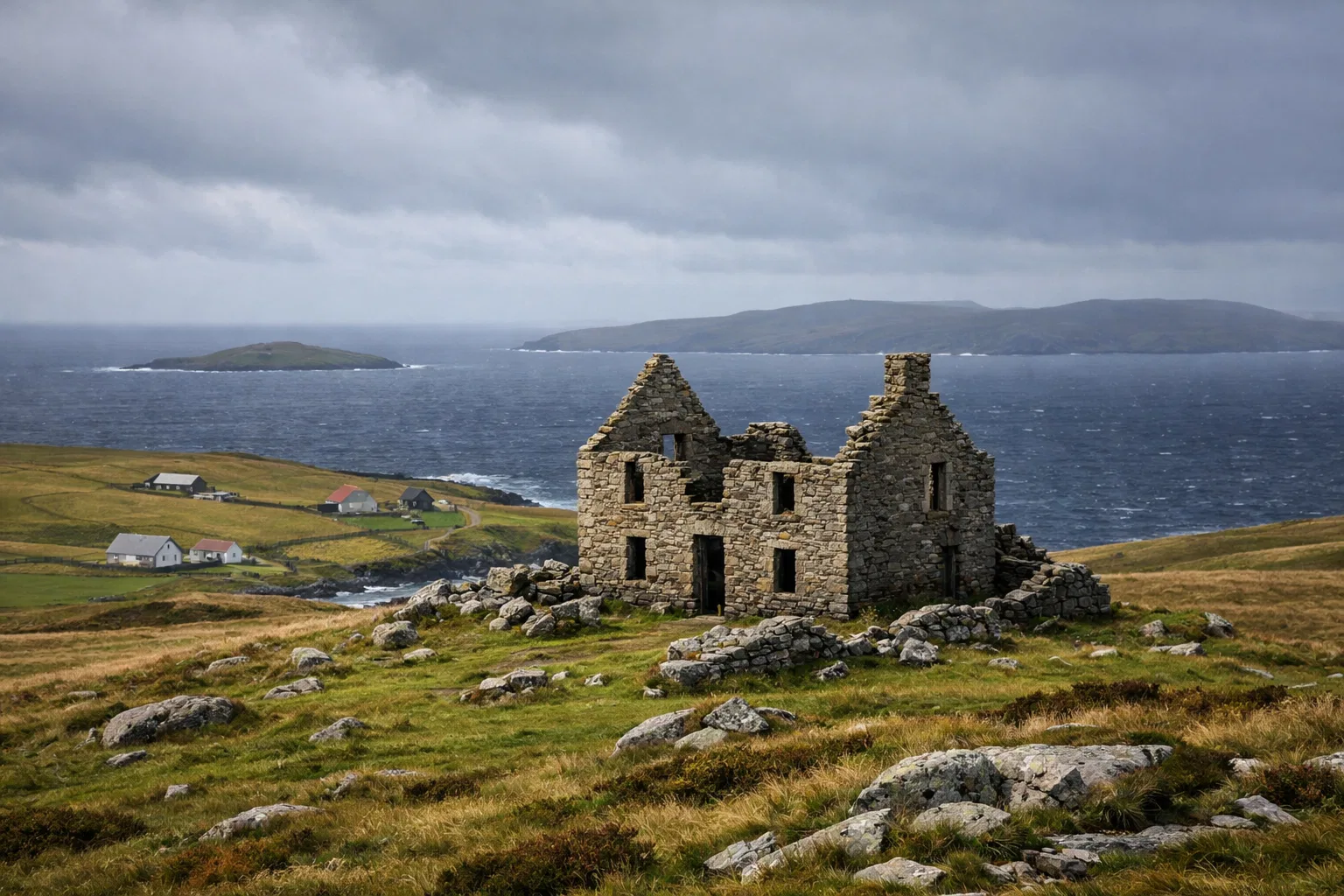
Windhouse, near Mid Yell, is the one Shetland haunting that repeatedly breaks out of local folklore into wider haunted-Scotland lists and travel writing. Historic Environment Scotland’s Trove record identifies Yell, Windhouse as a documented historic place with National Record of the Historic Environment references, associated listed buildings and nearby designations, including Windhouse itself, Windhouse farmhouse and steading, a nearby broch and a chapel and graveyard site. That official record is important: it anchors the story in a real, layered historic site rather than a free-floating ghost anecdote.[Trove Scot]trove.scotOpen source on trove.scot.
The commonly repeated ghost story is a cluster rather than a single neat legend. Shetland.org describes Windhouse as reportedly the most haunted house in Shetland, if not the country, and says the visible ruins at Mid Yell were built in 1707, allegedly on an ancient burial ground. The reported inhabitants include a Lady in Silk, a man in a top hat, a servant girl and a dog. NorthLink Ferries’ account gives the tall man more shape: a figure in a long black coat and top hat, seen outside before vanishing into the walls, sometimes linked in local lore to a missing tax collector.[Shetland.org]shetland.orgSpooky Tales from ShetlandSpooky Tales from Shetland
What makes Windhouse unusually compelling is that the ghost stories are attached to genuine archaeological and burial-ground disturbance. Shetland News reported in 2017 that two human skeletons, possibly dating to the 13th or 14th century, were found only inches below the ground at the site described as Shetland’s most haunted property. Trove’s Windhouse record also refers to standing-building recording and excavation work, while a built-environment case study describes the ruin as archaeologically “sandwiched” between a broch and a chapel site. These facts do not prove any apparition, but they explain why Windhouse has become a magnet for haunted interpretation: the ruin sits among older, partly visible layers of settlement and burial.[shetnews.co.uk]shetnews.co.ukShetland News Ancient graveyard at 'most haunted houseShetland News Ancient graveyard at 'most haunted house
There are also more folkloric details whose evidence is harder to weigh. One popular account says that, in the early 1900s, two men repairing a window removed a nailed-up shutter and found a child’s skeleton wrapped in sheepskin; another tradition links a six-foot skeleton found during 19th-century alterations to the tall male apparition. These are best read as local legend attached to building work, disturbance and memory, not as verified forensic history. They are precisely the sort of details that make haunted-house stories endure: they connect the invisible ghost to a physical discovery, even when the documentary trail remains thin.[Shetland.org]shetland.orgSpooky Tales from ShetlandSpooky Tales from Shetland

Trows, hill-folk and the haunted landscape beyond human ghosts
A Shetland haunting page cannot be limited to dead-person apparitions. The islands’ most distinctive supernatural beings are trows: nocturnal hill-folk often described as small, troublesome figures who live in mounds, hills or hidden places. Shetland.org summarises the core tradition: trows were thought to come out at night to make mischief, and if caught by the rising sun they could turn to stone; many standing stones were explained in folklore as petrified trows.[Shetland.org]shetland.orgOpen source on shetland.org.
This matters for haunted history because trow stories often perform the same function as ghost stories elsewhere. They make dangerous or lonely places feel inhabited. They explain strange sounds, missing time, uncanny music, unlucky journeys and the anxiety of being outside after dark. NorthLink’s retelling of “Robbie Anderson and the Trows” places the story in Cullivoe on Yell and begins with a fiddle player returning on Old Christmas Eve, a classic threshold moment: night, winter, music, poverty and the path home.[NorthLink Ferries]northlinkferries.co.ukOpen source on northlinkferries.co.uk.
Windhouse itself connects to this older layer through “The Trow of Windhouse” or “Trow of Yell”, described by one folklore essay as among the best-known Shetland folktales. Unlike the “peerie folk” of many trow stories, this creature is presented as grotesque and monstrous. The point is not that Windhouse has one stable, modern ghost file; rather, the site has drawn several different kinds of supernatural story towards it — human apparitions, disturbed burials and older trow lore.[ghostweather.com]ghostweather.comThe Haunting of Windhouse on YellThe Haunting of Windhouse on Yell
John Spence’s 1899 Shetland Folk-Lore, available through Wikisource and archive copies, is especially valuable because it shows that these beliefs were being collected as local tradition more than a century ago. Its folklore section records protective beliefs involving steel instruments and silver coins against witches and trows, giving modern readers a glimpse of a world in which supernatural threat was answered not by ghost-hunting equipment but by household charms, metal objects and inherited practice.[Wikisource]en.wikisource.orgShetland Folk-LoreShetland Folk-Lore
Witches, fear and remembered injustice
Shetland’s witchcraft history is not a ghost story in the simple sense, but it is central to the county’s darker folklore. Shetland Museum and Archives explains that between about 1615 and 1680, ordinary Shetlanders and their superiors began to worry about witches, placing the islands within the wider Scottish and European witch-hunt period. A later museum event listing frames the question historically: witch-hunts came in waves, rose and fell, and ended in the late 17th and early 18th century rather than continuing as a constant process.[Shetland Museum & Archives]shetlandmuseumandarchives.org.ukshetland witchesshetland witches
This history is often remembered through named victims and modern memorial culture. Shetland.org’s account of Marion Pardone says the number of people executed for witchcraft in Shetland is thought to be eight, including one man, while Hidden Scotland notes that the Database of Scottish Witches lists 28 people tried in Shetland, though the outcomes are not always certain and the database must be handled carefully for local detail. That distinction is crucial: “accused”, “tried” and “executed” are not interchangeable.[Shetland.org]shetland.orgda fateful tale o marion pardone witchcraft in shetlandda fateful tale o marion pardone witchcraft in shetland
For haunted-place readers, the witchcraft material helps explain why Shetland’s supernatural stories can feel morally charged. These are not just tales of spooky cottages. They are also memories of suspicion, illness, social conflict and punishment in small communities. Archaeology Shetland’s discussion of Shetland witches points readers back to older writers such as Edmondston, Saxby and G. F. Black, showing how later folklore writing blended archival fragments, oral tradition and interpretation.[archaeologyshetland]archaeologyshetland.orgSite in FocusSite in Focus
The careful way to tell these stories is to avoid turning victims of witch trials into Halloween props. Their relevance to haunted Shetland lies in how accusation and fear entered local memory. Witchcraft belief shaped explanations for misfortune, sickness, bad weather, failed fishing and uncanny encounters; modern historians and museums now reframe those accusations as human tragedies rather than evidence of supernatural guilt.[Shetland Museum & Archives]shetlandmuseumandarchives.org.ukshetland witchesshetland witches

Castles, power and why Shetland has fewer castle ghosts
Shetland has castles, but its haunted reputation does not rest on them as heavily as many mainland counties do. Historic Environment Scotland describes Scalloway Castle as the home of Patrick Stewart, Earl of Orkney and Shetland, known in Shetland as “Black Patie”, notorious for oppression, accused of using forced labour in the castle’s construction in 1599, and executed in Edinburgh in 1615. The castle served as residence and courthouse beside Shetland’s head court meeting place, making it a symbol of authority rather than merely a romantic ruin.[Historic Environment Scotland]historicenvironment.scotOpen source on historicenvironment.scot.
That oppressive history is the real darkness of Scalloway Castle. Some local storytelling preserves grim details, such as the saying that mortar was mixed with blood and eggs, but the better-supported public history concerns Stewart power, forced labour allegations, legal authority and eventual downfall. For a haunted-history project, Scalloway works best as a place where the atmosphere comes from documented coercion and political memory, not from a well-attested recurring apparition.[Scalloway]scalloway.netOpen source on scalloway.net.
Muness Castle on Unst has a similar pattern. Historic Environment Scotland says it was begun in 1598 for Laurence Bruce of Cultmalindie, a figure accused and investigated for oppressing Shetlanders, although some legends portray him more heroically. It was later burnt by foreign privateers in 1627 and was probably never fully repaired. Again, the most reliable eerie quality is not a famous named ghost but the ruin’s connection to violent politics, fear of attack, family rivalry and abandonment.[Historic Environment Scotland]historicenvironment.scotOpen source on historicenvironment.scot.
This relative lack of castle-ghost emphasis is part of Shetland’s character. The islands have fewer medieval and early modern castles than many Scottish mainland counties; their stronger haunted texture lies in ruined lairds’ houses, coastal danger, old mounds, burial sites, folklore beings and stories carried by families and communities rather than by ticketed ghost-tour tradition.[Wikipedia]WikipediaList of castles in ShetlandList of castles in Shetland
Sea phantoms, njuggles and the fear of water
Shetland’s haunted geography is inseparable from water. J. A. Teit’s 1918 article on water-beings in Shetlandic folklore lists sea-serpents, floating monsters, sea-phantoms, phantom boats and ships, sea-spirits and sea-witches among the traditions remembered by Shetlanders. Even as a scholarly collection, the list reads like a map of maritime anxiety: the sea gives food and travel, but it also takes people without witnesses.[JSTOR]jstor.orgOpen source on jstor.org.
Njuggles belong to this watery supernatural world. Modern Shetland folklore explainers describe the njuggle as a horse-like being, often compared with the Scottish kelpie, associated with burns, lochs, damp ground and drowning danger. Such stories are not “ghosts” in the narrow human-apparition sense, yet they are essential to the county’s haunted history because they attach fear to real hazards: watercourses, marshy ground, poor visibility and children or travellers moving through risky places.[Shetland With Laurie]shetlandwithlaurie.comBlog Post Title One 9pngd yj4jy 3e8wx rjsnt 6l7exBlog Post Title One 9pngd yj4jy 3e8wx rjsnt 6l7ex
The same applies to sea monsters and phantom craft. In fishing communities, a phantom boat is not just a decorative legend; it can carry the emotional weight of wreck, disappearance and warning. Shetland’s supernatural sea lore therefore belongs beside its haunted houses. Both are ways of making danger narratable — one through a figure at a window or staircase, the other through something glimpsed on water where ordinary certainty fails.[JSTOR]jstor.orgOpen source on jstor.org.
How credible are Shetland’s hauntings?
The short answer is that Shetland’s hauntings are culturally strong but evidentially mixed. Windhouse is the best example. The ruin, its historic record, nearby broch and chapel associations, and reported burial discoveries are real matters of heritage and archaeology. The apparitions — Lady in Silk, tall man, servant girl, dog — are reported traditions, repeated in local-interest and travel sources, but they do not amount to verifiable proof of ghosts.[trove.scot]trove.scotOpen source on trove.scot.
Folklore sources need the same care. Spence’s 1899 collection, Teit’s 1918 article and museum interpretation are valuable because they preserve belief and narrative, not because every supernatural claim inside them should be read literally. A trow story may tell us far more about night travel, old social customs, music, fear of outsiders or Norse-influenced imagination than about a physical creature.[wikisource.org]en.wikisource.orgShetland Folk-LoreShetland Folk-Lore
Tourism and local-history writing also have different purposes. A Halloween article, ferry-company blog or visitor guide can be accurate and useful, but it naturally favours memorable storytelling. Official heritage records, museum pages, archival catalogues and archaeological reports are better for confirming places, dates and excavations; local blogs and oral-tradition pieces are often better for understanding how the stories are actually told. The most trustworthy reading uses both, while keeping the categories separate.[trove.scot]trove.scotOpen source on trove.scot.
Where the haunted traveller should start
For a reader exploring Shetland’s eerie history, Windhouse is the obvious starting point, but it should be approached as a ruin and archaeological landscape as much as a haunted house. Its reputation comes from the combination of visibility, abandonment, burial discoveries, older sites nearby and a thick cluster of apparition stories. That blend gives it more depth than a simple “most haunted” label.[shetland.org]shetland.orgSpooky Tales from ShetlandSpooky Tales from Shetland
Lerwick offers a different kind of haunting: urban fragments, tragic incidents and local tales rather than a single dominant ghost site. Shetland with Laurie’s account of Lerwick ghost stories notes that, although many people have ghostly tales, relatively few recorded ghost stories come from the town, which is itself a useful warning against over-inflating thin evidence.[Shetland With Laurie]shetlandwithlaurie.comspine tingling tales from lerwickspine tingling tales from lerwick
Scalloway and Muness are best read through power and ruin. Their atmosphere comes from the Stewart and Bruce period, allegations of oppression, forced labour, courthouse authority, attack and abandonment. They may not provide the neatest ghost stories, but they help explain the historical darkness behind Shetland’s built heritage.[Historic Environment Scotland]historicenvironment.scotOpen source on historicenvironment.scot.
The final layer is the open landscape: trow hills, burns, lochs, standing stones, sea roads and old paths. In Shetland, the haunted past is not confined to buildings. It lives in the way older communities spoke about night, weather, water, illness, music and the uneasy feeling that a place may be occupied by more than the living.
Amazon book picks
Further Reading
Books and field guides related to Why Shetland's Hauntings Feel So Different. Use these as the next step if you want deeper reading beyond the article.

Scottish fairy belief
Explains traditional supernatural beliefs relevant to trows and island folklore.
eBay marketplace picks
Marketplace Samples
Live-tested eBay searches with available results related to this page.

Endnotes
1.
Source: shetland.org
Title: Spooky Tales from Shetland
Link:https://www.shetland.org/blog/spooky-tales-from-shetland
2.
Source: en.wikisource.org
Title: Shetland Folk-Lore
Link:https://en.wikisource.org/wiki/Shetland_Folk-Lore
3.
Source: jstor.org
Link:https://www.jstor.org/stable/pdf/534874.pdf
4.
Source: shetland.org
Link:https://www.shetland.org/blog/shetland-folklore
5.
Source: en.wikisource.org
Title: Folk Lore
Link:https://en.wikisource.org/wiki/Shetland_Folk-Lore/Folk-Lore
6.
Source: trove.scot
Link:https://www.trove.scot/place/178922
7.
Source: befs.org.uk
Link:https://www.befs.org.uk/resources/historic-environment-case-studies/care-protect/windhouse/
8.
Source: ghostweather.com
Title: The Haunting of Windhouse on Yell
Link:https://ghostweather.com/essays/windhouse.html
9.
Source: shetland.org
Title: da fateful tale o marion pardone witchcraft in shetland
Link:https://www.shetland.org/blog/da-fateful-tale-o-marion-pardone-witchcraft-in-shetland
10.
Source: archaeologyshetland.org
Title: Site in Focus
Link:https://www.archaeologyshetland.org/post/2019/11/05/site-in-focus-shetland-witches
11.
Source: archaeologyshetland.org
Link:https://www.archaeologyshetland.org/resources
12.
Source: scalloway.net
Link:https://scalloway.net/history/scalloway-castle/
13.
Source: Wikipedia
Title: Muness Castle
Link:https://en.wikipedia.org/wiki/Muness_Castle
14.
Source: Wikipedia
Title: List of castles in Shetland
Link:https://en.wikipedia.org/wiki/List_of_castles_in_Shetland
15.
Source: Wikipedia
Title: Trow (folklore)
Link:https://en.wikipedia.org/wiki/Trow_%28folklore%29
16.
Source: Wikipedia
Title: Scalloway Castle
Link:https://en.wikipedia.org/wiki/Scalloway_Castle
17.
Source: Wikipedia
Title: Counties of Scotland
Link:https://en.wikipedia.org/wiki/Counties_of_Scotland
18.
Source: Wikipedia
Title: File:Shetland British Isles.svg
Link:https://en.wikipedia.org/wiki/File%3AShetland_-_British_Isles.svg
19.
Source: archive.org
Link:https://archive.org/details/scottishfolktale0000wils
20.
Source: archive.org
Link:https://archive.org/details/folklorelegends03cjt/folklorelegends03cjt
21.
Source: archive.org
Link:https://archive.org/details/scottishfolktale0000kerw
22.
Source: archive.org
Link:https://archive.org/details/folktalesfairylo00macduoft
23.
Source: archive.org
Link:https://archive.org/details/shetlandfolklor00spengoog
24.
Source: archive.org
Title: britishgoblinswelsh 1607 librivox
Link:https://archive.org/details/britishgoblinswelsh_1607_librivox
25.
Source: commons.wikimedia.org
Title: Category:Maps of traditional counties of Scotland
Link:https://commons.wikimedia.org/wiki/Category%3AMaps_of_traditional_counties_of_Scotland
26.
Source: commons.wikimedia.org
Title: File:Shetland British Isles.svg
Link:https://commons.wikimedia.org/wiki/File%3AShetland_-_British_Isles.svg
27.
Source: commons.wikimedia.org
Title: File:Shetland Folk Lore Spence 1899
Link:https://commons.wikimedia.org/wiki/File%3AShetland_Folk-Lore_-Spence-_1899.pdf
28.
Source: en.wikisource.org
Title: Index:Shetland Folk Lore Spence 1899
Link:https://en.wikisource.org/wiki/Index%3AShetland_Folk-Lore_-Spence-_1899.pdf
29.
Source: shetland.org
Title: career moves the folklore inspired heritage apprentic
Link:https://www.shetland.org/blog/career-moves-the-folklore-inspired-heritage-apprentic
30.
Source: northlinkferries.co.uk
Link:https://www.northlinkferries.co.uk/shetland-blog/the-haunting-history-of-windhouse/
31.
Source: wikishire.co.uk
Link:https://wikishire.co.uk/wiki/Shetland
32.
Source: scotlandspeople.gov.uk
Title: shetland county
Link:https://www.scotlandspeople.gov.uk/content/shetland-county
33.
Source: shetlandmuseumandarchives.org.uk
Link:https://www.shetlandmuseumandarchives.org.uk/visit/galleries/customs-and-folklore
34.
Source: shetlandwithlaurie.com
Title: Blog Post Title One 9pngd yj4jy 3e8wx rjsnt 6l7ex
Link:https://shetlandwithlaurie.com/shetland-guidebook-bonus-essays/Blog%20Post%20Title%20One-9pngd-yj4jy-3e8wx-rjsnt-6l7ex
35.
Source: shetnews.co.uk
Title: Shetland News Ancient graveyard at ‘most haunted house’
Link:https://www.shetnews.co.uk/2017/09/21/ancient-graveyard-found-at-isles-most-haunted-house/
36.
Source: northlinkferries.co.uk
Link:https://www.northlinkferries.co.uk/shetland-blog/a-shetland-folk-tale-robbie-anderson-and-the-trows/
37.
Source: shetlandmuseumandarchives.org.uk
Title: shetland witches
Link:https://www.shetlandmuseumandarchives.org.uk/blog/shetland-witches
38.
Source: shetlandmuseumandarchives.org.uk
Title: 2024 05 23t21 08 32 01 00
Link:https://www.shetlandmuseumandarchives.org.uk/events/smaa-archive/2024-05-23t21
39.
Source: historicenvironment.scot
Link:https://www.historicenvironment.scot/visit/all/scalloway-castle/
40.
Source: historicenvironment.scot
Title: history and stories
Link:https://www.historicenvironment.scot/visit/all/scalloway-castle/history-and-stories/
41.
Source: historicenvironment.scot
Link:https://www.historicenvironment.scot/visit/all/muness-castle/history-and-stories/
42.
Source: shetlandwithlaurie.com
Title: shetland folklore series creatures from the sea selkies mermaids beasts serpents
Link:https://shetlandwithlaurie.com/the-blog/shetland-folklore-series-creatures-from-the-sea-selkies-mermaids-beasts-serpents
43.
Source: shetlandwithlaurie.com
Title: spine tingling tales from lerwick
Link:https://shetlandwithlaurie.com/the-blog/spine-tingling-tales-from-lerwick
44.
Source: historicenvironment.scot
Title: retiral of hes web services
Link:https://www.historicenvironment.scot/about-us/news/retiral-of-hes-web-services/
45.
Source: catalog.hathitrust.org
Link:https://catalog.hathitrust.org/Record/102675474
46.
Source: shetlandwithlaurie.com
Title: shetlands haunted places
Link:https://shetlandwithlaurie.com/the-blog/shetlands-haunted-places
47.
Source: shetlandwithlaurie.com
Title: shetland folklore series trows
Link:https://shetlandwithlaurie.com/the-blog/shetland-folklore-series-trows
48.
Source: shetlandwithlaurie.com
Title: witchcraft in 17th century shetland
Link:https://shetlandwithlaurie.com/podcast/witchcraft-in-17th-century-shetland
49.
Source: shetlandwithlaurie.com
Title: the stewart earls and a brief history of scalloway castle
Link:https://shetlandwithlaurie.com/the-blog/the-stewart-earls-and-a-brief-history-of-scalloway-castle
50.
Source: facebook.com
Link:https://www.facebook.com/DEADLIVEUK/posts/scalloway-castle-shetland-witch-trial-history-dark-hauntings/1367165675450176/
51.
Source: facebook.com
Link:https://www.facebook.com/RealCounties/photos/the-county-of-shetland-or-zetland-is-the-uks-northernmost-shireit-consists-of-a-/829456382671264/
52.
Source: bol.com
Title: shetland folklore
Link:https://www.bol.com/nl/nl/f/shetland-folklore/9200000016730446/
53.
Source: thecastlesofscotland.co.uk
Link:https://www.thecastlesofscotland.co.uk/the-best-castles/magnificent-ruins/scalloway-castle/
54.
Source: gov.scot
Title: Shetland Islands
Link:https://www.gov.scot/binaries/content/documents/govscot/publications/map/2020/11/local-authority-maps-of-scotland/documents/shetland-islands-council-area-map/shetland-islands-council-area-map/govscot%3Adocument/Shetland_Islands.pdf
55.
Source: shetlink.com
Link:https://www.shetlink.com/index.php?%2Fforums%2Ftopic%2F368-windhouse-yell%2F=
56.
Source: wikishire.co.uk
Title: Great Britain and Ireland
Link:https://wikishire.co.uk/map/
57.
Source: wikishire.co.uk
Link:https://www.wikishire.co.uk/
Additional References
58.
Source: youtube.com
Title: Spooky Shetland Part 5
Link:https://www.youtube.com/watch?v=_ioFDSzF_RM
Source snippet
Stories From Shetland Folklore - Incredible Tales From The Northern Isles...
59.
Source: visitscotland.com
Link:https://www.visitscotland.com/nl-nl/things-to-do/attractions/castles/haunted
60.
Source: archaeologyscotland.org.uk
Link:https://www.archaeologyscotland.org.uk/learn/https-archaeologyscotland-org-uk-heritage-resources-portal-canmore/
61.
Source: hebrideanconnections.com
Link:https://hebrideanconnections.com/record/resources/119157/
62.
Source: catalog.hathitrust.org
Link:https://catalog.hathitrust.org/Record/001276516
63.
Source: hiddenscotland.com
Link:https://hiddenscotland.com/articles/shetlands-forgotten-women
64.
Source: facebook.com
Link:https://www.facebook.com/RealCounties/posts/looking-for-a-detailed-map-of-the-historiccounties-of-england-ireland-scotland-a/711005821182988/
65.
Source: facebook.com
Link:https://www.facebook.com/groups/lovetovisitscotland/posts/9990022091123968/
66.
Source: gazetteer.org.uk
Link:https://gazetteer.org.uk/place/North_Hill%2C_Shetland_234309
67.
Source: app-hes-pubs-prod-neu-01.azurewebsites.net
Link:https://app-hes-pubs-prod-neu-01.azurewebsites.net/api/file/f7f2e1d4-70f3-4000-ba79-aafc0125a39e
Topic Tree
Follow this branch
Related pages 91
- Haunted Clackmannanshire
- Haunted Antrim
- Haunted Armagh
- Haunted Durham
- Haunted Londonderry
- +86 more in sidebar