Within Haunted Glamorgan
Why Do Glamorgan's Roads Feel So Haunted?
The lanes around St Athan, Wick and Cowbridge preserve older roadside ghost traditions about omens, white figures and funeral visions.
On this page
- White figures and death omens on country lanes
- Phantom funerals and older Welsh belief
- Danger, darkness and memory in the Vale roads
Page outline Jump by section
Introduction
Glamorgan’s roadside ghost stories are at their strongest in the Vale: around St Athan, Wick, Cowbridge and the older church roads that once carried people, horses, carts and coffins between scattered villages. These are not mainly tales of one haunted house. They are stories of roads behaving like thresholds: a white figure crossing a field, funeral music heard before a death, a procession appearing on a lane, or a traveller meeting something frightening on the way between Bridgend and Cowbridge.
The best-known written source for this cluster is Marie Trevelyan’s 1909 collection Folk-lore and Folk-stories of Wales, which preserves several Glamorgan examples of phantom funerals, corpse-candles and night-road apparitions. Trevelyan’s work is invaluable but not straightforward proof: she was a folklore collector and popular writer, often recording oral testimony at second hand. Read carefully, the stories reveal less about verified supernatural events than about how Vale communities attached fear, warning and memory to the roads between chapel, church, farm and village.[archive.org]archive.orgOpen source on archive.org.
Where the road ghosts belong in Glamorgan
The centre of this tradition is historic Glamorgan, especially the rural Vale rather than the later urban county-borough sense of the name. Glamorgan is one of Wales’s thirteen historic counties, and modern boundary language can be confusing because older sources speak of Glamorgan or Glamorganshire while the same places now fall within areas such as the Vale of Glamorgan, Bridgend or Cardiff. The Royal Commission’s historic county boundary data explains that Wales’s historic counties sit within a much older landscape of lordships, commotes and cantrefs, while Wikimedia’s Glamorgan map marks the historic county as one of the thirteen Welsh counties.[Data Map Wales]datamap.gov.walesmetadata detailmetadata detail
For roadside apparitions, the important local geography is more intimate. St Athan lies among medieval churches, old manorial sites, farm lanes and chapel routes; Wick sits on the road-world between Bridgend, Cowbridge and the coast; and Cowbridge marks one of the Vale’s older market and route centres. The Vale itself is described by Wikishire as an undulating limestone plateau of farmland and villages stretching from Porthcawl towards Cardiff, which is exactly the kind of landscape in which stories of dark lanes, funeral paths and sudden apparitions could attach themselves to everyday journeys.[Wikishire]wikishire.co.ukOpen source on wikishire.co.uk.
That matters because these legends are not random “spooky road” anecdotes. They are tied to a former travel culture in which walking home after dusk, crossing fields before dawn, or meeting another funeral on a narrow lane were ordinary possibilities. The haunting is often the road’s social function made uncanny: the way to church, the way to chapel, the way to market, the way home, and finally the way to burial.
White figures and death omens on country lanes
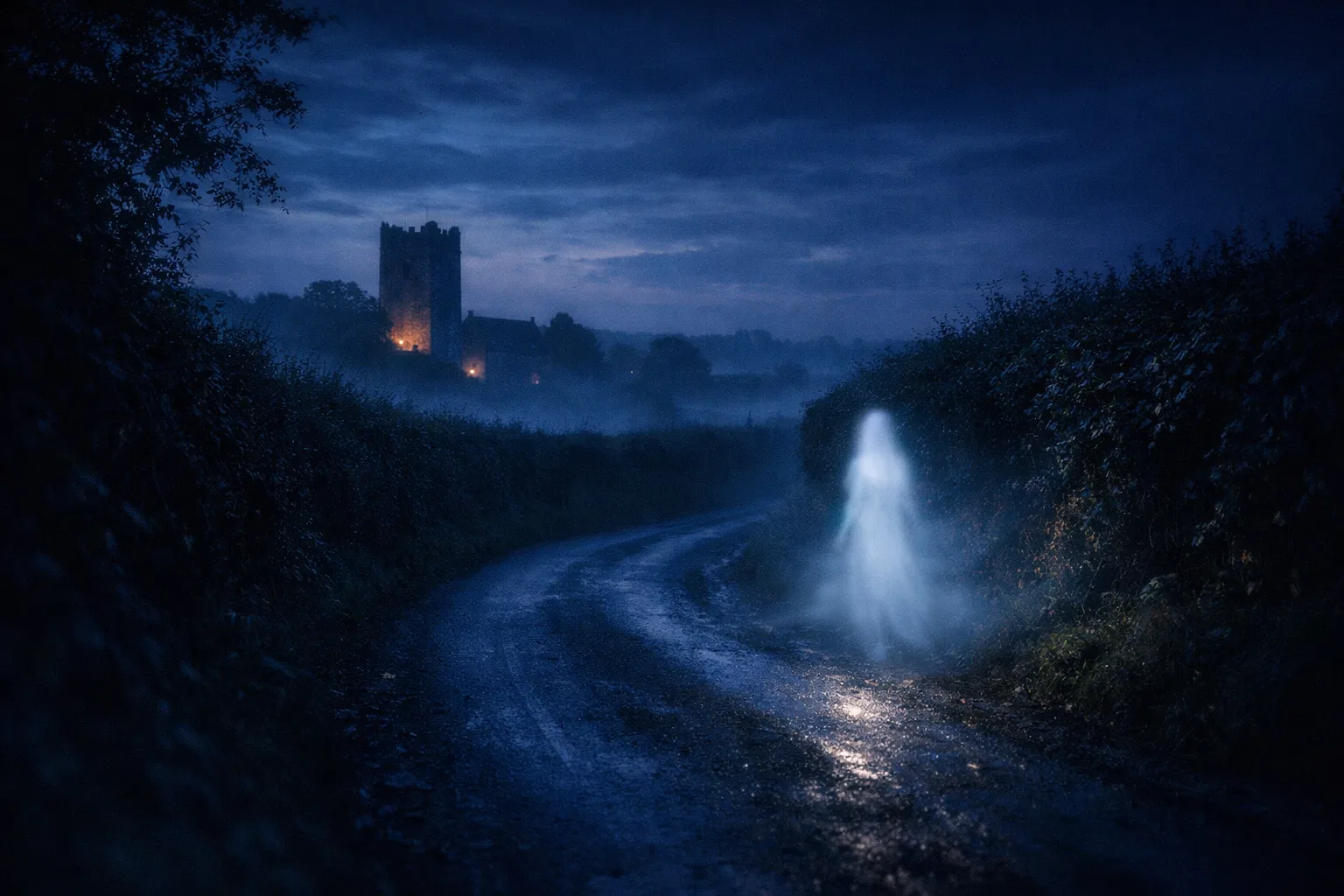
The most memorable roadside image in the St Athan area is the white lady, often linked with West Orchard and the Berkerolles family. Modern retellings place the apparition in a field near West Orchard Castle and connect her with a tragic legend of jealousy, wrongful accusation and cruel death. A local history retelling describes the story as an old St Athan legend about an often-reported white lady near West Orchard, while the wider folklore tradition identifies the figure with the Welsh “lady in white” motif and links the St Athan version to Gwenllian Berkerolles.[Wales History & Folklore]grahamloveluckedwards.comWales History & Folklore The legend of the white lady of West OrchardWales History & Folklore The legend of the white lady of West Orchard
The historical setting gives the story its local weight. Cadw’s listing for the Church of St Athan notes the importance of the south transept monuments to the de Berkerolles family of East Orchard, including Sir Roger de Berkerolles, who died in 1351. The Vale of Glamorgan’s County Treasures inventory also records fourteenth-century stone tombs in St Athan church representing the later generations of the Berkerolles family of East Orchard. These sources do not verify the ghost story, but they explain why the legend feels rooted: the family, tombs, church and manor landscape are real local anchors.[Cadw Public API]cadwpublic-api.azurewebsites.netCadw Public APIListed BuildingsCadw Public APIListed Buildings
The white lady story works differently from a modern witness report. It is a moralised legend, not a dated police-style account. Its power comes from familiar ingredients: a noble household, sexual jealousy, a woman wrongly condemned, a field remembered as a place of suffering, and a pale apparition glimpsed at night or early morning. In that sense, the white figure is less a “case” to prove than a local way of turning landscape into warning. The field is no longer just a field; it becomes a place where injustice is said to have left a mark.
There is also a practical reason why white apparitions recur in road folklore. A pale dress, mist, moonlight, limestone dust, a moving animal, a hedge gap or a half-seen person can all become vivid in low light. Folklore does not need those natural explanations to “debunk” it entirely. Rather, the uncertain conditions of travel helped the story type survive: the Vale road at dawn or dusk is exactly where the eye can misread and the imagination can complete the shape.

Phantom funerals and older Welsh belief
The most important Glamorgan examples of phantom funerals are attached to Roger’s Lane, the route from St Athan towards Bethesda’r Fro. Trevelyan records Roger’s Lane as a byway “leading from St. Athan to Bethesda ar Fro” and says it was reputedly the scene of many phantom funerals. In one account, a man walking after dark in late autumn hears two different funeral hymns, then finds himself among two processions moving in opposite directions, one towards St Athan and one towards Bethesda. Later, he attends a real funeral on the same lane and believes the earlier vision has been repeated in detail.[Internet Archive]archive.orgOpen source on archive.org.
A second St Athan account shifts the scene to dawn. A Vale farmer hears a Welsh funeral hymn, sees a procession coming from the church, and watches it halt before a house at the west end of the village. Trevelyan’s version says he recognises the mourners before the apparition vanishes; three months later, a neighbour’s son dies in Cardiff, his body is brought past St Athan Church, and the funeral follows the pattern the farmer believed he had already seen.[Internet Archive]archive.orgOpen source on archive.org.
Bethesda’r Fro itself gives the tradition a concrete setting. The chapel is not a fictional gothic ruin but a real Nonconformist place of worship near St Athan. Llantwit Major History Society says it was established in 1807 when Thomas William brought his congregation from Burton, Aberthaw, and notes its plain interior, candlelight and lack of electricity; the listed-building record describes Bethesda’r Fro as a Congregational chapel founded in 1807, with the present building apparently early to mid nineteenth century and Thomas Williams, the Welsh hymn writer, associated with it.[Llantwit Major History Society]llantwitmajorhistorysociety.co.ukLlantwit Major History Society Bethesda'r Fro ~ Llantwit Major History SocietyLlantwit Major History Society Bethesda'r Fro ~ Llantwit Major History Society
That chapel setting is crucial. Phantom funeral stories rely on the idea that death has a route. The apparition is not merely a ghostly crowd; it is a funeral following the path a real coffin might later take. In older Welsh belief, omens of death often moved along recognisable lines between home, road, chapel, church and grave. The story becomes frightening because it appears to show the future already travelling through the landscape.
Trevelyan groups these accounts with corpse-candles, another Welsh death-omen tradition in which mysterious lights were said to precede a death or trace a funeral route. Later summaries of Welsh death folklore describe phantom funerals as mysterious processions seen on rural roads, often on paths later followed by an actual burial. Such sources should be used cautiously, especially when they generalise from older collections, but they help show that the St Athan stories belong to a wider Welsh pattern rather than an isolated local invention.[Internet Archive]archive.orgOpen source on archive.org.
Wick, Cowbridge and the haunted road network
St Athan is the clearest named focus, but Trevelyan’s material also points west and north across the Vale. Her text says the neighbourhood of Wick, near Bridgend, once had a reputation for many phantom funerals going to and from district churches, some bound for Wick Parish Church and others passing on to St Bride Minor. This is exactly the sort of detail that makes the tradition feel road-based: the “haunting” is not fixed to a single building but to movement between parishes.[Internet Archive]archive.orgOpen source on archive.org.
Wick’s position helps explain the motif. The village sits in the older route-world of the Vale, and local summaries note its later association with medieval drovers’ routes bypassing the toll road through Cowbridge. Whether or not every detail of those summaries is equally strong, the broad point is plausible: Wick was not isolated from movement, trade and church traffic. Its ghost traditions fit a landscape of lanes used by drovers, farmers, mourners and night travellers.[Wikipedia]WikipediaWick, Vale of GlamorganWick, Vale of Glamorgan
Cowbridge adds a different road atmosphere. Trevelyan’s “Crack Hill” story places uncanny encounters on the high road from Bridgend to Cowbridge, where two travellers are said to have independently reported frightening experiences at night. A modern local-history retelling identifies Crack Hill as a steep stretch on the old Roman road line later known as the Glamorgan Turnpike and now broadly associated with the A48 corridor. The tale is more demonic than funerary, but it belongs in the same mechanism: danger, darkness and loneliness turn a road into a place where ordinary travel becomes a test.[Wales History & Folklore]grahamloveluckedwards.comWales History & Folklore The demon of Crack HillWales History & Folklore The demon of Crack Hill
This does not mean Wick, Cowbridge and St Athan had one neat “haunted road system” in the modern paranormal-tour sense. The evidence is patchier than that. What survives is a cluster of stories preserved by folklore collection, local retelling and place memory. Their shared logic is strong: rural roads are haunted when they carry repeated social anxieties, especially death, unsafe travel, strangers, animals, darkness, and the fear of being alone between settlements.
Why funerals appear before they happen
Phantom funeral stories can seem odd to modern readers because they are not usually about the dead returning. They are about a future death appearing in advance. That makes them closer to omen traditions than to the popular idea of a ghost as a departed person. In the St Athan and Wick accounts, the frightening event is not simply “I saw a spirit”, but “I saw a funeral that later seemed to come true”.
The mechanism depends on several linked beliefs:
The road remembers the ritual. A funeral procession is a repeated public act. If the same lanes are used generation after generation, the route gains emotional force. A future funeral imagined on that road feels almost as if it is already waiting there.
The witness recognises details. The most persuasive folklore accounts often include recognisable mourners, hymns, animals or stopping places. In Trevelyan’s St Athan stories, the force lies in details later said to be repeated: two hymns, a difficult passing, a halt before a house, a white dog or a piebald pony.[Internet Archive]archive.orgOpen source on archive.org.
The apparition appears at a threshold time. Dusk, dawn, late autumn and night recur because they are liminal: neither full day nor full night, neither safety nor danger. They also create poor visibility and heightened attention.
The story has a social use. Such tales teach caution about night travel, reinforce the seriousness of burial customs, and give sudden death a pattern. A death that might otherwise feel random becomes, in story form, something the community had been warned about.
For a sceptical reader, the most likely explanations include memory reshaping, coincidence, grief after the event, misheard sounds, expectation and later retelling. A person may remember an earlier strange experience more sharply after a death, especially if the community already has a vocabulary for omens. That does not make the stories worthless. It makes them valuable as records of how people gave emotional structure to uncertainty.
Danger, darkness and memory in the Vale roads
The Vale’s road legends are strongest when the road itself is difficult to read. Roger’s Lane after dark, fields at first light, the route past a chapel, a steep hill between Bridgend and Cowbridge, or lanes between Wick and district churches all place the witness between known points rather than safely inside one of them. The road is a middle space, and folklore loves middle spaces.
Older travel conditions made that feeling sharper. Before modern lighting, phones and fast transport, a person walking alone after dusk had to manage poor surfaces, animals, weather, strangers and the possibility of getting lost. Glamorgan’s wider road history includes Roman routes, parish-maintained tracks, turnpikes and later main roads; the A48 corridor broadly follows the Roman Via Julia Maritima across South Wales, according to summaries of Glamorgan’s transport history.[Wikipedia]WikipediaOpen source on wikipedia.org.
This helps explain why roadside apparitions in Glamorgan often involve processions rather than solitary ghosts. A procession is a moving community. To meet one unexpectedly on a narrow lane is already a practical problem; to meet one when no funeral should be taking place turns that problem into fear. The Roger’s Lane story is especially effective because it makes the supernatural feel physically crowded: the witness is not merely watching but struggling to pass.
The same mechanism appears in the Crack Hill accounts, though with a different emotional colour. Instead of solemn funeral order, the traveller meets attack, pressure or demonic fear on a dark road. Modern retellings emphasise that both claimed incidents happened at night while travelling from Bridgend to Cowbridge, and that the place’s reputation was strong enough to make later locals wary of the journey after dark.[Wales History & Folklore]grahamloveluckedwards.comWales History & Folklore The demon of Crack HillWales History & Folklore The demon of Crack Hill
How credible are the sources?
The evidence for Glamorgan’s roadside apparitions is strong as folklore and weak as proof of paranormal events. That distinction is essential. Trevelyan’s 1909 book is a major source because it preserves named local settings, repeated motifs and accounts said to come from informants. It is not, however, a modern archive of independently verified witness statements. It belongs to a period when folklore collectors often blended oral history, local belief, literary shaping and moral storytelling.[Hoap]hoap.co.ukOpen source on hoap.co.uk.
Later local retellings, including modern Vale folklore blogs and heritage writing, are useful for showing that the stories still circulate and remain attached to places such as St Athan, West Orchard, Wick and Crack Hill. They are less useful when treated as independent confirmation, because many of them ultimately return to Trevelyan or to the same local tradition.[Wales History & Folklore]grahamloveluckedwards.comWales History & Folklore The legend of the white lady of West OrchardWales History & Folklore The legend of the white lady of West Orchard
Official and heritage sources help most with the setting, not the haunting. Cadw, the Vale of Glamorgan Council inventory, listed-building records and local history society pages can verify that St Athan church, the Berkerolles monuments, West Orchard, Bethesda’r Fro and the old chapel landscape are real and historically layered. They cannot verify that phantom funerals appeared on Roger’s Lane.[azurewebsites.net]cadwpublic-api.azurewebsites.netCadw Public APIListed BuildingsCadw Public APIListed Buildings
The fair reading is therefore this: Glamorgan’s roadside apparitions are credible as long-lived local traditions attached to real routes and communities. They are not credible as settled evidence that ghosts or omens objectively occurred. Their importance lies in what they reveal about older Vale life: the emotional power of funeral routes, the fear of night travel, the authority of chapel and church, and the way memory turns certain lanes into story-bearing places.
What makes Glamorgan’s road ghosts distinctive?
Glamorgan has many haunted castles, mansions and public attractions, but the Vale road traditions feel older and less commercial. They do not depend on ticketed ghost tours or dramatic interiors. Their atmosphere comes from ordinary movement through an inhabited rural landscape: a farmer at dawn, a woman passing a chapel at gloaming, a traveller on a hill road, a procession between church and village.
The distinctive pattern is the blending of three things:
First, there are real medieval and chapel landscapes: St Athan church, Berkerolles tombs, West Orchard, Bethesda’r Fro and the parish routes around them. Second, there is Welsh death-omen folklore, especially phantom funerals and corpse-candles. Third, there is road danger, the practical unease of walking or riding through dark lanes before modern lighting and transport.
That combination gives the St Athan, Wick and Cowbridge cluster its local force. A phantom funeral on Roger’s Lane is not just a generic ghost story moved into Glamorgan. It belongs to a place where church, chapel, farm, burial and road were tightly connected. A white figure near West Orchard is not just another “lady in white”; she is tied to a named local family and a remembered manorial landscape. A frightening encounter on Crack Hill is not just a monster tale; it belongs to an old east-west route where night travel itself could feel dangerous.[archive.org]archive.orgOpen source on archive.org.
The lasting pull of the haunted lane
The reason Glamorgan’s roadside apparitions still matter is that they change how the Vale is imagined. They ask the reader to look beyond castles and ruins and notice the quieter haunted geography: lanes, stiles, chapel roads, church paths, fields and bends in the road. These are places that rarely get a plaque, yet they carried some of the most emotionally charged journeys in village life.
In the strongest stories, the road does not simply connect places. It foretells, remembers and repeats. A funeral hymn is heard where no mourners should be. A procession halts before a house not yet bereaved. A white figure appears near a field already heavy with legend. A dark hill road makes a traveller feel pursued or oppressed. None of this needs to be accepted as fact to be meaningful.
As folklore, the roadside hauntings of Glamorgan are among the county’s most atmospheric traditions because they bring the supernatural down to walking pace. They belong to the moment when the last light is going, the road is empty, and the way home passes a church, a chapel or a field whose story everyone nearby once knew.
Amazon book picks
Further Reading
Books and field guides related to Why Do Glamorgan's Roads Feel So Haunted?. Use these as the next step if you want deeper reading beyond the article.

The Mammoth Book of Haunted House Stories
Broad supernatural reading for interested visitors.

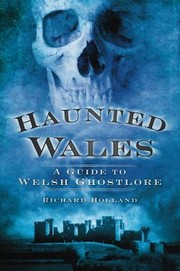
Haunted Wales A Guide To Welsh Ghostlore
First published 2011. Subjects: Ghosts, Haunted places, Folklore, great britain, Folklore.
eBay marketplace picks
Marketplace Samples
Live-tested eBay searches with available results related to this page.




Endnotes
1.
Source: archive.org
Link:https://archive.org/stream/afl2317.0001.001.umich.edu/afl2317.0001.001.umich.edu_djvu.txt
2.
Source: cdnc.heyzine.com
Link:https://cdnc.heyzine.com/files/uploaded/v2/9bef85067d480521deeb36630b052dde739114ff.pdf
3.
Source: commons.wikimedia.org
Link:https://commons.wikimedia.org/wiki/File%3AWales_Historic_Counties_map_Glamorgan.svg
4.
Source: Wikipedia
Title: Y Ladi Wen
Link:https://en.wikipedia.org/wiki/Y_Ladi_Wen
5.
Source: cadwpublic-api.azurewebsites.net
Title: Cadw Public APIListed Buildings
Link:https://cadwpublic-api.azurewebsites.net/reports/listedbuilding/FullReport?id=13166
6.
Source: Wikipedia
Title: Wick, Vale of Glamorgan
Link:https://en.wikipedia.org/wiki/Wick%2C_Vale_of_Glamorgan
7.
Source: Wikipedia
Link:https://en.wikipedia.org/wiki/Glamorgan
8.
Source: ia800104.us.archive.org
Link:https://ia800104.us.archive.org/20/items/afl2317.0001.001.umich.edu/afl2317.0001.001.umich.edu.pdf
9.
Source: archive.org
Link:https://www.archive.org/stream/bestbooksreaders00sonnuoft/bestbooksreaders00sonnuoft_djvu.txt?keepThis=true
10.
Source: archive.org
Link:https://archive.org/download/b29004470_0002/b29004470_0002.pdf
11.
Source: archive.org
Link:https://archive.org/stream/royalacademyofar05grav_0/royalacademyofar05grav_0_djvu.txt
12.
Source: archive.org
Link:https://archive.org/stream/gentlemansmagazi193hatt/gentlemansmagazi193hatt_djvu.txt
13.
Source: archive.org
Link:https://archive.org/stream/oldcowbridgeboro00hopkiala/oldcowbridgeboro00hopkiala_djvu.txt
14.
Source: archive.org
Link:https://archive.org/stream/cambridgehistory15warduoft/cambridgehistory15warduoft_djvu.txt
15.
Source: archive.org
Link:https://archive.org/stream/cambridgehistory008599mbp/cambridgehistory008599mbp_djvu.txt
16.
Source: archive.org
Link:https://archive.org/stream/gentlemansmagaz10unkngoog/gentlemansmagaz10unkngoog_djvu.txt
17.
Source: upload.wikimedia.org
Title: Folk lore and folk stories of Wales (IA afl2317.0001.001.umich.edu)
Link:https://upload.wikimedia.org/wikipedia/commons/7/77/Folk-lore_and_folk-stories_of_Wales_%28IA_afl2317.0001.001.umich.edu%29.pdf
18.
Source: commons.wikimedia.org
Link:https://commons.wikimedia.org/wiki/File%3ABethesda%27r_Fro_Chapel%2C_near_St.Athan_West_Camp%2C_Vale_of_Glamorgan.-_geograph.org.uk-_376352.jpg
19.
Source: Wikipedia
Title: St Athan
Link:https://en.wikipedia.org/wiki/St_Athan
20.
Source: Wikipedia
Title: Historic counties of Wales
Link:https://en.wikipedia.org/wiki/Historic_counties_of_Wales
21.
Source: hoap.co.uk
Link:https://www.hoap.co.uk/aatf1.rtf
22.
Source: datamap.gov.wales
Title: metadata detail
Link:https://datamap.gov.wales/layers/geonode%3Ahistoric_counties_bng_rcahmw_ply/metadata_detail
23.
Source: wikishire.co.uk
Link:https://wikishire.co.uk/wiki/Glamorgan
24.
Source: grahamloveluckedwards.com
Title: Wales History & Folklore The legend of the white lady of West Orchard
Link:https://grahamloveluckedwards.com/2023/05/12/the-legend-of-the-white-lady-of-west-orchard/
25.
Source: valeofglamorgan.gov.uk
Title: Vale of Glamorgan Council St_Athan
Link:https://www.valeofglamorgan.gov.uk/files/Living/Planning/Policy/County_Treasures/St_Athan.pdf
26.
Source: llantwitmajorhistorysociety.co.uk
Title: Llantwit Major History Society Bethesda’r Fro ~ Llantwit Major History Society
Link:https://llantwitmajorhistorysociety.co.uk/bethesdar-fro/
27.
Source: myend.com
Link:https://myend.com/country/wales-united-kingdom/
28.
Source: grahamloveluckedwards.com
Title: Wales History & Folklore The demon of Crack Hill
Link:https://grahamloveluckedwards.com/2024/11/02/the-demon-of-crack-hill/
29.
Source: hauntedohiobooks.com
Title: phantom funerals
Link:https://hauntedohiobooks.com/news/phantom-funerals/
30.
Source: wikishire.co.uk
Title: St Athan
Link:https://wikishire.co.uk/wiki/St_Athan
31.
Source: grahamloveluckedwards.com
Link:https://grahamloveluckedwards.com/category/welsh-folklore/
32.
Source: grahamloveluckedwards.com
Title: vale of glamorgan
Link:https://grahamloveluckedwards.com/tag/vale-of-glamorgan/
33.
Source: grahamloveluckedwards.com
Link:https://grahamloveluckedwards.com/category/bridgend/
34.
Source: facebook.com
Link:https://www.facebook.com/groups/512798028821584/posts/7733764996724815/
35.
Source: valeofglamorgan.gov.uk
Link:https://www.valeofglamorgan.gov.uk/Documents/Our%20Council/Jobs/Responsible-Finance-Officer-St-Athan-Community-Council-English.docx
36.
Source: datamap.gov.wales
Title: wales Listed Buildings | Data Map Wales
Link:https://datamap.gov.wales/layers/inspire-wg%3ACadw_ListedBuildings
37.
Source: datamap.gov.wales
Title: wales Historic County Boundaries of Wales
Link:https://datamap.gov.wales/layers/geonode%3Ahistoric_counties_bng_rcahmw_ply
38.
Source: stathancommunitycouncil.gov.uk
Title: st athan flemingston and gileston history
Link:https://stathancommunitycouncil.gov.uk/st-athan-flemingston-and-gileston-history/
39.
Source: rcahmw.gov.uk
Title: recent updates to the list of historic place names of wales
Link:https://rcahmw.gov.uk/recent-updates-to-the-list-of-historic-place-names-of-wales/
40.
Source: rcahmw.gov.uk
Link:https://rcahmw.gov.uk/discover/list-of-historic-place-names/
41.
Source: rcahmw.gov.uk
Link:https://rcahmw.gov.uk/discover/
42.
Source: pinterest.com
Link:https://www.pinterest.com/pin/glamorgan-wikipedia–245024035969577611/
43.
Source: llantwitmajorhistorysociety.co.uk
Link:https://llantwitmajorhistorysociety.co.uk/trevelyan/
44.
Source: glamarchives.gov.uk
Link:https://glamarchives.gov.uk/
45.
Source: antiquemaps.com
Link:https://www.antiquemaps.com/uk/wales/southwales/glamorgan/
46.
Source: bardicvintagebooks.substack.com
Title: marie trevelyan
Link:https://bardicvintagebooks.substack.com/p/marie-trevelyan
47.
Source: alamy.com
Title: glamorgan map
Link:https://www.alamy.com/stock-photo/glamorgan-map.html
Additional References
48.
Source: youtube.com
Title: Corpse Candles & Goblin Funerals: Wales’s Most Terrifying Death Omens
Link:https://www.youtube.com/watch?v=CQxM8MgTDbM
Source snippet
Funeral Phantoms and Paranormal Portents: Death Omens | Ghosts and Folklore of Wales podcast EP113...
49.
Source: youtube.com
Title: Phantom Funerals Britain’s Haunted Corpse Roads and Death Omens
Link:https://www.youtube.com/watch?v=AliyylyHjAM
Source snippet
The legend of the white lady of West Orchard | The back story of the ghost of Lady Berkerolles...
50.
Source: youtube.com
Link:https://www.youtube.com/watch?v=li53XKi5wIk
Source snippet
Ghosts Of Glamorgan with Bethan-Briggs Miller...
51.
Source: youtube.com
Title: Ghosts Of Glamorgan with Bethan-Briggs Miller
Link:https://www.youtube.com/watch?v=j0q2SkDxqT0
Source snippet
Phantom Funerals Britain's Haunted Corpse Roads and Death Omens...
52.
Source: facebook.com
Link:https://www.facebook.com/groups/102268440112893/posts/2321858301487218/
53.
Source: core.ac.uk
Link:https://core.ac.uk/download/227100742.pdf
54.
Source: facebook.com
Link:https://www.facebook.com/AuthorAdamNicke/posts/did-the-devil-visit-19th-century-walesa-tale-of-immortal-love-that-can-survive-p/553716868480762/
55.
Source: facebook.com
Link:https://www.facebook.com/groups/glamorganhistory/posts/5684325944977979/
56.
Source: facebook.com
Link:https://www.facebook.com/groups/barryastronomicalsociety/posts/1503227128242455/
57.
Source: landoflegends.wales
Link:https://www.landoflegends.wales/theme/ghosts
Topic Tree