Within Haunted Hampshire
Where Do Hampshire's City Ghosts Appear?
Old theatres, cathedral closes, Tudor cellars and city pubs give Hampshire's urban hauntings a different texture from forest and abbey lore.
On this page
- Theatre Royal Winchester and John Simpkins
- Cathedral Close monks and erased architecture
- Tudor House, cellars and port city stories
Page outline Jump by section
Introduction
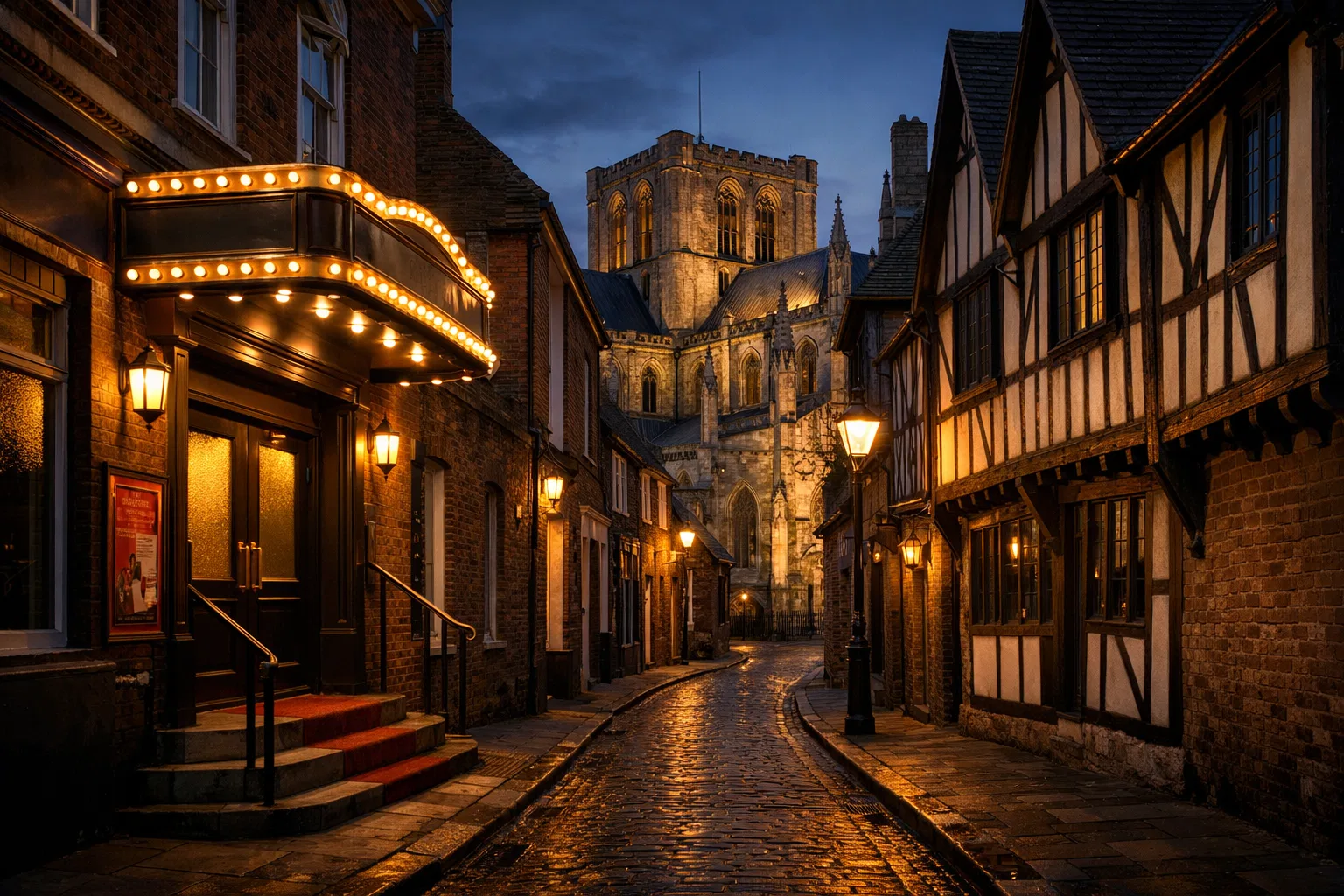
Winchester and Southampton give Hampshire’s haunted geography its most urban flavour: not lonely forest roads or ruined abbeys, but theatres, cathedral closes, medieval vaults, Tudor rooms, pub cellars and tourable streets. The best-known city stories cluster around three kinds of place: Theatre Royal Winchester, where John Simpkins is said to check an unfinished architectural slight; Winchester Cathedral Close, where monk legends attach themselves to vanished monastic buildings and altered ground levels; and Southampton Old Town, where Tudor House, underground cellars, the Red Lion and port-city memory turn ordinary heritage visits into ghost-walk territory. These are stories, claims and traditions rather than verified hauntings, but they endure because they fit their settings: Winchester’s layered religious cityscape and Southampton’s walled, raided, maritime old town both make the past feel unusually close.[theatreroyalwinchester.co.uk]theatreroyalwinchester.co.ukTheatre Royal WinchesterGhosts of Theatre Royal WinchesterThe ghost of John Simpkins has been spotted many times over the years, and used…
Why Do Winchester and Southampton Feel Different From Rural Haunted Hampshire?
Hampshire’s wider haunted landscape often works through open space: the New Forest, abbey ruins, old roads, military edges and country houses. Winchester and Southampton are different because the stories are concentrated into walkable streets and working public buildings. A reader can stand in Clasketgate and look towards Theatre Royal Winchester, walk the Cathedral Close where the priory once stood, or descend into Southampton’s Old Town and find timber, stone, vaults and town walls pressed together in a small area.
That density changes the texture of the ghost stories. Urban hauntings are less often about a lone apparition on a moor and more often about buildings whose uses have changed: hotel to theatre, monastery to cathedral close, merchant house to museum, medieval vault to pub cellar, walled port to tourist quarter. The haunting becomes a way of explaining why a place still feels inhabited by earlier versions of itself.
This is also why scepticism matters. In both cities, many of the strongest tales survive through theatre publicity, ghost walks, local blogs, museum events and paranormal tourism rather than through early documentary witness records. That does not make them worthless. It means they should be read as urban folklore attached to real historic fabric: stories that reveal what locals and visitors find memorable, unsettling or morally charged about old city spaces.
Theatre Royal Winchester: Who Is John Simpkins Supposed To Be Looking For?
The most focused Winchester city haunting is the story of John Simpkins at Theatre Royal Winchester. The theatre’s own history says the building began in 1850 as the Market Hotel, a useful stop for farmers visiting the cattle market and Corn Exchange; it was later bought by the Simpkins brothers and converted into a theatre, opening in the early twentieth century. Historic England lists Theatre Royal on Clasketgate as a Grade II listed building, while the Theatres Trust describes it as a notably complete small cine-variety theatre developed from the former hotel site.[theatreroyalwinchester.co.uk]theatreroyalwinchester.co.ukOpen source on theatreroyalwinchester.co.uk.
The ghost story turns on a very theatre-like grievance: a public mark above the stage. Theatre Royal Winchester’s own account says that during construction James Simpkins had the initials “JS” placed above the proscenium arch. John, according to the tradition, wanted both brothers represented. James is said to have promised to correct the omission, but John died before seeing it done. The reported apparition is therefore not random: John is said to appear in Edwardian clothing, stern and upright, still inspecting the arch that failed to include him.[Theatre Royal Winchester]theatreroyalwinchester.co.ukTheatre Royal WinchesterGhosts of Theatre Royal WinchesterThe ghost of John Simpkins has been spotted many times over the years, and used…
What makes this a strong urban haunting is its precision. Many ghost stories blur into “a figure seen in an old building”; the Simpkins tale gives the apparition a motive, a route and an object of attention. The University of Winchester’s 2025 student blog repeats the version in which John’s ghost drifts through a wall, checks the arch and exits through the opposite wall, showing how the story still circulates locally in accessible visitor culture.[University of Winchester]winchester.ac.ukHaunted Winchester A Ghost Tour for the BraveHaunted Winchester A Ghost Tour for the Brave
The theatre also has other reported figures, including a dancing girl and a soldier, but John Simpkins remains the central case because the story is structurally tied to the building itself. The proscenium, the old theatre business, the Edwardian clothing and the sense of unresolved authorship all belong to the venue. For readers assessing credibility, the key point is that the tale is well preserved by the theatre and local tourism sources, but it is still a heritage ghost story rather than independently verified evidence of paranormal activity.[Culture on Call]cultureoncall.comCulture on Call The haunting history of WinchesterCulture on Call The haunting history of Winchester
Cathedral Close: Why Do Monk Stories Gather Around Erased Architecture?
Winchester Cathedral Close has the classic ingredients of an English ecclesiastical haunting: a huge medieval church, former monastic life, altered buildings and spaces where the vanished past can be imagined underfoot. The ghost commonly described here is a monk, sometimes limping, seen near the south side of the cathedral or close to where monastic buildings once stood. Visit Winchester summarises the tradition as a monk haunting the Cathedral Close where the Benedictine priory formerly adjoined the south wall, with sightings placing him near the South Transept and apparently walking up steps that no longer exist.[Visit Winchester]visitwinchester.co.ukVisit WinchesterMost Haunted Places to Visit in Winchester: 8…While no physical structure from the priory remains today, some believe tha…
That last detail is important. “Walking up steps that no longer exist” is one of the most persuasive motifs in urban haunting, not because it proves a ghost, but because it turns architectural change into a story. The apparition seems to remember an older version of the city. The same idea appears in accounts of hooded figures in Winchester Cathedral who seem to move at the level of an earlier floor, with one paranormal database entry referring to monks reportedly walking on the original floor and a 1957 photograph said to show medieval-looking male figures.[Paranormal Database]paranormaldatabase.comOpen source on paranormaldatabase.com.
Historically, Winchester gives that folklore plenty to attach to. The city’s ecclesiastical centre has been repeatedly rebuilt and reinterpreted, and the cathedral area preserves layers of religious, royal and civic memory. Historic England’s local heritage material emphasises Winchester Cathedral’s major medieval fabric, including its remodelled nave and Perpendicular recasing, while nearby Wolvesey Palace and precinct walls remind visitors that the close sat within a wider landscape of bishops, monasteries, walls and power.[Historic England]historicengland.org.ukHistoric England Winchester (cityHistoric England Winchester (city
The monk stories are therefore best read as “memory hauntings” rather than simple scare tales. They are about absence: buildings dissolved, steps removed, floors changed, daily monastic movement erased from the visible city. A sceptical reading might point to misperception, tour embellishment, old photographs interpreted after the fact, or the suggestive power of a cathedral setting. A folkloric reading sees something equally useful: Winchester’s ghostly monks keep vanished architecture legible for modern visitors.
Southampton Old Town: Why Do Cellars, Vaults and Tudor Rooms Carry So Many Stories?
Southampton’s urban hauntings feel less clerical than Winchester’s and more maritime, domestic and subterranean. Tudor House and Garden sits at the centre of this atmosphere. Its official visitor material describes it as Southampton’s most important historic building, revealing more than 800 years of history in the Old Town. The timber-framed house facing St Michael’s Square dates from the late fifteenth century, while the adjacent King John’s Palace is a Norman house dating back roughly another 300 years.[Tudor House]tudorhouseandgarden.comTudor HouseTudor House & Garden: Discover Southampton's Oldest…Tudor House is Southampton's most important historic building, revealin…
Tudor House’s own history page gives the building a sequence that almost invites haunting: medieval origins, Sir John Dawtrey’s late fifteenth- and early sixteenth-century development, wealthy Tudor occupation, later merchant and domestic uses, Georgian alteration, nineteenth-century subdivision into dwellings and businesses, near-demolition, rescue and eventual museum life. Historic England lists Tudor House Museum on Bugle Street at Grade I, confirming its national architectural importance even before any ghost story is added.[Tudor House]tudorhouseandgarden.comOpen source on tudorhouseandgarden.com.
The reported ghosts at Tudor House are varied. The museum’s own blog describes unexplained footsteps, loud bangs and experiences reported by staff, volunteers and paranormal investigators. Event listings and museum programming have promoted talks and ghost-hunting sessions about “reports of ghosts at Tudor House through the centuries”, with named figures in tour culture including Little Nora, the Grey Lady, a phantom dog, a young woman and darker presences in corridors or upper rooms.[wordpress.com]teamtudor.wordpress.comthe ghosts of tudor housethe ghosts of tudor house
The cellars matter because Southampton’s Old Town is not only old above ground. Archaeological and heritage material on Bugle Street cellars shows that medieval cellarage survives beneath later houses, with stone fabric, alterations and repairs creating exactly the kind of layered, enclosed space that ghost stories favour. Tudor House Halloween programming explicitly uses that atmosphere, inviting visitors into the dark attic and down into the dingy cellars as part of a family-friendly haunted experience.[Southampton Archaeology]southamptonarchaeology.co.ukSouthampton Archaeology Cellars at 43, 45, 47, 49 and 51 Bugle Street,Southampton Archaeology Cellars at 43, 45, 47, 49 and 51 Bugle Street,
As with Winchester, the most careful approach is neither to dismiss nor overstate. Tudor House is unquestionably old, nationally important and rich in human occupation. The ghost stories are modernly preserved through museum interpretation, events and paranormal tourism. Their value lies in how they turn a complex building biography into memorable figures: the child, the lady, the dog, the disturbing presence, the unexplained sound in the historic house after hours.
The Red Lion, Medieval Vaults and Southampton’s Port-City Memory
Southampton’s haunted Old Town does not stop at Tudor House. The Red Lion Inn on High Street is one of the city’s most often mentioned haunted pubs, helped by its architectural status and by a strong local legend linking it to the Southampton Plot of 1415. Historic England lists the Red Lion Inn including its medieval vault at Grade II*, giving the site a firm heritage foundation. Southampton Forward describes the pub as a place where cellars descend into deep time and Tudor fabric sits above older structures.[Historic England]historicengland.org.uklist entrylist entry
The famous story says that conspirators against Henry V were tried in the Red Lion’s “court room” before execution. This is where source caution is essential. The plot itself is historical, but the inn-trial setting is widely treated as legend rather than secure fact; even summary accounts note that the building’s date and the lack of documentary evidence make the trial-room claim doubtful. The ghostly extension of that legend is a procession or presence associated with condemned men, alongside pub-haunting figures such as a barmaid visible only above the knees.[Wikipedia]WikipediaRed Lion Inn, SouthamptonRed Lion Inn, Southampton
This is a useful example of how urban ghost stories often build from contested history. The Red Lion does not need the 1415 trial story to be a significant historic building; its listed medieval vault already gives it weight. But the legend supplies moral drama: conspiracy, judgement, execution, a room beneath a pub, and the idea that civic punishment left an imprint.
Southampton’s wider Old Town ghost walks also draw on the city’s medieval vaults, walls, raids and sea-facing vulnerability. Contemporary ghost-tour material advertises routes through the historic streets, with stops such as Tudor House, Westgate and the Red Lion, while other tours emphasise rare access to old vaults and stories tied to the French raids.[Visit Southampton]visitsouthampton.co.ukOpen source on visitsouthampton.co.uk.
The 1338 French raid gives those stories a sharper historical backdrop. Local-history work on the raid stresses Southampton’s vulnerability from the waterside, the stealth of the attackers, panic among inhabitants, violent counter-attack and the later lesson that the town needed stronger walls. A careful historian warns that repetition can broaden myth, which is exactly the risk in ghost storytelling: a real catastrophe becomes a flexible atmospheric resource for later tales.[Plimsoll Southampton]plimsoll.southampton.gov.ukLHF Journal 23 Autumn 2014 p 3 56 French Raid on Southampton 1338LHF Journal 23 Autumn 2014 p 3 56 French Raid on Southampton 1338

What Makes These City Ghosts Locally Famous?
The urban haunts of Winchester and Southampton survive because they are easy to locate, easy to retell and easy to experience in person. A forest apparition asks a visitor to imagine a wide landscape; a city ghost points to a doorway, arch, cellar, wall, transept or pub room.
Several features make these stories especially durable:
- A visible trigger. John Simpkins has the proscenium arch; the Cathedral Close monk has lost steps and vanished priory buildings; Tudor House has attics, cellars and long domestic occupation; the Red Lion has its medieval vault.
- A compact route. Winchester and Southampton both support walking-tour storytelling. The audience moves from site to site, so each haunting becomes part of a chain rather than an isolated anecdote.
- A link to real heritage. The main places are not invented spooky backdrops. Theatre Royal, Tudor House and the Red Lion are listed buildings or nationally recognised historic sites, while Winchester Cathedral Close sits within one of England’s most resonant ecclesiastical landscapes.[Historic England]historicengland.org.ukHistoric England Theatre Royal, Non Civil ParishHistoric England Theatre Royal, Non Civil Parish
- A story that explains atmosphere. The ghosts give emotional shape to architectural facts: a theatre has rivalry and performance; a cathedral close has lost monastic life; a port town has cellars, raids, plots and trade.
This also explains why the stories are so uneven as evidence. The places are well evidenced; the apparitions are not. The folklore is credible as folklore because it is consistently attached to recognisable settings, but the reported phenomena remain claims, tour traditions and personal experiences rather than established facts.
How Should Readers Judge the Evidence?
The strongest evidence for this page is not evidence that ghosts exist. It is evidence that particular ghost traditions are attached to particular urban sites and have been preserved by venues, museums, tourist bodies, local-history writers and ghost-tour companies.
Theatre Royal Winchester is the clearest case because the venue itself preserves the John Simpkins story and connects it directly to the building’s proscenium arch. That makes the tradition stable, even though the apparition remains unverified.[Theatre Royal Winchester]theatreroyalwinchester.co.ukTheatre Royal WinchesterGhosts of Theatre Royal WinchesterThe ghost of John Simpkins has been spotted many times over the years, and used…
The Cathedral Close monk stories are more folkloric. They are highly atmospheric and make sense in Winchester’s monastic landscape, but they depend on repeated sighting traditions, paranormal databases, ghost-walk retellings and later interpretations of old photographs. Their historical value lies in the way they preserve awareness of erased monastic architecture.[Visit Winchester]visitwinchester.co.ukVisit WinchesterMost Haunted Places to Visit in Winchester: 8…While no physical structure from the priory remains today, some believe tha…
Tudor House sits between heritage interpretation and paranormal programming. The building’s history is strongly documented, and the museum itself has acknowledged ghost stories, staff experiences and ghost-hunting events. The named spirits, however, belong to reported experience and visitor tradition rather than archival certainty.[Tudor House]tudorhouseandgarden.comTudor HouseTudor House & Garden: Discover Southampton's Oldest…Tudor House is Southampton's most important historic building, revealin…
The Red Lion shows the greatest need for caution. The pub and medieval vault are real and listed, but the famous Southampton Plot trial-room association is better treated as local legend than settled history. That does not ruin the ghost story; it clarifies its nature. The haunting is part of Southampton’s habit of turning old civic trauma, punishment and underground space into memorable urban folklore.[Historic England]historicengland.org.uklist entrylist entry
Why These Haunts Matter Within Hampshire
Winchester and Southampton show that haunted Hampshire is not only rural, ruined or aristocratic. Its city ghosts are crowded, architectural and public. They appear in places still used for culture, tourism, worship, drinking, learning and guided walking. Their power comes from overlap: the everyday city laid directly over older floors, lost rooms, dissolved institutions and remembered violence.
That makes “City Haunts” a useful branch of Hampshire’s haunted map. Theatre Royal Winchester gives the county a backstage ghost with a named grievance. Cathedral Close gives it monks who seem to walk through erased architecture. Tudor House gives Southampton a domestic museum haunting rooted in more than 800 years of occupation. The Red Lion and Old Town vaults give the port city darker tales of plots, raids, cellars and civic memory.
The careful conclusion is not that Winchester and Southampton are demonstrably haunted. It is that their ghost stories are unusually place-specific. They help readers notice how Hampshire’s old cities hold the past differently from abbey ruins or forest roads: not as distant scenery, but as something built into arches, walls, floors, cellars and streets that people still pass through today.
Amazon book picks
Further Reading
Books and field guides related to Where Do Hampshire's City Ghosts Appear?. Use these as the next step if you want deeper reading beyond the article.
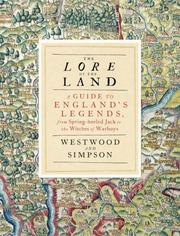

Ghostland: In Search of a Haunted Country
Explores haunted cities and historic landscapes across England.
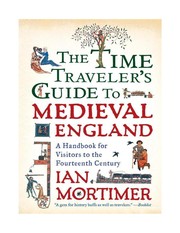
The time traveller's guide to medieval England
First published 2010. Subjects: Social conditions, Social life and customs, History, Great britain, history, medieval period, 1066-1485,...
eBay marketplace picks
Marketplace Samples
Live-tested eBay searches with available results related to this page.




Endnotes
1.
Source: visitwinchester.co.uk
Link:https://www.visitwinchester.co.uk/blog/the-most-haunted-places-in-winchester
Source snippet
Visit WinchesterMost Haunted Places to Visit in Winchester: 8…While no physical structure from the priory remains today, some believe tha...
2.
Source: Wikipedia
Title: Red Lion Inn, Southampton
Link:https://en.wikipedia.org/wiki/Red_Lion_Inn%2C_Southampton
3.
Source: ghost-walks.com
Link:https://ghost-walks.com/tours/the-southampton-ghost-walk
4.
Source: ghost-walks.com
Link:https://ghost-walks.com/winchester-ghost-tours
5.
Source: ghost-walks.com
Link:https://ghost-walks.com/tours/the-winchester-ghost-walk
6.
Source: Wikipedia
Title: Tudor House and Garden
Link:https://en.wikipedia.org/wiki/Tudor_House_and_Garden
7.
Source: theatreroyalwinchester.co.uk
Link:https://www.theatreroyalwinchester.co.uk/news/ghosts-theatre-royal-winchester
Source snippet
Theatre Royal WinchesterGhosts of Theatre Royal WinchesterThe ghost of John Simpkins has been spotted many times over the years, and used...
8.
Source: tudorhouseandgarden.com
Link:https://tudorhouseandgarden.com/
Source snippet
Tudor HouseTudor House & Garden: Discover Southampton's Oldest...Tudor House is Southampton's most important historic building, revealin...
9.
Source: historicengland.org.uk
Title: list entry
Link:https://historicengland.org.uk/listing/the-list/list-entry/1092055
10.
Source: theatreroyalwinchester.co.uk
Link:https://www.theatreroyalwinchester.co.uk/your-visit/about-us/history
11.
Source: historicengland.org.uk
Title: Historic England Theatre Royal, Non Civil Parish
Link:https://historicengland.org.uk/listing/the-list/list-entry/1388499
12.
Source: database.theatrestrust.org.uk
Link:https://database.theatrestrust.org.uk/resources/theatres/show/796
13.
Source: winchester.ac.uk
Title: Haunted Winchester A Ghost Tour for the Brave
Link:https://www.winchester.ac.uk/student-life/UWin-Student-Blog/Blog-Posts/Haunted-Winchester-A-Ghost-Tour-for-the-Brave.php
14.
Source: cultureoncall.com
Title: Culture on Call The haunting history of Winchester
Link:https://www.cultureoncall.com/haunting-history/
15.
Source: paranormaldatabase.com
Link:https://www.paranormaldatabase.com/hotspots/winchester.php
16.
Source: historicengland.org.uk
Title: Historic England Winchester (city)
Link:https://historicengland.org.uk/local/locations/winchester-city/
17.
Source: historicengland.org.uk
Title: Historic England Wolvesey Palace, Non Civil Parish
Link:https://historicengland.org.uk/listing/the-list/list-entry/1005535
18.
Source: southampton.gov.uk
Link:https://www.southampton.gov.uk/culture-leisure-tourism/museums/tudor-house-and-garden/
19.
Source: tudorhouseandgarden.com
Link:https://tudorhouseandgarden.com/explore/history/
20.
Source: historicengland.org.uk
Title: Historic England Tudor House Museum, Non Civil Parish
Link:https://historicengland.org.uk/listing/the-list/list-entry/1339964
21.
Source: teamtudor.wordpress.com
Title: the ghosts of tudor house
Link:https://teamtudor.wordpress.com/2018/06/21/the-ghosts-of-tudor-house/
22.
Source: tudorhouseandgarden.com
Title: Tudor House Adult Learning
Link:https://tudorhouseandgarden.com/learning/adult-learning/
23.
Source: wegottickets.com
Link:https://wegottickets.com/event/507344/
24.
Source: southamptonmuseumsandgallery.co.uk
Title: Sea City Museum Tudor House Ghost Hunt
Link:https://southamptonmuseumsandgallery.co.uk/events/tudor-house-ghost-hunt-jan2026/
25.
Source: southamptonarchaeology.co.uk
Title: Southampton Archaeology Cellars at 43, 45, 47, 49 and 51 Bugle Street,
Link:https://southamptonarchaeology.co.uk/wp-content/uploads/2025/03/Bugle_-St_cellars_survey_summary.pdf
26.
Source: tudorhouseandgarden.com
Link:https://tudorhouseandgarden.com/whats-on/halloween/
27.
Source: visitsouthampton.co.uk
Link:https://www.visitsouthampton.co.uk/event/southampton-ghost-tour/282056101/
28.
Source: plimsoll.southampton.gov.uk
Title: LHF Journal 23 Autumn 2014 p 3 56 French Raid on Southampton 1338
Link:https://plimsoll.southampton.gov.uk/SOTON_Documents/local_history_forum/Local_History_Forum_Journal/LHF_Journal_23_Autumn_2014_p_3-56_French_Raid_on_Southampton_1338.pdf
29.
Source: southamptonlocalhistorycentre.wordpress.com
Link:https://southamptonlocalhistorycentre.wordpress.com/wp-content/uploads/2014/11/lhf-journal-23-autumn-2014.pdf
30.
Source: historicengland.org.uk
Title: bse excel hampshire
Link:https://historicengland.org.uk/content/docs/advice/building-stones-england/bse-excel-hampshire/
31.
Source: historicengland.org.uk
Title: Winchester (district)
Link:https://historicengland.org.uk/local/locations/winchester-district/
32.
Source: historicengland.org.uk
Link:https://historicengland.org.uk/images-books/photos/results?filters%5B0%5D%5Bfield%5D=parent&filters%5B0%5D%5Btype%5D=all&filters%5B0%5D%5Bvalues%5D%5B0%5D=111199229
33.
Source: historicengland.org.uk
Link:https://historicengland.org.uk/local/locations/hampshire/
34.
Source: historicengland.org.uk
Link:https://historicengland.org.uk/images-books/publications/conservation-bulletin-05/conservationbulletin05/
35.
Source: historicengland.org.uk
Title: aw hobart air pictures portleven collection
Link:https://historicengland.org.uk/images-books/archive/collections/photographs/aw-hobart-air-pictures-portleven-collection/
36.
Source: historicengland.org.uk
Title: har 2022 entries additions removals
Link:https://historicengland.org.uk/content/docs/har/har-2022-entries-additions-removals/
37.
Source: historicengland.org.uk
Link:https://historicengland.org.uk/images-books/publications/dssg-commemorative-funerary/heag239-commemorative-and-funerary-ssg/
38.
Source: mapservices1.historicengland.org.uk
Title: HLE A4L Grade|HLE A3L Grade
Link:https://mapservices1.historicengland.org.uk/printwebservicehle/StatutoryPrint.svc/307810/HLE_A4L_Grade%7CHLE_A3L_Grade.pdf
39.
Source: historicengland.org.uk
Title: Red Lion Inn, Southwick and Widley
Link:https://historicengland.org.uk/listing/the-list/list-entry/1096221
40.
Source: historicengland.org.uk
Title: The Theatre Royal, Non Civil Parish
Link:https://historicengland.org.uk/listing/the-list/list-entry/1209703
41.
Source: facebook.com
Link:https://www.facebook.com/groups/735389799823006/posts/6251330834895514/
42.
Source: planning.data.gov.uk
Link:https://www.planning.data.gov.uk/entity/31549455
43.
Source: planning.data.gov.uk
Link:https://www.planning.data.gov.uk/entity/31795855
44.
Source: visitwinchester.co.uk
Title: a brief history of theatre royal winchester
Link:https://www.visitwinchester.co.uk/blog/a-brief-history-of-theatre-royal-winchester
45.
Source: visit-hampshire.co.uk
Link:https://www.visit-hampshire.co.uk/whats-on/tudor-house-ghost-hunt-p1774311
46.
Source: winchester.gov.uk
Link:https://www.winchester.gov.uk/assets/attach/27498/Listed-Buildings.pdf
47.
Source: southamptonmuseumsandgallery.co.uk
Title: Tudor House Ghost Hunt
Link:https://southamptonmuseumsandgallery.co.uk/events/tudor-house-ghost-hunt-7nov2026/
48.
Source: whichmuseum.com
Title: Tudor House and Garden (Southampton)
Link:https://whichmuseum.com/museum/tudor-house-and-garden-southampton-4104
49.
Source: historyhit.com
Title: Tudor House and Garden
Link:https://www.historyhit.com/locations/tudor-house-and-garden/
50.
Source: winchester-cathedral.org.uk
Link:https://www.winchester-cathedral.org.uk/pre-bookable-special-guided-tours/
51.
Source: andyvskinner.wordpress.com
Title: sources for the 1338 raid
Link:https://andyvskinner.wordpress.com/2024/02/20/sources-for-the-1338-raid/
52.
Source: museumsuk.com
Title: Tudor House and Garden, southampton | history
Link:https://museumsuk.com/museums/southampton/tudor-house-and-garden.html
53.
Source: visitsoutheastengland.com
Title: Tudor House and Garden
Link:https://www.visitsoutheastengland.com/things-to-do/tudor-house-and-garden-p8041
54.
Source: britishlistedbuildings.co.uk
Title: Tudor House Museum
Link:https://britishlistedbuildings.co.uk/101339964-tudor-house-museum-bargate-ward/maps
55.
Source: aubreyresearch.com
Title: french raid on southampton 1338
Link:https://www.aubreyresearch.com/battlefields/french-raid-on-southampton-1338
56.
Source: bff-architects.com
Link:https://bff-architects.com/theatre-royal-winchester
57.
Source: opendata-historicengland.hub.arcgis.com
Link:https://opendata-historicengland.hub.arcgis.com/datasets/historicengland%3A%3Anational-heritage-list-for-england-nhle/explore?layer=0
Additional References
58.
Source: youtube.com
Title: Red Lion, Southampton
Link:https://www.youtube.com/watch?v=xOV-sjPAqdc
Source snippet
Haunted Winchester ghost stories Hampshire Exploring History, Mystery & Hauntings of Winchester's MOST HAUNTED Hill...
59.
Source: hauntedrooms.co.uk
Link:https://www.hauntedrooms.co.uk/haunted-places/southampton
60.
Source: redfunnel.co.uk
Link:https://www.redfunnel.co.uk/isle-of-wight-guide/explore/discover-southamptons-hidden-history
61.
Source: facebook.com
Link:https://www.facebook.com/groups/522471662730776/posts/1506161927695073/
62.
Source: supernaturalstudies.com
Link:https://www.supernaturalstudies.com/previous-journal-issues/vol-6-issue-2/hay
63.
Source: facebook.com
Link:https://www.facebook.com/61583539634325/posts/hidden-under-southamptons-streets-a-700-year-old-medieval-cellar-that-also-saved/122143966521117987/
64.
Source: facebook.com
Link:https://www.facebook.com/groups/sothamptonheritage/posts/10161791272217883/
65.
Source: winchester-cathedral.org.uk
Link:https://www.winchester-cathedral.org.uk/mortuary-chests-project/image-gallery/
66.
Source: cwtarchive.co.uk
Link:https://www.cwtarchive.co.uk/archive/core/listed.shtml
67.
Source: instagram.com
Link:https://www.instagram.com/p/DNALI-hqUx0/?hl=en
Topic Tree