Within Haunted Westmorland
Who Was the Crier of Claife?
The Crier of Claife turns Windermere's ferry shore into a story about cries across water, bad weather and haunted tourism.
On this page
- The haunted cry above Windermere
- Ferry routes, weather and danger
- Folklore, tourism and sceptical readings
Page outline Jump by section
Introduction
The Crier of Claife is the ghostly voice said to haunt Claife Heights above Windermere, calling across the water for a ferry that should not come. In the best-known version, a boatman answers the cry on a stormy night, rows towards the western shore, returns speechless with terror, and soon dies; later, monks exorcise the spirit and bind it to an old quarry on the wooded heights. The story matters because it is not just a campfire ghost tale. It is tied to a real ferry crossing, a real lakeside landscape, early Lake District tourism, and a place-name that appears on historic mapping as “Crier of Claife”.[National Trust]nationaltrust.org.ukOpen source on nationaltrust.org.uk.
For a Westmorland haunted-history page, the legend sits neatly on a boundary. Bowness and Ferry Nab belong to historic Westmorland, while Claife Heights and Far Sawrey lie on the western side of Windermere, historically associated with Lancashire north of the sands; anyone crossing by the ferry moves through a landscape where old county geography, tourism and folklore overlap.[Gazetteer]gazetteer.org.ukBowness on Windermere, Westmorland 5028Bowness on Windermere, Westmorland 5028
The haunted cry above Windermere
The core of the legend is simple and effective: a cry is heard from Claife, usually at night and often in bad weather, asking for the ferry. The ferrymen know not to answer it. One newcomer, sceptical or brave, takes the boat out anyway. He returns alone, unable to explain what he has seen, and dies soon after. The Crier’s power lies in that gap. The story does not need to show a monster; it makes the unseen voice, the black water and the silent ferryman do the work.
The National Trust’s modern walking material gives the most visitor-facing version. It describes the Crier as “a particularly noisy ghost”, reputed to be the spirit of a monk whose mission was to rescue “fallen women”. According to that version, he fell in love, was rejected, went mad, died, and continued to wail until he was exorcised and banished to a small quarry on Claife Heights.[National Trust]nationaltrust.org.ukOpen source on nationaltrust.org.uk.
Older literary versions are not identical, which is important for credibility. The earliest widely cited printed account appears to be the Kendal Mercury’s Christmas Day 1852 story, “The Crier of Claife: A Christmas Ghost Story for Country Firesides”, signed “Snow Drop”. Harriet Martineau then included the tale in A Complete Guide to the English Lakes in 1855, helping to put it in front of the Victorian visitors who were turning Windermere into a celebrated tourist landscape.[lakedistrictletters.blogspot.com]lakedistrictletters.blogspot.comthe crier of claife revisitedthe crier of claife revisited
In Martineau’s guide, the setting is already practical as well as supernatural. The traveller is warned that if they arrive at Ferry Nab too late, the boat will not come, and the local tale of the Crier explains why. That makes the legend feel like a piece of haunted travel advice: do not expect the ferry after dark; do not trust every sound that comes over the water; and do not treat Windermere as harmless just because it is beautiful.[Lakes Guides]lakesguides.co.ukLakes Guides Ferry Nab, WindermereLakes Guides Ferry Nab, Windermere

Why the ferry makes the legend work
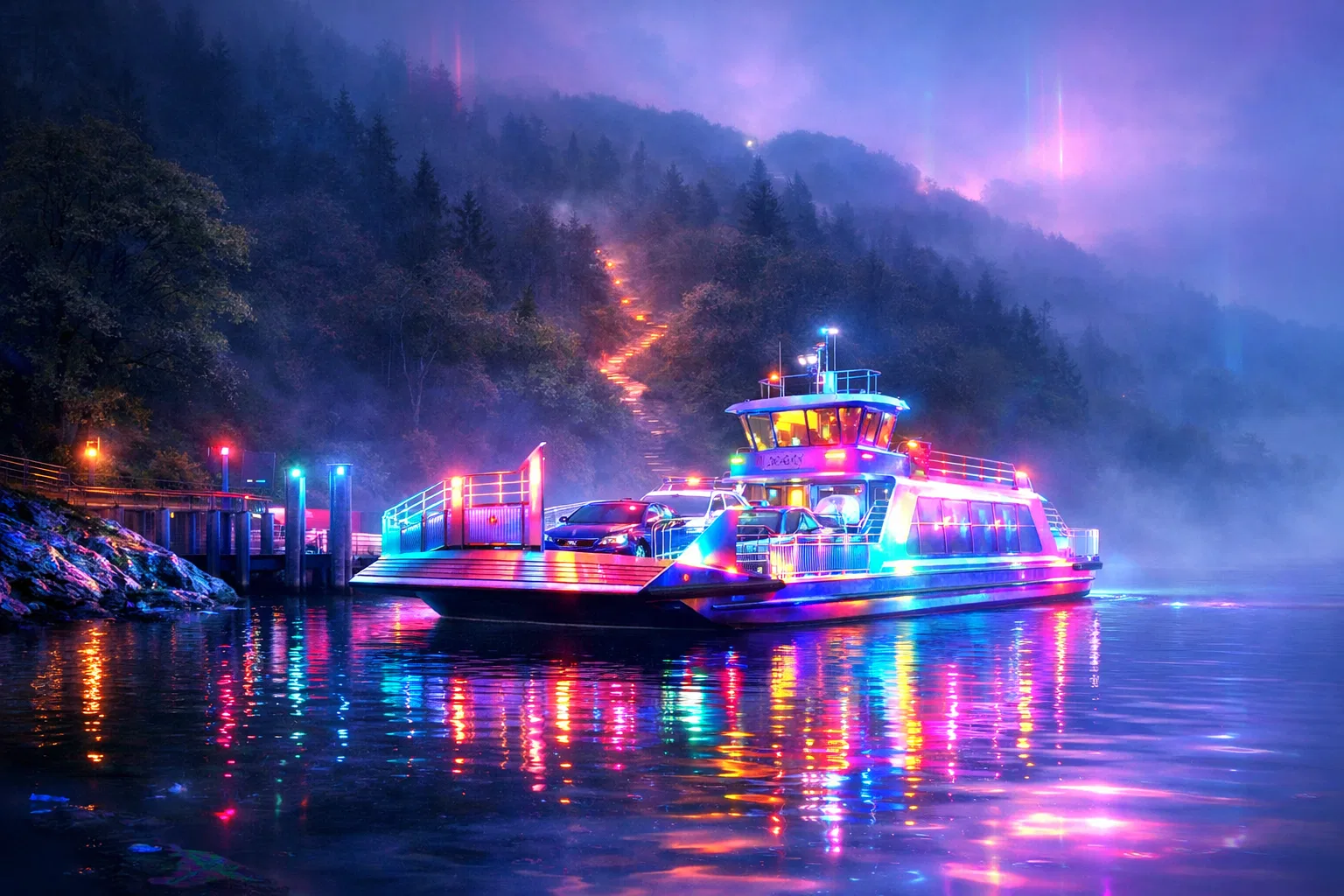
The Windermere ferry gives the Crier story its everyday machinery. Today, the official ferry runs between Ferry Nab at Bowness and Far Sawrey, carrying vehicles, bicycles and foot passengers across Windermere in a journey of about ten minutes.[Westmorland and Furness Council]westmorlandandfurness.gov.ukOpen source on westmorlandandfurness.gov.uk. In the older world of the tale, however, the crossing depended on boatmen, weather, darkness and judgement. A call from the opposite shore could be a fare, a trap, a prank, a person in distress, or something no sensible ferryman wanted to meet.
That is why the Crier belongs to Windermere more tightly than many generic lake ghosts. It is not merely “a figure seen near water”. It is a legend about whether to answer a cry. The sound has a practical consequence: launch the boat, cross the lake, risk the weather, and find out who called. The story turns a routine service into a moral and physical test.
Windermere’s ferry tradition also has a real history of danger. Modern summaries of the ferry’s history note a recorded disaster in 1635, when a ferry capsized and forty-seven people died.[Wikipedia]WikipediaWindermere FerryWindermere Ferry Some later retellings allow the disaster and the Crier legend to blur together, but the link should be handled carefully. The 1635 disaster is historically useful because it shows that ferry travel could be deadly; it does not prove that the Crier story began with that accident.
The haunted logic is still powerful. A lake ferry is a threshold: between shore and shore, daylight and darkness, safety and exposure, Westmorland’s busy Bowness side and the quieter western woods. The Crier’s voice comes from the side that feels more remote. Even now, visitor descriptions often contrast the busy eastern shore with the quieter western side, and official tourist material presents the ferry as the way to leave the crowds behind and reach the west shore paths.[National Trust]nationaltrust.org.ukOpen source on nationaltrust.org.uk.
How old is the Crier of Claife story?
The legend is often dressed in medieval clothing, especially through the monk motif and the reference to exorcism, but the strongest written evidence points to the nineteenth century. The 1852 Kendal Mercury story and Martineau’s 1855 guide are the key early printed forms most often cited.[lakedistrictletters.blogspot.com]lakedistrictletters.blogspot.comthe crier of claife revisitedthe crier of claife revisited
That does not mean the whole tale was invented from nothing in 1852. Folklore often reaches print long after it has circulated orally. One useful clue is the appearance of “Crier of Claife” on early Ordnance Survey mapping, where it is associated with the old quarry on Claife Heights; a local-history discussion notes that this map evidence appears to pre-date, or at least sit very close to, the 1852 printed story.[lakedistrictletters.blogspot.com]lakedistrictletters.blogspot.comthe crier of claife revisitedthe crier of claife revisited
The most cautious reading is that the Crier probably developed from a mixture of older local sound-beliefs, ferry warnings, place-name tradition and mid-nineteenth-century Gothic storytelling. By the time it reached guidebooks, it had become a polished legend: storm, tavern, ferryman, dreadful return, exorcism, quarry. That is a strong narrative shape, but it is not the same as a chain of independent witness statements.
There is also a telling sceptical voice within the tradition itself. In Lays and Legends of the English Lake Country, the discussion of the Crier cites Alexander Craig Gibson’s explanation that he had heard a sound near Windermere which locals identified as the Crier, but he thought it could be explained by wind gathering behind Gummers How and rushing across the lake, sounding like a human cry before the squall struck the woods.[Project Gutenberg]gutenberg.orgOpen source on gutenberg.org.

The quarry, the monk and the mapped ghost
The old quarry is one reason the Crier has remained so memorable. Many ghosts are attached vaguely to a road, a room or a ruin; the Crier is tied to a named feature on the heights. The National Trust places the banishment at a small quarry on its Claife Heights walk, and nineteenth-century literary material also describes the “Crier of Claife” as a disused slate or flag quarry, overgrown with wood, on the lonely height above the ferry.[National Trust]nationaltrust.org.ukOpen source on nationaltrust.org.uk.
This has fed the popular claim that the Crier is one of the only ghosts, or the only ghost, named on an Ordnance Survey map. That claim is repeated in modern folklore writing and local commentary, but it is best phrased cautiously: “Crier of Claife” appears as a mapped place-name, and that unusual cartographic survival has helped make the legend famous.[Paul J. Scribbans - Author]pjscribbans.co.ukPaul J. ScribbansPaul J. Scribbans
The monk backstory is more slippery. One version makes the Crier a monk from Furness Abbey, driven mad by forbidden love. Another emphasises monks being called in to lay the spirit after the ferryman’s terrible encounter. Local-history retellings point out that the religious geography is not always tidy: traditions involving Lady Holme, Furness Abbey and other religious sites can be blended together in later versions of the tale.[Arcus Atlantis]arcus-atlantis.org.ukcrier of claifecrier of claife
That blending is typical of folkloric development. A ghost story gains authority by borrowing from recognised old institutions: abbeys, hermitages, dissolved monasteries and holy men with bells and books. In the Crier legend, the monk motif gives the tale a moral charge, while the quarry gives it a fixed place. Together they make the story feel older and more rooted than a simple report of an eerie noise.
Claife Viewing Station and haunted tourism
Claife Heights is not only a haunted wood. It is also a designed tourist landscape. Claife Viewing Station, close to the ferry and west shore paths, was built in the 1790s and later expanded as one of the early monuments created to frame Lake District scenery for visitors. The National Trust describes its coloured glass as a way of viewing Windermere under different seasonal and atmospheric effects: yellow for summer, orange for autumn, light green for spring, dark blue for moonlight and other tints for altered moods.[National Trust]nationaltrust.org.ukthe history of claife viewing stationthe history of claife viewing station
That matters because the Crier legend grew into print at almost the same time that Windermere was being packaged for scenic consumption. Claife was a place where visitors were taught how to look: from a station, through coloured glass, across the lake. The Crier teaches them how to listen: to wind, water, cries, echoes and warnings. One side of Claife offers curated beauty; the other offers a story about what happens when the landscape turns hostile.
Historic England lists “The Station” at Claife as a Grade II structure, and the National Trust’s restoration has made it a modern visitor stop again.[Historic England]historicengland.org.ukHistoric England The Station, ClaifeHistoric England The Station, Claife This makes the Crier unusually accessible for a ghost legend. Readers and walkers can connect the story with the ferry, Ash Landing, the viewing station and the wooded slopes, even if the exact quarry or “haunted spot” is not presented as a formal attraction.
The result is haunted tourism without needing a staged ghost tour. The story sits inside an ordinary Lake District day out: ferry crossing, café, viewpoint, woodland walk, lake path. Its eeriness depends on changing conditions. In sunshine, Claife is picturesque. At dusk, in wind or rain, the same woods and water make the old warning easier to understand.
Folklore, weather and sceptical readings
The most convincing sceptical explanation is not that people were foolish, but that the landscape is acoustically and emotionally suggestive. Wind across a large lake, squalls moving through leafless woods, animal cries, waterfowl, echoes and the shape of the surrounding fells could all make ordinary sounds seem uncanny, especially at night or in bad weather. Gibson’s account of wind from behind Gummers How is valuable precisely because it preserves both parts of the experience: the sound was startlingly human, but he believed it had a natural cause.[Project Gutenberg]gutenberg.orgOpen source on gutenberg.org.
The legend also belongs to a wider family of northern sound-hauntings. Local writers have compared it with traditions of phantom hunts, spectral hounds and ominous cries in the sky, where a natural or half-heard sound becomes a supernatural warning.[Esmeralda's Cumbrian History & Folklore]esmeraldamac.wordpress.comthe claife crier windermeres famous spookthe claife crier windermeres famous spook The Crier’s distinctiveness is that it is not heard in the open sky or on a moor, but across a working ferry route. It turns a sound into a summons.
Credibility therefore depends on what question is being asked. As evidence for a literal haunting, the record is weak: the main forms are literary, guidebook, folkloric and touristic, with no solid sequence of named modern witnesses. As evidence for local fear and landscape memory, it is much stronger. The Crier preserves anxiety about night crossings, sudden weather, lonely woods, and the difficulty of telling a human call from a dangerous illusion.
That is why the legend has lasted. It does not ask the reader to believe every detail about monks, exorcism and a ghost imprisoned in a quarry. It asks a more durable question: if a voice calls across dark water in a storm, how sure are you that you should answer?
Why the Crier still defines haunted Windermere
The Crier of Claife remains one of Westmorland’s most useful haunted legends because it is compact, place-specific and interpretable. It can be read as a ghost story, a ferry warning, a tourist-era invention, a memory of dangerous travel, or an explanation for strange sounds on the lake. None of those readings cancels the others. Together, they show how a local haunting becomes famous.
Its setting also keeps it alive. Windermere is not a remote ruin visited only by specialists; it is one of the Lake District’s best-known visitor landscapes. The ferry still crosses, walkers still climb to Claife, and the viewing station still frames the lake.[Westmorland and Furness Council]westmorlandandfurness.gov.ukOpen source on westmorlandandfurness.gov.uk. The old story now travels with them, turning a short crossing and a wooded slope into one of the county’s most atmospheric pieces of folklore.
In the wider haunted geography of Westmorland, the Crier belongs beside stories of dangerous roads, exposed passes, old religious sites and lonely houses. Yet it has its own signature: not a face at a window or footsteps in a corridor, but a voice over water. That voice is the whole legend. Heard as folklore rather than proof, it is one of the clearest examples of how Windermere’s beauty, weather and risk became a ghost story.
Amazon book picks
Further Reading
Books and field guides related to Who Was the Crier of Claife?. Use these as the next step if you want deeper reading beyond the article.

Ghostland: In Search of a Haunted Country
Lake District folklore fits naturally with its themes.
The lore of the land
Explains place legends such as spectral cries and haunted waters.
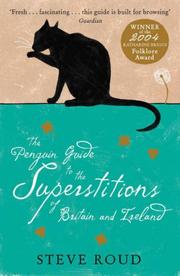
The Penguin Guide to the Superstitions of Britain and Ireland
Covers traditional beliefs surrounding ghosts and warnings.
eBay marketplace picks
Marketplace Samples
Live-tested eBay searches with available results related to this page.

Endnotes
1.
Source: gutenberg.org
Link:https://www.gutenberg.org/files/48207/48207-h/48207-h.htm
2.
Source: lakedistrictletters.blogspot.com
Title: the crier of claife revisited
Link:https://lakedistrictletters.blogspot.com/2017/04/the-crier-of-claife-revisited.html
3.
Source: Wikipedia
Title: Windermere Ferry
Link:https://en.wikipedia.org/wiki/Windermere_Ferry
4.
Source: pjscribbans.co.uk
Title: Paul J. Scribbans
Link:https://pjscribbans.co.uk/2025/10/08/the-claife-crier-windermeres-haunted-history/
5.
Source: scafellhike.blogspot.com
Title: the great boat disaster of windermere
Link:https://scafellhike.blogspot.com/2023/08/the-great-boat-disaster-of-windermere.html
6.
Source: Wikipedia
Link:https://en.wikipedia.org/wiki/Westmorland
7.
Source: Wikipedia
Link:https://en.wikipedia.org/wiki/Windermere
8.
Source: lakedistrictletters.blogspot.com
Link:https://lakedistrictletters.blogspot.com/2017/
9.
Source: gutenberg.org
Link:https://www.gutenberg.org/ebooks/40857.epub.noimages
10.
Source: nationaltrust.org.uk
Link:https://www.nationaltrust.org.uk/visit/lake-district/claife-viewing-station-and-windermere-west-shore/ash-landing-and-claife-heights-windermere-walk
11.
Source: gazetteer.org.uk
Title: Bowness on Windermere, Westmorland 5028
Link:https://gazetteer.org.uk/place/Bowness-on-Windermere%2C_Westmorland_5028
12.
Source: westmorlandandfurness.gov.uk
Link:https://www.westmorlandandfurness.gov.uk/parking-streets-and-transport/windermere-ferry
13.
Source: lakesguides.co.uk
Title: Lakes Guides Ferry Nab, Windermere
Link:https://lakesguides.co.uk/html/lgaz/lk14034.htm
14.
Source: arcus-atlantis.org.uk
Title: crier of claife
Link:https://www.arcus-atlantis.org.uk/spooky-lancashire/crier-of-claife.html
15.
Source: nationaltrust.org.uk
Link:https://www.nationaltrust.org.uk/visit/lake-district/claife-viewing-station-and-windermere-west-shore/explore-claife-and-windermere-west-shore
16.
Source: esmeraldamac.wordpress.com
Title: the claife crier windermeres famous spook
Link:https://esmeraldamac.wordpress.com/2011/05/20/the-claife-crier-windermeres-famous-spook/
17.
Source: nationaltrust.org.uk
Title: the history of claife viewing station
Link:https://www.nationaltrust.org.uk/visit/lake-district/claife-viewing-station-and-windermere-west-shore/the-history-of-claife-viewing-station
18.
Source: nationaltrust.org.uk
Title: claife viewing station and windermere west shore
Link:https://www.nationaltrust.org.uk/visit/lake-district/claife-viewing-station-and-windermere-west-shore
19.
Source: historicengland.org.uk
Title: Historic England The Station, Claife
Link:https://historicengland.org.uk/listing/the-list/list-entry/1087305
20.
Source: gazetteer.org.uk
Link:https://gazetteer.org.uk/place/Westmorland
21.
Source: gazetteer.org.uk
Title: Westmorland and Furness Council Historic Counties
Link:https://gazetteer.org.uk/Westmorland_and_Furness_Council_Historic_Counties.pdf
22.
Source: nationaltrust.org.uk
Link:https://www.nationaltrust.org.uk/visit/lake-district/claife-viewing-station-and-windermere-west-shore/claife-viewing-station-to-wray-castle-trail
23.
Source: nationaltrust.org.uk
Link:https://www.nationaltrust.org.uk/visit/lake-district/claife-viewing-station-and-windermere-west-shore/our-work-at-lake-windermere-and-claife-viewing-station
24.
Source: nationaltrust.org.uk
Link:https://www.nationaltrust.org.uk/visit/castles-forts
25.
Source: nationaltrust.org.uk
Link:https://www.nationaltrust.org.uk/visit/lake-district/claife-viewing-station-and-windermere-west-shore/eating-and-drinking-at-claife-viewing-station
26.
Source: wikishire.co.uk
Link:https://wikishire.co.uk/wiki/Westmorland
27.
Source: wikishire.co.uk
Link:https://wikishire.co.uk/wiki/Windermere
28.
Source: historicengland.org.uk
Title: Station Cottage, Claife
Link:https://historicengland.org.uk/listing/the-list/list-entry/1087271
29.
Source: historicengland.org.uk
Title: Westmorland and Furness
Link:https://historicengland.org.uk/local/locations/westmorland-and-furness/
30.
Source: lakesguides.co.uk
Link:https://lakesguides.co.uk/html/mtineau/mnu1fram.htm
31.
Source: lakesguides.co.uk
Link:https://www.lakesguides.co.uk/html/lgaz/lk12383.htm
32.
Source: lakelandwalkingtales.co.uk
Title: the crier of claife
Link:https://www.lakelandwalkingtales.co.uk/tag/the-crier-of-claife/
33.
Source: visit-windermere.com
Title: Claife Viewing Station
Link:https://visit-windermere.com/place/claife-viewing-station/
34.
Source: westmorlandandfurness.gov.uk
Link:https://www.westmorlandandfurness.gov.uk/planning-and-building-control/street-naming-and-numbering-0/how-we-manage-local-land-and-property-gazetteer
35.
Source: realcounties.com
Link:https://realcounties.com/counties/westmorland
36.
Source: esmeraldamac.wordpress.com
Title: comclaife cryer
Link:https://esmeraldamac.wordpress.com/tag/claife-cryer/
37.
Source: greatacre.wordpress.com
Title: claife viewing station
Link:https://greatacre.wordpress.com/2021/06/17/claife-viewing-station/
38.
Source: britainexpress.com
Link:https://www.britainexpress.com/counties/cumbria/properties/claife-viewing-station.htm
39.
Source: nationaltrustscones.com
Title: claife viewing station
Link:https://www.nationaltrustscones.com/2022/03/claife-viewing-station.html
40.
Source: tripadvisor.com
Title: Windermere ferry
Link:https://www.tripadvisor.com/Attraction_Review-g190820-d13557868-Reviews-Windermere_ferry-Bowness_on_Windermere_Lake_District_Cumbria_England.html
41.
Source: cumbriacountyhistory.org.uk
Link:https://www.cumbriacountyhistory.org.uk/sites/default/files/he_barrow.pdf
42.
Source: trip.com
Title: National Trust
Link:https://www.trip.com/travel-guide/attraction/claife/national-trust-claife-viewing-station-and-windermere-west-shore-38730114/
43.
Source: lakedistrict.gov.uk
Link:https://lakedistrict.gov.uk/learning/learning-resources/history-resources/history-case-studies/viewing-stations/
44.
Source: archives.history.ac.uk
Link:https://archives.history.ac.uk/gazetteer/westmor.html
45.
Source: en.wikisource.org
Link:https://en.wikisource.org/wiki/1911_Encyclop%C3%A6dia_Britannica/Westmorland
Additional References
46.
Source: youtube.com
Title: Lake District Walks: Claife Heights Guided Walk
Link:https://www.youtube.com/watch?v=EvvDevRPatQ
Source snippet
Hawkshead, Claife Viewing Station & Windermere Ferry...
47.
Source: tripadvisor.co.uk
Link:https://www.tripadvisor.co.uk/Attraction_Review-g3665848-d7793757-Reviews-Claife_Viewing_Station-Far_Sawrey_Lake_District_Cumbria_England.html
48.
Source: facebook.com
Link:https://www.facebook.com/thecumbriaguide/posts/bownessieenjoy-a-special-screening-experienceas-you-watch-and-discover-the-legen/1729711118428174/
49.
Source: visitcumbria.com
Link:https://www.visitcumbria.com/amb/claife-viewing-station/
50.
Source: reallakedistrict.co.uk
Link:https://www.reallakedistrict.co.uk/attractions/claife-viewing-station-national-trust.aspx
51.
Source: nt.global.ssl.fastly.net
Link:https://nt.global.ssl.fastly.net/binaries/content/assets/website/national/regions/lake-district/places/claife-viewing-station-and-windermere-west-shore/pdf/claife-viewing-station-access-statement.pdf
52.
Source: facebook.com
Link:https://www.facebook.com/NTWrayCastle/posts/do-you-believe-in-ghosts-located-just-down-the-west-shore-of-windermere-from-wra/578136428225926/
53.
Source: instagram.com
Link:https://www.instagram.com/p/DZ1zCOwkpxs/
54.
Source: instagram.com
Link:https://www.instagram.com/far.landscape/
55.
Source: visit-windermere.com
Link:https://visit-windermere.com/ferry-running/
Topic Tree