Within Haunted Denbighshire
Why Does Ruthin Gaol Feel Haunted?
Ruthin Gaol turns real Victorian punishment, confinement, and execution into one of Denbighshire's most unsettling haunted sites.
On this page
- The prison spaces visitors see
- William Hughes and the condemned cell
- How heritage becomes haunting
Page outline Jump by section
Introduction
Ruthin Gaol feels haunted because its ghost stories are inseparable from the building’s real purpose: punishment, isolation, fear, waiting, and official death. The site on Clwyd Street in Ruthin, Denbighshire, is not a vague “spooky old building” with a loose legend attached. It is a preserved prison where visitors can still move through cells, punishment spaces, the dark cell and the condemned cell, while the museum interprets the daily life of prisoners under the Victorian prison system. Denbighshire County Council describes it as the only purpose-built Pentonville-style prison open to the public as a heritage attraction, and Visit Wales highlights its cells, crank, “silent system” and stories of notorious inmates as central to the visitor experience.[Denbighshire County Council]denbighshire.gov.ukRuthin Gaol | Denbighshire County Council…[Visit Wales]visitwales.comVisit Wales Ruthin Gaol | Visit WalesVisit Wales Ruthin Gaol | Visit Wales
The haunting tradition centres above all on William Hughes, the only person known to have been hanged at Ruthin Gaol, and on reports of doors slamming, voices, footsteps, presences, cold spots and touches in the prison spaces. These accounts should be read as claims and folklore, not as proof of ghosts. What makes Ruthin Gaol unusually powerful in Denbighshire’s haunted landscape is the way its legends grow directly out of the architecture of confinement: a condemned cell, a short walk to the gallows, heavy doors, narrow corridors, staged prison scenes, and the moral discomfort of seeing punishment turned into heritage.
The prison spaces visitors see
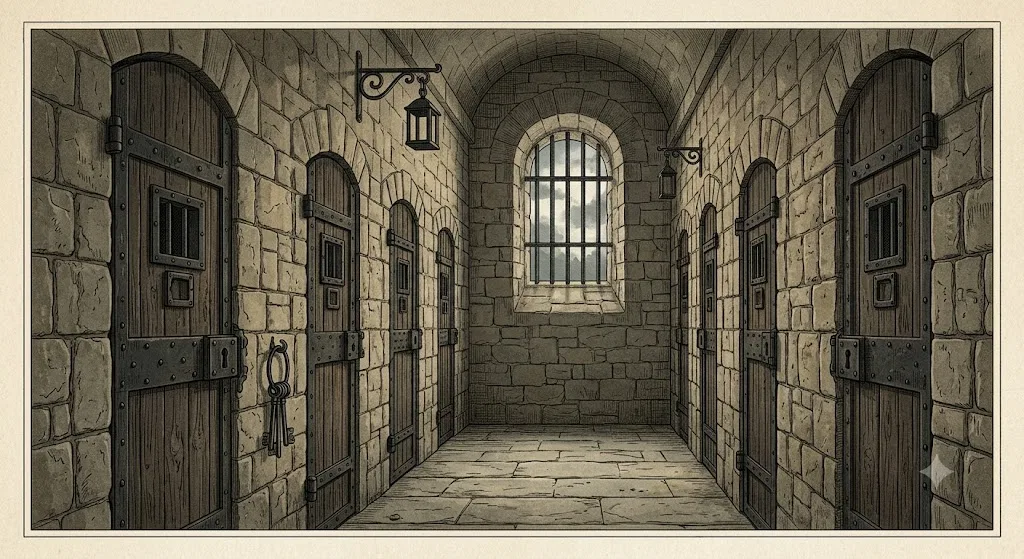
Ruthin Gaol’s atmosphere begins with its survival as a physical prison. The present heritage site sits at 46 Clwyd Street, near the lower end of Ruthin’s old town. The official visitor description invites people to explore “nooks and crannies”, learn what prisoners ate and how they worked, and enter spaces including the punishment cell, dark cell and condemned cell. That matters for the haunting tradition because the stories are not floating free of place: they attach to rooms whose original or interpreted purpose is already unsettling.[Denbighshire County Council]denbighshire.gov.ukRuthin Gaol | Denbighshire County Council…
The gaol’s history stretches back to a house of correction founded in 1654. Cadw’s account describes Ruthin Gaol as having begun as a place where those considered “unwilling to work” were sent for punishment and reform, before later prison phases and wartime reuse. The same Cadw page notes that the building became a munitions factory during the Second World War and identifies the old gaol as a listed historic building, now known for its rare public survival as a Pentonville-style prison attraction.[Cadw]cadw.gov.walesCadw9 listed buildings that helped Britain’s wartime efforts in Wales | CadwCadw9 listed buildings that helped Britain’s wartime efforts in Wales | Cadw
The Pentonville connection is important because it gives Ruthin Gaol a particular emotional texture. Pentonville-style prison design was associated with separation, surveillance, silence and moral discipline. Visit Wales describes Ruthin Gaol’s interpretation of prisoners kept under the “silent system”, while a heritage guide to the site explains that the Victorian prison used separation, repetitive labour and controlled movement as part of its regime.[Visit Wales]visitwales.comVisit Wales Ruthin Gaol | Visit WalesVisit Wales Ruthin Gaol | Visit Wales[Britain Express]britainexpress.comOpen source on britainexpress.com.
For a visitor, those features turn ordinary architectural details into triggers for unease. A cell door is not just old ironwork; it represents being shut away. A corridor is not just a passage; it is a route between authority, punishment and fear. A dark cell is not just a gloomy room; it is an interpreted punishment space where darkness itself becomes part of the story. This is why Ruthin Gaol’s haunted reputation is more convincing as “prison memory” than as a simple list of apparitions.
The crank is another vivid example. Visit Wales includes “The Crank” among the site’s visitor images, and heritage descriptions explain that crank labour was a deliberately monotonous punishment in which prisoners turned a handle thousands of times for no useful purpose. The alleged haunting atmosphere at Ruthin therefore grows from something historically legible: the building teaches visitors about confinement through repetitive labour, silence, hard furniture, small spaces and moral judgement.[Visit Wales]visitwales.comVisit Wales Ruthin Gaol | Visit WalesVisit Wales Ruthin Gaol | Visit Wales[Britain Express]britainexpress.comOpen source on britainexpress.com.

William Hughes and the condemned cell
The strongest named haunting at Ruthin Gaol is linked to William Hughes. The official Ruthin Gaol page identifies Hughes as the last man hanged there, while the People’s Collection Wales entry for the condemned cell says he was a Wrexham miner, originally from Denbigh, who was hanged at Ruthin prison on 17 February 1903 after being found guilty of shooting his wife. The same entry says Hughes is, as far as is known, the only person to have been hanged at Ruthin Gaol.[Denbighshire County Council]denbighshire.gov.ukRuthin Gaol | Denbighshire County Council…[People's Collection Wales]peoplescollection.walesOpen source on peoplescollection.wales.
The condemned cell is central because it compresses the whole story into a room. People’s Collection Wales describes the cell as showing Hughes waiting to be led to execution. It also records a striking practical detail: on the day of the hanging, the scaffold was only about fifteen yards from the cell, and a hole had been knocked through the outer wall to the second storey of the gallows so that the condemned prisoner had only a few final steps to take.[People's Collection Wales]peoplescollection.walesOpen source on peoplescollection.wales.
A Ruthin Gaol heritage blog gives the same account in fuller narrative form, citing the Denbighshire Free Press report of February 1903. It says Hughes occupied two cells knocked into one, furnished with a bed, table and stool, and that the altered wall allowed him to walk directly onto the trap door. The blog also records that the execution was carried out by the Billington brothers and witnessed by six people, including the High Sheriff.[Tales from Ruthin Gaol]ruthingaolblog.wordpress.comTales from Ruthin Gaol William HughesTales from Ruthin Gaol William Hughes
Those details explain why the condemned cell has become the gaol’s most haunted-feeling room. It is not only that someone died nearby. It is that the heritage display, the historic account and the visitor’s own movement through the space all point towards the same moment: a man waiting, a wall breached, a short passage, a scaffold close at hand. The story’s power comes from proximity.
Popular ghost accounts say Hughes haunts the condemned man’s cell. Haunted Rooms, a paranormal tourism source rather than an archival authority, names Hughes as the main spirit associated with the gaol and repeats a report that a motion-triggered commentary in the condemned cell has activated when nobody appeared to be present. Myths, Legends & Oddities of North-East Wales repeats a similar account, while also framing the cell as a favourite with tourists.[Haunted Rooms®]hauntedrooms.co.ukOpen source on hauntedrooms.co.uk.[Curious Clwyd]mythslegendsodditiesnorth-east-wales.co.ukOpen source on mythslegendsodditiesnorth-east-wales.co.uk.
That kind of report should be treated carefully. A sensor triggering unexpectedly may have many possible causes: a technical fault, vibration, visitor movement just out of sight, changes in light, insects, dust, draughts, or misremembered timing. Yet as folklore, the story is revealing. A modern audio device misbehaving in a condemned cell becomes a new version of an old prison ghost: technology seems to give the dead a voice, even when the evidence is not strong enough to prove anything supernatural.
What is said to happen there?
The reported phenomena at Ruthin Gaol are typical of haunted-prison folklore, but they are unusually place-specific because they match the building’s functions. The most common claims include heavy cell doors slamming, footsteps in corridors, voices in empty spaces, sudden coldness, shadowy figures, touches on visitors, and the sense of someone sitting nearby. Visit Wales includes Ruthin Gaol in its haunted Wales material, describing reports of doors slamming, presences, muttering voices and laughter in corridors.[Visit Wales]visitwales.comOpen source on visitwales.com.
Local journalism has helped preserve and spread the modern haunting reputation. A 2016 Daily Post article reported that visitors and staff had spoken of strange noises and being touched by ghosts at the historic site, while a 2019 Daily Post events piece described Ruthin Gaol as a place where staff and guests had reported activity by day as well as night. These are not formal investigations, but they show how the gaol’s ghost reputation circulates in North Wales media as well as in paranormal-tourism advertising.[Daily Post]dailypost.co.ukcould ruthin gaol haunted restless 11428345could ruthin gaol haunted restless 11428345[Daily Post]dailypost.co.ukghost hunters wanted meet spectral 15800638ghost hunters wanted meet spectral 15800638
Private ghost-hunt companies have also shaped the site’s reputation. Haunted Happenings advertises Ruthin Gaol as a haunted prison with ghostly figures, strange noises, temperature drops and poltergeist-like activity, while Paranormal Eye UK presents it as a destination for overnight investigations and daytime reports by visitors. These sources are useful for understanding the folklore economy around the gaol, but they should not be confused with neutral historical evidence.[Haunted Happenings]hauntedhappenings.co.ukOpen source on hauntedhappenings.co.uk.[Paranormal Eye Uk]paranormaleyeuk.co.ukOpen source on paranormaleyeuk.co.uk.
The most important pattern is that the reported phenomena echo prison life:
- Doors and bangs recall locking, unlocking, authority and confinement.
- Footsteps fit long corridors, patrols, warders and prisoners being moved.
- Muttering voices suit a building designed around silence and separation.
- Cold spots and dark cells intensify the physical discomfort of punishment spaces.
- Touches and presences turn the visitor from observer into participant.
This does not prove a haunting. It does explain why the stories feel appropriate to the building. Ruthin Gaol does not need a theatrical white lady to seem haunted; its architecture already supplies the emotional script.
How heritage becomes haunting
Ruthin Gaol is a strong example of how heritage interpretation can become haunting without anyone needing to invent a full ghost mythology. The museum’s purpose is educational: it shows prison diet, work, punishment, discipline and notorious inmates. Yet the very tools that make the past understandable — reconstructed cells, waxwork-like figures, sound effects, commentary and preserved spaces — can also make visitors feel watched, trapped or unsettled.[Denbighshire County Council]denbighshire.gov.ukRuthin Gaol | Denbighshire County Council…[Mainly Museums]mainlymuseums.comruthin gaolruthin gaol
This is especially true in the condemned cell. People’s Collection Wales describes the room as showing Hughes waiting for execution and records the family photograph detail: it was reported that the last thing Hughes did before leaving the cell was look at a photograph of his family. That image turns a legal execution into a human scene of dread, guilt, grief and finality.[People's Collection Wales]peoplescollection.walesOpen source on peoplescollection.wales.
The modern visitor knows capital punishment has ended in the UK, which creates another layer of distance and discomfort. A museum display that asks visitors to imagine a man’s final night may produce sensations that are emotional rather than paranormal: silence, unease, pity, disgust, fear, or the feeling that the room is somehow charged. Those reactions can be sincere without requiring a ghost to be present.
Ruthin Gaol’s prison memory is also wider than Hughes. The official site points visitors towards the “Welsh Houdini”, John Jones, also known as Coch Bach y Bala, whose escapes made him one of the gaol’s most famous inmates. Bangor University’s archive account says Jones escaped from Ruthin Gaol in 1879 by walking through the front door while staff were at supper, and that by 1913 he had spent nearly half his life behind bars.[Denbighshire County Council]denbighshire.gov.ukRuthin Gaol | Denbighshire County Council…[Bangor University]bangor.ac.ukarchive of the month 16279archive of the month 16279
John Jones is not the central ghost of Ruthin Gaol in the way Hughes is, but his story adds to the building’s atmosphere. He represents a different kind of prison memory: not execution, but repeated confinement, escape, pursuit and public fascination. The gaol’s haunted character therefore comes from a cluster of remembered pressures — condemned waiting, silent discipline, punishment labour, escape attempts, warders’ routines and the long afterlife of local crime stories.
Why the story belongs to Denbighshire
Ruthin Gaol belongs firmly within Denbighshire’s haunted geography because it is one of the county’s clearest examples of a place where official history and ghost tradition overlap. Ruthin Castle has the older, more romanticised haunted-castle material; Nantclwyd y Dre offers domestic Tudor atmosphere; Denbigh Castle and the moors supply ruined and upland unease. Ruthin Gaol is different. Its darkness is bureaucratic, Victorian and institutional.
The building also served a wider north-east Wales region. Historical summaries note that, when Ruthin County Gaol became HM Prison Ruthin in 1878, it covered the old counties of Denbighshire, Flintshire and Merionethshire. This gives the site a reach beyond modern Denbighshire, but its physical and emotional centre remains Ruthin: a county town with courts, archives, old civic buildings and a preserved prison in close urban proximity.[Curious Clwyd]mythslegendsodditiesnorth-east-wales.co.ukOpen source on mythslegendsodditiesnorth-east-wales.co.uk.
That civic setting matters. The gaol is not isolated on a moor or hidden in a ruined abbey. It stands in a town street, close to ordinary life. The haunting therefore has a public-memory quality: it asks how a community remembers punishment carried out in its name. When visitors walk into the condemned cell or hear stories of doors slamming after closing time, they are entering not just a ghost story but a local memory of law, order, class, violence, poverty and authority.
The wartime reuse of the building complicates the atmosphere further. Cadw records that, after its prison years, the old gaol became a munitions factory during the Second World War, with adaptations made for wartime production. This means the building has more than one layer of institutional memory: prison, archive, library, wartime work, museum and tourist site.[Cadw]cadw.gov.walesCadw9 listed buildings that helped Britain’s wartime efforts in Wales | CadwCadw9 listed buildings that helped Britain’s wartime efforts in Wales | Cadw
How credible are the hauntings?
The historical framework of Ruthin Gaol is strong. The building’s prison function, its preserved spaces, its use as a heritage attraction, the story of William Hughes, the condemned cell and the site’s listed-building status are all supported by official, heritage or local-history sources.[Denbighshire County Council]denbighshire.gov.ukRuthin Gaol | Denbighshire County Council…[People's Collection Wales]peoplescollection.walesOpen source on peoplescollection.wales.[Cadw]cadw.gov.walesCadw9 listed buildings that helped Britain’s wartime efforts in Wales | CadwCadw9 listed buildings that helped Britain’s wartime efforts in Wales | Cadw
The ghost claims are weaker as evidence. Most published accounts of the haunting come from paranormal event organisers, haunted-location websites, tourism features and local newspaper reports. These sources preserve what people say they have experienced, but they rarely provide the kind of detail needed to test an event: exact time, number of witnesses, environmental conditions, maintenance records, independent corroboration, or alternative explanations.
That does not make the stories worthless. Folklore often works by attaching emotional truth to memorable places. Ruthin Gaol’s haunting tradition expresses something historically plausible: prisons leave impressions on communities long after the last prisoner has gone. Visitors are primed by the building itself to notice sounds, shadows, draughts and mechanical surprises. Once a place has a reputation, ambiguous experiences are more likely to be interpreted through that reputation.
A careful reading therefore separates three layers:
- Documented history: the gaol, its prison spaces, William Hughes’s execution, John Jones’s escapes, closure and later reuse.
- Reported experience: doors, footsteps, voices, touches, coldness and sensor incidents described by visitors, staff, journalists and ghost-hunt organisers.
- Interpretation: the idea that these experiences are caused by spirits, prison trauma, residual energy or the restless dead.
The first layer is well grounded. The second layer is socially important but unevenly documented. The third layer remains a matter of belief, storytelling and atmosphere rather than proof.
Why Ruthin Gaol still feels haunted
Ruthin Gaol’s haunted reputation lasts because it is not built only on a single apparition. It is built on a mechanism: a preserved prison teaches visitors to imagine confinement, and that act of imagination makes the building feel occupied. The condemned cell focuses the emotion through William Hughes; the dark cell and punishment spaces give the body a sense of discomfort; the corridors and doors supply sound and movement; the town setting reminds visitors that this was once part of ordinary civic life.
That is why the gaol is one of Denbighshire’s most unsettling haunted sites. Its ghost stories are not the strongest because they are the most spectacular. They are strong because they are spatially convincing. The alleged haunting happens where a haunting would be expected to happen: in the condemned cell, in the prison corridors, around the heavy doors, and in the places where punishment was made physical.
For readers exploring haunted Denbighshire, Ruthin Gaol is best understood as a prison-memory site before it is treated as a paranormal case. The stories of William Hughes, strange sounds, unseen presences and restless corridors matter because they show how a real institution of punishment becomes a place where the past is felt as atmosphere. Whether one reads the reports as ghosts, suggestion, theatre, building noise or folklore, the result is the same: Ruthin Gaol makes Denbighshire’s haunted history feel close, confined and uncomfortably human.
Amazon book picks
Further Reading
Books and field guides related to Why Does Ruthin Gaol Feel Haunted?. Use these as the next step if you want deeper reading beyond the article.


Newgate: London's Prototype of Hell
Explains punishment, prisons and execution culture relevant to Ruthin Gaol.

Haunted Wales: A Guide to Welsh Ghostlore
Relevant companion to Welsh prison ghost stories.
eBay marketplace picks
Marketplace Samples
Live-tested eBay searches with available results related to this page.



Endnotes
1.
Source: denbighshire.gov.uk
Title: Denbighshire County Council
Link:https://www.denbighshire.gov.uk/en/leisure-and-tourism/museums-and-historic-houses/ruthin-gaol.aspx
Source snippet
Ruthin Gaol | Denbighshire County Council...
2.
Source: visitwales.com
Title: Visit Wales Ruthin Gaol | Visit Wales
Link:https://www.visitwales.com/attraction/museum/ruthin-gaol-558641
3.
Source: cadw.gov.wales
Title: Cadw9 listed buildings that helped Britain’s wartime efforts in Wales | Cadw
Link:https://cadw.gov.wales/about-us/news/9-listed-buildings-helped-britains-wartime-efforts-wales
4.
Source: britainexpress.com
Link:https://www.britainexpress.com/wales/north/ruthin-gaol.htm
5.
Source: peoplescollection.wales
Link:https://www.peoplescollection.wales/items/7746
6.
Source: ruthingaolblog.wordpress.com
Title: Tales from Ruthin Gaol William Hughes
Link:https://ruthingaolblog.wordpress.com/2017/02/01/william-hughes/
7.
Source: hauntedrooms.co.uk
Link:https://www.hauntedrooms.co.uk/ruthin-gaol
8.
Source: mythslegendsodditiesnorth-east-wales.co.uk
Link:https://www.mythslegendsodditiesnorth-east-wales.co.uk/ruthin-gaol
9.
Source: visitwales.com
Link:https://www.visitwales.com/inspire-me/short-breaks/haunted-wales
10.
Source: dailypost.co.uk
Title: could ruthin gaol haunted restless 11428345
Link:https://www.dailypost.co.uk/news/north-wales-news/could-ruthin-gaol-haunted-restless-11428345
11.
Source: dailypost.co.uk
Title: ghost hunters wanted meet spectral 15800638
Link:https://www.dailypost.co.uk/whats-on/whats-on-news/ghost-hunters-wanted-meet-spectral-15800638
12.
Source: hauntedhappenings.co.uk
Link:https://www.hauntedhappenings.co.uk/ruthin-gaol/
13.
Source: paranormaleyeuk.co.uk
Link:https://www.paranormaleyeuk.co.uk/peuk1/ruthin-gaol-wales-ghost-hunt
14.
Source: mainlymuseums.com
Title: ruthin gaol
Link:https://mainlymuseums.com/post/244/ruthin-gaol/
15.
Source: bangor.ac.uk
Title: archive of the month 16279
Link:https://www.bangor.ac.uk/news/archive/archive-of-the-month-16279
16.
Source: denbighshire.gov.uk
Link:https://www.denbighshire.gov.uk/en/community-and-living/community-development/levelling-up-fund/round-2-clwyd-west/ruthin-gaol/ruthin-gaol.aspx
17.
Source: Wikipedia
Title: Ruthin Gaol
Link:https://en.wikipedia.org/wiki/Ruthin_Gaol
18.
Source: hauntedrooms.co.uk
Link:https://www.hauntedrooms.co.uk/product/ruthin-castle-hotel-denbighshire-north-wales
19.
Source: cadw.gov.wales
Link:https://cadw.gov.wales/advice-support/cof-cymru/search-cadw-records
20.
Source: datamap.gov.wales
Title: wales Listed Buildings | Data Map Wales
Link:https://datamap.gov.wales/layers/inspire-wg%3ACadw_ListedBuildings
21.
Source: welshcountry.co.uk
Title: ch bach y bala
Link:https://www.welshcountry.co.uk/coch-bach-y-bala/
22.
Source: youtube.com
Title: Ghost Story
Link:https://www.youtube.com/watch?v=OscdIRDGLPY
23.
Source: dailypost.co.uk
Title: ghost hunter claims secure i 27294501
Link:https://www.dailypost.co.uk/news/north-wales-news/ghost-hunter-claims-secure-i-27294501
24.
Source: dailypost.co.uk
Title: condemned north wales mans incredible 24240595
Link:https://www.dailypost.co.uk/news/north-wales-news/condemned-north-wales-mans-incredible-24240595
25.
Source: ruthingaolblog.wordpress.com
Title: coch bach y bala
Link:https://ruthingaolblog.wordpress.com/2017/01/09/coch-bach-y-bala/
26.
Source: traveltrade.visitwales.com
Title: haunted wales
Link:https://traveltrade.visitwales.com/itineraries/heritage-and-culture/haunted-wales
27.
Source: traveltrade.visitwales.com
Title: ruthin gaol 583131
Link:https://traveltrade.visitwales.com/attraction/museum/ruthin-gaol-583131
28.
Source: historic-uk.com
Link:https://www.historic-uk.com/HistoryMagazine/DestinationsUK/Ruthin/
29.
Source: visitmidwales.co.uk
Title: Ruthin Gaol
Link:https://www.visitmidwales.co.uk/showmewales/things-to-do/ruthin-gaol-p1715801
30.
Source: peoplescollection.wales
Title: ruthin gaol
Link:https://www.peoplescollection.wales/content/ruthin-gaol
31.
Source: youtube.com
Title: Inside Ruthin Gaol | The Dark History of North Wales’ Haunted Prison
Link:https://www.youtube.com/watch?v=PM3YySkv37I
Source snippet
Ghost Story - Ruthin Gaol...
32.
Source: youtube.com
Title: Ruthin Gaol Museum (Prison) 【4K HDR】
Link:https://www.youtube.com/watch?v=ixU3ut87hTU
Source snippet
Ruthin Gaol - Denbighshire Wales...
33.
Source: youtube.com
Title: Ruthin Gaol
Link:https://www.youtube.com/watch?v=oEADoLGV_sY
Source snippet
GHOST CAUGHT ON CAMERA IN RUTHIN GAOL...
Additional References
34.
Source: youtube.com
Title: Ruthin Gaol Museum in Denbighshire, North Wales, UK
Link:https://www.youtube.com/watch?v=ZK2LrL0s3YY
Source snippet
Ruthin Gaol Ruthin Gaol Museum (Prison) 【4K HDR】 🚶 🇬🇧 𝗕𝗮𝗱𝗴𝗲𝗿𝘀 𝗪𝗮𝗹𝗸𝗶𝗻𝗴 𝗧𝗼𝘂𝗿𝘀...
35.
Source: facebook.com
Link:https://www.facebook.com/ruthingaol/videos/william-hughes-part-1/284530539458003/
36.
Source: facebook.com
Link:https://www.facebook.com/TheHistoryOfWales/posts/30th-septembercoch-bach-y-bala-the-welsh-houdinion-30th-september-1913-at-the-ag/790048621115822/
37.
Source: facebook.com
Link:https://www.facebook.com/groups/35809823308/posts/10159847914953309/
38.
Source: ruthinhistoryhanesrhuthun.org
Link:https://www.ruthinhistoryhanesrhuthun.org/broadsheet-no-10
39.
Source: historypoints.org
Link:https://historypoints.org/index.php?page=former-ruthin-jail
40.
Source: newa.wales
Link:https://www.newa.wales/visit-us/how-to-find-us/
41.
Source: britishlistedbuildings.co.uk
Link:https://britishlistedbuildings.co.uk/wales/ruthin-denbighshire
42.
Source: haunted-houses.co.uk
Link:https://www.haunted-houses.co.uk/ghost-hunt/penrhyn-old-hall-ghost-hunt/
43.
Source: facebook.com
Link:https://www.facebook.com/groups/381688085599512/posts/2057013521400285/
Topic Tree